roof OPEL KARL 2018 Manual user
[x] Cancel search | Manufacturer: OPEL, Model Year: 2018, Model line: KARL, Model: OPEL KARL 2018Pages: 203, PDF Size: 5.44 MB
Page 112 of 203

110Driving and operating0:ignition off: Some functions
remain active until key is
removed or driver's door is
opened, provided the ignition was
on previously1:accessory power mode: Steering wheel lock released, some
electrical functions are operable,
ignition is off2:ignition on power mode: Ignition
is on. Control indicators
illuminate and most electrical
functions are operable3:engine start: Release key after
starting procedure beginsSteering wheel lock
Remove key from ignition switch and
turn steering wheel until it engages.
Retained power off The following electronic systems areoperable until the driver's door is
opened or at the latest for ten minutes
after the ignition is switched off:
● power windows
● power outlets
● power sunroof
Power to the Infotainment system will continue to operate for 30 minutes or
until the key is removed from the
ignition switch, regardless of whether
any door is opened.Starting the engine
Turn key to position 1 to release the
steering wheel lock.
Manual transmission: operate clutch
and brake pedal.
Manual transmission automated:
operate brake pedal.
Do not operate the accelerator pedal. Turn key briefly to position 3 and
release: an automatic procedure
operates the starter after a brief
delay, until the engine is running. See
"Automatic Starter Control".
Page 116 of 203

114Driving and operatingParking9Warning
● Do not park the vehicle on an
easily ignitable surface. The
high temperature of the
exhaust system could ignite the
surface.
● Always apply the parking brake. Activate the manual
parking brake without pressing the release button. Apply as
firmly as possible on a downhill slope or uphill slope. Depress
brake pedal at the same time to
reduce operating force.
● Switch off the engine.
● If the vehicle is on a level surface or uphill slope, engage
first gear before removing the ignition key. On an uphill slope,
turn the front wheels away from
the kerb.
If the vehicle is on a downhill
slope, engage reverse gear
before removing the ignition
key. Turn the front wheels
towards the kerb.
● Close the windows and the sunroof.
● Remove the ignition key from the ignition switch. Turn the
steering wheel until the
steering wheel lock is felt to
engage.
For vehicles with manual
transmission automated, the key
can only be removed from the
ignition switch when the parking
brake is applied.
● Lock the vehicle.
● Activate the anti-theft alarm system.
● The engine cooling fans may run
after the engine has been
switched off 3 139.
Caution
After running at high engine
speeds or with high engine loads,
operate the engine briefly at a low
load or run in neutral for
approx. 30 seconds before
switching off, in order to protect
the turbocharger.
Note
In the event of an accident with
airbag deployment, the engine is
switched off automatically if the
vehicle comes to a standstill within a
certain time.
Page 154 of 203

152Vehicle careEngine compartment fuse
box
The fuse box is in the front left of the
engine compartment.
Disengage the cover, lift it upwards
and remove.
No.Circuit1Tailgate2–3Heated rear window4Heated exterior mirror5Sunroof6Transmission control module7Engine control module8–9ABS10Body control module, voltage11Rear view camera12–13–14Engine control module/Trans‐
mission control module15Injection system/Starter16Fuel pump17Engine control module1
Page 156 of 203
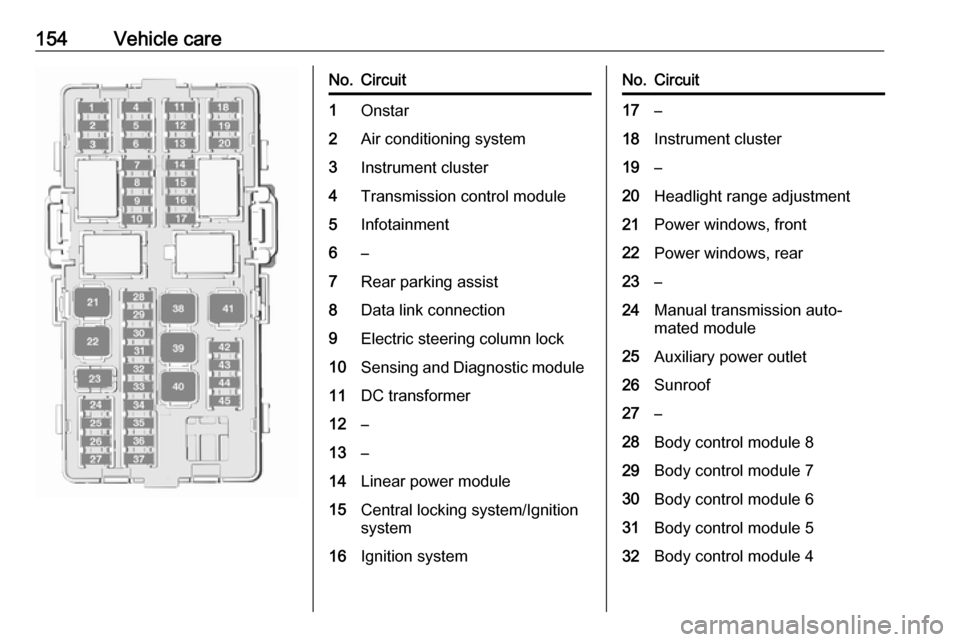
154Vehicle careNo.Circuit1Onstar2Air conditioning system3Instrument cluster4Transmission control module5Infotainment6–7Rear parking assist8Data link connection9Electric steering column lock10Sensing and Diagnostic module11DC transformer12–13–14Linear power module15Central locking system/Ignition
system16Ignition systemNo.Circuit17–18Instrument cluster19–20Headlight range adjustment21Power windows, front22Power windows, rear23–24Manual transmission auto‐
mated module25Auxiliary power outlet26Sunroof27–28Body control module 829Body control module 730Body control module 631Body control module 532Body control module 4
Page 174 of 203

172Vehicle careCaution
Drive slowly. Do not drive jerkily.
Excessive tractive force can
damage the vehicle.
When the engine is not running,
considerably more force is needed to
brake and steer.
To prevent the entry of exhaust gases from the towing vehicle, switch on the
air recirculation and close the
windows.
The vehicle must be towed facing
forward, not faster than 88 km/h. In all
other cases and when the
transmission is defective, the front
axle must be raised off the ground.
Seek the assistance of a workshop.
After towing, unscrew the towing eye.
Insert cap and engage in the front
bumper.
Appearance care
Exterior care
Locks The locks are lubricated at the factoryusing a high quality lock cylinder
grease. Use a de-icing agent only
when absolutely necessary, as this
has a degreasing effect and impairs
lock function. After using a de-icing
agent, have the locks regreased by a workshop.
Washing The paintwork of your vehicle is
exposed to environmental influences.
Wash and wax your vehicle regularly. When using automatic vehicle
washes, select a programme that
includes waxing.
Bird droppings, dead insects, resin,
pollen and the like should be cleaned
off immediately, as they contain
aggressive constituents which can
cause paint damage.If using a car wash, comply with the
car wash manufacturer's instructions.
The windscreen wiper and rear
window wiper must be switched off.
Remove antenna and external
accessories such as roof racks etc.
If you wash your vehicle by hand,
make sure that the insides of the
wheel housings are also thoroughly
rinsed out.
Clean edges and folds on opened
doors and the bonnet as well as the
areas they cover.
Clean bright metal mouldings with a
cleaning solution approved for
aluminium to avoid damages.Caution
Always use a cleaning agent with
a pH value of four to nine.
Do not use cleaning agents on hot surfaces.
Have the door hinges of all doors
greased by a workshop.
Do not clean the engine compartment with a steam-jet or high-pressure jet
cleaner.
Page 175 of 203

Vehicle care173Thoroughly rinse and leather-off the
vehicle. Rinse leather frequently. Use
separate leathers for painted and
glass surfaces: remnants of wax on the windows will impair vision.
Do not use hard objects to remove
spots of tar. Use tar removal spray on
painted surfaces.
Exterior lights
Headlight and other light covers are
made of plastic. Do not use any
abrasive or caustic agents, do not use
an ice scraper, and do not clean them
dry.
Polishing and waxing
Wax painted parts of the vehicle
regularly (at the latest when water no longer beads). Otherwise, the
paintwork will dry out.
Polishing is necessary only if the paint
has become dull or if solid deposits
have become attached to it.
Paintwork polish with silicone forms a
protective film, making waxing
unnecessary.Unpainted plastic body parts must not be treated with wax or polishing
agents.
Windows and windscreen wiper
blades
Use a soft lint-free cloth or chamois leather together with window cleaner
and insect remover.
When cleaning the rear window from
inside, always wipe in parallel to the
heating element to prevent damage.
For mechanical removal of ice, use a
sharp-edged ice scraper. Press the
scraper firmly against the glass so
that no dirt can get under it and
scratch the glass.
Clean smearing wiper blades with a
soft cloth and window cleaner.
Sunroof
Never clean with solvents or abrasive agents, fuels, aggressive media (e.g.
paint cleaner, acetone-containing solutions etc.), acidic or highly
alkaline media or abrasive pads. Do
not apply wax or polishing agents to
the sunroof.Wheels and tyres
Do not use high-pressure jet
cleaners.
Clean rims with a pH-neutral wheel
cleaner.
Rims are painted and can be treated
with the same agents as the body.
Paintwork damageRectify minor paintwork damage witha touch-up pen before rust forms.
Have more extensive damage or rust
areas repaired by a workshop.
Underbody Some areas of the vehicle underbody
have a PVC undercoating while other
critical areas have a durable
protective wax coating.
After the underbody is washed, check
the underbody and have it waxed if
necessary.
Bitumen/rubber materials could
damage the PVC coating. Have
underbody work carried out by a
workshop.
Page 178 of 203

176Service and maintenancedriving at high altitude and large
variations of temperature. Under
these severe operating conditions,
certain service work may be required more frequently than the regular
service interval.
The international service intervals are
valid for the countries which are not
listed in the European service
intervals.
Service display 3 68.
Confirmations Confirmation of service is recorded in
the Service and Warranty Booklet.
The date and mileage is completed
with the stamp and signature of the
servicing workshop.
Make sure that the Service and
Warranty Booklet is completed
correctly as continuous proof of
service is essential if any warranty or
goodwill claims are to be met, and is
also a benefit when selling the
vehicle.Service interval with remaining
engine oil life duration
The service interval is based on
several parameters depending on
usage.
The service display lets you know
when to change the engine oil.
Service display 3 68.Recommended fluids,
lubricants and parts
Recommended fluids and lubricants
Only use products that meet the
recommended specifications.9 Warning
Operating materials are
hazardous and could be
poisonous. Handle with care. Pay
attention to information given on
the containers.
Engine oil
Engine oil is identified by its quality
and its viscosity. Quality is more
important than viscosity when
selecting which engine oil to use. The oil quality ensures e.g. engine
cleanliness, wear protection and oil
aging control, whereas viscosity
grade gives information on the oil's
thickness over a temperature range.
Page 188 of 203
![OPEL KARL 2018 Manual user 186Technical dataVehicle dimensionsLength [mm]3675Width without exterior mirrors [mm]1595-16323)Width with two exterior mirrors [mm]1876Height (without antenna) [mm] without roof rack1476-1495 3)Lengt](/img/37/18880/w960_18880-187.png "OPEL KARL 2018 Manual user 186Technical dataVehicle dimensionsLength [mm]3675Width without exterior mirrors [mm]1595-16323)Width with two exterior mirrors [mm]1876Height (without antenna) [mm] without roof rack1476-1495 3)Lengt")
186Technical dataVehicle dimensionsLength [mm]3675Width without exterior mirrors [mm]1595-16323)Width with two exterior mirrors [mm]1876Height (without antenna) [mm] without roof rack1476-1495 3)Length of load compartment floor [mm]486Length of load compartment with folded rear seats [mm]1109Load compartment width [mm]968Load compartment height with cover [mm]499Height of load compartment opening [mm]608Wheelbase [mm]2385Turning circle diameter [m] 3)9.8 - 10.73)
Depending on equipment variants.
Page 200 of 203

198Instrument cluster ........................65
Instrument panel fuse box .........153
Instrument panel illumination .....150
Instrument panel illumination control ...................................... 96
Instrument panel overview ........... 10
Interior care ............................... 174
Interior lighting .............................. 96
Interior lights ........................ 97, 150
Interior mirrors .............................. 30
Introduction .................................... 3
J
Jump starting ............................. 169
K Key, memorised settings ..............23
Keys ............................................. 21
Keys, locks ................................... 21
L
Lane departure warning .......74, 128
Light switch .................................. 93
Load compartment ................26, 54
Load compartment cover .............56
Loading information .....................59
Low fuel ....................................... 76
M Malfunction indicator light ............73
Manual adjustment ......................29Manual anti-dazzle ......................30
Manual mode ............................. 118
Manual transmission .................. 115
Manual transmission automated 116
Manual windows ..........................31
Memorised settings ......................23
Mirror adjustment ........................... 8
Mirrors ......................................... 29
Misted light covers .......................96
N
New vehicle running-in ..............109
Number plate light .....................149
O Object detection systems ...........127
Odometer ..................................... 66 Oil, engine .......................... 176, 181
OnStar .......................................... 88
Operate pedal ............................... 73
Outside temperature ....................63
Overrun cut-off ........................... 111
P Parking ................................ 20, 114
Parking assist ............................ 127
Parking brake ............................ 120
Parking lights ............................... 96
Performance .............................. 185
Performing work ........................139
Pollen filter ................................. 106Power outlets ............................... 65
Power steering.............................. 74
Power windows ............................ 31
Puncture ..................................... 165
R
Radio Frequency Identification (RFID) ..................................... 195
Radio remote control ...................22
REACH ....................................... 192
Reading lights .............................. 97
Rear doors ................................... 26
Rear floor storage cover ..............57
Rear fog light ......................... 76, 95
Rear window wiper/washer .......... 63
Recommended fluids and lubricants ........................ 176, 181
Reduced engine power ................76
Refuelling ................................... 132 Registered trademarks ...............194
Retained power off .....................110
Reversing lights ........................... 96
Ride control systems ..................121
Roof .............................................. 33
Roof load ...................................... 59
Roof rack ..................................... 58
S Safety belts ................................... 39
Seat adjustment ....................... 7, 37
Seat belt ........................................ 8
Page 201 of 203

199Seat belt reminder .......................72
Seat belts ..................................... 39 Seat heating ................................. 38
Seat position ................................ 36
Selector lever ............................. 117
Service ....................................... 107
Service display ............................ 68
Service information ....................175
Service vehicle soon .................... 73
Side airbag system ......................45
Sidelights ...................................... 93
Side turn signal lights ................148
Software acknowledgement .......192
Spare wheel ............................... 167
Speed limiter......................... 76, 125
Speedometer ............................... 65
Starting and operating ................109
Starting off ................................... 18
Starting the engine ............110, 116
Steering ...................................... 109
Steering wheel adjustment ......9, 61
Steering wheel controls ...............61
Stop-start system........................ 111
Storage ......................................... 53
Storage compartments .................53
Sunroof ........................................ 33
Sun visors .................................... 33
Symbols ......................................... 4T
Tachometer ................................. 66
Tail lights ................................... 147
Three-point seat belt .................... 40
Tools .......................................... 155
Towing ........................................ 171
Towing the vehicle .....................171
Traction Control system ............. 121
Traction Control system off........... 75
Transmission ............................... 17
Transmission display .................116
Tread depth ............................... 161
Trip odometer .............................. 66
Turn and lane-change signals .....95
Turn signal ................................... 71
Tyre chains ................................ 162
Tyre designations ......................156
Tyre pressure ............................ 156
Tyre pressure monitoring system ............................... 75, 157
Tyre pressures ........................... 188
Tyre repair kit ............................. 162
U Ultrasonic parking assist ...... 74, 127
Upholstery .................................. 174
Using this manual ..........................3
V Valet mode ................................... 82
Vehicle battery ........................... 142Vehicle checks............................ 139
Vehicle data ................................ 181
Vehicle data recording and privacy ..................................... 195
Vehicle dimensions .................... 186
Vehicle Identification Number ....179
Vehicle jack ................................ 155
Vehicle messages .......................83
Vehicle personalisation ...............86
Vehicle specific data ......................3
Vehicle storage ........................... 138
Vehicle tools ............................... 155
Vehicle unlocking ........................... 6
Vehicle weight ........................... 185
Ventilation ..................................... 99
W
Warning chimes ........................... 85
Warning lights ............................... 65
Warning triangle .......................... 57
Washer and wiper systems .........15
Washer fluid ............................... 141
Wheel changing .........................165
Wheel covers ............................. 161
Wheels and tyres .......................156
Windows ....................................... 30
Windscreen................................... 30
Windscreen wiper/washer ...........62
Winter tyres ............................... 156
Wiper blade replacement ..........144