battery OPEL KARL 2018 Manual user
[x] Cancel search | Manufacturer: OPEL, Model Year: 2018, Model line: KARL, Model: OPEL KARL 2018Pages: 203, PDF Size: 5.44 MB
Page 145 of 203

Vehicle care143Replacing the vehicle batteryNote
Any deviation from the instructions
given in this section may lead to
temporary deactivation or
disturbance of the stop-start system.
When the vehicle battery is being
replaced, please ensure that there
are no open ventilation holes in the
vicinity of the positive terminal. If a
ventilation hole is open in this area, it
must be closed off with a dummy cap, and the ventilation in the vicinity of the
negative terminal must be opened.
Ensure that the battery is always replaced by the same type of battery.
We recommend the use of an originalOpel battery.
Note
Using an AGM vehicle battery
different from the original Opel
vehicle battery may result in a lower
performance.
We recommend that you have the
vehicle battery replaced by a
workshop.Charging the vehicle battery9 Warning
On vehicles with stop-start
system, ensure that the charging potential does not exceed 14.6
volts when using a battery
charger. Otherwise the battery
might be damaged.
Jump starting 3 169.
Stop-start system 3 111.
Warning label
Meaning of symbols: ● No sparks, naked flames or smoking.
● Always shield eyes. Explosive gases can cause blindness or
injury.
● Keep the vehicle battery out of the reach of children.
● The vehicle battery contains sulfuric acid which could cause
blindness or serious burn
injuries.
● See the Owner's manual for further information.
● Explosive gas may be present in the vicinity of the battery.
Page 155 of 203

Vehicle care153No.Circuit18Engine control module219Injection system/Ignition20Air conditioning system21Battery sensor22Electric steering column lock23Cooling fan low24–25Exterior mirror switch26Engine control module/Manual
transmission automated
module27Fuel system28Brake system29Seat occupancy recognition30Headlight range adjustment31Horn32Front fog light33High beam leftNo.Circuit34High beam right35–36Rear wiper37Cornering light left38Washer system39Cornering light right40–41–42Starter 243Instrument panel44Manual transmission auto‐
mated, DC-DC converter45Starter 146ABS47Cooling fan high48Front wiper49Body control module/Retained
power offAfter having changed defective fuses
close the fuse box cover and press
until it engages.
If the fuse box cover is not closed
correctly, malfunction may occur.
Instrument panel fuse box
The fuse box is located on the driver's
side behind a cover in the instrument
panel.
To open the compartment, compress
the locking tabs, fold cover down and
remove.
Page 165 of 203
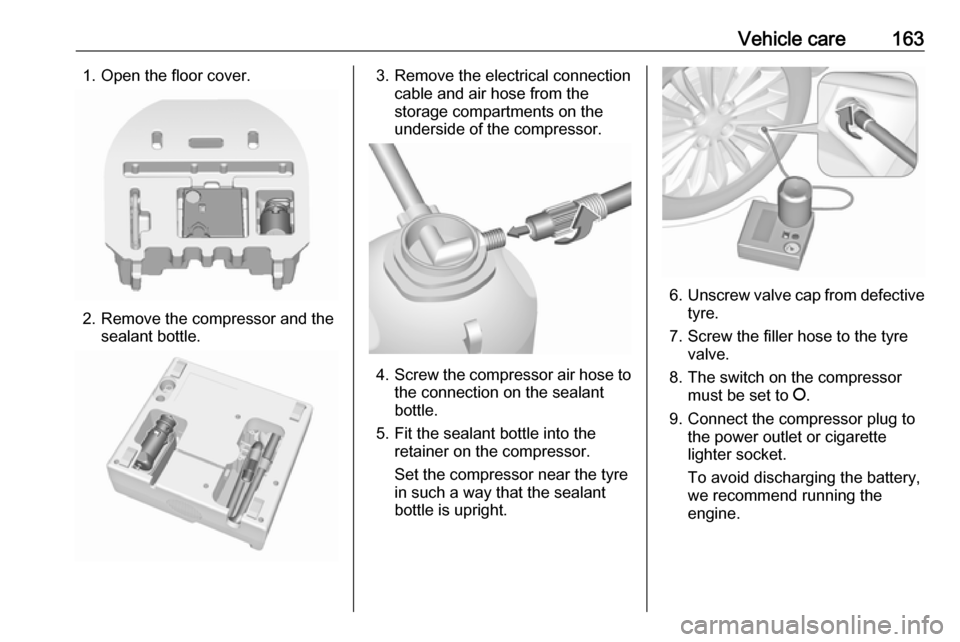
Vehicle care1631. Open the floor cover.
2. Remove the compressor and thesealant bottle.
3. Remove the electrical connectioncable and air hose from the
storage compartments on the
underside of the compressor.
4. Screw the compressor air hose to
the connection on the sealant
bottle.
5. Fit the sealant bottle into the retainer on the compressor.
Set the compressor near the tyre
in such a way that the sealant
bottle is upright.
6. Unscrew valve cap from defective
tyre.
7. Screw the filler hose to the tyre valve.
8. The switch on the compressor must be set to J.
9. Connect the compressor plug to the power outlet or cigarette
lighter socket.
To avoid discharging the battery, we recommend running the
engine.
Page 171 of 203

Vehicle care169
5. Pull back the backrests.
6. Mount the hook to the tailgate latch.
7. Tighten the strap and secure it using the buckle.
9 Warning
Storing a jack, a wheel or other
equipment in the load
compartment could cause injury if they are not fixed properly. During a sudden stop or a collision, loose
equipment could strike someone.
Store jack and tools always in the
respective storage compartments
and secure them by fixing.
Damaged wheel placed in the load
compartment must always be
secured by the strap.Jump starting
Do not start with a quick charger.
A vehicle with a discharged vehicle
battery can be started using jump
leads and the vehicle battery of
another vehicle.9 Warning
Be extremely careful when starting
with jump leads. Any deviation
from the following instructions can
lead to injuries or damage caused
by battery explosion or damage to the electrical systems of both
vehicles.
9 Warning
Avoid contact of the battery with
eyes, skin, fabrics and painted
surfaces. The fluid contains
sulphuric acid which can cause
injuries and damage in the event
of direct contact.
● Never expose the battery to naked flames or sparks.
Page 172 of 203
170Vehicle care● A discharged vehicle battery canalready freeze at a temperature
of 0 °C. Defrost the frozen battery before connecting jump leads.
● Wear eye protection and protective clothing when
handling a battery.
● Use a booster battery with the same voltage (12 Volts). Its
capacity (Ah) must not be much less than that of the discharged
battery.
● Use jump leads with insulated terminals and a cross section of
at least 16 mm 2
.
● Do not disconnect the discharged
vehicle battery from the vehicle.
● Switch off all unnecessary electrical consumers.
● Do not lean over the battery during jump starting.
● Do not allow the terminals of one
lead to touch those of the other
lead.
● The vehicles must not come into contact with each other during
the jump starting process.● Apply the parking brake, transmission in neutral.
● Open the positive terminal protection caps of both vehicle
batteries.
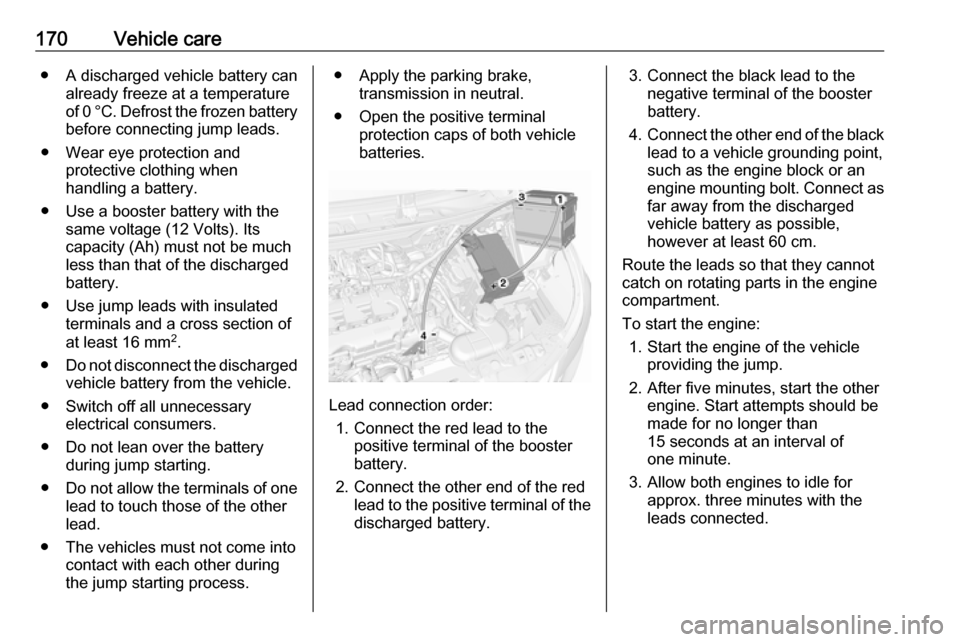
Lead connection order:
1. Connect the red lead to the positive terminal of the booster
battery.
2. Connect the other end of the red lead to the positive terminal of the
discharged battery.
3. Connect the black lead to the negative terminal of the booster
battery.
4. Connect the other end of the black
lead to a vehicle grounding point,
such as the engine block or an
engine mounting bolt. Connect as far away from the discharged
vehicle battery as possible,
however at least 60 cm.
Route the leads so that they cannot
catch on rotating parts in the engine
compartment.
To start the engine: 1. Start the engine of the vehicle providing the jump.
2. After five minutes, start the other engine. Start attempts should be
made for no longer than
15 seconds at an interval of
one minute.
3. Allow both engines to idle for approx. three minutes with the
leads connected.
Page 198 of 203

196IndexAAccessories and vehicle modifications .......................... 137
Adjustable air vents ...................105
Airbag and belt tensioners ...........72
Airbag deactivation ................46, 72
Airbag label................................... 41 Airbag system .............................. 41
Air conditioning regular operation ................................ 106
Air conditioning system .............. 100
Air intake .................................... 106
Air vents...................................... 105
Antilock brake system ................ 119
Antilock brake system (ABS) .......74
Anti-theft alarm system ................27
Appearance care ........................172
Ashtrays ....................................... 65
Autostop ..................................... 111
B Battery discharge protection ........98
Battery voltage ............................. 85
Belts.............................................. 39
Bonnet ....................................... 139
Bonnet open ................................. 76
Brake and clutch fluid .................176
Brake and clutch system .............73
Brake assist ............................... 120
Brake fluid .................................. 142Brakes ............................... 119, 142
Breakdown.................................. 171
Bulb replacement ....................... 144
C Capacities .................................. 187
Catalytic converter .....................115
Central locking system ................23
Centre console storage ...............54
Centre high-mounted brake light 149
Changing tyre and wheel size ...161
Charging system .......................... 73
Child locks ................................... 25
Child restraint installation locations ................................... 50
Child restraints.............................. 47
Child restraint systems ................47
Cigarette lighter ........................... 65
City mode ................................... 123
Climate control ............................. 17
Climate control systems ...............99
Clock ............................................ 63
Code ............................................. 83
Collision damage repair ..............192
Control indicators.......................... 69
Control of the vehicle .................108
Controls ........................................ 61
Coolant and antifreeze ...............176
Cornering lights ............................ 94
Cruise control ...................... 76, 124
Page 201 of 203

199Seat belt reminder .......................72
Seat belts ..................................... 39 Seat heating ................................. 38
Seat position ................................ 36
Selector lever ............................. 117
Service ....................................... 107
Service display ............................ 68
Service information ....................175
Service vehicle soon .................... 73
Side airbag system ......................45
Sidelights ...................................... 93
Side turn signal lights ................148
Software acknowledgement .......192
Spare wheel ............................... 167
Speed limiter......................... 76, 125
Speedometer ............................... 65
Starting and operating ................109
Starting off ................................... 18
Starting the engine ............110, 116
Steering ...................................... 109
Steering wheel adjustment ......9, 61
Steering wheel controls ...............61
Stop-start system........................ 111
Storage ......................................... 53
Storage compartments .................53
Sunroof ........................................ 33
Sun visors .................................... 33
Symbols ......................................... 4T
Tachometer ................................. 66
Tail lights ................................... 147
Three-point seat belt .................... 40
Tools .......................................... 155
Towing ........................................ 171
Towing the vehicle .....................171
Traction Control system ............. 121
Traction Control system off........... 75
Transmission ............................... 17
Transmission display .................116
Tread depth ............................... 161
Trip odometer .............................. 66
Turn and lane-change signals .....95
Turn signal ................................... 71
Tyre chains ................................ 162
Tyre designations ......................156
Tyre pressure ............................ 156
Tyre pressure monitoring system ............................... 75, 157
Tyre pressures ........................... 188
Tyre repair kit ............................. 162
U Ultrasonic parking assist ...... 74, 127
Upholstery .................................. 174
Using this manual ..........................3
V Valet mode ................................... 82
Vehicle battery ........................... 142Vehicle checks............................ 139
Vehicle data ................................ 181
Vehicle data recording and privacy ..................................... 195
Vehicle dimensions .................... 186
Vehicle Identification Number ....179
Vehicle jack ................................ 155
Vehicle messages .......................83
Vehicle personalisation ...............86
Vehicle specific data ......................3
Vehicle storage ........................... 138
Vehicle tools ............................... 155
Vehicle unlocking ........................... 6
Vehicle weight ........................... 185
Ventilation ..................................... 99
W
Warning chimes ........................... 85
Warning lights ............................... 65
Warning triangle .......................... 57
Washer and wiper systems .........15
Washer fluid ............................... 141
Wheel changing .........................165
Wheel covers ............................. 161
Wheels and tyres .......................156
Windows ....................................... 30
Windscreen................................... 30
Windscreen wiper/washer ...........62
Winter tyres ............................... 156
Wiper blade replacement ..........144