light OPEL KARL 2018 Manual user
[x] Cancel search | Manufacturer: OPEL, Model Year: 2018, Model line: KARL, Model: OPEL KARL 2018Pages: 203, PDF Size: 5.44 MB
Page 152 of 203

150Vehicle careInterior lightsCourtesy light, reading lights 1. To remove, prise the opposite side of the lamp switch using a
flat-blade screwdriver. (Be careful
not to make scratches.)
2. Remove the bulb.
3. Replace the bulb.
4. Reinstall the lamp assembly.
Load compartment light
1. Prise the lamp out with a screwdriver.
2. Remove bulb.
3. Insert new bulb.
4. Install lamp.
Instrument panel illumination
Have bulbs replaced by a workshop.
Electrical system
Fuses
Data on the replacement fuse must
match the data on the defective fuse.
There are two fuse boxes in the
vehicle:
● In the front left of the engine compartment.
● On the driver's side behind a cover in the instrument panel.
Before replacing a fuse, turn off the
respective switch and the ignition.
Page 155 of 203

Vehicle care153No.Circuit18Engine control module219Injection system/Ignition20Air conditioning system21Battery sensor22Electric steering column lock23Cooling fan low24–25Exterior mirror switch26Engine control module/Manual
transmission automated
module27Fuel system28Brake system29Seat occupancy recognition30Headlight range adjustment31Horn32Front fog light33High beam leftNo.Circuit34High beam right35–36Rear wiper37Cornering light left38Washer system39Cornering light right40–41–42Starter 243Instrument panel44Manual transmission auto‐
mated, DC-DC converter45Starter 146ABS47Cooling fan high48Front wiper49Body control module/Retained
power offAfter having changed defective fuses
close the fuse box cover and press
until it engages.
If the fuse box cover is not closed
correctly, malfunction may occur.
Instrument panel fuse box
The fuse box is located on the driver's
side behind a cover in the instrument
panel.
To open the compartment, compress
the locking tabs, fold cover down and
remove.
Page 156 of 203
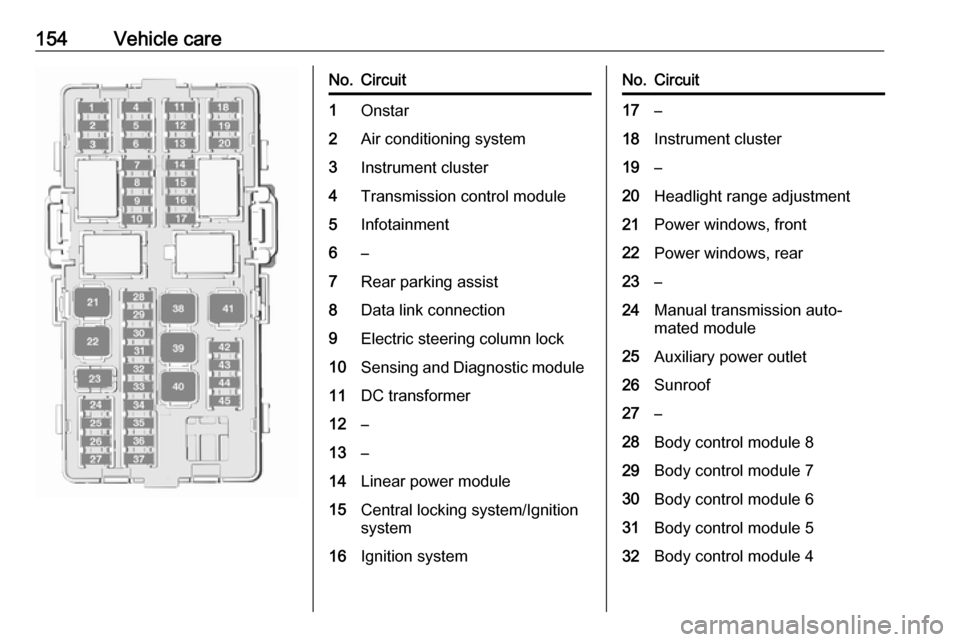
154Vehicle careNo.Circuit1Onstar2Air conditioning system3Instrument cluster4Transmission control module5Infotainment6–7Rear parking assist8Data link connection9Electric steering column lock10Sensing and Diagnostic module11DC transformer12–13–14Linear power module15Central locking system/Ignition
system16Ignition systemNo.Circuit17–18Instrument cluster19–20Headlight range adjustment21Power windows, front22Power windows, rear23–24Manual transmission auto‐
mated module25Auxiliary power outlet26Sunroof27–28Body control module 829Body control module 730Body control module 631Body control module 532Body control module 4
Page 162 of 203

160Vehicle careTyre pressure sensor matching
process
Each tyre pressure sensor has a
unique identification code. The
identification code must be matched
to a new tyre/wheel position after
rotating the tyres or exchanging the
complete wheel set and if one or more
tyre pressure sensors were replaced. The tyre pressure sensor matching
process should also be performed
after replacing a spare tyre with a
road tyre containing the tyre pressure sensor.
The malfunction light w and the
warning message or code should go
off at the next ignition cycle. The
sensors are matched to the wheel
positions, using a relearn tool, in the
following order: left side front wheel,
right side front wheel, right side rear
wheel and left side rear wheel. The
turn signal light at the current active
position is illuminated until sensor is
matched.
Consult a workshop for service. There
are two minutes to match the first
wheel position, and five minutes
overall to match all four wheelpositions. If it takes longer, the
matching process stops and must be
restarted.
The tyre pressure sensor matching
process is:
1. Apply the parking brake.
2. Turn the ignition on.
3. On vehicles with manual transmission: select neutral.
4. Use MENU on the turn signal
lever to select the Vehicle
Information Menu in the Driver
Information Centre.
5. Turn the adjuster wheel to scroll to
the tyre pressure menu.
6. Press SET/CLR to begin the
sensor matching process. A
message requesting acceptance
of the process should be
displayed.
7. Press SET/CLR again to confirm
the selection. The horn sounds
twice to indicate that the receiver
is in relearn mode.
8. Start with the left side front wheel.9. Place the relearn tool against the
tyre sidewall, near the valve stem.Then press the button to activate
the tyre pressure sensor. A horn
chirp confirms that the sensor
identification code has been
matched to this wheel position.
10. Proceed to the right side front wheel, and repeat the procedure
in Step 9.
11. Proceed to the right side rear wheel, and repeat the procedure
in Step 9.
12. Proceed to the left side rear wheel, and repeat the procedure
in Step 9. The horn sounds twice
to indicate that the sensor
identification code has been
matched to the left side rear
wheel, and the tyre pressure
sensor matching process is no
longer active.
13. Turn off the ignition.
Page 165 of 203
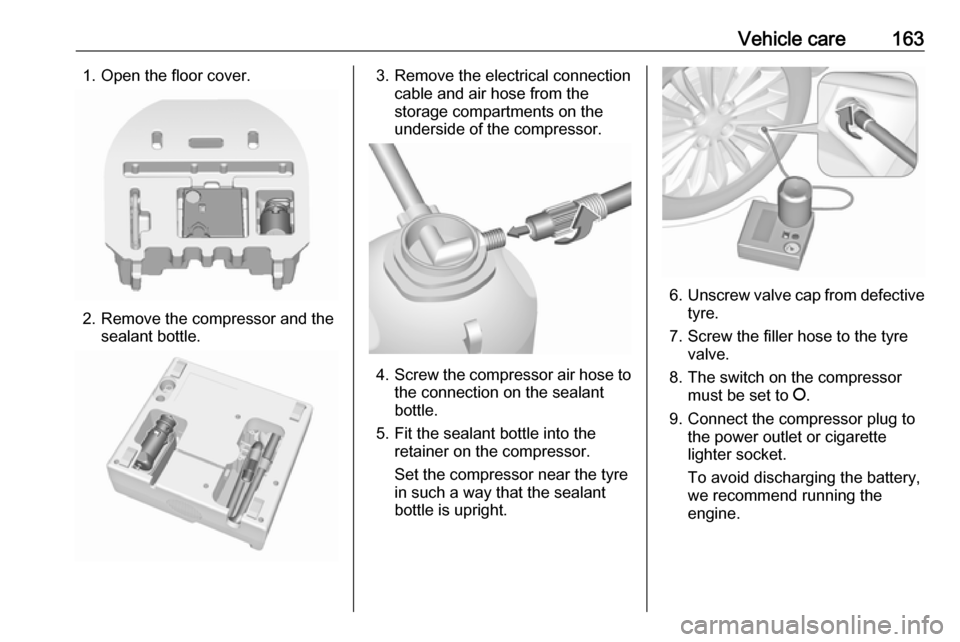
Vehicle care1631. Open the floor cover.
2. Remove the compressor and thesealant bottle.
3. Remove the electrical connectioncable and air hose from the
storage compartments on the
underside of the compressor.
4. Screw the compressor air hose to
the connection on the sealant
bottle.
5. Fit the sealant bottle into the retainer on the compressor.
Set the compressor near the tyre
in such a way that the sealant
bottle is upright.
6. Unscrew valve cap from defective
tyre.
7. Screw the filler hose to the tyre valve.
8. The switch on the compressor must be set to J.
9. Connect the compressor plug to the power outlet or cigarette
lighter socket.
To avoid discharging the battery, we recommend running the
engine.
Page 173 of 203

Vehicle care1714. Switch on electrical consumers(e.g. headlights, heated rear
window) of the vehicle receiving
the jump start.
5. Reverse above sequence exactly when removing leads.Towing
Towing the vehicle The towing eye is stowed with the
vehicle tools 3 155.
1. Disengage cap by using the
screwdriver and remove the cap.
2. Screw in the towing eye as far as it will go until it stops in a
horizontal position.
3. Attach a tow rope – or better still a
tow rod – to the towing eye.
General
The towing eye must only be used for
towing and not for recovering the
vehicle.
Switch on ignition to release steering
wheel lock and to permit operation of
brake lights, horn and windscreen
wiper.
Switch the selector lever to neutral.
Release the parking brake.
Page 175 of 203

Vehicle care173Thoroughly rinse and leather-off the
vehicle. Rinse leather frequently. Use
separate leathers for painted and
glass surfaces: remnants of wax on the windows will impair vision.
Do not use hard objects to remove
spots of tar. Use tar removal spray on
painted surfaces.
Exterior lights
Headlight and other light covers are
made of plastic. Do not use any
abrasive or caustic agents, do not use
an ice scraper, and do not clean them
dry.
Polishing and waxing
Wax painted parts of the vehicle
regularly (at the latest when water no longer beads). Otherwise, the
paintwork will dry out.
Polishing is necessary only if the paint
has become dull or if solid deposits
have become attached to it.
Paintwork polish with silicone forms a
protective film, making waxing
unnecessary.Unpainted plastic body parts must not be treated with wax or polishing
agents.
Windows and windscreen wiper
blades
Use a soft lint-free cloth or chamois leather together with window cleaner
and insect remover.
When cleaning the rear window from
inside, always wipe in parallel to the
heating element to prevent damage.
For mechanical removal of ice, use a
sharp-edged ice scraper. Press the
scraper firmly against the glass so
that no dirt can get under it and
scratch the glass.
Clean smearing wiper blades with a
soft cloth and window cleaner.
Sunroof
Never clean with solvents or abrasive agents, fuels, aggressive media (e.g.
paint cleaner, acetone-containing solutions etc.), acidic or highly
alkaline media or abrasive pads. Do
not apply wax or polishing agents to
the sunroof.Wheels and tyres
Do not use high-pressure jet
cleaners.
Clean rims with a pH-neutral wheel
cleaner.
Rims are painted and can be treated
with the same agents as the body.
Paintwork damageRectify minor paintwork damage witha touch-up pen before rust forms.
Have more extensive damage or rust
areas repaired by a workshop.
Underbody Some areas of the vehicle underbody
have a PVC undercoating while other
critical areas have a durable
protective wax coating.
After the underbody is washed, check
the underbody and have it waxed if
necessary.
Bitumen/rubber materials could
damage the PVC coating. Have
underbody work carried out by a
workshop.
Page 176 of 203

174Vehicle careBefore and after winter, wash the
underbody and have the protective
wax coating checked.
Liquid gas system9 Danger
Liquid gas is heavier than air and
can collect in sink points.
Take care when performing work
at the underbody in a pit.
For painting work and when using a
drying booth at a temperature above
60 °C, the liquid gas tank must be
removed.
Do not make any modifications to the
liquid gas system.
Interior care
Interior and upholstery
Only clean the vehicle interior,
including the instrument panel fascia
and panelling, with a dry cloth or
interior cleaner.
Clean the leather upholstery with
clear water and a soft cloth. In case of heavy soiling, use leather care.
The instrument cluster and the
displays should only be cleaned using
a soft damp cloth. If necessary use a
weak soap solution.
Clean fabric upholstery with a
vacuum cleaner and brush. Remove
stains with an upholstery cleaner.
Clothing fabrics may not be
colourfast. This could cause visible
discolourations, especially on light- coloured upholstery. Removable
stains and discolourations should be
cleaned as soon as possible.
Clean seat belts with lukewarm water or interior cleaner.Caution
Close Velcro fasteners as open
Velcro fasteners on clothing could damage seat upholstery.
The same applies to clothing with
sharp-edged objects, like zips or
belts or studded jeans.
Plastic and rubber parts
Plastic and rubber parts can be
cleaned with the same cleaner as
used to clean the body. Use interior cleaner if necessary. Do not use any
other agent. Avoid solvents and petrol in particular. Do not use high-
pressure jet cleaners.
Page 198 of 203

196IndexAAccessories and vehicle modifications .......................... 137
Adjustable air vents ...................105
Airbag and belt tensioners ...........72
Airbag deactivation ................46, 72
Airbag label................................... 41 Airbag system .............................. 41
Air conditioning regular operation ................................ 106
Air conditioning system .............. 100
Air intake .................................... 106
Air vents...................................... 105
Antilock brake system ................ 119
Antilock brake system (ABS) .......74
Anti-theft alarm system ................27
Appearance care ........................172
Ashtrays ....................................... 65
Autostop ..................................... 111
B Battery discharge protection ........98
Battery voltage ............................. 85
Belts.............................................. 39
Bonnet ....................................... 139
Bonnet open ................................. 76
Brake and clutch fluid .................176
Brake and clutch system .............73
Brake assist ............................... 120
Brake fluid .................................. 142Brakes ............................... 119, 142
Breakdown.................................. 171
Bulb replacement ....................... 144
C Capacities .................................. 187
Catalytic converter .....................115
Central locking system ................23
Centre console storage ...............54
Centre high-mounted brake light 149
Changing tyre and wheel size ...161
Charging system .......................... 73
Child locks ................................... 25
Child restraint installation locations ................................... 50
Child restraints.............................. 47
Child restraint systems ................47
Cigarette lighter ........................... 65
City mode ................................... 123
Climate control ............................. 17
Climate control systems ...............99
Clock ............................................ 63
Code ............................................. 83
Collision damage repair ..............192
Control indicators.......................... 69
Control of the vehicle .................108
Controls ........................................ 61
Coolant and antifreeze ...............176
Cornering lights ............................ 94
Cruise control ...................... 76, 124
Page 199 of 203

197Cupholders .................................. 53
Curtain airbag system .................. 45
D
Danger, Warnings and Cautions ...4
Daytime running lights .................94
Declaration of conformity ............189
Door open .................................... 77
Doors ............................................ 26
Driver assistance systems ..........124
Driver Information Centre .............77
Driving hints ................................ 108
E Electric adjustment ......................29
Electrical system......................... 150
Electronic climate control system 102
Electronic driving programmes ..118
Electronic Stability Control.......... 122
Electronic Stability Control and Traction Control system ............74
Electronic Stability Control off....... 74
End-of-life vehicle recovery .......138
Engine compartment fuse box ...152
Engine coolant ........................... 141
Engine coolant temperature ........75
Engine coolant temperature gauge ....................................... 68
Engine data ............................... 184
Engine exhaust .......................... 115
Engine identification ...................180Engine oil ................... 140, 176, 181
Engine oil pressure ......................75
Event data recorders ..................195
Exit lighting .................................. 97
Exterior care .............................. 172
Exterior light ................................. 76
Exterior lighting ......................14, 93
Exterior mirrors ............................. 29
F Fault ........................................... 118
First aid ......................................... 58
First aid kit ................................... 58
Fixed air vents ........................... 106
Fog light ....................................... 76
Fog lights ................................... 146
Folding mirrors ............................. 29
Front airbag system .....................44
Front doors ................................... 25
Front fog lights ............................. 95
Front seats.................................... 36
Front turn signal lights ...............147
Fuel............................................. 129
Fuel consumption - CO 2-
Emissions ............................... 136
Fuel for liquid gas operation .......130
Fuel for petrol engines ...............129
Fuel gauge ................................... 66 Fuel selector ................................ 67
Fuses ......................................... 150G
Gauges ......................................... 65
Gear shifting ................................. 74
Glovebox ..................................... 53
H
Halogen headlights ....................145
Hand brake ......................... 119, 120
Hazard warning flashers ..............94
Headlight flash ............................. 93
Headlight range adjustment ........94
Headlights..................................... 93
Headlights when driving abroad ..94
Head restraint adjustment .............8
Head restraints ............................ 35
Heated mirrors ............................. 29
Heated rear window ..................... 32
Heated steering wheel .................61
Heating ........................................ 38
Heating and ventilation system ...99
High beam ............................. 76, 93
Hill start assist ........................... 120
Horn ....................................... 15, 62
I
Identification plate .....................180
Ignition switch positions .............109
Immobiliser ............................ 28, 76
Indicators ...................................... 65
Info display ................................... 82
Information displays...................... 77