battery OPEL KARL 2019 Manual user
[x] Cancel search | Manufacturer: OPEL, Model Year: 2019, Model line: KARL, Model: OPEL KARL 2019Pages: 191, PDF Size: 5.51 MB
Page 135 of 191
Vehicle care133Meaning of symbols:● No sparks, naked flames or smoking.
● Always shield eyes. Explosive gases can cause blindness or
injury.
● Keep the vehicle battery out of the reach of children.
● The vehicle battery contains sulfuric acid which could cause
blindness or serious burn
injuries.
● See the Owner's manual for further information.
● Explosive gas may be present in the vicinity of the battery.Wiper blade replacement
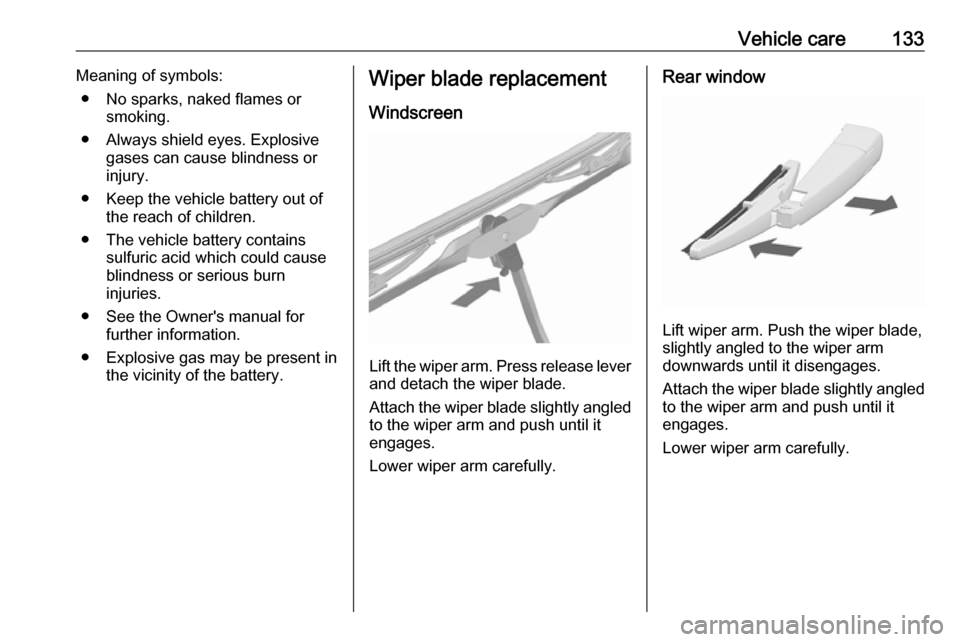
Windscreen
Lift the wiper arm. Press release lever
and detach the wiper blade.
Attach the wiper blade slightly angled to the wiper arm and push until it
engages.
Lower wiper arm carefully.
Rear window
Lift wiper arm. Push the wiper blade,
slightly angled to the wiper arm
downwards until it disengages.
Attach the wiper blade slightly angled
to the wiper arm and push until it
engages.
Lower wiper arm carefully.
Page 144 of 191

142Vehicle careNo.Circuit1Tailgate2Transmission output speed
sensor3Heated rear window4Heated exterior mirror5Sunroof6Transmission control module7Engine control module8–9ABS10Body control module, voltage11Rear view camera12–13–14Engine control module/Trans‐
mission control module15Injection system/Starter16Fuel pumpNo.Circuit17Engine control module118Engine control module219Injection system/Ignition20Air conditioning system21Battery sensor22Electric steering column lock23Cooling fan low24–25Exterior mirror switch26Engine control module27Fuel system28–29Seat occupancy recognition30Headlight range adjustment31Horn32Front fog light33High beam leftNo.Circuit34High beam right35–36Rear wiper37Cornering light left38Washer system39Cornering light right40–41–42Starter 243Instrument panel44DC-DC converter45Starter 146ABS47Cooling fan high48Front wiper49Body control module/Retained
power off
Page 154 of 191
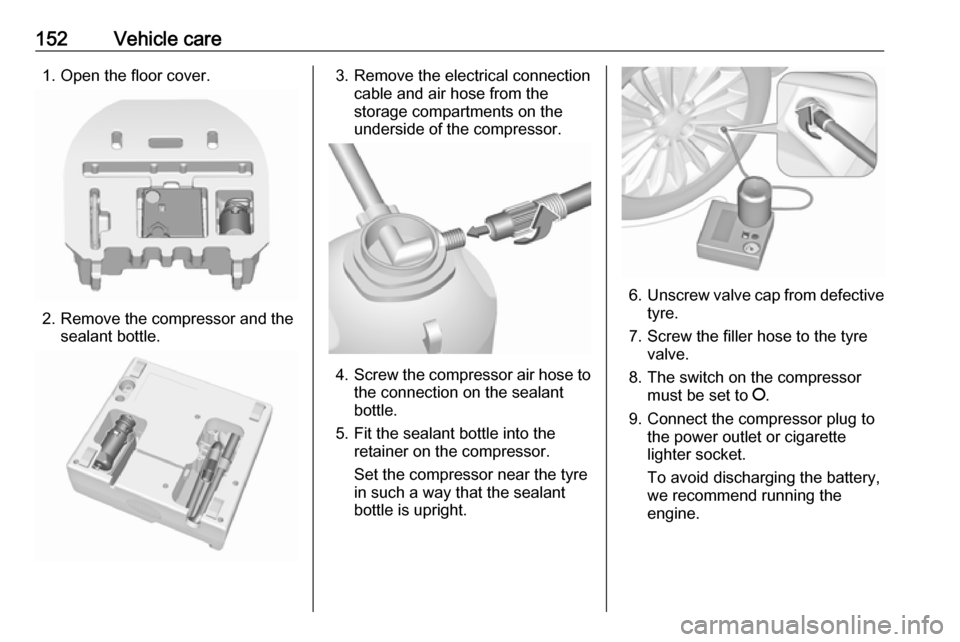
152Vehicle care1. Open the floor cover.
2. Remove the compressor and thesealant bottle.
3. Remove the electrical connectioncable and air hose from the
storage compartments on the
underside of the compressor.
4. Screw the compressor air hose to
the connection on the sealant
bottle.
5. Fit the sealant bottle into the retainer on the compressor.
Set the compressor near the tyre
in such a way that the sealant
bottle is upright.
6. Unscrew valve cap from defective
tyre.
7. Screw the filler hose to the tyre valve.
8. The switch on the compressor must be set to J.
9. Connect the compressor plug to the power outlet or cigarette
lighter socket.
To avoid discharging the battery, we recommend running the
engine.
Page 161 of 191
Vehicle care159Jump starting
Do not start with a quick charger.
A vehicle with a discharged vehicle
battery can be started using jump
leads and the vehicle battery of
another vehicle.9 Warning
Be extremely careful when starting
with jump leads. Any deviation
from the following instructions can
lead to injuries or damage caused
by battery explosion or damage to the electrical systems of both
vehicles.
9 Warning
Avoid contact of the battery with
eyes, skin, fabrics and painted
surfaces. The fluid contains
sulphuric acid which can cause
injuries and damage in the event
of direct contact.
● Never expose the battery to naked flames or sparks.
● A discharged vehicle battery canalready freeze at a temperature
of 0 °C. Defrost the frozen battery
before connecting jump leads.
● Wear eye protection and protective clothing when
handling a battery.
● Use a booster battery with the same voltage (12 V). Its capacity
(Ah) must not be much less than
that of the discharged battery.
● Use jump leads with insulated terminals and a cross section of
at least 16 mm 2
.
● Do not disconnect the discharged
vehicle battery from the vehicle.
● Switch off all unnecessary electrical consumers.
● Do not lean over the battery during jump starting.
● Do not allow the terminals of one
lead to touch those of the other
lead.
● The vehicles must not come into contact with each other during
the jump starting process.● Apply the parking brake, transmission in neutral.
● Open the positive terminal protection caps of both vehicle
batteries.
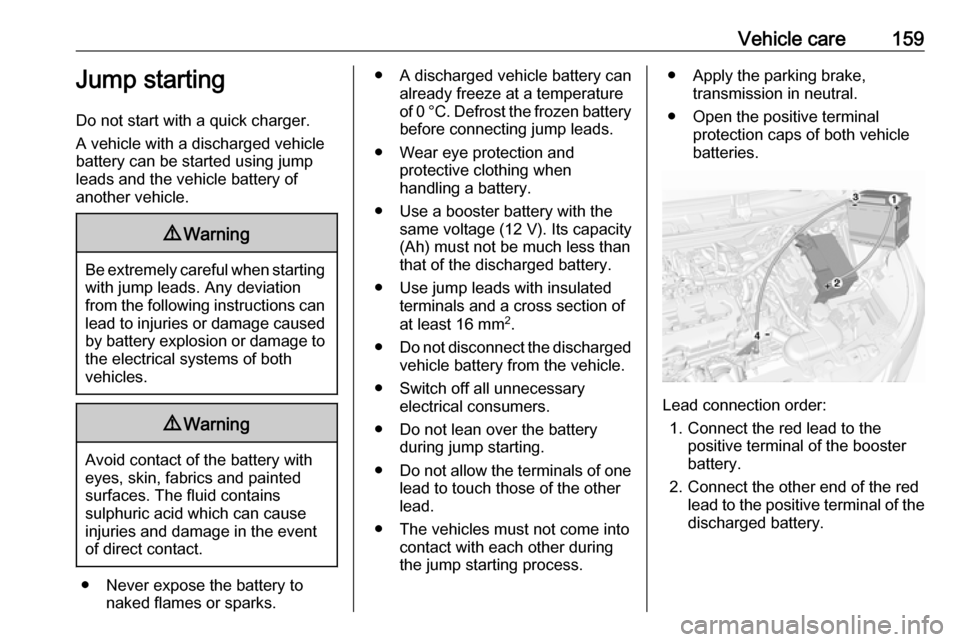
Lead connection order:
1. Connect the red lead to the positive terminal of the booster
battery.
2. Connect the other end of the red lead to the positive terminal of the
discharged battery.
Page 162 of 191
160Vehicle care3. Connect the black lead to thenegative terminal of the booster
battery.
4. Connect the other end of the black
lead to a vehicle grounding point,
such as the engine block or an
engine mounting bolt. Connect as far away from the discharged
vehicle battery as possible,
however at least 60 cm.
Route the leads so that they cannot
catch on rotating parts in the engine
compartment.
To start the engine: 1. Start the engine of the vehicle providing the jump.
2. After 5 minutes, start the other engine. Start attempts should be
made for no longer than
15 seconds at an interval of 1 minute.
3. Allow both engines to idle for approx. 3 minutes with the leads
connected.4. Switch on electrical consumers (e.g. headlights, heated rear
window) of the vehicle receiving
the jump start.
5. Reverse above sequence exactly when removing leads.Towing
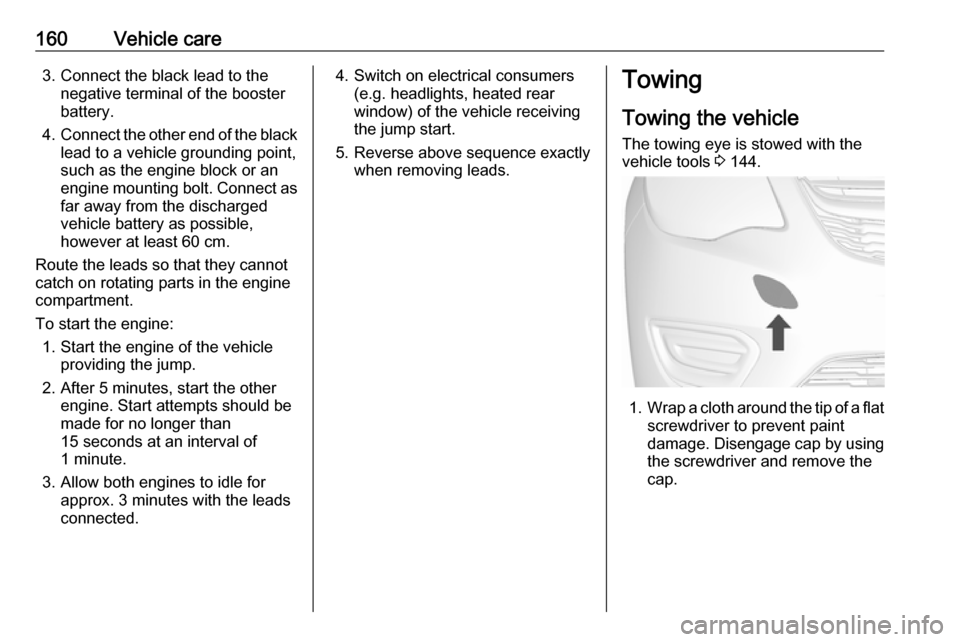
Towing the vehicle The towing eye is stowed with the
vehicle tools 3 144.
1. Wrap a cloth around the tip of a flat
screwdriver to prevent paint
damage. Disengage cap by using
the screwdriver and remove the
cap.
Page 183 of 191

Customer information181Depending on technical equipment
level, the data stored is as follows:
● system component operating states (e.g. fill level, tyre
pressure, battery status)
● faults and defects in important system components (e.g. lights,
brakes)
● system reactions in special driving situations (e.g. triggeringof an airbag, actuation of the
stability control systems)
● information on events damaging the vehicle
● for electric vehicles the amount of
charge in the high-voltage
battery, estimated range
In special cases (e.g. if the vehicle
has detected a malfunction), it may be
necessary to save data that would
otherwise just be volatile.
When you use services (e.g. repairs,
maintenance), the operating data
saved can be read together with the
vehicle identification number and
used when necessary. Staff working
for the service network ( e.g. garages,
manufacturers) or third parties (e.g.breakdown services) can read the
data from the vehicle. The same
applies to warranty work and quality
assurance measures.
Data is generally read via the OBD
(On-Board Diagnostics) port
prescribed by law in the vehicle. The operating data which is read out,
documents the technical condition of
the vehicle or individual components
and assists with fault diagnosis,
compliance with warranty obligations
and quality improvement. This data,
in particular information on
component stress, technical events,
operator errors and other faults, is
transmitted to the manufacturer
where appropriate, together with the
vehicle identification number. The
manufacturer is also subject to
product liability. The manufacturer
potentially also uses operating data
from vehicles for product recalls. This
data can also be used to check
customer warranty and guarantee
claims.
Fault memories in the vehicle can be
reset by a service company when
carrying out servicing or repairs or at
your request.Comfort and infotainment
functions
Comfort settings and custom settings can be stored in the vehicle and
changed or reset at any time.
Depending on the equipment level in
question, these include
● seat and steering wheel position settings
● chassis and air conditioning settings
● custom settings such as interior lighting
You can input your own data in the
infotainment functions for your
vehicle as part of the selected
features.
Depending on the equipment level in
question, these include
● multimedia data such as music, videos or photos for playback in
an integrated multimedia system
● address book data for use with an
integrated hands-free system or an integrated navigation system
Page 186 of 191

184IndexAAccessories and vehicle modifications .......................... 126
Adjustable air vents ...................102
Airbag and belt tensioners ...........70
Airbag deactivation ................45, 70
Airbag label................................... 40 Airbag system .............................. 40
Air conditioning regular operation ................................ 103
Air conditioning system ................ 97
Air intake .................................... 103
Air vents...................................... 102
Antilock brake system ................ 112
Antilock brake system (ABS) .......72
Anti-theft alarm system ................27
Appearance care ........................161
Ashtrays ....................................... 64
Autostop ..................................... 107
B Battery discharge protection ........95
Battery voltage ............................. 83
Belts.............................................. 38
Bonnet ....................................... 128
Bonnet open ................................. 74
Brake and clutch fluid .................165
Brake and clutch system .............71
Brake assist ............................... 113
Brake fluid .................................. 131Brakes ............................... 112, 131
Breakdown.................................. 160
Bulb replacement ....................... 134
C Catalytic converter .....................110
Central locking system ................22
Centre console storage ...............53
Centre high-mounted brake light 138
Changing tyre and wheel size ...150
Charging system .......................... 71
Child locks ................................... 24
Child restraint installation locations ................................... 49
Child restraints.............................. 46
Child restraint systems ................46
Cigarette lighter ........................... 64
City mode ................................... 115
Climate control ............................. 17
Climate control systems ...............96
Clock ............................................ 62
Code ............................................. 81
Control indicators.......................... 67
Control of the vehicle .................104
Controls ........................................ 60
Coolant and antifreeze ...............165
Cornering lights ............................ 91
Cruise control ...................... 74, 117
Cupholders .................................. 52
Curtain airbag system .................. 45
Page 189 of 191

187Software acknowledgement.......178
Spare wheel ............................... 155
Speed limiter......................... 74, 118
Speedometer ............................... 64
Starting and operating ................105
Starting off ................................... 18
Starting the engine ....................107
Steering ...................................... 105
Steering wheel adjustment ......9, 60
Steering wheel controls ...............60
Stop-start system........................ 107
Storage ......................................... 52
Storage compartments .................52
Sunroof ........................................ 32
Sun visors .................................... 32
Symbols ......................................... 4
T
Tachometer ................................. 65
Tail lights ................................... 137
Three-point seat belt .................... 39
Tools .......................................... 144
Towing ........................................ 160
Towing the vehicle .....................160
Traction Control system ............. 114
Traction Control system off........... 73
Transmission ............................... 17
Tread depth ............................... 150
Trip odometer .............................. 65
Turn lights .............................. 69, 92Tyre chains ................................ 151
Tyre designations ......................145
Tyre pressure ............................ 146
Tyre pressure monitoring system ............................... 73, 147
Tyre pressures ........................... 174
Tyre repair kit ............................. 151
U
Upholstery .................................. 163
Using this manual ..........................3
V Valet mode ................................... 80
Vehicle battery ........................... 131
Vehicle checks............................ 128
Vehicle data ........................ 169, 172
Vehicle data recording and privacy ..................................... 180
Vehicle dimensions .................... 173
Vehicle Identification Number ....167
Vehicle jack ................................ 144
Vehicle messages .......................81
Vehicle personalisation ...............83
Vehicle specific data ......................3
Vehicle storage ........................... 127
Vehicle tools ............................... 144
Vehicle unlocking ........................... 6
Ventilation ..................................... 96W
Warning chimes ........................... 83
Warning lights ............................... 64
Warning triangle .......................... 56
Washer and wiper systems .........15
Washer fluid ............................... 131
Wheel changing .........................154
Wheel covers ............................. 150
Wheels and tyres .......................145
Windows ....................................... 30
Windscreen................................... 30
Windscreen wiper and washer ....61
Winter tyres ............................... 145
Wiper blade replacement ..........133