Door OPEL KARL 2019 User Guide
[x] Cancel search | Manufacturer: OPEL, Model Year: 2019, Model line: KARL, Model: OPEL KARL 2019Pages: 191, PDF Size: 5.51 MB
Page 29 of 191
Keys, doors and windows27Vehicle security
Anti-theft alarm system
It monitors: ● doors, tailgate, bonnet
● ignition
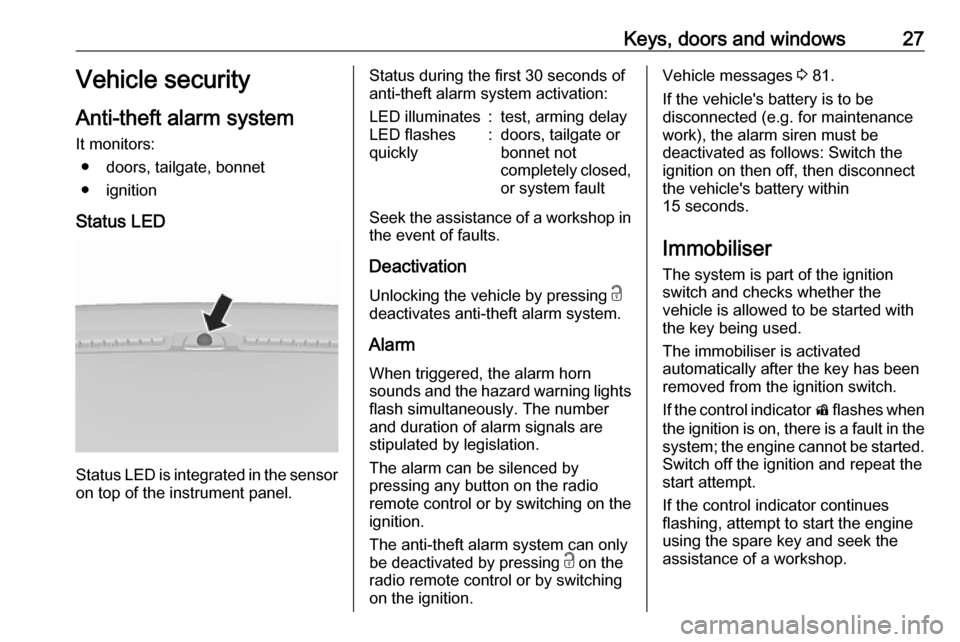
Status LED
Status LED is integrated in the sensor
on top of the instrument panel.
Status during the first 30 seconds of
anti-theft alarm system activation:LED illuminates:test, arming delayLED flashes
quickly:doors, tailgate or
bonnet not
completely closed,
or system fault
Seek the assistance of a workshop in the event of faults.
Deactivation Unlocking the vehicle by pressing c
deactivates anti-theft alarm system.
Alarm When triggered, the alarm horn
sounds and the hazard warning lights flash simultaneously. The number
and duration of alarm signals are
stipulated by legislation.
The alarm can be silenced by
pressing any button on the radio
remote control or by switching on the
ignition.
The anti-theft alarm system can only
be deactivated by pressing c on the
radio remote control or by switching
on the ignition.
Vehicle messages 3 81.
If the vehicle's battery is to be
disconnected (e.g. for maintenance
work), the alarm siren must be
deactivated as follows: Switch the
ignition on then off, then disconnect
the vehicle's battery within
15 seconds.
Immobiliser
The system is part of the ignition
switch and checks whether the
vehicle is allowed to be started with the key being used.
The immobiliser is activated
automatically after the key has been
removed from the ignition switch.
If the control indicator d flashes when
the ignition is on, there is a fault in the
system; the engine cannot be started. Switch off the ignition and repeat the
start attempt.
If the control indicator continues
flashing, attempt to start the engine
using the spare key and seek the
assistance of a workshop.
Page 30 of 191
28Keys, doors and windowsNote
The immobiliser does not lock the
doors. You should always lock the
vehicle after leaving it.
Switch on the anti-theft alarm
system 3 22, 3 27.
Control indicator d 3 74.Exterior mirrors
Mirrors
The shape of the mirrors makes
objects appear smaller, which will
affect the ability to estimate
distances.
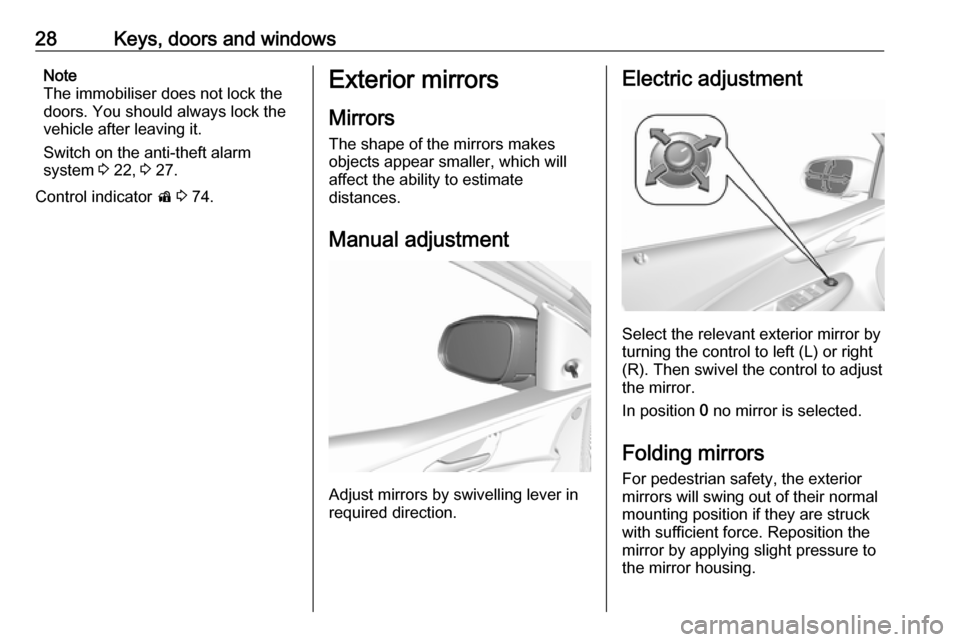
Manual adjustment
Adjust mirrors by swivelling lever in
required direction.
Electric adjustment
Select the relevant exterior mirror by
turning the control to left (L) or right
(R). Then swivel the control to adjust
the mirror.
In position 0 no mirror is selected.
Folding mirrors
For pedestrian safety, the exterior
mirrors will swing out of their normal
mounting position if they are struck
with sufficient force. Reposition the
mirror by applying slight pressure to
the mirror housing.
Page 31 of 191
Keys, doors and windows29
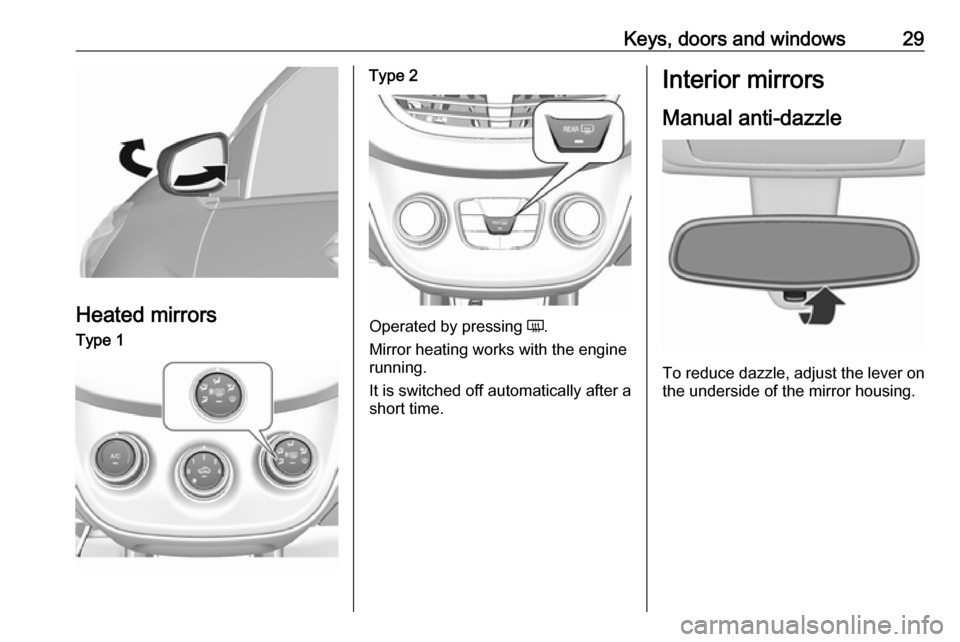
Heated mirrors
Type 1Type 2
Operated by pressing Ü.
Mirror heating works with the engine
running.
It is switched off automatically after a
short time.
Interior mirrors
Manual anti-dazzle
To reduce dazzle, adjust the lever on the underside of the mirror housing.
Page 32 of 191
30Keys, doors and windowsWindows
Windscreen Windscreen stickers
Do not attach stickers, e.g. toll road stickers or similar, on the windscreen
in the area of the interior mirror.
Otherwise the detection zone of the
sensor in the mirror housing could be restricted.
Windscreen replacementCaution
If the vehicle has a front-looking
camera sensor for the driver
assistance systems, it is very
important that any windscreen
replacement is performed
accurately according to Opel
specifications. Otherwise, these
systems may not work properly
and there is a risk of unexpected
behaviour and / or messages from these systems.
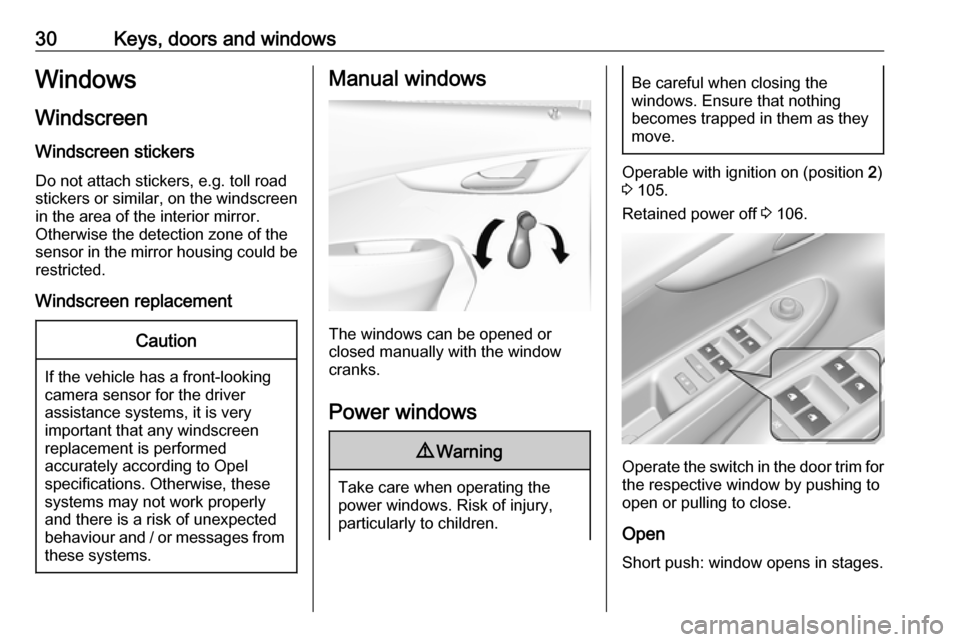
Manual windows
The windows can be opened or
closed manually with the window
cranks.
Power windows
9 Warning
Take care when operating the
power windows. Risk of injury,
particularly to children.
Be careful when closing the
windows. Ensure that nothing
becomes trapped in them as they
move.
Operable with ignition on (position 2)
3 105.
Retained power off 3 106.
Operate the switch in the door trim for
the respective window by pushing to
open or pulling to close.
Open
Short push: window opens in stages.
Page 33 of 191
Keys, doors and windows31Long push: window opens
automatically up to end position. To
stop movement, move switch in
opposite direction.
Close
Short pull: window closes in stages.
Longer pull: window closes
automatically up to end position. To
stop movement, move switch in
opposite direction.
Safety function
If the window glass encounters
resistance above the middle of the
window during automatic closing, it is
immediately stopped and opened
again.
Override safety function In the event of closing difficulties due
to frost or the like, switch on the
ignition, then pull the switch several times to close the windows in stages.Child safety system for rear
windows
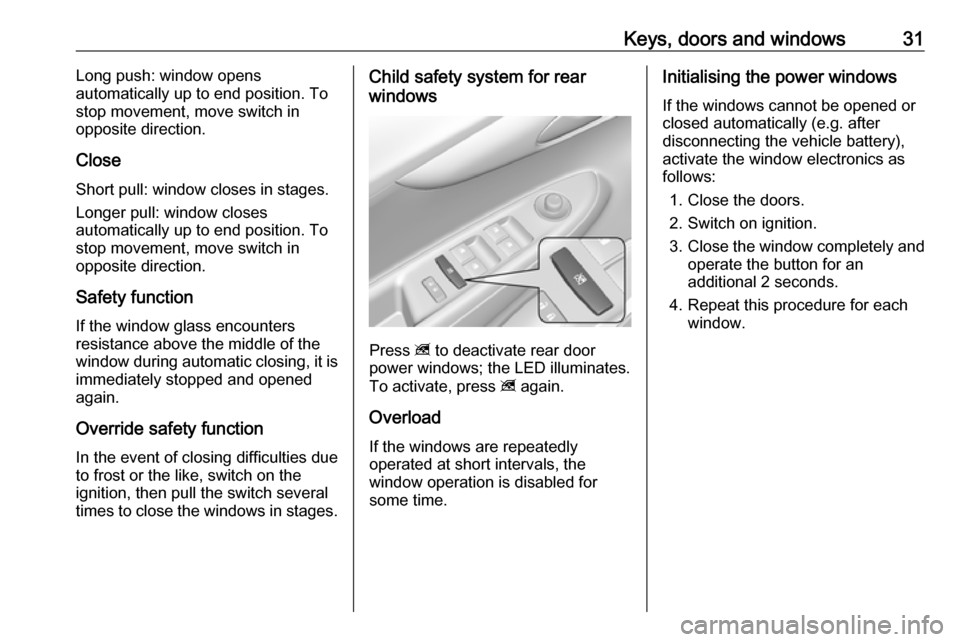
Press z to deactivate rear door
power windows; the LED illuminates.
To activate, press z again.
Overload
If the windows are repeatedly
operated at short intervals, the
window operation is disabled for
some time.
Initialising the power windows
If the windows cannot be opened or
closed automatically (e.g. after
disconnecting the vehicle battery),
activate the window electronics as
follows:
1. Close the doors.
2. Switch on ignition.
3. Close the window completely and
operate the button for an
additional 2 seconds.
4. Repeat this procedure for each window.
Page 34 of 191
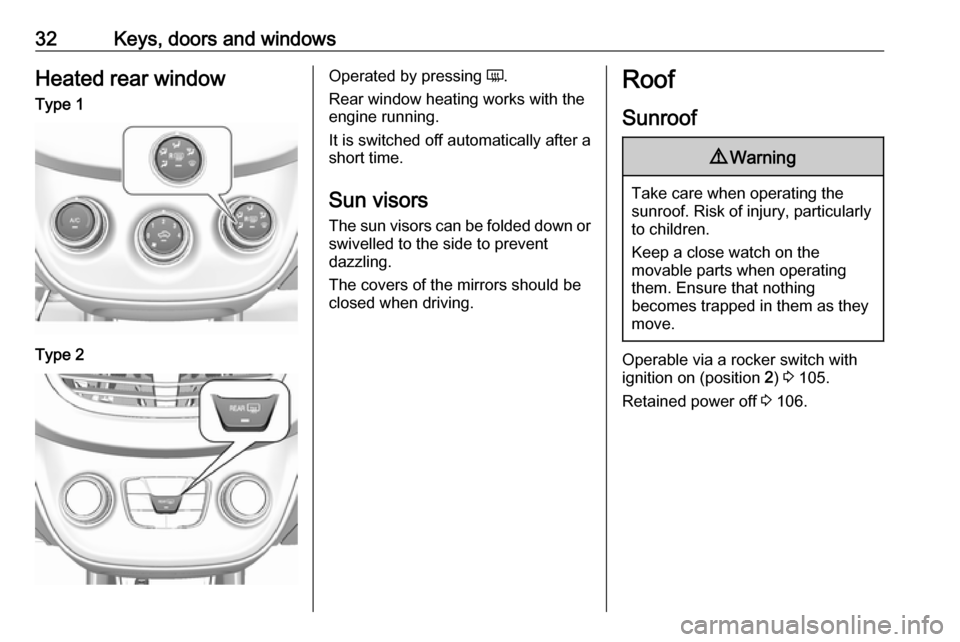
32Keys, doors and windowsHeated rear windowType 1Type 2Operated by pressing Ü.
Rear window heating works with the engine running.
It is switched off automatically after a
short time.
Sun visors
The sun visors can be folded down or swivelled to the side to prevent
dazzling.
The covers of the mirrors should be
closed when driving.Roof
Sunroof9 Warning
Take care when operating the
sunroof. Risk of injury, particularly to children.
Keep a close watch on the
movable parts when operating
them. Ensure that nothing
becomes trapped in them as they
move.
Operable via a rocker switch with
ignition on (position 2) 3 105.
Retained power off 3 106.
Page 35 of 191
Keys, doors and windows33
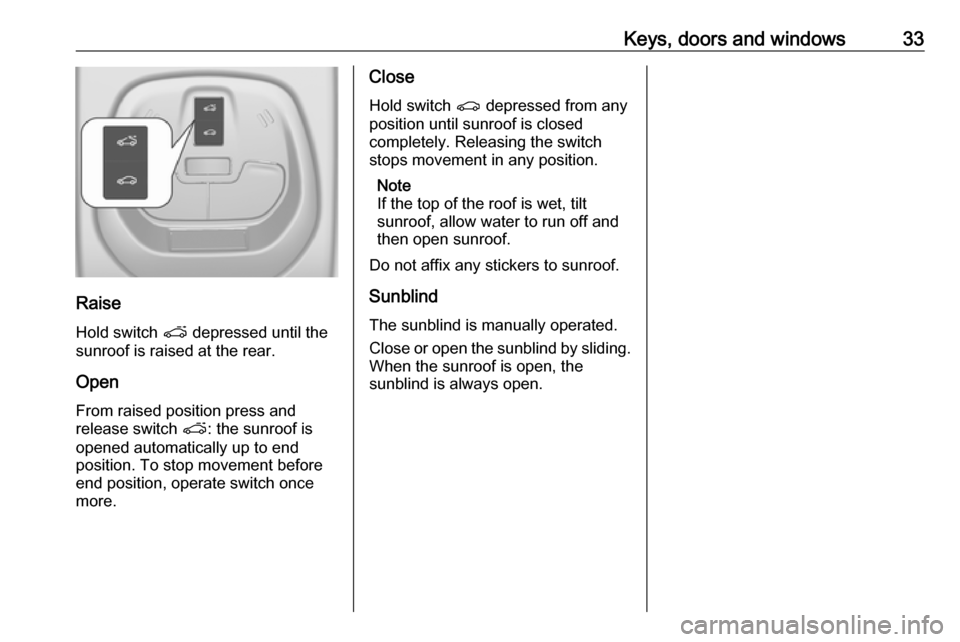
Raise
Hold switch p depressed until the
sunroof is raised at the rear.
Open
From raised position press and
release switch p: the sunroof is
opened automatically up to end
position. To stop movement before
end position, operate switch once
more.
Close
Hold switch r depressed from any
position until sunroof is closed
completely. Releasing the switch
stops movement in any position.
Note
If the top of the roof is wet, tilt
sunroof, allow water to run off and
then open sunroof.
Do not affix any stickers to sunroof.
Sunblind
The sunblind is manually operated. Close or open the sunblind by sliding. When the sunroof is open, the
sunblind is always open.
Page 42 of 191
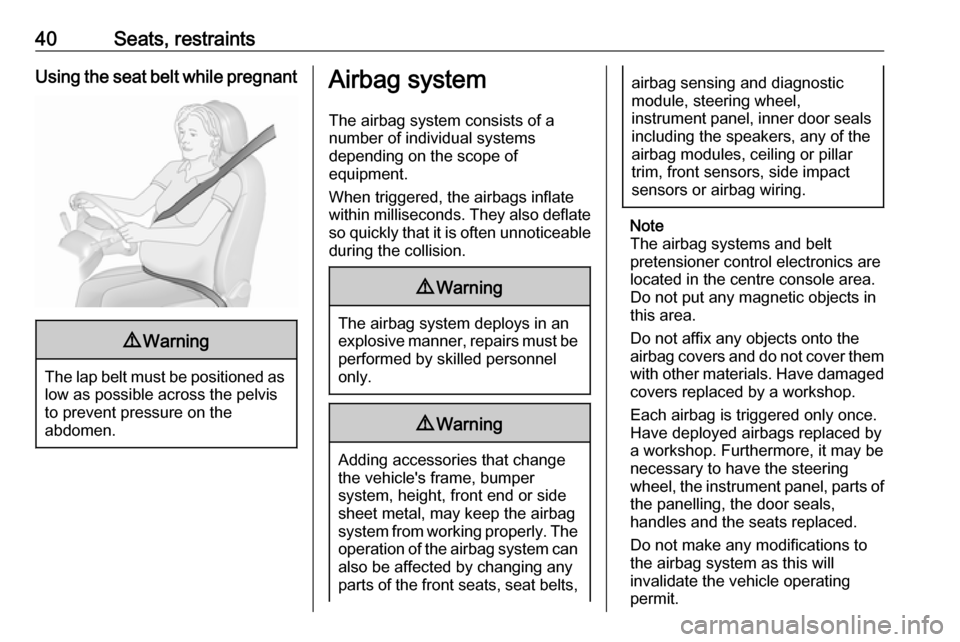
40Seats, restraintsUsing the seat belt while pregnant9Warning
The lap belt must be positioned as
low as possible across the pelvis
to prevent pressure on the
abdomen.
Airbag system
The airbag system consists of a
number of individual systems
depending on the scope of
equipment.
When triggered, the airbags inflate
within milliseconds. They also deflate
so quickly that it is often unnoticeable
during the collision.9 Warning
The airbag system deploys in an
explosive manner, repairs must be performed by skilled personnel
only.
9 Warning
Adding accessories that change
the vehicle's frame, bumper
system, height, front end or side
sheet metal, may keep the airbag
system from working properly. The operation of the airbag system can
also be affected by changing any
parts of the front seats, seat belts,
airbag sensing and diagnostic
module, steering wheel,
instrument panel, inner door seals including the speakers, any of the
airbag modules, ceiling or pillar
trim, front sensors, side impact
sensors or airbag wiring.
Note
The airbag systems and belt
pretensioner control electronics are
located in the centre console area.
Do not put any magnetic objects in
this area.
Do not affix any objects onto the
airbag covers and do not cover them with other materials. Have damagedcovers replaced by a workshop.
Each airbag is triggered only once.
Have deployed airbags replaced by
a workshop. Furthermore, it may be
necessary to have the steering
wheel, the instrument panel, parts of
the panelling, the door seals,
handles and the seats replaced.
Do not make any modifications to
the airbag system as this will
invalidate the vehicle operating
permit.
Page 61 of 191

Instruments and controls59Instruments and
controlsControls ....................................... 60
Steering wheel adjustment ........60
Steering wheel controls .............60
Heated steering wheel ...............60
Horn ........................................... 61
Windscreen wiper and washer ..61
Rear window wiper and washer ...................................... 62
Outside temperature ..................62
Clock ......................................... 62
Power outlets ............................. 64
Cigarette lighter ......................... 64
Ashtrays .................................... 64
Warning lights, gauges and indi‐ cators ........................................... 64
Instrument cluster ......................64
Speedometer ............................. 64
Odometer .................................. 65
Trip odometer ............................ 65
Tachometer ............................... 65
Fuel gauge ................................ 65
Engine coolant temperature gauge ....................................... 66
Service display .......................... 66Control indicators ......................67
Turn lights .................................. 69
Seat belt reminder .....................70
Airbag and belt tensioners .........70
Airbag deactivation ....................70
Charging system .......................71
Malfunction indicator light ..........71
Service vehicle soon .................71
Brake and clutch system ...........71
Operate pedal ............................ 71
Antilock brake system (ABS) .....72
Gear shifting .............................. 72
Power steering .......................... 72
Lane departure warning ............72
Parking assist ............................ 72
Electronic Stability Control off ...72
Electronic Stability Control and Traction Control system ...........72
Traction Control system off .......73
Engine coolant temperature ......73
Tyre pressure monitoring system ...................................... 73
Engine oil pressure ....................73
Low fuel ..................................... 74
Immobiliser ................................ 74
Reduced engine power .............74
Exterior light .............................. 74
High beam ................................. 74
Front fog lights ........................... 74
Rear fog light ............................. 74Cruise control............................ 74
Speed limiter ............................. 74
Bonnet open .............................. 74
Door open .................................. 75
Displays ....................................... 75
Driver Information Centre ..........75
Info Display ................................ 80
Vehicle messages ........................81
Warning chimes .........................83
Battery voltage .......................... 83
Vehicle personalisation ................83
Telematics service .......................86
OnStar ....................................... 86
Page 71 of 191
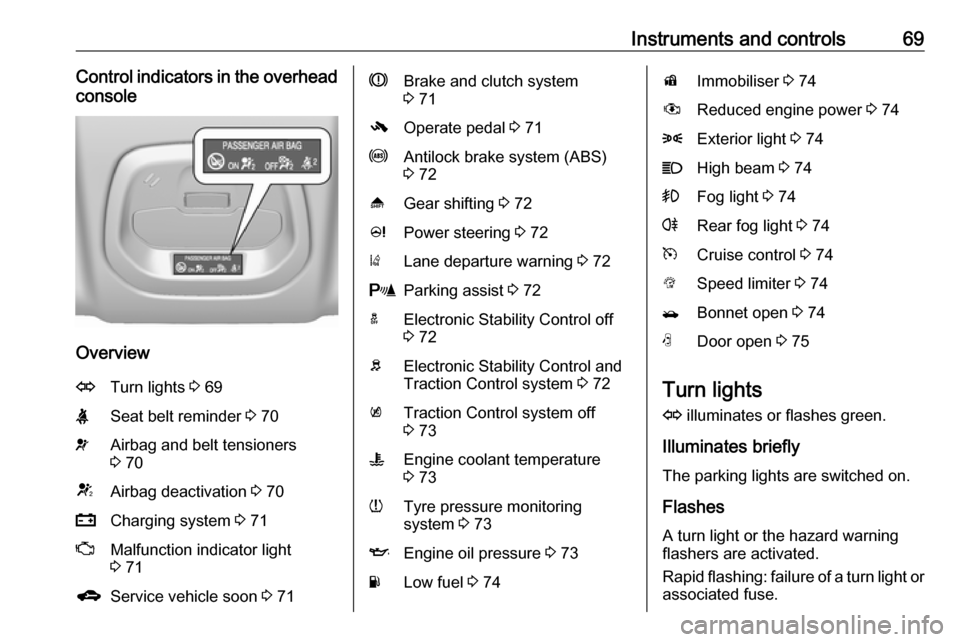
Instruments and controls69Control indicators in the overheadconsole
Overview
OTurn lights 3 69XSeat belt reminder 3 70vAirbag and belt tensioners
3 70VAirbag deactivation 3 70pCharging system 3 71ZMalfunction indicator light
3 71gService vehicle soon 3 71RBrake and clutch system
3 71-Operate pedal 3 71uAntilock brake system (ABS)
3 72[Gear shifting 3 72cPower steering 3 72)Lane departure warning 3 72rParking assist 3 72aElectronic Stability Control off
3 72bElectronic Stability Control and
Traction Control system 3 72kTraction Control system off
3 73WEngine coolant temperature
3 73wTyre pressure monitoring
system 3 73IEngine oil pressure 3 73YLow fuel 3 74dImmobiliser 3 74#Reduced engine power 3 748Exterior light 3 74CHigh beam 3 74>Fog light 3 74rRear fog light 3 74mCruise control 3 74LSpeed limiter 3 74/Bonnet open 3 74NDoor open 3 75
Turn lights
O illuminates or flashes green.
Illuminates briefly The parking lights are switched on.
Flashes
A turn light or the hazard warning flashers are activated.
Rapid flashing: failure of a turn light or associated fuse.