gear OPEL MANTA 1973 Owners Manual
[x] Cancel search | Manufacturer: OPEL, Model Year: 1973, Model line: MANTA, Model: OPEL MANTA 1973Pages: 625, PDF Size: 17.22 MB
Page 409 of 625
7C- 481973 OPEL SERVICE MANUAL
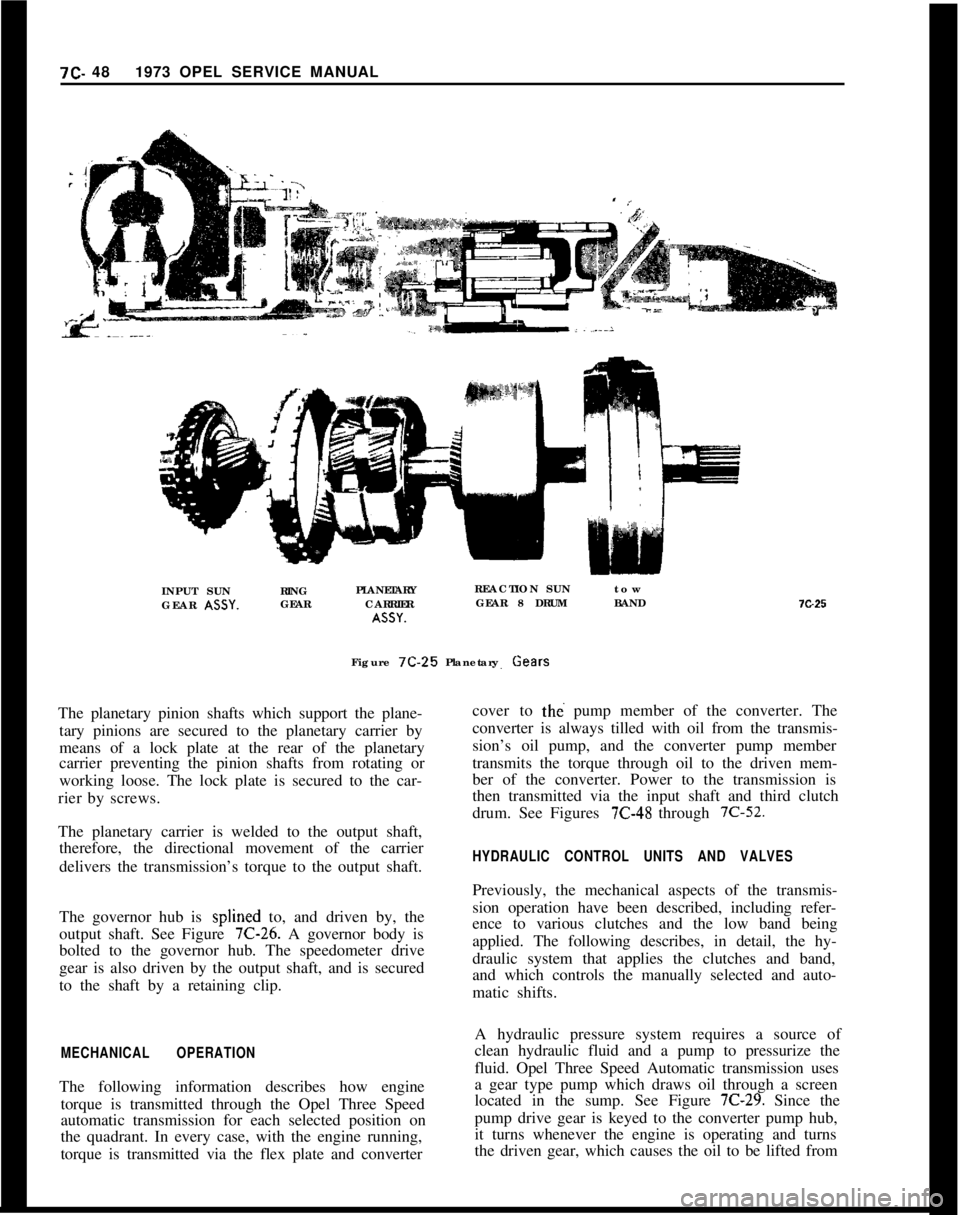
INPUT SUNRING
GEAR ASSY.GEARPLANETARY
CARRIERASSY.REACTION SUNtow
GEAR 8 DRUMBAND
Figure 7C-25Planetary Gears
The planetary pinion shafts which support the plane-
tary pinions are secured to the planetary carrier by
means of a lock plate at the rear of the planetary
carrier preventing the pinion shafts from rotating or
working loose. The lock plate is secured to the car-
rier by screws.
The planetary carrier is welded to the output shaft,
therefore, the directional movement of the carrier
delivers the transmission’s torque to the output shaft.
The governor hub is splined to, and driven by, the
output shaft. See Figure 7C-26. A governor body is
bolted to the governor hub. The speedometer drive
gear is also driven by the output shaft, and is secured
to the shaft by a retaining clip.
MECHANICAL OPERATIONThe following information describes how engine
torque is transmitted through the Opel Three Speed
automatic transmission for each selected position on
the quadrant. In every case, with the engine running,
torque is transmitted via the flex plate and converter7G25
cover to
tht? pump member of the converter. The
converter is always tilled with oil from the transmis-
sion’s oil pump, and the converter pump member
transmits the torque through oil to the driven mem-
ber of the converter. Power to the transmission is
then transmitted via the input shaft and third clutch
drum. See Figures
7C-48 through 7C-52.
HYDRAULIC CONTROL UNITS AND VALVESPreviously, the mechanical aspects of the transmis-
sion operation have been described, including refer-
ence to various clutches and the low band being
applied. The following describes, in detail, the hy-
draulic system that applies the clutches and band,
and which controls the manually selected and auto-
matic shifts.
A hydraulic pressure system requires a source of
clean hydraulic fluid and a pump to pressurize the
fluid. Opel Three Speed Automatic transmission uses
a gear type pump which draws oil through a screen
located in the sump. See Figure
7C-29. Since the
pump drive gear is keyed to the converter pump hub,
it turns whenever the engine is operating and turns
the driven gear, which causes the oil to be lifted from
Page 410 of 625
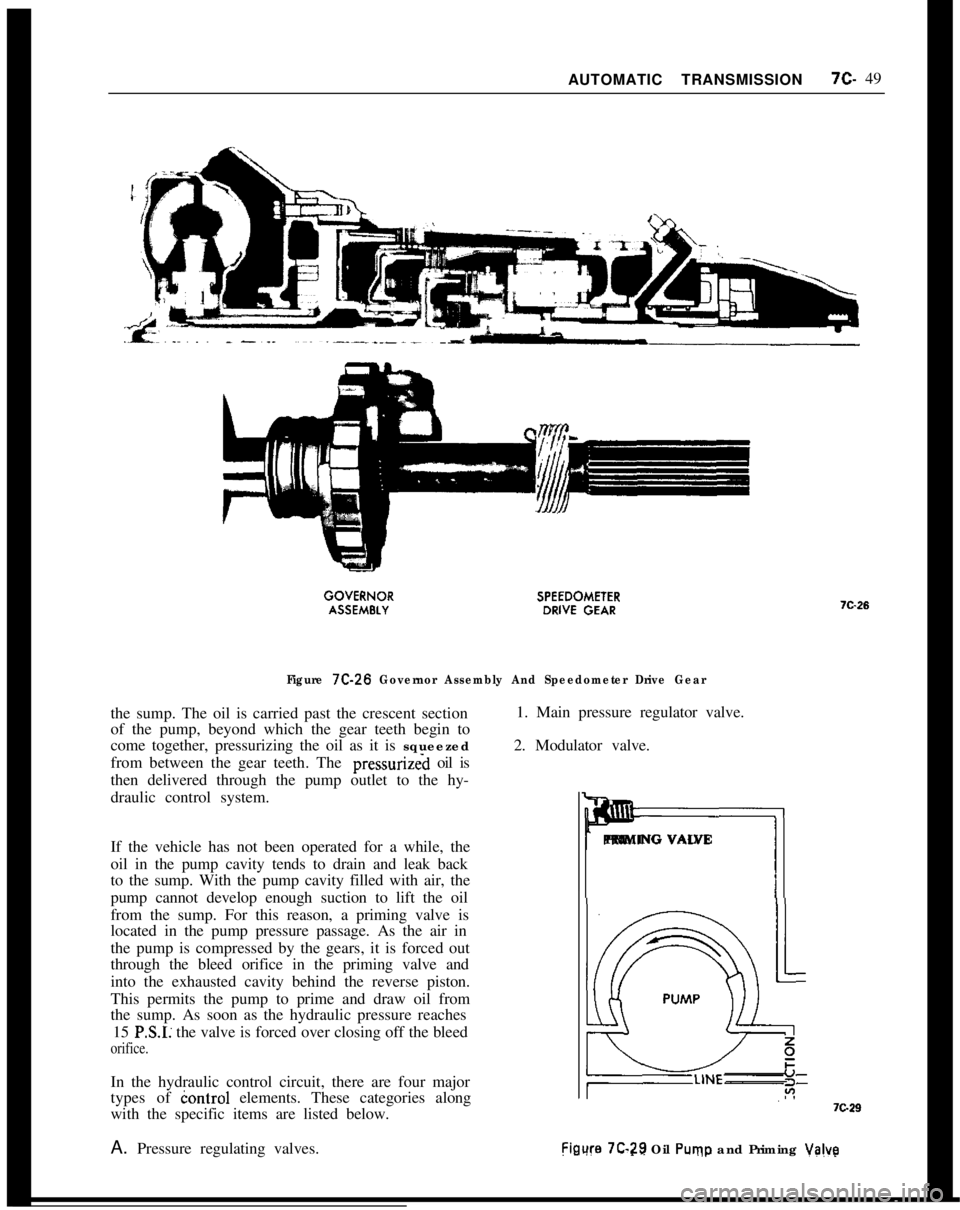
AUTOMATIC TRANSMISSION7c- 49Figure 7C-26 Governor Assembly And Speedometer Drive Gearthe sump. The oil is carried past the crescent section
of the pump, beyond which the gear teeth begin to
come together, pressurizing the oil as it is squeezed
from between the gear teeth. The pressurizeh oil is
then delivered through the pump outlet to the hy-
draulic control system.1. Main pressure regulator valve.
2. Modulator valve.
mPRIMING VALVE
If the vehicle has not been operated for a while, the
oil in the pump cavity tends to drain and leak back
to the sump. With the pump cavity filled with air, the
pump cannot develop enough suction to lift the oil
from the sump. For this reason, a priming valve is
located in the pump pressure passage. As the air in
the pump is compressed by the gears, it is forced out
through the bleed orifice in the priming valve and
into the exhausted cavity behind the reverse piston.
This permits the pump to prime and draw oil from
the sump. As soon as the hydraulic pressure reaches
15
PSI: the valve is forced over closing off the bleed
orifice.PRIMING VALVE
In the hydraulic control circuit, there are four major
types of iontrol elements. These categories along
with the specific items are listed below.
A. Pressure regulating valves.
Fieure 7C-7.9 Oil Puvp and Priming Valve
Page 411 of 625
712.501973 OPEL SERVICE MANUAL
3. Detent pressure regulator valve.
4. 1 - 2 Accumulator valve.
5. Governor.
B. Selector valves (manually and hydraulically con-
trolled).
I. Manual valve.
2. Detent valve.
3. 1
- 2 Shift valve.
4. 2
- 3 Shift valve.
5. 3
- 2 Downshift control valve.
6. Manual low and reverse control valve.
7. Boost control valve.
C. Timing Valves.
1. Low speed downshift timing valve.
2. High speed downshift timing valve.
3. Second clutch orifice valve.
D. Accumulators.
1. 1
- 2 Accumulator.
2. Low servo piston.
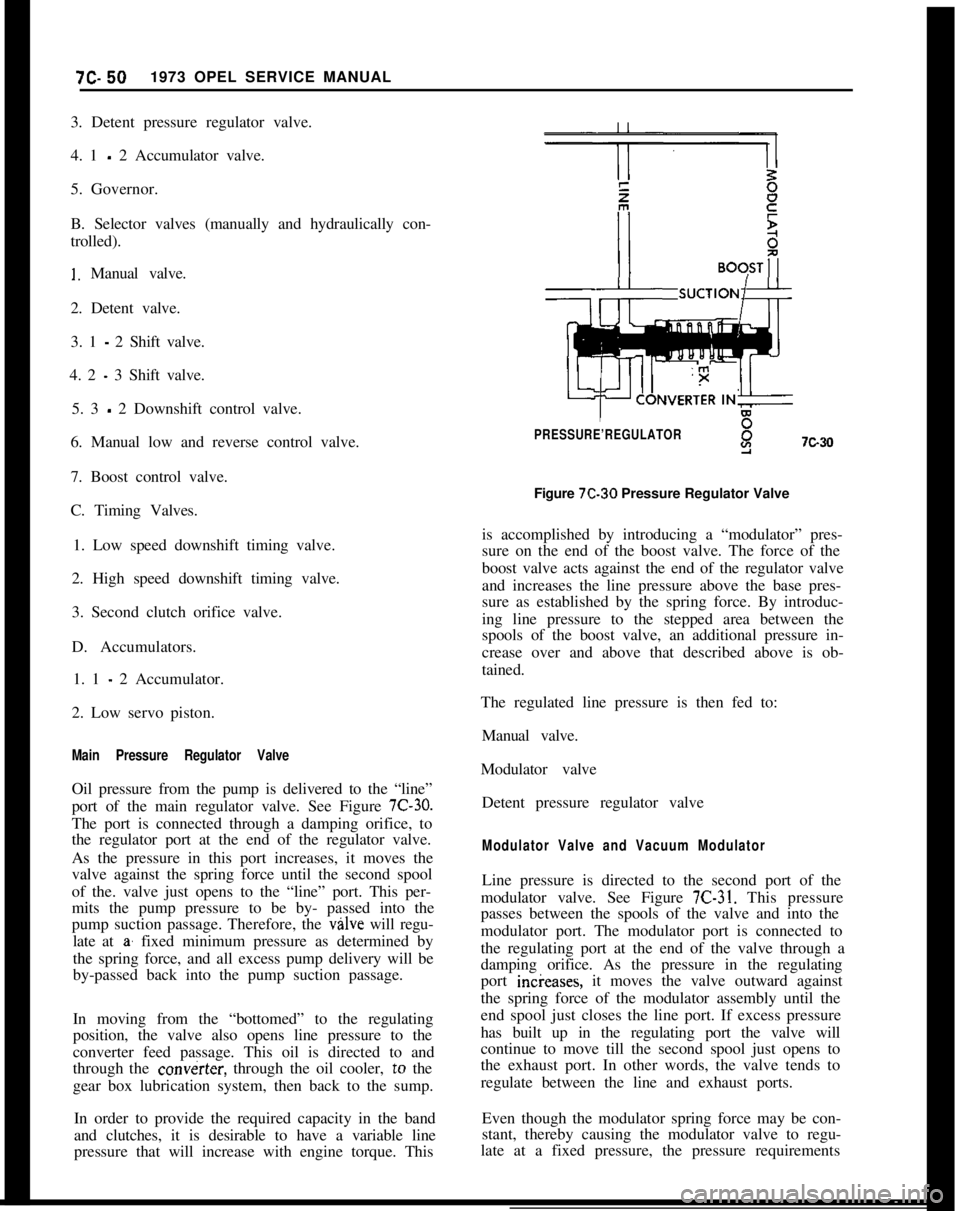
Main Pressure Regulator ValveOil pressure from the pump is delivered to the “line”
port of the main regulator valve. See Figure
7C-30.The port is connected through a damping orifice, to
the regulator port at the end of the regulator valve.
As the pressure in this port increases, it moves the
valve against the spring force until the second spool
of the. valve just opens to the “line” port. This per-
mits the pump pressure to be by- passed into the
pump suction passage. Therefore, the valve will regu-
late at
a’ fixed minimum pressure as determined by
the spring force, and all excess pump delivery will be
by-passed back into the pump suction passage.
In moving from the “bottomed” to the regulating
position, the valve also opens line pressure to the
converter feed passage. This oil is directed to and
through the
cow&x, through the oil cooler, to the
gear box lubrication system, then back to the sump.
In order to provide the required capacity in the band
and clutches, it is desirable to have a variable line
pressure that will increase with engine torque. This
PRESSURE’REGULATORY7c30Figure 7C-30 Pressure Regulator Valve
is accomplished by introducing a “modulator” pres-
sure on the end of the boost valve. The force of the
boost valve acts against the end of the regulator valve
and increases the line pressure above the base pres-
sure as established by the spring force. By introduc-
ing line pressure to the stepped area between the
spools of the boost valve, an additional pressure in-
crease over and above that described above is ob-
tained.
The regulated line pressure is then fed to:
Manual valve.
Modulator valve
Detent pressure regulator valve
Modulator Valve and Vacuum ModulatorLine pressure is directed to the second port of the
modulator valve. See Figure
7C-31. This pressure
passes between the spools of the valve and into the
modulator port. The modulator port is connected to
the regulating port at the end of the valve through a
damping orifice. As the pressure in the regulating
port incieases, it moves the valve outward against
the spring force of the modulator assembly until the
end spool just closes the line port. If excess pressure
has built up in the regulating port the valve will
continue to move till the second spool just opens to
the exhaust port. In other words, the valve tends to
regulate between the line and exhaust ports.
Even though the modulator spring force may be con-
stant, thereby causing the modulator valve to regu-
late at a fixed pressure, the pressure requirements
Page 414 of 625
AUTOMATIC TRANSMISSIONlC- 53
Manual ValveThe manual valve is mechanically connected to the
shift lever. Its function is to direct hydraulic pressure
to the various circuits to establish the base hydraulic
range of the transmission.
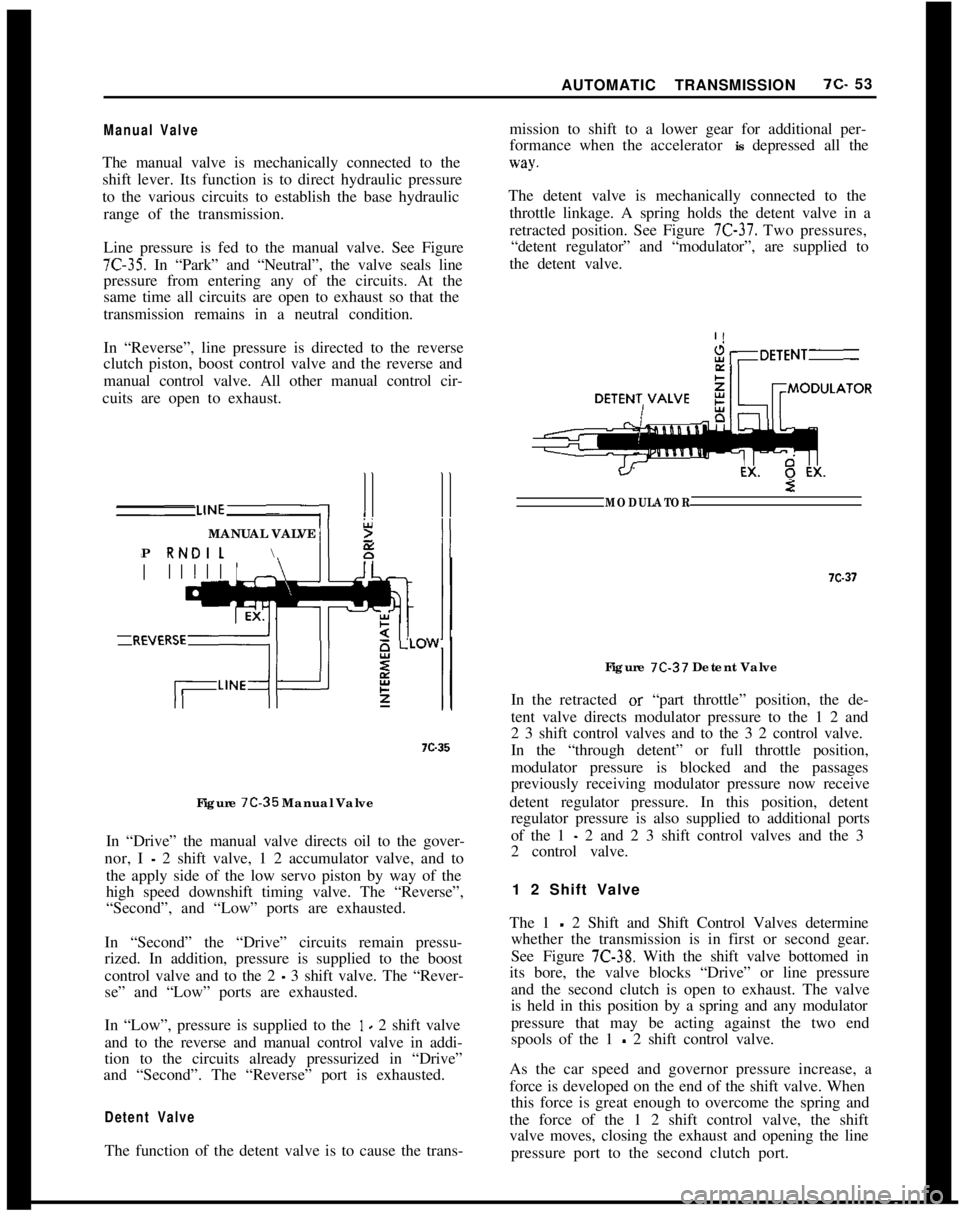
Line pressure is fed to the manual valve. See Figure
7C-35. In “Park” and “Neutral”, the valve seals line
pressure from entering any of the circuits. At the
same time all circuits are open to exhaust so that the
transmission remains in a neutral condition.
In “Reverse”, line pressure is directed to the reverse
clutch piston, boost control valve and the reverse and
manual control valve. All other manual control cir-
cuits are open to exhaust.
MANUAL VALVE
;i
\2
P RNDILII7D35
Figure
7C-35 Manual Valve
In “Drive” the manual valve directs oil to the gover-
nor, I
- 2 shift valve, 1 2 accumulator valve, and to
the apply side of the low servo piston by way of the
high speed downshift timing valve. The “Reverse”,
“Second”, and “Low” ports are exhausted.
In “Second” the “Drive” circuits remain pressu-
rized. In addition, pressure is supplied to the boost
control valve and to the 2
- 3 shift valve. The “Rever-
se” and “Low” ports are exhausted.
In “Low”, pressure is supplied to the
1 - 2 shift valve
and to the reverse and manual control valve in addi-
tion to the circuits already pressurized in “Drive”
and “Second”. The “Reverse” port is exhausted.
Detent ValveThe function of the detent valve is to cause the trans-mission to shift to a lower gear for additional per-
formance when the accelerator is depressed all the
way.The detent valve is mechanically connected to the
throttle linkage. A spring holds the detent valve in a
retracted position. See Figure
7C-37. Two pressures,
“detent regulator” and “modulator”, are supplied to
the detent valve.
iiiDETENTE2
MODULATORFigure
7C-37 Detent Valve
In the retracted or “part throttle” position, the de-
tent valve directs modulator pressure to the 1 2 and
2 3 shift control valves and to the 3 2 control valve.
In the “through detent” or full throttle position,
modulator pressure is blocked and the passages
previously receiving modulator pressure now receive
detent regulator pressure. In this position, detent
regulator pressure is also supplied to additional ports
of the 1
- 2 and 2 3 shift control valves and the 3
2 control valve.
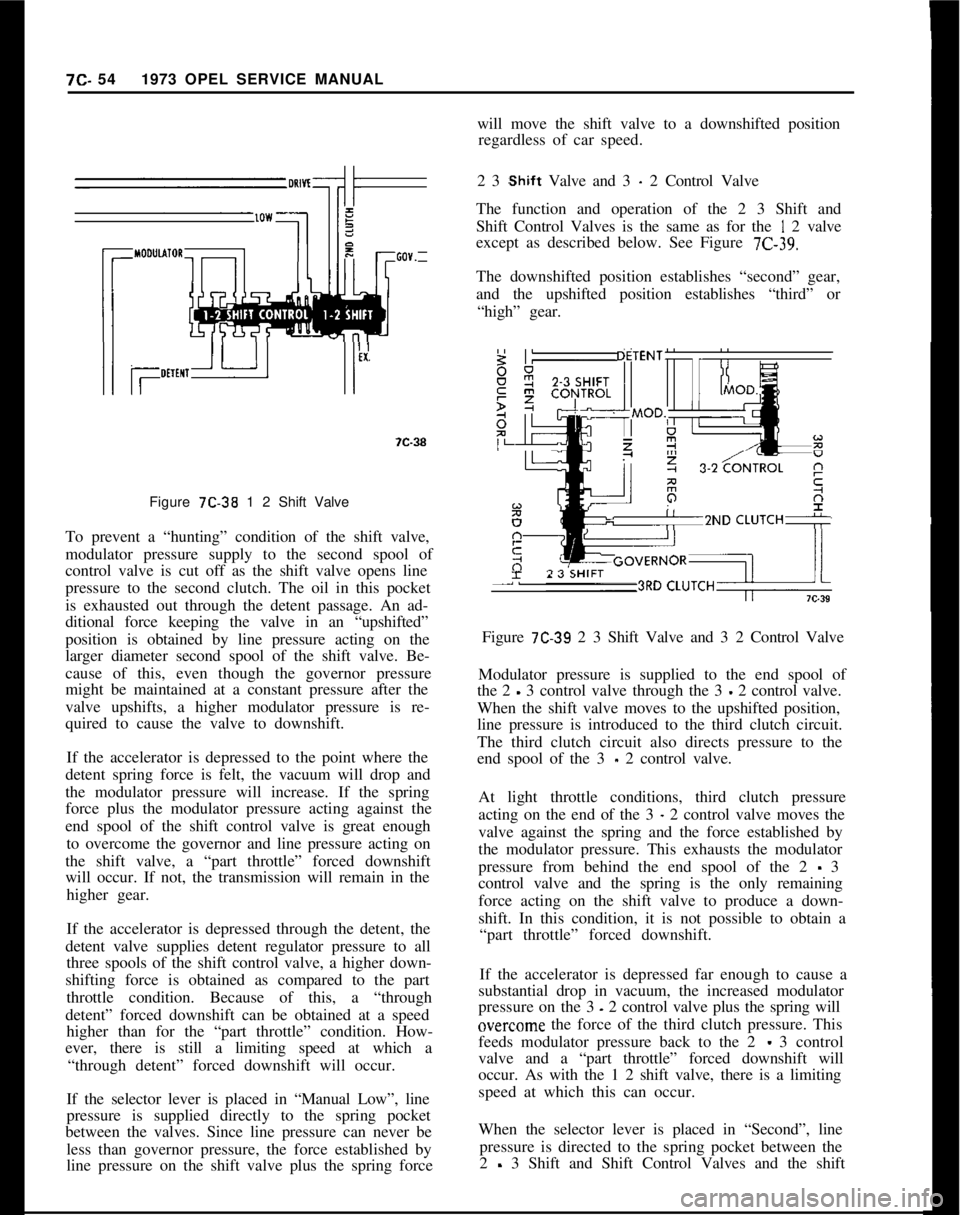
1 2 Shift Valve
The 1
- 2 Shift and Shift Control Valves determine
whether the transmission is in first or second gear.
See Figure
7C-38. With the shift valve bottomed in
its bore, the valve blocks “Drive” or line pressure
and the second clutch is open to exhaust. The valve
is held in this position by a spring and any modulator
pressure that may be acting against the two end
spools of the 1
- 2 shift control valve.
As the car speed and governor pressure increase, a
force is developed on the end of the shift valve. When
this force is great enough to overcome the spring and
the force of the 1 2 shift control valve, the shift
valve moves, closing the exhaust and opening the line
pressure port to the second clutch port.
Page 415 of 625
7C- 541973 OPEL SERVICE MANUAL
Figure 7C-38 1 2 Shift Valve
To prevent a “hunting” condition of the shift valve,
modulator pressure supply to the second spool of
control valve is cut off as the shift valve opens line
pressure to the second clutch. The oil in this pocket
is exhausted out through the detent passage. An ad-
ditional force keeping the valve in an “upshifted”
position is obtained by line pressure acting on the
larger diameter second spool of the shift valve. Be-
cause of this, even though the governor pressure
might be maintained at a constant pressure after the
valve upshifts, a higher modulator pressure is re-
quired to cause the valve to downshift.
If the accelerator is depressed to the point where the
detent spring force is felt, the vacuum will drop and
the modulator pressure will increase. If the spring
force plus the modulator pressure acting against the
end spool of the shift control valve is great enough
to overcome the governor and line pressure acting on
the shift valve, a “part throttle” forced downshift
will occur. If not, the transmission will remain in the
higher gear.
If the accelerator is depressed through the detent, the
detent valve supplies detent regulator pressure to all
three spools of the shift control valve, a higher down-
shifting force is obtained as compared to the part
throttle condition. Because of this, a “through
detent” forced downshift can be obtained at a speed
higher than for the “part throttle” condition. How-
ever, there is still a limiting speed at which a
“through detent” forced downshift will occur.
If the selector lever is placed in “Manual Low”, line
pressure is supplied directly to the spring pocket
between the valves. Since line pressure can never be
less than governor pressure, the force established by
line pressure on the shift valve plus the spring forcewill move the shift valve to a downshifted position
regardless of car speed.
2 3
,Shift Valve and 3 - 2 Control Valve
The function and operation of the 2 3 Shift and
Shift Control Valves is the same as for the
I 2 valve
except as described below. See Figure
7C-39.The downshifted position establishes “second” gear,
and the upshifted position establishes “third” or
“high” gear.
~ZND CLUTCH*
-I.Figure
7C-39 2 3 Shift Valve and 3 2 Control Valve
Modulator pressure is supplied to the end spool of
the 2
- 3 control valve through the 3 - 2 control valve.
When the shift valve moves to the upshifted position,
line pressure is introduced to the third clutch circuit.
The third clutch circuit also directs pressure to the
end spool of the 3
- 2 control valve.
At light throttle conditions, third clutch pressure
acting on the end of the 3
- 2 control valve moves the
valve against the spring and the force established by
the modulator pressure. This exhausts the modulator
pressure from behind the end spool of the 2
- 3
control valve and the spring is the only remaining
force acting on the shift valve to produce a down-
shift. In this condition, it is not possible to obtain a
“part throttle” forced downshift.
If the accelerator is depressed far enough to cause a
substantial drop in vacuum, the increased modulator
pressure on the 3
- 2 control valve plus the spring will
overc,ome the force of the third clutch pressure. This
feeds modulator pressure back to the 2
- 3 control
valve and a “part throttle” forced downshift will
occur. As with the 1 2 shift valve, there is a limiting
speed at which this can occur.
When the selector lever is placed in “Second”, line
pressure is directed to the spring pocket between the
2
- 3 Shift and Shift Control Valves and the shift
Page 416 of 625
AUTOMATIC TRANSMISSION7c- 55
valve will be held in downshifted, or second gear,
condition regardless of car speed.
Manual Low and Reverse Control Valve
As described in the text on “Mechanical Operation”,
the third clutch is applied in manual “Low” and in
“Reverse” to prevent a free wheeling condition. In
“Drive” range third gear, third clutch pressure is
also directed to the release side of the low servo (to
be covered later). This is the pressure which causes
the low band to release during a 2-3 upshift. How-
ever, in manual low, the band must remain applied
even though the third clutch is on.
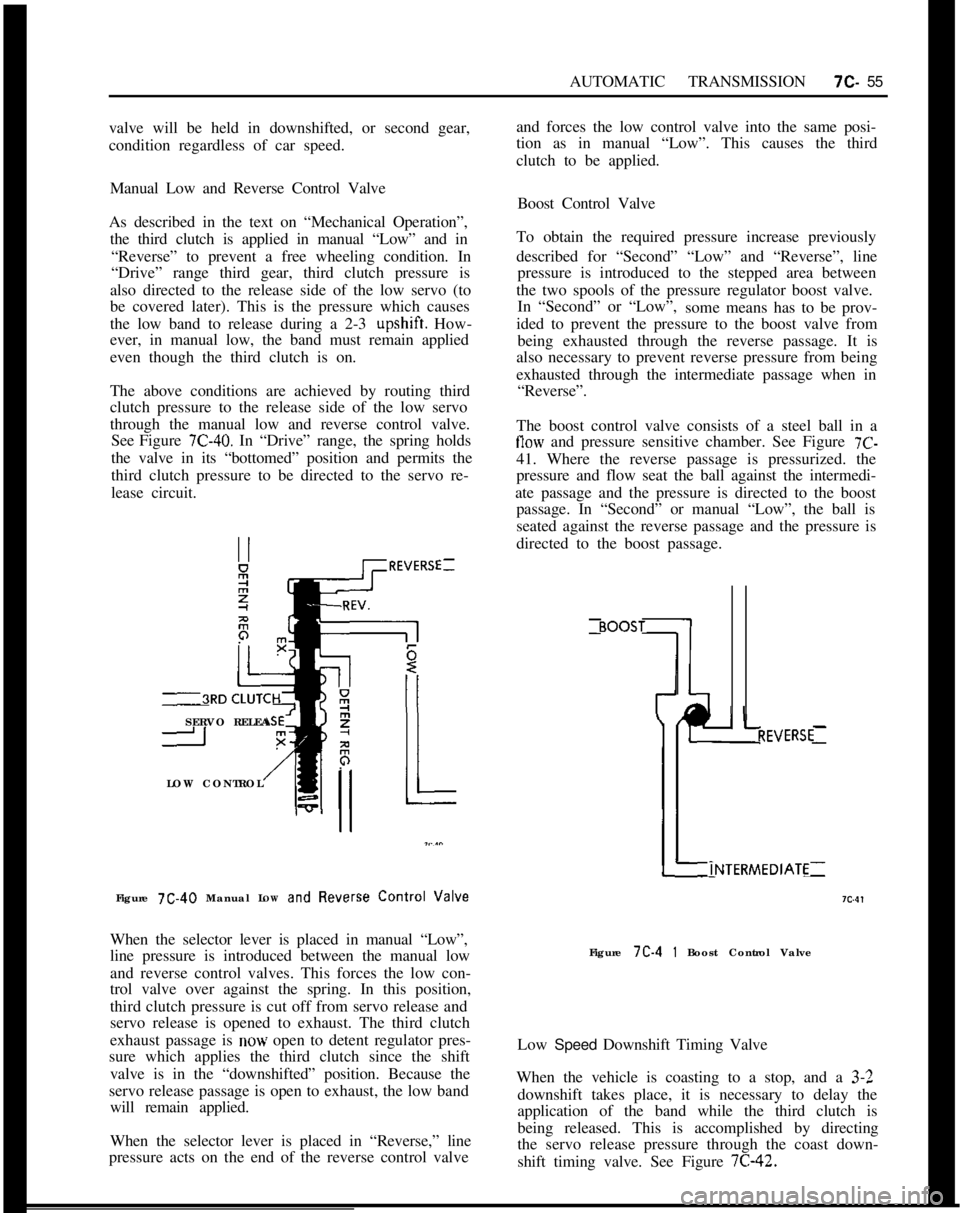
The above conditions are achieved by routing third
clutch pressure to the release side of the low servo
through the manual low and reverse control valve.
See Figure 7C-40. In “Drive” range, the spring holds
the valve in its “bottomed” position and permits the
third clutch pressure to be directed to the servo re-
lease circuit.
_~RDSERVO RELEA
ILOW CONTROL
Figure 7C-40 Manual LOW
and Ftever~e Control Valve
When the selector lever is placed in manual “Low”,
line pressure is introduced between the manual low
and reverse control valves. This forces the low con-
trol valve over against the spring. In this position,
third clutch pressure is cut off from servo release and
servo release is opened to exhaust. The third clutch
exhaust passage is now open to detent regulator pres-
sure which applies the third clutch since the shift
valve is in the “downshifted” position. Because the
servo release passage is open to exhaust, the low band
will remain applied.
When the selector lever is placed in “Reverse,” line
pressure acts on the end of the reverse control valveand forces the low control valve into the same posi-
tion as in manual “Low”. This causes the third
clutch to be applied.
Boost Control Valve
To obtain the required pressure increase previously
described for “Second” “Low” and “Reverse”, line
pressure is introduced to the stepped area between
the two spools of the pressure regulator boost valve.
In “Second” or “Low”,
some means has to be prov-
ided to prevent the pressure to the boost valve from
being exhausted through the reverse passage. It is
also necessary to prevent reverse pressure from being
exhausted through the intermediate passage when in
“Reverse”.
The boost control valve consists of a steel ball in a
flow and pressure sensitive chamber. See Figure 7C-41. Where the reverse passage is pressurized. the
pressure and flow seat the ball against the intermedi-
ate passage and the pressure is directed to the boost
passage. In “Second” or manual “Low”, the ball is
seated against the reverse passage and the pressure is
directed to the boost passage.
t-INTERMEDIATE
7c.4,
I I
REVERSE:Figure 7C-4
1 Boost Control Valve
Low Speed Downshift Timing Valve
When the vehicle is coasting to a stop, and a
3-2downshift takes place, it is necessary to delay the
application of the band while the third clutch is
being released. This is accomplished by directing
the servo release pressure through the coast down-
shift timing valve. See Figure 7C-42.
Page 418 of 625
AUTOMATIC TRANSMISSION7c-57
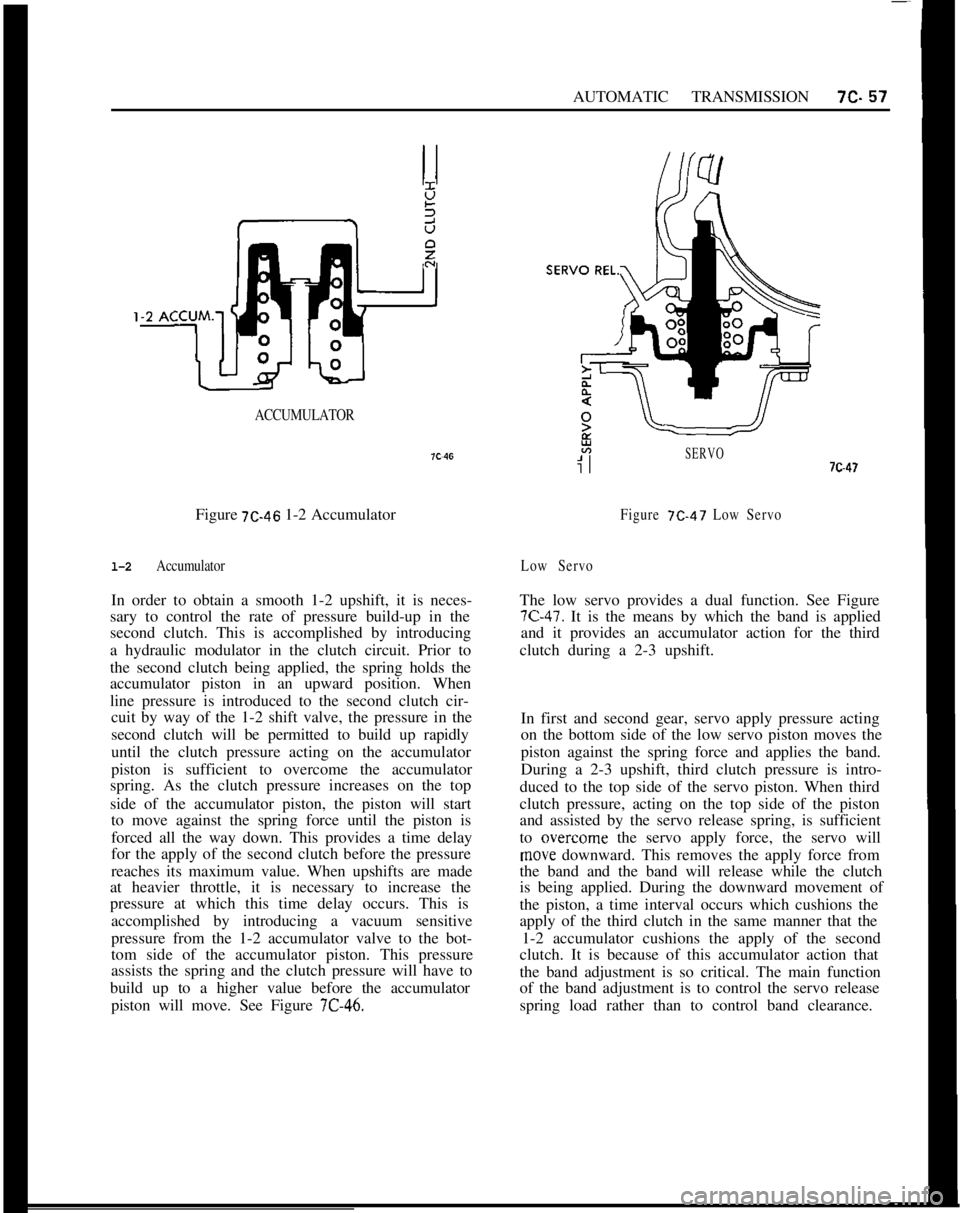
ACCUMULATORFigure
7C-46 1-2 Accumulator
l-2 AccumulatorIn order to obtain a smooth 1-2 upshift, it is neces-
sary to control the rate of pressure build-up in the
second clutch. This is accomplished by introducing
a hydraulic modulator in the clutch circuit. Prior to
the second clutch being applied, the spring holds the
accumulator piston in an upward position. When
line pressure is introduced to the second clutch cir-
cuit by way of the 1-2 shift valve, the pressure in the
second clutch will be permitted to build up rapidly
until the clutch pressure acting on the accumulator
piston is sufficient to overcome the accumulator
spring. As the clutch pressure increases on the top
side of the accumulator piston, the piston will start
to move against the spring force until the piston is
forced all the way down. This provides a time delay
for the apply of the second clutch before the pressure
reaches its maximum value. When upshifts are made
at heavier throttle, it is necessary to increase the
pressure at which this time delay occurs. This is
accomplished by introducing a vacuum sensitive
pressure from the 1-2 accumulator valve to the bot-
tom side of the accumulator piston. This pressure
assists the spring and the clutch pressure will have to
build up to a higher value before the accumulator
piston will move. See Figure
7C-46.
SERVO7c-47
Figure 7C-47 Low Servo
Low ServoThe low servo provides a dual function. See Figure
7C-47. It is the means by which the band is applied
and it provides an accumulator action for the third
clutch during a 2-3 upshift.
In first and second gear, servo apply pressure acting
on the bottom side of the low servo piston moves the
piston against the spring force and applies the band.
During a 2-3 upshift, third clutch pressure is intro-
duced to the top side of the servo piston. When third
clutch pressure, acting on the top side of the piston
and assisted by the servo release spring, is sufficient
to overcome the servo apply force, the servo will
move downward. This removes the apply force from
the band and the band will release while the clutch
is being applied. During the downward movement of
the piston, a time interval occurs which cushions the
apply of the third clutch in the same manner that the
1-2 accumulator cushions the apply of the second
clutch. It is because of this accumulator action that
the band adjustment is so critical. The main function
of the band adjustment is to control the servo release
spring load rather than to control band clearance.
Page 419 of 625
7c. 581973 OPEL SERVICE MANUAL
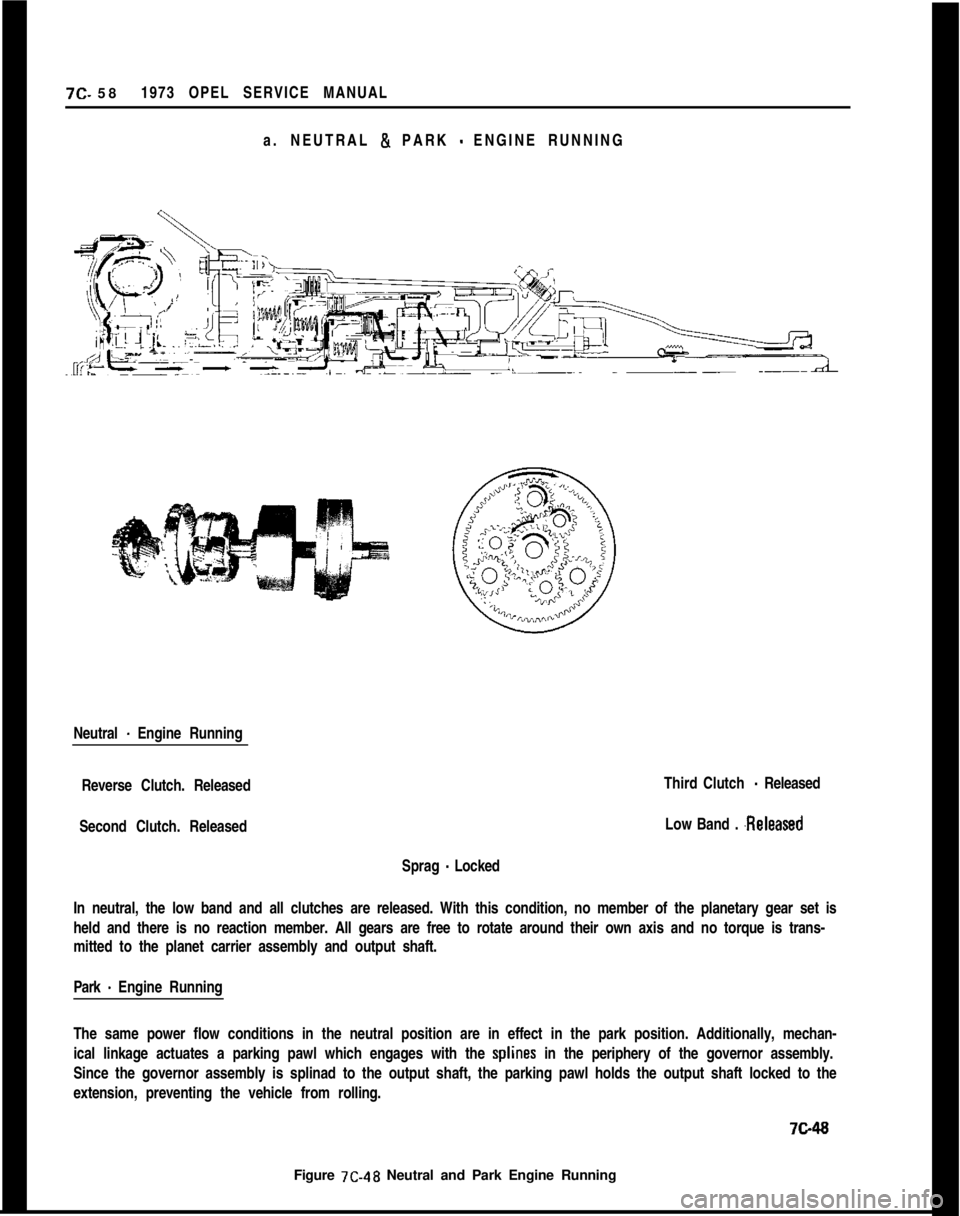
a. NEUTRAL & PARK
- ENGINE RUNNING
Neutral
- Engine Running
Reverse Clutch. Released
Second Clutch. Released
Sprag
- LockedThird Clutch
- Released
Low Band .
.ReleasedIn neutral, the low band and all clutches are released. With this condition, no member of the planetary gear set is
held and there is no reaction member. All gears are free to rotate around their own axis and no torque is trans-
mitted to the planet carrier assembly and output shaft.
Park
- Engine Running
The same power flow conditions in the neutral position are in effect in the park position. Additionally, mechan-
ical linkage actuates a parking pawl which engages with the
splines in the periphery of the governor assembly.
Since the governor assembly is splinad to the output shaft, the parking pawl holds the output shaft locked to the
extension, preventing the vehicle from rolling.7ci48
Figure 7C-48 Neutral and Park Engine Running
Page 420 of 625

AUTOMATIC TRANSMISSION7c- 59
b. DRIVE RANGE . FIRST GEAROrive Range . First Gear
Reverse Clutch Released
Second Clutch. Released
Sprag Locked
In Drive Range. First Gear, the low band is applied and all clutches are released.
Figure 7C-49 Drive Range First GearThird Clutch. Released
Low Band. Applied
The low band holds the reaction sun gear and drum stationary, which serves as the reaction member of the planet-
ary gear set in first gear. The input shaft drives the third clutch drum in a clockwise direction, which turns the
sprag race and retainer assembly clockwise. The sprags wedge and drive the input
sun gear.
The power is then transmitted through the gear set to the output shaft as outlined in “Principles of Operation”.
The ratio in first gear is 2.4O:l.
Low RangeIn Low Range, the third clutch is applied together with the low band. The input power flow is exactly the
Same as
drive range first gear except that the third clutch is engaged and prevents the sprag from overrunning, thus pro-
viding engine braking when coasting in Low Range.
7c49
Page 421 of 625
7C- 601973 OPEL SERVICE MANUAL
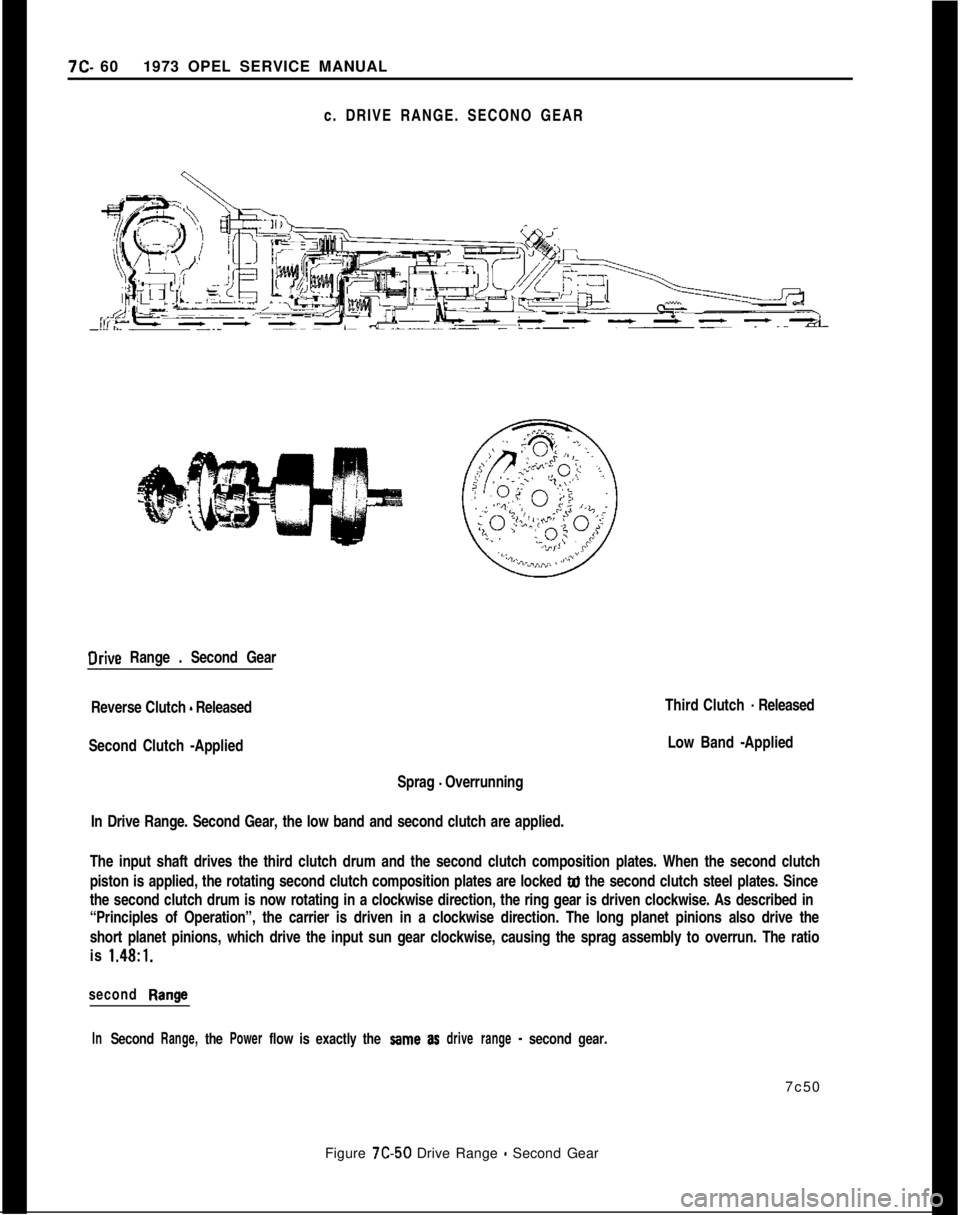
c. DRIVE RANGE. SECONO GEAROrive Range . Second Gear
Reverse Clutch - Released
Second Clutch -Applied
Sprag
- Overrunning
In Drive Range. Second Gear, the low band and second clutch are applied.Third Clutch
- Released
Low Band -Applied
The input shaft drives the third clutch drum and the second clutch composition plates. When the second clutch
piston is applied, the rotating second clutch composition plates are locked
w the second clutch steel plates. Since
the second clutch drum is now rotating in a clockwise direction, the ring gear is driven clockwise. As described in
“Principles of Operation”, the carrier is driven in a clockwise direction. The long planet pinions also drive the
short planet pinions, which drive the input sun gear clockwise, causing the sprag assembly to overrun. The ratio
is 1.48:1.
second Range
In Second Range, the Power flow is exactly the seme as drive range - second gear.7c50
Figure
7C-50 Drive Range - Second Gear