automatic transmission OPEL MANTA 1973 Workshop Manual
[x] Cancel search | Manufacturer: OPEL, Model Year: 1973, Model line: MANTA, Model: OPEL MANTA 1973Pages: 625, PDF Size: 17.22 MB
Page 476 of 625
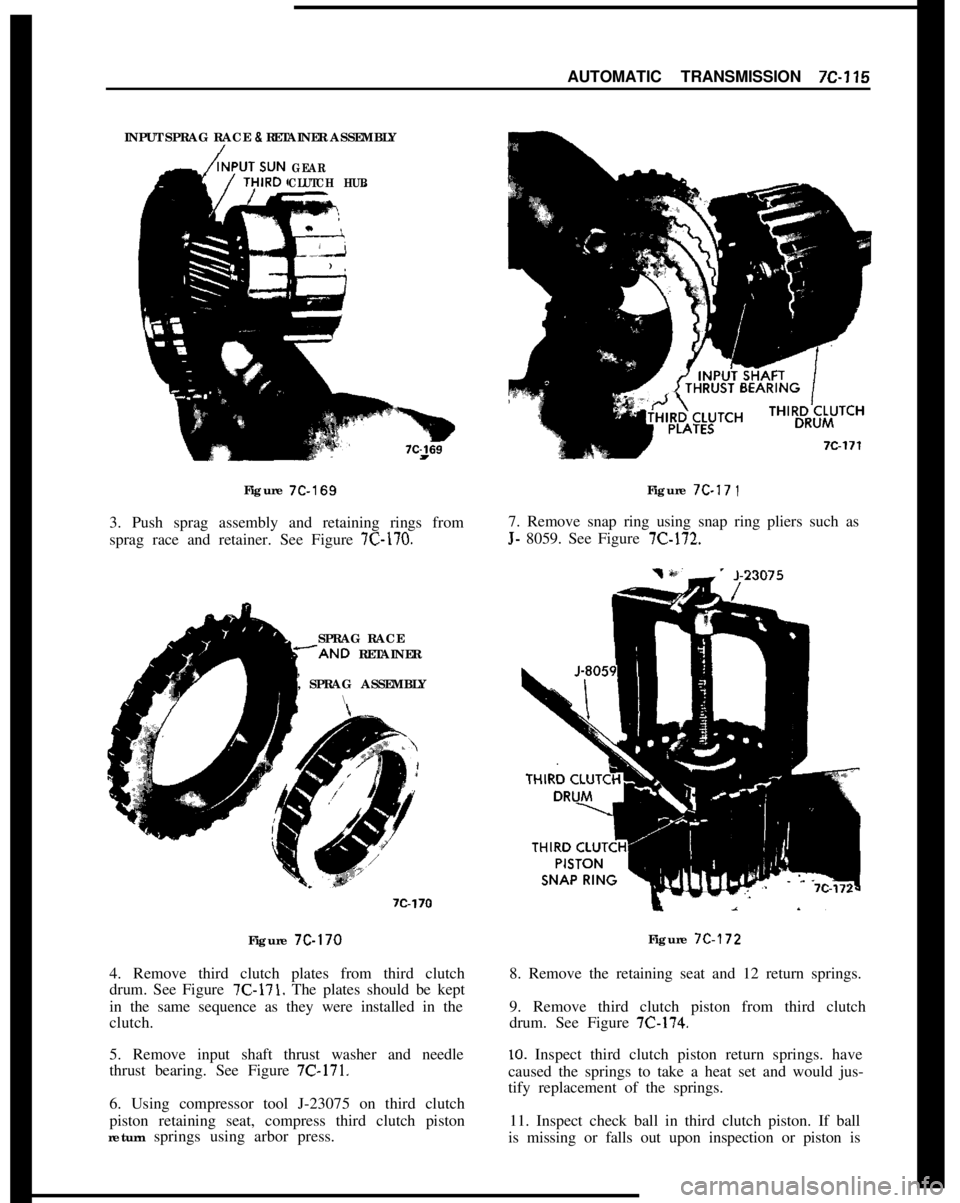
AUTOMATIC TRANSMISSION 7C-115INPUT SPRAG RACE
8 RETAINER ASSEMBLY/
GEAR
CLUTCH HUBFigure
7C-1693. Push sprag assembly and retaining rings from
sprag race and retainer. See Figure
7C-170.Figure
7C.17 I7. Remove snap ring using snap ring pliers such as
J- 8059. See Figure 7C-172.SPRAG RACE
-AND RETAINER
,, SPRAG ASSEMBLY
\Figure
7C-1704. Remove third clutch plates from third clutch
drum. See Figure
7C-171. The plates should be kept
in the same sequence as they were installed in the
clutch.
5. Remove input shaft thrust washer and needle
thrust bearing. See Figure
7C-171.6. Using compressor tool J-23075 on third clutch
piston retaining seat, compress third clutch piston
return springs using arbor press.Figure 7C.172
8. Remove the retaining seat and 12 return springs.
9. Remove third clutch piston from third clutch
drum. See Figure
7C-174.
10. Inspect third clutch piston return springs. have
caused the springs to take a heat set and would jus-
tify replacement of the springs.
11. Inspect check ball in third clutch piston. If ball
is missing or falls out upon inspection or piston is
Page 478 of 625
AUTOMATIC TRANSMISSION 7C-117WIRE CRIMPED
INTO COPPERTUBING
Figure 7C-178
19. Inspect condition of the third clutch composition
and steel plates. Do not diagnose a composition
drive plate by color,A. Dry composition plates with compressed air and
inspect the composition surface for:
1. Pitting and flaking
2. Wear
3. Glazing
4. Cracking
5. Charring
6. Chips or metal particles imbedded in lining
If a composition drive plate exhibits any of the above
conditions, replacement is required.
B. Wipe steel plates dry and check for heat discolora-
tion. If the surface is smooth and an even color smear
is indicated, the plates should be reused. If severe
heat spot discoloration or surface
scutXng is in-
dicated, the plates must be replaced.
20. Install third clutch plates into third clutch drum
beginning with a steel plate, composition plate, steel
plate, composition plate, etc. Use a liberal amount of
transmission fluid.
21. Inspect thrust washer and needle thrust bearing
for damage. Replace if necessary.
22. Install thrust washer and bearing onto input
shaft. Secure with petroleum jelly (unmedicated).23. Inspect sprag assembly for wear, damage orsprags that freely fall out of cage. Inspect input sun
gear for chipped or nicked teeth or abnormal wear.
Replace part if necessary.
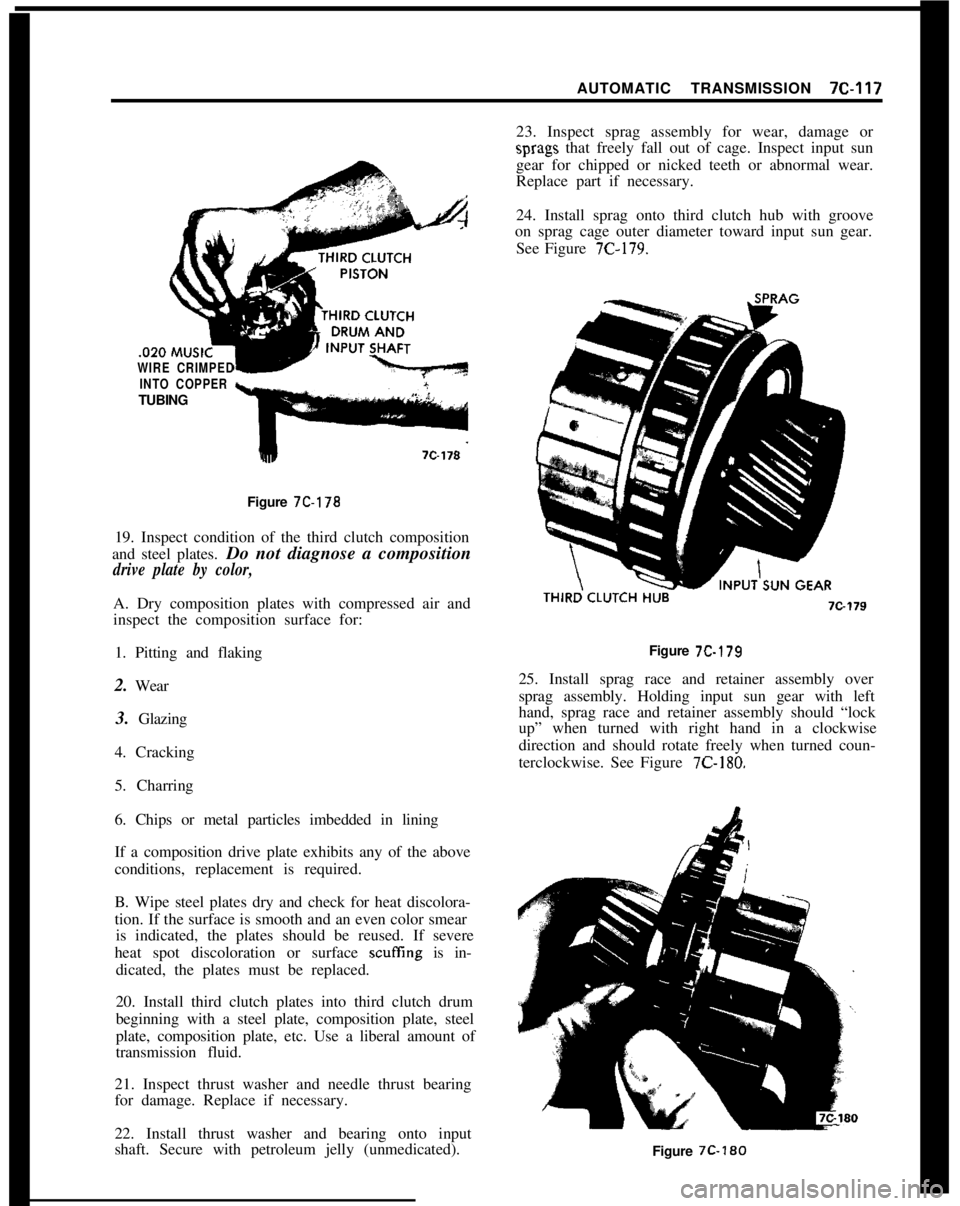
24. Install sprag onto third clutch hub with groove
on sprag cage outer diameter toward input sun gear.
See Figure
7C-179.Figure 7C-179
25. Install sprag race and retainer assembly over
sprag assembly. Holding input sun gear with left
hand, sprag race and retainer assembly should “lock
up” when turned with right hand in a clockwise
direction and should rotate freely when turned coun-
terclockwise. See Figure
7C-180.Figure 7C-180
Page 482 of 625
AUTOMATIC TRANSMISSION 7C-121
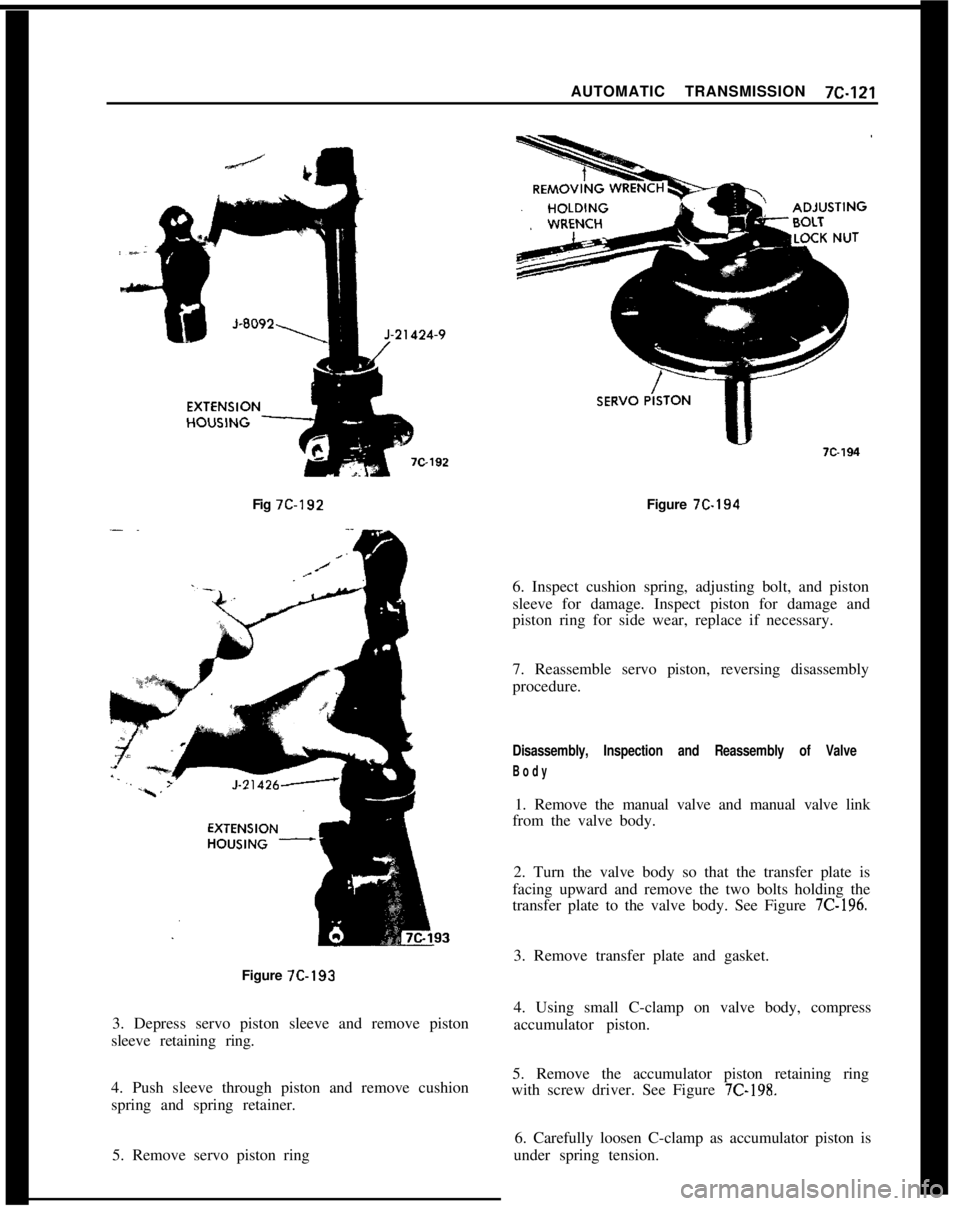
Fig 7C-192Figure 7C-194
6. Inspect cushion spring, adjusting bolt, and piston
sleeve for damage. Inspect piston for damage and
piston ring for side wear, replace if necessary.
7. Reassemble servo piston, reversing disassembly
procedure.Disassembly, Inspection and Reassembly of Valve
Body1. Remove the manual valve and manual valve link
from the valve body.
2. Turn the valve body so that the transfer plate is
facing upward and remove the two bolts holding the
transfer plate to the valve body. See Figure
7C-196.3. Remove transfer plate and gasket.
Figure 7C-193
3. Depress servo piston sleeve and remove piston
sleeve retaining ring.
4. Push sleeve through piston and remove cushion
spring and spring retainer.
5. Remove servo piston ring4. Using small C-clamp on valve body, compress
accumulator piston.
5. Remove the accumulator piston retaining ring
with screw driver. See Figure
7C-198.6. Carefully loosen C-clamp as accumulator piston is
under spring tension.
Page 484 of 625
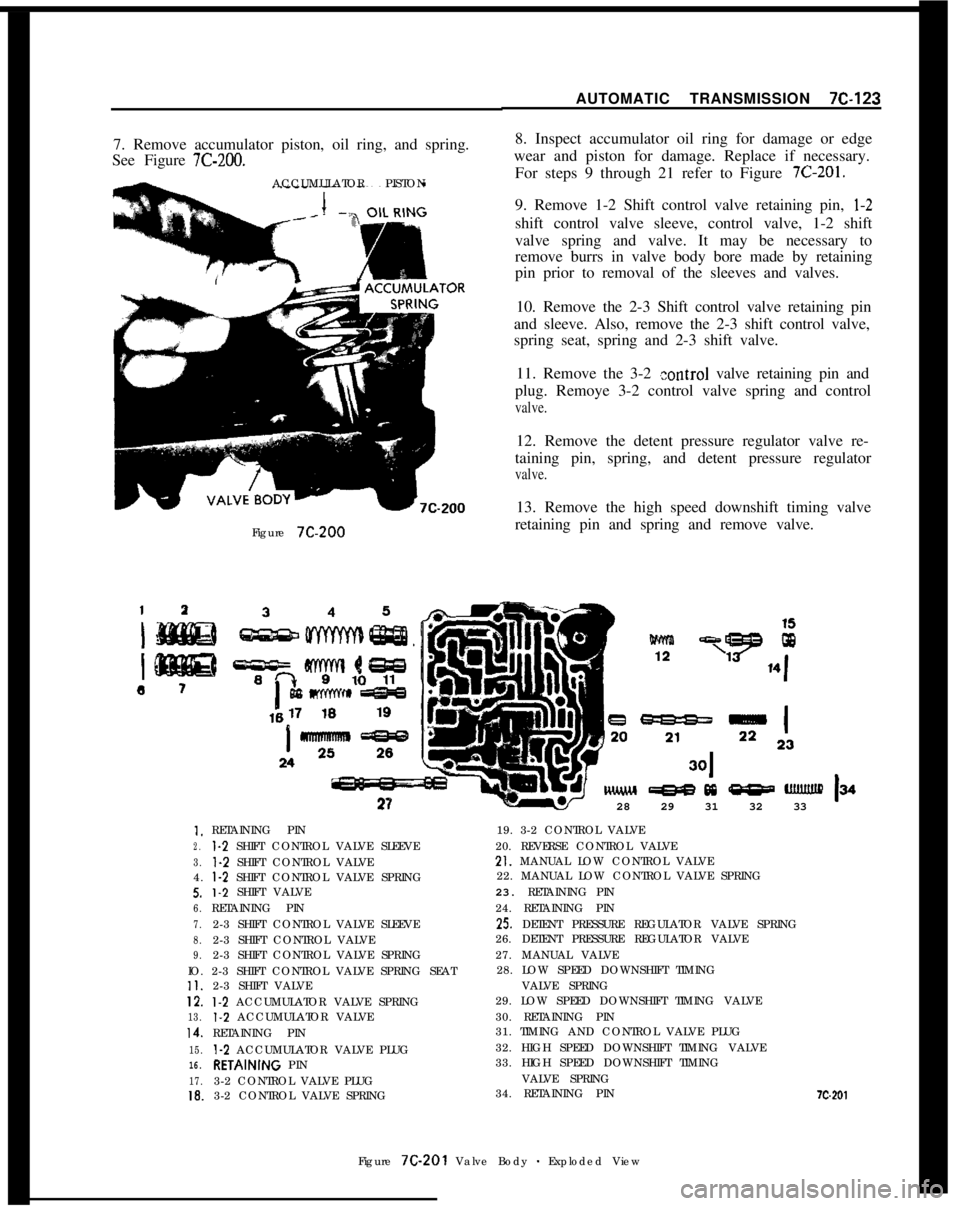
7. Remove accumulator piston, oil ring, and spring.
See Figure 7C-200.ACCUMULATOR PISTON
Figure 7C-200AUTOMATIC TRANSMISSION 7C-123
8. Inspect accumulator oil ring for damage or edge
wear and piston for damage. Replace if necessary.
For steps 9 through 21 refer to Figure 7C-201.9. Remove 1-2 Shift control valve retaining pin, l-2
shift control valve sleeve, control valve, 1-2 shift
valve spring and valve. It may be necessary to
remove burrs in valve body bore made by retaining
pin prior to removal of the sleeves and valves.
10. Remove the 2-3 Shift control valve retaining pin
and sleeve. Also, remove the 2-3 shift control valve,
spring seat, spring and 2-3 shift valve.
11. Remove the 3-2
,control valve retaining pin and
plug. Remoye 3-2 control valve spring and control
valve.12. Remove the detent pressure regulator valve re-
taining pin, spring, and detent pressure regulator
valve.13. Remove the high speed downshift timing valve
retaining pin and spring and remove valve.
1.RETAINING PIN
2.1-2 SHIFT CONTROL VALVE SLEEVE
3.1-2 SHIFT CONTROL VALVE
4. l-2 SHIFT CONTROL VALVE SPRING5.1-2 SHIFT VALVE
6.RETAINING PIN
7.2-3 SHIFT CONTROL VALVE SLEEVE
8.2-3 SHIFT CONTROL VALVE9.2-3 SHIFT CONTROL VALVE SPRING
IO. 2-3 SHIFT CONTROL VALVE SPRING SEAT
11.2-3 SHIFT VALVE
12.1-2 ACCUMULATOR VALVE SPRING13.1-2 ACCUMULATOR VALVE
14.RETAINING PIN
15.1-2 ACCUMULATOR VALVE PLUG16.RETAlNlNG PIN
17.3-2 CONTROL VALVE PLUG18.3-2 CONTROL VALVE SPRING
d 28 29 31 32 33uu44ucBBt?a~~19. 3-2 CONTROL VALVE
20. REVERSE CONTROL VALVE
21. MANUAL LOW CONTROL VALVE
22. MANUAL LOW CONTROL VALVE SPRING
23. RETAINING PIN
24. RETAINING PIN
25. DETENT PRESSURE REGULATOR VALVE SPRING
26. DETENT PRESSURE REGULATOR VALVE
27. MANUAL VALVE
28. LOW SPEED DOWNSHIFT TIMING
VALVE SPRING
29. LOW SPEED DOWNSHIFT TIMING VALVE
30. RETAINING PIN
31. TIMING AND CONTROL VALVE PLUG
32. HIGH SPEED DOWNSHIFT TIMING VALVE
33. HIGH SPEED DOWNSHIFT TIMING
VALVE SPRING
34. RETAINING PIN
7c-201Figure 7C-201 Valve Body
- Exploded View
Page 486 of 625
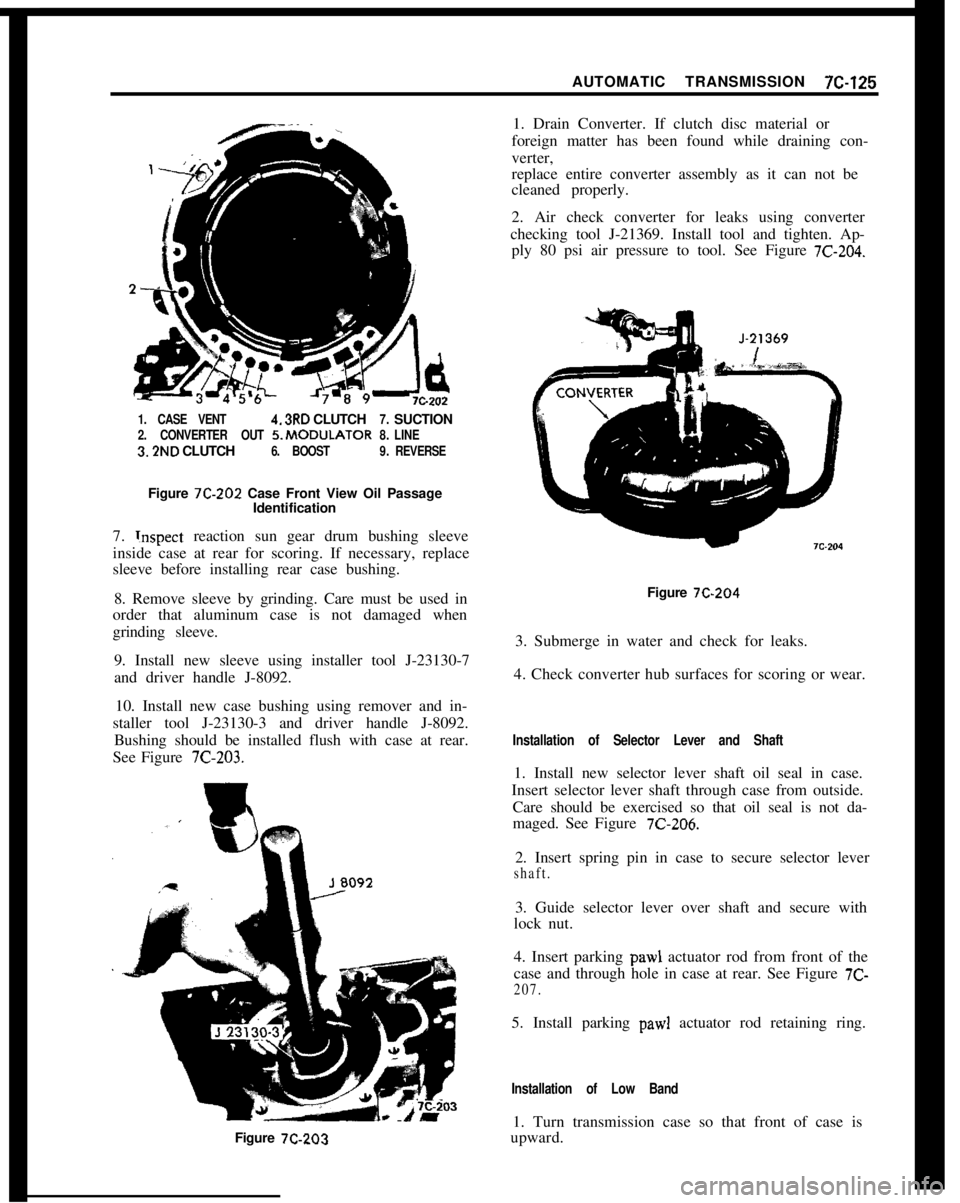
AUTOMATIC TRANSMISSION 7C-1251. CASE VENT4.3RD CLUTCH7.SUCTION
2. CONVERTER OUT5MODULATOR8.LINE/3.2ND CLUTCH
6. BOOST9.REVERSEFigure 7C-202 Case Front View Oil Passage
Identification
7.
!nspect reaction sun gear drum bushing sleeve
inside case at rear for scoring. If necessary, replace
sleeve before installing rear case bushing.
8. Remove sleeve by grinding. Care must be used in
order that aluminum case is not damaged when
grinding sleeve.
9. Install new sleeve using installer tool J-23130-7
and driver handle J-8092.
10. Install new case bushing using remover and in-
staller tool J-23130-3 and driver handle J-8092.
Bushing should be installed flush with case at rear.
See Figure
7C-203.Figure 7C-2031. Drain Converter. If clutch disc material or
foreign matter has been found while draining con-
verter,
replace entire converter assembly as it can not be
cleaned properly.
2. Air check converter for leaks using converter
checking tool J-21369. Install tool and tighten. Ap-
ply 80 psi air pressure to tool. See Figure
7C-204.Figure 7C-204
3. Submerge in water and check for leaks.
4. Check converter hub surfaces for scoring or wear.
Installation of Selector Lever and Shaft1. Install new selector lever shaft oil seal in case.
Insert selector lever shaft through case from outside.
Care should be exercised so that oil seal is not da-
maged. See Figure
7C-206.2. Insert spring pin in case to secure selector lever
shaft.3. Guide selector lever over shaft and secure with
lock nut.
4. Insert parking
paw1 actuator rod from front of the
case and through hole in case at rear. See Figure 7C-
207.5. Install parking
paw1 actuator rod retaining ring.
Installation of Low Band1. Turn transmission case so that front of case is
upward.
Page 488 of 625
AUTOMATIC TRANSMISSION ?C-127
INPUT SHAFT
Figure 7C-208
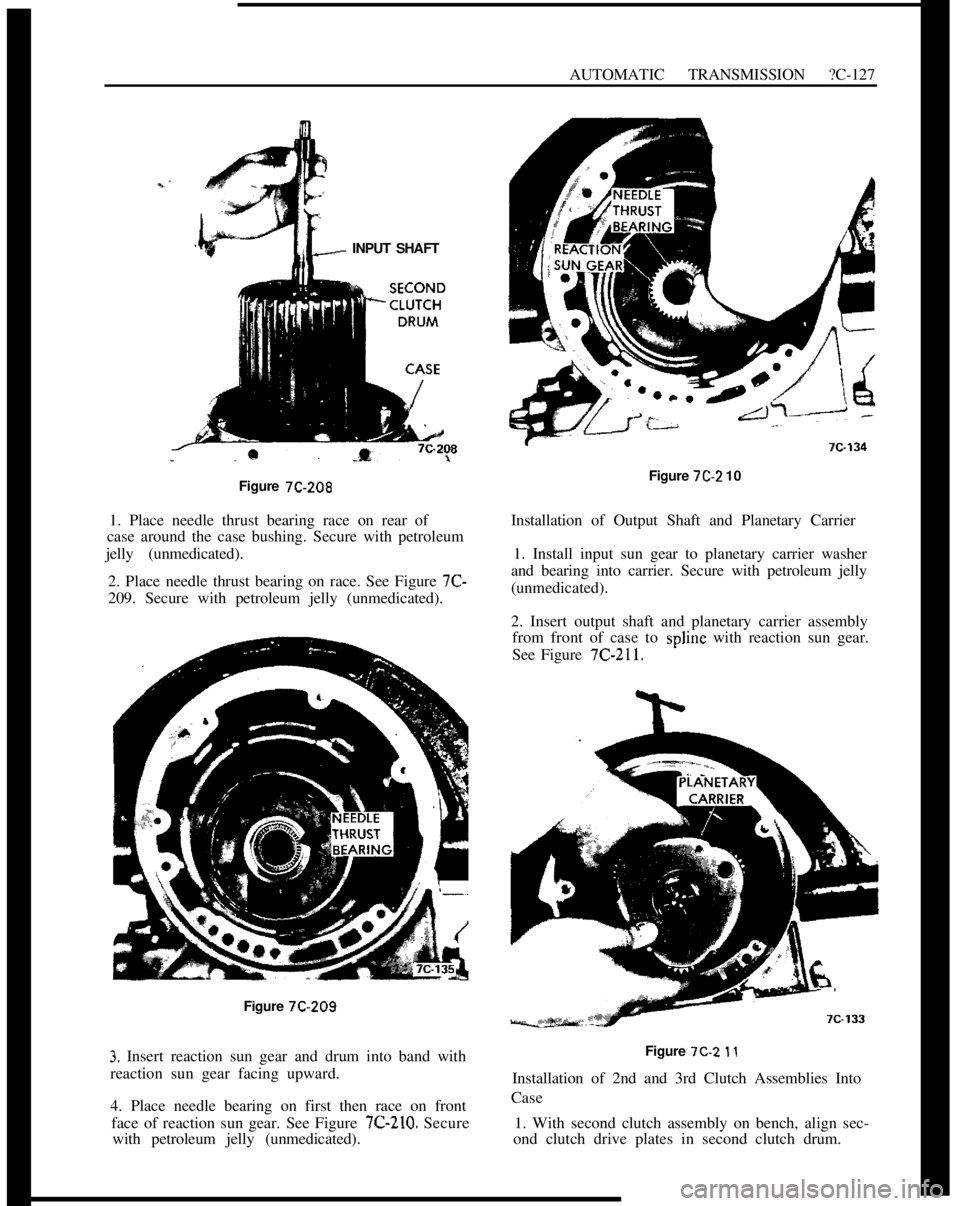
1. Place needle thrust bearing race on rear of
case around the case bushing. Secure with petroleum
jelly (unmedicated).
2. Place needle thrust bearing on race. See Figure 7C-
209. Secure with petroleum jelly (unmedicated).
Figure 7C-2093. Insert reaction sun gear and drum into band with
reaction sun gear facing upward.
4. Place needle bearing on first then race on front
face of reaction sun gear. See Figure
7C-210. Secure
with petroleum jelly (unmedicated).Figure
7C-2 10
Installation of Output Shaft and Planetary Carrier
1. Install input sun gear to planetary carrier washer
and bearing into carrier. Secure with petroleum jelly
(unmedicated).
2. Insert output shaft and planetary carrier assembly
from front of case to spline with reaction sun gear.
See Figure
7C-211.Figure
7C-2 1 1Installation of 2nd and 3rd Clutch Assemblies Into
Case
1. With second clutch assembly on bench, align sec-
ond clutch drive plates in second clutch drum.
Page 490 of 625
AUTOMATIC TRANSMISSION 7C-129
4. Install reverse clutch cushion plate (wave washer)2. Insert guide pin into oil pump for alignment of
into case.converter housing and lower housing onto pump.Determining Selective Washer Size
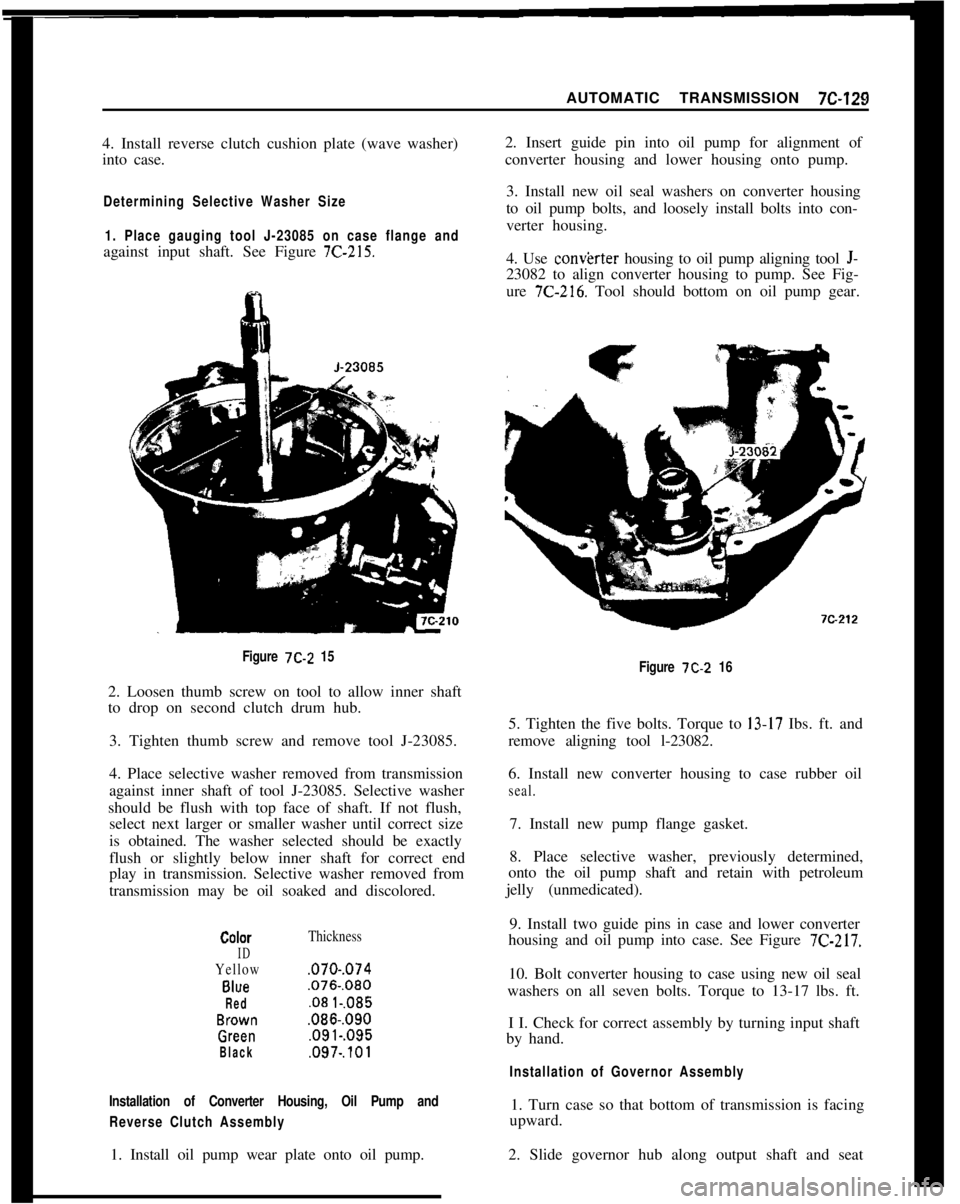
1. Place gauging tool J-23085 on case flange andagainst input shaft. See Figure
7C-215.3. Install new oil seal washers on converter housing
to oil pump bolts, and loosely install bolts into con-
verter housing.
4. Use convkrter housing to oil pump aligning tool J-23082 to align converter housing to pump. See Fig-
ure
7C-216. Tool should bottom on oil pump gear.
Figure 7C-2 152. Loosen thumb screw on tool to allow inner shaft
to drop on second clutch drum hub.
3. Tighten thumb screw and remove tool J-23085.
4. Place selective washer removed from transmission
against inner shaft of tool J-23085. Selective washer
should be flush with top face of shaft. If not flush,
select next larger or smaller washer until correct size
is obtained. The washer selected should be exactly
flush or slightly below inner shaft for correct end
play in transmission. Selective washer removed from
transmission may be oil soaked and discolored.
CObX
ID
Yellow
Blue
Red
BVSNIl
GPX3”
Black
Thickness,070.,074,076.,080
.08 l-.085,086.,090,091.,095
,097.,101
Installation of Converter Housing, Oil Pump and
Reverse Clutch Assembly1. Turn case so that bottom of transmission is facing
upward.
1. Install oil pump wear plate onto oil pump.2. Slide governor hub along output shaft and seat
Figure 7C-2 165. Tighten the five bolts. Torque to
13-17 Ibs. ft. and
remove aligning tool l-23082.
6. Install new converter housing to case rubber oil
seal.7. Install new pump flange gasket.
8. Place selective washer, previously determined,
onto the oil pump shaft and retain with petroleum
jelly (unmedicated).
9. Install two guide pins in case and lower converter
housing and oil pump into case. See Figure
7C-217.10. Bolt converter housing to case using new oil seal
washers on all seven bolts. Torque to 13-17 lbs. ft.
I I. Check for correct assembly by turning input shaft
by hand.
Installation of Governor Assembly
Page 492 of 625
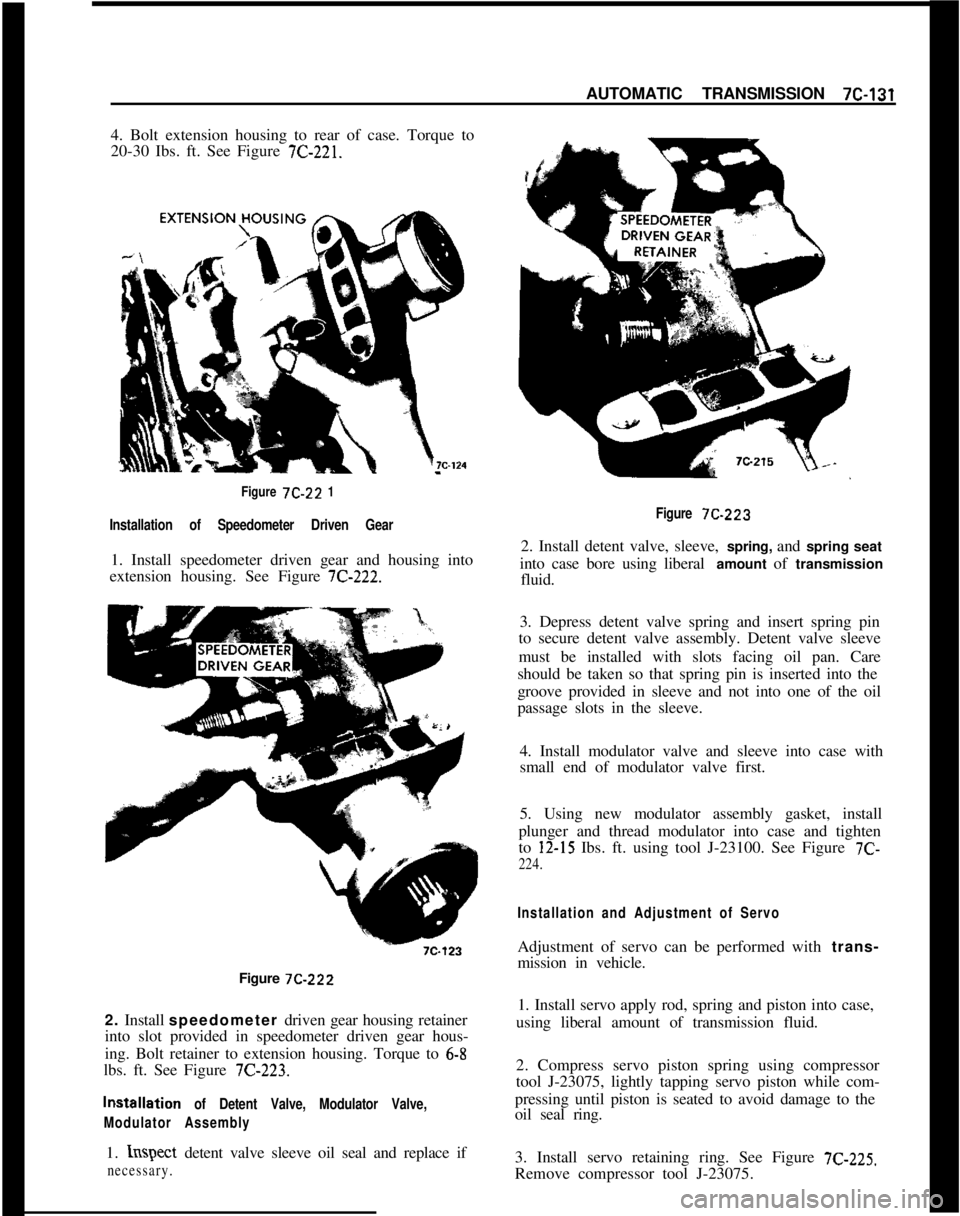
AUTOMATIC TRANSMISSION 7C-1314. Bolt extension housing to rear of case. Torque to
20-30 Ibs. ft. See Figure
7C-221.
Figure 7C-22
1
Installation of Speedometer Driven Gear1. Install speedometer driven gear and housing into
extension housing. See Figure
7C-222.Figure 7C-222
2. Install speedometer driven gear housing retainer
into slot provided in speedometer driven gear hous-
ing. Bolt retainer to extension housing. Torque to
6-Slbs. ft. See Figure
7C-223.
installation of Detent Valve, Modulator Valve,
Modulator Assembly1. inspect detent valve sleeve oil seal and replace if
necessary.Figure 7C-223
2. Install detent valve, sleeve, spring, and spring seat
into case bore using liberal amount of transmission
fluid.
3. Depress detent valve spring and insert spring pin
to secure detent valve assembly. Detent valve sleeve
must be installed with slots facing oil pan. Care
should be taken so that spring pin is inserted into the
groove provided in sleeve and not into one of the oil
passage slots in the sleeve.
4. Install modulator valve and sleeve into case with
small end of modulator valve first.
5. Using new modulator assembly gasket, install
plunger and thread modulator into case and tighten
to
12-15 Ibs. ft. using tool J-23100. See Figure 7C-
224.
Installation and Adjustment of ServoAdjustment of servo can be performed with trans-
mission in vehicle.
1. Install servo apply rod, spring and piston into case,
using liberal amount of transmission fluid.
2. Compress servo piston spring using compressor
tool J-23075, lightly tapping servo piston while com-
pressing until piston is seated to avoid damage to the
oil seal ring.
3. Install servo retaining ring. See Figure
7C-225.Remove compressor tool J-23075.
Page 494 of 625
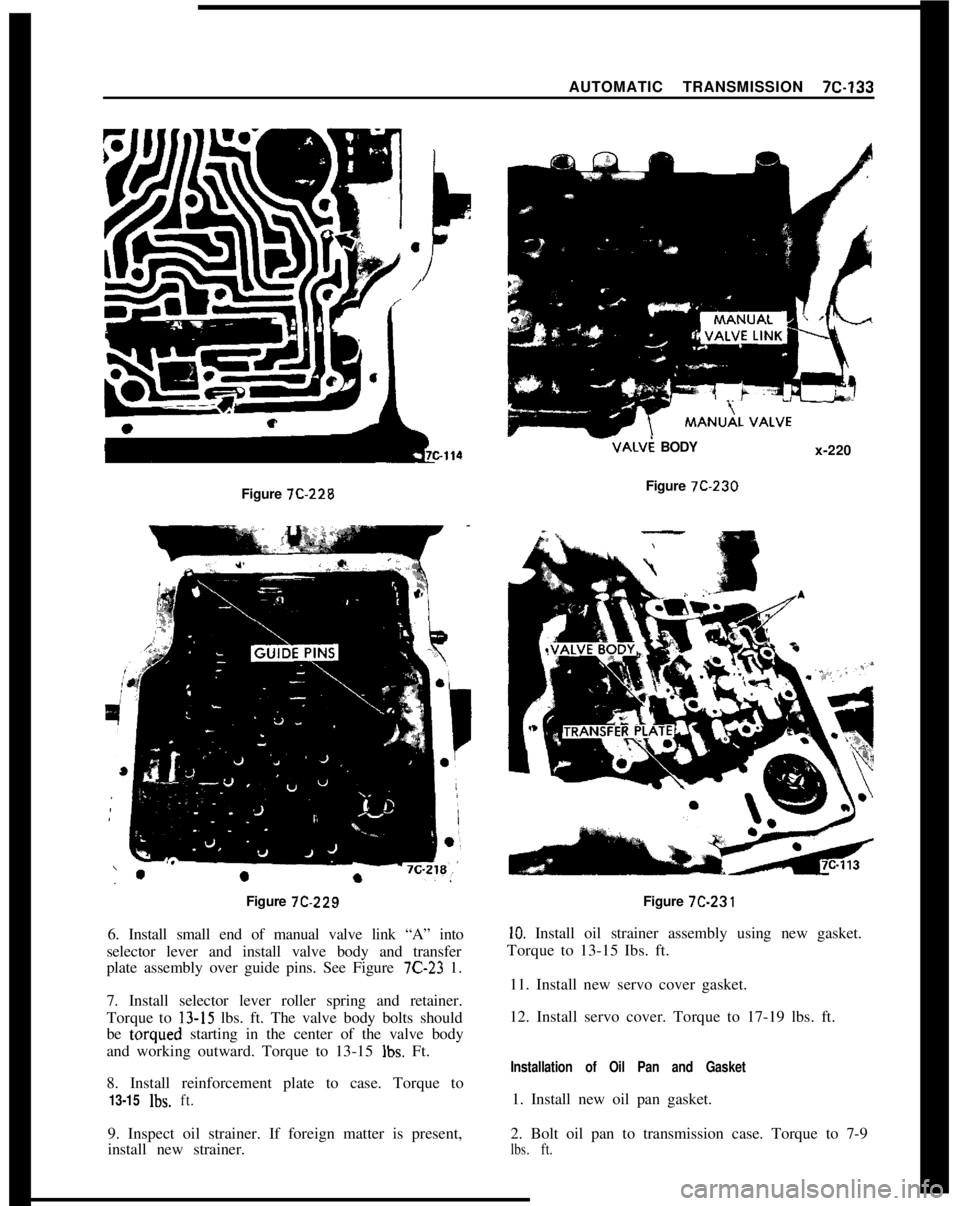
AUTOMATIC TRANSMISSION 7C-1338/Figure 7C-228
Figure 7C-229
6. Install small end of manual valve link “A” into
selector lever and install valve body and transfer
plate assembly over guide pins. See Figure
7C-23 1.
7. Install selector lever roller spring and retainer.
Torque to
13-15 lbs. ft. The valve body bolts should
be torqued starting in the center of the valve body
and working outward. Torque to 13-15
lbs. Ft.
8. Install reinforcement plate to case. Torque to
13-15 lbs. ft.9. Inspect oil strainer. If foreign matter is present,
install new strainer.
-VALV; BODY
x-220
Figure 7C-230
Figure
7C-231
10. Install oil strainer assembly using new gasket.
Torque to 13-15 Ibs. ft.
11. Install new servo cover gasket.
12. Install servo cover. Torque to 17-19 lbs. ft.
Installation of Oil Pan and Gasket1. Install new oil pan gasket.
2. Bolt oil pan to transmission case. Torque to 7-9
lbs. ft.
Page 495 of 625
7C-1341973 OPEL SERVICE MANUAL
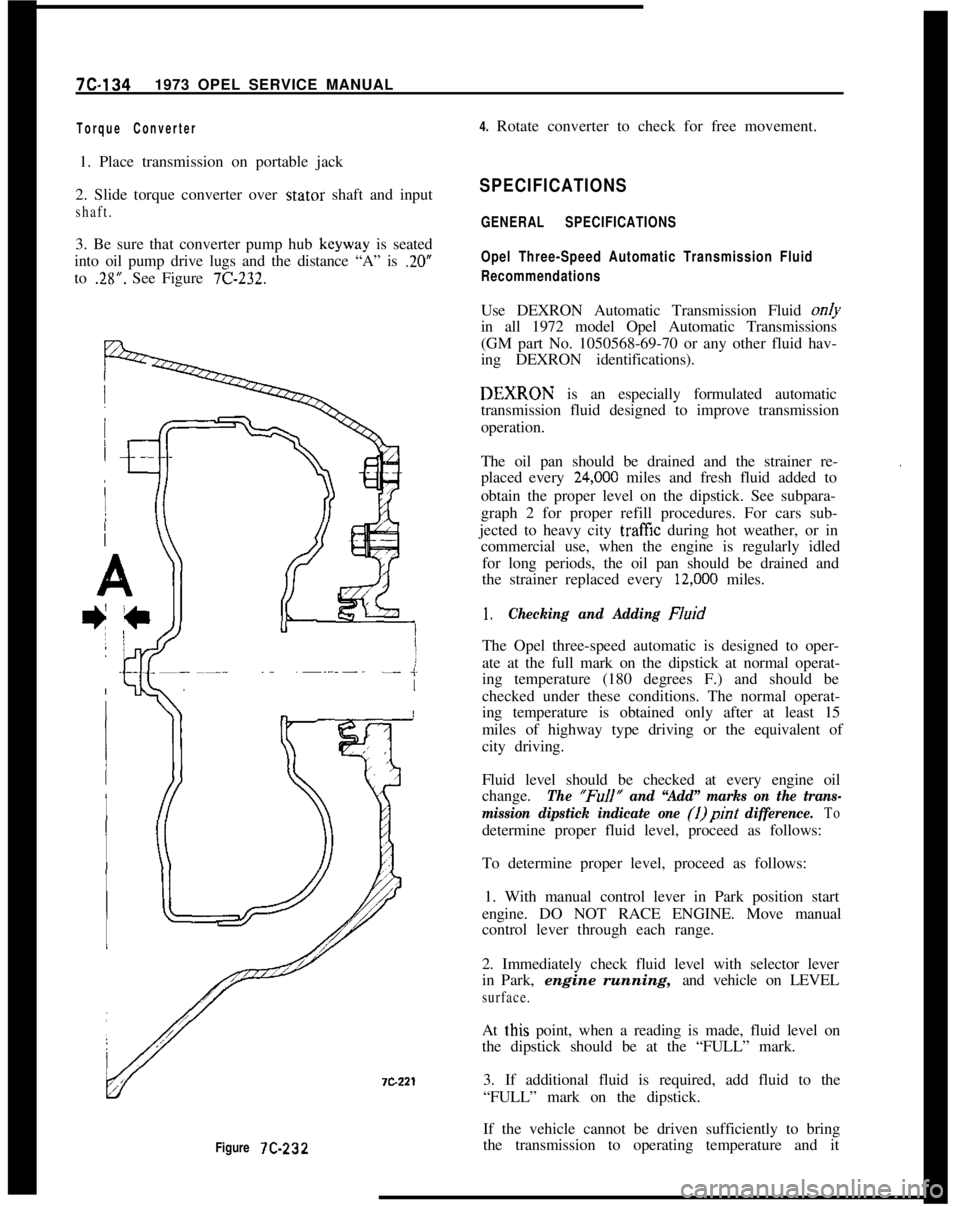
Figure 7C-232
Torque Converter4. Rotate converter to check for free movement.
1. Place transmission on portable jack
2. Slide torque converter over stator shaft and input
shaft.3. Be sure that converter pump hub keyway is seated
into oil pump drive lugs and the distance “A” is
.20”to
.28”. See Figure 7C-232.
SPECIFICATIONS
GENERAL SPECIFICATIONS
Opel Three-Speed Automatic Transmission Fluid
RecommendationsUse DEXRON Automatic Transmission Fluid on/y
in all 1972 model Opel Automatic Transmissions
(GM part No. 1050568-69-70 or any other fluid hav-
ing DEXRON identifications).DEXIRON is an especially formulated automatic
transmission fluid designed to improve transmission
operation.
The oil pan should be drained and the strainer re-
placed every
24,ooO miles and fresh fluid added to
obtain the proper level on the dipstick. See subpara-
graph 2 for proper refill procedures. For cars sub-
jected to heavy city
traff%z during hot weather, or in
commercial use, when the engine is regularly idled
for long periods, the oil pan should be drained and
the strainer replaced every
12,ooO miles.
.
1.Checking and Adding FluidThe Opel three-speed automatic is designed to oper-
ate at the full mark on the dipstick at normal operat-
ing temperature (180 degrees F.) and should be
checked under these conditions. The normal operat-
ing temperature is obtained only after at least 15
miles of highway type driving or the equivalent of
city driving.
Fluid level should be checked at every engine oil
change.
The “FuIl” and “Add” marks on the trans-
mission dipstick indicate one (1)pint
difference. Todetermine proper fluid level, proceed as follows:
To determine proper level, proceed as follows:
1. With manual control lever in Park position start
engine. DO NOT RACE ENGINE. Move manual
control lever through each range.
2. Immediately check fluid level with selector lever
in Park, engine running, and vehicle on LEVEL
surface.At
t,his point, when a reading is made, fluid level on
the dipstick should be at the “FULL” mark.
3. If additional fluid is required, add fluid to the
“FULL” mark on the dipstick.
If the vehicle cannot be driven sufficiently to bring
the transmission to operating temperature and it