ECO mode OPEL MERIVA 2009 User Guide
[x] Cancel search | Manufacturer: OPEL, Model Year: 2009, Model line: MERIVA, Model: OPEL MERIVA 2009Pages: 248, PDF Size: 4.46 MB
Page 141 of 248
135
Driving and operation
Driving hintsThe first 1000 km
Drive your vehicle at various speeds. Do
not use full throttle. Never allow the engine
to labour at low revs.
Drive moderately. In all gears, only depress
the accelerator pedal around
3/4 of the way
down.
Do not drive faster than three quarters of
maximum speed.
Do not brake unnecessarily hard for the
first 200 km.
During the first drive smoke may develop
because of wax and oil evaporating on the
exhaust system. Park the vehicle in the
open for a while after the first drive and
avoid inhaling the fumes.
Fuel and engine oil consumption is higher
than normal during the running-in period.
Never coast with engine not running
Many units will not function in this situation
(e.g. brake servo unit, power steering 3).
Driving in this manner is a danger to
yourself and others. Brake servo unit
When the engine is not running, the brake
servo unit is no longer effective once the
brake pedal has been depressed once or
twice. Braking effect is not reduced, but
significantly greater force is required for
braking.
Electric power steering
3
If the power assisted steering fails when
being towed with the engine switched off,
the vehicle can still be steered, but
considerably more force is required.
Driving in mountainous terrain or with a
trailer/caravan
The cooling fan is elec trically operated. Its
cooling power is therefore independent of
the engine speed.
Since a considerable amount of heat is
generated at high engine speeds and less
at slower speeds, do not shift down when
climbing hills whilst the vehicle is still coping
with the gradient in the higher gear. Driving with a roof load
Do not exceed the permissible roof load
3
226. For reasons of safety, distribute the
load evenly and secure it properly with
retaining straps. Adjust tyre pressure to
load conditions. Do not drive faster
than 120 km/h. Check and retighten the
straps frequently. Observe country-specific
regulations.
Switching off the engine
When you switch off, fans in the engine
compartment may continue running for a
time to cool the engine.
If the engine temperature is very high, e.g.
after driving in mountainous terrain: allow
the engine to idle for approximately two
minutes in order to prevent heat
accumulation.
Vehicles with turbocharged engine
3
After running at high engine speeds or high
engine loads, operate the engine briefly
at a low load or run in neutral for
approx. 30 seconds before switching off in
order to protect the turbocharger.
Page 142 of 248
136 Driving and operationSave energy – more kilometres
Please observe the running-in hints on the
previous page and the tips for energy
saving on the following pages.
Good, technically correct and economical
driving ensures maximum durability and
performance for your vehicle.
Overrun cut-off
The fuel supply is automatically cut off
during overrun, e.g. when the vehicle is
driven with a gear engaged but no throttle
application. Overrun cut-off is deactivated
if catalytic converter temperature is high.
Vehicles with turbocharged engine
3
Flow-generated noises may be audible if
the accelerator is released quickly on
account of air flow in the turbocharger.
Engine speed
Drive in a low engine speed range for each
gear as much as possible. Warming up
Allow the engine to wa
rm up while driving.
Do not warm it up by letting it ru n at idling
speed. Do not apply full throttle until the
engine has reached operating
temperature.
After a cold start, the manual transmission
automated 3 does not switch to higher
gears until the speed increases when it is in
automatic mode. This allows the catalytic
converter to reach th e temperature quickly
which is required for optimum emission
reduction.
Correct gear selection
Do not race your engine whilst in neutral or
with a low gear selected. Driving too fast in
individual gears as well as stop-and-go
traffic increases engine wear and fuel
consumption.
Change down
When decreasing speed, shift down into
the next lowest gear. Do not slip the clutch
with a high-revving engine. This is
especially important when hill climbing. Cooling fan
The cooling fan is controlled via a
thermoswitch and therefore only runs if
necessary.
The cooling fan automatically switches on
when the diesel particle filter is being
cleaned
3 depending on the engine.
Pedals
Do not place any objects in the foot well
which could slip under the pedals and
inhibit the pedal travel.
To ensure the pedal travel is uninhibited,
there must be no mats in the area of the
pedals.
Battery care
When driving slowly or when the vehicle is
stationary, e.g. in slow urban traffic, stop-
and-go traffic or traffic jams, turn off all
unnecessary electrical loads where
possible (e.g. heated rear window, heated
front seats, etc.).
Declutch when starting in order to relieve
the strain on the starter and the battery.
Page 143 of 248
137
Driving and operation
Saving fuel, protecting the
environmentTrend-setting technology
Environmentally friendly and mainly
recyclable materials were used when your
vehicle was being developed and
manufactured. The production methods
used to make your vehicle are also
environmentally-compatible.
Recycling of production wastes keeps the
circulation of material closed. Reduction of
energy and water requirements also helps
to conserve natural resources.
A highly advanced design means that your
vehicle can be easily disassembled at the
end of its working life, and the individual
materials separated for subsequent re-use.
Materials such as asbestos and cadmium
are not used. The refrigerant in the air
conditioning system 3 is CFC-free.
New painting techniques employ water as
a solvent. End-of-life vehicle recovery
Information on end-of-life vehicle recovery
centres and the recycling of end-of-life
vehicles is availabl
e at www.opel.com.
Energy and environment-conscious
driving
z High noise levels and exhaust emissions
are often a result of driving without due
attention to saving energy and
protecting the environment.
z You should therefore drive with energy in
mind: "more miles – less fuel".
Reduce the noise level and exhaust
emissions by adopting an environment-
conscious driving style. This is extremely
worthwhile and improves the quality of
life.
Fuel consumption depends to a great
extent on your own personal driving
style. The following hints are intended to
help you consume fuel at a rate that is as
close as possible to the specified levels
3224.
Check your vehicle’s fuel consumption
every time you refuel. This facilitates
early detection of any irregularities
causing increased fuel consumption. Warming up
z
Full throttle and warming up at idle
speed increase wear, fuel consumption,
exhaust emission, the amount of
pollutant in the exhaust and the amount
of noise.
z Drive off immediately after starting.
Warm up the engine by running it at
moderate engine speeds.
Uniform speed
z Hectic driving significantly increases fuel
consumption, the exhaust emissions, the
proportion of pollutant in the exhaust
gas and the noise level.
z Do not accelerate and brake
unnecessarily. Drive at uniform speed,
watching the road.
Avoid frequent starting off and stopping
e.g. at traffic lights, in short distance
traffic and in queues of traffic by means
of clever planning. Select roads with
good traffic flow.
Idling
z The engine also consumes fuel when
idling.
z If you have to wait for more than one
minute, it is worthwhile switching off the
engine. Five minutes of idling
corresponds to approximately one
kilometre of driving.
Page 154 of 248
148 Driving and operationCruise control 3
Cruise control can store and maintain
speeds of approx. 30 to 200 km/h.
Deviation from the stored speed is possible
on uphill or downhill inclines.
For safety reasons the cruise control
cannot be activated until the foot brake
has been operated once.
The cruise control is operated with the
buttons I, R and O on the turn signal lever.
Do not use the cruise control if it is not
advisable to maintain a constant speed
(e.g. in situations presenting a danger to
yourself and other road users, in heavy
traffic or on winding, slippery or greasy
roads). For manual transmission automated
3,
engage cruise control in automatic mode
only.
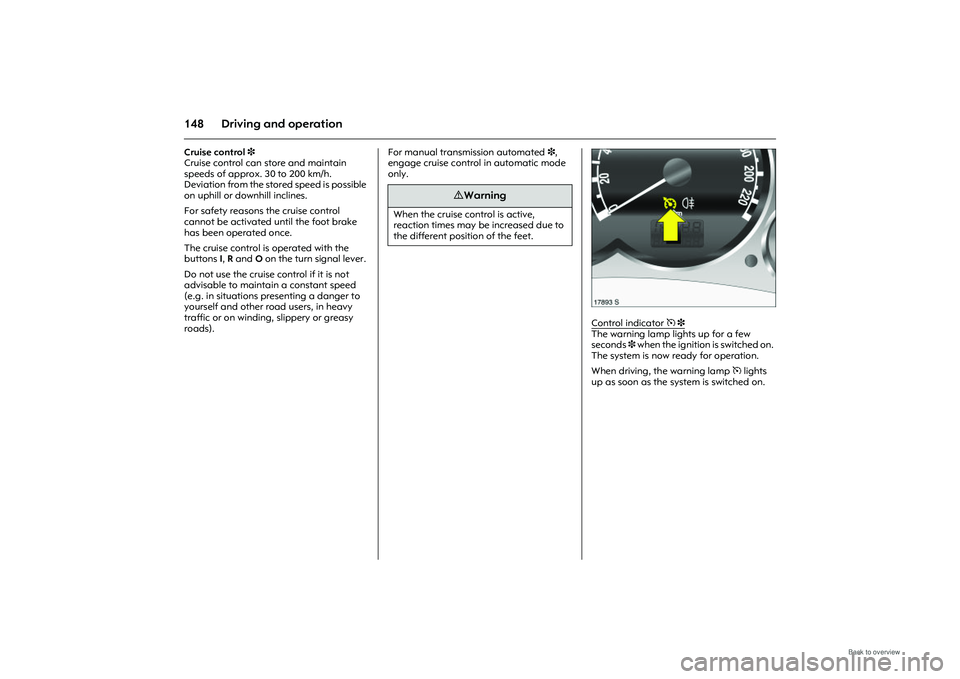
Picture no: 17893s.tif
Control indicator
m 3
The warning lamp lights up for a few
seconds 3 when the ignition is switched on.
The system is now ready for operation.
When driving, th e warning lamp m lights
up as soon as the sy stem is switched on.
9 Warning
When the cruise control is active,
reaction times may be increased due to
the different position of the feet.
Page 230 of 248
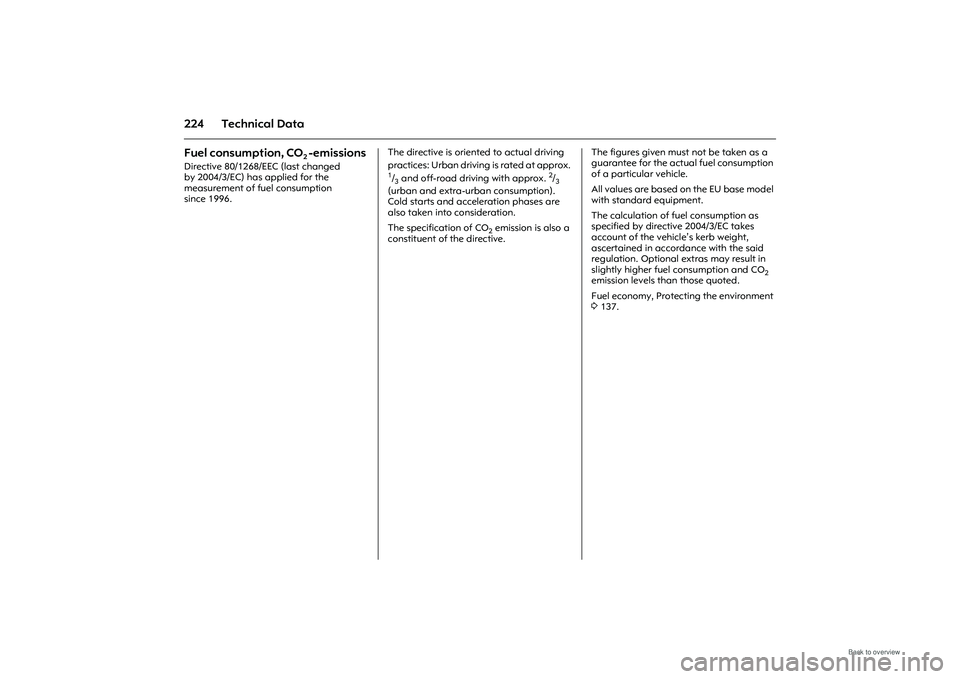
224 Technical DataFuel consumption, CO
2 -emissions
Directive 80/1268/EEC (last changed
by 2004/3/EC) has applied for the
measurement of fuel consumption
since 1996.The directive is oriented to actual driving
practices: Urban driving is rated at approx.
1
/3 and off-road driving with approx.
2/3
(urban and extra-ur ban consumption).
Cold starts and acceleration phases are
also taken into consideration.
The specification of CO
2 emission is also a
constituent of the directive. The figures given must not be taken as a
guarantee for the actual fuel consumption
of a particular vehicle.
All values are based on the EU base model
with standard equipment.
The calculation of fuel consumption as
specified by directive 2004/3/EC takes
account of the vehicle’s kerb weight,
ascertained in accordance with the said
regulation. Optional ex
tras may result in
slightly higher fuel consumption and CO
2
emission levels than those quoted.
Fuel economy, Protec ting the environment
3 137.
Page 234 of 248
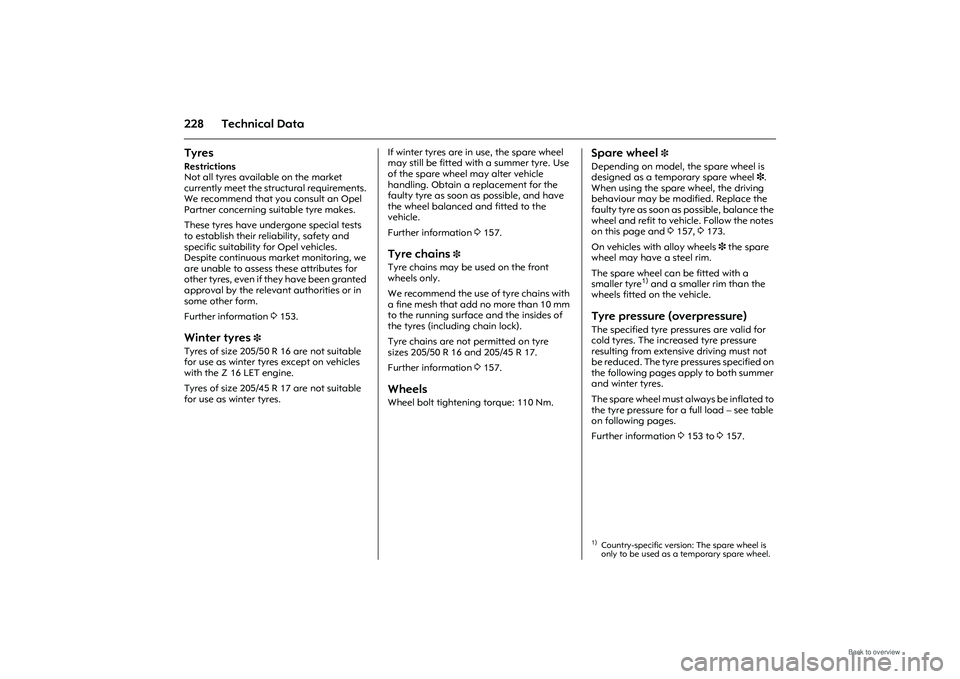
228 Technical DataTyres Restrictions
Not all tyres available on the market
currently meet the structural requirements.
We recommend that you consult an Opel
Partner concerning suitable tyre makes.
These tyres have undergone special tests
to establish their reliability, safety and
specific suitability for Opel vehicles.
Despite continuous market monitoring, we
are unable to assess these attributes for
other tyres, even if they have been granted
approval by the relevant authorities or in
some other form.
Further information 3153. Winter tyres
3
Tyres of size 205/50 R 16 are not suitable
for use as winter tyres except on vehicles
with the Z 16 LET engine.
Tyres of size 205/45 R 17 are not suitable
for use as winter tyres. If winter tyres are in use, the spare wheel
may still be fitted with a summer tyre. Use
of the spare wheel may alter vehicle
handling. Obtain a replacement for the
faulty tyre as soon as possible, and have
the wheel balanced and fitted to the
vehicle.
Further information 3
157.
Tyre chains
3
Tyre chains may be used on the front
wheels only.
We recommend the use of tyre chains with
a fine mesh that add no more than 10 mm
to the running surface and the insides of
the tyres (including chain lock).
Tyre chains are not permitted on tyre
sizes 205/50 R 16 and 205/45 R 17.
Further information 3157. Wheels Wheel bolt tightening torque: 110 Nm.
Spare wheel
3
Depending on model, the spare wheel is
designed as a temporary spare wheel 3.
When using the spare wheel, the driving
behaviour may be modified. Replace the
faulty tyre as soon as possible, balance the
wheel and refit to vehicle. Follow the notes
on this page and 3157, 3173.
On vehicles with alloy wheels 3 the spare
wheel may have a steel rim.
The spare wheel can be fitted with a
smaller tyre
1)and a smaller rim than the
wheels fitted on the vehicle.
Tyre pressure (overpressure) The specified tyre pressures are valid for
cold tyres. The increased tyre pressure
resulting from extensive driving must not
be reduced. The tyre pressures specified on
the following pages apply to both summer
and winter tyres.
The spare wheel must always be inflated to
the tyre pressure for a full load – see table
on following pages.
Further information 3153 to 3157. 1)Country-specific version: The spare wheel is
only to be used as a temporary spare wheel.
Page 241 of 248
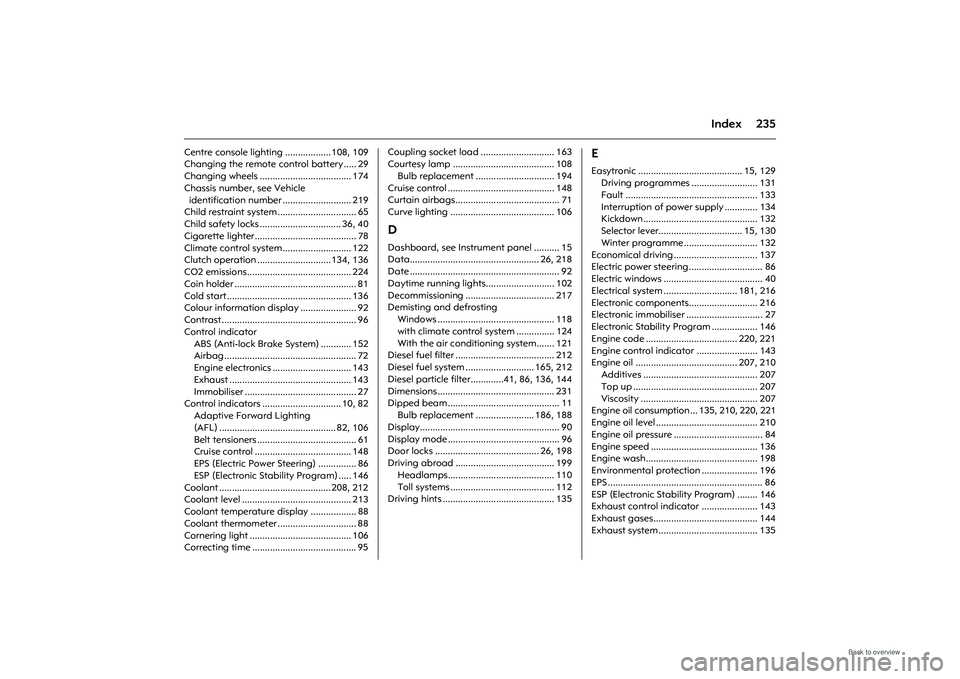
235
Index
Centre console lighting .................. 108, 109
Changing the remote control battery ..... 29
Changing wheels .................................... 174
Chassis number, see Vehicle identification number ........................... 219
Child restraint system ............................... 65
Child safety locks ................................ 36, 40
Cigarette lighter........................................ 78
Climate control system ........................... 122
Clutch operation ............................. 134, 136
CO2 emissions......................................... 224
Coin holder ................................................ 81
Cold start ................................................. 136
Colour information display ...................... 92
Contrast ..................................................... 96
Control indicator ABS (Anti-lock Brake System) ............ 152
Airbag .................................................... 72
Engine electronics ............................... 143
Exhaust ................................................ 143
Immobiliser ............................................ 27
Control indicators ............................... 10, 82 Adaptive Forward Lighting
(AFL) .............................................. 82, 106
Belt tensioners ....................................... 61
Cruise control ...................................... 148
EPS (Electric Power Steering) ............... 86
ESP (Electronic Stability Program) ..... 146
Coolant ............................................ 208, 212
Coolant level ........................................... 213
Coolant temperature display .................. 88
Coolant thermometer ............................... 88
Cornering light ........................................ 106
Correcting time ......................................... 95 Coupling socket load ............................. 163
Courtesy lamp ........................................ 108
Bulb replacement ............................... 194
Cruise control .......................................... 148
Curtain airbags......................................... 71
Curve lighting ......................................... 106
DDashboard, see Instrument panel .......... 15
Data................................................... 26, 218
Date ........................................................... 92
Daytime running lights........................... 102
Decommissioning ................................... 217
Demisting and defrosting Windows .............................................. 118
with climate control system ............... 124
With the air conditioning system....... 121
Diesel fuel filter ....................................... 212
Diesel fuel system ........................... 165, 212
Diesel particle filter.............41, 86, 136, 144
Dimensions .............................................. 231
Dipped beam ............................................ 11 Bulb replacement ....................... 186, 188
Display....................................................... 90
Display mode ............................................ 96
Door locks ......................................... 26, 198
Driving abroad ....................................... 199 Headlamps.......................................... 110
Toll systems ......................................... 112
Driving hints ............................................ 135
EEasytronic ......................................... 15, 129 Driving programmes .......................... 131
Fault .................................................... 133
Interruption of power supply ............. 134
Kickdown............................................. 132
Selector lever................................. 15, 130
Winter programme ............................. 132
Economical driving ................................. 137
Electric power steering ............................. 86
Electric windows ....................................... 40
Electrical system ............................. 181, 216
Electronic components........................... 216
Electronic immobiliser .............................. 27
Electronic Stability Program .................. 146
Engine code .................................... 220, 221
Engine control indicator ........................ 143
Engine oil ........................................ 207, 210 Additives ............................................. 207
Top up ................................................. 207
Viscosity .............................................. 207
Engine oil consumption ... 135, 210, 220, 221
Engine oil level ........................................ 210
Engine oil pressure ................................... 84
Engine speed .......................................... 136
Engine wash............................................ 198
Environmental protection ...................... 196
EPS ............................................................. 86
ESP (Electronic Stability Program) ........ 146
Exhaust control indicator ...................... 143
Exhaust gases......................................... 144
Exhaust system ....................................... 135
Page 245 of 248
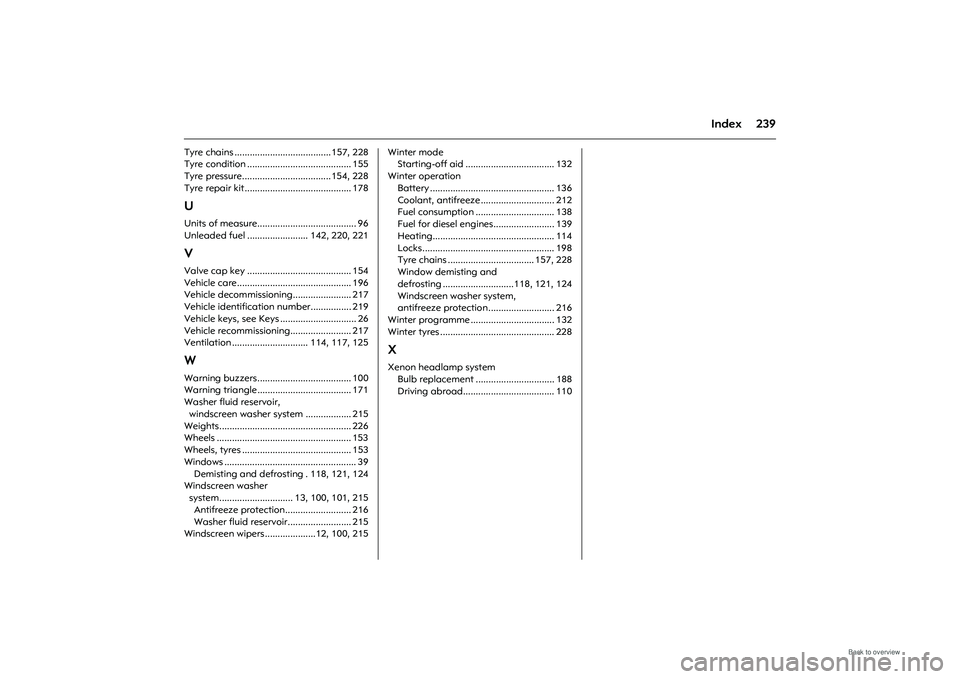
239
Index
Tyre chains ...................................... 157, 228
Tyre condition ......................................... 155
Tyre pressure................................... 154, 228
Tyre repair kit .......................................... 178UUnits of measure....................................... 96
Unleaded fuel ........................ 142, 220, 221VValve cap key ......................................... 154
Vehicle care............................................. 196
Vehicle decommissioning....................... 217
Vehicle identification number................ 219
Vehicle keys, see Keys .............................. 26
Vehicle recommissioning........................ 217
Ventilation .............................. 114, 117, 125WWarning buzzers..................................... 100
Warning triangle ..................................... 171
Washer fluid reservoir, windscreen washer system .................. 215
Weights.................................................... 226
Wheels ..................................................... 153
Wheels, tyres ........................................... 153
Windows .................................................... 39 Demisting and defrosting . 118, 121, 124
Windscreen washer system............................. 13, 100, 101, 215Antifreeze protection.......................... 216
Washer fluid reservoir......................... 215
Windscreen wipers ....................12, 100, 215 Winter mode
Starting-off aid ................................... 132
Winter operation Battery ................................................. 136
Coolant, antifreeze ............................. 212
Fuel consumption ............................... 138
Fuel for diesel engines........................ 139
Heating................................................ 114
Locks .................................................... 198
Tyre chains .................................. 157, 228
Window demisting and
defrosting ............................118, 121, 124
Windscreen washer system,
antifreeze protection .......................... 216
Winter programme ................................. 132
Winter tyres ............................................. 228
XXenon headlamp system Bulb replacement ............................... 188
Driving abroad.................................... 110