ESP OPEL MERIVA 2009 User Guide
[x] Cancel search | Manufacturer: OPEL, Model Year: 2009, Model line: MERIVA, Model: OPEL MERIVA 2009Pages: 248, PDF Size: 4.46 MB
Page 131 of 248
125
Climate control
Picture no: 16503s.tif
Activating and deactivating air
conditioning compressor
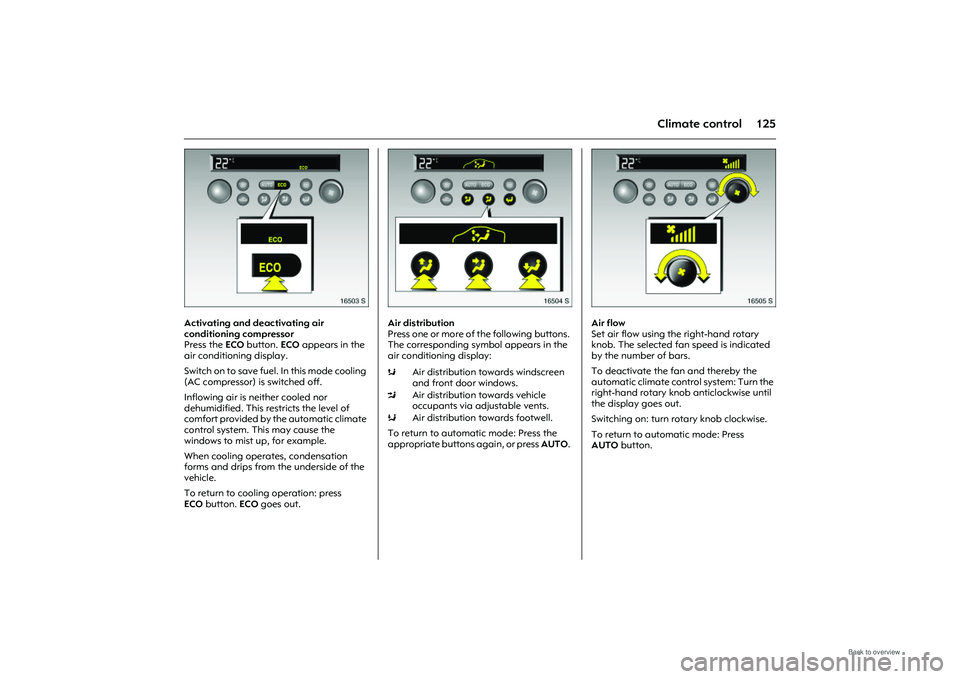
Press the ECO button. ECO appears in the
air conditioning display.
Switch on to sa ve fuel. In this m ode cooling
(AC compressor) is switched off.
Inflowing air is neither cooled nor
dehumidified. This restricts the level of
comfort provided by the automatic climate
control system. This may cause the
windows to mist up, for example.
When cooling operates, condensation
forms and drips from the underside of the
vehicle.
To return to cooling operation: press
ECO button. ECO goes out.
Picture no: 16504s.tif
Air distribution
Press one or more of the following buttons.
The corresponding symbol appears in the
air conditioning display:
To return to automatic mode: Press the
appropriate buttons again, or press AUTO.
Picture no: 16505s.tif
Air flow
Set air flow using the right-hand rotary
knob. The selected fan speed is indicated
by the number of bars.
To deactivate the fan and thereby the
automatic climate control system: Turn the
right-hand rotary knob anticlockwise until
the display goes out.
Switching on: turn rota ry knob clockwise.
To return to automatic mode: Press
AUTO button.
sAir distribution towards windscreen
and front door windows.
M Air distribution towards vehicle
occupants via adjustable vents.
K Air distribution towards footwell.
Page 136 of 248
130 Driving and operation
Picture no: 18386s.tif
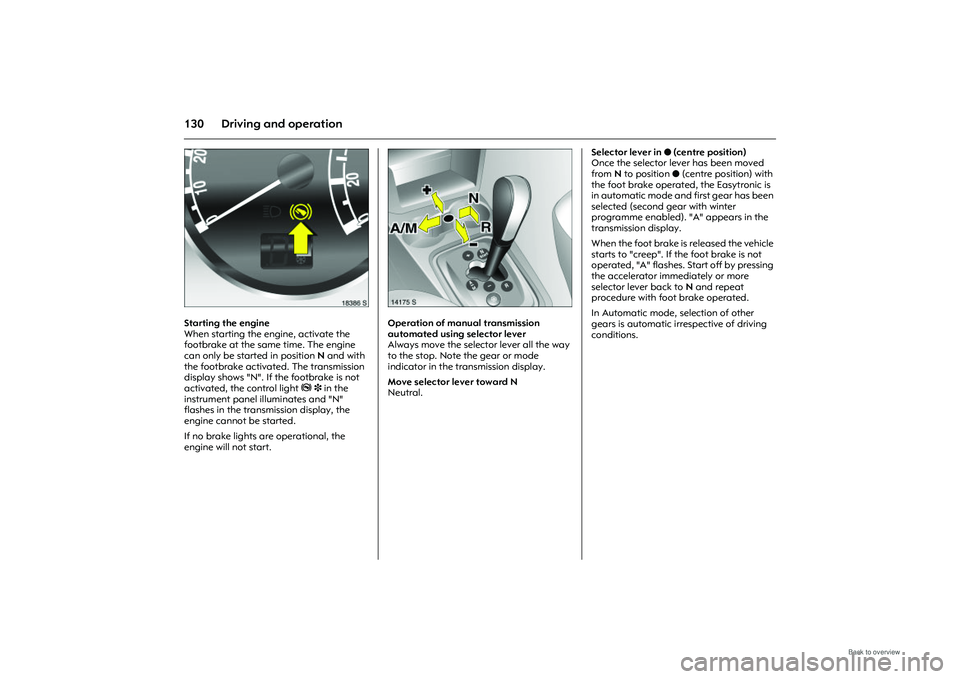
Starting the engine
When starting the engine, activate the
footbrake at the same time. The engine
can only be started in position N and with
the footbrake activated. The transmission
display shows "N". If the footbrake is not
activated, the control light j 3 in the
instrument panel illuminates and "N"
flashes in the transmission display, the
engine cannot be started.
If no brake lights are operational, the
engine will not start.
Picture no: 14175s.tif
Operation of manual transmission
automated using selector lever
Always move the selector lever all the way
to the stop. Note the gear or mode
indicator in the transmission display.
Move selector lever toward N
Neutral. Selector lever in
o (centre position)
Once the selector lever has been moved
from N to position o (centre position) with
the foot brake operated, the Easytronic is
in automatic mode and first gear has been
selected (second gear with winter
programme enabled). "A" appears in the
transmission display.
When the foot brake is released the vehicle
starts to "creep". If the foot brake is not
operated, "A" flashes. Start off by pressing
the accelerator immediately or more
selector lever back to N and repeat
procedure with foot brake operated.
In Automatic mode, selection of other
gears is automatic irrespective of driving
conditions.
Page 139 of 248
133
Driving and operation
Picture no: 14083j.tif
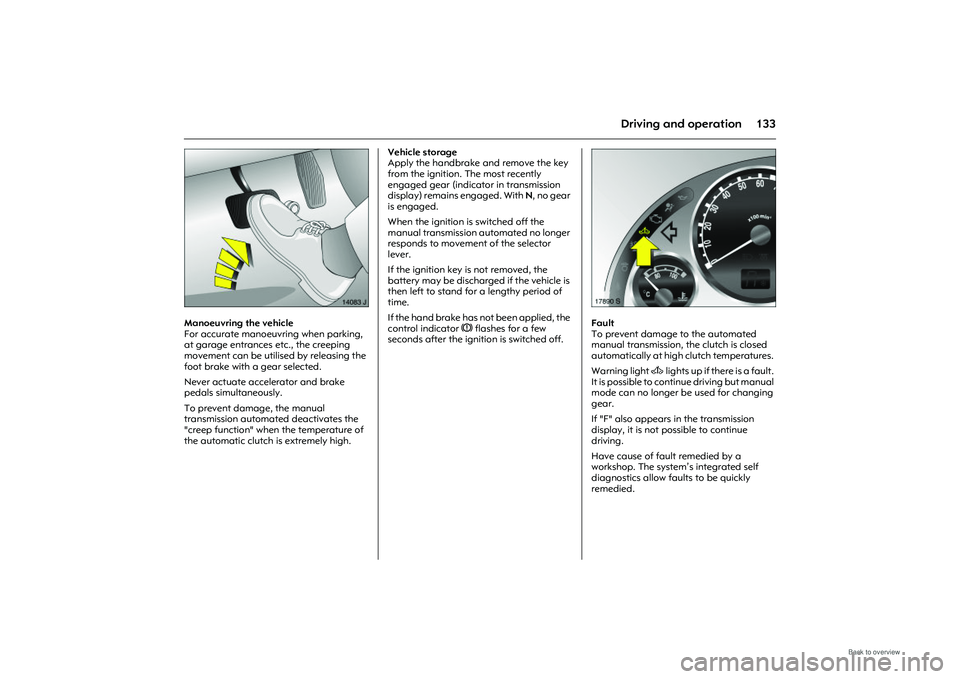
Manoeuvring the vehicle
For accurate manoeuvring when parking,
at garage entrances etc., the creeping
movement can be utilised by releasing the
foot brake with a gear selected.
Never actuate accelerator and brake
pedals simultaneously.
To prevent damage, the manual
transmission automated deactivates the
"creep function" when the temperature of
the automatic clutch is extremely high. Vehicle storage
Apply the handbrake and remove the key
from the ignition. The most recently
engaged gear (indicator in transmission
display) remains engaged. With
N, no gear
is engaged.
When the ignition is switched off the
manual transmission automated no longer
responds to movement of the selector
lever.
If the ignition key is not removed, the
battery may be discharg ed if the vehicle is
then left to stand for a lengthy period of
time.
If the hand brake has not been applied, the
control indicator R flashes for a few
seconds after the ignition is switched off.
Picture no: 17890s.tif
Fault
To prevent damage to the automated
manual transmission, the clutch is closed
automatically at high clutch temperatures.
Warning light A lights up if there is a fault.
It is possible to continue driving but manual
mode can no longer be used for changing
gear.
If "F" also appears in the transmission
display, it is not possible to continue
driving.
Have cause of fault remedied by a
workshop. The system’s integrated self
diagnostics allow faults to be quickly
remedied.
Page 142 of 248
136 Driving and operationSave energy – more kilometres
Please observe the running-in hints on the
previous page and the tips for energy
saving on the following pages.
Good, technically correct and economical
driving ensures maximum durability and
performance for your vehicle.
Overrun cut-off
The fuel supply is automatically cut off
during overrun, e.g. when the vehicle is
driven with a gear engaged but no throttle
application. Overrun cut-off is deactivated
if catalytic converter temperature is high.
Vehicles with turbocharged engine
3
Flow-generated noises may be audible if
the accelerator is released quickly on
account of air flow in the turbocharger.
Engine speed
Drive in a low engine speed range for each
gear as much as possible. Warming up
Allow the engine to wa
rm up while driving.
Do not warm it up by letting it ru n at idling
speed. Do not apply full throttle until the
engine has reached operating
temperature.
After a cold start, the manual transmission
automated 3 does not switch to higher
gears until the speed increases when it is in
automatic mode. This allows the catalytic
converter to reach th e temperature quickly
which is required for optimum emission
reduction.
Correct gear selection
Do not race your engine whilst in neutral or
with a low gear selected. Driving too fast in
individual gears as well as stop-and-go
traffic increases engine wear and fuel
consumption.
Change down
When decreasing speed, shift down into
the next lowest gear. Do not slip the clutch
with a high-revving engine. This is
especially important when hill climbing. Cooling fan
The cooling fan is controlled via a
thermoswitch and therefore only runs if
necessary.
The cooling fan automatically switches on
when the diesel particle filter is being
cleaned
3 depending on the engine.
Pedals
Do not place any objects in the foot well
which could slip under the pedals and
inhibit the pedal travel.
To ensure the pedal travel is uninhibited,
there must be no mats in the area of the
pedals.
Battery care
When driving slowly or when the vehicle is
stationary, e.g. in slow urban traffic, stop-
and-go traffic or traffic jams, turn off all
unnecessary electrical loads where
possible (e.g. heated rear window, heated
front seats, etc.).
Declutch when starting in order to relieve
the strain on the starter and the battery.
Page 143 of 248
137
Driving and operation
Saving fuel, protecting the
environmentTrend-setting technology
Environmentally friendly and mainly
recyclable materials were used when your
vehicle was being developed and
manufactured. The production methods
used to make your vehicle are also
environmentally-compatible.
Recycling of production wastes keeps the
circulation of material closed. Reduction of
energy and water requirements also helps
to conserve natural resources.
A highly advanced design means that your
vehicle can be easily disassembled at the
end of its working life, and the individual
materials separated for subsequent re-use.
Materials such as asbestos and cadmium
are not used. The refrigerant in the air
conditioning system 3 is CFC-free.
New painting techniques employ water as
a solvent. End-of-life vehicle recovery
Information on end-of-life vehicle recovery
centres and the recycling of end-of-life
vehicles is availabl
e at www.opel.com.
Energy and environment-conscious
driving
z High noise levels and exhaust emissions
are often a result of driving without due
attention to saving energy and
protecting the environment.
z You should therefore drive with energy in
mind: "more miles – less fuel".
Reduce the noise level and exhaust
emissions by adopting an environment-
conscious driving style. This is extremely
worthwhile and improves the quality of
life.
Fuel consumption depends to a great
extent on your own personal driving
style. The following hints are intended to
help you consume fuel at a rate that is as
close as possible to the specified levels
3224.
Check your vehicle’s fuel consumption
every time you refuel. This facilitates
early detection of any irregularities
causing increased fuel consumption. Warming up
z
Full throttle and warming up at idle
speed increase wear, fuel consumption,
exhaust emission, the amount of
pollutant in the exhaust and the amount
of noise.
z Drive off immediately after starting.
Warm up the engine by running it at
moderate engine speeds.
Uniform speed
z Hectic driving significantly increases fuel
consumption, the exhaust emissions, the
proportion of pollutant in the exhaust
gas and the noise level.
z Do not accelerate and brake
unnecessarily. Drive at uniform speed,
watching the road.
Avoid frequent starting off and stopping
e.g. at traffic lights, in short distance
traffic and in queues of traffic by means
of clever planning. Select roads with
good traffic flow.
Idling
z The engine also consumes fuel when
idling.
z If you have to wait for more than one
minute, it is worthwhile switching off the
engine. Five minutes of idling
corresponds to approximately one
kilometre of driving.
Page 144 of 248
138 Driving and operationOverrun
zThe fuel supply is shut off automatically
on overrun, e.g. when descending steep
hills or when braking 3136.
z To enable the overrun cut-off to come
into action and save fuel, do not
accelerate or declutch during overrun.
Correct gear selection
z High revs increase engine wear and fuel
consumption.
z Do not race your engine. Avoid driving at
high engine speeds.
Making use of the tachometer helps to
save fuel. Drive in a low engine speed
range for each gear as much as possible
with uniform engine speeds. Drive as
often as possible in top gear, select the
next higher gear as soon as possible,
and only change down when the engine
is no longer running perfectly smoothly.
High speed
z The higher the speed, the higher the
consumption and the noise level. At top
speed, you consume a great deal of fuel
and produce excessive noise and
exhaust emissions. z
Slightly releasing th e accelerator pedal
results in distinct fu el savings with no
major loss of speed.
Drive at no more than around three
quarters of maximum speed and you will
use up to 50 % less fuel, without losing a
great deal of time.
Tyre pressure
z Inadequate tyre pressure, leading to
higher road resistance, costs money in
two ways: for more fuel and increased
tyre wear.
z Regular checks (every 14 days) pay off.
Electrical loads
z The power consumption of electrical
equipment increases fuel consumption.
z Switch off all auxiliary electrical loads
(e.g. air conditioning 3, heated rear
window) when not needed.
Roof racks, ski-holders
z Due to air resistance, a roof load can
increase fuel consumption by
approx. 1l/100 km.
z Remove them if they are not being used. Repair and maintenance
z
Improper repairs or adjustment and
maintenance work can increase fuel
consumption. Do not carry out work on
the engine yourself.
You may out of ignorance infringe
environmental laws by not disposing of
materials properly.
Appropriate parts might not be recycled.
Contact with some of the materials
involved may pose a health hazard.
z We recommend that repair and
maintenance be entrusted to your Opel
Partner.
Extreme driving conditions
z Going up steep slopes, cornering, driving
on poor roads and winter driving all
increase fuel consumption.
Fuel consumption increases dramatically
in urban traffic and at winter
temperatures, especially on short trips
when the engine operating temperature
is not reached.
z Follow the hints given above to keep
consumption to a minimum under such
conditions.
Page 148 of 248
142 Driving and operation
Picture no: 6448u.tif
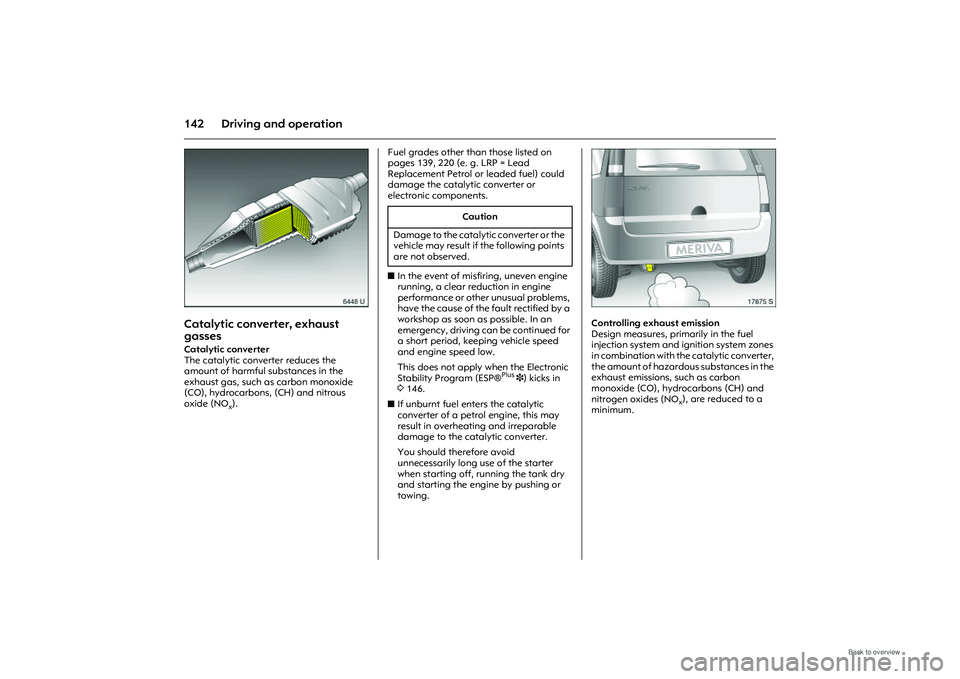
Catalytic converter, exhaust
gassesCatalytic converter
The catalytic converter reduces the
amount of harmful substances in the
exhaust gas, such as carbon monoxide
(CO), hydrocarbons, (CH) and nitrous
oxide (NO
x). Fuel grades other than those listed on
pages 139, 220 (e. g. LRP = Lead
Replacement Petrol or leaded fuel) could
damage the catalytic converter or
electronic components.
z
In the event of misfiring, uneven engine
running, a clear reduction in engine
performance or other unusual problems,
have the cause of the fault rectified by a
workshop as soon as possible. In an
emergency, driving can be continued for
a short period, keeping vehicle speed
and engine speed low.
This does not apply when the Electronic
Stability Program (ESP®
Plus
3) kicks in
3 146.
z If unburnt fuel enters the catalytic
converter of a petrol engine, this may
result in overheating and irreparable
damage to the catalytic converter.
You should therefore avoid
unnecessarily long use of the starter
when starting off, running the tank dry
and starting the engine by pushing or
towing.
Picture no: 17875s.tif
Controlling exhaust emission
Design measures, primarily in the fuel
injection system and ignition system zones
in combination with the catalytic converter,
the amount of hazardous substances in the
exhaust emissions, such as carbon
monoxide (CO), hydrocarbons (CH) and
nitrogen oxides (NO
x), are reduced to a
minimum.
Caution
Damage to the catalytic converter or the
vehicle may result if the following points
are not observed.
Page 152 of 248
146 Driving and operationDrive Control SystemsElectronic Stability Program (ESP®
Plus
) 3
ESP®
Plus
improves driving stability when
necessary in any driving situation
regardless of the type of road surface or
tyre grip. It also prevents the drive wheels
from spinning. As soon as the vehicle starts to swerve
(understeer/oversteer), engine output is
reduced and the wheels are braked
individually. This considerably improves
the driving stability of the vehicle on
slippery road surfaces.
ESP®
Plus
is ready for operation as soon as
the ignition is switched on and control
indicator v goes out.
When ESP®
Plus
comes into action, v
flashes. The vehicle is now in a critical situation;
ESP®
Plus
allows you to keep control of the
vehicle and reminds you to match your
speed to the road conditions.
9 Warning
Do not let this special safety feature
tempt you into taking risks when driving.
ESP®
Plus
does not negate the laws of
physics.
Adapt speed to the road conditions.
Page 156 of 248
150 Driving and operationUltrasonic parking sensors 3
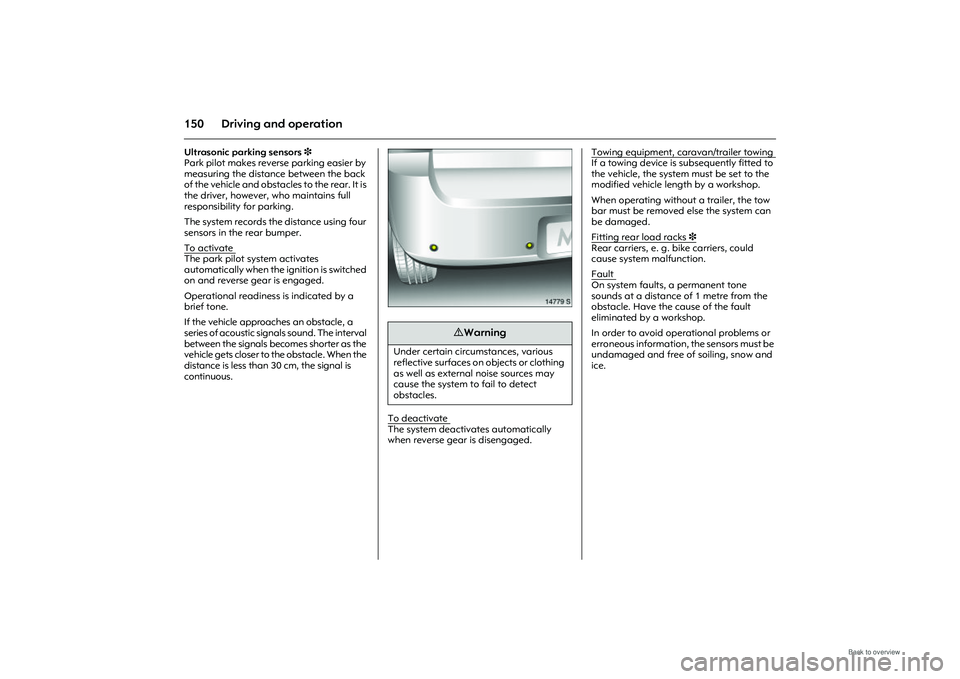
Park pilot makes reverse parking easier by
measuring the distance between the back
of the vehicle and obstacles to the rear. It is
the driver, however, who maintains full
responsibility for parking.
The system records the distance using four
sensors in the rear bumper.
To activate The park pilot system activates
automatically when the ignition is switched
on and reverse gear is engaged.
Operational readiness is indicated by a
brief tone.
If the vehicle approaches an obstacle, a
series of acoustic signals sound. The interval
between the signals be comes shorter as the
vehicle gets closer to the obstacle. When the
distance is less than 30 cm, the signal is
continuous.
Picture no: 14779s.tif
To deactivate The system deactivates automatically
when reverse gear is disengaged. Towing equipment, caravan/trailer towing
If a towing device is subsequently fitted to
the vehicle, the system must be set to the
modified vehicle length by a workshop.
When operating without a trailer, the tow
bar must be removed else the system can
be damaged.
Fitting rear load racks
3
Rear carriers, e. g. bike carriers, could
cause system malfunction.
Fault
On system faults, a permanent tone
sounds at a distance of 1 metre from the
obstacle. Have the cause of the fault
eliminated by a workshop.
In order to avoid operational problems or
erroneous information, the sensors must be
undamaged and free of soiling, snow and
ice.
9 Warning
Under certain circumstances, various
reflective surfaces on objects or clothing
as well as external noise sources may
cause the system to fail to detect
obstacles.
Page 157 of 248
151
Driving and operation
Picture no: 14722s.tif
Hydraulic brake system The brake system comprises two
independent brake circuits.
If a brake circuit fails, the vehicle can still be
braked using the other brake circuit.
However, the brake pedal must be
depressed a considerable way before any
braking effect occurs, and much more
force is required. The braking distance is
longer. Contact a workshop for assistance
before continuing to drive. To ensure that full
pedal travel can be
utilised, especially in case of a fault in one
of the brake circuits, there must be no mats
in the vicinity of the pedals 3136.
When the engine is not running, the
support of the brake servo unit disappears
once the brake pedal has been depressed
once or twice. Braking effect is not
reduced, but braking requires significantly
greater force. This is especially important
to bear in mind when towing.
The brake fluid level should be checked
regularly. If the brake fluid level is too low
and the hand brake is not applied, control
indicator R on the instrument panel
illuminates 385.
Picture no: 17894s.tif
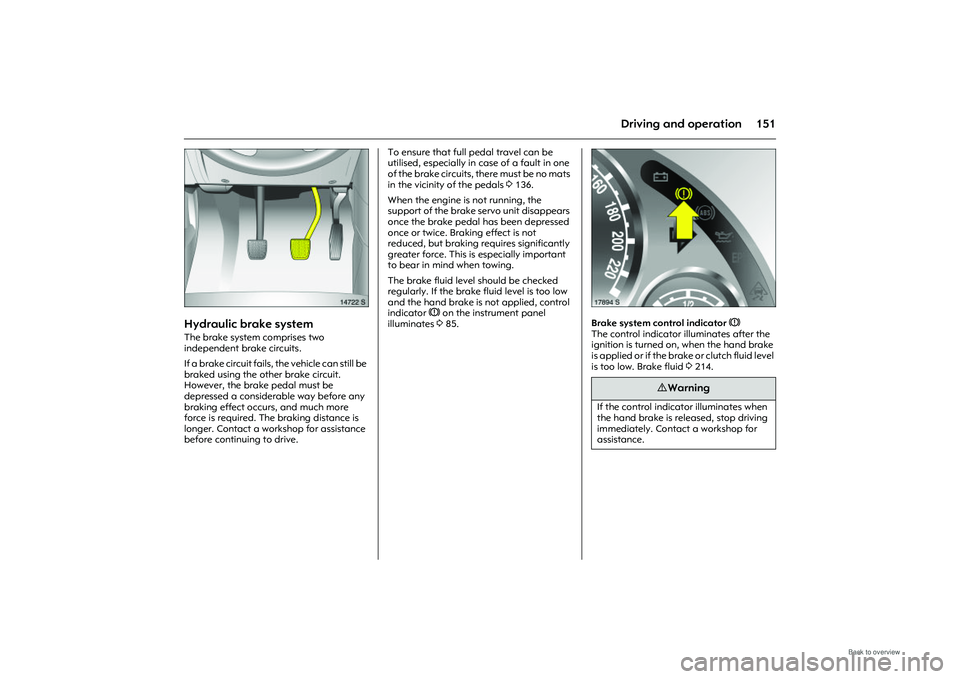
Brake system control indicator R
The control indicator illuminates after the
ignition is turned on, when the hand brake
is applied or if the brake or clutch fluid level
is too low. Brake fluid 3214.
9 Warning
If the control indicator illuminates when
the hand brake is released, stop driving
immediately. Contact a workshop for
assistance.