airbag OPEL MERIVA 2009 User Guide
[x] Cancel search | Manufacturer: OPEL, Model Year: 2009, Model line: MERIVA, Model: OPEL MERIVA 2009Pages: 248, PDF Size: 4.46 MB
Page 65 of 248
59
Seats, Interior
Three-stage safety system Comprising:
zthree-point seat belts,
z belt tensioners at the front seats,
z airbag systems for the driver and front
passenger seats 3 as well as the
outboard rear seats 3.
The three stages are activated in sequence
depending on the severity of the accident:
z The automatic seat belt locking devices
prevent the belt strap from being pulled
out and thus ensure that the vehicle
occupants are retained in their seats.
z The front seat belts are pulled down at
the belt buckles. This means the belts fit
snugly, the occupants are decelerated
early with the vehicle and the body
loading is reduced.
z The airbag systems are also triggered in
the event of severe accidents and form a
safety cushion for the occupants. Read the instructions supplied with the
child restraint system
Picture no: 18531s.tif
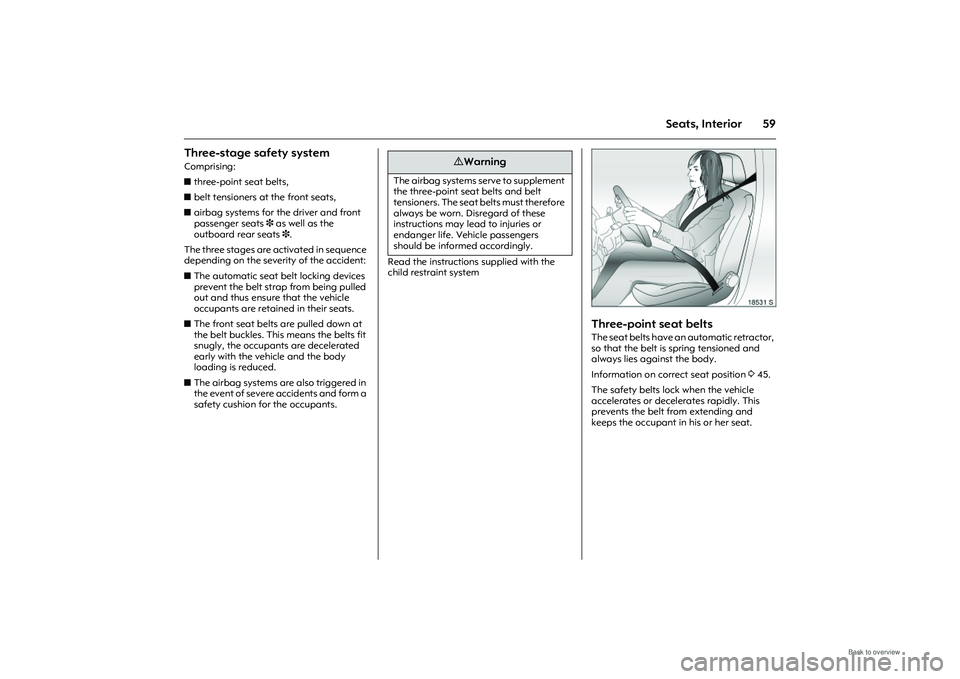
Three-point seat belts The seat belts have an automatic retractor,
so that the belt is spring tensioned and
always lies against the body.
Information on correct seat position
345.
The safety belts lock when the vehicle
accelerates or decelerates rapidly. This
prevents the belt from extending and
keeps the occupant in his or her seat.
9 Warning
The airbag systems serve to supplement
the three-point seat belts and belt
tensioners. The seat belts must therefore
always be worn. Disregard of these
instructions may lead to injuries or
endanger life. Vehicle passengers
should be informed accordingly.
Page 67 of 248
61
Seats, Interior
Picture no: 17885s.tif
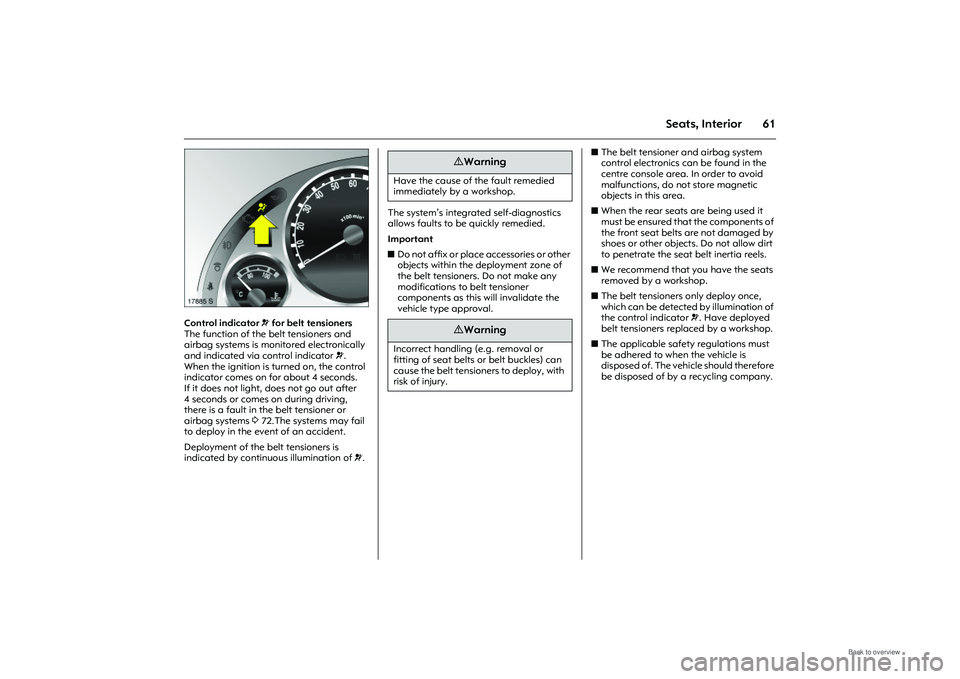
Control indicator v for belt tensioners
The function of the belt tensioners and
airbag systems is monitored electronically
and indicated via control indicator v.
When the ignition is turned on, the control
indicator comes on for about 4 seconds.
If it does not light, does not go out after
4 seconds or comes on during driving,
there is a fault in the belt tensioner or
airbag systems 372.The systems may fail
to deploy in the event of an accident.
Deployment of the belt tensioners is
indicated by continuous illumination of v . The system’s integrated self-diagnostics
allows faults to be quickly remedied.
Important
z
Do not affix or place accessories or other
objects within the deployment zone of
the belt tensioners. Do not make any
modifications to belt tensioner
components as this will invalidate the
vehicle type approval. z
The belt tensioner and airbag system
control electronics can be found in the
centre console area. In order to avoid
malfunctions, do not store magnetic
objects in this area.
z When the rear seats are being used it
must be ensured that the components of
the front seat belts are not damaged by
shoes or other objects. Do not allow dirt
to penetrate the seat belt inertia reels.
z We recommend that you have the seats
removed by a workshop.
z The belt tensioners only deploy once,
which can be detected by illumination of
the control indicator v . Have deployed
belt tensioners replaced by a workshop.
z The applicable safety regulations must
be adhered to when the vehicle is
disposed of. The vehicle should therefore
be disposed of by a recycling company.
9 Warning
Have the cause of the fault remedied
immediately by a workshop.
9 Warning
Incorrect handling (e.g. removal or
fitting of seat belts or belt buckles) can
cause the belt tensioners to deploy, with
risk of injury.
Page 72 of 248
66 Seats, Interior
Note
zChildren under 12 years or under 150 cm
tall should only travel in an appropriate
child restraint system.
z When transporting children, use the child
restraint systems suitable for the child’s
weight.
z Ensure correct installation of child
restraint system, see the instructions
enclosed with the system.
z The covers of the Opel child restraint
system can be wiped clean.
z Do not stick anything on the child
restraint systems and do not cover them
with any other materials.
z Only allow children to enter and exit at
the side facing away from the traffic.
z A child restraint system which has been
subjected to stress in an accident must
be replaced.
z Secure or remove child restraint systems
that are in the vehicle but not in use.
B
1= Conditional, without front
passenger airbags or with seat
occupancy recognition and Opel
child restraint systems with
transponders.
The front passenger seat must also
have a height adjusting facility:
move to highest position, slide front
passenger seat all the way back and
move front passenger seat belt
anchorage point to lowest possible
position.
B2= Conditional, without side airbag, of front passenger seat has been slid
all the way back, or with seat
occupancy recognition and Opel
child restraint systems with
transponders.
The front passenger seat must also
have a height adjusting facility:
move to highest position and slide
front passenger seat all the way
back so that the seat belt runs
towards the front from the
anchorage point.
U = Universal suitability in conjunction with three-point seat belt. + = Vehicle seat available with ISOFIX
fixings. When using ISOFIX, only
ISOFIX child restraint systems
approved for the vehicle may be
used.
++ = Only if both outboard seats are pushed back and flush with the
centre seat.
X = No child restraint system permitted in this weight class.
Page 73 of 248
67
Seats, Interior
Picture no: 16424s.tif
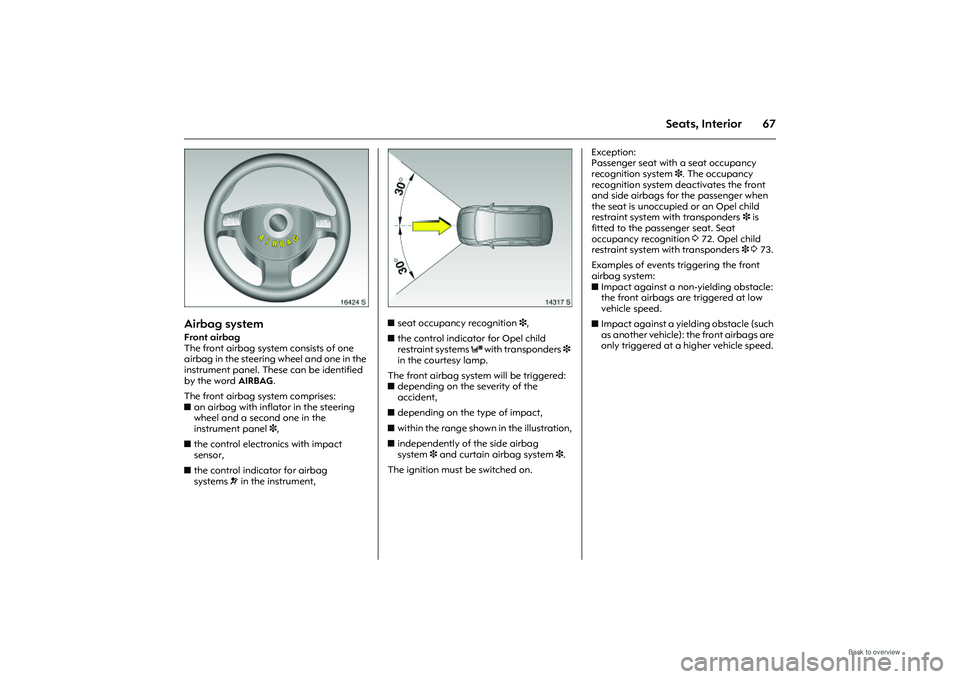
Airbag system Front airbag
The front airbag system consists of one
airbag in the steering wheel and one in the
instrument panel. These can be identified
by the word AIRBAG.
The front airbag system comprises:
z an airbag with inflator in the steering
wheel and a second one in the
instrument panel 3,
z the control electronics with impact
sensor,
z the control indicator for airbag
systems v in the instrument,
Picture no: 14317s.tif
z seat occupancy recognition 3,
z the control indicator for Opel child
restraint systems
y
with transponders 3
in the courtesy lamp.
The front airbag system will be triggered:
z depending on the severity of the
accident,
z depending on the type of impact,
z within the range show n in the illustration,
z independently of the side airbag
system 3 and curtain airbag system 3.
The ignition must be switched on. Exception:
Passenger seat with a seat occupancy
recognition system
3. The occupancy
recognition system deactivates the front
and side airbags for the passenger when
the seat is unoccupied or an Opel child
restraint system with transponders 3 is
fitted to the passenger seat. Seat
occupancy recognition 372. Opel child
restraint system with transponders 3 3 73.
Examples of events triggering the front
airbag system:
z Impact against a non-yielding obstacle:
the front airbags are triggered at low
vehicle speed.
z Impact against a yielding obstacle (such
as another vehicle): the front airbags are
only triggered at a higher vehicle speed.
Page 74 of 248
68 Seats, Interior
Picture no: 14125s.tif
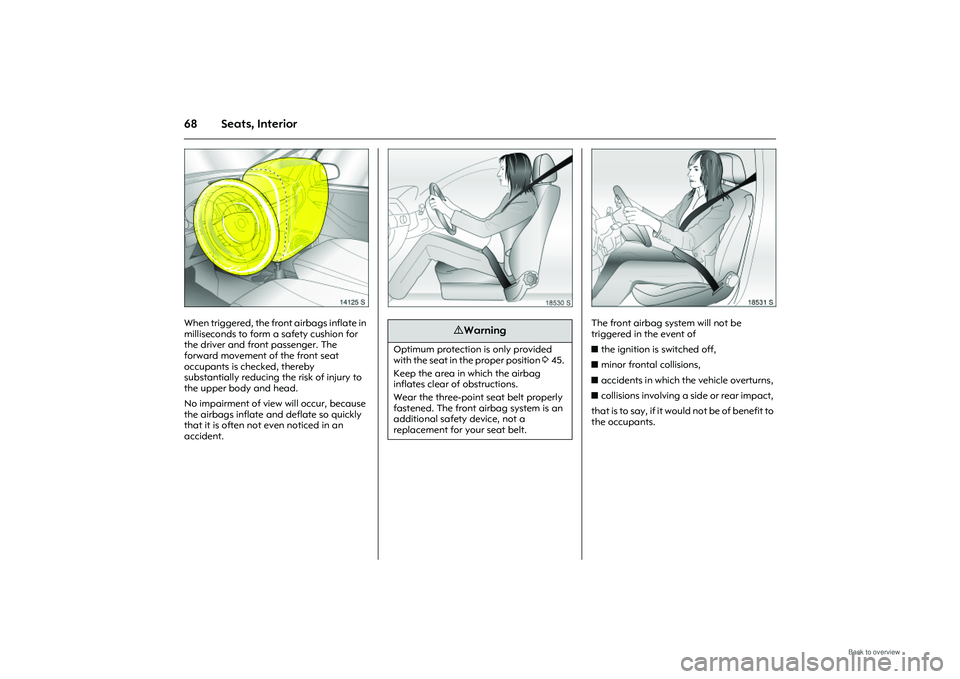
When triggered, the front airbags inflate in
milliseconds to form a safety cushion for
the driver and front passenger. The
forward movement of the front seat
occupants is checked, thereby
substantially reducing the risk of injury to
the upper body and head.
No impairment of view will occur, because
the airbags inflate and deflate so quickly
that it is often not even noticed in an
accident.
Picture no: 18530s.tif Picture no: 18531s.tif
The front airbag system will not be
triggered in the event of
zthe ignition is switched off,
z minor frontal collisions,
z accidents in which the vehicle overturns,
z collisions involving a side or rear impact,
that is to say, if it would not be of benefit to
the occupants.
9 Warning
Optimum protection is only provided
with the seat in the proper position 345.
Keep the area in which the airbag
inflates clear of obstructions.
Wear the three-point seat belt properly
fastened. The front airbag system is an
additional safety device, not a
replacement for your seat belt.
Page 75 of 248
69
Seats, Interior
In addition, the front airbag system will not
be triggered for the front passenger in
versions with seat occupancy recognition 3
if
z the front passenger seat is unoccupied,
z or there is a properly mounted Opel child
restraint system with transponders 3.
Seat occupancy recognition 372. Opel
child restraint system with
transponders 3 3 73.
Picture no: 14741s.tif
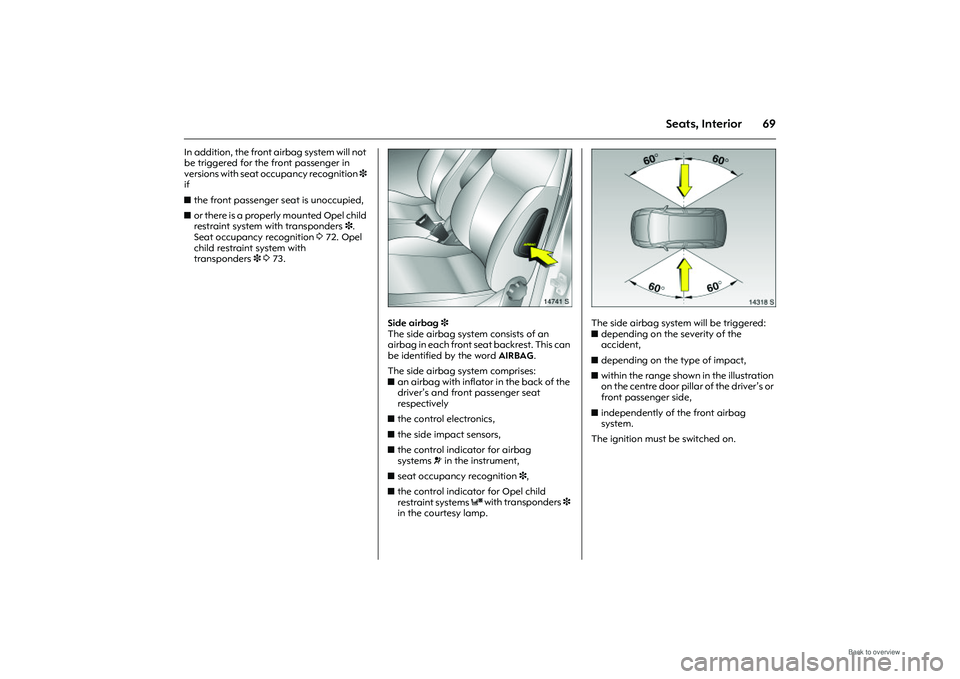
Side airbag 3
The side airbag system consists of an
airbag in each front seat backrest. This can
be identified by the word AIRBAG.
The side airbag system comprises:
z an airbag with inflator in the back of the
driver’s and front passenger seat
respectively
z the control electronics,
z the side impact sensors,
z the control indicator for airbag
systems v in the instrument,
z seat occupancy recognition 3,
z the control indicator for Opel child
restraint systems
y
with transponders 3
in the courtesy lamp.
Picture no: 14318s.tif
The side airbag system will be triggered:
z depending on the severity of the
accident,
z depending on the type of impact,
z within the range shown in the illustration
on the centre door pillar of the driver’s or
front passenger side,
z independently of the front airbag
system.
The ignition must be switched on.
Page 76 of 248
70 Seats, InteriorException:
Passenger seat with a seat occupancy
recognition system 3. The occupancy
recognition system deactivates the front
and side airbags for the passenger when
the seat is unoccupied or an Opel child
restraint system with transponders 3 is
fitted to the passenger seat. Seat
occupancy recognition 372. Opel child
restraint system with transponders 3 3 73.
Picture no: 14742s.tif
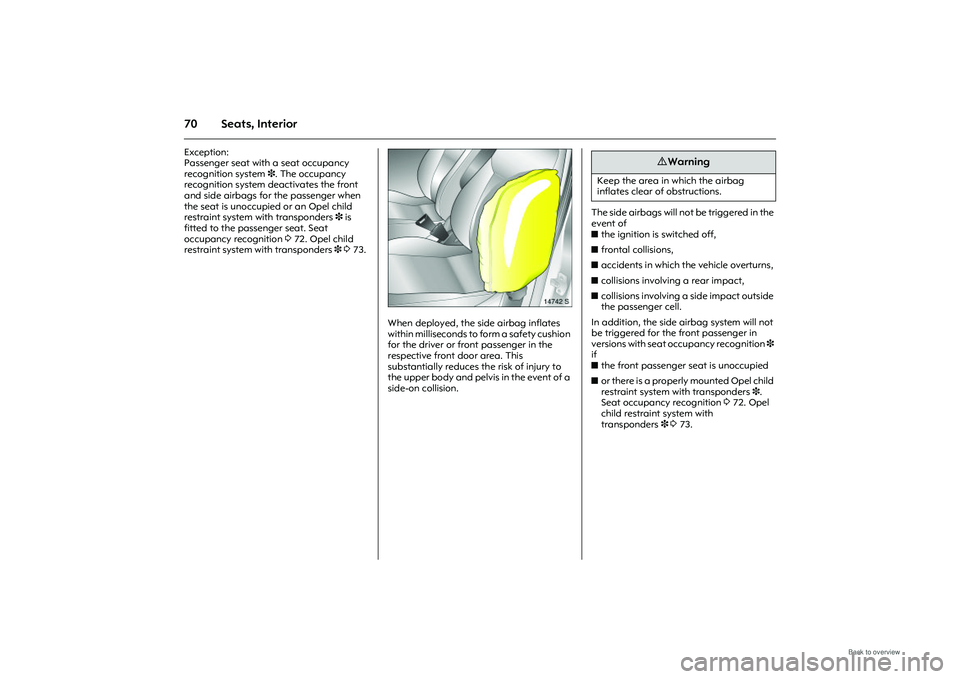
When deployed, the side airbag inflates
within milliseconds to form a safety cushion
for the driver or front passenger in the
respective front door area. This
substantially reduces th e risk of injury to
the upper body and pelvis in the event of a
side-on collision. The side airbags will not be triggered in the
event of
z
the ignition is switched off,
z frontal collisions,
z accidents in which the vehicle overturns,
z collisions involving a rear impact,
z collisions involving a side impact outside
the passenger cell.
In addition, the side airbag system will not
be triggered for the front passenger in
versions with seat occupancy recognition 3
if
z the front passenger seat is unoccupied
z or there is a properly mounted Opel child
restraint system with transponders 3.
Seat occupancy recognition 372. Opel
child restraint system with
transponders 3 373.
9 Warning
Keep the area in which the airbag
inflates clear of obstructions.
Page 77 of 248
71
Seats, Interior
Picture no: 14129s.tif
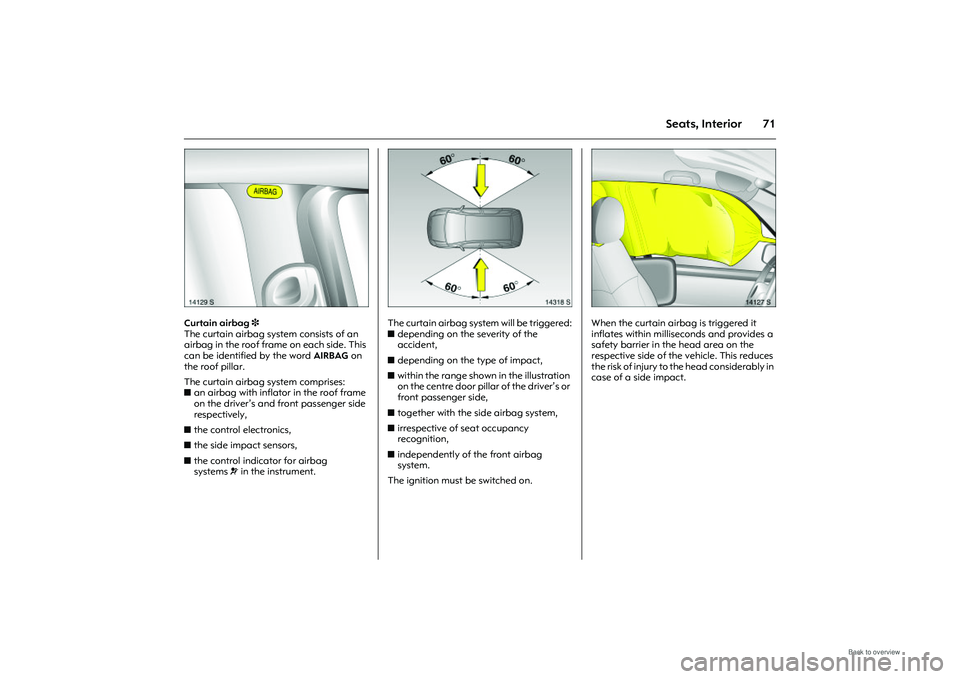
Curtain airbag 3
The curtain airbag system consists of an
airbag in the roof fram e on each side. This
can be identified by the word AIRBAG on
the roof pillar.
The curtain airbag system comprises:
z an airbag with inflator in the roof frame
on the driver’s and front passenger side
respectively,
z the control electronics,
z the side impact sensors,
z the control indicator for airbag
systems v in the instrument.
Picture no: 14318s.tif
The curtain airbag system will be triggered:
z depending on the severity of the
accident,
z depending on the type of impact,
z within the range shown in the illustration
on the centre door pillar of the driver’s or
front passenger side,
z together with the side airbag system,
z irrespective of seat occupancy
recognition,
z independently of the front airbag
system.
The ignition must be switched on.
Picture no: 14127s.tif
When the curtain airb ag is triggered it
inflates within milliseconds and provides a
safety barrier in the head area on the
respective side of the vehicle. This reduces
the risk of injury to th e head considerably in
case of a side impact.
Page 78 of 248
72 Seats, InteriorThe curtain airbags will not be triggered in
the event of
zthe ignition is switched off,
z frontal collisions,
z accidents in which the vehicle overturns,
z collisions involving a rear impact,
z collisions involving a side impact outside
the passenger cell.
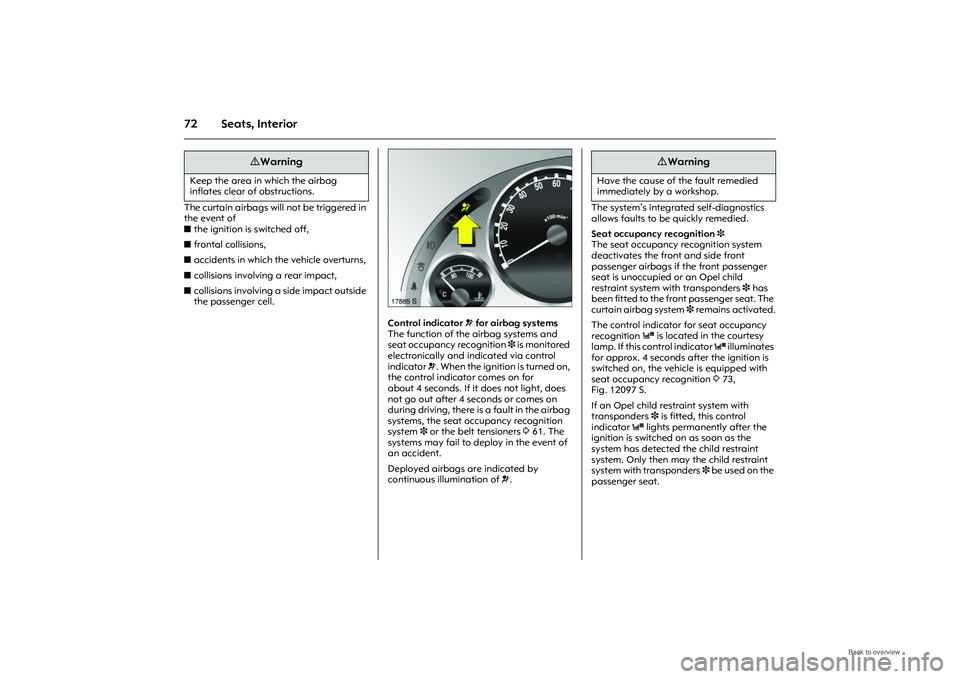
Picture no: 17885s.tif
Control indicator v for airbag systems
The function of the airbag systems and
seat occupancy recognition 3 is monitored
electronically and indicated via control
indicator v. When the ignition is turned on,
the control indicator comes on for
about 4 seconds. If it does not light, does
not go out after 4 seconds or comes on
during driving, there is a fault in the airbag
systems, the seat occupancy recognition
system 3 or the belt tensioners 361. The
systems may fail to deploy in the event of
an accident.
Deployed airbags are indicated by
continuous illumination of v. The system’s integrated self-diagnostics
allows faults to be quickly remedied.
Seat occupancy recognition
3
The seat occupancy recognition system
deactivates the front and side front
passenger airbags if the front passenger
seat is unoccupied or an Opel child
restraint system with transponders 3 has
been fitted to the front passenger seat. The
curtain airbag system 3 remains activated.
The control indicator for seat occupancy
recognition
y is located in the courtesy
lamp. If this control indicator
y illuminates
for approx. 4 seconds after the ignition is
switched on, the vehicle is equipped with
seat occupancy recognition 373,
Fig. 12097 S.
If an Opel child restraint system with
transponders 3 is fitted, this control
indicator
y lights permanently after the
ignition is switched on as soon as the
system has detected the child restraint
system. Only then may the child restraint
system with transponders 3 be used on the
passenger seat.
9 Warning
Keep the area in which the airbag
inflates clear of obstructions.
9 Warning
Have the cause of the fault remedied
immediately by a workshop.
Page 79 of 248
73
Seats, Interior
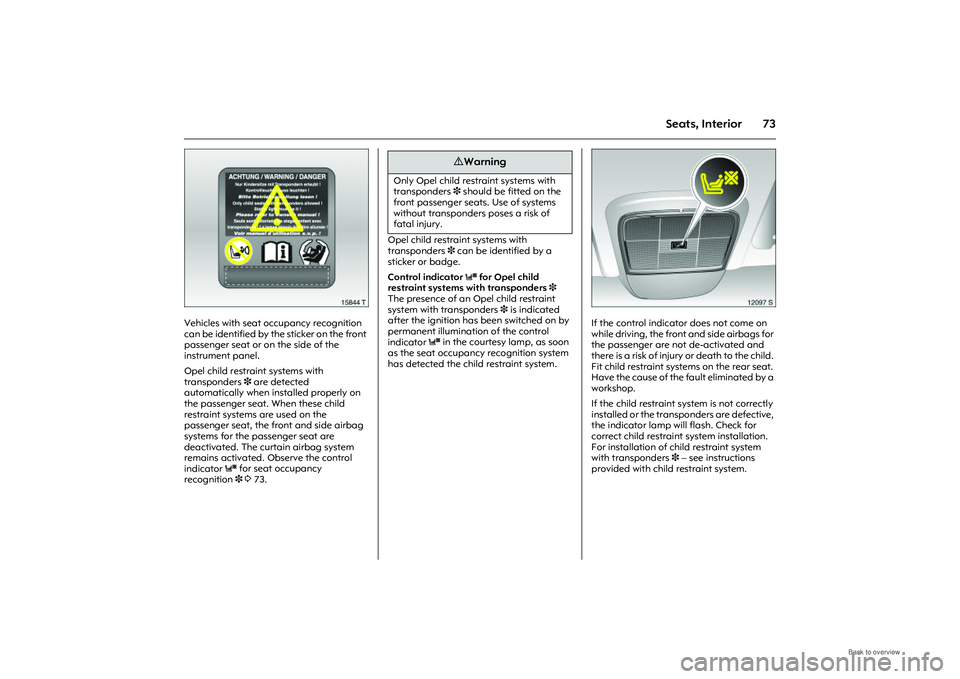
Picture no: 15844t.tif
Vehicles with seat occupancy recognition
can be identified by the sticker on the front
passenger seat or on the side of the
instrument panel.
Opel child restraint systems with
transponders 3 are detected
automatically when installed properly on
the passenger seat. When these child
restraint systems are used on the
passenger seat, the front and side airbag
systems for the passenger seat are
deactivated. The curtain airbag system
remains activated. Observe the control
indicator
y for seat occupancy
recognition 3 373. Opel child restraint systems with
transponders
3 can be identified by a
sticker or badge.
Control indicator
y for Opel child
restraint systems with transponders 3
The presence of an Opel child restraint
system with transponders 3 is indicated
after the ignition has been switched on by
permanent illumination of the control
indicator
y in the courtesy lamp, as soon
as the seat occupanc y recognition system
has detected the child restraint system.
Picture no: 12097s.tif
If the control indicator does not come on
while driving, the front and side airbags for
the passenger are not de-activated and
there is a risk of injury or death to the child.
Fit child restraint syst ems on the rear seat.
Have the cause of the fault eliminated by a
workshop.
If the child restraint system is not correctly
installed or the transponders are defective,
the indicator lamp will flash. Check for
correct child restraint system installation.
For installation of ch ild restraint system
with transponders 3 – see instructions
provided with child restraint system.
9 Warning
Only Opel child restraint systems with
transponders 3 should be fitted on the
front passenger seats. Use of systems
without transponders poses a risk of
fatal injury.