check engine OPEL MERIVA 2009 User Guide
[x] Cancel search | Manufacturer: OPEL, Model Year: 2009, Model line: MERIVA, Model: OPEL MERIVA 2009Pages: 248, PDF Size: 4.46 MB
Page 158 of 248
152 Driving and operationFor vehicles with manual transmission
automated 3, the control indicator flashes
for a few seconds when the ignition is
turned off when the hand brake is not
applied. Anti-lock brake system (ABS
u)
ABS prevents the wheels from locking.
ABS starts to regulate brake pressure as
soon as a wheel shows a tendency to lock.
The vehicle remains steerable, even during
hard braking.
ABS control is made apparent though a
pulse in the brake pedal and the noise of
the regulation process.
For optimum braking, keep the brake
pedal fully depresse d throughout the
braking process, despite the fact that the
pedal is pulsating. Do not reduce the
pressure on the pedal.
Picture no: 17895s.tif
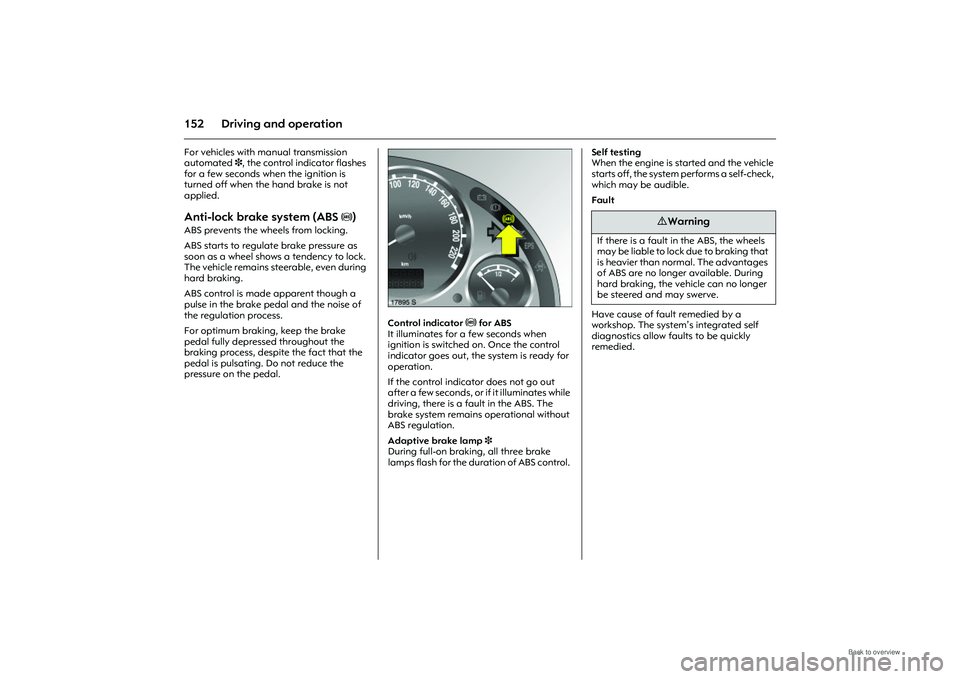
Control indicator u for ABS
It illuminates for a few seconds when
ignition is switched on. Once the control
indicator goes out, the system is ready for
operation.
If the control indica tor does not go out
after a few seconds, or if it illuminates while
driving, there is a fault in the ABS. The
brake system remains operational without
ABS regulation.
Adaptive brake lamp 3
During full-on braking, all three brake
lamps flash for the duration of ABS control. Self testing
When the engine is started and the vehicle
starts off, the system performs a self-check,
which may be audible.
Fault
Have cause of fault remedied by a
workshop. The system’s integrated self
diagnostics allow faults to be quickly
remedied.
9 Warning
If there is a fault in the ABS, the wheels
may be liable to lock due to braking that
is heavier than normal. The advantages
of ABS are no longer available. During
hard braking, the vehicle can no longer
be steered and may swerve.
Page 172 of 248
166 Self-help, vehicle care
Picture no: 17883s.tif
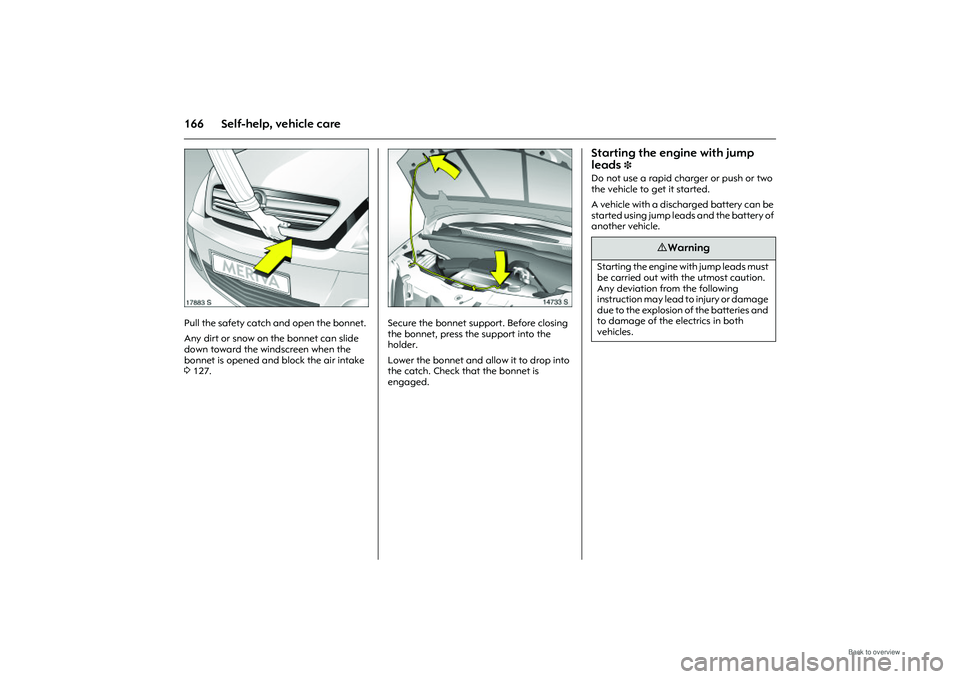
Pull the safety catch and open the bonnet.
Any dirt or snow on the bonnet can slide
down toward the windscreen when the
bonnet is opened and block the air intake
3127.
Picture no: 14733s.tif
Secure the bonnet support. Before closing
the bonnet, press the support into the
holder.
Lower the bonnet and allow it to drop into
the catch. Check that the bonnet is
engaged.
Starting the engine with jump
leads
3
Do not use a rapid charger or push or two
the vehicle to get it started.
A vehicle with a discha rged battery can be
started using jump leads and the battery of
another vehicle.
9 Warning
Starting the engine with jump leads must
be carried out with the utmost caution.
Any deviation from the following
instruction may lead to injury or damage
due to the explosion of the batteries and
to damage of the electrics in both
vehicles.
Page 191 of 248
185
Self-help, vehicle care
Picture no: 14214s.tif
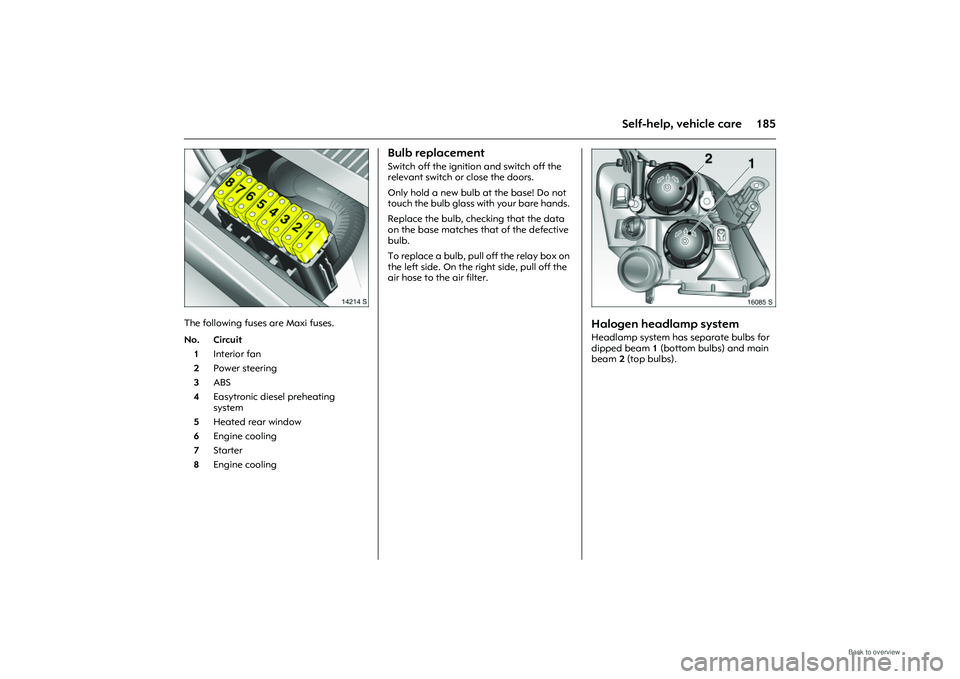
The following fuses are Maxi fuses.
Bulb replacement Switch off the ignition and switch off the
relevant switch or close the doors.
Only hold a new bulb at the base! Do not
touch the bulb glass with your bare hands.
Replace the bulb, checking that the data
on the base matches that of the defective
bulb.
To replace a bulb, pull off the relay box on
the left side. On the right side, pull off the
air hose to the air filter.
Picture no: 16085s.tif
Halogen headlamp systemHeadlamp system has separate bulbs for
dipped beam 1 (bottom bulbs) and main
beam 2 (top bulbs).
No. Circuit
1 Interior fan
2 Power steering
3 ABS
4 Easytronic diesel preheating
system
5 Heated rear window
6 Engine cooling
7 Starter
8 Engine cooling
Page 204 of 248
198 Self-help, vehicle careWindows and windscreen wiper blades
Use a soft lint-free cloth or chamois leather
together with window cleaner and insect
remover.
When cleaning the rear window, make sure
the heating element inside the window is
not damaged.
For mechanical removal of ice, use a sharp-
edged ice scraper. Pre ss the scraper firmly
against the glass so that no dirt can get
under it and scratch the glass.
Clean smearing wiper blades with a soft
cloth and window cleaner. Locks
The locks are lubricated with a high-quality
locking cylinder grease
in the factory. Only
use de-icer in urgent cases, since it has a
de-greasing effect and affects the
operation of the locks. Have the locks re-
greased in a workshop after using de-icer.
Engine compartment
Look after areas in the engine
compartment that are painted in the same
colour as the vehicle like any other
paintwork.
It is advisable to wash the engine
compartment before and after winter and
preserve it with wax. Cover alternator and
brake fluid reservoir with plastic sheets
before washing the engine.
When washing the engine with a steam-jet
cleaner, do not direct the steam jet at
components of the Anti-lock Braking
System 3, the automatic air conditioning
system 3 or the belt drive and its
components.
After an engine wash, have all engine room
components preserved thoroughly by a
workshop using protective wax.
Do not use high-pressure jet cleaners. Underbody
Some areas of the vehicle underbody have
a PVC undercoating while other critical
areas have a durable protective wax
coating.
After the underbody is washed, check the
underbody and have more protective wax
applied if necessary.
Bitumen/rubber materials could damage
the PVC coating. Have underbody work
carried out by a workshop.
Before and after winter, wash the
underbody and have the protective wax
coating checked.
Towing equipment
Do not clean the coupling ball bar with a
steam-jet or high-pressure jet cleaner.
Page 207 of 248
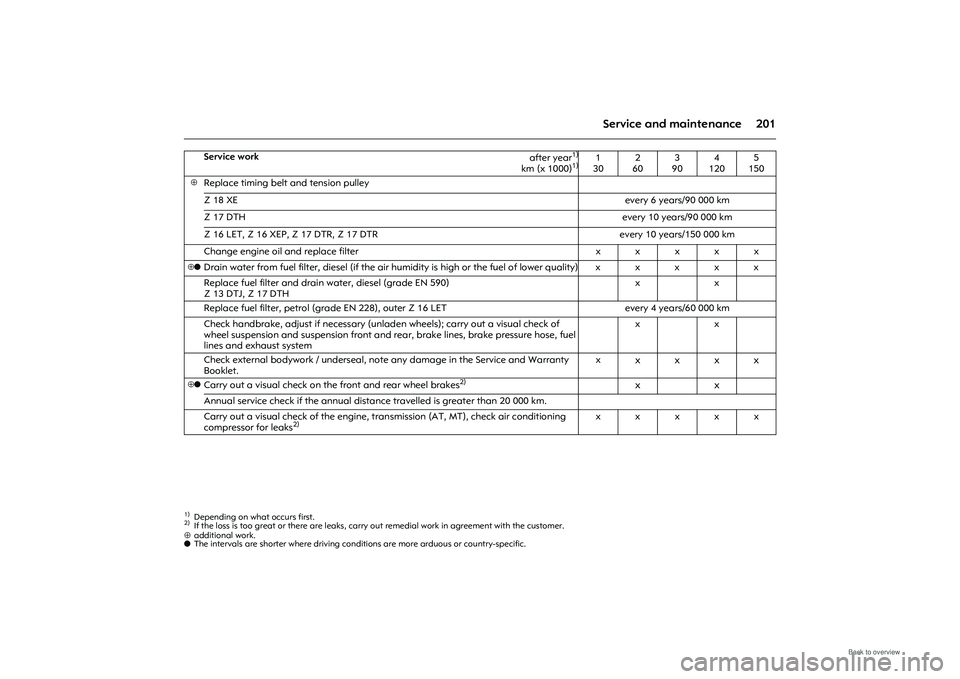
201
Service and maintenance
⊕ additional work.
o The intervals are shorter where driving conditions are more arduous or country-specific.
Service work
after year
1)
km (x 1000)
1)
1)Depending on what occurs first.
1
30 2
60 3
90 4
120 5
150
⊕
Replace timing belt and tension pulley
Z 18 XE every 6 years/90 000 km
Z 17 DTH every 10 years/90 000 km
Z 16 LET, Z 16 XEP, Z 17 DTR, Z 17 DTR every 10 years/150 000 km
Change engine oil and replace filter xxxxx
⊕o
Drain water from fuel filter, diesel (if the air humidity is high or the fuel of lower quality)xxxxx
Replace fuel filter and drain water, diesel (grade EN 590)
Z 13 DTJ, Z 17 DTH xx
Replace fuel filter, petrol (grade EN 228), outer Z 16 LET every 4 years/60 000 km
Check handbrake, adjust if necessary (unl aden wheels); carry out a visual check of
wheel suspension and suspension front and re ar, brake lines, brake pressure hose, fuel
lines and exhaust system xx
Check external bodywork / underseal, note any damage in the Service and Warranty
Booklet. x
xxxx
⊕o
Carry out a visual check on the front and rear wheel brakes
2)
2)If the loss is too great or there are leaks, carry out remedial work in agr
eement with the customer.
xx
Annual service check if the annual distance travelled is greater than 20 000 km.
Carry out a visual check of the engine, tran smission (AT, MT), check air conditioning
compressor for leaks
2)
xxxxx
Page 208 of 248
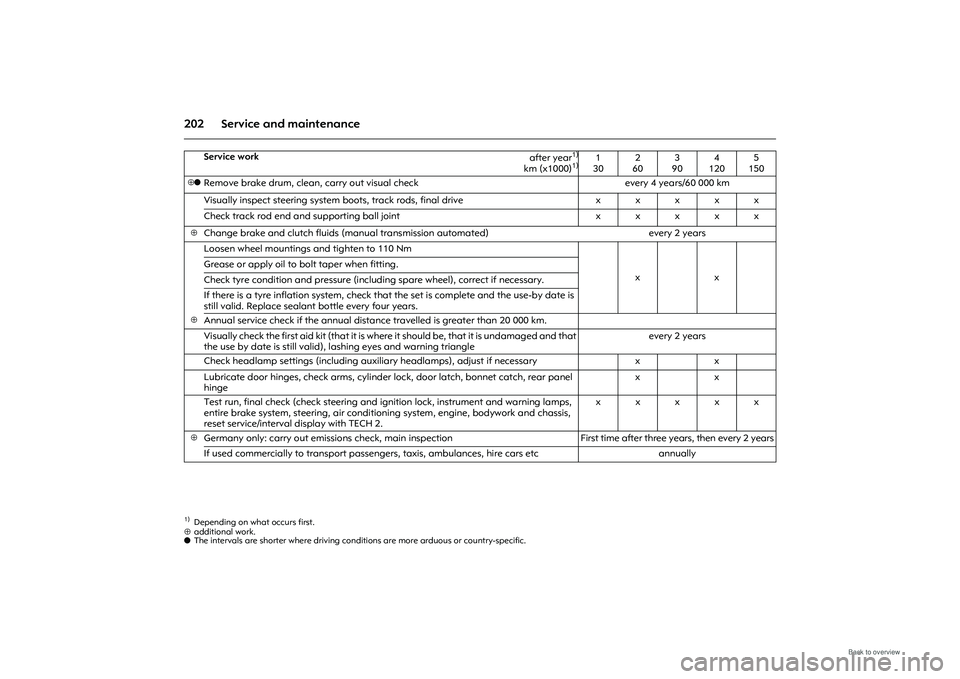
202 Service and maintenance⊕additional work.
o The intervals are shorter where driving conditions are more arduous or country-specific.
Service work
after year
1)
km (x1000)
1)
1)Depending on what occurs first.
1
30 2
60 3
90 4
120 5
150
⊕o
Remove brake drum, clean, carry out visual check every 4 years/60 000 km
Visually inspect steering system boots, track rods, final drive xxxxx
Check track rod end and supporting ball joint xxxxx
⊕
Change brake and clutch fluids (manual transmission automated) every 2 years
Loosen wheel mountings and tighten to 110 Nm
xx
Grease or apply oil to
bolt taper when fitting.
Check tyre condition and pressure (inclu ding spare wheel), correct if necessary.
If there is a tyre inflation system, check that the set is complete and the use-by date is
still valid. Replace sealant bottle every four years.
⊕
Annual service check if the annual distance travelled is greater than 20 000 km.
Visually check the first aid kit (that it is wher e it should be, that it is undamaged and that
the use by date is still valid), lashing eyes and warning triangle every 2 years
Check headlamp settings (including auxi liary headlamps), adjust if necessary xx
Lubricate door hinges, check arms, cylinder lo ck, door latch, bonnet catch, rear panel
hinge xx
Test run, final check (check steering and ig nition lock, instrument and warning lamps,
entire brake system, steering, air conditioni ng system, engine, bodywork and chassis,
reset service/interval display with TECH 2. xxxxx
⊕
Germany only: carry out emissions check, main inspection
First time after three years, then every 2 years
If used commercially to tran sport passengers, taxis, ambulances, hire cars etc annually
Page 210 of 248
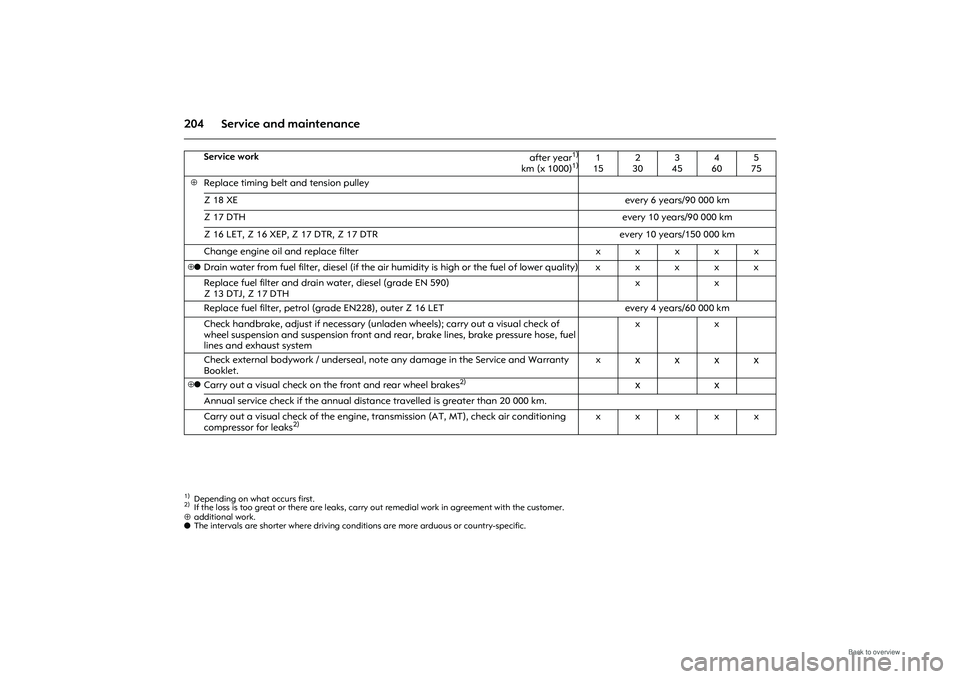
204 Service and maintenance⊕additional work.
o The intervals are shorter where driving conditions are more arduous or country-specific.
Service work
after year
1)
km (x 1000)
1)
1)Depending on what occurs first.
1
15 2
30 3
45 4
60 5
75
⊕
Replace timing belt and tension pulley
Z 18 XE every 6 years/90 000 km
Z 17 DTH every 10 years/90 000 km
Z 16 LET, Z 16 XEP, Z 17 DTR, Z 17 DTR every 10 years/150 000 km
Change engine oil and replace filter xxxxx
⊕o
Drain water from fuel filter, diesel (if the air humidity is high or the fuel of lower quality)xxxxx
Replace fuel filter and drain water, diesel (grade EN 590)
Z 13 DTJ, Z 17 DTH xx
Replace fuel filter, petrol (grade EN228), outer Z 16 LET every 4 years/60 000 km
Check handbrake, adjust if necessary (unl aden wheels); carry out a visual check of
wheel suspension and suspension front and re ar, brake lines, brake pressure hose, fuel
lines and exhaust system xx
Check external bodywork / underseal, note any damage in the Service and Warranty
Booklet. x
xxxx
⊕o
Carry out a visual check on the front and rear wheel brakes
2)
2)If the loss is too great or there are leaks, carry out remedial work in agr
eement with the customer.
xx
Annual service check if the annual distance travelled is greater than 20 000 km.
Carry out a visual check of the engine, tran smission (AT, MT), check air conditioning
compressor for leaks
2)
xxxxx
Page 211 of 248
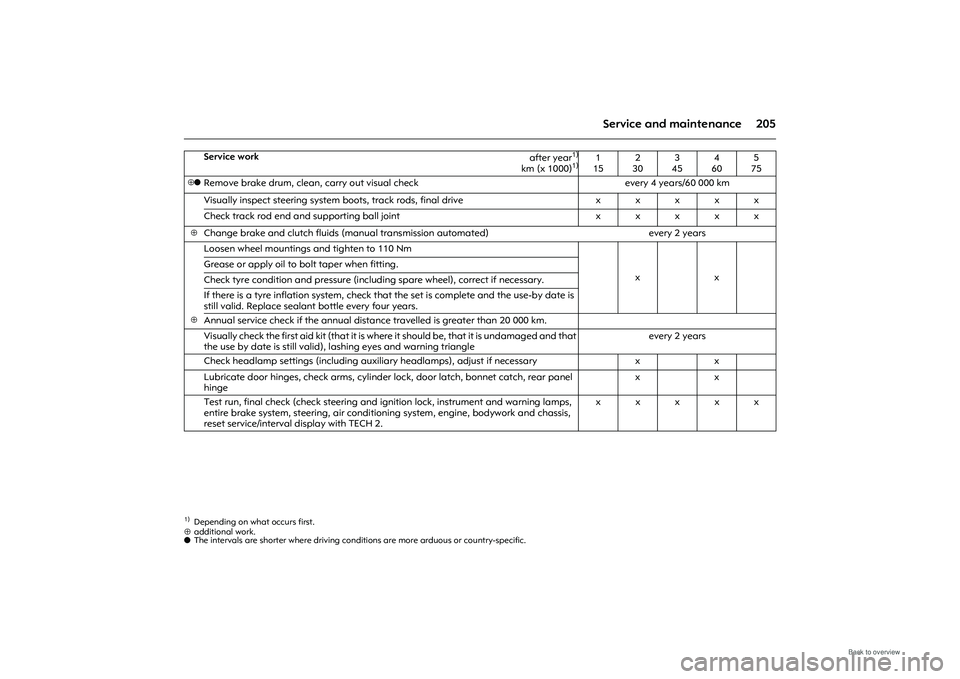
205
Service and maintenance
⊕ additional work.
o The intervals are shorter where driving conditions are more arduous or country-specific.
Service work
after year
1)
km (x 1000)
1)
1)Depending on what occurs first.
1
15 2
30 3
45 4
60 5
75
⊕o
Remove brake drum, clean, carry out visual check every 4 years/60 000 km
Visually inspect steering system boots, track rods, final drive xxxxx
Check track rod end and supporting ball joint xxxxx
⊕
Change brake and clutch fluids (manual transmission automated) every 2 years
Loosen wheel mountings and tighten to 110 Nm
xx
Grease or apply oil to
bolt taper when fitting.
Check tyre condition and pressure (inclu ding spare wheel), correct if necessary.
If there is a tyre inflation system, check that the set is complete and the use-by date is
still valid. Replace sealant bottle every four years.
⊕
Annual service check if the annual distance travelled is greater than 20 000 km.
Visually check the first aid kit (that it is wher e it should be, that it is undamaged and that
the use by date is still valid), lashing eyes and warning triangle every 2 years
Check headlamp settings (including auxi liary headlamps), adjust if necessary xx
Lubricate door hinges, check arms, cylinder lo ck, door latch, bonnet catch, rear panel
hinge xx
Test run, final check (check steering and ig nition lock, instrument and warning lamps,
entire brake system, steering, air conditioni ng system, engine, bodywork and chassis,
reset service/interval display with TECH 2. xxxxx
Page 213 of 248
207
Service and maintenance
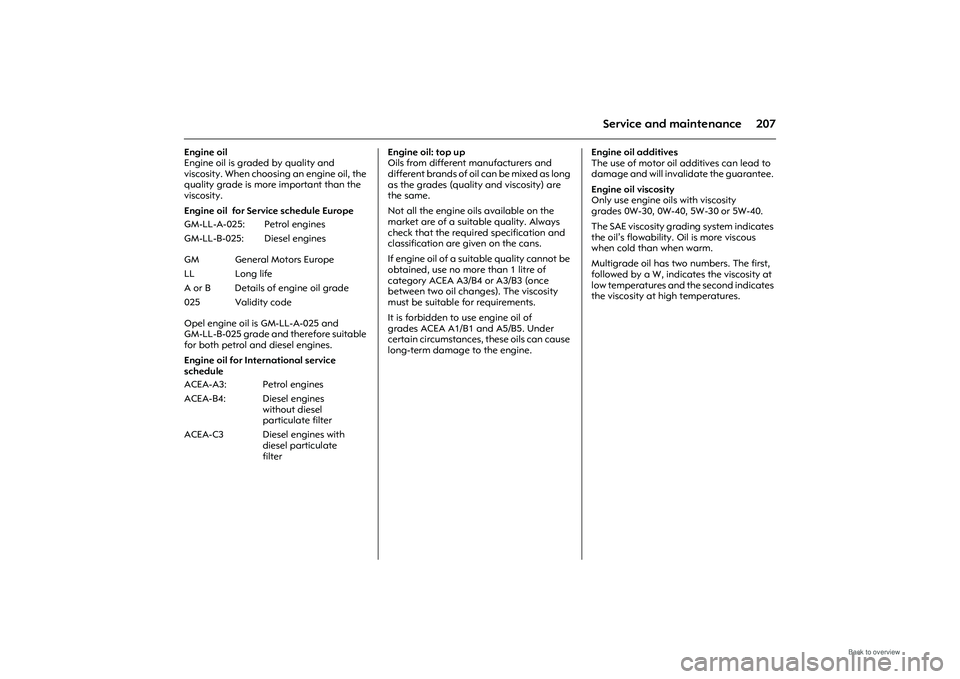
Engine oil
Engine oil is graded by quality and
viscosity. When choosing an engine oil, the
quality grade is more important than the
viscosity.
Engine oil for Service schedule Europe
Opel engine oil is GM-LL-A-025 and
GM-LL-B-025 grade and therefore suitable
for both petrol and diesel engines.
Engine oil for International service
scheduleEngine oil: top up
Oils from different manufacturers and
different brands of oil can be mixed as long
as the grades (quality and viscosity) are
the same.
Not all the engine oils available on the
market are of a suitable quality. Always
check that the required specification and
classification are given on the cans.
If engine oil of a suitable quality cannot be
obtained, use no more than 1 litre of
category ACEA A3/B4 or A3/B3 (once
between two oil changes). The viscosity
must be suitable for requirements.
It is forbidden to use engine oil of
grades ACEA A1/B1 and A5/B5. Under
certain circumstances, these oils can cause
long-term damage to the engine.
Engine oil additives
The use of motor oil additives can lead to
damage and will invalidate the guarantee.
Engine oil viscosity
Only use engine oils with viscosity
grades 0W-30, 0W-40, 5W-30 or 5W-40.
The SAE viscosity grading system indicates
the oil’s flowability. Oil is more viscous
when cold than when warm.
Multigrade oil has two numbers. The first,
followed by a W, indicates the viscosity at
low temperatures and the second indicates
the viscosity at high temperatures.
GM-LL-A-025: Petrol engines
GM-LL-B-025: Diesel engines
GM General Motors Europe
LL Long life
A or B Details of engine oil grade
025 Validity code
ACEA-A3: Petrol engines
ACEA-B4: Diesel engines
without diesel
particulate filter
ACEA-C3 Diesel engines with diesel particulate
filter
Page 215 of 248
209
Service and maintenance
Genuine Opel Parts and
Accessories We recommend that you use "Genuine
Opel Parts and Accessories" and
conversion parts released expressly for
your vehicle type. These parts have
undergone special tests to establish their
reliability, safety and specific suitability for
Opel vehicles. Despit e continuous market
monitoring, we cannot assess or guarantee
these attributes for other products, even if
they have been granted approval by the
relevant authorities or in some other form.
"Genuine Opel Parts and Accessories" and
conversion parts approved by Opel can be
obtained from your Op el Partner, who can
provide expert advice on permitted
technical changes and ensure correct
installation.
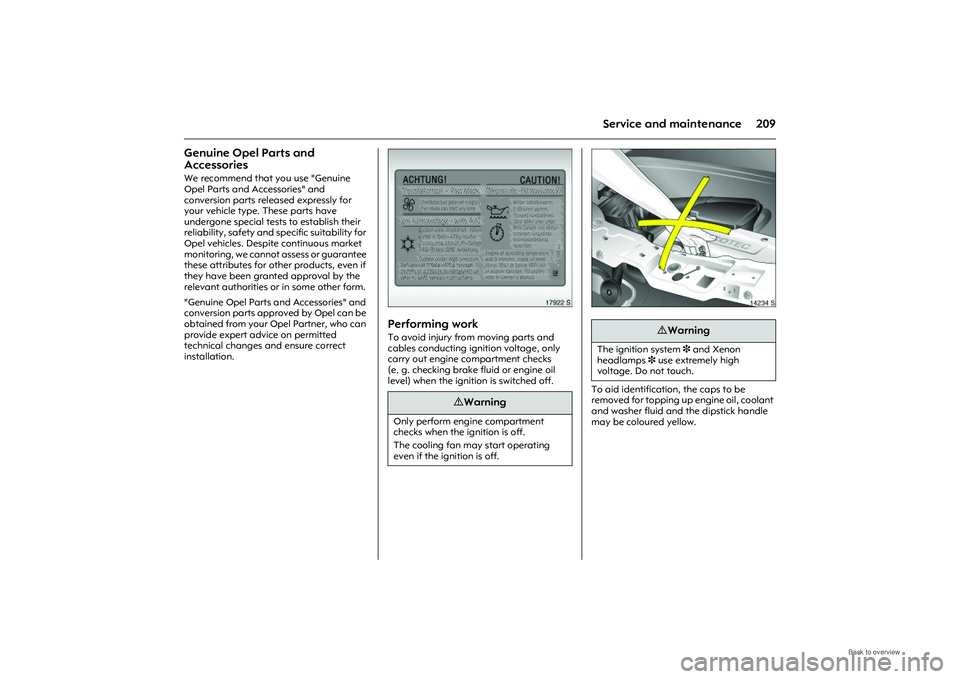
Picture no: 17922S.tif
Performing work To avoid injury from moving parts and
cables conducting ignition voltage, only
carry out engine compartment checks
(e. g. checking brake fluid or engine oil
level) when the igniti on is switched off.
Picture no: 14234s.tif
To aid identification, the caps to be
removed for topping up engine oil, coolant
and washer fluid and the dipstick handle
may be coloured yellow.
9 Warning
Only perform engine compartment
checks when the ignition is off.
The cooling fan may start operating
even if the ignition is off.
9 Warning
The ignition system 3 and Xenon
headlamps 3 use extremely high
voltage. Do not touch.