door lock OPEL MERIVA 2009 User Guide
[x] Cancel search | Manufacturer: OPEL, Model Year: 2009, Model line: MERIVA, Model: OPEL MERIVA 2009Pages: 248, PDF Size: 4.46 MB
Page 41 of 248
35
Keys, doors, windows, slide and tilt sunroof
Picture no: 14046s.tif
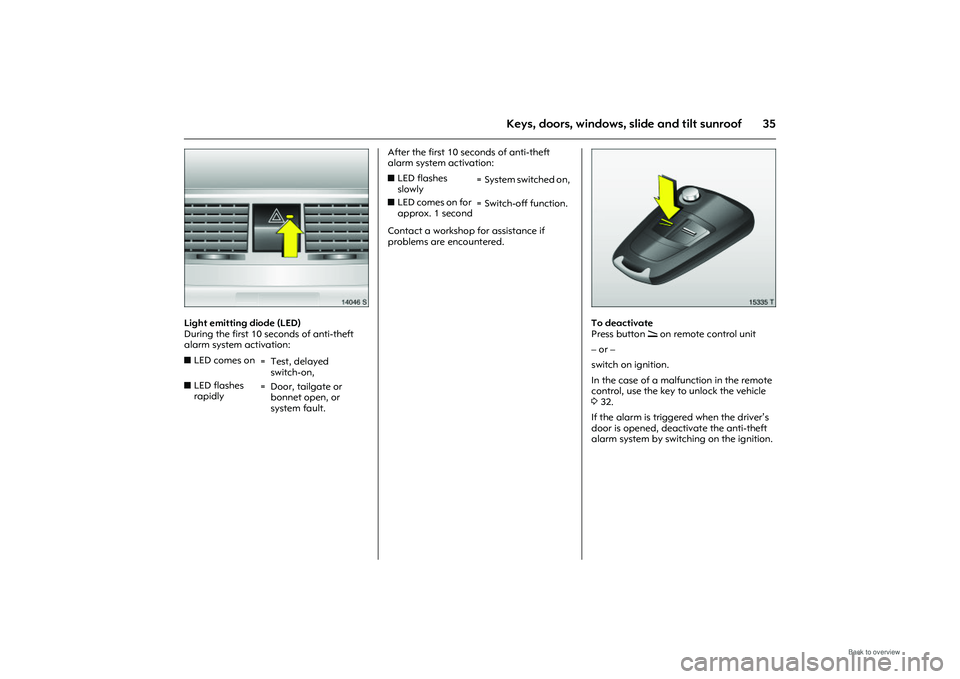
Light emitting diode (LED)
During the first 10 seconds of anti-theft
alarm system activation: After the first 10 seconds of anti-theft
alarm system activation:
Contact a workshop for assistance if
problems are encountered.
Picture no: 15335t.tif
To deactivate
Press button
q on remote control unit
– or –
switch on ignition.
In the case of a malfunction in the remote
control, use the key to unlock the vehicle
3 32.
If the alarm is triggered when the driver’s
door is opened, deactivate the anti-theft
alarm system by switching on the ignition.
z
LED comes on
= Test, delayed
switch-on,
z LED flashes
rapidly = Door, tailgate or
bonnet open, or
system fault.
zLED flashes
slowly =System switched on,
z LED comes on for
approx. 1 second = Switch-off function.
Page 42 of 248
36 Keys, doors, windows, slide and tilt sunroofNote
zChanges to the vehicle interior, such as
the use of seat covers, could impair the
function of passenger compartment
monitoring.
z Switch off the interior monitoring system
when the interior of a parked vehicle is
being heated.
Alarm
When triggered, the alarm gives off an
acoustic signal (horn) and a visual signal
(hazard warning flashers). The number
and duration of the alarms are stipulated
by legislation.
The alarm can be silenced by pressing a
button on the remote control or by
switching on the ignition. The anti-theft
alarm system is deactivated at the same
time.
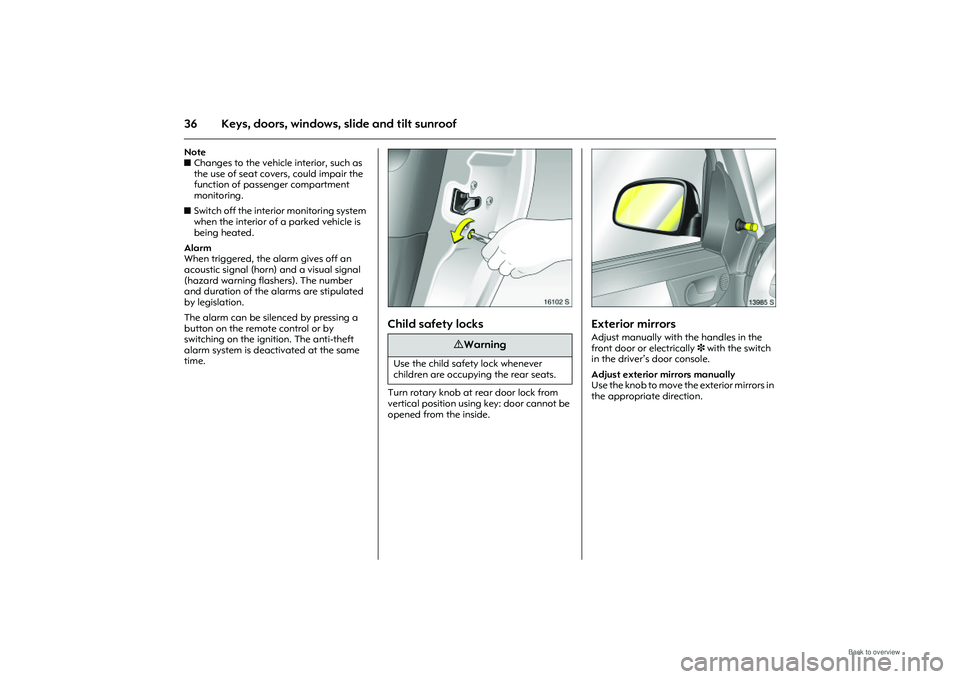
Picture no: 16102s.tif
Child safety locks Turn rotary knob at rear door lock from
vertical position using key: door cannot be
opened from the inside.
Picture no: 13985s.tif
Exterior mirrors Adjust manually with the handles in the
front door or electrically 3 with the switch
in the driver’s door console.
Adjust exterior mirrors manually
Use the knob to move the exterior mirrors in
the appropriate direction.
9 Warning
Use the child safety lock whenever
children are occupying the rear seats.
Page 113 of 248
107
Lighting
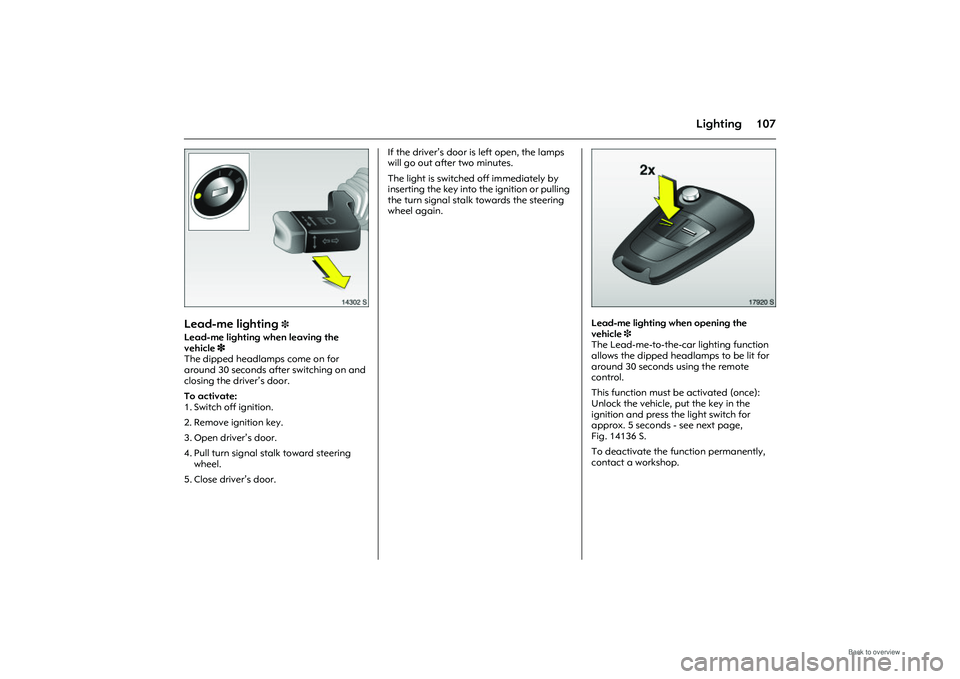
Picture no: 14302s.tif
Lead-me lighting
3
Lead-me lighting when leaving the
vehicle 3
The dipped headlamps come on for
around 30 seconds after switching on and
closing the driver’s door.
To activate:
1. Switch off ignition.
2. Remove ignition key.
3. Open driver’s door.
4. Pull turn signal stalk toward steering
wheel.
5. Close driver’s door. If the driver’s door is left open, the lamps
will go out after two minutes.
The light is switched off immediately by
inserting the key into
the ignition or pulling
the turn signal stalk towards the steering
wheel again.
Picture no: 17920S.tif
Lead-me lighting when opening the
vehicle 3
The Lead-me-to-the-car lighting function
allows the dipped headlamps to be lit for
around 30 seconds using the remote
control.
This function must be activated (once):
Unlock the vehicle, put the key in the
ignition and press the light switch for
approx. 5 seconds - see next page,
Fig. 14136 S.
To deactivate the function permanently,
contact a workshop.
Page 114 of 248
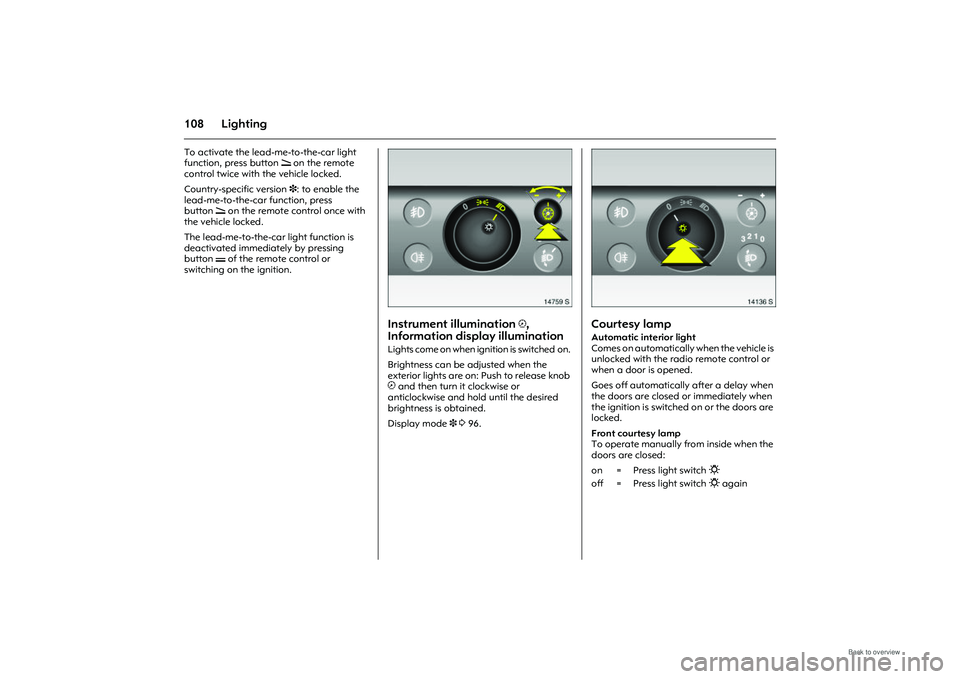
108 LightingTo activate the lead-me-to-the-car light
function, press button q on the remote
control twice with the vehicle locked.
Country-specific version 3: to enable the
lead-me-to-the-car function, press
button q on the remote control once with
the vehicle locked.
The lead-me-to-the-car light function is
deactivated immediately by pressing
button p of the remote control or
switching on the ignition.
Picture no: 14759s.tif
Instrument illumination
k,
Information display illumination
Lights come on when ignition is switched on.
Brightness can be adjusted when the
exterior lights are on: Push to release knob
k and then turn it clockwise or
anticlockwise and hold until the desired
brightness is obtained.
Display mode 3 396.
Picture no: 14136s.tif
Courtesy lamp Automatic interior light
Comes on automatically when the vehicle is
unlocked with the radi o remote control or
when a door is opened.
Goes off automatically after a delay when
the doors are closed or immediately when
the ignition is switched on or the doors are
locked.
Front courtesy lamp
To operate manually from inside when the
doors are closed: on = Press light switch 0
off = Press light switch 0 again
Page 115 of 248
109
Lighting
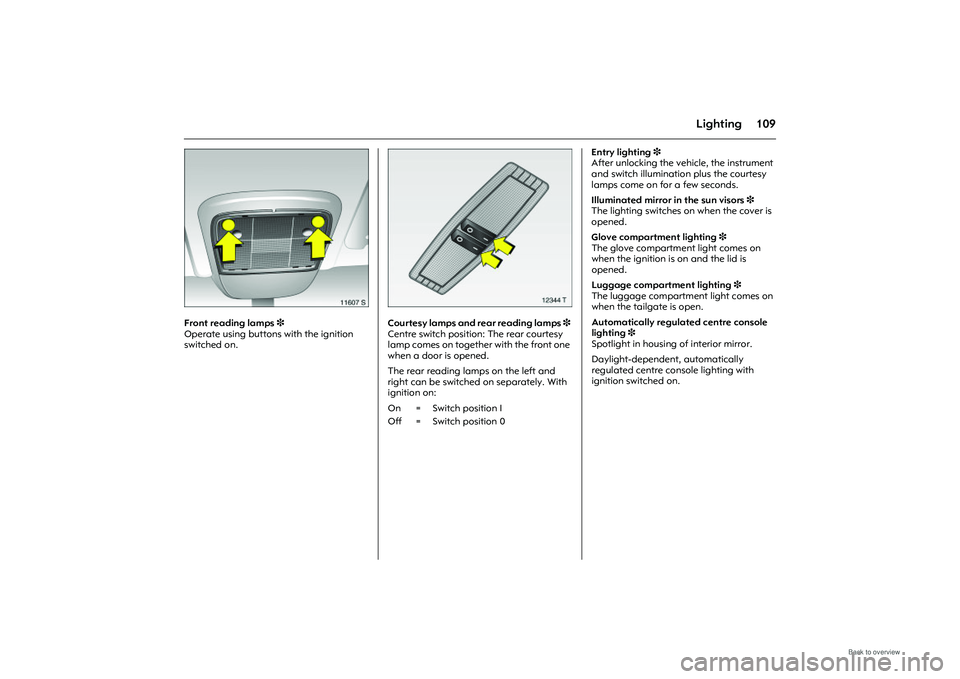
Picture no: 11607s.tif
Front reading lamps 3
Operate using buttons with the ignition
switched on.
Picture no: 12344t.tif
Courtesy lamps and rear reading lamps 3
Centre switch position: The rear courtesy
lamp comes on together with the front one
when a door is opened.
The rear reading lamps on the left and
right can be switched on separately. With
ignition on: Entry lighting
3
After unlocking the vehicle, the instrument
and switch illumination plus the courtesy
lamps come on for a few seconds.
Illuminated mirror in the sun visors 3
The lighting switches on when the cover is
opened.
Glove compartment lighting 3
The glove compartment light comes on
when the ignition is on and the lid is
opened.
Luggage compartment lighting 3
The luggage compartment light comes on
when the tailgate is open.
Automatically regulated centre console
lighting 3
Spotlight in housing of interior mirror.
Daylight-dependent, automatically
regulated centre console lighting with
ignition switched on. On = Switch position I
Off = Switch position 0
Page 124 of 248
118 Climate control
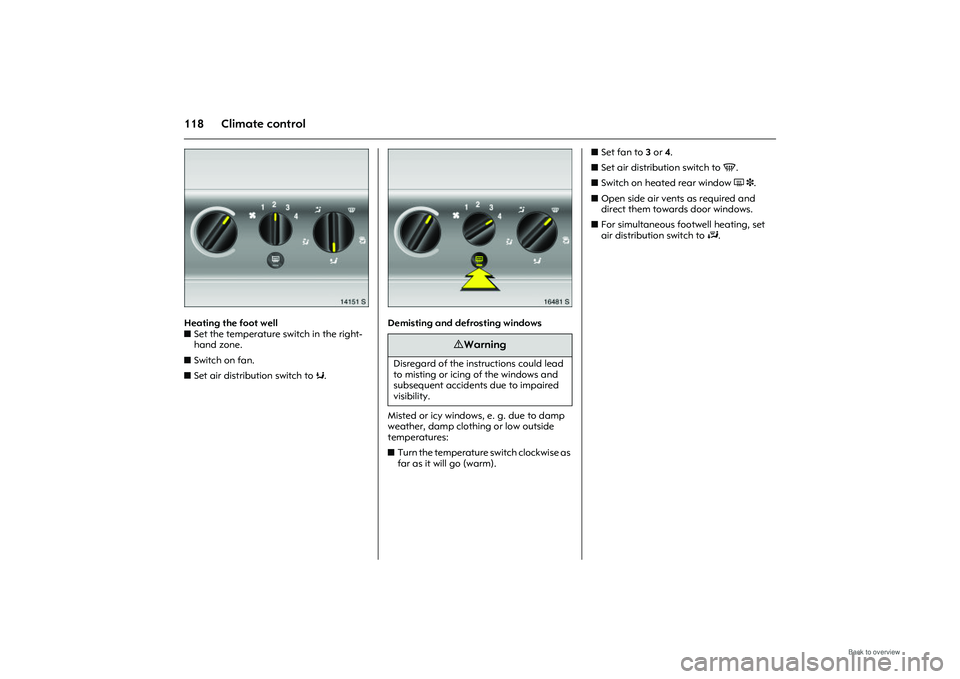
Picture no: 14151s.tif
Heating the foot well
zSet the temperature switch in the right-
hand zone.
z Switch on fan.
z Set air distribution switch to K.
Picture no: 16481s.tif
Demisting and defrosting windows
Misted or icy windows, e. g. due to damp
weather, damp clothing or low outside
temperatures:
z Turn the temperature switch clockwise as
far as it will go (warm). z
Set fan to 3 or 4 .
z Set air distribution switch to V.
z Switch on heated rear window Ü 3.
z Open side air vents as required and
direct them towards door windows.
z For simultaneous footwell heating, set
air distribution switch to J.
9 Warning
Disregard of the instructions could lead
to misting or icing of the windows and
subsequent accidents due to impaired
visibility.
Page 131 of 248
125
Climate control
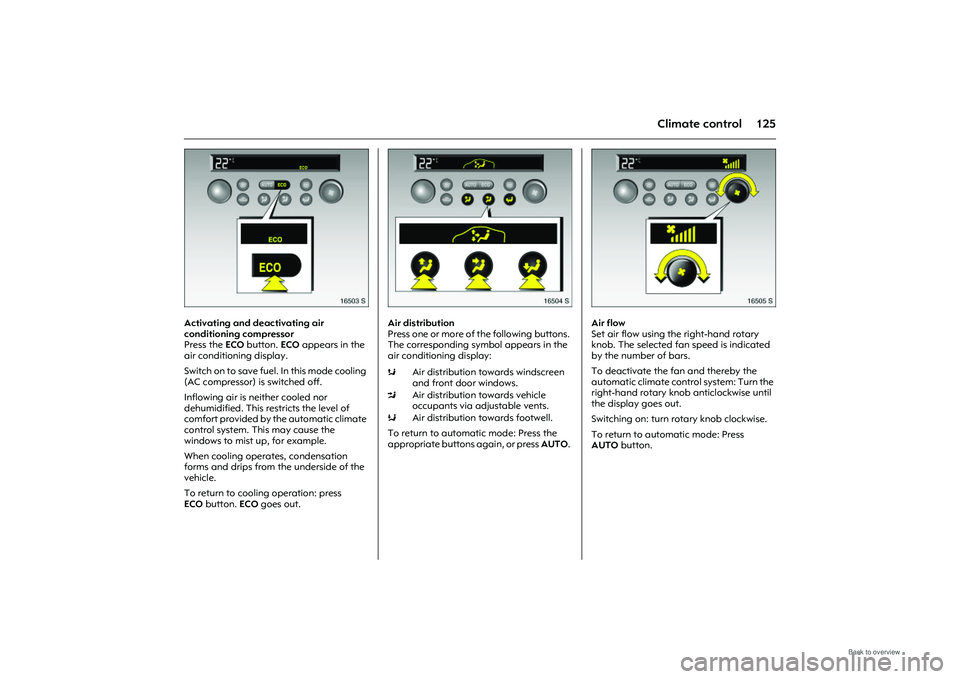
Picture no: 16503s.tif
Activating and deactivating air
conditioning compressor
Press the ECO button. ECO appears in the
air conditioning display.
Switch on to sa ve fuel. In this m ode cooling
(AC compressor) is switched off.
Inflowing air is neither cooled nor
dehumidified. This restricts the level of
comfort provided by the automatic climate
control system. This may cause the
windows to mist up, for example.
When cooling operates, condensation
forms and drips from the underside of the
vehicle.
To return to cooling operation: press
ECO button. ECO goes out.
Picture no: 16504s.tif
Air distribution
Press one or more of the following buttons.
The corresponding symbol appears in the
air conditioning display:
To return to automatic mode: Press the
appropriate buttons again, or press AUTO.
Picture no: 16505s.tif
Air flow
Set air flow using the right-hand rotary
knob. The selected fan speed is indicated
by the number of bars.
To deactivate the fan and thereby the
automatic climate control system: Turn the
right-hand rotary knob anticlockwise until
the display goes out.
Switching on: turn rota ry knob clockwise.
To return to automatic mode: Press
AUTO button.
sAir distribution towards windscreen
and front door windows.
M Air distribution towards vehicle
occupants via adjustable vents.
K Air distribution towards footwell.
Page 147 of 248
141
Driving and operation
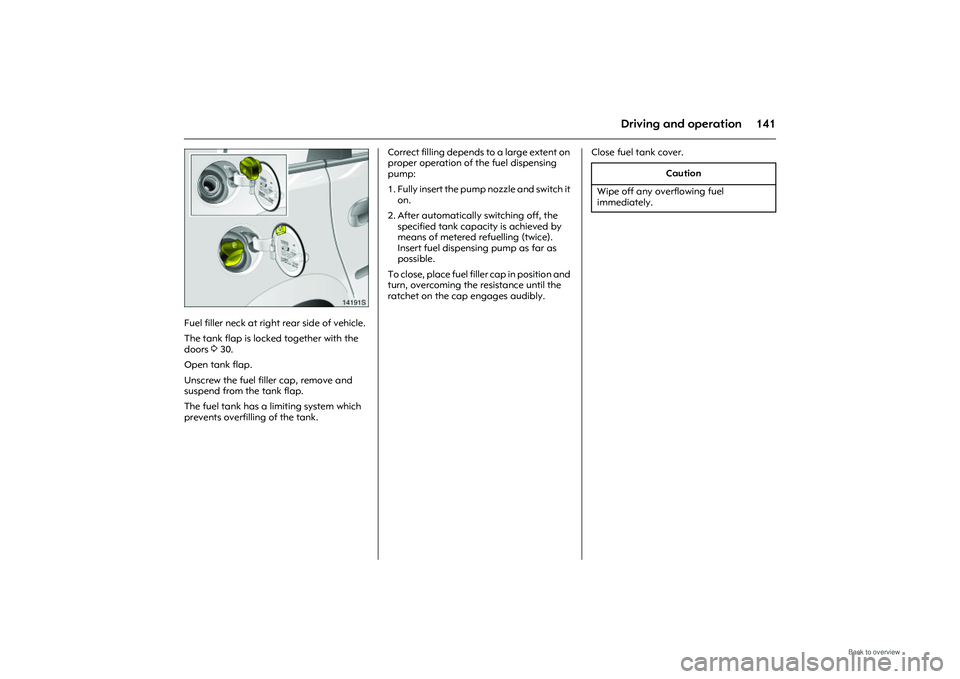
Picture no: 14191s.tif
Fuel filler neck at right rear side of vehicle.
The tank flap is locked together with the
doors 330.
Open tank flap.
Unscrew the fuel filler cap, remove and
suspend from the tank flap.
The fuel tank has a limiting system which
prevents overfilling of the tank. Correct filling depends to a large extent on
proper operation of
the fuel dispensing
pump:
1. Fully insert the pump nozzle and switch it on.
2. After automatically switching off, the specified tank capacity is achieved by
means of metered re fuelling (twice).
Insert fuel dispensing pump as far as
possible.
To close, place fuel filler cap in position and
turn, overcoming the resistance until the
ratchet on the cap engages audibly. Close fuel tank cover.
Caution
Wipe off any overflowing fuel
immediately.
Page 208 of 248
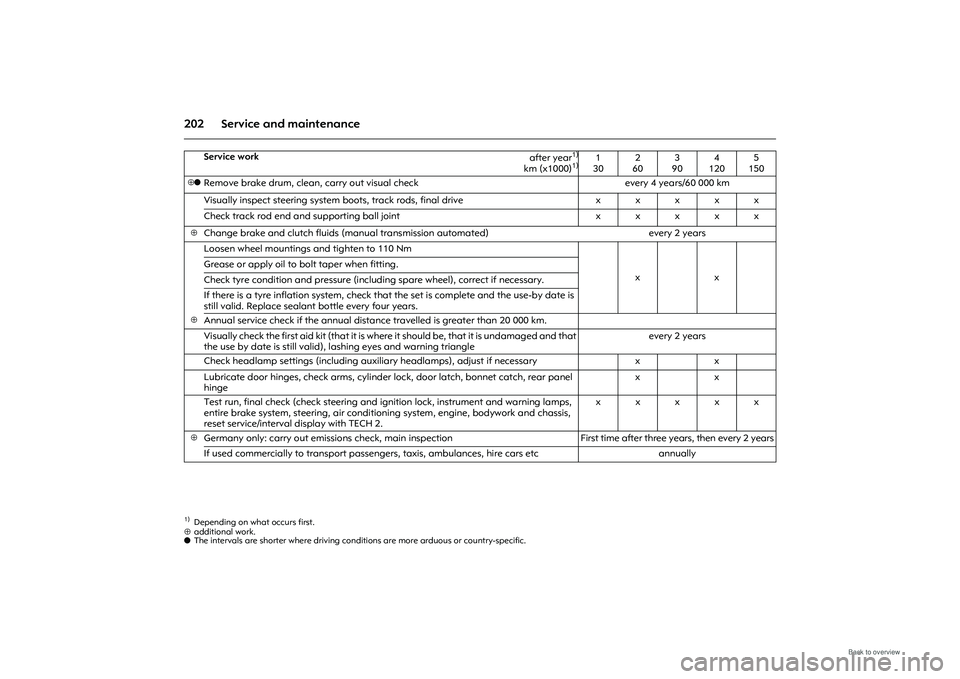
202 Service and maintenance⊕additional work.
o The intervals are shorter where driving conditions are more arduous or country-specific.
Service work
after year
1)
km (x1000)
1)
1)Depending on what occurs first.
1
30 2
60 3
90 4
120 5
150
⊕o
Remove brake drum, clean, carry out visual check every 4 years/60 000 km
Visually inspect steering system boots, track rods, final drive xxxxx
Check track rod end and supporting ball joint xxxxx
⊕
Change brake and clutch fluids (manual transmission automated) every 2 years
Loosen wheel mountings and tighten to 110 Nm
xx
Grease or apply oil to
bolt taper when fitting.
Check tyre condition and pressure (inclu ding spare wheel), correct if necessary.
If there is a tyre inflation system, check that the set is complete and the use-by date is
still valid. Replace sealant bottle every four years.
⊕
Annual service check if the annual distance travelled is greater than 20 000 km.
Visually check the first aid kit (that it is wher e it should be, that it is undamaged and that
the use by date is still valid), lashing eyes and warning triangle every 2 years
Check headlamp settings (including auxi liary headlamps), adjust if necessary xx
Lubricate door hinges, check arms, cylinder lo ck, door latch, bonnet catch, rear panel
hinge xx
Test run, final check (check steering and ig nition lock, instrument and warning lamps,
entire brake system, steering, air conditioni ng system, engine, bodywork and chassis,
reset service/interval display with TECH 2. xxxxx
⊕
Germany only: carry out emissions check, main inspection
First time after three years, then every 2 years
If used commercially to tran sport passengers, taxis, ambulances, hire cars etc annually
Page 211 of 248
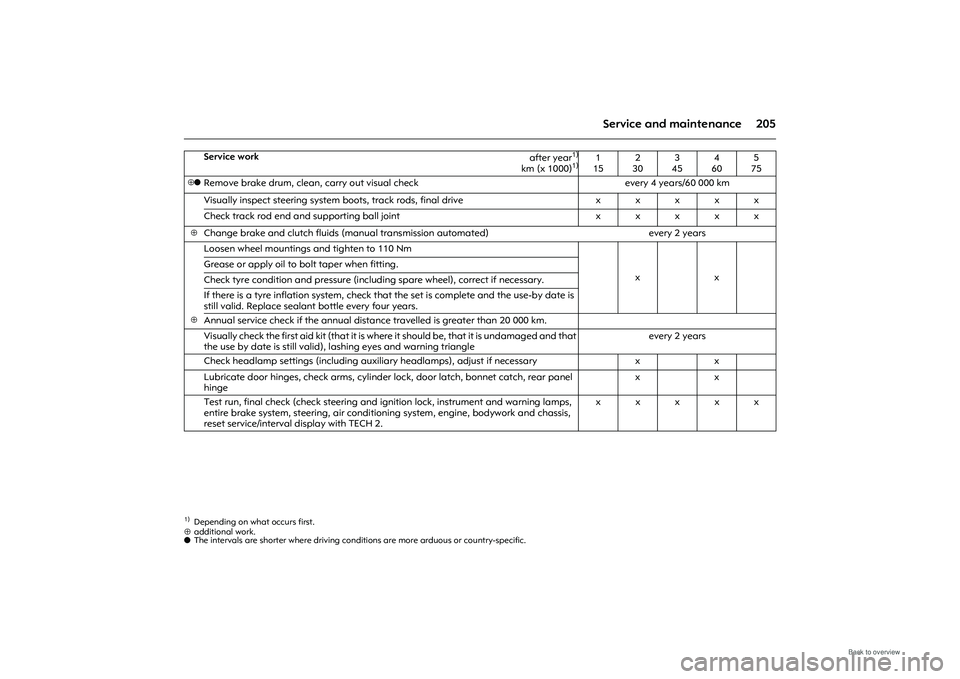
205
Service and maintenance
⊕ additional work.
o The intervals are shorter where driving conditions are more arduous or country-specific.
Service work
after year
1)
km (x 1000)
1)
1)Depending on what occurs first.
1
15 2
30 3
45 4
60 5
75
⊕o
Remove brake drum, clean, carry out visual check every 4 years/60 000 km
Visually inspect steering system boots, track rods, final drive xxxxx
Check track rod end and supporting ball joint xxxxx
⊕
Change brake and clutch fluids (manual transmission automated) every 2 years
Loosen wheel mountings and tighten to 110 Nm
xx
Grease or apply oil to
bolt taper when fitting.
Check tyre condition and pressure (inclu ding spare wheel), correct if necessary.
If there is a tyre inflation system, check that the set is complete and the use-by date is
still valid. Replace sealant bottle every four years.
⊕
Annual service check if the annual distance travelled is greater than 20 000 km.
Visually check the first aid kit (that it is wher e it should be, that it is undamaged and that
the use by date is still valid), lashing eyes and warning triangle every 2 years
Check headlamp settings (including auxi liary headlamps), adjust if necessary xx
Lubricate door hinges, check arms, cylinder lo ck, door latch, bonnet catch, rear panel
hinge xx
Test run, final check (check steering and ig nition lock, instrument and warning lamps,
entire brake system, steering, air conditioni ng system, engine, bodywork and chassis,
reset service/interval display with TECH 2. xxxxx