page 34 OPEL MERIVA 2009 User Guide
[x] Cancel search | Manufacturer: OPEL, Model Year: 2009, Model line: MERIVA, Model: OPEL MERIVA 2009Pages: 248, PDF Size: 4.46 MB
Page 142 of 248
136 Driving and operationSave energy – more kilometres
Please observe the running-in hints on the
previous page and the tips for energy
saving on the following pages.
Good, technically correct and economical
driving ensures maximum durability and
performance for your vehicle.
Overrun cut-off
The fuel supply is automatically cut off
during overrun, e.g. when the vehicle is
driven with a gear engaged but no throttle
application. Overrun cut-off is deactivated
if catalytic converter temperature is high.
Vehicles with turbocharged engine
3
Flow-generated noises may be audible if
the accelerator is released quickly on
account of air flow in the turbocharger.
Engine speed
Drive in a low engine speed range for each
gear as much as possible. Warming up
Allow the engine to wa
rm up while driving.
Do not warm it up by letting it ru n at idling
speed. Do not apply full throttle until the
engine has reached operating
temperature.
After a cold start, the manual transmission
automated 3 does not switch to higher
gears until the speed increases when it is in
automatic mode. This allows the catalytic
converter to reach th e temperature quickly
which is required for optimum emission
reduction.
Correct gear selection
Do not race your engine whilst in neutral or
with a low gear selected. Driving too fast in
individual gears as well as stop-and-go
traffic increases engine wear and fuel
consumption.
Change down
When decreasing speed, shift down into
the next lowest gear. Do not slip the clutch
with a high-revving engine. This is
especially important when hill climbing. Cooling fan
The cooling fan is controlled via a
thermoswitch and therefore only runs if
necessary.
The cooling fan automatically switches on
when the diesel particle filter is being
cleaned
3 depending on the engine.
Pedals
Do not place any objects in the foot well
which could slip under the pedals and
inhibit the pedal travel.
To ensure the pedal travel is uninhibited,
there must be no mats in the area of the
pedals.
Battery care
When driving slowly or when the vehicle is
stationary, e.g. in slow urban traffic, stop-
and-go traffic or traffic jams, turn off all
unnecessary electrical loads where
possible (e.g. heated rear window, heated
front seats, etc.).
Declutch when starting in order to relieve
the strain on the starter and the battery.
Page 148 of 248
142 Driving and operation
Picture no: 6448u.tif
Catalytic converter, exhaust
gassesCatalytic converter
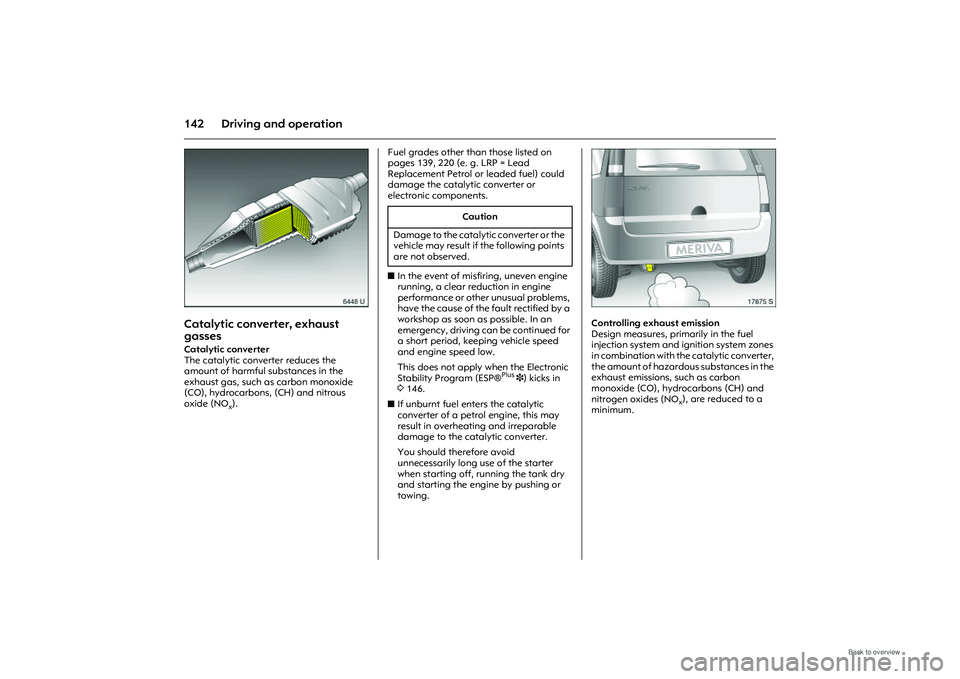
The catalytic converter reduces the
amount of harmful substances in the
exhaust gas, such as carbon monoxide
(CO), hydrocarbons, (CH) and nitrous
oxide (NO
x). Fuel grades other than those listed on
pages 139, 220 (e. g. LRP = Lead
Replacement Petrol or leaded fuel) could
damage the catalytic converter or
electronic components.
z
In the event of misfiring, uneven engine
running, a clear reduction in engine
performance or other unusual problems,
have the cause of the fault rectified by a
workshop as soon as possible. In an
emergency, driving can be continued for
a short period, keeping vehicle speed
and engine speed low.
This does not apply when the Electronic
Stability Program (ESP®
Plus
3) kicks in
3 146.
z If unburnt fuel enters the catalytic
converter of a petrol engine, this may
result in overheating and irreparable
damage to the catalytic converter.
You should therefore avoid
unnecessarily long use of the starter
when starting off, running the tank dry
and starting the engine by pushing or
towing.
Picture no: 17875s.tif
Controlling exhaust emission
Design measures, primarily in the fuel
injection system and ignition system zones
in combination with the catalytic converter,
the amount of hazardous substances in the
exhaust emissions, such as carbon
monoxide (CO), hydrocarbons (CH) and
nitrogen oxides (NO
x), are reduced to a
minimum.
Caution
Damage to the catalytic converter or the
vehicle may result if the following points
are not observed.
Page 179 of 248
173
Self-help, vehicle care
General information
Depending on version, the spare wheel
may be in the form of a temporary spare
wheel 3. Refer to the notes on this page
and 3157, 3228.
On vehicles with alloy wheels 3 the spare
wheel may have a steel rim.
Use of a spare wheel together with winter
tyres could alter driving conditions. Have
the defective tyre replaced as soon as
possible.
Use of a spare wheel that is smaller than
the other wheels could alter driving
conditions. In many countries, it is only
permitted as a temporary spare wheel.
Have the defective tyre replaced as soon
as possible. Notes on temporary spare wheel
3
z The use of the temporary spare wheel
may affect the handling of the vehicle,
particularly if winter tyres are being
used 3. The Electronic Stability Program
ESP®
Plus
3 may switch itself off. Replace
defective tyre as soon as possible,
balance wheel and fit to vehicle.
z Fit only one temporary spare wheel.
z Do not drive faster than 80 km/h.
z Take curves slowly.
z Do not use the temporary spare wheel
for a lengthy period.
z Replace temporary spare wheel with full
specification wheel without delay.
z Tyre chains are not permitted on the
temporary spare wheel. If tyre chains
have to be used after a front wheel
puncture, fit tempor ary spare wheel to
the rear axle and fit a rear wheel to the
front axle. Check tyre pressure and
correct if necessary 3228.
z Observe notes on temporary spare
wheel on 3157, 3228. Notes on directional tyres
3
Fit directional tyres such that they roll in the
direction of travel. The rolling direction is
indicated by a symbol (e.g. an arrow) on
the sidewall.
The following applies to tyres fitted
opposing the rolling direction:
z Driving conditions may be altered. Have
the defective tyre replaced as soon as
possible.
z Do not drive faster than 80 km/h.
z Be especially careful when driving in rain
and snow.
Further information on directional tyres
3 154.
Page 202 of 248
196 Self-help, vehicle care
Picture no: 12928j.tif
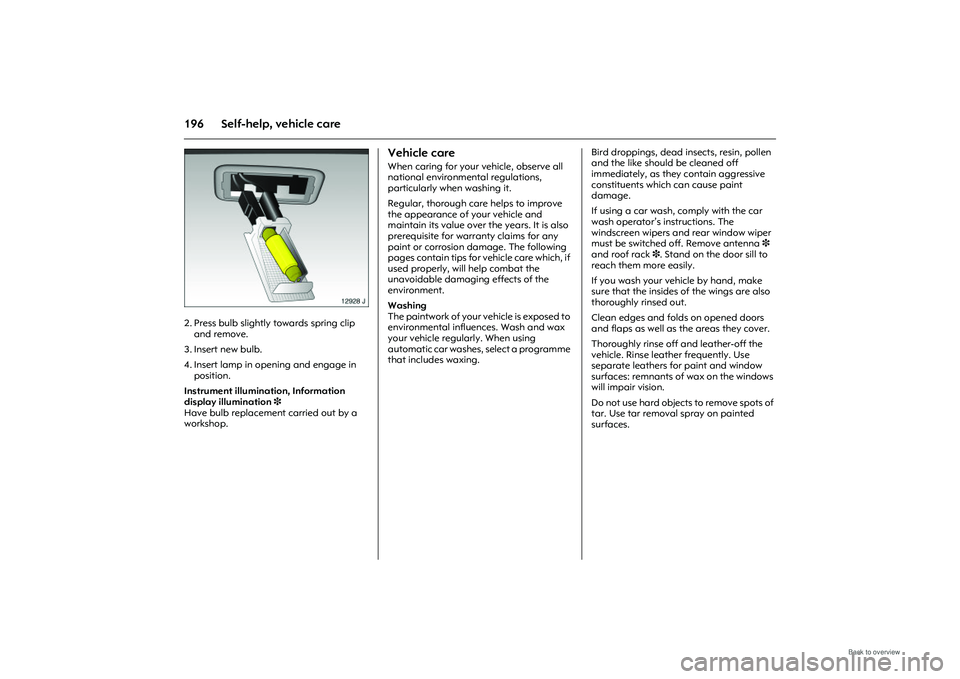
2. Press bulb slightly towards spring clip and remove.
3. Insert new bulb.
4. Insert lamp in op ening and engage in
position.
Instrument illumination, Information
display illumination 3
Have bulb replacement carried out by a
workshop.
Vehicle careWhen caring for your vehicle, observe all
national environmental regulations,
particularly when washing it.
Regular, thorough care helps to improve
the appearance of your vehicle and
maintain its value over the years. It is also
prerequisite for warranty claims for any
paint or corrosion damage. The following
pages contain tips for vehicle care which, if
used properly, will help combat the
unavoidable damaging effects of the
environment.
Washing
The paintwork of your vehicle is exposed to
environmental influences. Wash and wax
your vehicle regularly. When using
automatic car washes, select a programme
that includes waxing. Bird droppings, dead insects, resin, pollen
and the like should be cleaned off
immediately, as they contain aggressive
constituents which can cause paint
damage.
If using a car wash, comply with the car
wash operator’s instructions. The
windscreen wipers and rear window wiper
must be switched off. Remove antenna
3
and roof rack 3 . Stand on the door sill to
reach them more easily.
If you wash your vehicle by hand, make
sure that the insides of the wings are also
thoroughly rinsed out.
Clean edges and folds on opened doors
and flaps as well as the areas they cover.
Thoroughly rinse off and leather-off the
vehicle. Rinse leather frequently. Use
separate leathers for paint and window
surfaces: remnants of wax on the windows
will impair vision.
Do not use hard objects to remove spots of
tar. Use tar removal spray on painted
surfaces.
Page 234 of 248
228 Technical DataTyres Restrictions
Not all tyres available on the market
currently meet the structural requirements.
We recommend that you consult an Opel
Partner concerning suitable tyre makes.
These tyres have undergone special tests
to establish their reliability, safety and
specific suitability for Opel vehicles.
Despite continuous market monitoring, we
are unable to assess these attributes for
other tyres, even if they have been granted
approval by the relevant authorities or in
some other form.
Further information 3153. Winter tyres
3
Tyres of size 205/50 R 16 are not suitable
for use as winter tyres except on vehicles
with the Z 16 LET engine.
Tyres of size 205/45 R 17 are not suitable
for use as winter tyres. If winter tyres are in use, the spare wheel
may still be fitted with a summer tyre. Use
of the spare wheel may alter vehicle
handling. Obtain a replacement for the
faulty tyre as soon as possible, and have
the wheel balanced and fitted to the
vehicle.
Further information 3
157.
Tyre chains
3
Tyre chains may be used on the front
wheels only.
We recommend the use of tyre chains with
a fine mesh that add no more than 10 mm
to the running surface and the insides of
the tyres (including chain lock).
Tyre chains are not permitted on tyre
sizes 205/50 R 16 and 205/45 R 17.
Further information 3157. Wheels Wheel bolt tightening torque: 110 Nm.
Spare wheel
3
Depending on model, the spare wheel is
designed as a temporary spare wheel 3.
When using the spare wheel, the driving
behaviour may be modified. Replace the
faulty tyre as soon as possible, balance the
wheel and refit to vehicle. Follow the notes
on this page and 3157, 3173.
On vehicles with alloy wheels 3 the spare
wheel may have a steel rim.
The spare wheel can be fitted with a
smaller tyre
1)and a smaller rim than the
wheels fitted on the vehicle.
Tyre pressure (overpressure) The specified tyre pressures are valid for
cold tyres. The increased tyre pressure
resulting from extensive driving must not
be reduced. The tyre pressures specified on
the following pages apply to both summer
and winter tyres.
The spare wheel must always be inflated to
the tyre pressure for a full load – see table
on following pages.
Further information 3153 to 3157. 1)Country-specific version: The spare wheel is
only to be used as a temporary spare wheel.