belt OPEL MERIVA 2009 Owner's Manual
[x] Cancel search | Manufacturer: OPEL, Model Year: 2009, Model line: MERIVA, Model: OPEL MERIVA 2009Pages: 248, PDF Size: 4.46 MB
Page 82 of 248
76 Seats, InteriorUse of child restraint systems 3 on the
front passenger seat in vehicles with
airbag systems 3, but without seat
occupancy recognition 3
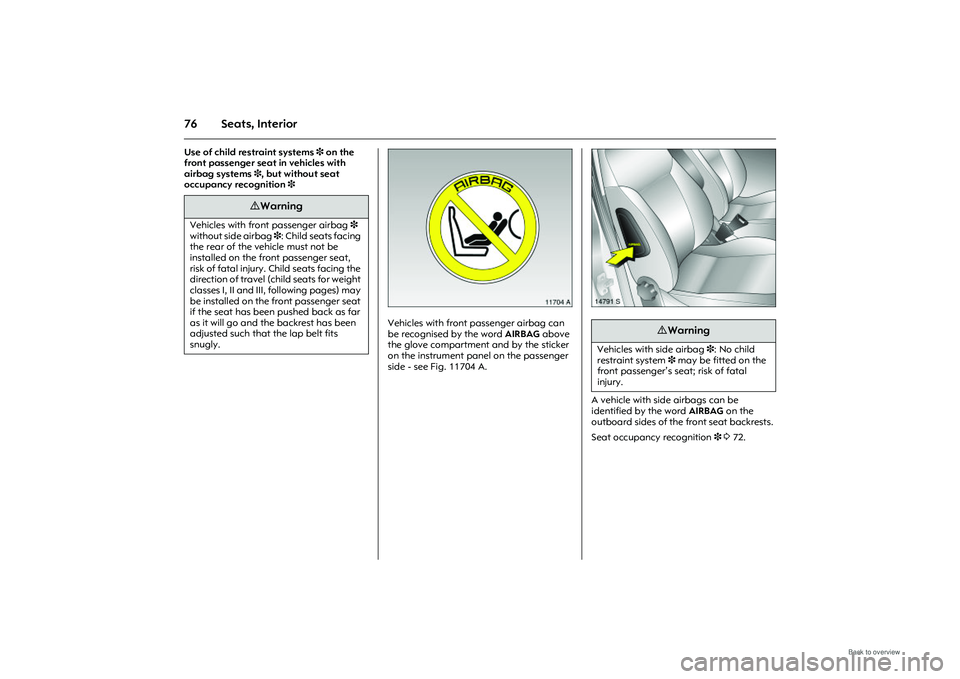
Picture no: 11704a.tif
Vehicles with front passenger airbag can
be recognised by the word AIRBAG above
the glove compartment and by the sticker
on the instrument panel on the passenger
side - see Fig. 11704 A.
Picture no: 14791s.tif
A vehicle with side airbags can be
identified by the word AIRBAG on the
outboard sides of the front seat backrests.
Seat occupancy recognition 3 372.
9 Warning
Vehicles with fron t passenger airbag 3
without side airbag 3: Child seats facing
the rear of the vehicle must not be
installed on the front passenger seat,
risk of fatal injury. Child seats facing the
direction of travel (child seats for weight
classes I, II and III, following pages) may
be installed on the front passenger seat
if the seat has been pushed back as far
as it will go and the backrest has been
adjusted such that the lap belt fits
snugly.
9 Warning
Vehicles with side airbag 3: No child
restraint system 3 may be fitted on the
front passenger’s seat; risk of fatal
injury.
Page 88 of 248
82 Instruments, ControlsInstruments, ControlsControl indicators ................................ 82
Instrument display ............................... 87
Information display ............................. 90
Warning buzzers.................................. 100
Windscreen wipers ............................... 100
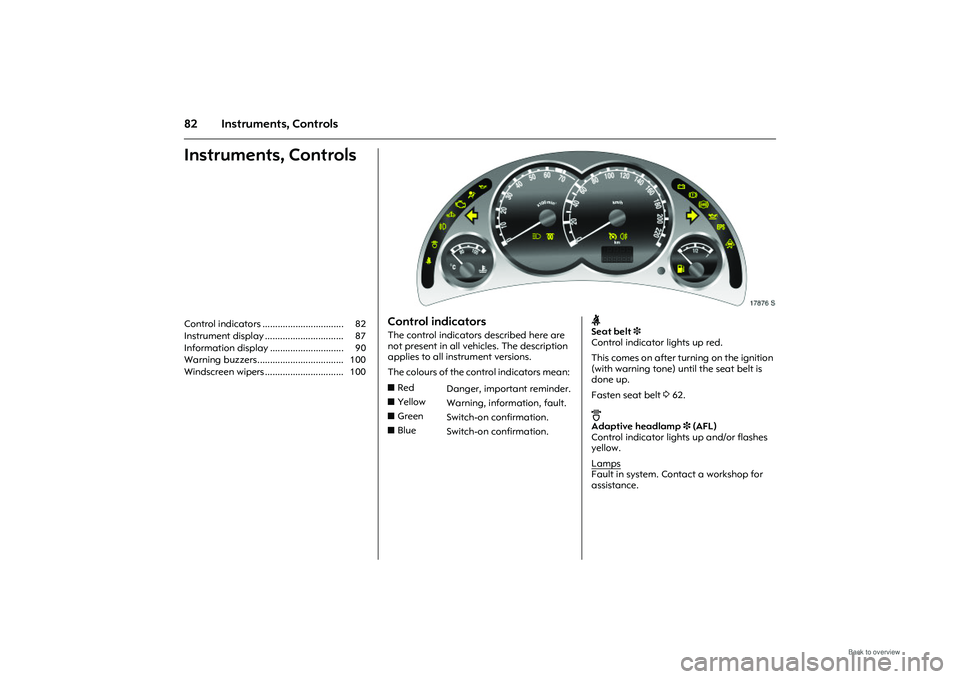
Picture no: 17876s.tif
Control indicators The control indicators described here are
not present in all vehicles. The description
applies to all instrument versions.
The colours of the control indicators mean:
Picture no:
X
Seat belt 3
Control indicator lights up red.
This comes on after turning on the ignition
(with warning tone) until the seat belt is
done up.
Fasten seat belt 362. B
Adaptive headlamp 3 (AFL)
Control indicator lights up and/or flashes
yellow.
Lamps
Fault in system. Contact a workshop for
assistance.
z
Red
Danger, important reminder.
z Yellow
Warning, information, fault.
z Green
Switch-on confirmation.
z Blue
Switch-on confirmation.
Page 89 of 248
83
Instruments, Controls
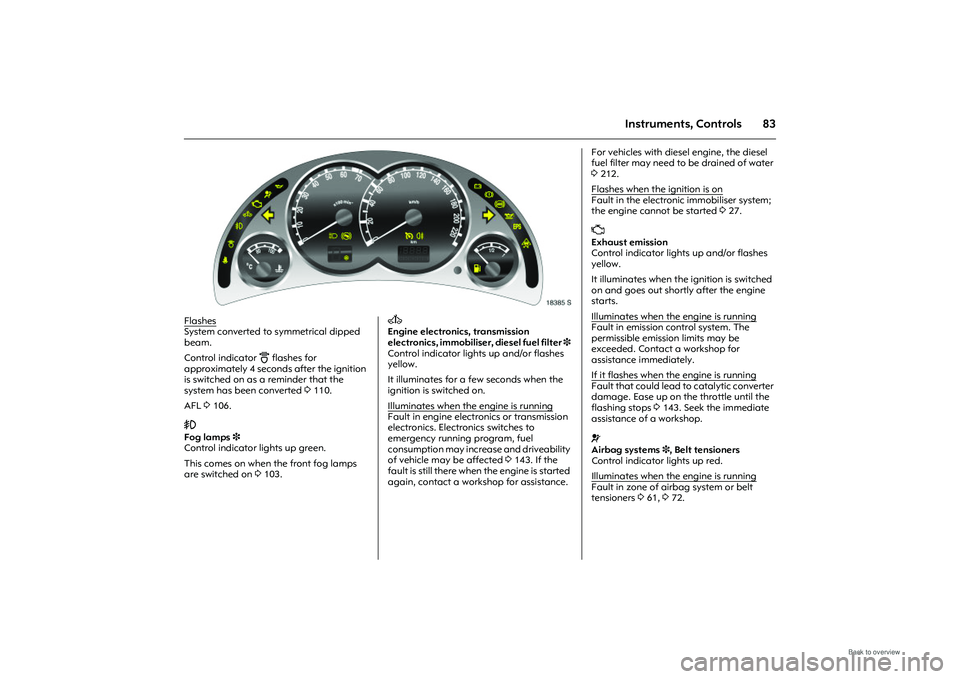
Picture no: 18385s.tif
Flashes
System converted to symmetrical dipped
beam.
Control indicator
B
flashes for
approximately 4 seconds after the ignition
is switched on as a reminder that the
system has been converted 3110.
AFL 3106.
>
Fog lamps 3
Control indicator lights up green.
This comes on when the front fog lamps
are switched on 3103.
Picture no:
A
Engine electronics, transmission
electronics, immo biliser, diesel fuel filter 3
Control indicator lights up and/or flashes
yellow.
It illuminates for a few seconds when the
ignition is switched on.
Illuminates when the engine is running
Fault in engine electronics or transmission
electronics. Electr onics switches to
emergency running program, fuel
consumption may increase and driveability
of vehicle may be affected 3143. If the
fault is still there when the engine is started
again, contact a workshop for assistance.
For vehicles with diesel engine, the diesel
fuel filter may need to be drained of water
3 212.
Flashes when the ignition is onFault in the electronic immobiliser system;
the engine cannot be started 327. Z
Exhaust emission
Control indicator lights up and/or flashes
yellow.
It illuminates when the ignition is switched
on and goes out shortly after the engine
starts.
Illuminates when the engine is running
Fault in emission control system. The
permissible emission limits may be
exceeded. Contact a workshop for
assistance immediately.
If it flashes when the engine is runningFault that could lead to catalytic converter
damage. Ease up on the throttle until the
flashing stops 3143. Seek the immediate
assistance of a workshop. v
Airbag systems 3, Belt tensioners
Control indicator lights up red.
Illuminates when the engine is runningFault in zone of airbag system or belt
tensioners 361, 372.
Page 106 of 248
100 Instruments, ControlsWarning buzzersWhen starting the engine or whilst
driving:
zIf seat belt is not fastened 3.
z If the speed programmed at the
factory 3 is exceeded.
z If the car has automated manual
transmission 3 and the driver’s door is
opened when the engine is running, a
gear is engaged and the foot brake is
not depressed.
When the vehicle is parked and the
driver’s door is opened:
z when the key is in the ignition switch
z with parking lamps or dipped beam on
z if the turn signal stalk is engaged
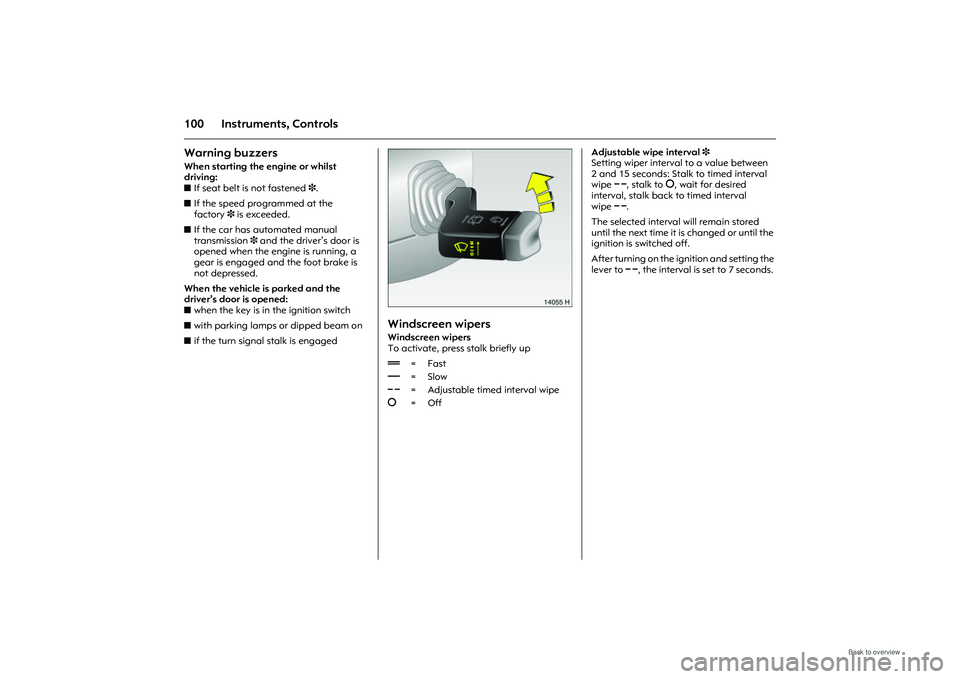
Picture no: 14055h.tif
Windscreen wipers Windscreen wipers
To activate, press stalk briefly up Adjustable wipe interval
3
Setting wiper interval to a value between
2 and 15 seconds: Stalk to timed interval
wipe $, stalk to § , wait for desired
interval, stalk back to timed interval
wipe $.
The selected interval will remain stored
until the next time it is changed or until the
ignition is switched off.
After turning on the ignition and setting the
lever to $, the interval is set to 7 seconds.
& =Fast
% =Slow
$ = Adjustable timed interval wipe
§ =Off
Page 134 of 248
128 Climate controlRegular operationFor consistently good operation, the air
cooling system 3 must be switched on for
several minutes once per month regardless
of the weather and the time of year.
Operation not possible with the cooling
system switched on and when the outside
temperature is low.
Service For optimal cooling performance, we
recommend that the climate control
system be checked annually, starting three
years after initial vehicle registration.
z Functionality and pressure test,
z Heating functionality,
z Leakage check,
z Check of drive belts,
z Cleaning of condenser and evaporator
drainage,
z Performance check.
Page 162 of 248
156 Driving and operation
Picture no: 6456u.tif
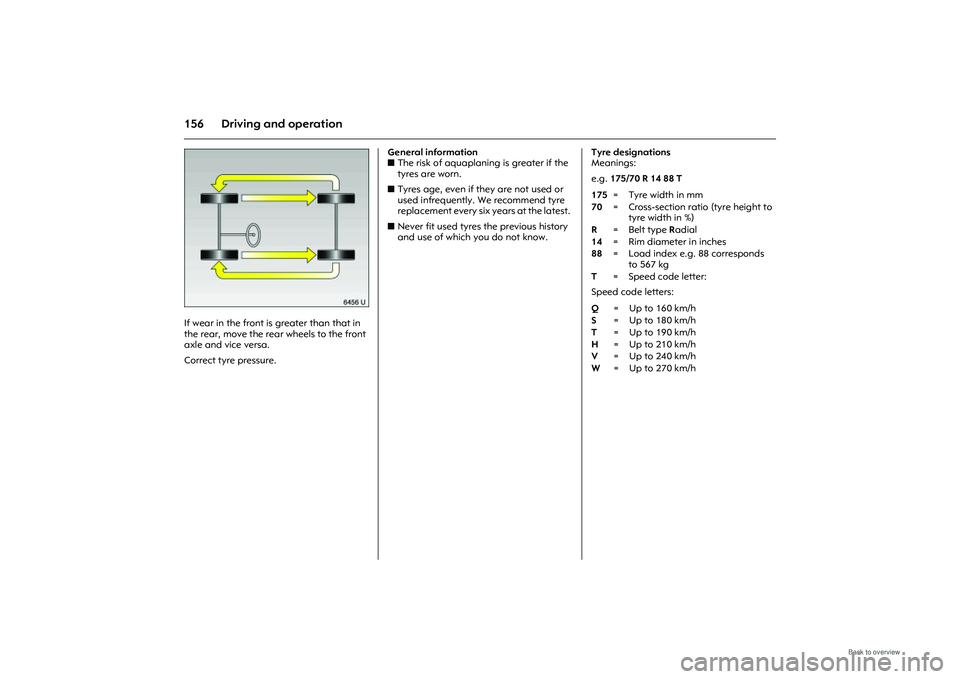
If wear in the front is greater than that in
the rear, move the rear wheels to the front
axle and vice versa.
Correct tyre pressure. General information
z
The risk of aquaplaning is greater if the
tyres are worn.
z Tyres age, even if they are not used or
used infrequently. We recommend tyre
replacement every six years at the latest.
z Never fit used tyres the previous history
and use of which you do not know. Tyre designations
Meanings:
e.g.
175/70 R 14 88 T
Speed code letters:
175 = Tyre width in mm
70 = Cross-section ratio (tyre height to
tyre width in %)
R = Belt type Radial
14 = Rim diameter in inches
88 = Load index e.g. 88 corresponds
to 567 kg
T = Speed code letter:
Q = Up to 160 km/h
S = Up to 180 km/h
T = Up to 190 km/h
H = Up to 210 km/h
V = Up to 240 km/h
W = Up to 270 km/h
Page 203 of 248
197
Self-help, vehicle care
Polishing and waxing
Wax the vehicle regularly (by the time the
water no longer beads at the latest).
Otherwise, the paintwork will dry out.
Polishing is necessary only if the paint has
become dull or if solid deposits have
become attached to it.
Paintwork polish with silicone forms a
protective film, making waxing
unnecessary.
Plastic body parts should not be treated
with wax and polish.
Wheels and tyres
Do not use high-pressure jet cleaners.
Clean wheels with a pH-neutral wheel
cleaner.
Wheels are painted and can be treated
with the same agents as the body.
Paintwork damage
Rectify minor paintwork damage with a
touch-up pen before rust forms. Have more
extensive damage or rust areas repaired
by a workshop. Exterior lights
Headlamp and other lamp covers are
made of plastic. Do not use any caustic
agents, do not use an ice scraper, and do
not clean them when dry.
Plastic and rubber parts
Plastic and rubber parts can be cleaned
with the same cleaner as used to clean the
body. Use interior cleaner if necessary. Do
not use any other agent. Avoid solvents
and petrol in particular. Do not use high-
pressure jet cleaners.
Interior and upholstery
Only clean the vehicle interior, including
the instrument panel fascia and panelling,
with a dry cloth or interior cleaner.
The instrument pane
l should only be
cleaned using a soft damp cloth.
Clean fabric upholstery with a vacuum
cleaner and brush. Remove stains with an
upholstery cleaner.
Clean seat belts with lukewarm water or
interior cleaner.
Caution
Close Velcro fasteners as open Velcro
fasteners on clothing could damage
seat upholstery.
Page 204 of 248
198 Self-help, vehicle careWindows and windscreen wiper blades
Use a soft lint-free cloth or chamois leather
together with window cleaner and insect
remover.
When cleaning the rear window, make sure
the heating element inside the window is
not damaged.
For mechanical removal of ice, use a sharp-
edged ice scraper. Pre ss the scraper firmly
against the glass so that no dirt can get
under it and scratch the glass.
Clean smearing wiper blades with a soft
cloth and window cleaner. Locks
The locks are lubricated with a high-quality
locking cylinder grease
in the factory. Only
use de-icer in urgent cases, since it has a
de-greasing effect and affects the
operation of the locks. Have the locks re-
greased in a workshop after using de-icer.
Engine compartment
Look after areas in the engine
compartment that are painted in the same
colour as the vehicle like any other
paintwork.
It is advisable to wash the engine
compartment before and after winter and
preserve it with wax. Cover alternator and
brake fluid reservoir with plastic sheets
before washing the engine.
When washing the engine with a steam-jet
cleaner, do not direct the steam jet at
components of the Anti-lock Braking
System 3, the automatic air conditioning
system 3 or the belt drive and its
components.
After an engine wash, have all engine room
components preserved thoroughly by a
workshop using protective wax.
Do not use high-pressure jet cleaners. Underbody
Some areas of the vehicle underbody have
a PVC undercoating while other critical
areas have a durable protective wax
coating.
After the underbody is washed, check the
underbody and have more protective wax
applied if necessary.
Bitumen/rubber materials could damage
the PVC coating. Have underbody work
carried out by a workshop.
Before and after winter, wash the
underbody and have the protective wax
coating checked.
Towing equipment
Do not clean the coupling ball bar with a
steam-jet or high-pressure jet cleaner.
Page 206 of 248
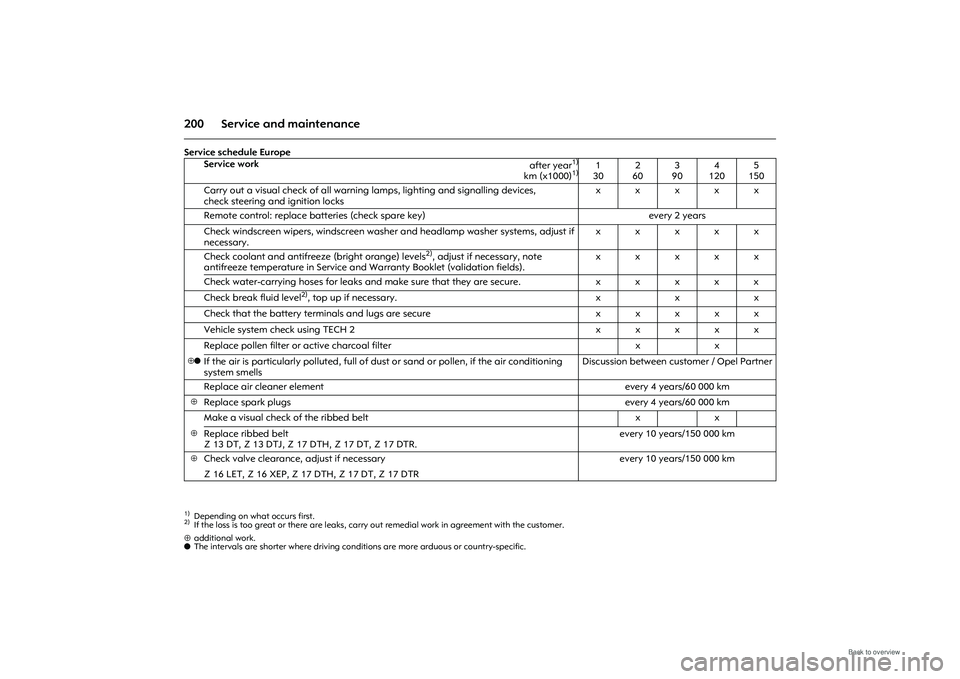
200 Service and maintenanceService schedule Europe⊕additional work.
o The intervals are shorter where driving conditions are more arduous or country-specific.
Service work
after year
1)
km (x1000)
1)
1)Depending on what occurs first.
1
30 2
60 3
90 4
120 5
150
Carry out a visual check of all warning lamps, lighting and signalling devices,
check steering and ignition locks xxxxx
Remote control: replace batteries (check spare key) every 2 years
Check windscreen wipers, windscreen washer and headlamp washer systems, adjust if
necessary. xxxxx
Check coolant and antifreeze (bright orange) levels
2), adjust if necessary, note
antifreeze temperature in Service and Warranty Booklet (validation fields).
2)If the loss is too great or there are leaks, carry out remedial work in agr eement with the customer.
xxxxx
Check water-carrying hoses for leaks and make sure that they are secure. xxxxx
Check break fluid level
2), top up if necessary. xxx
Check that the battery terminals and lugs are secure xxxxx
Vehicle system check using TECH 2 xxxxx
Replace pollen filter or active charcoal filter xx
⊕o
If the air is particularly polluted, full of du st or sand or pollen, if the air conditioning
system smells Discussion between customer / Opel Partner
Replace air cleaner element every 4 years/60 000 km
⊕
Replace spark plugsevery 4 years/60 000 km
Make a visual check of the ribbed belt xx
⊕
Replace ribbed belt
Z 13 DT, Z 13 DTJ, Z 17 DTH, Z 17 DT, Z 17 DTR. every 10 years/150 000 km
⊕
Check valve clearance,
adjust if necessary
Z 16 LET, Z 16 XEP, Z 17 DTH, Z 17 DT, Z 17 DTR every 10 years/150 000 km
Page 207 of 248
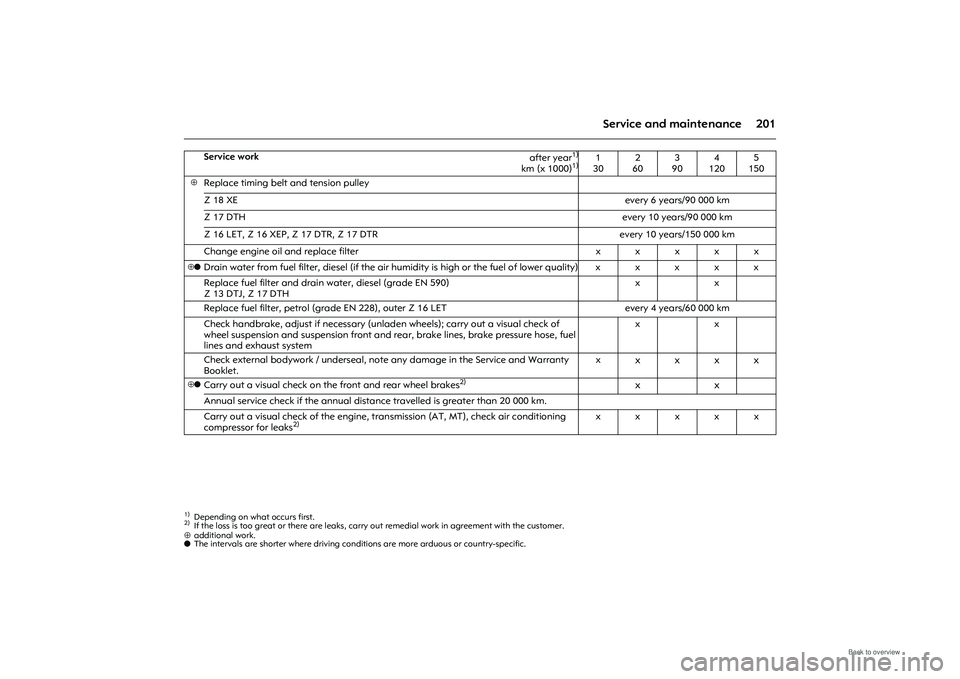
201
Service and maintenance
⊕ additional work.
o The intervals are shorter where driving conditions are more arduous or country-specific.
Service work
after year
1)
km (x 1000)
1)
1)Depending on what occurs first.
1
30 2
60 3
90 4
120 5
150
⊕
Replace timing belt and tension pulley
Z 18 XE every 6 years/90 000 km
Z 17 DTH every 10 years/90 000 km
Z 16 LET, Z 16 XEP, Z 17 DTR, Z 17 DTR every 10 years/150 000 km
Change engine oil and replace filter xxxxx
⊕o
Drain water from fuel filter, diesel (if the air humidity is high or the fuel of lower quality)xxxxx
Replace fuel filter and drain water, diesel (grade EN 590)
Z 13 DTJ, Z 17 DTH xx
Replace fuel filter, petrol (grade EN 228), outer Z 16 LET every 4 years/60 000 km
Check handbrake, adjust if necessary (unl aden wheels); carry out a visual check of
wheel suspension and suspension front and re ar, brake lines, brake pressure hose, fuel
lines and exhaust system xx
Check external bodywork / underseal, note any damage in the Service and Warranty
Booklet. x
xxxx
⊕o
Carry out a visual check on the front and rear wheel brakes
2)
2)If the loss is too great or there are leaks, carry out remedial work in agr
eement with the customer.
xx
Annual service check if the annual distance travelled is greater than 20 000 km.
Carry out a visual check of the engine, tran smission (AT, MT), check air conditioning
compressor for leaks
2)
xxxxx