key OPEL MERIVA 2009 Owner's Manual
[x] Cancel search | Manufacturer: OPEL, Model Year: 2009, Model line: MERIVA, Model: OPEL MERIVA 2009Pages: 248, PDF Size: 4.46 MB
Page 48 of 248
42 Keys, doors, windows, slide and tilt sunroof
Picture no: 14251s.tif
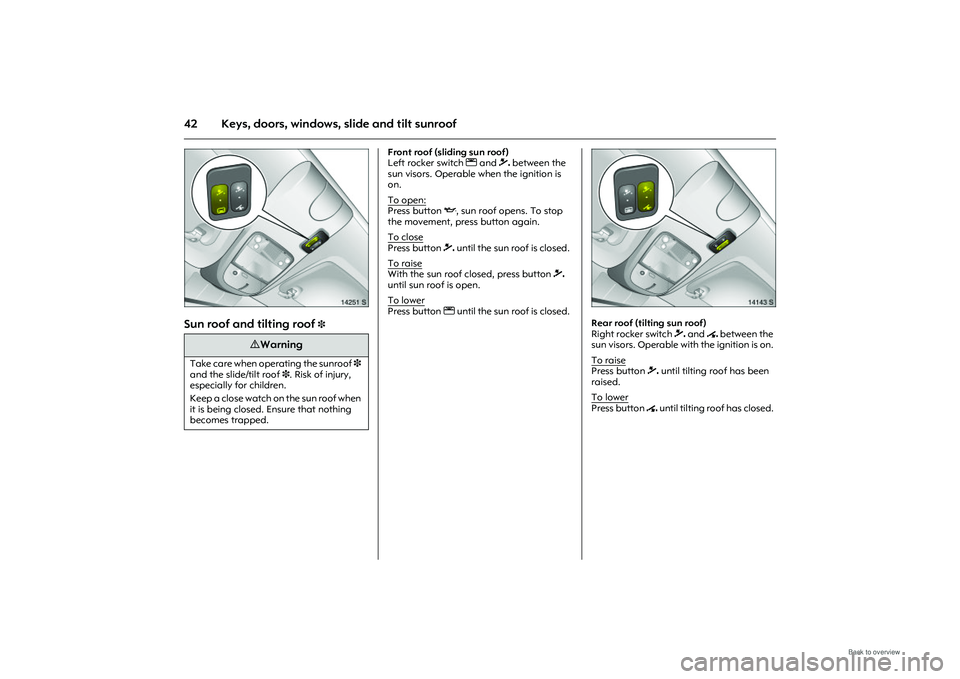
Sun roof and tilting roof
3
Front roof (sliding sun roof)
Left rocker switch l and \ between the
sun visors. Operable when the ignition is
on.
To open:Press button I, sun roof opens. To stop
the movement, press button again.
To close
Press button \ until the sun roof is closed.
To raise
With the sun roof closed, press button \
until sun roof is open.
To lower
Press button l until the sun roof is closed.
Picture no: 14143s.tif
Rear roof (tilting sun roof)
Right rocker switch \ and w between the
sun visors. Operable with the ignition is on.
To raise
Press button \ until tilting roof has been
raised.
To lower
Press button w until tilting roof has closed.
9 Warning
Take care when operating the sunroof 3
and the slide/tilt roof 3 . Risk of injury,
especially for children.
Keep a close watch on the sun roof when
it is being closed. Ensure that nothing
becomes trapped.
Page 49 of 248
43
Keys, doors, windows, slide and tilt sunroof
Sun shade
To reduce the sunlight in the interior with
the sliding roof closed or raised.
Open or close sun shade as required.
When the sun roof is opened, the sun shade
is also opened.
Note
zIf the top of the roof is wet, raise roof,
allow water to run off and then open
roof.
z When using a roof rack, check the
clearance of the sun roof to avoid
damage.
Picture no: 14802s.tif
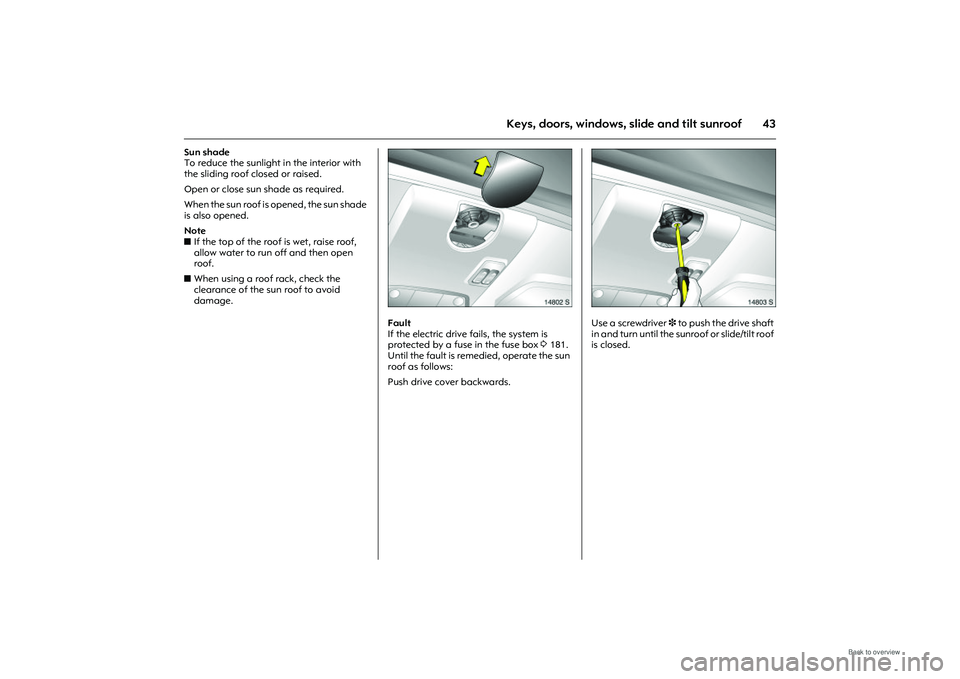
Fault
If the electric drive fails, the system is
protected by a fuse in the fuse box 3181.
Until the fault is remedied, operate the sun
roof as follows:
Push drive cover backwards.
Picture no: 14803s.tif
Use a screwdriver 3 to push the drive shaft
in and turn until the sunroof or slide/tilt roof
is closed.
Page 90 of 248
84 Instruments, Controls
Picture no: 17876s.tif
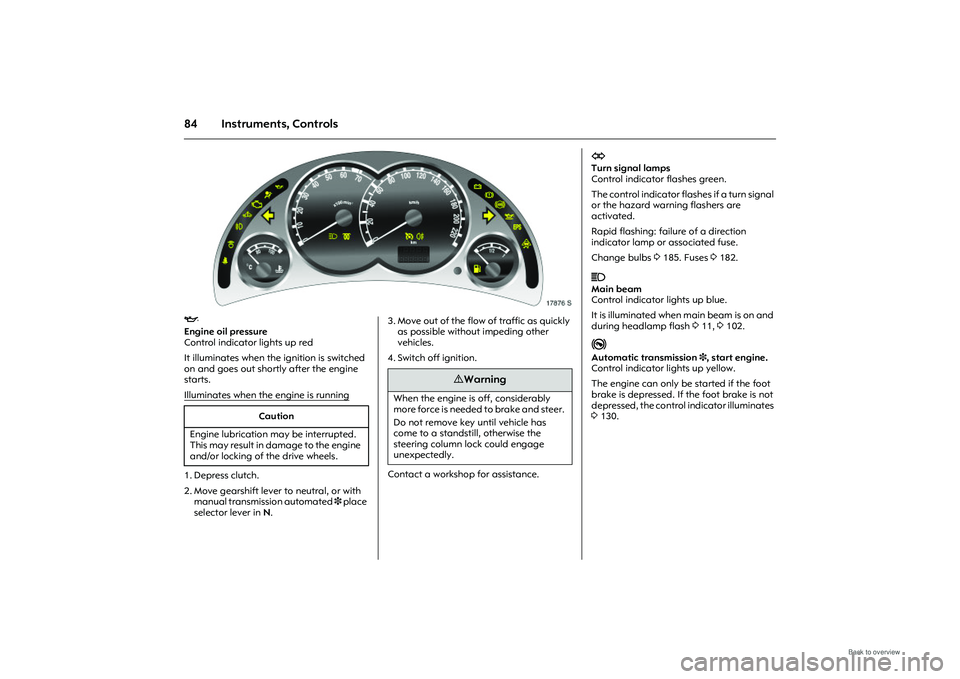
I
Engine oil pressure
Control indicator lights up red
It illuminates when the ignition is switched
on and goes out shortly after the engine
starts.
Illuminates when the engine is running
1. Depress clutch.
2. Move gearshift lever to neutral, or with
manual transmissi on automated 3 place
selector lever in N.
Picture no:
3. Move out of the flow of traffic as quickly
as possible without impeding other
vehicles.
4. Switch off ignition.
Contact a workshop for assistance.
Caution
Engine lubrication may be interrupted.
This may result in damage to the engine
and/or locking of the drive wheels.
9 Warning
When the engine is off, considerably
more force is needed to brake and steer.
Do not remove key until vehicle has
come to a standstill, otherwise the
steering column lock could engage
unexpectedly.
O
Turn signal lamps
Control indicator flashes green.
The control indicator flashes if a turn signal
or the hazard warning flashers are
activated.
Rapid flashing: failure of a direction
indicator lamp or associated fuse.
Change bulbs 3 185. Fuses 3182.
C
Main beam
Control indicator lights up blue.
It is illuminated when main beam is on and
during headlamp flash 311, 3102.
j
Automatic transmission 3, start engine.
Control indicator lights up yellow.
The engine can only be started if the foot
brake is depressed. If the foot brake is not
depressed, the control indicator illuminates
3 130.
Page 105 of 248
99
Instruments, Controls
Picture no: 16721t.tif
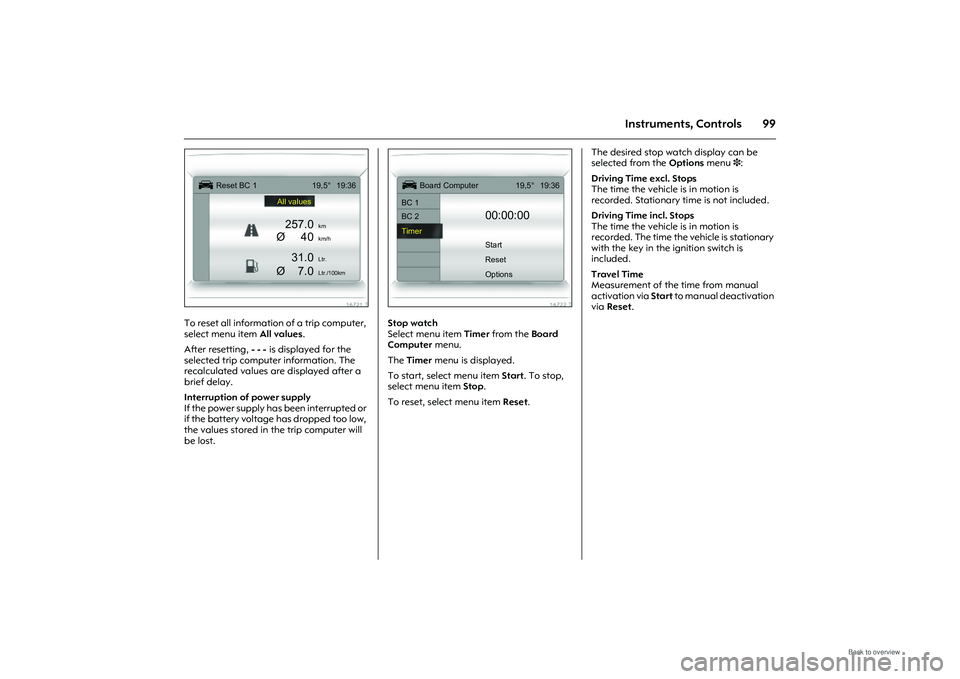
To reset all information of a trip computer,
select menu item All values.
After resetting, - - - is displayed for the
selected trip comput er information. The
recalculated values are displayed after a
brief delay.
Interruption of power supply
If the power supply has been interrupted or
if the battery voltage has dropped too low,
the values stored in the trip computer will
be lost.
Picture no: 16722t.tif
Stop watch
Select menu item Timer from the Board
Computer menu.
The Timer menu is displayed.
To start, select menu item Start. To stop,
select menu item Stop.
To reset, select menu item Reset. The desired stop watch display can be
selected from the Options
menu 3:
Driving Time excl. Stops
The time the vehicle is in motion is
recorded. Stationary ti me is not included.
Driving Time incl. Stops
The time the vehicle is in motion is
recorded. The time the vehicle is stationary
with the key in the ignition switch is
included.
Travel Time
Measurement of the time from manual
activation via Start to manual deactivation
via Reset .
Ü
Reset BC 1 19,5° 19:36
All values
257.0
km
Ø40
km/h
31.0
Ltr.
Ø
7.0
Ltr./100km
Ü
Board Computer 19,5° 19:36
BC 1
BC 2
00:00:00
Timer Start
Reset
Options
Page 106 of 248
100 Instruments, ControlsWarning buzzersWhen starting the engine or whilst
driving:
zIf seat belt is not fastened 3.
z If the speed programmed at the
factory 3 is exceeded.
z If the car has automated manual
transmission 3 and the driver’s door is
opened when the engine is running, a
gear is engaged and the foot brake is
not depressed.
When the vehicle is parked and the
driver’s door is opened:
z when the key is in the ignition switch
z with parking lamps or dipped beam on
z if the turn signal stalk is engaged
Picture no: 14055h.tif
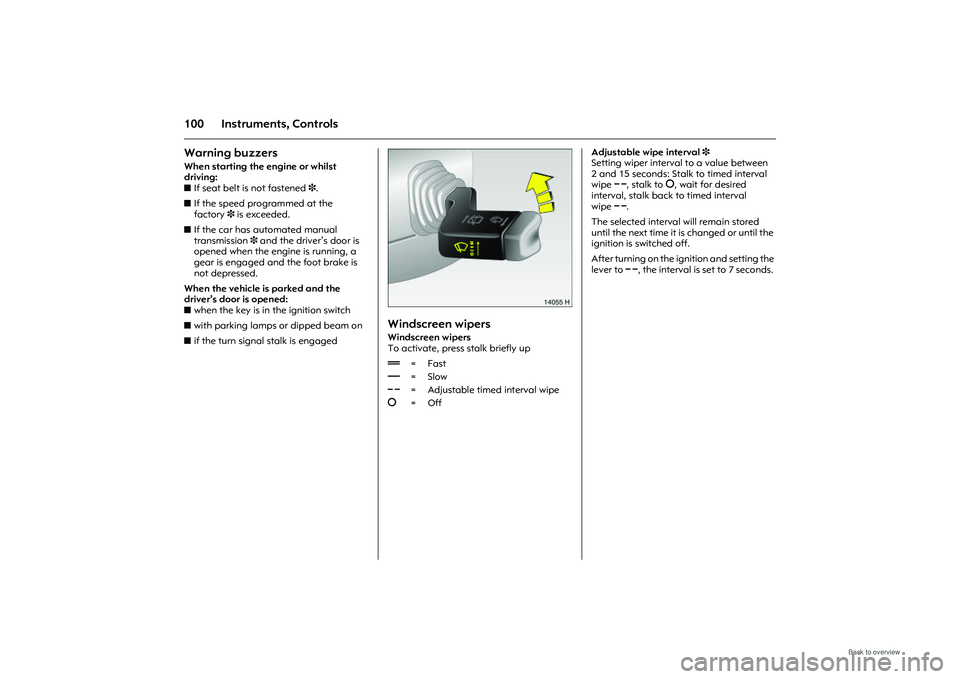
Windscreen wipers Windscreen wipers
To activate, press stalk briefly up Adjustable wipe interval
3
Setting wiper interval to a value between
2 and 15 seconds: Stalk to timed interval
wipe $, stalk to § , wait for desired
interval, stalk back to timed interval
wipe $.
The selected interval will remain stored
until the next time it is changed or until the
ignition is switched off.
After turning on the ignition and setting the
lever to $, the interval is set to 7 seconds.
& =Fast
% =Slow
$ = Adjustable timed interval wipe
§ =Off
Page 113 of 248
107
Lighting
Picture no: 14302s.tif
Lead-me lighting
3
Lead-me lighting when leaving the
vehicle 3
The dipped headlamps come on for
around 30 seconds after switching on and
closing the driver’s door.
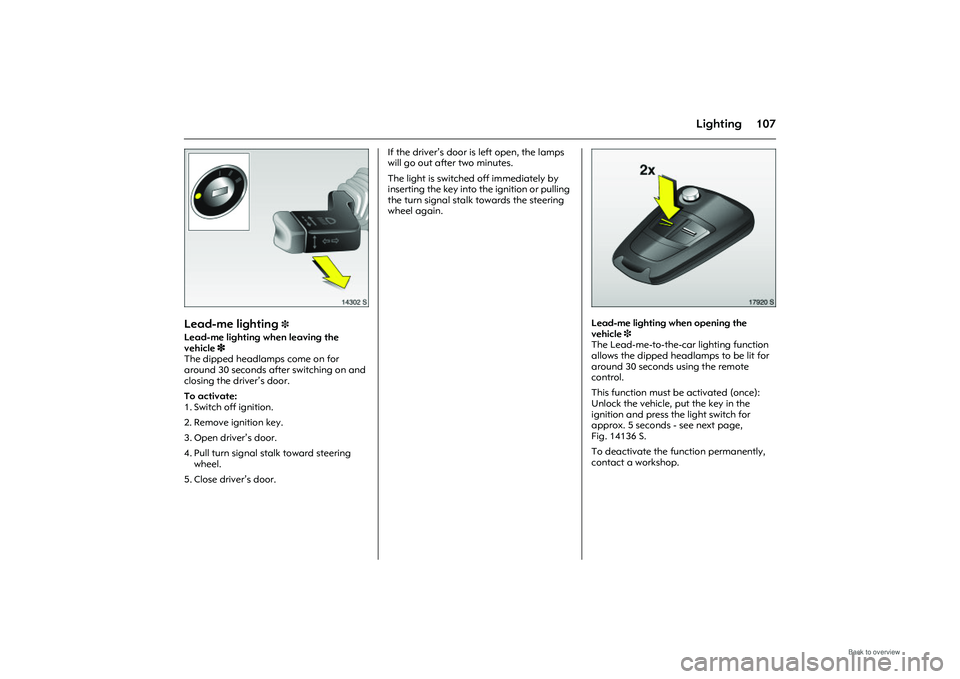
To activate:
1. Switch off ignition.
2. Remove ignition key.
3. Open driver’s door.
4. Pull turn signal stalk toward steering
wheel.
5. Close driver’s door. If the driver’s door is left open, the lamps
will go out after two minutes.
The light is switched off immediately by
inserting the key into
the ignition or pulling
the turn signal stalk towards the steering
wheel again.
Picture no: 17920S.tif
Lead-me lighting when opening the
vehicle 3
The Lead-me-to-the-car lighting function
allows the dipped headlamps to be lit for
around 30 seconds using the remote
control.
This function must be activated (once):
Unlock the vehicle, put the key in the
ignition and press the light switch for
approx. 5 seconds - see next page,
Fig. 14136 S.
To deactivate the function permanently,
contact a workshop.
Page 139 of 248
133
Driving and operation
Picture no: 14083j.tif
Manoeuvring the vehicle
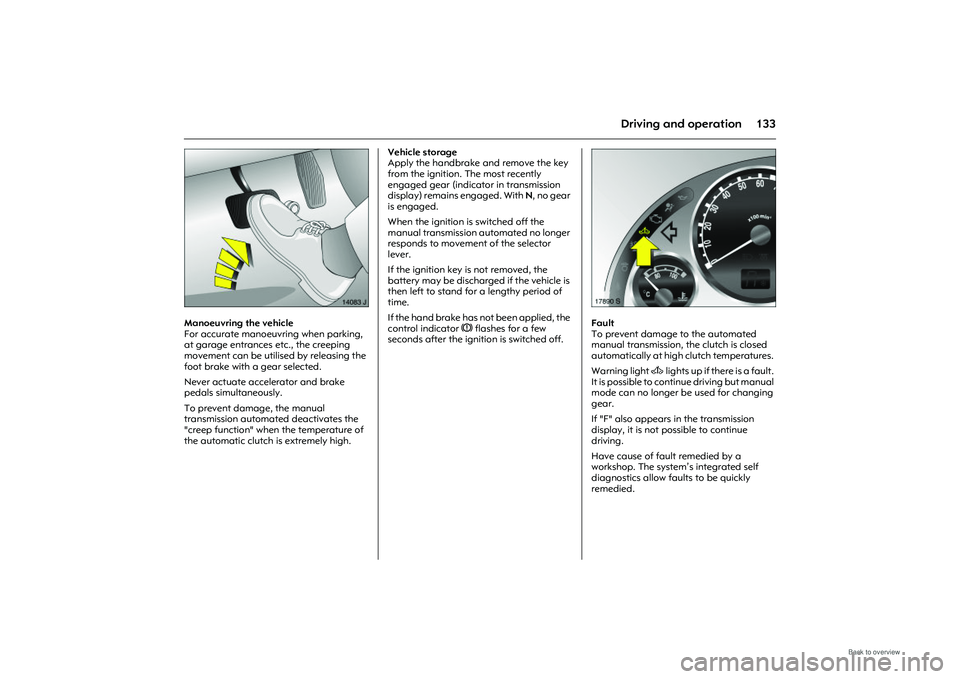
For accurate manoeuvring when parking,
at garage entrances etc., the creeping
movement can be utilised by releasing the
foot brake with a gear selected.
Never actuate accelerator and brake
pedals simultaneously.
To prevent damage, the manual
transmission automated deactivates the
"creep function" when the temperature of
the automatic clutch is extremely high. Vehicle storage
Apply the handbrake and remove the key
from the ignition. The most recently
engaged gear (indicator in transmission
display) remains engaged. With
N, no gear
is engaged.
When the ignition is switched off the
manual transmission automated no longer
responds to movement of the selector
lever.
If the ignition key is not removed, the
battery may be discharg ed if the vehicle is
then left to stand for a lengthy period of
time.
If the hand brake has not been applied, the
control indicator R flashes for a few
seconds after the ignition is switched off.
Picture no: 17890s.tif
Fault
To prevent damage to the automated
manual transmission, the clutch is closed
automatically at high clutch temperatures.
Warning light A lights up if there is a fault.
It is possible to continue driving but manual
mode can no longer be used for changing
gear.
If "F" also appears in the transmission
display, it is not possible to continue
driving.
Have cause of fault remedied by a
workshop. The system’s integrated self
diagnostics allow faults to be quickly
remedied.
Page 160 of 248
154 Driving and operationFitting new tyres
Fit tyres in pairs or in sets, which is even
better. Ensure that tyres on one axle are
zthe same size
z the same design
z the same make
z and have the same tread pattern
Fit directional tyres such that they roll in the
direction of travel. The rolling direction is
indicated by a symbol (e.g. an arrow) on
the sidewall.
Tyres fitted opposing the rolling direction
(such as when changing a tyre) should be
refitted as soon as possible. This is the only
way to benefit fully from the design
properties of the tyre.
Pay attention to legal requirements when
disposing of tyres.
Picture no: 14194s.tif
Tyre pressure
Check tyre pressure, including the spare
wheel, at least every 14 days and prior to
any long journey; the tyres should be
checked when cold. Do n’t forget to check
the spare wheel 3.
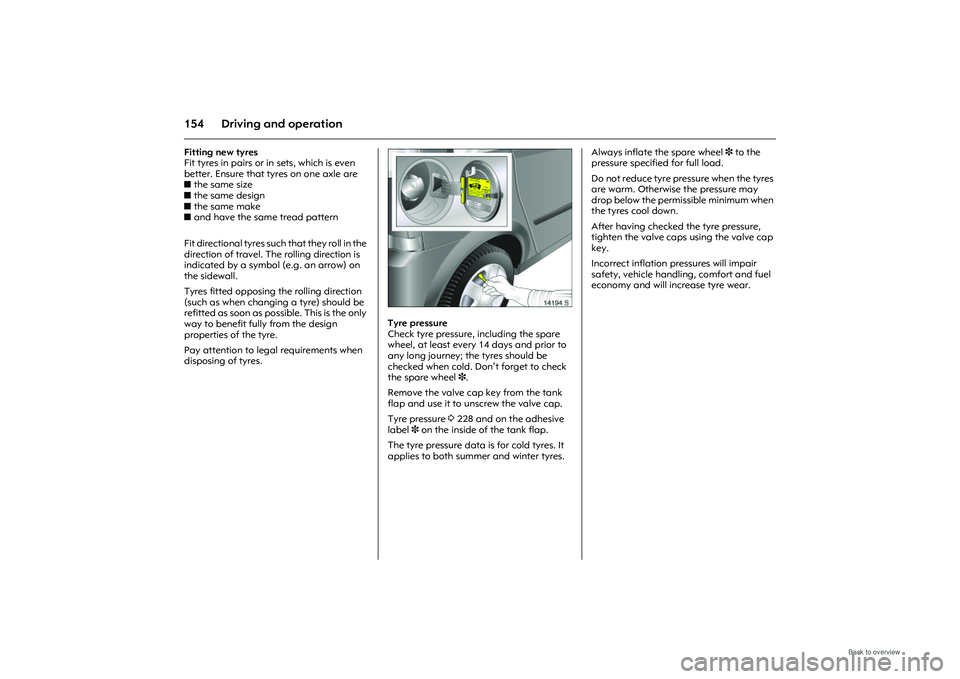
Remove the valve cap key from the tank
flap and use it to unscrew the valve cap.
Tyre pressure 3228 and on the adhesive
label 3 on the inside of the tank flap.
The tyre pressure data is for cold tyres. It
applies to both summer and winter tyres. Always inflate the spare wheel
3 to the
pressure specified for full load.
Do not reduce tyre pressure when the tyres
are warm. Otherwise the pressure may
drop below the permissible minimum when
the tyres cool down.
After having checked the tyre pressure,
tighten the valve caps using the valve cap
key.
Incorrect inflation pressures will impair
safety, vehicle handling, comfort and fuel
economy and will increase tyre wear.
Page 165 of 248
159
Driving and operation
Picture no: 14195s.tif
Towing equipment with
removable coupling ball bar
3
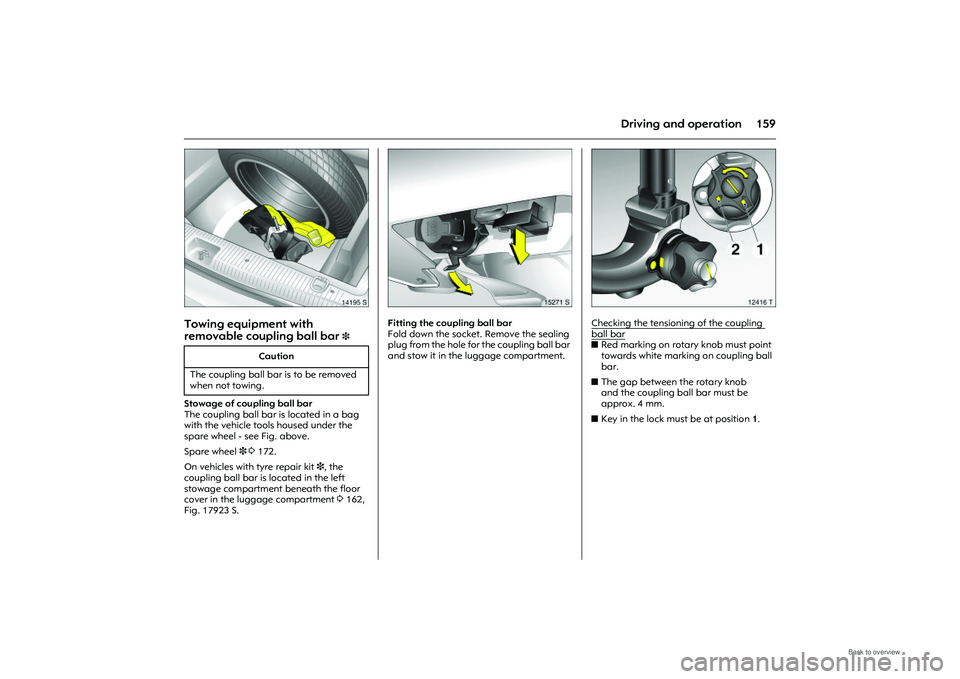
Stowage of coupling ball bar
The coupling ball bar is located in a bag
with the vehicle tools housed under the
spare wheel - see Fig. above.
Spare wheel 3 3172.
On vehicles with tyre repair kit 3, the
coupling ball bar is located in the left
stowage compartment beneath the floor
cover in the luggage compartment 3162,
Fig. 17923 S.
Picture no: 15271s.tif
Fitting the coupling ball bar
Fold down the socket. Remove the sealing
plug from the hole for the coupling ball bar
and stow it in the luggage compartment.
Picture no: 12416t.tif
Checking the tensioning of the coupling ball bar
z Red marking on rotary knob must point
towards white marking on coupling ball
bar.
z The gap between the rotary knob
and the coupling ball bar must be
approx. 4 mm.
z Key in the lock must be at position 1.
Caution
The coupling ball bar is to be removed
when not towing.
Page 166 of 248
160 Driving and operation
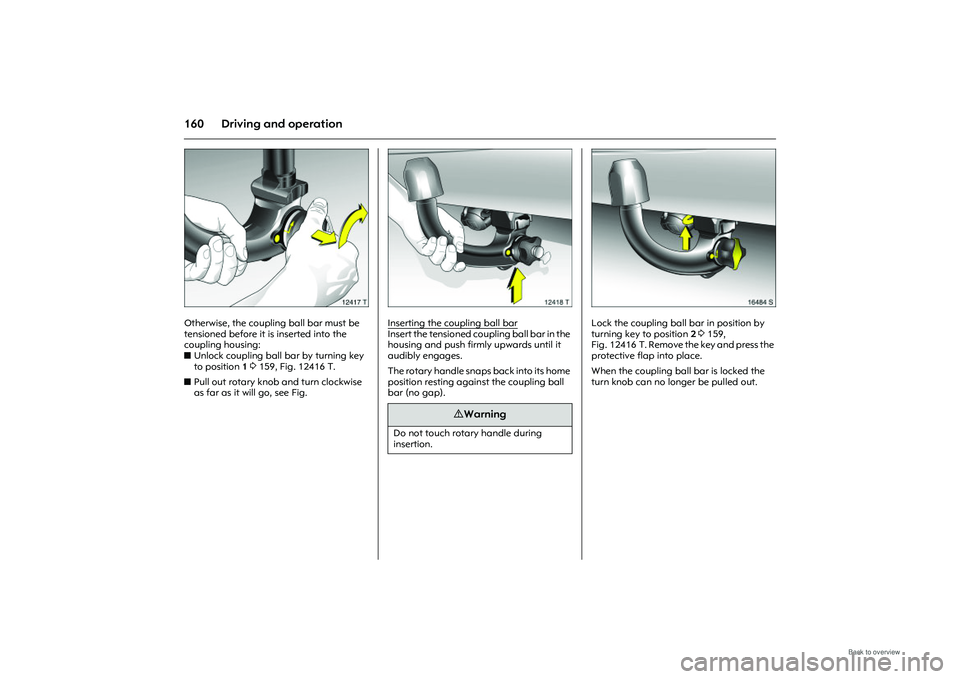
Picture no: 12417t.tif
Otherwise, the coupling ball bar must be
tensioned before it is inserted into the
coupling housing:
zUnlock coupling ball bar by turning key
to position 1 3 159, Fig. 12416 T.
z Pull out rotary knob and turn clockwise
as far as it will go, see Fig.
Picture no: 12418t.tif
Inserting the coupling ball bar
Insert the tensioned coupling ball bar in the
housing and push firmly upwards until it
audibly engages.
The rotary handle snaps back into its home
position resting against the coupling ball
bar (no gap).
Picture no: 16484s.tif
Lock the coupling ball bar in position by
turning key to position 2 3 159,
Fig. 12416 T. Remove the key and press the
protective flap into place.
When the coupling ball bar is locked the
turn knob can no longer be pulled out.
9 Warning
Do not touch rotary handle during
insertion.