roof OPEL MERIVA 2009 Owner's Manual
[x] Cancel search | Manufacturer: OPEL, Model Year: 2009, Model line: MERIVA, Model: OPEL MERIVA 2009Pages: 248, PDF Size: 4.46 MB
Page 49 of 248
43
Keys, doors, windows, slide and tilt sunroof
Sun shade
To reduce the sunlight in the interior with
the sliding roof closed or raised.
Open or close sun shade as required.
When the sun roof is opened, the sun shade
is also opened.
Note
zIf the top of the roof is wet, raise roof,
allow water to run off and then open
roof.
z When using a roof rack, check the
clearance of the sun roof to avoid
damage.
Picture no: 14802s.tif
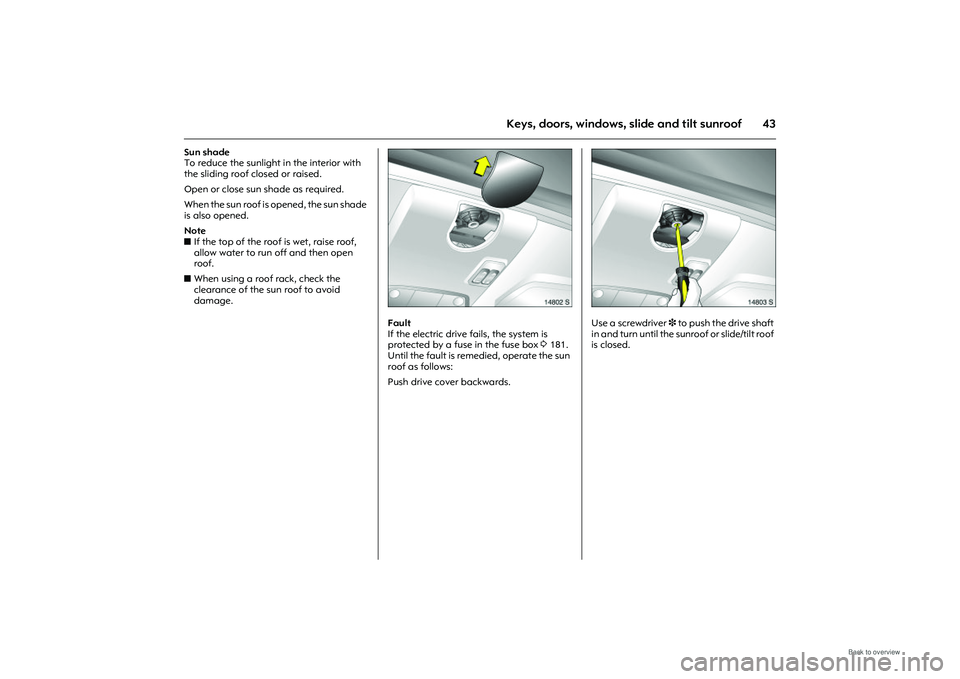
Fault
If the electric drive fails, the system is
protected by a fuse in the fuse box 3181.
Until the fault is remedied, operate the sun
roof as follows:
Push drive cover backwards.
Picture no: 14803s.tif
Use a screwdriver 3 to push the drive shaft
in and turn until the sunroof or slide/tilt roof
is closed.
Page 62 of 248
56 Seats, Interior
Picture no: 15272s.tif
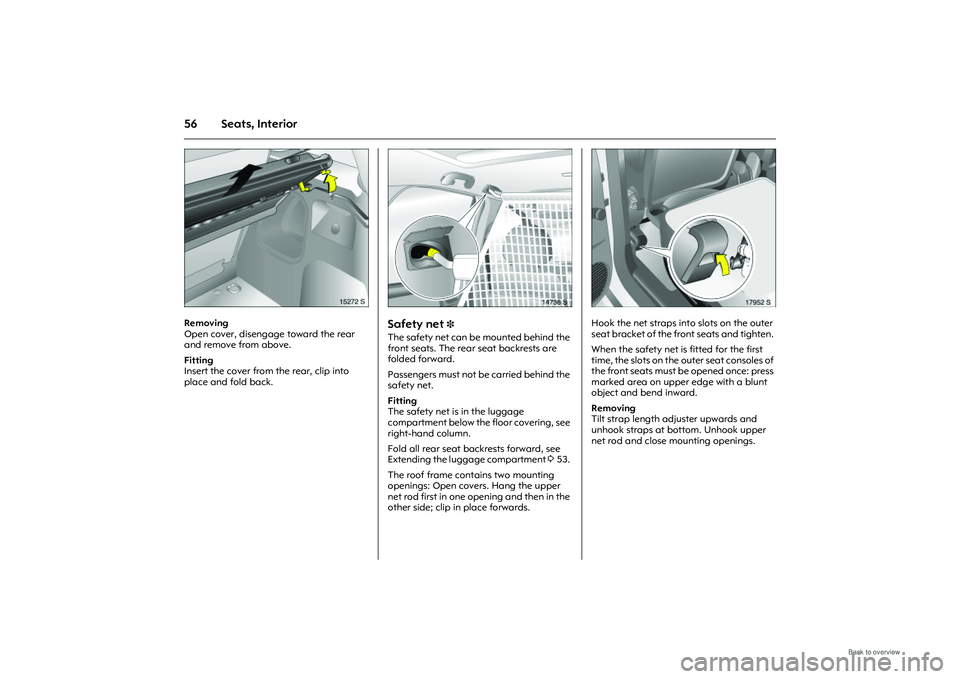
Removing
Open cover, disengage toward the rear
and remove from above.
Fitting
Insert the cover from the rear, clip into
place and fold back.
Picture no: 14736s.tif
Safety net
3
The safety net can be mounted behind the
front seats. The rear seat backrests are
folded forward.
Passengers must not be carried behind the
safety net.
Fitting
The safety net is in the luggage
compartment below the floor covering, see
right-hand column.
Fold all rear seat backrests forward, see
Extending the luggage compartment 353.
The roof frame contains two mounting
openings: Open covers. Hang the upper
net rod first in one opening and then in the
other side; clip in place forwards.
Picture no: 17952S.tif
Hook the net straps into slots on the outer
seat bracket of the front seats and tighten.
When the safety net is fitted for the first
time, the slots on the outer seat consoles of
the front seats must be opened once: press
marked area on upper edge with a blunt
object and bend inward.
Removing
Tilt strap length adjuster upwards and
unhook straps at bottom. Unhook upper
net rod and close mounting openings.
Page 64 of 248
58 Seats, Interior
Picture no: 14110s.tif
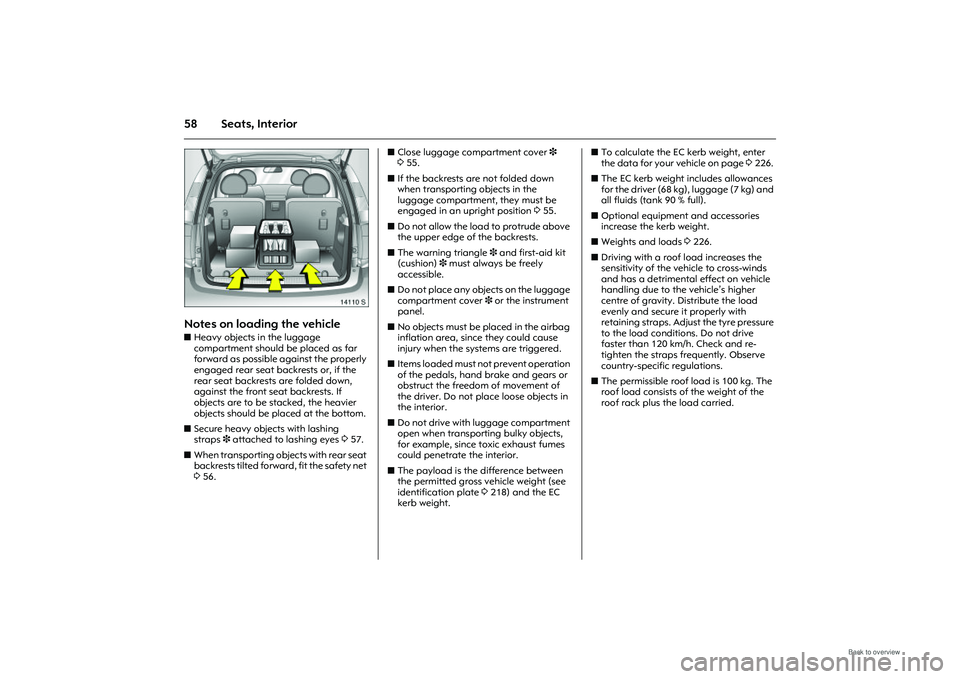
Notes on loading the vehicle zHeavy objects in the luggage
compartment should be placed as far
forward as possible against the properly
engaged rear seat backrests or, if the
rear seat backrests are folded down,
against the front seat backrests. If
objects are to be stacked, the heavier
objects should be placed at the bottom.
z Secure heavy objects with lashing
straps 3 attached to lashing eyes 357.
z When transporting objects with rear seat
backrests tilted forward, fit the safety net
356. z
Close luggage compartment cover 3
3 55.
z If the backrests are not folded down
when transporting objects in the
luggage compartment, they must be
engaged in an upright position 355.
z Do not allow the load to protrude above
the upper edge of the backrests.
z The warning triangle 3 and first-aid kit
(cushion) 3 must always be freely
accessible.
z Do not place any objects on the luggage
compartment cover 3 or the instrument
panel.
z No objects must be placed in the airbag
inflation area, since they could cause
injury when the systems are triggered.
z Items loaded must not prevent operation
of the pedals, hand brake and gears or
obstruct the freedom of movement of
the driver. Do not place loose objects in
the interior.
z Do not drive with luggage compartment
open when transporting bulky objects,
for example, since toxic exhaust fumes
could penetrate the interior.
z The payload is the difference between
the permitted gross vehicle weight (see
identification plate 3218) and the EC
kerb weight. z
To calculate the EC kerb weight, enter
the data for your vehicle on page 3 226.
z The EC kerb weight includes allowances
for the driver (68 kg), luggage (7 kg) and
all fluids (tank 90 % full).
z Optional equipment and accessories
increase the kerb weight.
z Weights and loads 3226.
z Driving with a roof load increases the
sensitivity of the vehicle to cross-winds
and has a detrimental effect on vehicle
handling due to the vehicle’s higher
centre of gravity. Distribute the load
evenly and secure it properly with
retaining straps. Adjust the tyre pressure
to the load conditions. Do not drive
faster than 120 km/h. Check and re-
tighten the straps frequently. Observe
country-specific regulations.
z The permissible roof load is 100 kg. The
roof load consists of the weight of the
roof rack plus the load carried.
Page 69 of 248
63
Seats, Interior
Picture no: 14122s.tif
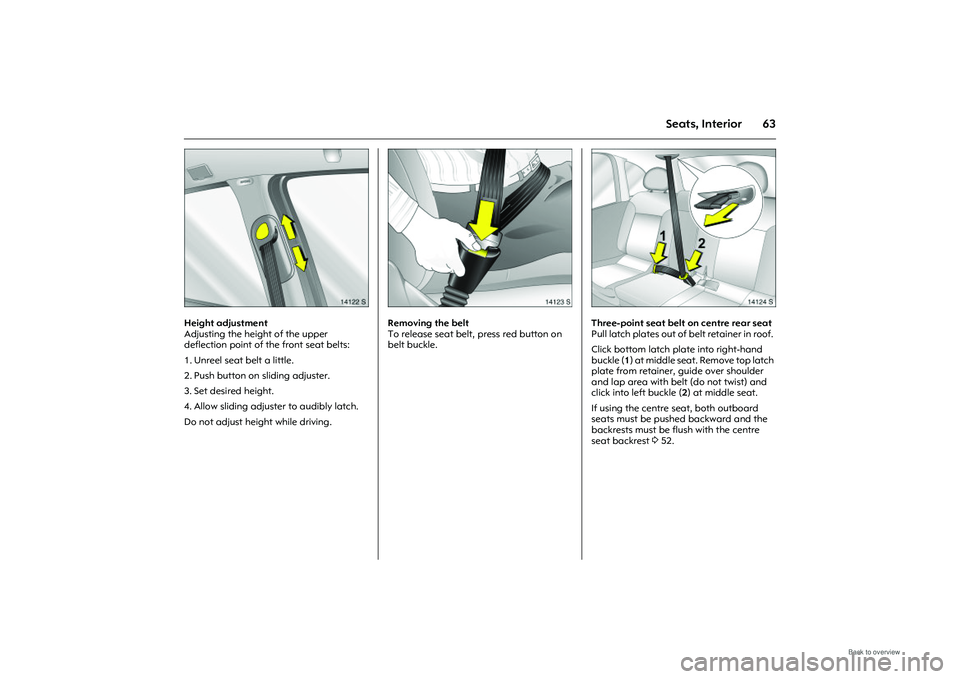
Height adjustment
Adjusting the height of the upper
deflection point of the front seat belts:
1. Unreel seat belt a little.
2. Push button on sliding adjuster.
3. Set desired height.
4. Allow sliding adjuster to audibly latch.
Do not adjust height while driving.
Picture no: 14123s.tif
Removing the belt
To release seat belt, press red button on
belt buckle.
Picture no: 14124S.tif
Three-point seat belt on centre rear seat
Pull latch plates out of belt retainer in roof.
Click bottom latch plate into right-hand
buckle ( 1) at middle seat. Remove top latch
plate from retainer, guide over shoulder
and lap area with belt (do not twist) and
click into left buckle ( 2) at middle seat.
If using the centre seat, both outboard
seats must be pushed backward and the
backrests must be flush with the centre
seat backrest 352.
Page 70 of 248
64 Seats, Interior
Picture no: 14739S.tif
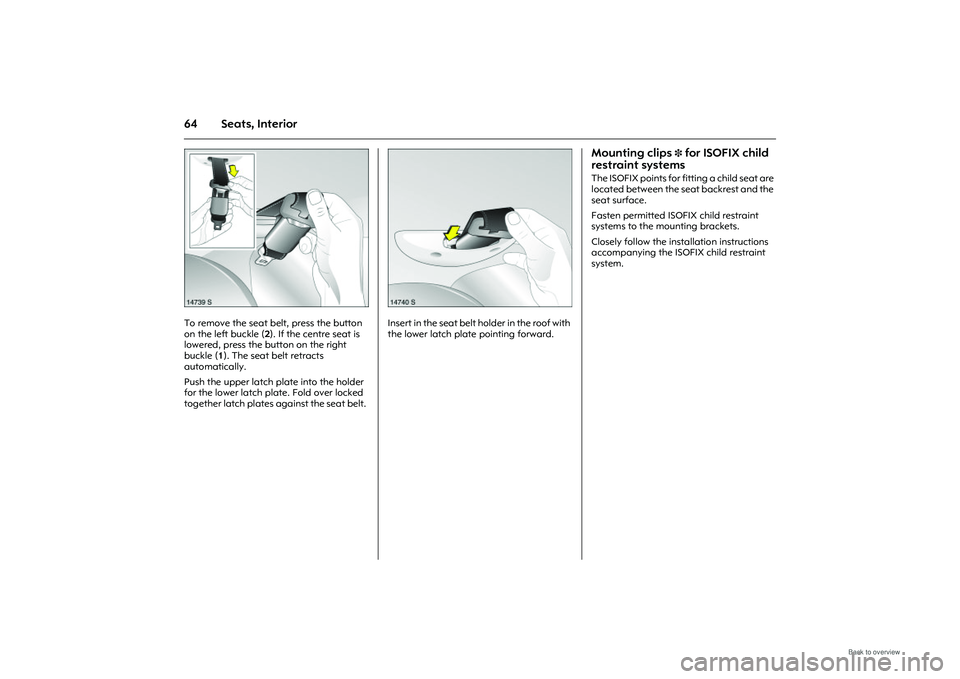
To remove the seat belt, press the button
on the left buckle (2). If the centre seat is
lowered, press the button on the right
buckle ( 1). The seat belt retracts
automatically.
Push the upper latch pl ate into the holder
for the lower latch plate. Fold over locked
together latch plates against the seat belt.
Picture no: 14740S.tif
Insert in the seat belt holder in the roof with
the lower latch plate pointing forward.
Mounting clips
3 for ISOFIX child
restraint systems
The ISOFIX points for fitting a child seat are
located between the seat backrest and the
seat surface.
Fasten permitted ISOF IX child restraint
systems to the mounting brackets.
Closely follow the installation instructions
accompanying the ISOFIX child restraint
system.
Page 77 of 248
71
Seats, Interior
Picture no: 14129s.tif
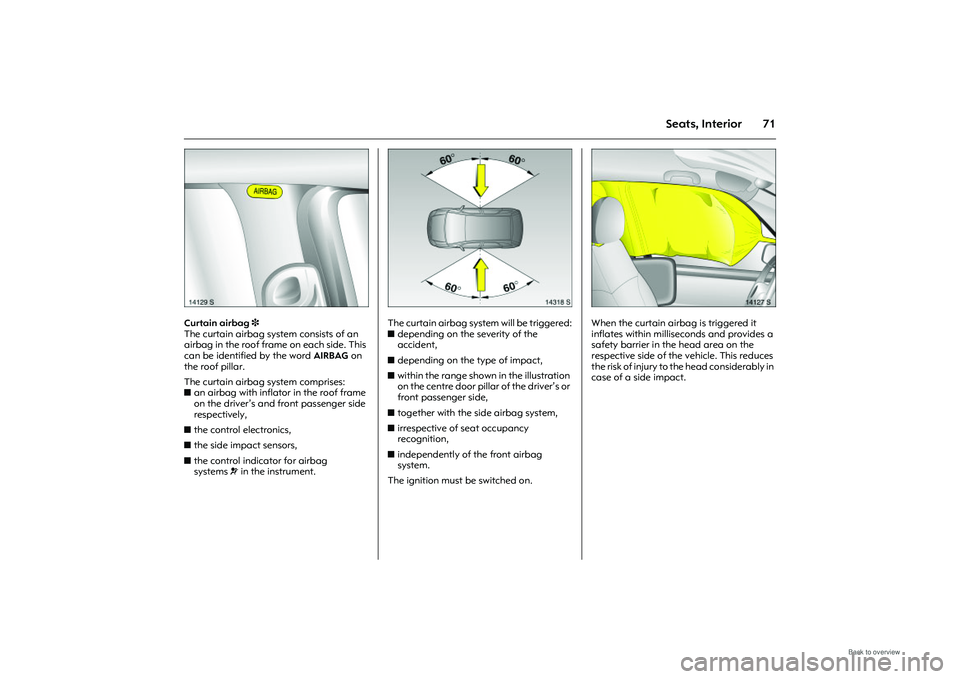
Curtain airbag 3
The curtain airbag system consists of an
airbag in the roof fram e on each side. This
can be identified by the word AIRBAG on
the roof pillar.
The curtain airbag system comprises:
z an airbag with inflator in the roof frame
on the driver’s and front passenger side
respectively,
z the control electronics,
z the side impact sensors,
z the control indicator for airbag
systems v in the instrument.
Picture no: 14318s.tif
The curtain airbag system will be triggered:
z depending on the severity of the
accident,
z depending on the type of impact,
z within the range shown in the illustration
on the centre door pillar of the driver’s or
front passenger side,
z together with the side airbag system,
z irrespective of seat occupancy
recognition,
z independently of the front airbag
system.
The ignition must be switched on.
Picture no: 14127s.tif
When the curtain airb ag is triggered it
inflates within milliseconds and provides a
safety barrier in the head area on the
respective side of the vehicle. This reduces
the risk of injury to th e head considerably in
case of a side impact.
Page 80 of 248
74 Seats, InteriorIf the control indicator flashes when the
child restraint system with transponders 3
is correctly fitted, there is a fault with risk of
injury to the child. Fit child restraint systems
on the rear seat. Have the cause of the
fault eliminated by a workshop.
If no Opel child restraint system with
transponders 3 is fitted, the control
indicator must not light or flash as the
passenger airbag systems would not
deploy. Have the cause of the fault
eliminated by a workshop. Important
z
Placing accessories and objects in the
expansion region of the airbag systems
is not permitted due to the risk of injury if
the airbag is triggered.
z Do not place any objects between the
airbag systems and the vehicle
occupants; danger of injury.
z Use the hooks in the roof frame only to
hang up light articles of clothing or coat
hangers. Do not place any objects in the
pockets of the hanging items – risk of
injury.
z The airbag systems and belt tensioner
control electronics can be found in the
centre console area. In order to avoid
malfunctions, do not store magnetic
objects in this area. z
Do not stick anything on the steering
wheel, instrument panel, front seat
backrests or roof frame in the vicinity of
the airbags, or on the front passenger’s
seat cushion, or cover any of those areas
with other materials.
z Use only a dry cloth or interior cleaner to
clean the steering wheel, instrument
panel, front seat backrests, roof frame
and seat cushion of the front passenger
seat. Do not use any aggressive cleaning
agents.
z Only protective covers which are
approved for your vehicle with side
airbag may be fitted on the front seats.
When fitting the protective covers, make
sure that the airbag units on the
outboard sides of the front seat
backrests are not covered.
z The airbag systems are triggered
independently of each other depending
on the severity of the accident and the
type of impact. The side airbag system 3
and the curtain airbag system 3 are
triggered together.
z Each airbag deploys once only. Have a
workshop replace deployed airbags
immediately.
9 Warning
If the Opel child restraint system with
transponders 3 has been fitted
according to the inst ructions, the control
indicator for Opel restraint systems with
transponders must illuminate in the
courtesy lamp when the ignition is
switched on.
If the control indicator does not come on
while driving, the passenger airbag
systems are not de-activated and there
is a risk of injury or death. In this case fit
child restraint system s on the rear seat.
Have the cause of th e fault eliminated
by a workshop.
9 Warning
As with any other ob ject, child restraint
systems must not be carried on a
passenger’s lap. Danger to life.
Page 127 of 248
121
Climate control
Picture no: 14162s.tif
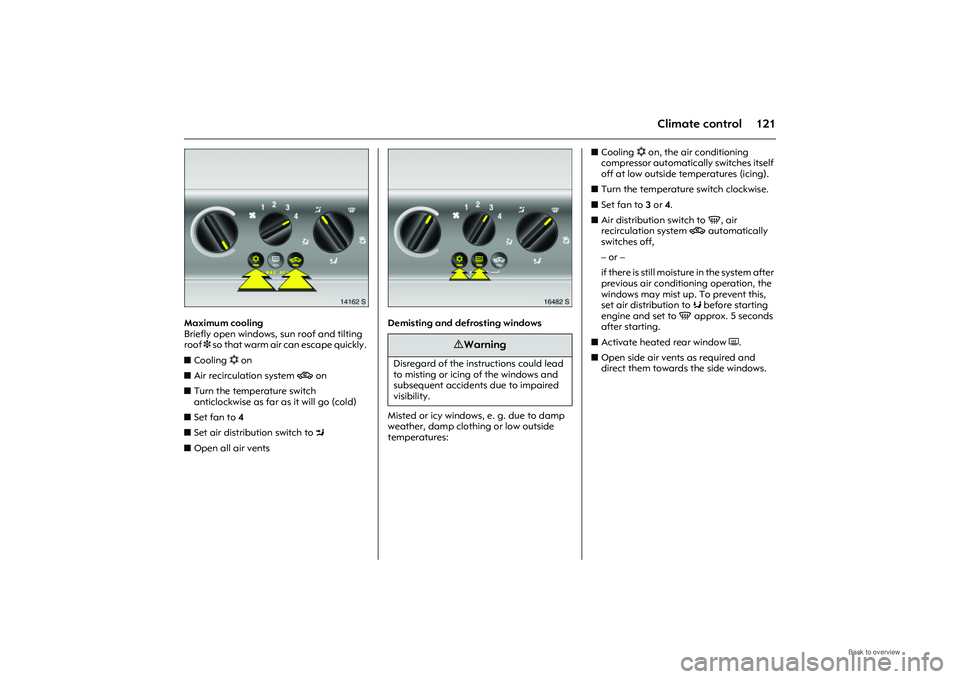
Maximum cooling
Briefly open windows, sun roof and tilting
roof 3 so that warm air can escape quickly.
z Cooling n on
z Air recirculation system 4 on
z Turn the temperature switch
anticlockwise as far as it will go (cold)
z Set fan to 4
z Set air distribution switch to M
z Open all air vents
Picture no: 16482s.tif
Demisting and defrosting windows
Misted or icy windows, e. g. due to damp
weather, damp clothing or low outside
temperatures: z
Cooling n on, the air conditioning
compressor automatically switches itself
off at low outside temperatures (icing).
z Turn the temperature switch clockwise.
z Set fan to 3 or 4 .
z Air distribution switch to V, air
recirculation system 4 automatically
switches off,
– or –
if there is still moisture in the system after
previous air conditioning operation, the
windows may mist up. To prevent this,
set air distribution to K before starting
engine and set to V approx. 5 seconds
after starting.
z Activate heated rear window Ü.
z Open side air vents as required and
direct them towards the side windows.
9 Warning
Disregard of the instructions could lead
to misting or icing of the windows and
subsequent accidents due to impaired
visibility.
Page 135 of 248
129
Driving and operation
Driving and operation
Manual transmission
automated
3
The manual transmission automated
transmission 3 permits manual ( manual
mode ) or automatic gear shifting
(automatic mode ), both with automatic
clutch control.
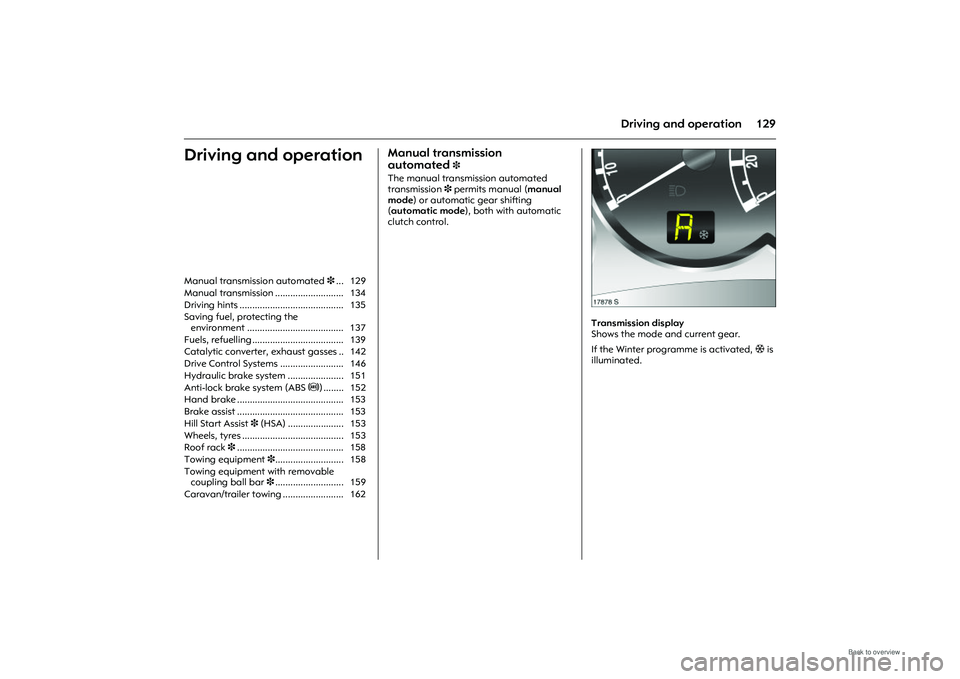
Picture no: 17878s.tif
Transmission display
Shows the mode and current gear.
If the Winter programme is activated, T is
illuminated.
Manual transmission automated
3... 129
Manual transmission ........................... 134
Driving hints ......................................... 135
Saving fuel, protecting the environment ...................................... 137
Fuels, refuelling .................................... 139
Catalytic converter, exhaust gasses .. 142
Drive Control Systems ......................... 146
Hydraulic brake system ...................... 151
Anti-lock brake system (ABS u ) ........ 152
Hand brake .......................................... 153
Brake assist .......................................... 153
Hill Start Assist 3 (HSA) ...................... 153
Wheels, tyres ........................................ 153
Roof rack 3.......................................... 158
Towing equipment 3........................... 158
Towing equipment with removable coupling ball bar 3........................... 159
Caravan/trailer towing ........................ 162
Page 141 of 248
135
Driving and operation
Driving hintsThe first 1000 km
Drive your vehicle at various speeds. Do
not use full throttle. Never allow the engine
to labour at low revs.
Drive moderately. In all gears, only depress
the accelerator pedal around
3/4 of the way
down.
Do not drive faster than three quarters of
maximum speed.
Do not brake unnecessarily hard for the
first 200 km.
During the first drive smoke may develop
because of wax and oil evaporating on the
exhaust system. Park the vehicle in the
open for a while after the first drive and
avoid inhaling the fumes.
Fuel and engine oil consumption is higher
than normal during the running-in period.
Never coast with engine not running
Many units will not function in this situation
(e.g. brake servo unit, power steering 3).
Driving in this manner is a danger to
yourself and others. Brake servo unit
When the engine is not running, the brake
servo unit is no longer effective once the
brake pedal has been depressed once or
twice. Braking effect is not reduced, but
significantly greater force is required for
braking.
Electric power steering
3
If the power assisted steering fails when
being towed with the engine switched off,
the vehicle can still be steered, but
considerably more force is required.
Driving in mountainous terrain or with a
trailer/caravan
The cooling fan is elec trically operated. Its
cooling power is therefore independent of
the engine speed.
Since a considerable amount of heat is
generated at high engine speeds and less
at slower speeds, do not shift down when
climbing hills whilst the vehicle is still coping
with the gradient in the higher gear. Driving with a roof load
Do not exceed the permissible roof load
3
226. For reasons of safety, distribute the
load evenly and secure it properly with
retaining straps. Adjust tyre pressure to
load conditions. Do not drive faster
than 120 km/h. Check and retighten the
straps frequently. Observe country-specific
regulations.
Switching off the engine
When you switch off, fans in the engine
compartment may continue running for a
time to cool the engine.
If the engine temperature is very high, e.g.
after driving in mountainous terrain: allow
the engine to idle for approximately two
minutes in order to prevent heat
accumulation.
Vehicles with turbocharged engine
3
After running at high engine speeds or high
engine loads, operate the engine briefly
at a low load or run in neutral for
approx. 30 seconds before switching off in
order to protect the turbocharger.