transmission OPEL MERIVA 2009 Owner's Manual
[x] Cancel search | Manufacturer: OPEL, Model Year: 2009, Model line: MERIVA, Model: OPEL MERIVA 2009Pages: 248, PDF Size: 4.46 MB
Page 155 of 248
149
Driving and operation
Picture no: 7758u.tif
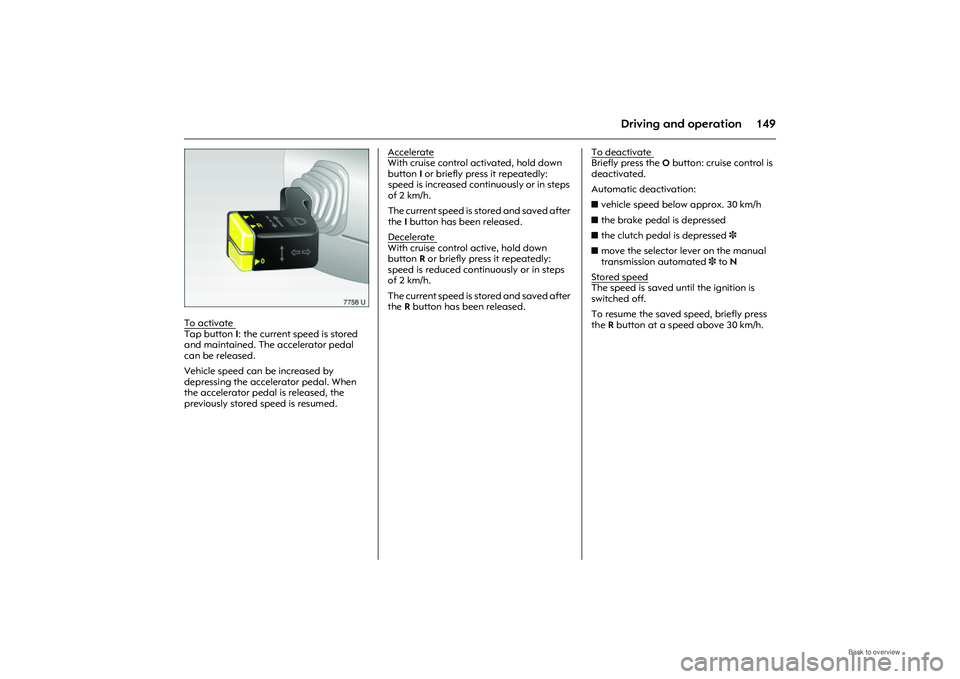
To activate Tap button I: the current speed is stored
and maintained. The accelerator pedal
can be released.
Vehicle speed can be increased by
depressing the accelerator pedal. When
the accelerator pedal is released, the
previously stored speed is resumed. Accelerate
With cruise control activated, hold down
button I or briefly press it repeatedly:
speed is increased continuously or in steps
of 2 km/h.
The current speed is stored and saved after
the I button has been released.
Decelerate
With cruise control active, hold down
button R or briefly press it repeatedly:
speed is reduced continuously or in steps
of 2 km/h.
The current speed is stored and saved after
the R button has been released. To deactivate
Briefly press the
O button: cruise control is
deactivated.
Automatic deactivation:
z vehicle speed below approx. 30 km/h
z the brake pedal is depressed
z the clutch pedal is depressed 3
z move the selector lever on the manual
transmission automated 3 to N
Stored speed
The speed is saved until the ignition is
switched off.
To resume the saved speed, briefly press
the R button at a speed above 30 km/h.
Page 158 of 248
152 Driving and operationFor vehicles with manual transmission
automated 3, the control indicator flashes
for a few seconds when the ignition is
turned off when the hand brake is not
applied. Anti-lock brake system (ABS
u)
ABS prevents the wheels from locking.
ABS starts to regulate brake pressure as
soon as a wheel shows a tendency to lock.
The vehicle remains steerable, even during
hard braking.
ABS control is made apparent though a
pulse in the brake pedal and the noise of
the regulation process.
For optimum braking, keep the brake
pedal fully depresse d throughout the
braking process, despite the fact that the
pedal is pulsating. Do not reduce the
pressure on the pedal.
Picture no: 17895s.tif
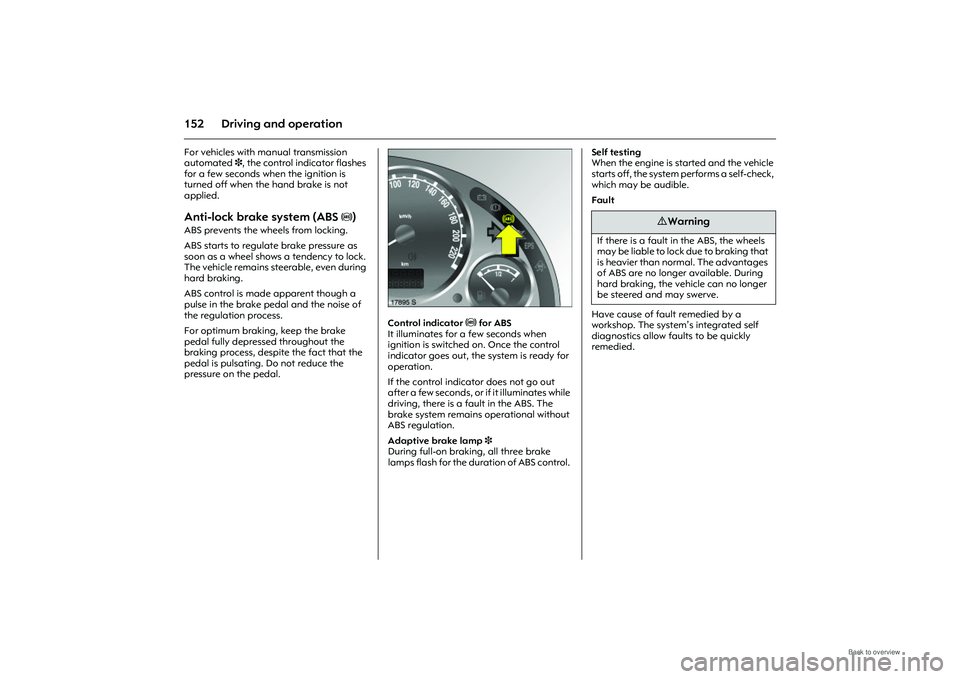
Control indicator u for ABS
It illuminates for a few seconds when
ignition is switched on. Once the control
indicator goes out, the system is ready for
operation.
If the control indica tor does not go out
after a few seconds, or if it illuminates while
driving, there is a fault in the ABS. The
brake system remains operational without
ABS regulation.
Adaptive brake lamp 3
During full-on braking, all three brake
lamps flash for the duration of ABS control. Self testing
When the engine is started and the vehicle
starts off, the system performs a self-check,
which may be audible.
Fault
Have cause of fault remedied by a
workshop. The system’s integrated self
diagnostics allow faults to be quickly
remedied.
9 Warning
If there is a fault in the ABS, the wheels
may be liable to lock due to braking that
is heavier than normal. The advantages
of ABS are no longer available. During
hard braking, the vehicle can no longer
be steered and may swerve.
Page 170 of 248
164 Driving and operationIf the trailer/caravan starts to sway, drive
more slowly, do not attempt to correct the
steering and brake sharply if necessary.
If it is necessary to apply the brakes fully,
depress the brake pedal as hard as
possible.
Remember that the braking distance for
vehicles towing carava ns/trailers with and
without brake is always greater than that
for vehicles not towing a caravan/trailer.
When driving downhill , drive in the same
gear as if driving uphill and drive at a
similar speed.
Adjust tyre pressure to the value specified
for full load 3228. Starting on inclines
For vehicles with ma
nual transmission,
the most favourable engine speed
when starting off on an incline is
between 2500 and 3000 rpm for petrol
engines and between 2000 and 2500 rpm
for diesel engines. Hold engine speed
constant, engage clutch gradually (let slip)
– release hand brake – and open throttle. If
possible, the engine speed should not drop
during this procedure.
For vehicles with ma nual transmission
automated 3 in Automatic mode simply
apply full gas. Before starting off under extreme
operating conditions, switch off
unnecessary consumers.
Page 176 of 248
170 Self-help, vehicle careIf the automatic clutch has been manually
disengaged in vehicles with manual
automated transmission 3 towing is not
permitted 3134. In this case, contact a
workshop for assistance immediately.
After towing, unscrew towing eye by
rotating clockwise and insert and close the
cap.
Picture no: 14199s.tif
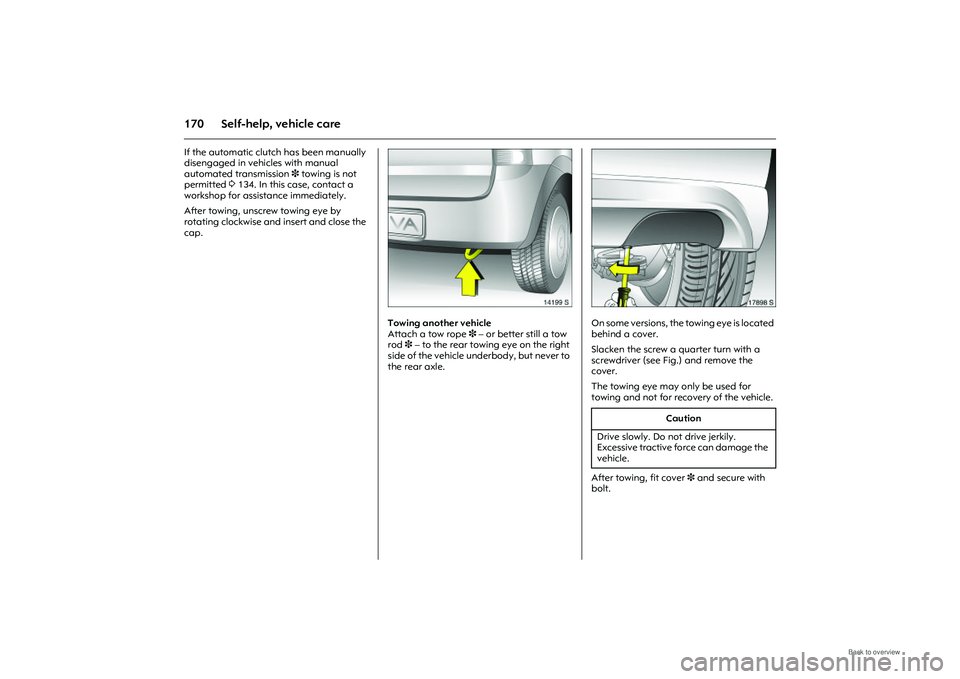
Towing another vehicle
Attach a tow rope 3 – or better still a tow
rod 3 – to the rear towing eye on the right
side of the vehicle underbody, but never to
the rear axle.
Picture no: 17898s.tif
On some versions, the towing eye is located
behind a cover.
Slacken the screw a quarter turn with a
screwdriver (see Fig.) and remove the
cover.
The towing eye may only be used for
towing and not for recovery of the vehicle.
After towing, fit cover 3 and secure with
bolt.
Caution
Drive slowly. Do not drive jerkily.
Excessive tractive force can damage the
vehicle.
Page 208 of 248
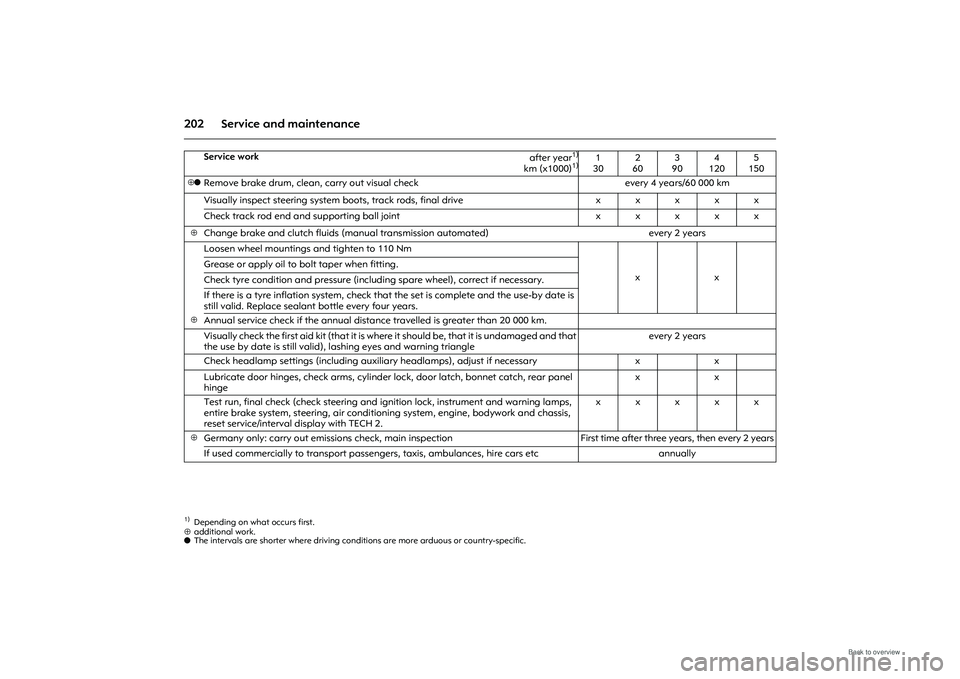
202 Service and maintenance⊕additional work.
o The intervals are shorter where driving conditions are more arduous or country-specific.
Service work
after year
1)
km (x1000)
1)
1)Depending on what occurs first.
1
30 2
60 3
90 4
120 5
150
⊕o
Remove brake drum, clean, carry out visual check every 4 years/60 000 km
Visually inspect steering system boots, track rods, final drive xxxxx
Check track rod end and supporting ball joint xxxxx
⊕
Change brake and clutch fluids (manual transmission automated) every 2 years
Loosen wheel mountings and tighten to 110 Nm
xx
Grease or apply oil to
bolt taper when fitting.
Check tyre condition and pressure (inclu ding spare wheel), correct if necessary.
If there is a tyre inflation system, check that the set is complete and the use-by date is
still valid. Replace sealant bottle every four years.
⊕
Annual service check if the annual distance travelled is greater than 20 000 km.
Visually check the first aid kit (that it is wher e it should be, that it is undamaged and that
the use by date is still valid), lashing eyes and warning triangle every 2 years
Check headlamp settings (including auxi liary headlamps), adjust if necessary xx
Lubricate door hinges, check arms, cylinder lo ck, door latch, bonnet catch, rear panel
hinge xx
Test run, final check (check steering and ig nition lock, instrument and warning lamps,
entire brake system, steering, air conditioni ng system, engine, bodywork and chassis,
reset service/interval display with TECH 2. xxxxx
⊕
Germany only: carry out emissions check, main inspection
First time after three years, then every 2 years
If used commercially to tran sport passengers, taxis, ambulances, hire cars etc annually
Page 211 of 248
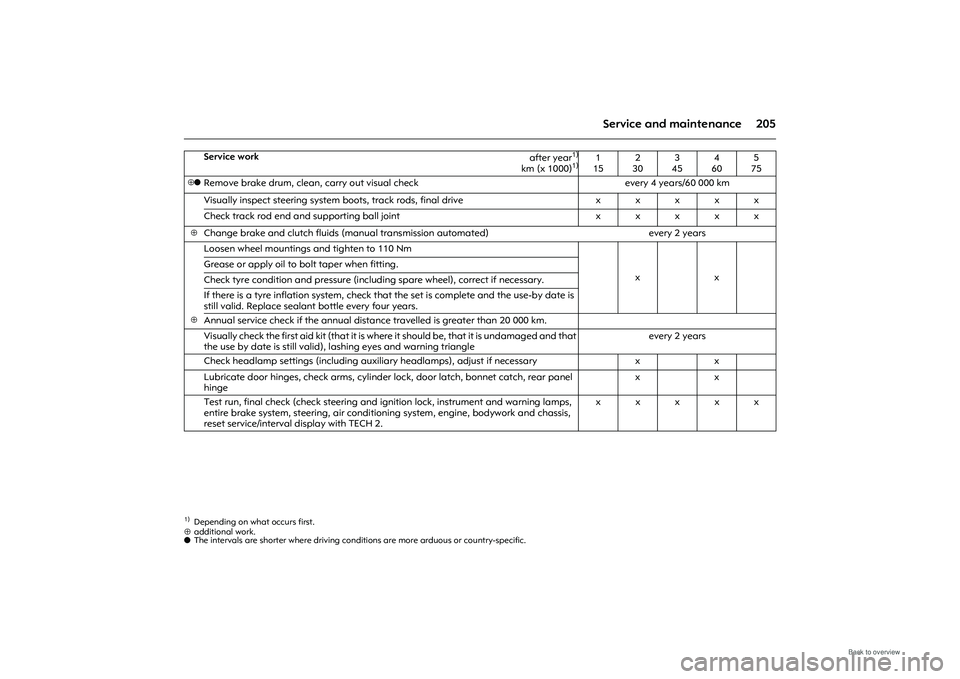
205
Service and maintenance
⊕ additional work.
o The intervals are shorter where driving conditions are more arduous or country-specific.
Service work
after year
1)
km (x 1000)
1)
1)Depending on what occurs first.
1
15 2
30 3
45 4
60 5
75
⊕o
Remove brake drum, clean, carry out visual check every 4 years/60 000 km
Visually inspect steering system boots, track rods, final drive xxxxx
Check track rod end and supporting ball joint xxxxx
⊕
Change brake and clutch fluids (manual transmission automated) every 2 years
Loosen wheel mountings and tighten to 110 Nm
xx
Grease or apply oil to
bolt taper when fitting.
Check tyre condition and pressure (inclu ding spare wheel), correct if necessary.
If there is a tyre inflation system, check that the set is complete and the use-by date is
still valid. Replace sealant bottle every four years.
⊕
Annual service check if the annual distance travelled is greater than 20 000 km.
Visually check the first aid kit (that it is wher e it should be, that it is undamaged and that
the use by date is still valid), lashing eyes and warning triangle every 2 years
Check headlamp settings (including auxi liary headlamps), adjust if necessary xx
Lubricate door hinges, check arms, cylinder lo ck, door latch, bonnet catch, rear panel
hinge xx
Test run, final check (check steering and ig nition lock, instrument and warning lamps,
entire brake system, steering, air conditioni ng system, engine, bodywork and chassis,
reset service/interval display with TECH 2. xxxxx
Page 223 of 248
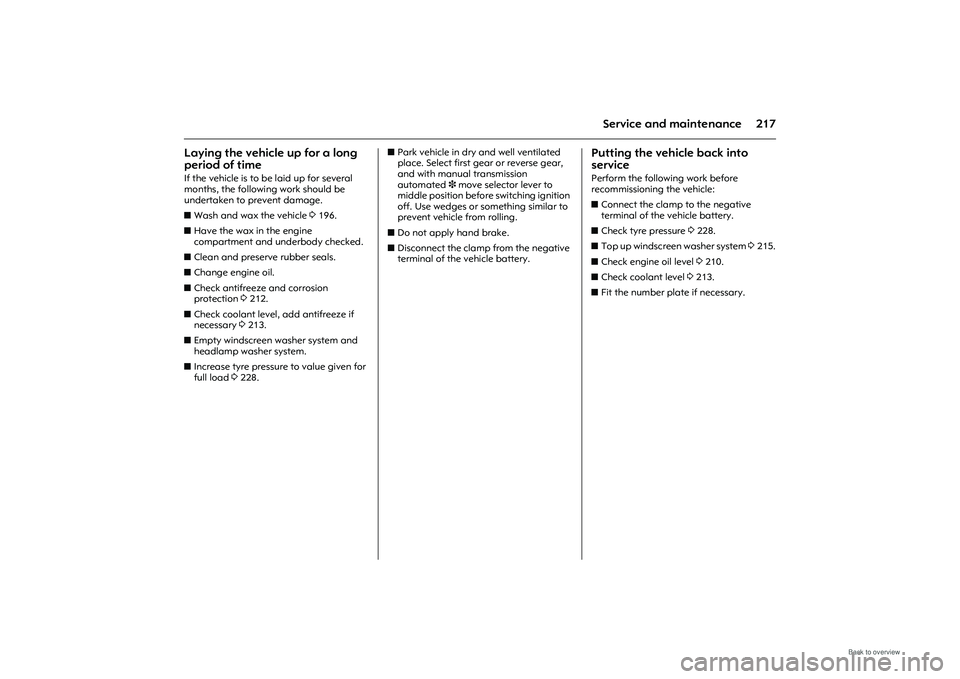
217
Service and maintenance
Laying the vehicle up for a long
period of time If the vehicle is to be laid up for several
months, the following work should be
undertaken to prevent damage.
zWash and wax the vehicle 3196.
z Have the wax in the engine
compartment and underbody checked.
z Clean and preserve rubber seals.
z Change engine oil.
z Check antifreeze and corrosion
protection 3 212.
z Check coolant level, add antifreeze if
necessary 3213.
z Empty windscreen washer system and
headlamp washer system.
z Increase tyre pressure to value given for
full load 3228. z
Park vehicle in dry and well ventilated
place. Select first gear or reverse gear,
and with manual transmission
automated 3 move selector lever to
middle position before switching ignition
off. Use wedges or something similar to
prevent vehicle from rolling.
z Do not apply hand brake.
z Disconnect the clamp from the negative
terminal of the vehicle battery.
Putting the vehicle back into
servicePerform the following work before
recommissioning the vehicle:
zConnect the clamp to the negative
terminal of the vehicle battery.
z Check tyre pressure 3228.
z Top up windscreen washer system 3215.
z Check engine oil level 3210.
z Check coolant level 3213.
z Fit the number plate if necessary.
Page 228 of 248
![OPEL MERIVA 2009 Owners Manual 222 Technical DataPerformance
Z 14 XEPZ 16 XEP Z 18 XEZ 16 LET
Top speed
1) [km/h]
5-speed transmission
5-gear sport transmission
6-speed transmission
manual transmission automated
1)The maximum spe](/img/37/58233/w960_58233-227.png "OPEL MERIVA 2009 Owners Manual 222 Technical DataPerformance
Z 14 XEPZ 16 XEP Z 18 XEZ 16 LET
Top speed
1) [km/h]
5-speed transmission
5-gear sport transmission
6-speed transmission
manual transmission automated
1)The maximum spe")
222 Technical DataPerformance
Z 14 XEPZ 16 XEP Z 18 XEZ 16 LET
Top speed
1) [km/h]
5-speed transmission
5-gear sport transmission
6-speed transmission
manual transmission automated
1)The maximum speed indicated is achievable at kerb weight (without driver) plus 200 kg payload. Optional equipment could reduce the specified
maximum speed of the vehicle.
168
–
–
– 181
–
–
181 190
–
–
190–
–
222
–
Page 229 of 248
![OPEL MERIVA 2009 Owners Manual 223
Technical Data
Performance
Z 13 DTJ Z 17 DT Z 17 DTH Z 17 DTR
Top speed
1) [km/h]
5-speed manual transmission
6-speed manual transmission
manual transmission automated
1)The maximum speed indica](/img/37/58233/w960_58233-228.png "OPEL MERIVA 2009 Owners Manual 223
Technical Data
Performance
Z 13 DTJ Z 17 DT Z 17 DTH Z 17 DTR
Top speed
1) [km/h]
5-speed manual transmission
6-speed manual transmission
manual transmission automated
1)The maximum speed indica")
223
Technical Data
Performance
Z 13 DTJ Z 17 DT Z 17 DTH Z 17 DTR
Top speed
1) [km/h]
5-speed manual transmission
6-speed manual transmission
manual transmission automated
1)The maximum speed indicated is achievable at kerb weight (without driver) plus 200 kg payload. Optional equipment could reduce the specified
maximum speed of the vehicle.
157
–
– –
180
– 178
–
– –
195
–
Page 231 of 248
![OPEL MERIVA 2009 Owners Manual 225
Technical Data
Fuel consumption, CO
2 emissions
Z 14 XEP Z 16 XEP Z 18 XE Z 16 LET
5-speed / sport / 6-gear / manual transmission automated fuel consumptionurban [l/100 km]
extra-urban [l/100 km]](/img/37/58233/w960_58233-230.png "OPEL MERIVA 2009 Owners Manual 225
Technical Data
Fuel consumption, CO
2 emissions
Z 14 XEP Z 16 XEP Z 18 XE Z 16 LET
5-speed / sport / 6-gear / manual transmission automated fuel consumptionurban [l/100 km]
extra-urban [l/100 km]")
225
Technical Data
Fuel consumption, CO
2 emissions
Z 14 XEP Z 16 XEP Z 18 XE Z 16 LET
5-speed / sport / 6-gear / manual transmission automated fuel consumptionurban [l/100 km]
extra-urban [l/100 km]
combined [l/100 km]
CO
2 [g/km]
8.1/–/–/–
5.1/–/–/–
6.2/–/–/–
148/–/–/–
8.9/–/–/ 8.9
5.4/–/–/ 5.4
6.7/–/–/ 6.7
159/–/–/159
10.3/–/–/10.1
5.6/–/–/ 5.7
7.3/–/–/ 7.3
174/–/–/ 174
–/–/ 10.4/–
–/–/ 6.3/–
–/–/ 7.8/–
–/–/ 187/–
Z 13 DTJ Z 17 DT Z 17 DTH Z 17 DTR
5-speed / 6-speed / sport / manual transmission automated fuel consumption
urban [l/100 km]
extra-urban [l/100 km]
combined [l/100 km]
CO2 [g/km]
6.2/–/–/–
4.3/–/–/–
5.0/–/–/–
135/–/–/–
–/ 6.8/–/–
–/ 4.6/–/–
–/ 5.4/–/–
–/ 146/–/–
6.6/–/–/–
4.4/–/–/–
5.2/–/–/–
139/–/–/–
–/ 6.8/–/–
–/ 4.6/–/–
–/ 5.4/–/–
–/ 146/–/–