display OPEL MERIVA 2009 Owner's Guide
[x] Cancel search | Manufacturer: OPEL, Model Year: 2009, Model line: MERIVA, Model: OPEL MERIVA 2009Pages: 248, PDF Size: 4.46 MB
Page 137 of 248
131
Driving and operation
Picture no: 14175s.tif
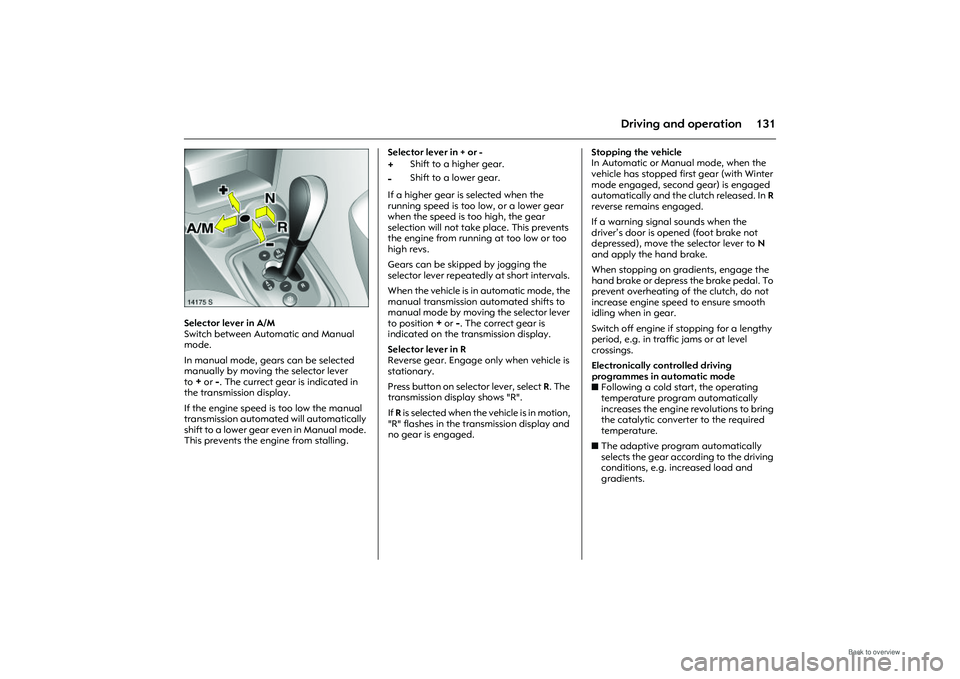
Selector lever in A/M
Switch between Automatic and Manual
mode.
In manual mode, gears can be selected
manually by moving the selector lever
to
+or
-. The currect gear is indicated in
the transmission display.
If the engine speed is too low the manual
transmission automated will automatically
shift to a lower gear even in Manual mode.
This prevents the engine from stalling. Selector lever in + or -
If a higher gear is selected when the
running speed is too low, or a lower gear
when the speed is too high, the gear
selection will not take place. This prevents
the engine from running at too low or too
high revs.
Gears can be skipped by jogging the
selector lever repeatedly
at short intervals.
When the vehicle is in automatic mode, the
manual transmission automated shifts to
manual mode by moving the selector lever
to position
+ or
-. The correct gear is
indicated on the transmission display.
Selector lever in R
Reverse gear. Engage only when vehicle is
stationary.
Press button on selector lever, select R. The
transmission display shows "R".
If R is selected when the vehicle is in motion,
"R" flashes in the transmission display and
no gear is engaged. Stopping the vehicle
In Automatic or Manual mode, when the
vehicle has stopped first gear (with Winter
mode engaged, second gear) is engaged
automatically and the
clutch released. In R
reverse remains engaged.
If a warning signal sounds when the
driver’s door is opened (foot brake not
depressed), move the selector lever to N
and apply the hand brake.
When stopping on gradients, engage the
hand brake or depress the brake pedal. To
prevent overheating of the clutch, do not
increase engine speed to ensure smooth
idling when in gear.
Switch off engine if stopping for a lengthy
period, e.g. in traffic jams or at level
crossings.
Electronically controlled driving
programmes in automatic mode
z Following a cold start, the operating
temperature program automatically
increases the engine revolutions to bring
the catalytic converter to the required
temperature.
z The adaptive program automatically
selects the gear according to the driving
conditions, e.g. increased load and
gradients.
+
Shift to a higher gear.
-
Shift to a lower gear.
Page 138 of 248
132 Driving and operation
Picture no: 17889s.tif
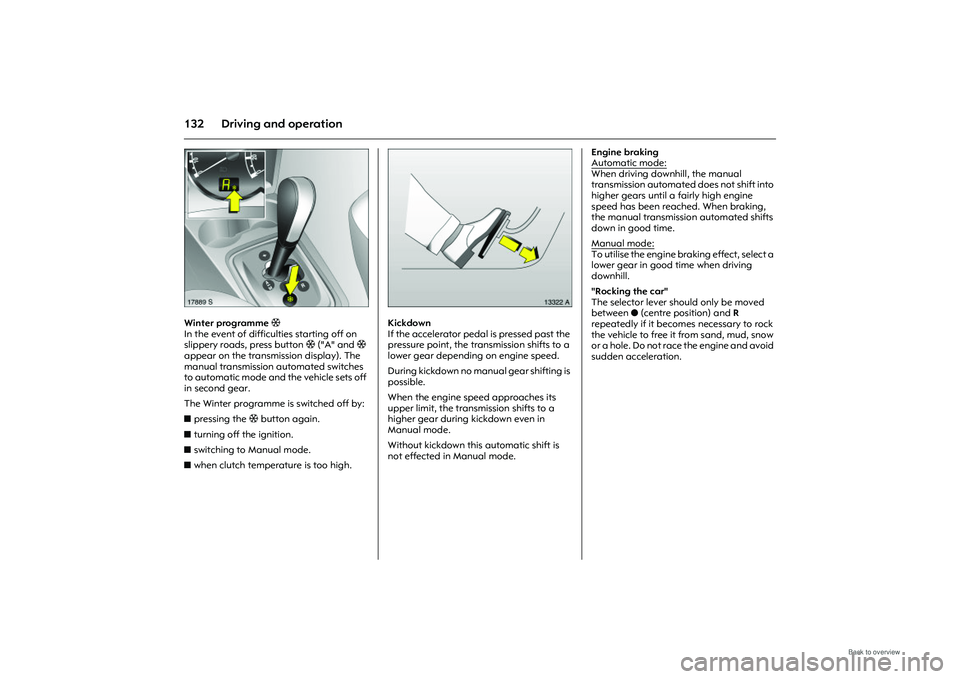
Winter programme T
In the event of difficulties starting off on
slippery roads, press button T ("A" and T
appear on the transmission display). The
manual transmission automated switches
to automatic mode and the vehicle sets off
in second gear.
The Winter programme is switched off by:
z pressing the T button again.
z turning off the ignition.
z switching to Manual mode.
z when clutch temperature is too high.
Picture no: 13322a.tif
Kickdown
If the accelerator pedal is pressed past the
pressure point, the transmission shifts to a
lower gear depending on engine speed.
During kickdown no manual gear shifting is
possible.
When the engine speed approaches its
upper limit, the transmission shifts to a
higher gear during kickdown even in
Manual mode.
Without kickdown this automatic shift is
not effected in Manual mode. Engine braking
Automatic mode:
When driving downhill, the manual
transmission automated does not shift into
higher gears until a fairly high engine
speed has been reached. When braking,
the manual transmission automated shifts
down in good time.
Manual mode:To utilise the engine br
aking effect, select a
lower gear in good time when driving
downhill.
"Rocking the car"
The selector lever should only be moved
between o (centre position) and R
repeatedly if it beco mes necessary to rock
the vehicle to free it from sand, mud, snow
or a hole. Do not race the engine and avoid
sudden acceleration.
Page 139 of 248
133
Driving and operation
Picture no: 14083j.tif
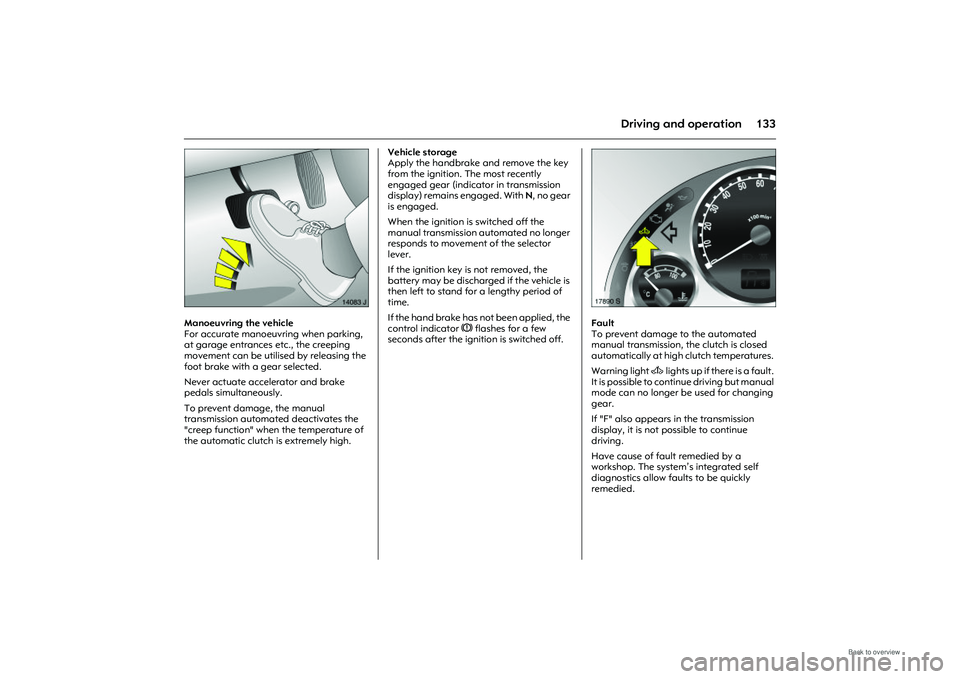
Manoeuvring the vehicle
For accurate manoeuvring when parking,
at garage entrances etc., the creeping
movement can be utilised by releasing the
foot brake with a gear selected.
Never actuate accelerator and brake
pedals simultaneously.
To prevent damage, the manual
transmission automated deactivates the
"creep function" when the temperature of
the automatic clutch is extremely high. Vehicle storage
Apply the handbrake and remove the key
from the ignition. The most recently
engaged gear (indicator in transmission
display) remains engaged. With
N, no gear
is engaged.
When the ignition is switched off the
manual transmission automated no longer
responds to movement of the selector
lever.
If the ignition key is not removed, the
battery may be discharg ed if the vehicle is
then left to stand for a lengthy period of
time.
If the hand brake has not been applied, the
control indicator R flashes for a few
seconds after the ignition is switched off.
Picture no: 17890s.tif
Fault
To prevent damage to the automated
manual transmission, the clutch is closed
automatically at high clutch temperatures.
Warning light A lights up if there is a fault.
It is possible to continue driving but manual
mode can no longer be used for changing
gear.
If "F" also appears in the transmission
display, it is not possible to continue
driving.
Have cause of fault remedied by a
workshop. The system’s integrated self
diagnostics allow faults to be quickly
remedied.
Page 189 of 248
183
Self-help, vehicle care
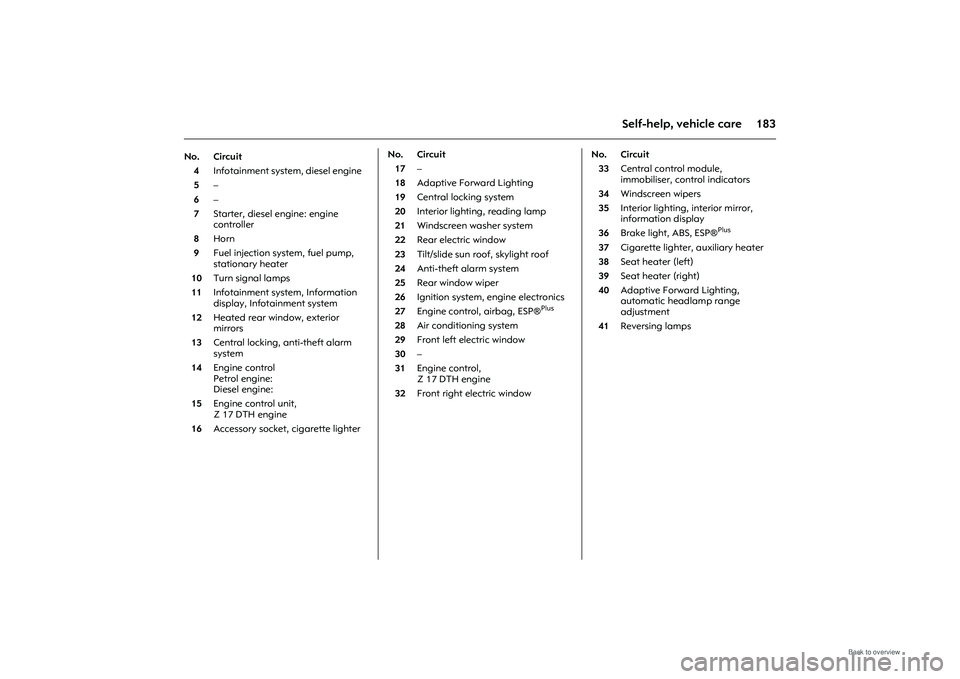
No. Circuit4 Infotainment system, diesel engine
5 –
6 –
7 Starter, diesel engine: engine
controller
8 Horn
9 Fuel injection system, fuel pump,
stationary heater
10 Turn signal lamps
11 Infotainment system, Information
display, Infotainment system
12 Heated rear window, exterior
mirrors
13 Central locking, anti-theft alarm
system
14 Engine control
Petrol engine:
Diesel engine:
15 Engine control unit,
Z 17 DTH engine
16 Accessory socket, cigarette lighter No. Circuit
17 –
18 Adaptive Forward Lighting
19 Central locking system
20 Interior lighting, reading lamp
21 Windscreen washer system
22 Rear electric window
23 Tilt/slide sun roof, skylight roof
24 Anti-theft alarm system
25 Rear window wiper
26 Ignition system, engine electronics
27 Engine control, airbag, ESP®
Plus
28 Air conditioning system
29 Front left electric window
30 –
31 Engine control,
Z 17 DTH engine
32 Front right electric window No. Circuit
33 Central control module,
immobiliser, control indicators
34 Windscreen wipers
35 Interior lighting, interior mirror,
information display
36 Brake light, ABS, ESP®
Plus
37Cigarette lighter, auxiliary heater
38 Seat heater (left)
39 Seat heater (right)
40 Adaptive Forward Lighting,
automatic headlamp range
adjustment
41 Reversing lamps
Page 202 of 248
196 Self-help, vehicle care
Picture no: 12928j.tif
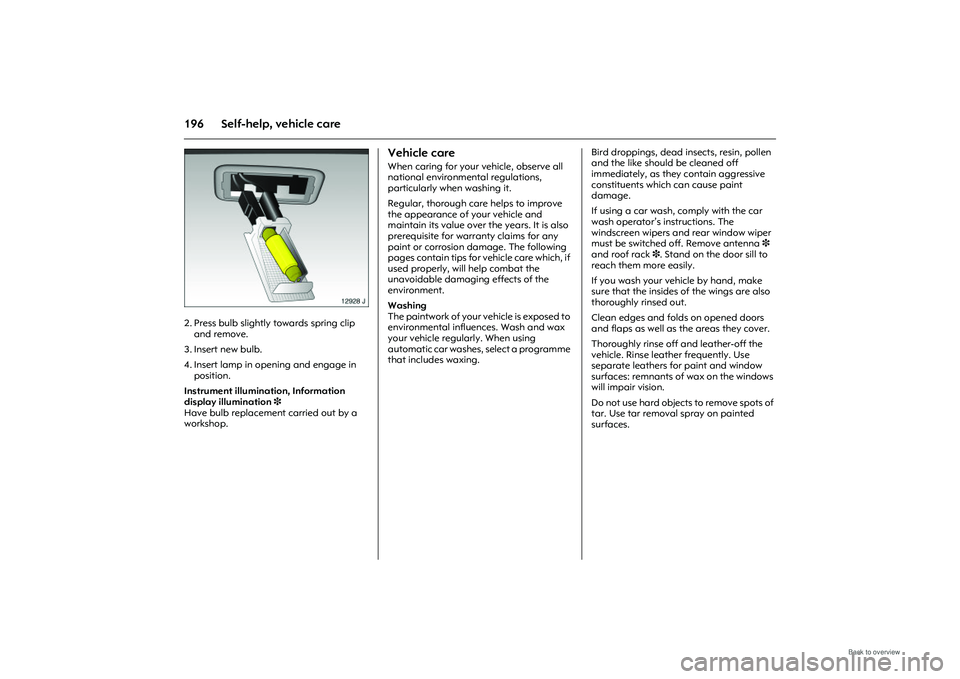
2. Press bulb slightly towards spring clip and remove.
3. Insert new bulb.
4. Insert lamp in op ening and engage in
position.
Instrument illumination, Information
display illumination 3
Have bulb replacement carried out by a
workshop.
Vehicle careWhen caring for your vehicle, observe all
national environmental regulations,
particularly when washing it.
Regular, thorough care helps to improve
the appearance of your vehicle and
maintain its value over the years. It is also
prerequisite for warranty claims for any
paint or corrosion damage. The following
pages contain tips for vehicle care which, if
used properly, will help combat the
unavoidable damaging effects of the
environment.
Washing
The paintwork of your vehicle is exposed to
environmental influences. Wash and wax
your vehicle regularly. When using
automatic car washes, select a programme
that includes waxing. Bird droppings, dead insects, resin, pollen
and the like should be cleaned off
immediately, as they contain aggressive
constituents which can cause paint
damage.
If using a car wash, comply with the car
wash operator’s instructions. The
windscreen wipers and rear window wiper
must be switched off. Remove antenna
3
and roof rack 3 . Stand on the door sill to
reach them more easily.
If you wash your vehicle by hand, make
sure that the insides of the wings are also
thoroughly rinsed out.
Clean edges and folds on opened doors
and flaps as well as the areas they cover.
Thoroughly rinse off and leather-off the
vehicle. Rinse leather frequently. Use
separate leathers for paint and window
surfaces: remnants of wax on the windows
will impair vision.
Do not use hard objects to remove spots of
tar. Use tar removal spray on painted
surfaces.
Page 205 of 248
199
Service and maintenance
Service and
maintenance
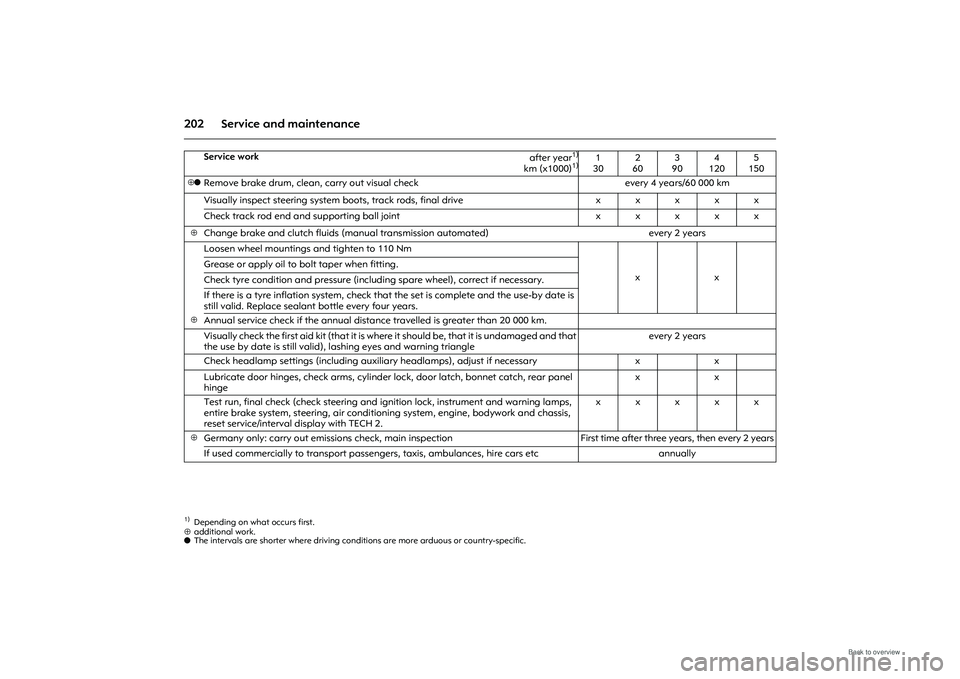
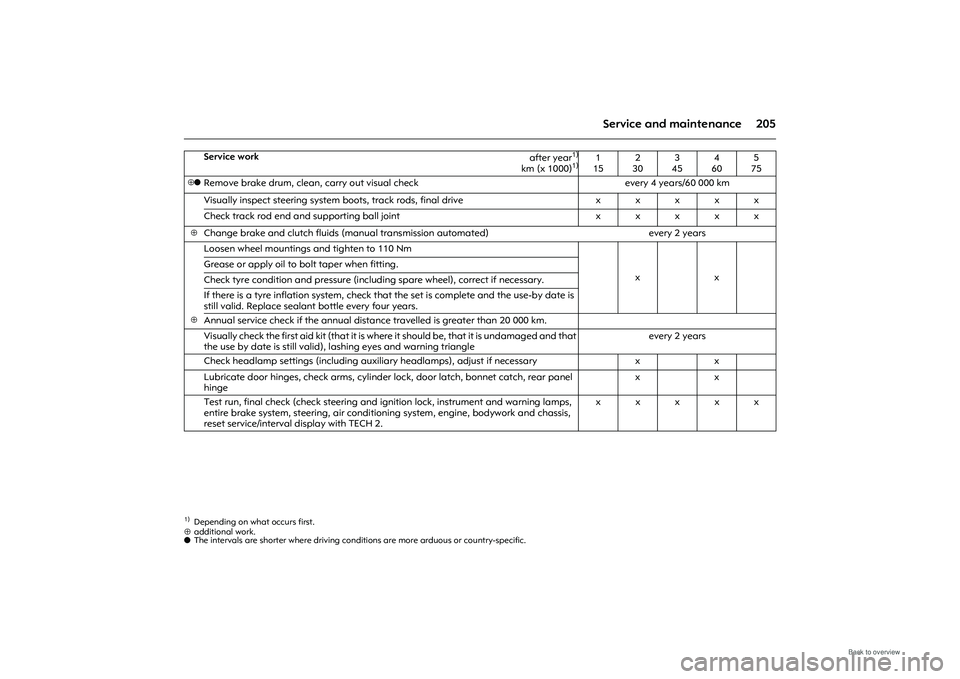
Scheduled maintenanceThese service intervals apply only under
normal driving conditions. If conditions are
more arduous 3206
Service interval display 3208.
European service intervals
Every 30 000 km or annually, whichever
occurs first.
International service intervals
Every 15 000 km or annually, whichever
occurs first.
Validation
Service is validated using the spaces
provided in the Service and Warranty
Booklet. The date of service and kilometre
reading are added, stamped and signed
by the service workshop.
Ensure that the Service and Warranty
Booklet is filled in correctly - an
uninterrupted service history is important
when making guarantee or goodwill
claims, and is also an advantage when
selling the vehicle on.
Service scheduleThe service schedule applies in the
following countries: Andorra, Austria,
Belgium, Cyprus, Czech Republic,
Denmark, Estonia, Finland, France,
Germany, Great Br itain, Greece,
Greenland, Hungary, Iceland, Ireland, Italy,
Latvia, Lithuania, Luxembourg, Malta,
Netherlands, Norway, Poland, Portugal,
Slovakia, Slovenia , Spain, Sweden,
Switzerland.
The international serv ice schedule applies
in all other countries.
Scheduled maintenance ..................... 199
Service schedule .................................. 199
Additional service work ....................... 206
Recommended fluids and lubricants .. 206
Inspection system ................................ 208
Genuine Opel Parts and Accessories .. 209
Performing work .................................. 209
Engine oil .............................................. 210
Diesel fuel filter .................................... 212
Coolant ................................................. 212
Brakes ................................................... 213
Brake fluid ............................................ 214
Windscreen wiper replacement .......... 215
Windscreen and headlamp washer
systems 3........................................... 215
Battery .................................................. 216
Protecting electronic components ..... 216
Laying the vehicle up for a long period of time .................................... 217
Putting the vehicle back into service ... 217
Page 208 of 248
202 Service and maintenance⊕additional work.
o The intervals are shorter where driving conditions are more arduous or country-specific.
Service work
after year
1)
km (x1000)
1)
1)Depending on what occurs first.
1
30 2
60 3
90 4
120 5
150
⊕o
Remove brake drum, clean, carry out visual check every 4 years/60 000 km
Visually inspect steering system boots, track rods, final drive xxxxx
Check track rod end and supporting ball joint xxxxx
⊕
Change brake and clutch fluids (manual transmission automated) every 2 years
Loosen wheel mountings and tighten to 110 Nm
xx
Grease or apply oil to
bolt taper when fitting.
Check tyre condition and pressure (inclu ding spare wheel), correct if necessary.
If there is a tyre inflation system, check that the set is complete and the use-by date is
still valid. Replace sealant bottle every four years.
⊕
Annual service check if the annual distance travelled is greater than 20 000 km.
Visually check the first aid kit (that it is wher e it should be, that it is undamaged and that
the use by date is still valid), lashing eyes and warning triangle every 2 years
Check headlamp settings (including auxi liary headlamps), adjust if necessary xx
Lubricate door hinges, check arms, cylinder lo ck, door latch, bonnet catch, rear panel
hinge xx
Test run, final check (check steering and ig nition lock, instrument and warning lamps,
entire brake system, steering, air conditioni ng system, engine, bodywork and chassis,
reset service/interval display with TECH 2. xxxxx
⊕
Germany only: carry out emissions check, main inspection
First time after three years, then every 2 years
If used commercially to tran sport passengers, taxis, ambulances, hire cars etc annually
Page 211 of 248
205
Service and maintenance
⊕ additional work.
o The intervals are shorter where driving conditions are more arduous or country-specific.
Service work
after year
1)
km (x 1000)
1)
1)Depending on what occurs first.
1
15 2
30 3
45 4
60 5
75
⊕o
Remove brake drum, clean, carry out visual check every 4 years/60 000 km
Visually inspect steering system boots, track rods, final drive xxxxx
Check track rod end and supporting ball joint xxxxx
⊕
Change brake and clutch fluids (manual transmission automated) every 2 years
Loosen wheel mountings and tighten to 110 Nm
xx
Grease or apply oil to
bolt taper when fitting.
Check tyre condition and pressure (inclu ding spare wheel), correct if necessary.
If there is a tyre inflation system, check that the set is complete and the use-by date is
still valid. Replace sealant bottle every four years.
⊕
Annual service check if the annual distance travelled is greater than 20 000 km.
Visually check the first aid kit (that it is wher e it should be, that it is undamaged and that
the use by date is still valid), lashing eyes and warning triangle every 2 years
Check headlamp settings (including auxi liary headlamps), adjust if necessary xx
Lubricate door hinges, check arms, cylinder lo ck, door latch, bonnet catch, rear panel
hinge xx
Test run, final check (check steering and ig nition lock, instrument and warning lamps,
entire brake system, steering, air conditioni ng system, engine, bodywork and chassis,
reset service/interval display with TECH 2. xxxxx
Page 214 of 248
208 Service and maintenance
Picture no: 18602s.tif
Inspection system In order to guarantee economical and safe
vehicle operation and to maintain the
value of your vehicle, it is of vital
importance that all maintenance work is
carried out at the proper intervals.
Fixed service interval
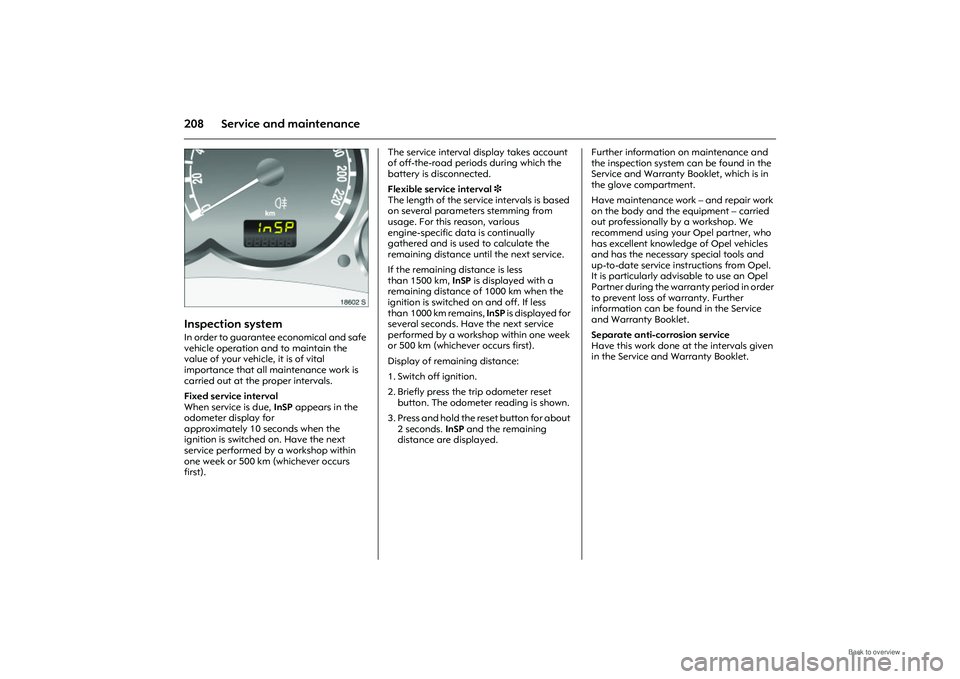
When service is due, InSP appears in the
odometer display for
approximately 10 seconds when the
ignition is switched on. Have the next
service performed by a workshop within
one week or 500 km (whichever occurs
first). The service interval display takes account
of off-the-road periods during which the
battery is disconnected.
Flexible service interval
3
The length of the service intervals is based
on several parameters stemming from
usage. For this reason, various
engine-specific data is continually
gathered and is used to calculate the
remaining distance until the next service.
If the remaining distance is less
than 1500 km, InSP is displayed with a
remaining distance of 1000 km when the
ignition is switched on and off. If less
than 1000 km remains, InSP is displayed for
several seconds. Have the next service
performed by a workshop within one week
or 500 km (whichever occurs first).
Display of remaining distance:
1. Switch off ignition.
2. Briefly press the trip odometer reset button. The odometer reading is shown.
3. Press and hold the reset button for about 2 seconds. InSP and the remaining
distance are displayed. Further information
on maintenance and
the inspection system can be found in the
Service and Warranty Booklet, which is in
the glove compartment.
Have maintenance work – and repair work
on the body and the equipment – carried
out professionally by a workshop. We
recommend using your Opel partner, who
has excellent knowledge of Opel vehicles
and has the necessary special tools and
up-to-date service inst ructions from Opel.
It is particularly advisable to use an Opel
Partner during the warranty period in order
to prevent loss of warranty. Further
information can be found in the Service
and Warranty Booklet.
Separate anti-corrosion service
Have this work done at the intervals given
in the Service and Warranty Booklet.
Page 241 of 248
235
Index
Centre console lighting .................. 108, 109
Changing the remote control battery ..... 29
Changing wheels .................................... 174
Chassis number, see Vehicle identification number ........................... 219
Child restraint system ............................... 65
Child safety locks ................................ 36, 40
Cigarette lighter........................................ 78
Climate control system ........................... 122
Clutch operation ............................. 134, 136
CO2 emissions......................................... 224
Coin holder ................................................ 81
Cold start ................................................. 136
Colour information display ...................... 92
Contrast ..................................................... 96
Control indicator ABS (Anti-lock Brake System) ............ 152
Airbag .................................................... 72
Engine electronics ............................... 143
Exhaust ................................................ 143
Immobiliser ............................................ 27
Control indicators ............................... 10, 82 Adaptive Forward Lighting
(AFL) .............................................. 82, 106
Belt tensioners ....................................... 61
Cruise control ...................................... 148
EPS (Electric Power Steering) ............... 86
ESP (Electronic Stability Program) ..... 146
Coolant ............................................ 208, 212
Coolant level ........................................... 213
Coolant temperature display .................. 88
Coolant thermometer ............................... 88
Cornering light ........................................ 106
Correcting time ......................................... 95 Coupling socket load ............................. 163
Courtesy lamp ........................................ 108
Bulb replacement ............................... 194
Cruise control .......................................... 148
Curtain airbags......................................... 71
Curve lighting ......................................... 106
DDashboard, see Instrument panel .......... 15
Data................................................... 26, 218
Date ........................................................... 92
Daytime running lights........................... 102
Decommissioning ................................... 217
Demisting and defrosting Windows .............................................. 118
with climate control system ............... 124
With the air conditioning system....... 121
Diesel fuel filter ....................................... 212
Diesel fuel system ........................... 165, 212
Diesel particle filter.............41, 86, 136, 144
Dimensions .............................................. 231
Dipped beam ............................................ 11 Bulb replacement ....................... 186, 188
Display....................................................... 90
Display mode ............................................ 96
Door locks ......................................... 26, 198
Driving abroad ....................................... 199 Headlamps.......................................... 110
Toll systems ......................................... 112
Driving hints ............................................ 135
EEasytronic ......................................... 15, 129 Driving programmes .......................... 131
Fault .................................................... 133
Interruption of power supply ............. 134
Kickdown............................................. 132
Selector lever................................. 15, 130
Winter programme ............................. 132
Economical driving ................................. 137
Electric power steering ............................. 86
Electric windows ....................................... 40
Electrical system ............................. 181, 216
Electronic components........................... 216
Electronic immobiliser .............................. 27
Electronic Stability Program .................. 146
Engine code .................................... 220, 221
Engine control indicator ........................ 143
Engine oil ........................................ 207, 210 Additives ............................................. 207
Top up ................................................. 207
Viscosity .............................................. 207
Engine oil consumption ... 135, 210, 220, 221
Engine oil level ........................................ 210
Engine oil pressure ................................... 84
Engine speed .......................................... 136
Engine wash............................................ 198
Environmental protection ...................... 196
EPS ............................................................. 86
ESP (Electronic Stability Program) ........ 146
Exhaust control indicator ...................... 143
Exhaust gases......................................... 144
Exhaust system ....................................... 135