warning OPEL MERIVA 2009 Workshop Manual
[x] Cancel search | Manufacturer: OPEL, Model Year: 2009, Model line: MERIVA, Model: OPEL MERIVA 2009Pages: 248, PDF Size: 4.46 MB
Page 130 of 248
124 Climate controlManual settings
Under certain circumstances (e.g. iced or
misted windows), the functions of the
climate control system can be modified
manually.
Manual settings are saved when the
ignition is switched off.
Make manual settings as follows when
necessary:
Picture no: 16501s.tif
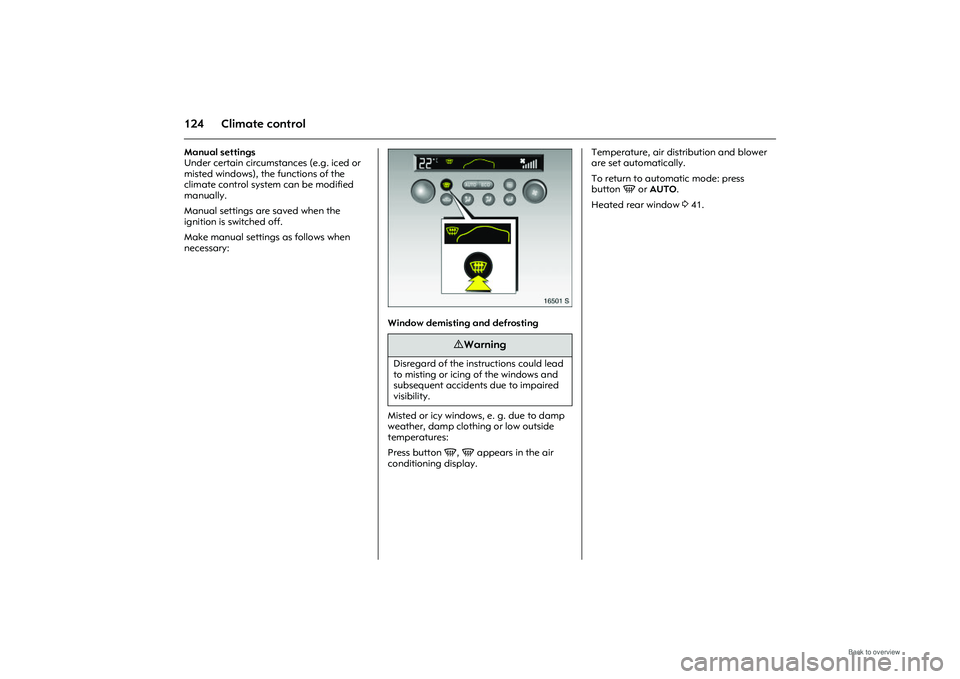
Window demisting and defrosting
Misted or icy windows, e. g. due to damp
weather, damp clothing or low outside
temperatures:
Press button V, V appears in the air
conditioning display. Temperature, air dist
ribution and blower
are set automatically.
To return to automatic mode: press
button V or AUTO .
Heated rear window 341.
9 Warning
Disregard of the instructions could lead
to misting or icing of the windows and
subsequent accidents due to impaired
visibility.
Page 132 of 248
126 Climate control
Picture no: 16506s.tif
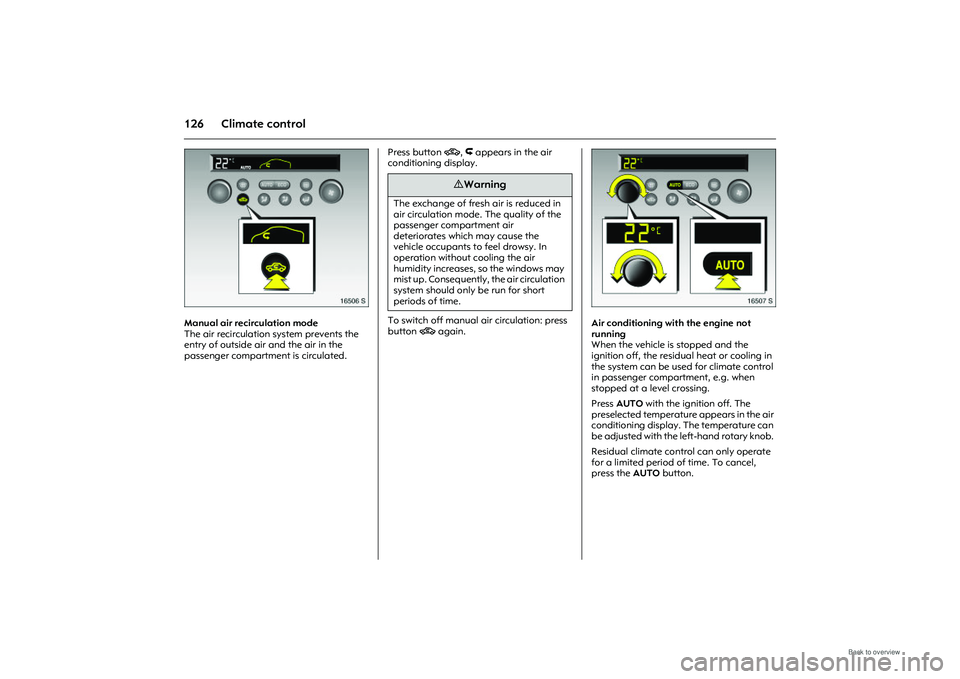
Manual air recirculation mode
The air recirculation system prevents the
entry of outside air and the air in the
passenger compartment is circulated. Press button
4, % appears in the air
conditioning display.
To switch off manual air circulation: press
button 4 again.
Picture no: 16507s.tif
Air conditioning with the engine not
running
When the vehicle is stopped and the
ignition off, the residu al heat or cooling in
the system can be used for climate control
in passenger compartment, e.g. when
stopped at a level crossing.
Press AUTO with the ignition off. The
preselected temperature appears in the air
conditioning display. The temperature can
be adjusted with the left-hand rotary knob.
Residual climate control can only operate
for a limited period of time. To cancel,
press the AUTO button.
9 Warning
The exchange of fresh air is reduced in
air circulation mode. The quality of the
passenger compartment air
deteriorates which may cause the
vehicle occupants to feel drowsy. In
operation without cooling the air
humidity increases, so the windows may
mist up. Consequently, the air circulation
system should only be run for short
periods of time.
Page 137 of 248
131
Driving and operation
Picture no: 14175s.tif
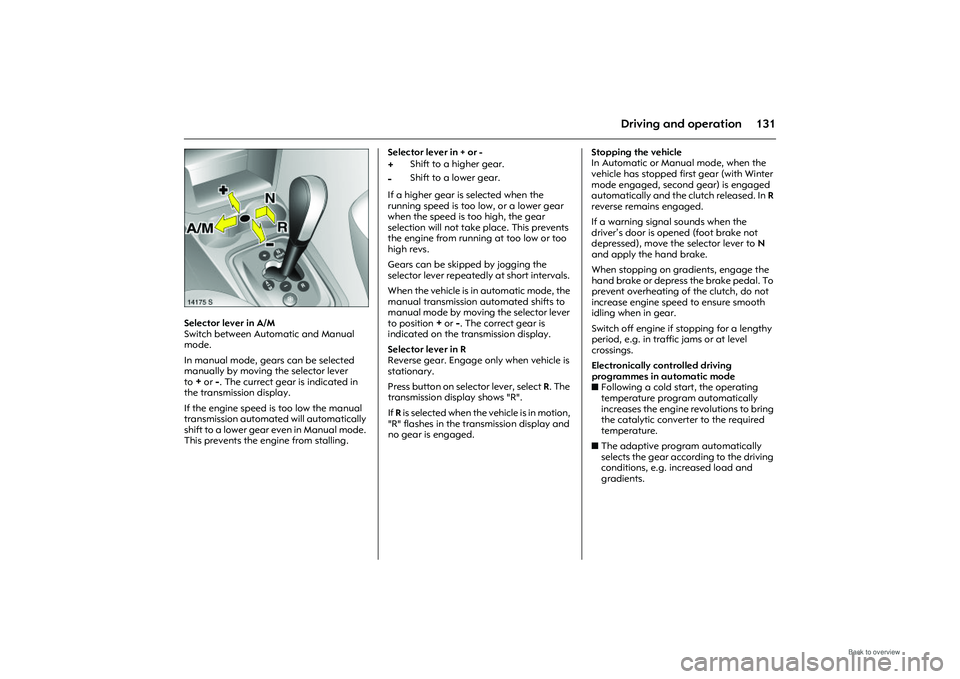
Selector lever in A/M
Switch between Automatic and Manual
mode.
In manual mode, gears can be selected
manually by moving the selector lever
to
+or
-. The currect gear is indicated in
the transmission display.
If the engine speed is too low the manual
transmission automated will automatically
shift to a lower gear even in Manual mode.
This prevents the engine from stalling. Selector lever in + or -
If a higher gear is selected when the
running speed is too low, or a lower gear
when the speed is too high, the gear
selection will not take place. This prevents
the engine from running at too low or too
high revs.
Gears can be skipped by jogging the
selector lever repeatedly
at short intervals.
When the vehicle is in automatic mode, the
manual transmission automated shifts to
manual mode by moving the selector lever
to position
+ or
-. The correct gear is
indicated on the transmission display.
Selector lever in R
Reverse gear. Engage only when vehicle is
stationary.
Press button on selector lever, select R. The
transmission display shows "R".
If R is selected when the vehicle is in motion,
"R" flashes in the transmission display and
no gear is engaged. Stopping the vehicle
In Automatic or Manual mode, when the
vehicle has stopped first gear (with Winter
mode engaged, second gear) is engaged
automatically and the
clutch released. In R
reverse remains engaged.
If a warning signal sounds when the
driver’s door is opened (foot brake not
depressed), move the selector lever to N
and apply the hand brake.
When stopping on gradients, engage the
hand brake or depress the brake pedal. To
prevent overheating of the clutch, do not
increase engine speed to ensure smooth
idling when in gear.
Switch off engine if stopping for a lengthy
period, e.g. in traffic jams or at level
crossings.
Electronically controlled driving
programmes in automatic mode
z Following a cold start, the operating
temperature program automatically
increases the engine revolutions to bring
the catalytic converter to the required
temperature.
z The adaptive program automatically
selects the gear according to the driving
conditions, e.g. increased load and
gradients.
+
Shift to a higher gear.
-
Shift to a lower gear.
Page 139 of 248
133
Driving and operation
Picture no: 14083j.tif
Manoeuvring the vehicle
For accurate manoeuvring when parking,
at garage entrances etc., the creeping
movement can be utilised by releasing the
foot brake with a gear selected.
Never actuate accelerator and brake
pedals simultaneously.
To prevent damage, the manual
transmission automated deactivates the
"creep function" when the temperature of
the automatic clutch is extremely high. Vehicle storage
Apply the handbrake and remove the key
from the ignition. The most recently
engaged gear (indicator in transmission
display) remains engaged. With
N, no gear
is engaged.
When the ignition is switched off the
manual transmission automated no longer
responds to movement of the selector
lever.
If the ignition key is not removed, the
battery may be discharg ed if the vehicle is
then left to stand for a lengthy period of
time.
If the hand brake has not been applied, the
control indicator R flashes for a few
seconds after the ignition is switched off.
Picture no: 17890s.tif
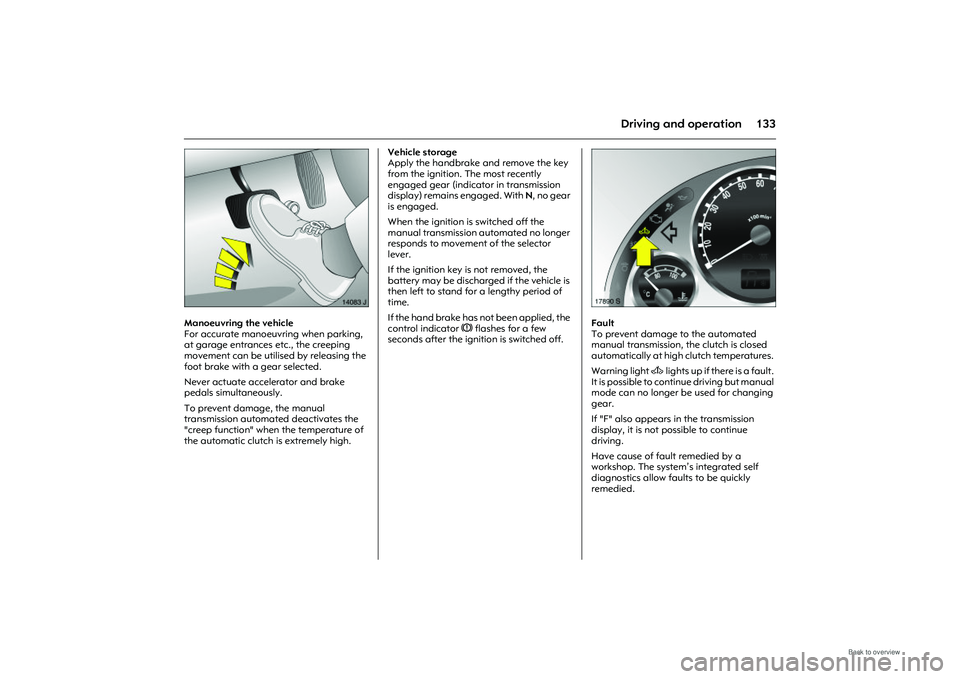
Fault
To prevent damage to the automated
manual transmission, the clutch is closed
automatically at high clutch temperatures.
Warning light A lights up if there is a fault.
It is possible to continue driving but manual
mode can no longer be used for changing
gear.
If "F" also appears in the transmission
display, it is not possible to continue
driving.
Have cause of fault remedied by a
workshop. The system’s integrated self
diagnostics allow faults to be quickly
remedied.
Page 146 of 248
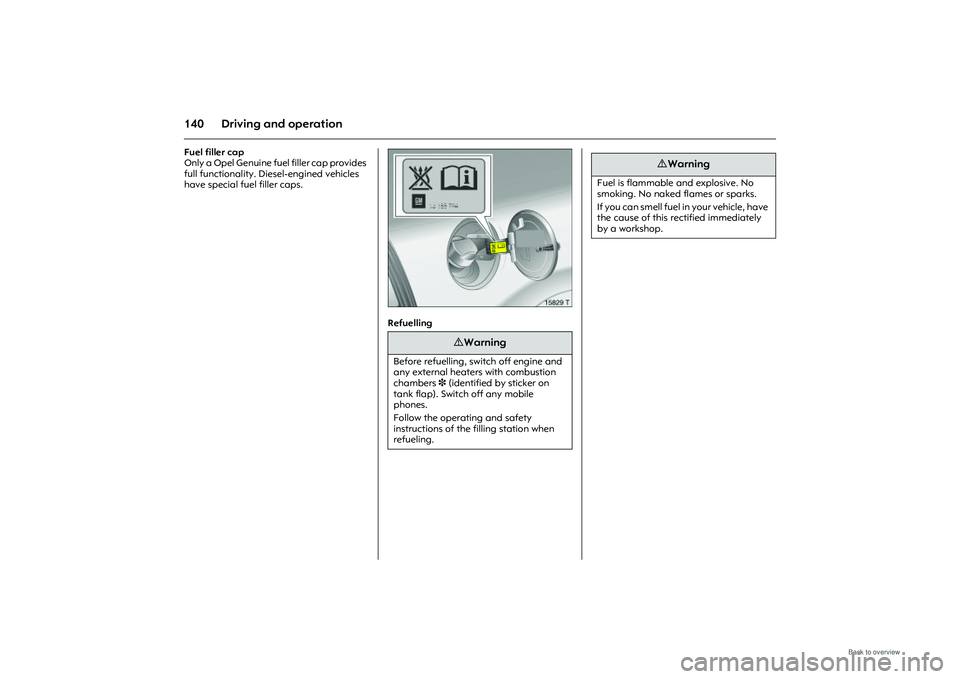
140 Driving and operationFuel filler cap
Only a Opel Genuine fuel filler cap provides
full functionality. Diesel-engined vehicles
have special fuel filler caps.
Picture no: 15829t.tif
Refuelling
9 Warning
Before refuelling, switch off engine and
any external heaters with combustion
chambers 3 (identified by sticker on
tank flap). Switch off any mobile
phones.
Follow the operating and safety
instructions of the filling station when
refueling.
9 Warning
Fuel is flammable and explosive. No
smoking. No naked flames or sparks.
If you can smell fuel in your vehicle, have
the cause of this rectified immediately
by a workshop.
Page 150 of 248
144 Driving and operationEngine exhaust
Picture no: 18600S.tif
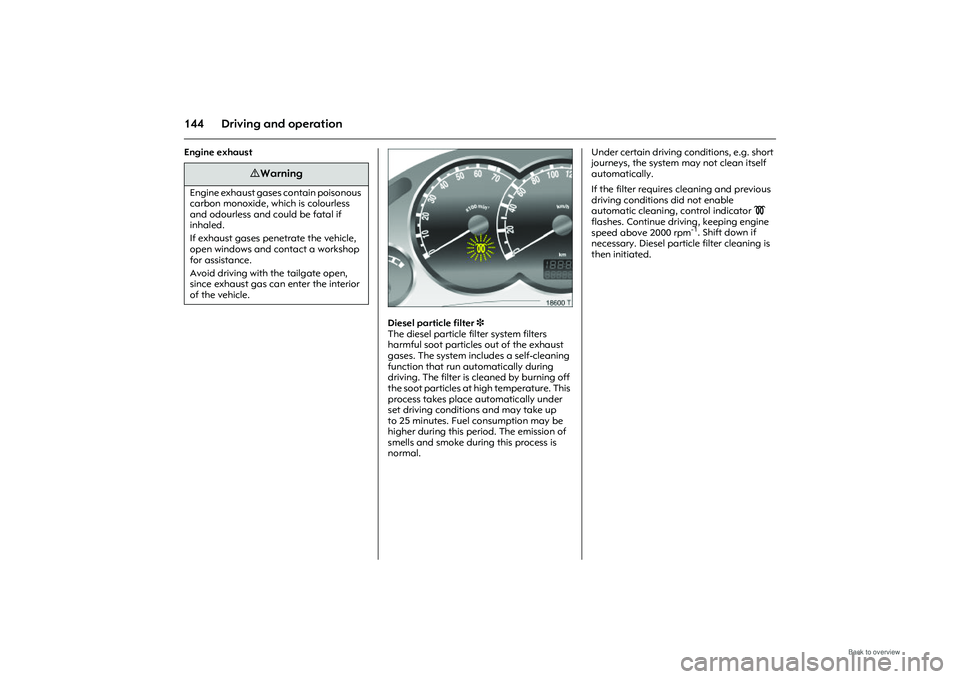
Diesel particle filter 3
The diesel particle filter system filters
harmful soot particles out of the exhaust
gases. The system includes a self-cleaning
function that run automatically during
driving. The filter is cleaned by burning off
the soot particles at hi gh temperature. This
process takes place automatically under
set driving conditions and may take up
to 25 minutes. Fuel consumption may be
higher during this period. The emission of
smells and smoke during this process is
normal. Under certain driving conditions, e.g. short
journeys, the system may not clean itself
automatically.
If the filter requires cleaning and previous
driving conditions did not enable
automatic cleaning, control indicator
!
flashes. Continue driving, keeping engine
speed above 2000 rpm
-1. Shift down if
necessary. Diesel partic le filter cleaning is
then initiated.
9 Warning
Engine exhaust gases contain poisonous
carbon monoxide, which is colourless
and odourless and could be fatal if
inhaled.
If exhaust gases penetrate the vehicle,
open windows and contact a workshop
for assistance.
Avoid driving with the tailgate open,
since exhaust gas can enter the interior
of the vehicle.
Page 152 of 248
146 Driving and operationDrive Control SystemsElectronic Stability Program (ESP®
Plus
) 3
ESP®
Plus
improves driving stability when
necessary in any driving situation
regardless of the type of road surface or
tyre grip. It also prevents the drive wheels
from spinning. As soon as the vehicle starts to swerve
(understeer/oversteer), engine output is
reduced and the wheels are braked
individually. This considerably improves
the driving stability of the vehicle on
slippery road surfaces.
ESP®
Plus
is ready for operation as soon as
the ignition is switched on and control
indicator v goes out.
When ESP®
Plus
comes into action, v
flashes. The vehicle is now in a critical situation;
ESP®
Plus
allows you to keep control of the
vehicle and reminds you to match your
speed to the road conditions.
9 Warning
Do not let this special safety feature
tempt you into taking risks when driving.
ESP®
Plus
does not negate the laws of
physics.
Adapt speed to the road conditions.
Page 153 of 248
147
Driving and operation
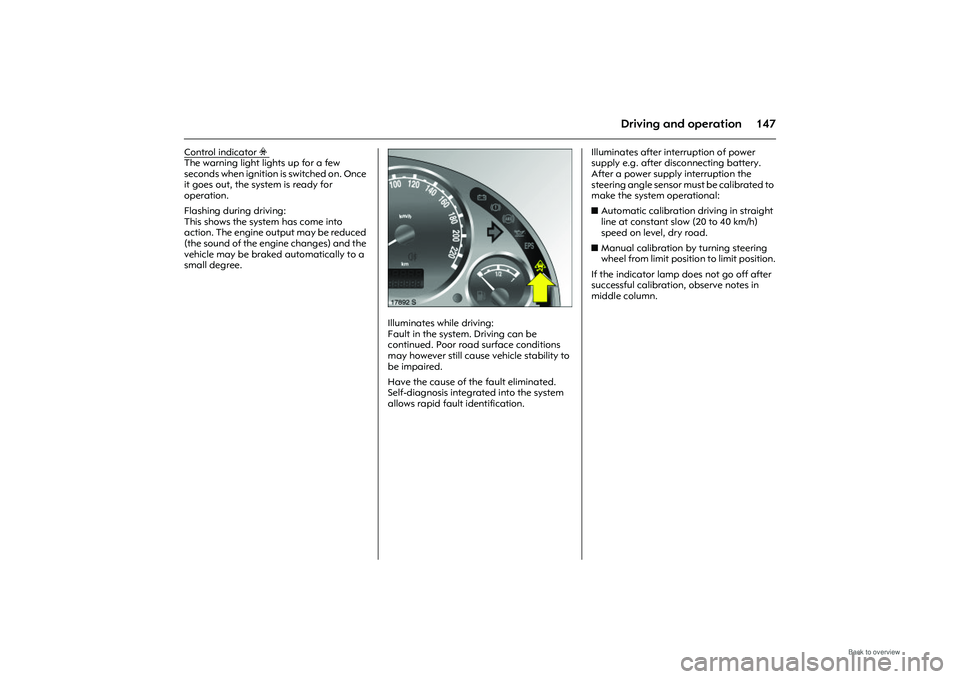
Control indicator
v
The warning light lights up for a few
seconds when ignition is switched on. Once
it goes out, the system is ready for
operation.
Flashing during driving:
This shows the system has come into
action. The engine output may be reduced
(the sound of the engine changes) and the
vehicle may be braked automatically to a
small degree.
Picture no: 17892s.tif
Illuminates while driving:
Fault in the system. Driving can be
continued. Poor road surface conditions
may however still cause vehicle stability to
be impaired.
Have the cause of the fault eliminated.
Self-diagnosis integrated into the system
allows rapid fault identification. Illuminates after interruption of power
supply e.g. after disconnecting battery.
After a power supply interruption the
steering angle sensor must be calibrated to
make the system operational:
z
Automatic calibration driving in straight
line at constant slow (20 to 40 km/h)
speed on level, dry road.
z Manual calibration by turning steering
wheel from limit position to limit position.
If the indicator lamp does not go off after
successful calibration , observe notes in
middle column.
Page 154 of 248
148 Driving and operationCruise control 3
Cruise control can store and maintain
speeds of approx. 30 to 200 km/h.
Deviation from the stored speed is possible
on uphill or downhill inclines.
For safety reasons the cruise control
cannot be activated until the foot brake
has been operated once.
The cruise control is operated with the
buttons I, R and O on the turn signal lever.
Do not use the cruise control if it is not
advisable to maintain a constant speed
(e.g. in situations presenting a danger to
yourself and other road users, in heavy
traffic or on winding, slippery or greasy
roads). For manual transmission automated
3,
engage cruise control in automatic mode
only.
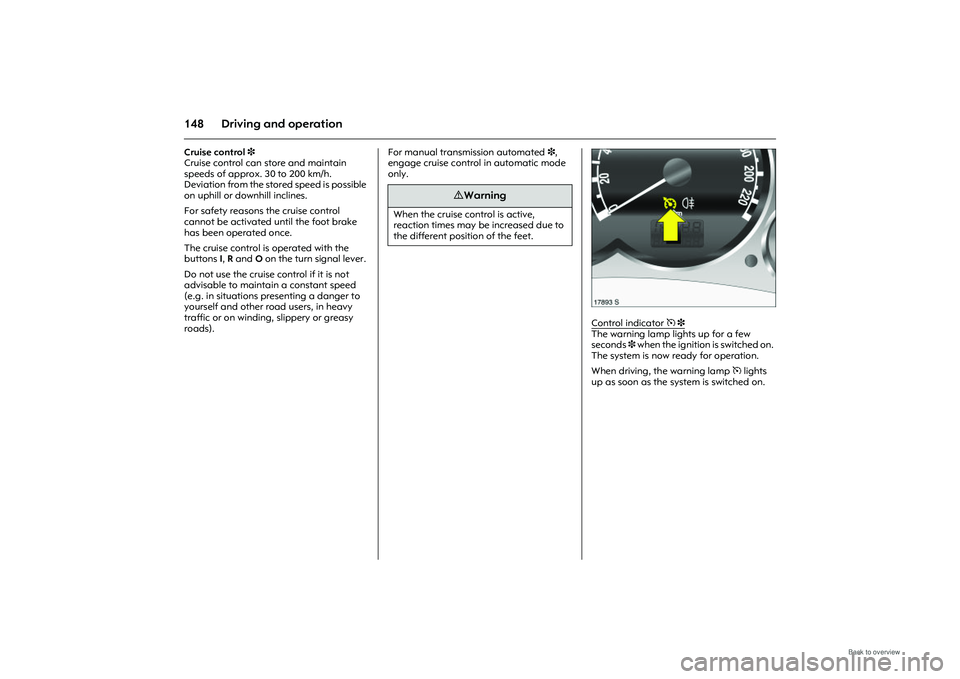
Picture no: 17893s.tif
Control indicator
m 3
The warning lamp lights up for a few
seconds 3 when the ignition is switched on.
The system is now ready for operation.
When driving, th e warning lamp m lights
up as soon as the sy stem is switched on.
9 Warning
When the cruise control is active,
reaction times may be increased due to
the different position of the feet.
Page 156 of 248
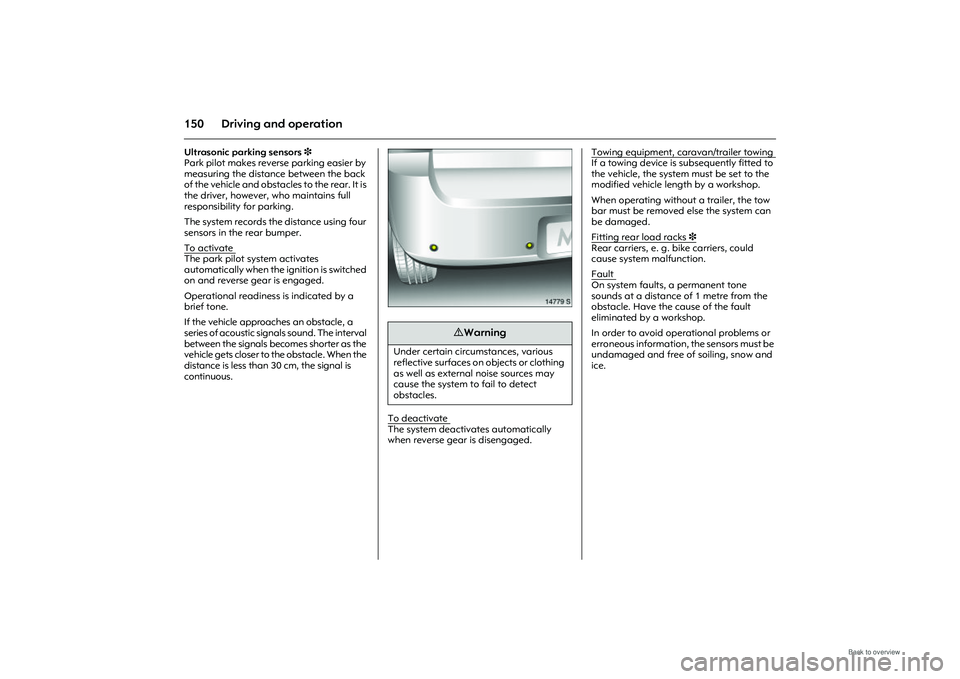
150 Driving and operationUltrasonic parking sensors 3
Park pilot makes reverse parking easier by
measuring the distance between the back
of the vehicle and obstacles to the rear. It is
the driver, however, who maintains full
responsibility for parking.
The system records the distance using four
sensors in the rear bumper.
To activate The park pilot system activates
automatically when the ignition is switched
on and reverse gear is engaged.
Operational readiness is indicated by a
brief tone.
If the vehicle approaches an obstacle, a
series of acoustic signals sound. The interval
between the signals be comes shorter as the
vehicle gets closer to the obstacle. When the
distance is less than 30 cm, the signal is
continuous.
Picture no: 14779s.tif
To deactivate The system deactivates automatically
when reverse gear is disengaged. Towing equipment, caravan/trailer towing
If a towing device is subsequently fitted to
the vehicle, the system must be set to the
modified vehicle length by a workshop.
When operating without a trailer, the tow
bar must be removed else the system can
be damaged.
Fitting rear load racks
3
Rear carriers, e. g. bike carriers, could
cause system malfunction.
Fault
On system faults, a permanent tone
sounds at a distance of 1 metre from the
obstacle. Have the cause of the fault
eliminated by a workshop.
In order to avoid operational problems or
erroneous information, the sensors must be
undamaged and free of soiling, snow and
ice.
9 Warning
Under certain circumstances, various
reflective surfaces on objects or clothing
as well as external noise sources may
cause the system to fail to detect
obstacles.