AUX OPEL MERIVA 2009 Owners Manual
[x] Cancel search | Manufacturer: OPEL, Model Year: 2009, Model line: MERIVA, Model: OPEL MERIVA 2009Pages: 248, PDF Size: 4.46 MB
Page 84 of 248
78 Seats, Interior
Picture no: 14111s.tif
Cigarette lighter
3
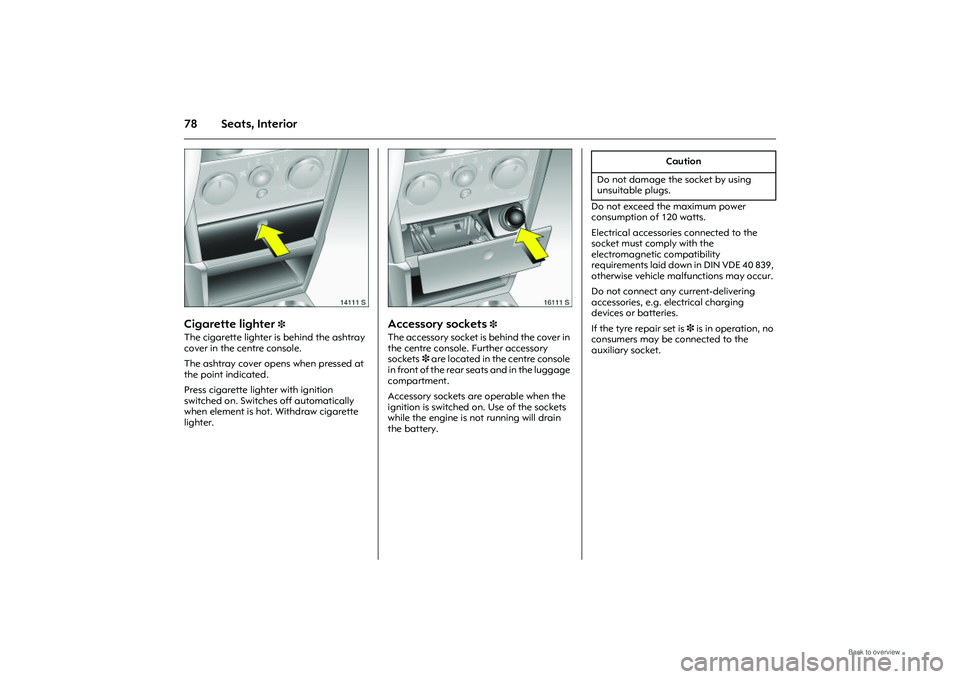
The cigarette lighter is behind the ashtray
cover in the centre console.
The ashtray cover opens when pressed at
the point indicated.
Press cigarette lighter with ignition
switched on. Switches off automatically
when element is hot. Withdraw cigarette
lighter.
Picture no: 16111s.tif
Accessory sockets
3
The accessory socket is behind the cover in
the centre console. Further accessory
sockets3 are located in the centre console
in front of the rear seats and in the luggage
compartment.
Accessory sockets are operable when the
ignition is switched on. Use of the sockets
while the engine is no t running will drain
the battery. Do not exceed the maximum power
consumption of 120 watts.
Electrical accessories connected to the
socket must comply with the
electromagnetic compatibility
requirements laid down in DIN VDE 40 839,
otherwise vehicle malfunctions may occur.
Do not connect any current-delivering
accessories, e.g. el
ectrical charging
devices or batteries.
If the tyre repair set is 3 is in operation, no
consumers may be connected to the
auxiliary socket.
Caution
Do not damage the socket by using
unsuitable plugs.
Page 117 of 248
111
Infotainment system
Infotainment system
Radio reception
3
Radio reception may be disrupted by
static, noise, distortion or loss of reception
due to
zchanges in dist ance from the
transmitter,
z multi-path reception due to reflection
and,
z shadowing. Infotainment system
3
The infotainment system is operated as
described in the operating instructions.
Picture no: 14034s.tif
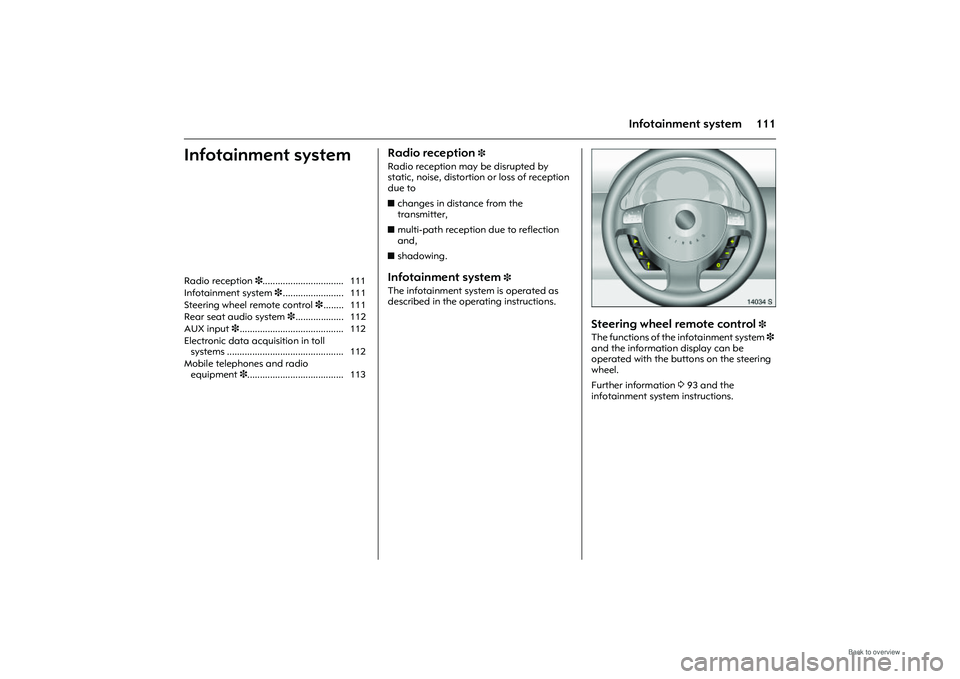
Steering wheel remote control
3
The functions of the infotainment system 3
and the information display can be
operated with the buttons on the steering
wheel.
Further information 393 and the
infotainment system instructions.
Radio reception
3................................ 111
Infotainment system 3........................ 111
Steering wheel remote control 3........ 111
Rear seat audio system 3................... 112
AUX input 3......................................... 112
Electronic data acquisition in toll systems .............................................. 112
Mobile telephones and radio equipment 3...................................... 113
Page 118 of 248
112 Infotainment system
Picture no: 14035s.tif
Rear seat audio system
3
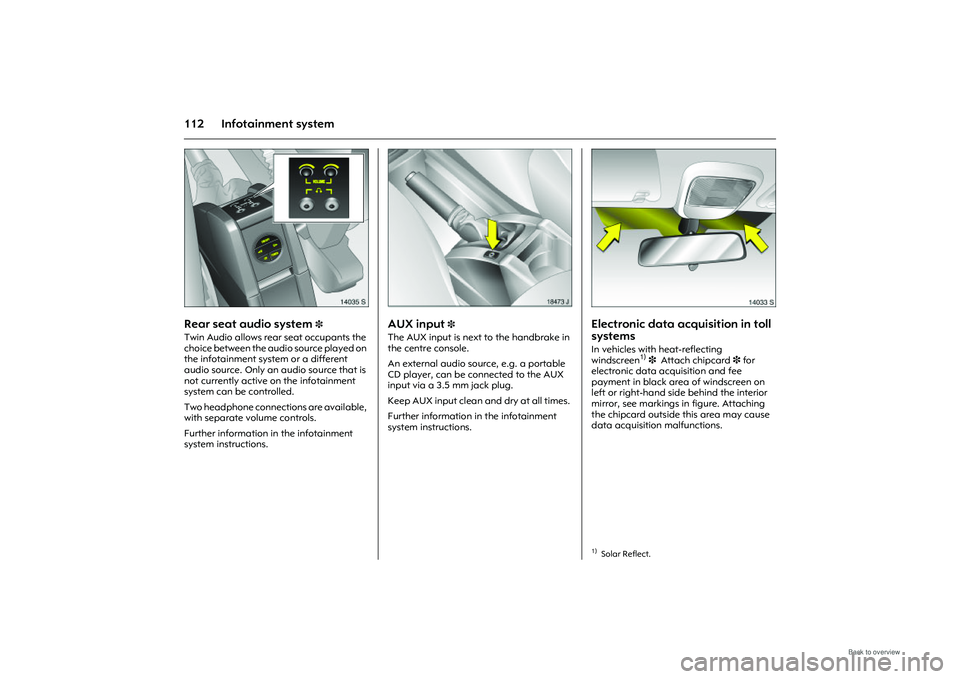
Twin Audio allows rear seat occupants the
choice between the audio source played on
the infotainment system or a different
audio source. Only an audio source that is
not currently active on the infotainment
system can be controlled.
Two headphone connections are available,
with separate volume controls.
Further information in the infotainment
system instructions.
Picture no: 18473s.tif
AUX input
3
The AUX input is next to the handbrake in
the centre console.
An external audio source, e.g. a portable
CD player, can be connected to the AUX
input via a 3.5 mm jack plug.
Keep AUX input clean and dry at all times.
Further information in the infotainment
system instructions.
Picture no: 14033s.tif
Electronic data acquisition in toll
systems In vehicles with heat-reflecting
windscreen
1) 3 Attach chipcard 3 for
electronic data acquisition and fee
payment in black area of windscreen on
left or right-hand side behind the interior
mirror, see markings in figure. Attaching
the chipcard outside this area may cause
data acquisition malfunctions.
1)Solar Reflect.
Page 120 of 248
114 Climate controlClimate control
Picture no: 14154s.tif
Heating and ventilation system,
air conditioning system
3
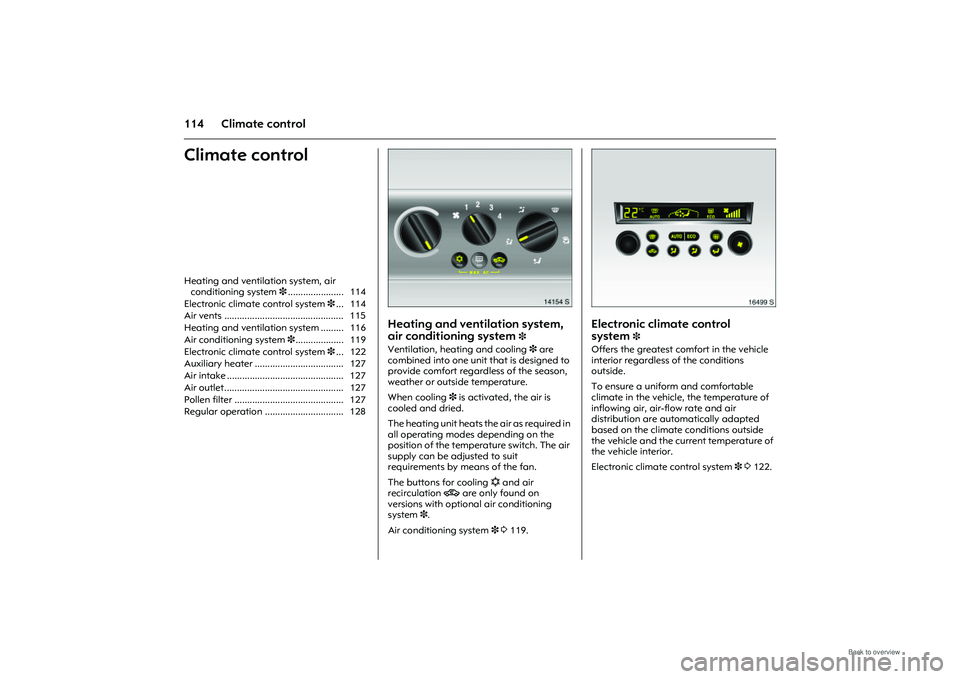
Ventilation, heating and cooling 3 are
combined into one unit that is designed to
provide comfort regardless of the season,
weather or outside temperature.
When cooling 3 is activated, the air is
cooled and dried.
The heating unit heats the air as required in
all operating modes depending on the
position of the temperature switch. The air
supply can be adjusted to suit
requirements by means of the fan.
The buttons for cooling n and air
recirculation 4 are only found on
versions with optional air conditioning
system 3.
Air conditioning system 3 3 119.
Picture no: 16499s.tif
Electronic climate control
system
3
Offers the greatest comfort in the vehicle
interior regardless of the conditions
outside.
To ensure a uniform and comfortable
climate in the vehicle, the temperature of
inflowing air, air-flow rate and air
distribution are automatically adapted
based on the climate conditions outside
the vehicle and the current temperature of
the vehicle interior.
Electronic climate control system 3 3 122.
Heating and ventilation system, air
conditioning system 3...................... 114
Electronic climate control system 3... 114
Air vents ............................................... 115
Heating and ventilation system ......... 116
Air conditioning system 3................... 119
Electronic climate control system 3... 122
Auxiliary heater ................................... 127
Air intake .............................................. 127
Air outlet............................................... 127
Pollen filter ........................................... 127
Regular operation ............................... 128
Page 133 of 248
127
Climate control
Auxiliary heater Depending on outside temperature and
engine temperature, the passenger
compartment of vehicles with Quickheat 3
electric auxiliary heating is warmed up
more quickly.
Diesel-engined vehicles have a fuel-
powered auxiliary heater 3.
Picture no: 14147s.tif
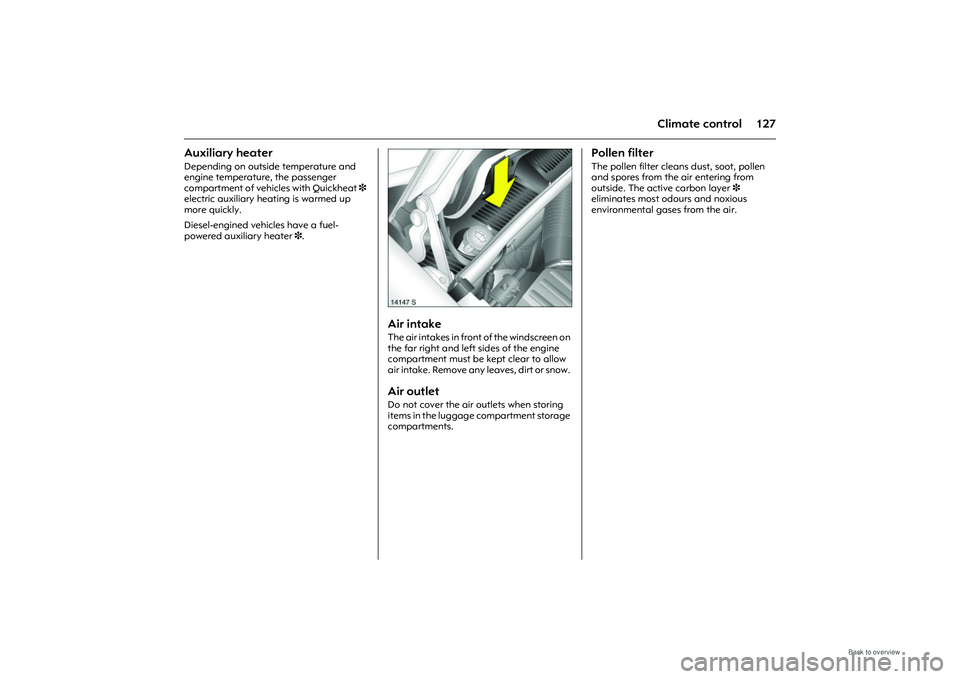
Air intake The air intakes in front of the windscreen on
the far right and left sides of the engine
compartment must be kept clear to allow
air intake. Remove any leaves, dirt or snow. Air outletDo not cover the air outlets when storing
items in the luggage compartment storage
compartments.
Pollen filter The pollen filter cleans dust, soot, pollen
and spores from the air entering from
outside. The active carbon layer 3
eliminates most odours and noxious
environmental gases from the air.
Page 144 of 248
138 Driving and operationOverrun
zThe fuel supply is shut off automatically
on overrun, e.g. when descending steep
hills or when braking 3136.
z To enable the overrun cut-off to come
into action and save fuel, do not
accelerate or declutch during overrun.
Correct gear selection
z High revs increase engine wear and fuel
consumption.
z Do not race your engine. Avoid driving at
high engine speeds.
Making use of the tachometer helps to
save fuel. Drive in a low engine speed
range for each gear as much as possible
with uniform engine speeds. Drive as
often as possible in top gear, select the
next higher gear as soon as possible,
and only change down when the engine
is no longer running perfectly smoothly.
High speed
z The higher the speed, the higher the
consumption and the noise level. At top
speed, you consume a great deal of fuel
and produce excessive noise and
exhaust emissions. z
Slightly releasing th e accelerator pedal
results in distinct fu el savings with no
major loss of speed.
Drive at no more than around three
quarters of maximum speed and you will
use up to 50 % less fuel, without losing a
great deal of time.
Tyre pressure
z Inadequate tyre pressure, leading to
higher road resistance, costs money in
two ways: for more fuel and increased
tyre wear.
z Regular checks (every 14 days) pay off.
Electrical loads
z The power consumption of electrical
equipment increases fuel consumption.
z Switch off all auxiliary electrical loads
(e.g. air conditioning 3, heated rear
window) when not needed.
Roof racks, ski-holders
z Due to air resistance, a roof load can
increase fuel consumption by
approx. 1l/100 km.
z Remove them if they are not being used. Repair and maintenance
z
Improper repairs or adjustment and
maintenance work can increase fuel
consumption. Do not carry out work on
the engine yourself.
You may out of ignorance infringe
environmental laws by not disposing of
materials properly.
Appropriate parts might not be recycled.
Contact with some of the materials
involved may pose a health hazard.
z We recommend that repair and
maintenance be entrusted to your Opel
Partner.
Extreme driving conditions
z Going up steep slopes, cornering, driving
on poor roads and winter driving all
increase fuel consumption.
Fuel consumption increases dramatically
in urban traffic and at winter
temperatures, especially on short trips
when the engine operating temperature
is not reached.
z Follow the hints given above to keep
consumption to a minimum under such
conditions.
Page 189 of 248
183
Self-help, vehicle care
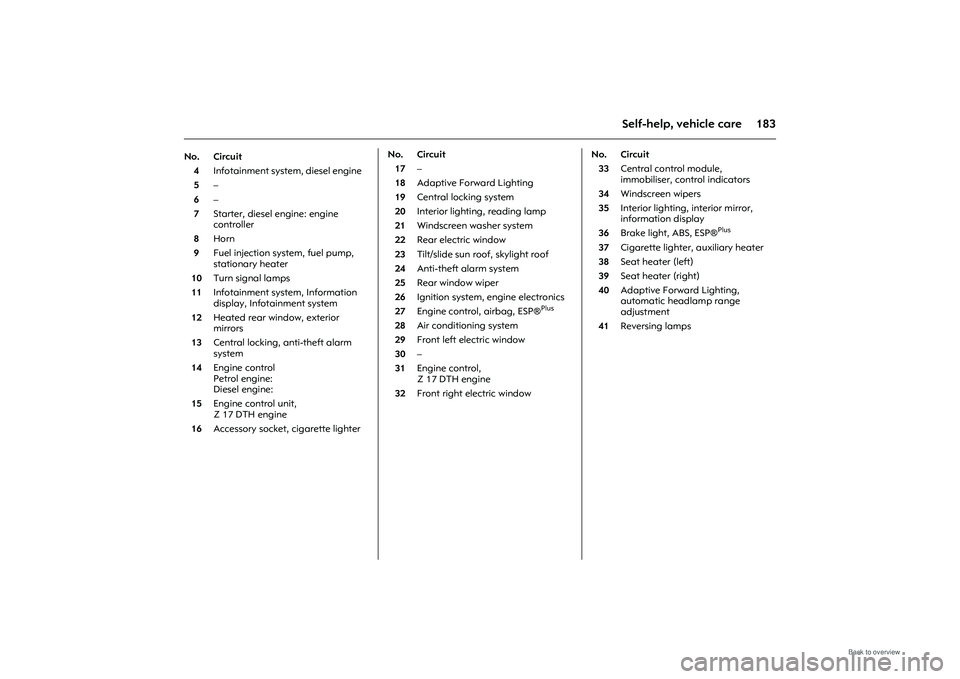
No. Circuit4 Infotainment system, diesel engine
5 –
6 –
7 Starter, diesel engine: engine
controller
8 Horn
9 Fuel injection system, fuel pump,
stationary heater
10 Turn signal lamps
11 Infotainment system, Information
display, Infotainment system
12 Heated rear window, exterior
mirrors
13 Central locking, anti-theft alarm
system
14 Engine control
Petrol engine:
Diesel engine:
15 Engine control unit,
Z 17 DTH engine
16 Accessory socket, cigarette lighter No. Circuit
17 –
18 Adaptive Forward Lighting
19 Central locking system
20 Interior lighting, reading lamp
21 Windscreen washer system
22 Rear electric window
23 Tilt/slide sun roof, skylight roof
24 Anti-theft alarm system
25 Rear window wiper
26 Ignition system, engine electronics
27 Engine control, airbag, ESP®
Plus
28 Air conditioning system
29 Front left electric window
30 –
31 Engine control,
Z 17 DTH engine
32 Front right electric window No. Circuit
33 Central control module,
immobiliser, control indicators
34 Windscreen wipers
35 Interior lighting, interior mirror,
information display
36 Brake light, ABS, ESP®
Plus
37Cigarette lighter, auxiliary heater
38 Seat heater (left)
39 Seat heater (right)
40 Adaptive Forward Lighting,
automatic headlamp range
adjustment
41 Reversing lamps
Page 208 of 248
202 Service and maintenance⊕additional work.
o The intervals are shorter where driving conditions are more arduous or country-specific.
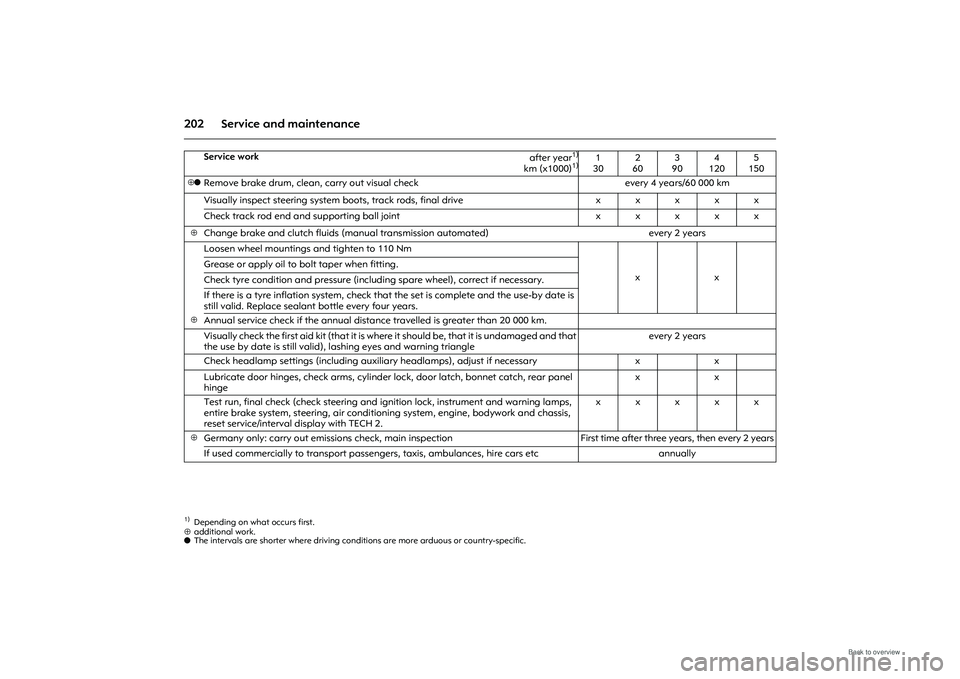
Service work
after year
1)
km (x1000)
1)
1)Depending on what occurs first.
1
30 2
60 3
90 4
120 5
150
⊕o
Remove brake drum, clean, carry out visual check every 4 years/60 000 km
Visually inspect steering system boots, track rods, final drive xxxxx
Check track rod end and supporting ball joint xxxxx
⊕
Change brake and clutch fluids (manual transmission automated) every 2 years
Loosen wheel mountings and tighten to 110 Nm
xx
Grease or apply oil to
bolt taper when fitting.
Check tyre condition and pressure (inclu ding spare wheel), correct if necessary.
If there is a tyre inflation system, check that the set is complete and the use-by date is
still valid. Replace sealant bottle every four years.
⊕
Annual service check if the annual distance travelled is greater than 20 000 km.
Visually check the first aid kit (that it is wher e it should be, that it is undamaged and that
the use by date is still valid), lashing eyes and warning triangle every 2 years
Check headlamp settings (including auxi liary headlamps), adjust if necessary xx
Lubricate door hinges, check arms, cylinder lo ck, door latch, bonnet catch, rear panel
hinge xx
Test run, final check (check steering and ig nition lock, instrument and warning lamps,
entire brake system, steering, air conditioni ng system, engine, bodywork and chassis,
reset service/interval display with TECH 2. xxxxx
⊕
Germany only: carry out emissions check, main inspection
First time after three years, then every 2 years
If used commercially to tran sport passengers, taxis, ambulances, hire cars etc annually
Page 211 of 248
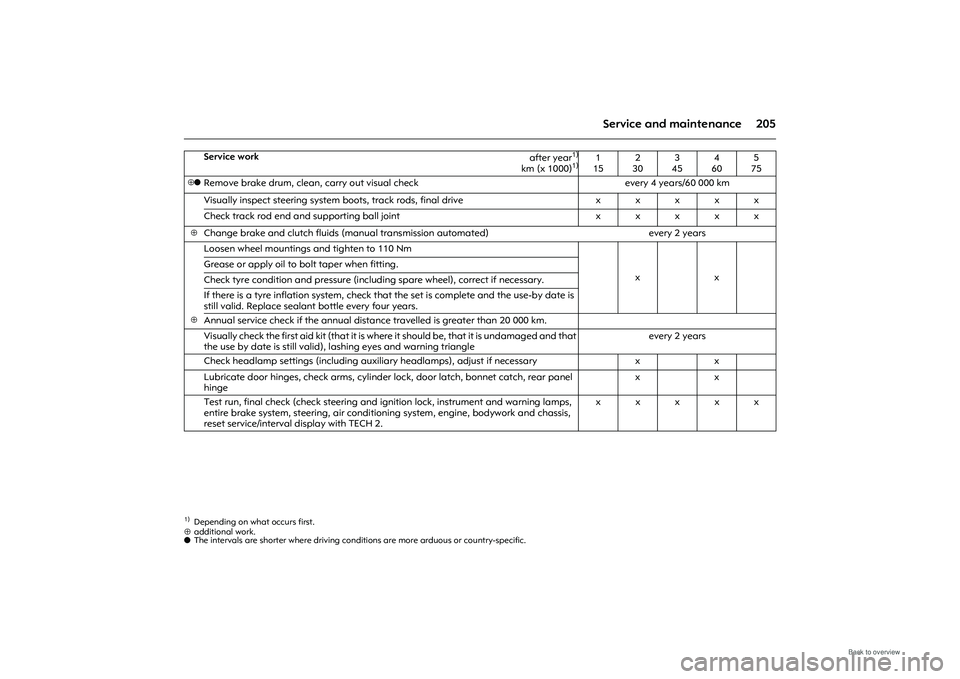
205
Service and maintenance
⊕ additional work.
o The intervals are shorter where driving conditions are more arduous or country-specific.
Service work
after year
1)
km (x 1000)
1)
1)Depending on what occurs first.
1
15 2
30 3
45 4
60 5
75
⊕o
Remove brake drum, clean, carry out visual check every 4 years/60 000 km
Visually inspect steering system boots, track rods, final drive xxxxx
Check track rod end and supporting ball joint xxxxx
⊕
Change brake and clutch fluids (manual transmission automated) every 2 years
Loosen wheel mountings and tighten to 110 Nm
xx
Grease or apply oil to
bolt taper when fitting.
Check tyre condition and pressure (inclu ding spare wheel), correct if necessary.
If there is a tyre inflation system, check that the set is complete and the use-by date is
still valid. Replace sealant bottle every four years.
⊕
Annual service check if the annual distance travelled is greater than 20 000 km.
Visually check the first aid kit (that it is wher e it should be, that it is undamaged and that
the use by date is still valid), lashing eyes and warning triangle every 2 years
Check headlamp settings (including auxi liary headlamps), adjust if necessary xx
Lubricate door hinges, check arms, cylinder lo ck, door latch, bonnet catch, rear panel
hinge xx
Test run, final check (check steering and ig nition lock, instrument and warning lamps,
entire brake system, steering, air conditioni ng system, engine, bodywork and chassis,
reset service/interval display with TECH 2. xxxxx
Page 240 of 248
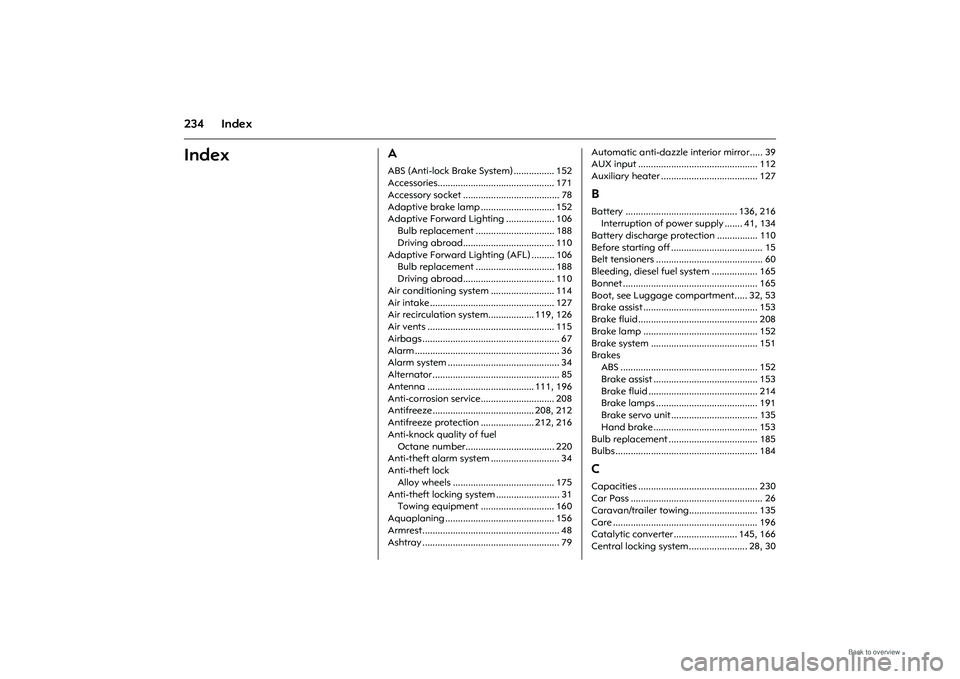
234 IndexIndex
AABS (Anti-lock Brake System) ................ 152
Accessories.............................................. 171
Accessory socket ...................................... 78
Adaptive brake lamp ............................. 152
Adaptive Forward Lighting ................... 106Bulb replacement ............................... 188
Driving abroad.................................... 110
Adaptive Forward Lighting (AFL) ......... 106 Bulb replacement ............................... 188
Driving abroad.................................... 110
Air conditioning system ......................... 114
Air intake ................................................. 127
Air recirculation system.................. 119, 126
Air vents .................................................. 115
Airbags ...................................................... 67
Alarm ......................................................... 36
Alarm system ............................................ 34
Alternator .................................................. 85
Antenna .......................................... 111, 196
Anti-corrosion service............................. 208
Antifreeze........................................ 208, 212
Antifreeze protection ..................... 212, 216
Anti-knock quality of fuel Octane number................................... 220
Anti-theft alarm system ........................... 34
Anti-theft lock Alloy wheels ........................................ 175
Anti-theft lockin g system ......................... 31
Towing equipment ............................. 160
Aquaplaning ........................................... 156
Armrest...................................................... 48
Ashtray ...................................................... 79 Automatic anti-dazzle interior mirror..... 39
AUX input ............................................... 112
Auxiliary heater ...................................... 127
BBattery ............................................ 136, 216
Interruption of power supply ....... 41, 134
Battery discharge protection ................ 110
Before starting off .................................... 15
Belt tensioners .......................................... 60
Bleeding, diesel fuel system .................. 165
Bonnet ..................................................... 165
Boot, see Luggage compartment..... 32, 53
Brake assist ............................................. 153
Brake fluid ............................................... 208
Brake lamp ............................................. 152
Brake system .......................................... 151
Brakes ABS ...................................................... 152
Brake assist ......................................... 153
Brake fluid ........................................... 214
Brake lamps ........................................ 191
Brake servo unit .................................. 135
Hand brake ......................................... 153
Bulb replacement ................................... 185
Bulbs ........................................................ 184CCapacities ............................................... 230
Car Pass .................................................... 26
Caravan/trailer towing........................... 135
Care ......................................................... 196
Catalytic converter ......................... 145, 166
Central locking system ....................... 28, 30