trailer OPEL MERIVA 2009 Owners Manual
[x] Cancel search | Manufacturer: OPEL, Model Year: 2009, Model line: MERIVA, Model: OPEL MERIVA 2009Pages: 248, PDF Size: 4.46 MB
Page 110 of 248
104 LightingFog tail lamp
r
The fog tail lamp can only be switched on
both the ignition and dipped
beam/parking lamps are on.
Operated with the r button.
The fog tail lamps on the vehicle are
deactivated when towing a caravan/
trailer.
Reversing lamps The reversing lamps come on when the
ignition is on and reverse gear is engaged.
Picture no: 14303s.tif
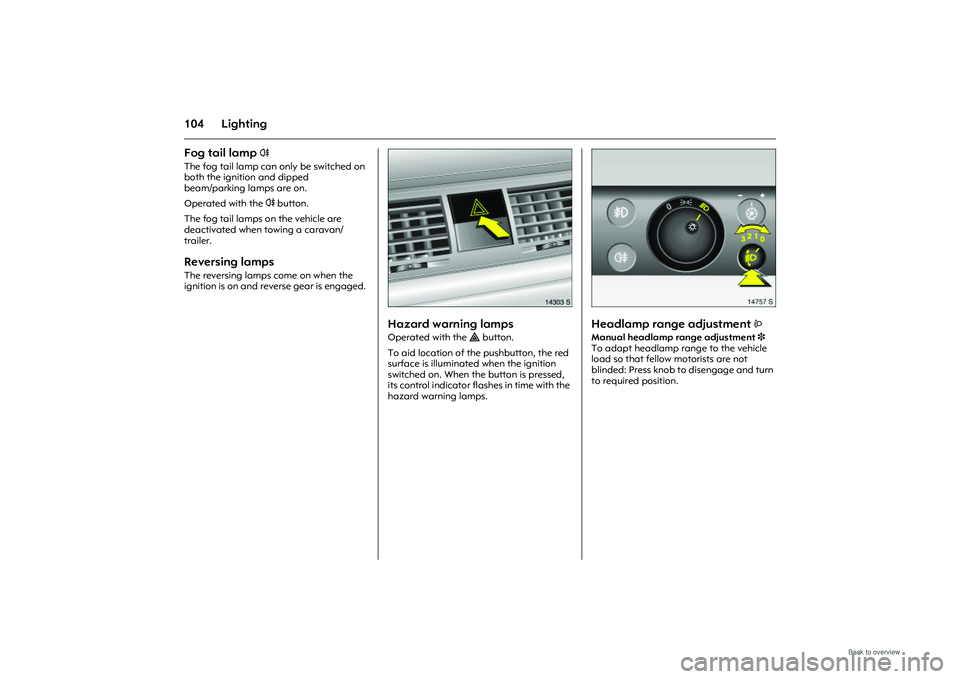
Hazard warning lamps Operated with the ¨ button.
To aid location of the pushbutton, the red
surface is illuminated when the ignition
switched on. When the button is pressed,
its control indicator flashes in time with the
hazard warning lamps.
Picture no: 14757s.tif
Headlamp range adjustment
?
Manual headlamp range adjustment 3
To adapt headlamp ra nge to the vehicle
load so that fellow motorists are not
blinded: Press knob to disengage and turn
to required position.
Page 135 of 248
129
Driving and operation
Driving and operation
Manual transmission
automated
3
The manual transmission automated
transmission 3 permits manual ( manual
mode ) or automatic gear shifting
(automatic mode ), both with automatic
clutch control.
Picture no: 17878s.tif
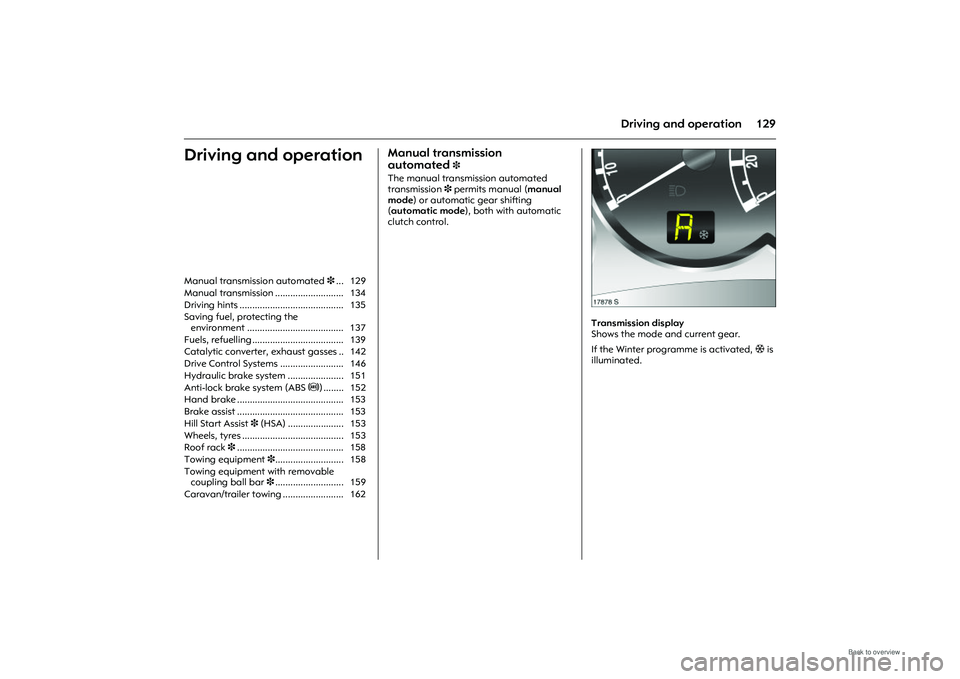
Transmission display
Shows the mode and current gear.
If the Winter programme is activated, T is
illuminated.
Manual transmission automated
3... 129
Manual transmission ........................... 134
Driving hints ......................................... 135
Saving fuel, protecting the environment ...................................... 137
Fuels, refuelling .................................... 139
Catalytic converter, exhaust gasses .. 142
Drive Control Systems ......................... 146
Hydraulic brake system ...................... 151
Anti-lock brake system (ABS u ) ........ 152
Hand brake .......................................... 153
Brake assist .......................................... 153
Hill Start Assist 3 (HSA) ...................... 153
Wheels, tyres ........................................ 153
Roof rack 3.......................................... 158
Towing equipment 3........................... 158
Towing equipment with removable coupling ball bar 3........................... 159
Caravan/trailer towing ........................ 162
Page 141 of 248
135
Driving and operation
Driving hintsThe first 1000 km
Drive your vehicle at various speeds. Do
not use full throttle. Never allow the engine
to labour at low revs.
Drive moderately. In all gears, only depress
the accelerator pedal around
3/4 of the way
down.
Do not drive faster than three quarters of
maximum speed.
Do not brake unnecessarily hard for the
first 200 km.
During the first drive smoke may develop
because of wax and oil evaporating on the
exhaust system. Park the vehicle in the
open for a while after the first drive and
avoid inhaling the fumes.
Fuel and engine oil consumption is higher
than normal during the running-in period.
Never coast with engine not running
Many units will not function in this situation
(e.g. brake servo unit, power steering 3).
Driving in this manner is a danger to
yourself and others. Brake servo unit
When the engine is not running, the brake
servo unit is no longer effective once the
brake pedal has been depressed once or
twice. Braking effect is not reduced, but
significantly greater force is required for
braking.
Electric power steering
3
If the power assisted steering fails when
being towed with the engine switched off,
the vehicle can still be steered, but
considerably more force is required.
Driving in mountainous terrain or with a
trailer/caravan
The cooling fan is elec trically operated. Its
cooling power is therefore independent of
the engine speed.
Since a considerable amount of heat is
generated at high engine speeds and less
at slower speeds, do not shift down when
climbing hills whilst the vehicle is still coping
with the gradient in the higher gear. Driving with a roof load
Do not exceed the permissible roof load
3
226. For reasons of safety, distribute the
load evenly and secure it properly with
retaining straps. Adjust tyre pressure to
load conditions. Do not drive faster
than 120 km/h. Check and retighten the
straps frequently. Observe country-specific
regulations.
Switching off the engine
When you switch off, fans in the engine
compartment may continue running for a
time to cool the engine.
If the engine temperature is very high, e.g.
after driving in mountainous terrain: allow
the engine to idle for approximately two
minutes in order to prevent heat
accumulation.
Vehicles with turbocharged engine
3
After running at high engine speeds or high
engine loads, operate the engine briefly
at a low load or run in neutral for
approx. 30 seconds before switching off in
order to protect the turbocharger.
Page 156 of 248
150 Driving and operationUltrasonic parking sensors 3
Park pilot makes reverse parking easier by
measuring the distance between the back
of the vehicle and obstacles to the rear. It is
the driver, however, who maintains full
responsibility for parking.
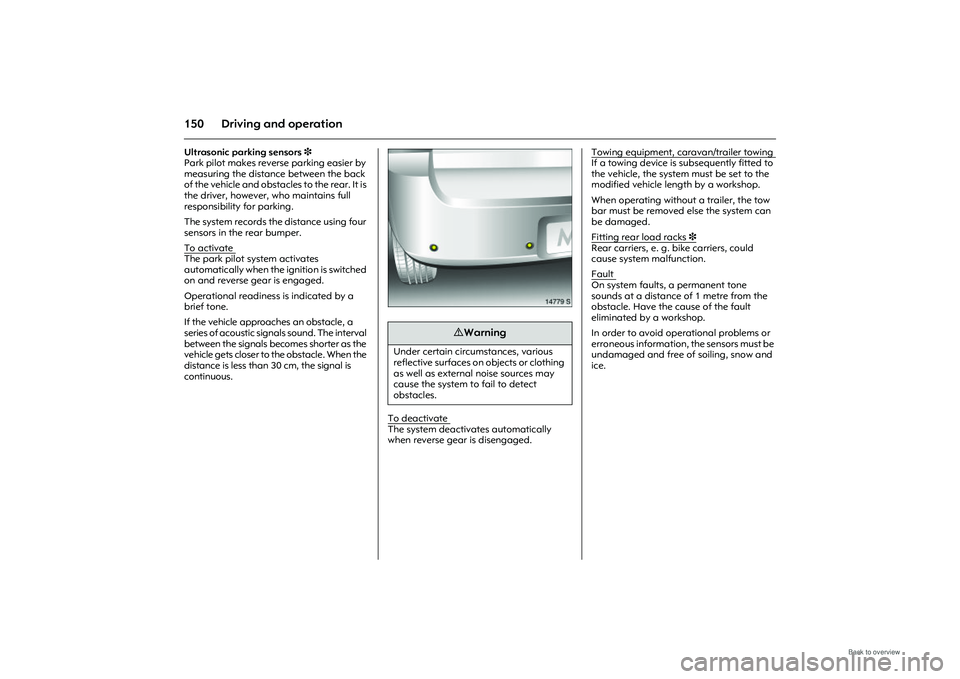
The system records the distance using four
sensors in the rear bumper.
To activate The park pilot system activates
automatically when the ignition is switched
on and reverse gear is engaged.
Operational readiness is indicated by a
brief tone.
If the vehicle approaches an obstacle, a
series of acoustic signals sound. The interval
between the signals be comes shorter as the
vehicle gets closer to the obstacle. When the
distance is less than 30 cm, the signal is
continuous.
Picture no: 14779s.tif
To deactivate The system deactivates automatically
when reverse gear is disengaged. Towing equipment, caravan/trailer towing
If a towing device is subsequently fitted to
the vehicle, the system must be set to the
modified vehicle length by a workshop.
When operating without a trailer, the tow
bar must be removed else the system can
be damaged.
Fitting rear load racks
3
Rear carriers, e. g. bike carriers, could
cause system malfunction.
Fault
On system faults, a permanent tone
sounds at a distance of 1 metre from the
obstacle. Have the cause of the fault
eliminated by a workshop.
In order to avoid operational problems or
erroneous information, the sensors must be
undamaged and free of soiling, snow and
ice.
9 Warning
Under certain circumstances, various
reflective surfaces on objects or clothing
as well as external noise sources may
cause the system to fail to detect
obstacles.
Page 167 of 248
161
Driving and operation
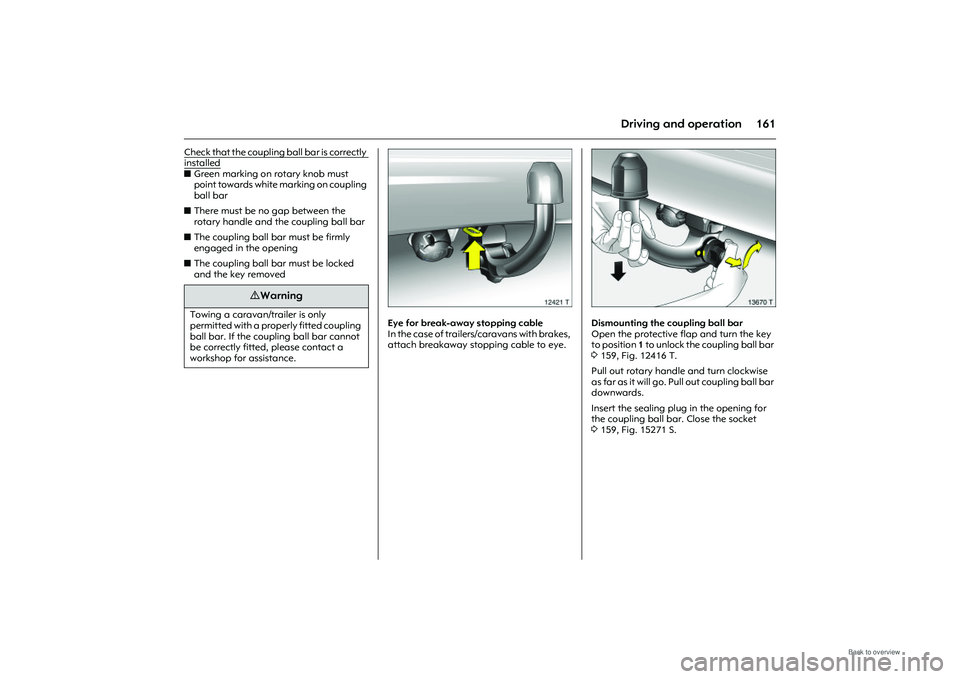
Check that the coupling ball bar is correctly installedzGreen marking on rotary knob must
point towards white ma rking on coupling
ball bar
z There must be no gap between the
rotary handle and the coupling ball bar
z The coupling ball bar must be firmly
engaged in the opening
z The coupling ball bar must be locked
and the key removed
Picture no: 12421t.tif
Eye for break-away stopping cable
In the case of trailers/caravans with brakes,
attach breakaway stopping cable to eye.
Picture no: 13670t.tif
Dismounting the coupling ball bar
Open the protective flap and turn the key
to position 1 to unlock the coupling ball bar
3 159, Fig. 12416 T.
Pull out rotary handle and turn clockwise
as far as it will go. Pull out coupling ball bar
downwards.
Insert the sealing plug in the opening for
the coupling ball bar. Close the socket
3 159, Fig. 15271 S.
9 Warning
Towing a caravan/trailer is only
permitted with a properly fitted coupling
ball bar. If the coupling ball bar cannot
be correctly fitted, please contact a
workshop for assistance.
Page 168 of 248
162 Driving and operation
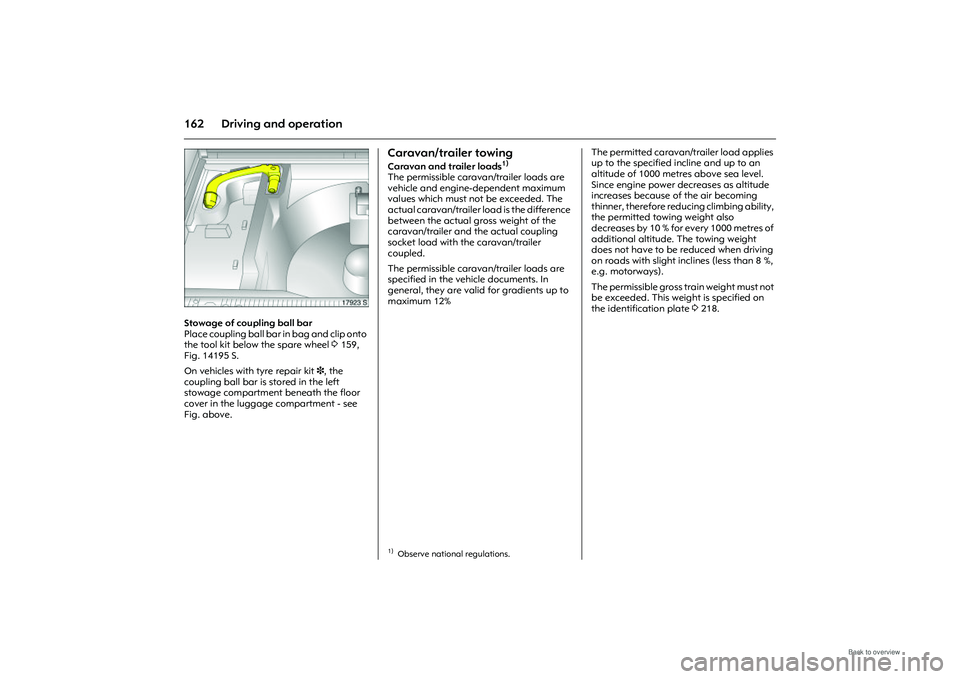
Picture no: 17923s.tif
Stowage of coupling ball bar
Place coupling ball bar in bag and clip onto
the tool kit below the spare wheel 3159,
Fig. 14195 S.
On vehicles with tyre repair kit 3, the
coupling ball bar is stored in the left
stowage compartment beneath the floor
cover in the luggage compartment - see
Fig. above.
Caravan/trailer towingCaravan and trailer loads
1)
The permissible caravan/trailer loads are
vehicle and engine-dependent maximum
values which must not be exceeded. The
actual caravan/trailer load is the difference
between the actual gross weight of the
caravan/trailer and the actual coupling
socket load with the caravan/trailer
coupled.
The permissible caravan/trailer loads are
specified in the vehi cle documents. In
general, they are valid for gradients up to
maximum 12% The permitted caravan/trailer load applies
up to the specified incline and up to an
altitude of 1000 metres above sea level.
Since engine power decreases as altitude
increases because of the air becoming
thinner, therefore reducing climbing ability,
the permitted towing weight also
decreases by 10 % for
every 1000 metres of
additional altitude. The towing weight
does not have to be reduced when driving
on roads with slight inclines (less than 8 %,
e.g. motorways).
The permissible gross train weight must not
be exceeded. This weig ht is specified on
the identification plate 3218. 1)Observe national regulations.
Page 169 of 248
163
Driving and operation
Coupling socket load
The coupling socket load is the load
exerted by the trailer/caravan on the
coupling ball. It can be varied by changing
the weight distribution when loading the
trailer/caravan.
The maximum permissible coupling socket
load (55 kg) of the towing vehicle is
specified on the towing equipment
identification plate and in the vehicle
documents. This must always be complied
with, particularly in the case of heavy
caravans/trailers. The coupling socket load
should be no less than 25 kg.
When measuring the coupling socket load,
make sure that the drawbar of the loaded
trailer/caravan is at the same height as it
will be when the trailer/caravan is coupled
with the towing vehicle loaded. Particularly
important for trailers/caravans with
tandem axle. Rear axle load during towing
With the trailer connected and the towing
vehicle fully loaded including all
occupants, the permitted rear axle load
(specified on the identification plate and
vehicle documents) must be exceeded by
no more than 25 kg and the maximum
permitted gross vehicle weight by no more
than 30 kg. If the maximum permitted rear
axle load is exceeded, a maximum speed
of 100 km/h applies, and 80 km/h for
commercial vehicles.
Driving characteristics, towing tips
Before attaching th
e trailer/caravan,
lubricate the ball of the trailer/caravan
towing device. However, do not lubricate
the ball if a stabiliser, which acts on the
coupling ball, is being used to damp
hunting.
Check caravan/traile r lighting before
starting to drive. The fog tail lamps on the
vehicle are deactivated when towing a
caravan or trailer.
Trailers with LED turn signals must have a
provision enables lamp monitoring for
commercial bulbs.
Handling is greatly influenced by the
loading of the trailer/caravan. Loads
should therefore be secured so that they
cannot slip and be placed in the centre of
the trailer/caravan if possible, i.e. above
the axle.
In the case of trailers with low driving
stability, do not exceed a speed of 80 km/h;
the use of a friction-type stabiliser is
strongly recommended.
Page 170 of 248
164 Driving and operationIf the trailer/caravan starts to sway, drive
more slowly, do not attempt to correct the
steering and brake sharply if necessary.
If it is necessary to apply the brakes fully,
depress the brake pedal as hard as
possible.
Remember that the braking distance for
vehicles towing carava ns/trailers with and
without brake is always greater than that
for vehicles not towing a caravan/trailer.
When driving downhill , drive in the same
gear as if driving uphill and drive at a
similar speed.
Adjust tyre pressure to the value specified
for full load 3228. Starting on inclines
For vehicles with ma
nual transmission,
the most favourable engine speed
when starting off on an incline is
between 2500 and 3000 rpm for petrol
engines and between 2000 and 2500 rpm
for diesel engines. Hold engine speed
constant, engage clutch gradually (let slip)
– release hand brake – and open throttle. If
possible, the engine speed should not drop
during this procedure.
For vehicles with ma nual transmission
automated 3 in Automatic mode simply
apply full gas. Before starting off under extreme
operating conditions, switch off
unnecessary consumers.
Page 212 of 248
206 Service and maintenanceAdditional service workAdditional work ⊕
Additional work is not always necessary at
each service, but can be carried out at the
same time as a regular service.
T h e c o s t o f th i s t y p e o f w o r k i s n o t i n c l ud e d
in the charge for a regular service and will
be invoiced separately. It is, however, more
c o s t - e f f e c t i v e t o h a v e t h i s w o r k d o n e a t t h e
same time as a scheduled service rather
than have it done separately.
Hard driving conditions o
Conditions are considered hard when one
or more of the following situations occurs
more frequently:
z cold start,
z stop and go,
z caravan/trailer towing,
z inclines or steep climbs,
z poor road conditions,
z sand and dust,
z extreme temperature fluctuations.
Police vehicles, taxis and driving school
vehicles are classified as being subjected to
hard driving conditions. With hard driving conditions it might be
necessary to carry out certain service work
more frequently than the scheduled
intervals.
We recommend seeking technical advice
with regard to servic
ing requirements for
your particular driving circumstances.
Recommended fluids and
lubricants Only use products which have been tested
and approved. Damage caused by using
operating materials which have not been
approved is not covere d by the guarantee.
9 Warning
Operating materials are dangerous and
must be handled carefully. If swallowed,
seek medical help immediately. Do not
breath in fumes and avoid contact with
the skin. Keep away from children.
These materials are forbidden to
contaminate waste water, surface
water, groundwater or soil. Dispose of
empty containers correctly. Always
remember that operating materials are
dangerous.
Page 232 of 248
226 Technical DataWeights, payload and roof load The payload is the difference between the
permitted gross vehicle weight (see
identification plate 3218) and the EC kerb
weight.
To calculate the kerb weight, enter the
data for your vehicle below:
is the EC kerb weight.
Optional equipmen t and accessories
increase the kerb weight, which means that
the payload will also change slightly.
Note weight ranges in the vehicle
documents and on the rating plate. The combined total of front and rear axle
loads must not exceed the permissible
gross vehicle weight. For example, if the
front axle is bearing its maximum
permissible load, the rear axle can only
bear a load that is equal to the gross
vehicle weight minus
the front axle load.
When the trailer is coupled and the towing
vehicle fully loaded (including all
occupants), the permissible rear axle load
(see identification plate or vehicle
documents) may be exceeded by 25 kg
and the permissible gross vehicle weight by
25 kg. If the permissible rear axle load is
exceeded, a maximum speed of 100 km/h
applies. If national regulations specify a
lower maximum speed for vehicles towing
a trailer, this must be observed.
See the identification plate or vehicle
documents for permissible axle loads. Roof load
The permissible roof load is 100 kg. The
roof load consists of the weight of the roof
rack plus the load carried.
Driving hints
3135. Roof rack 3158.
z Unladen weight from
table 1 3227 +.............. kg
z Weight of heavy
accessories from
table 2 3227. +.............. kg
Total =.............. kg