wheel OPEL MERIVA 2017 User Guide
[x] Cancel search | Manufacturer: OPEL, Model Year: 2017, Model line: MERIVA, Model: OPEL MERIVA 2017Pages: 251, PDF Size: 8.14 MB
Page 66 of 251
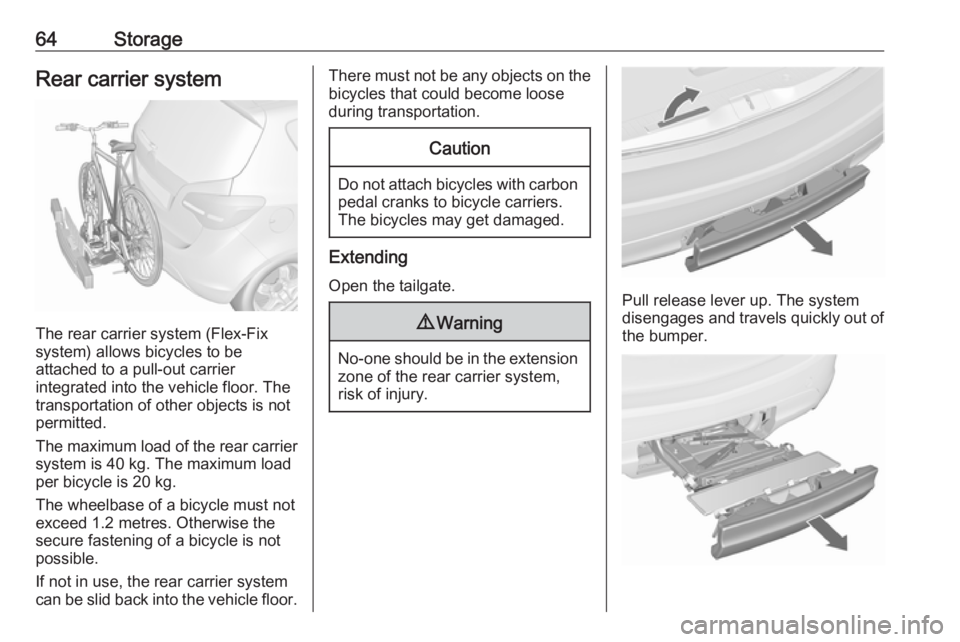
64StorageRear carrier system
The rear carrier system (Flex-Fix
system) allows bicycles to be
attached to a pull-out carrier
integrated into the vehicle floor. The
transportation of other objects is not
permitted.
The maximum load of the rear carrier
system is 40 kg. The maximum load
per bicycle is 20 kg.
The wheelbase of a bicycle must not
exceed 1.2 metres. Otherwise the
secure fastening of a bicycle is not possible.
If not in use, the rear carrier system
can be slid back into the vehicle floor.
There must not be any objects on the bicycles that could become loose
during transportation.Caution
Do not attach bicycles with carbon pedal cranks to bicycle carriers.
The bicycles may get damaged.
Extending
Open the tailgate.
9 Warning
No-one should be in the extension
zone of the rear carrier system,
risk of injury.
Pull release lever up. The system
disengages and travels quickly out of
the bumper.
Page 69 of 251
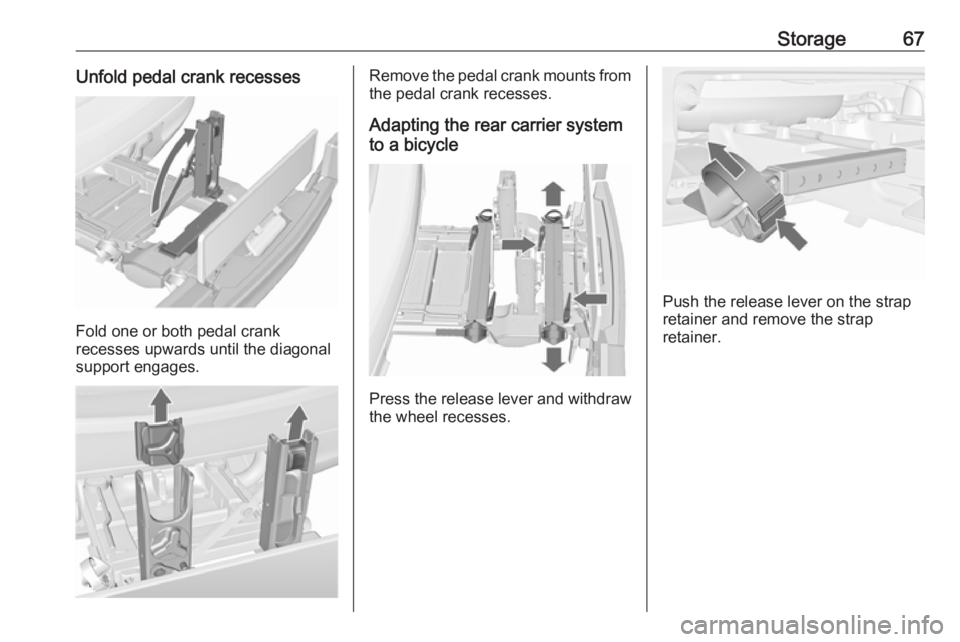
Storage67Unfold pedal crank recesses
Fold one or both pedal crank
recesses upwards until the diagonal
support engages.
Remove the pedal crank mounts from
the pedal crank recesses.
Adapting the rear carrier system
to a bicycle
Press the release lever and withdraw
the wheel recesses.
Push the release lever on the strap
retainer and remove the strap
retainer.
Page 70 of 251
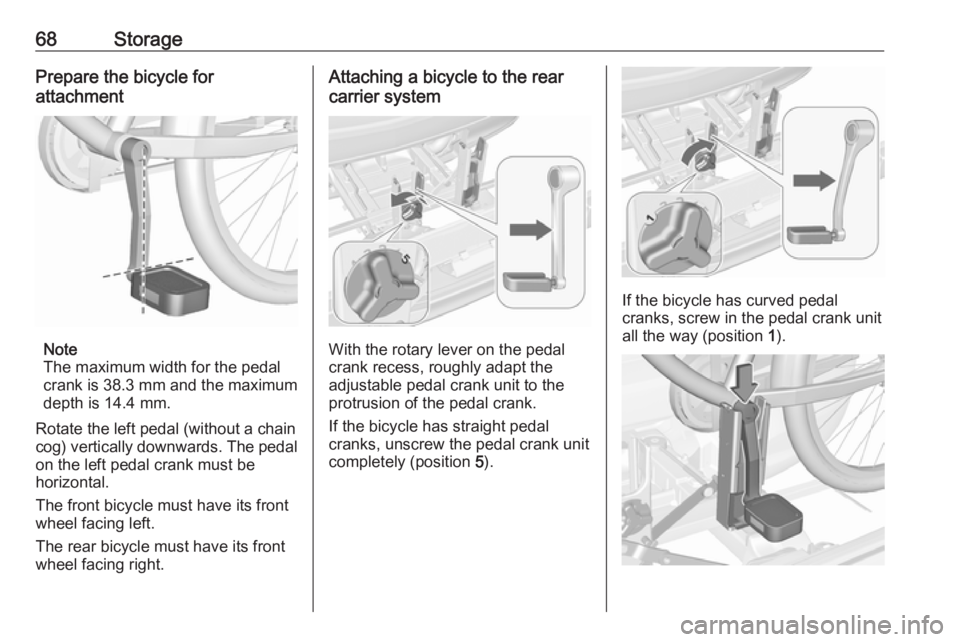
68StoragePrepare the bicycle for
attachment
Note
The maximum width for the pedal
crank is 38.3 mm and the maximum
depth is 14.4 mm.
Rotate the left pedal (without a chain
cog) vertically downwards. The pedal
on the left pedal crank must be
horizontal.
The front bicycle must have its front
wheel facing left.
The rear bicycle must have its front
wheel facing right.
Attaching a bicycle to the rear
carrier system
With the rotary lever on the pedal
crank recess, roughly adapt the
adjustable pedal crank unit to the
protrusion of the pedal crank.
If the bicycle has straight pedal
cranks, unscrew the pedal crank unit
completely (position 5).
If the bicycle has curved pedal
cranks, screw in the pedal crank unit all the way (position 1).
Page 71 of 251
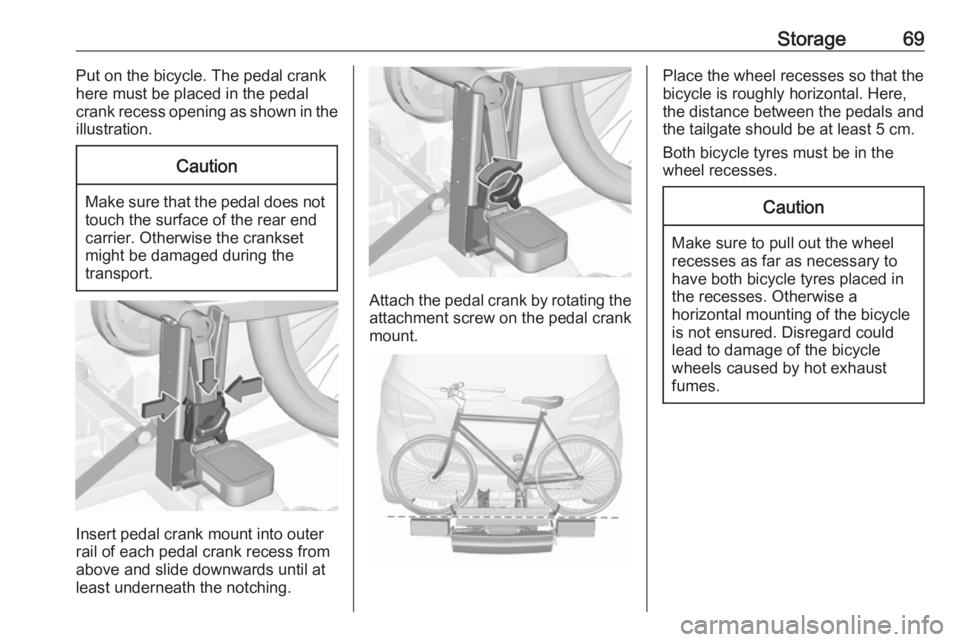
Storage69Put on the bicycle. The pedal crank
here must be placed in the pedal crank recess opening as shown in the
illustration.Caution
Make sure that the pedal does not
touch the surface of the rear end
carrier. Otherwise the crankset
might be damaged during the
transport.
Insert pedal crank mount into outer
rail of each pedal crank recess from
above and slide downwards until at
least underneath the notching.
Attach the pedal crank by rotating the
attachment screw on the pedal crank
mount.
Place the wheel recesses so that the
bicycle is roughly horizontal. Here,
the distance between the pedals and
the tailgate should be at least 5 cm.
Both bicycle tyres must be in the
wheel recesses.Caution
Make sure to pull out the wheel
recesses as far as necessary to
have both bicycle tyres placed in
the recesses. Otherwise a
horizontal mounting of the bicycle
is not ensured. Disregard could
lead to damage of the bicycle
wheels caused by hot exhaust
fumes.
Page 72 of 251
70Storage
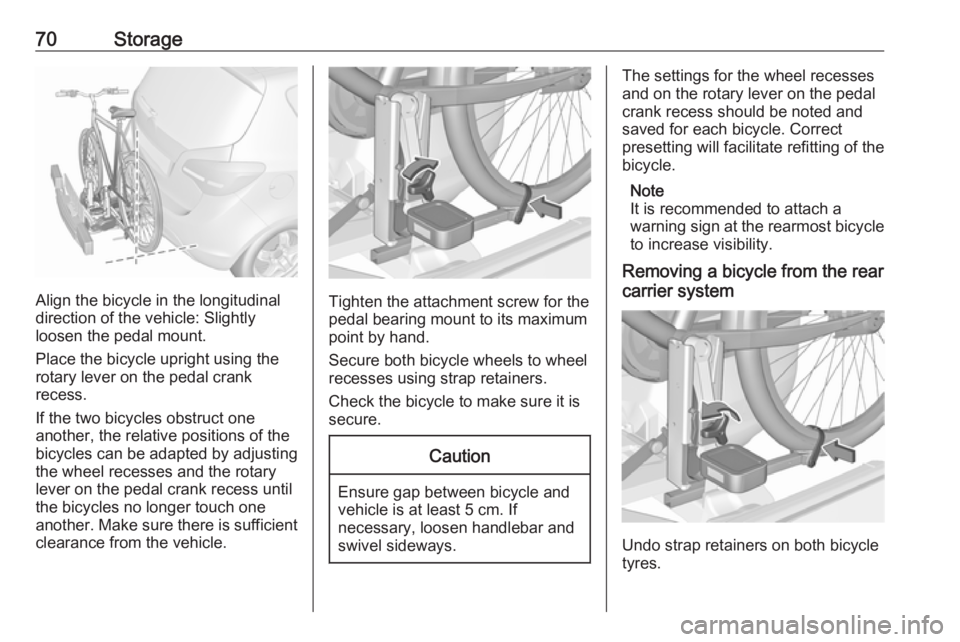
Align the bicycle in the longitudinal
direction of the vehicle: Slightly
loosen the pedal mount.
Place the bicycle upright using the
rotary lever on the pedal crank
recess.
If the two bicycles obstruct one
another, the relative positions of the
bicycles can be adapted by adjusting
the wheel recesses and the rotary
lever on the pedal crank recess until
the bicycles no longer touch one
another. Make sure there is sufficient
clearance from the vehicle.Tighten the attachment screw for the
pedal bearing mount to its maximum
point by hand.
Secure both bicycle wheels to wheel
recesses using strap retainers.
Check the bicycle to make sure it is
secure.
Caution
Ensure gap between bicycle and
vehicle is at least 5 cm. If
necessary, loosen handlebar and swivel sideways.
The settings for the wheel recesses
and on the rotary lever on the pedal
crank recess should be noted and saved for each bicycle. Correct
presetting will facilitate refitting of the
bicycle.
Note
It is recommended to attach a
warning sign at the rearmost bicycle to increase visibility.
Removing a bicycle from the rear
carrier system
Undo strap retainers on both bicycle
tyres.
Page 73 of 251
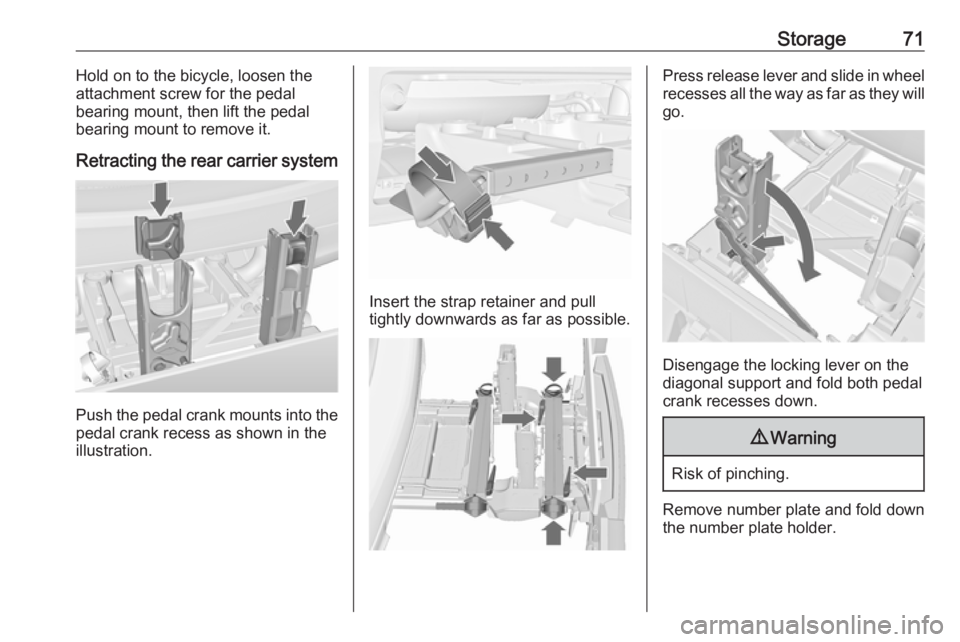
Storage71Hold on to the bicycle, loosen the
attachment screw for the pedal
bearing mount, then lift the pedal bearing mount to remove it.
Retracting the rear carrier system
Push the pedal crank mounts into the
pedal crank recess as shown in the
illustration.
Insert the strap retainer and pull
tightly downwards as far as possible.
Press release lever and slide in wheel recesses all the way as far as they will
go.
Disengage the locking lever on the
diagonal support and fold both pedal crank recesses down.
9 Warning
Risk of pinching.
Remove number plate and fold down
the number plate holder.
Page 77 of 251
Storage75Remove the cover.
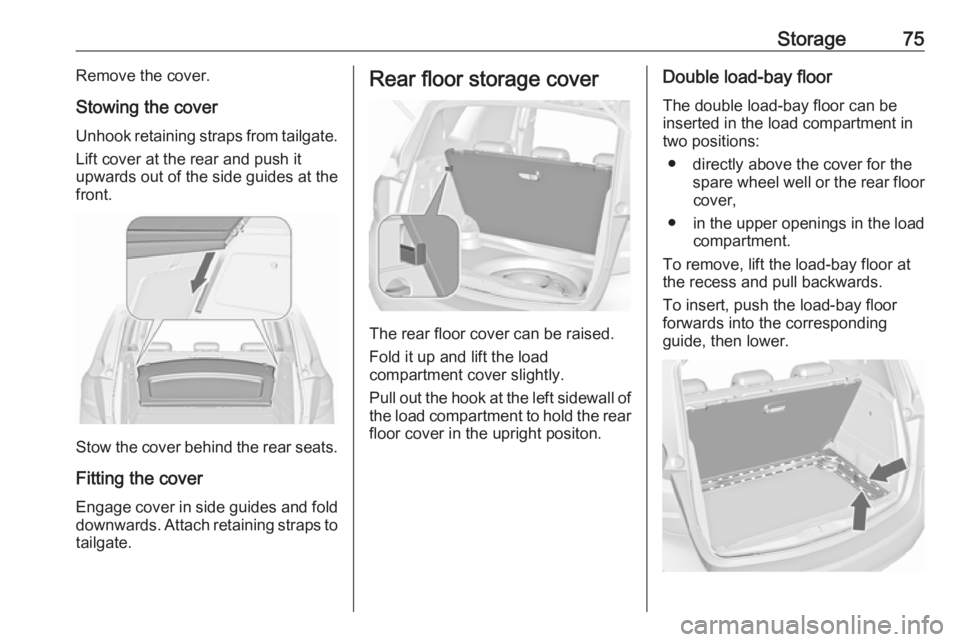
Stowing the cover Unhook retaining straps from tailgate.
Lift cover at the rear and push it
upwards out of the side guides at the front.
Stow the cover behind the rear seats.
Fitting the cover Engage cover in side guides and fold
downwards. Attach retaining straps to
tailgate.
Rear floor storage cover
The rear floor cover can be raised.
Fold it up and lift the load
compartment cover slightly.
Pull out the hook at the left sidewall of
the load compartment to hold the rear floor cover in the upright positon.
Double load-bay floor
The double load-bay floor can be
inserted in the load compartment in
two positions:
● directly above the cover for the spare wheel well or the rear floorcover,
● in the upper openings in the load
compartment.
To remove, lift the load-bay floor at
the recess and pull backwards.
To insert, push the load-bay floor
forwards into the corresponding
guide, then lower.
Page 78 of 251
76StorageIf mounted in the upper position, the
space between the load-bay floor and
the spare wheel well cover can be
used as a stowage compartment.
In this position, if the rear seat
backrests are folded forwards, an
almost completely flat load bay is
created.
In the upper position, the double load-
bay floor is able to withstand a
maximum load of 100 kg. In the lower
position, the double load-bay floor is able to withstand the maximum
permissible load.
In models with a tyre repair kit, the
spare wheel well may be used as an
additional storage compartment. Tyre repair kit 3 202.
Liquid gas shut-off valve 3 160.Lashing eyes
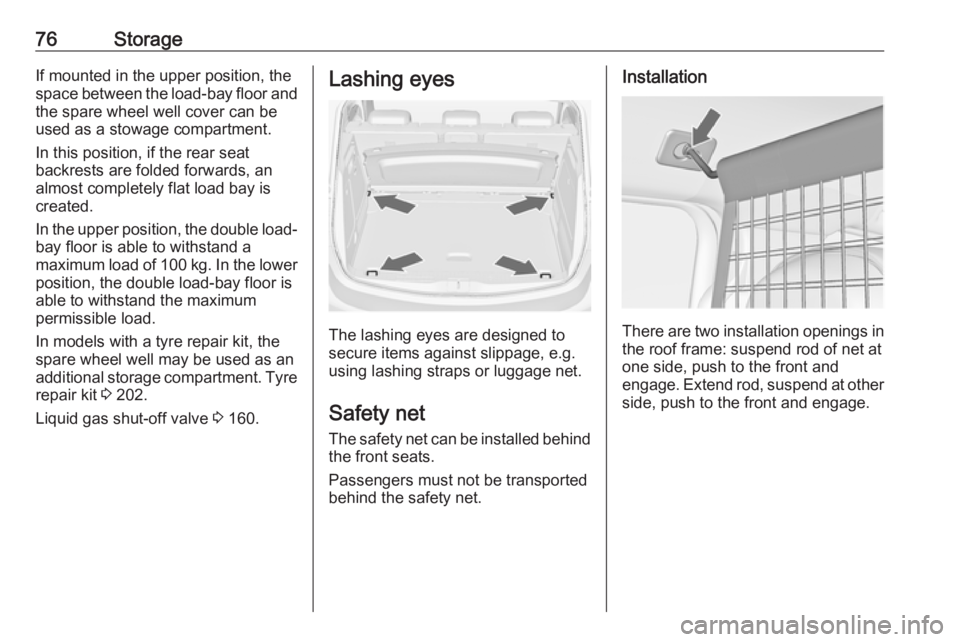
The lashing eyes are designed to
secure items against slippage, e.g.
using lashing straps or luggage net.
Safety net The safety net can be installed behind
the front seats.
Passengers must not be transported
behind the safety net.
Installation
There are two installation openings in the roof frame: suspend rod of net at
one side, push to the front and
engage. Extend rod, suspend at other
side, push to the front and engage.
Page 83 of 251
Instruments and controls81Instruments and
controlsControls ....................................... 82
Steering wheel adjustment ........82
Steering wheel controls .............82
Heated steering wheel ...............82
Horn ........................................... 83
Windscreen wiper/washer .........83
Rear window wiper/washer .......85
Outside temperature ..................85
Clock ......................................... 86
Power outlets ............................. 87
Cigarette lighter ......................... 88
Ashtrays .................................... 88
Warning lights, gauges and indi‐ cators ........................................... 89
Instrument cluster ......................89
Speedometer ............................. 89
Odometer .................................. 89
Trip odometer ............................ 89
Tachometer ............................... 89
Fuel gauge ................................ 90
Fuel selector .............................. 90
Engine coolant temperature gauge ....................................... 90
Service display .......................... 91Control indicators ......................92
Turn signal ................................. 94
Seat belt reminder .....................95
Airbag and belt tensioners .........95
Airbag deactivation ....................95
Charging system .......................96
Malfunction indicator light ..........96
Service vehicle soon .................96
Brake and clutch system ...........96
Operate pedal ............................ 96
Electric parking brake ................97
Electric parking brake fault ........97
Antilock brake system (ABS) .....97
Upshift ....................................... 97
Variable effort steering ..............97
Ultrasonic parking assist ...........97
Electronic Stability Control off ...98
Electronic Stability Control and Traction Control system ...........98
Traction Control system off .......98
Preheating ................................. 98
Diesel particle filter ....................98
Tyre pressure monitoring system ...................................... 98
Engine oil pressure ....................99
Low fuel ..................................... 99
Immobiliser ................................ 99
Reduced engine power .............99
Exterior light .............................. 99
High beam ............................... 100Adaptive forward lighting .........100
Fog light ................................... 100
Rear fog light ........................... 100
Cruise control .......................... 100
Door open ................................ 100
Automatic locking ....................100
Information displays ...................101
Driver Information Centre ........101
Graphic-Info-Display, Colour- Info-Display ............................ 104
Vehicle messages ......................106
Warning chimes .......................108
Battery voltage ........................ 109
Trip computer ............................. 109
Vehicle personalisation ..............112
OnStar ....................................... 116
Page 84 of 251
82Instruments and controlsControlsSteering wheel adjustment
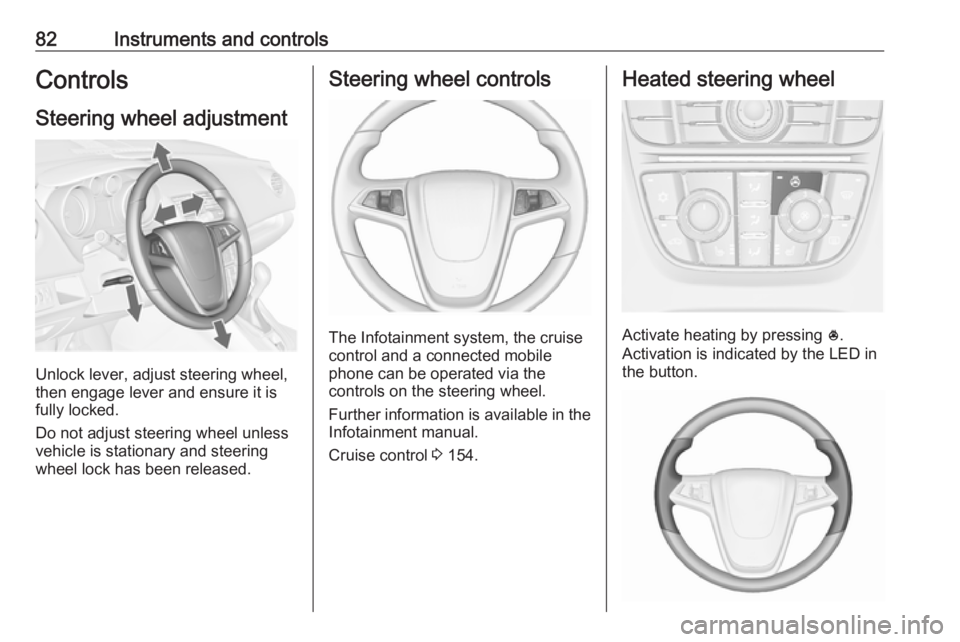
Unlock lever, adjust steering wheel,
then engage lever and ensure it is
fully locked.
Do not adjust steering wheel unless
vehicle is stationary and steering
wheel lock has been released.
Steering wheel controls
The Infotainment system, the cruise
control and a connected mobile
phone can be operated via the
controls on the steering wheel.
Further information is available in the
Infotainment manual.
Cruise control 3 154.
Heated steering wheel
Activate heating by pressing *.
Activation is indicated by the LED in
the button.