light OPEL MERIVA 2017 Manual PDF
[x] Cancel search | Manufacturer: OPEL, Model Year: 2017, Model line: MERIVA, Model: OPEL MERIVA 2017Pages: 251, PDF Size: 8.14 MB
Page 202 of 251
200Vehicle care
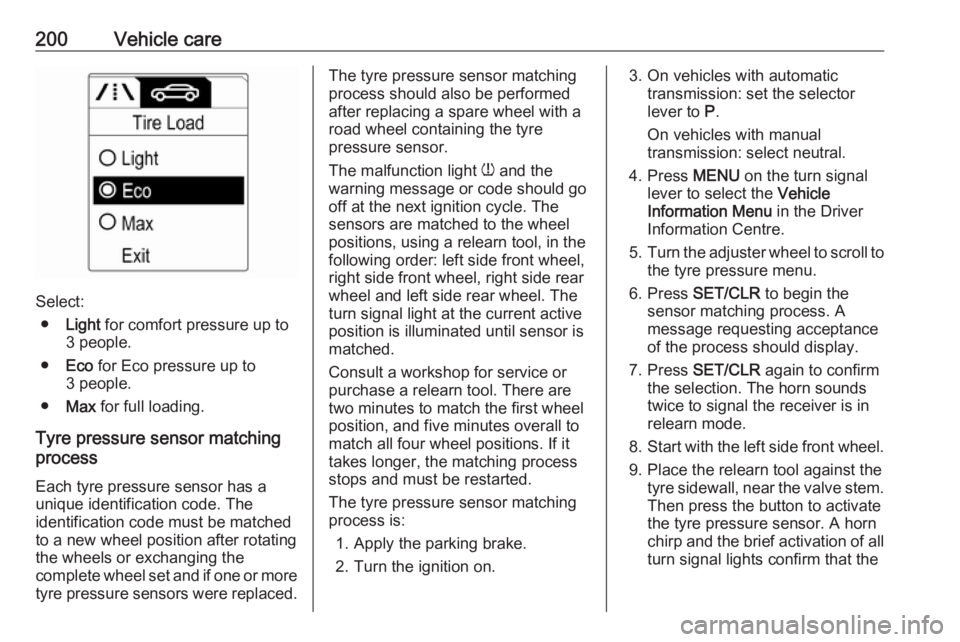
Select:● Light for comfort pressure up to
3 people.
● Eco for Eco pressure up to
3 people.
● Max for full loading.
Tyre pressure sensor matching
process
Each tyre pressure sensor has a
unique identification code. The
identification code must be matched
to a new wheel position after rotating the wheels or exchanging the
complete wheel set and if one or more tyre pressure sensors were replaced.
The tyre pressure sensor matching
process should also be performed
after replacing a spare wheel with a
road wheel containing the tyre
pressure sensor.
The malfunction light w and the
warning message or code should go
off at the next ignition cycle. The
sensors are matched to the wheel
positions, using a relearn tool, in the following order: left side front wheel,
right side front wheel, right side rear
wheel and left side rear wheel. The
turn signal light at the current active
position is illuminated until sensor is
matched.
Consult a workshop for service or
purchase a relearn tool. There are
two minutes to match the first wheel
position, and five minutes overall to
match all four wheel positions. If it
takes longer, the matching process stops and must be restarted.
The tyre pressure sensor matching
process is:
1. Apply the parking brake.
2. Turn the ignition on.3. On vehicles with automatic transmission: set the selector
lever to P.
On vehicles with manual
transmission: select neutral.
4. Press MENU on the turn signal
lever to select the Vehicle
Information Menu in the Driver
Information Centre.
5. Turn the adjuster wheel to scroll to
the tyre pressure menu.
6. Press SET/CLR to begin the
sensor matching process. A
message requesting acceptance
of the process should display.
7. Press SET/CLR again to confirm
the selection. The horn sounds
twice to signal the receiver is in
relearn mode.
8. Start with the left side front wheel.
9. Place the relearn tool against the tyre sidewall, near the valve stem.Then press the button to activate
the tyre pressure sensor. A horn
chirp and the brief activation of all turn signal lights confirm that the
Page 208 of 251
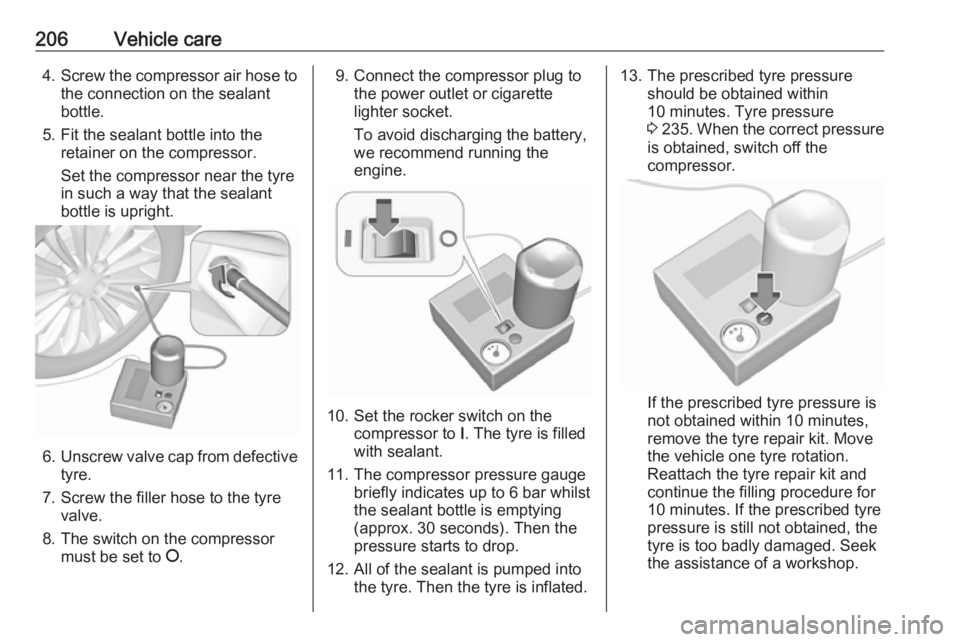
206Vehicle care4.Screw the compressor air hose to
the connection on the sealant
bottle.
5. Fit the sealant bottle into the retainer on the compressor.
Set the compressor near the tyre
in such a way that the sealant
bottle is upright.
6. Unscrew valve cap from defective
tyre.
7. Screw the filler hose to the tyre valve.
8. The switch on the compressor must be set to J.
9. Connect the compressor plug to
the power outlet or cigarette
lighter socket.
To avoid discharging the battery,
we recommend running the
engine.
10. Set the rocker switch on the compressor to I. The tyre is filled
with sealant.
11. The compressor pressure gauge briefly indicates up to 6 bar whilstthe sealant bottle is emptying
(approx. 30 seconds). Then the
pressure starts to drop.
12. All of the sealant is pumped into the tyre. Then the tyre is inflated.
13. The prescribed tyre pressure should be obtained within
10 minutes. Tyre pressure
3 235 . When the correct pressure
is obtained, switch off the
compressor.
If the prescribed tyre pressure is
not obtained within 10 minutes,
remove the tyre repair kit. Move
the vehicle one tyre rotation.
Reattach the tyre repair kit and
continue the filling procedure for
10 minutes. If the prescribed tyre
pressure is still not obtained, the
tyre is too badly damaged. Seek
the assistance of a workshop.
Page 210 of 251
208Vehicle careMake the following preparations and
observe the following information:
● Park the vehicle on a level, firm and non-skid surface. The front
wheels must be in the straight- ahead position.
● Apply the parking brake and engage first gear, reverse gear or
P .
● Remove the spare wheel 3 210.
● Never change more than one wheel at once.
● Use the jack only to change wheels in case of puncture, not
for seasonal winter or summer
tyre change.
● The jack is maintenance-free.
● If the ground on which the vehicle
is standing is soft, a solid board
(max. 1 cm thick) should be
placed under the jack.
● Take heavy objects out of the vehicle before jacking up.
● No people or animals may be in the vehicle when it is jacked-up.
● Never crawl under a jacked-up vehicle.●Do not start the vehicle when it is
raised on the jack.
● Before screwing in the wheel bolts, clean them and lightly coat
the taper of each wheel bolt with
commercially available grease.9 Warning
Do not grease the thread of the
wheel bolt.
1. Pull off the wheel cover.
For wheel covers with visible
wheel bolts: The cover can remain
on the wheel. Do not remove the
retaining rings on the wheel bolts.
Alloy wheels: Disengage wheel
bolt caps with a screwdriver and
remove. To protect the wheel,
place a soft cloth between the
screwdriver and the alloy wheel.
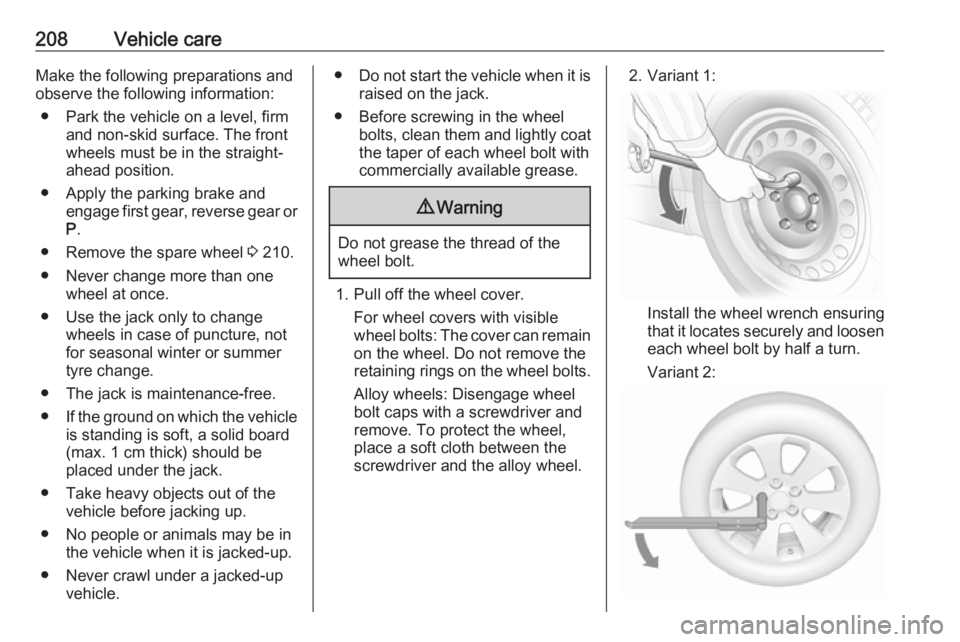
2. Variant 1:
Install the wheel wrench ensuring
that it locates securely and loosen
each wheel bolt by half a turn.
Variant 2:
Page 216 of 251
214Vehicle care3. Connect the black lead to thenegative terminal of the booster
battery.
4. Connect the other end of the black
lead to a vehicle grounding point,
such as the engine block or an
engine mounting bolt. Connect as far away from the discharged
battery as possible, however at
least 60 cm.
Route the leads so that they cannot
catch on rotating parts in the engine
compartment.
To start the engine: 1. Start the engine of the vehicle providing the jump.
2. After 5 minutes, start the other engine. Start attempts should be
made for no longer than
15 seconds at an interval of 1 minute.
3. Allow both engines to idle for approx. 3 minutes with the leads
connected.4. Switch on electrical consumers (e.g. headlights, heated rear
window) of the vehicle receiving
the jump start.
5. Reverse above sequence exactly when removing leads.Towing
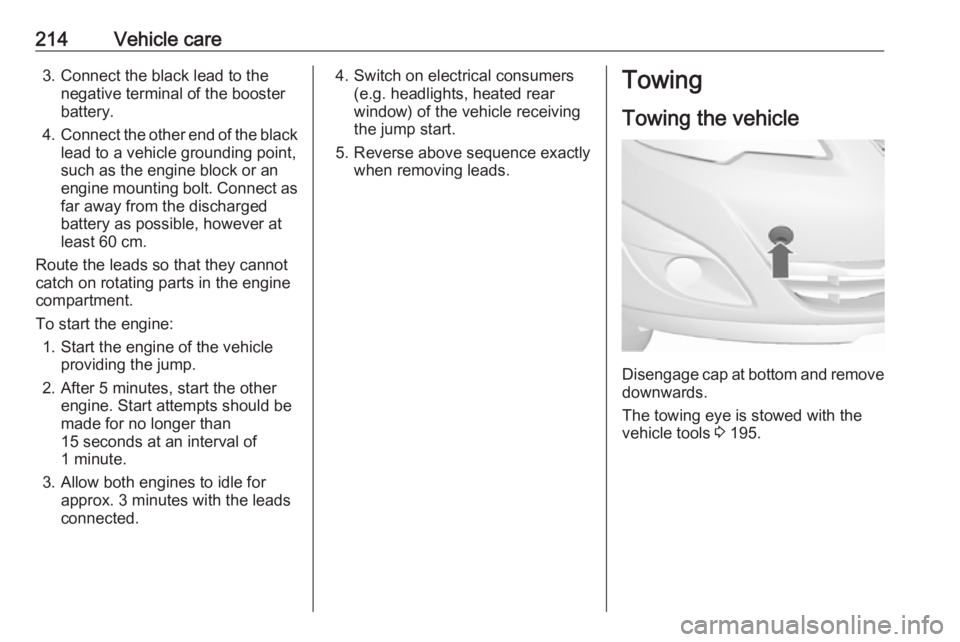
Towing the vehicle
Disengage cap at bottom and removedownwards.
The towing eye is stowed with the
vehicle tools 3 195.
Page 217 of 251
Vehicle care215
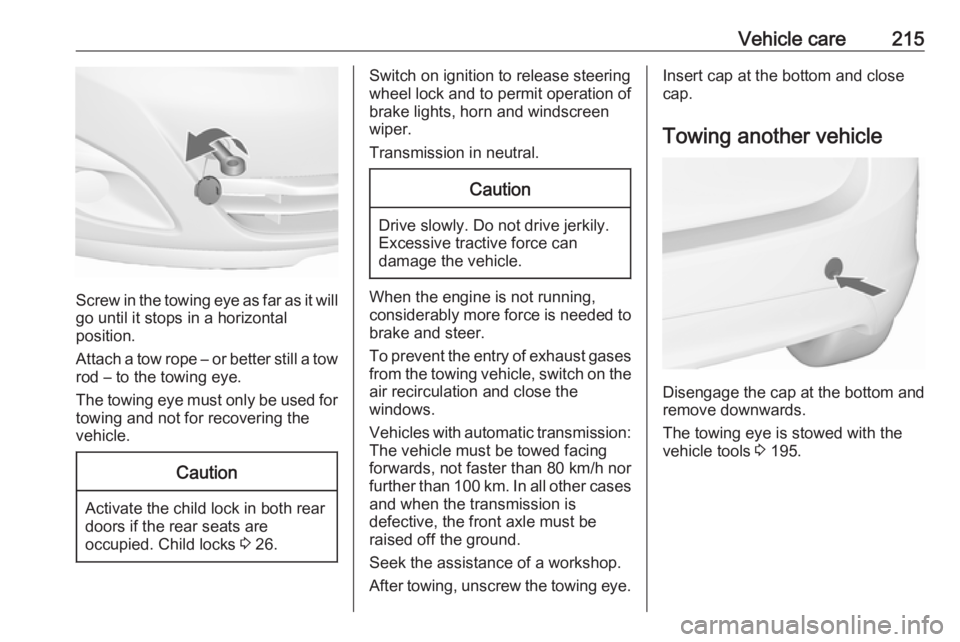
Screw in the towing eye as far as it will
go until it stops in a horizontal
position.
Attach a tow rope – or better still a tow
rod – to the towing eye.
The towing eye must only be used for towing and not for recovering the
vehicle.
Caution
Activate the child lock in both rear
doors if the rear seats are
occupied. Child locks 3 26.
Switch on ignition to release steering
wheel lock and to permit operation of
brake lights, horn and windscreen
wiper.
Transmission in neutral.Caution
Drive slowly. Do not drive jerkily.
Excessive tractive force can
damage the vehicle.
When the engine is not running,
considerably more force is needed to
brake and steer.
To prevent the entry of exhaust gases from the towing vehicle, switch on the
air recirculation and close the
windows.
Vehicles with automatic transmission: The vehicle must be towed facing
forwards, not faster than 80 km/h nor further than 100 km. In all other cases
and when the transmission is
defective, the front axle must be
raised off the ground.
Seek the assistance of a workshop.
After towing, unscrew the towing eye.
Insert cap at the bottom and close
cap.
Towing another vehicle
Disengage the cap at the bottom and
remove downwards.
The towing eye is stowed with the
vehicle tools 3 195.
Page 219 of 251
Vehicle care217If using a vehicle wash, comply with
the vehicle wash manufacturer's
instructions. The windscreen wiper and rear window wiper must be
switched off. Remove antenna and
external accessories such as roof
racks etc.
If you wash your vehicle by hand,
make sure that the insides of the
wheel housings are also thoroughly
rinsed out.
Clean edges and folds on opened
doors and the bonnet as well as the
areas they cover.Caution
Always use a cleaning agent with
a pH value of 4 to 9.
Do not use cleaning agents on hot surfaces.
Have the door hinges of all doors
greased by a workshop.
Do not clean the engine compartment with a steam-jet or high-pressure jet
cleaner.
Thoroughly rinse and leather-off the vehicle. Rinse leather frequently. Use
separate leathers for painted and
glass surfaces: remnants of wax on
the windows will impair vision.
Do not use hard objects to remove
spots of tar. Use tar removal spray on
painted surfaces.
Exterior lights
Headlight and other light covers are
made of plastic. Do not use any
abrasive or caustic agents, do not use
an ice scraper, and do not clean them
dry.
Polishing and waxing
Wax the vehicle regularly (at the
latest when water no longer beads).
Otherwise, the paintwork will dry out.
Polishing is necessary only if the paint
has become dull or if solid deposits
have become attached to it.
Paintwork polish with silicone forms a
protective film, making waxing
unnecessary.
Plastic body parts must not be treated with wax or polishing agents.Windows and windscreen wiper
blades
Use a soft lint-free cloth or chamois
leather together with window cleaner and insect remover.
When cleaning the rear window from
inside, always wipe in parallel to the
heating element to prevent damage.
For mechanical removal of ice, use a
sharp-edged ice scraper. Press the
scraper firmly against the glass so
that no dirt can get under it and
scratch the glass.
Remove dirt residues from smearing wiper blades by using a soft cloth and window cleaner. Also make sure to
remove any residues such as wax,
insect residues and similar from the
window.
Ice residues, pollution and continuous
wiping on dry windows will damage or even destroy the wiper blades.
Page 221 of 251
Vehicle care219Clean fabric upholstery with a
vacuum cleaner and brush. Remove
stains with an upholstery cleaner.
Clothing fabrics may not be
colourfast. This could cause visible discolourations, especially on light-
coloured upholstery. Removable
stains and discolourations should be
cleaned as soon as possible.
Clean seat belts with lukewarm water
or interior cleaner.Caution
Close Velcro fasteners as open
Velcro fasteners on clothing could
damage seat upholstery.
The same applies to clothing with
sharp-edged objects, like zips or
belts or studded jeans.
Plastic and rubber parts
Plastic and rubber parts can be
cleaned with the same cleaner as
used to clean the body. Use interior cleaner if necessary. Do not use any
other agent. Avoid solvents and petrol in particular. Do not use high-
pressure jet cleaners.
Page 246 of 251
244IndexAAccessories and vehicle modifications .......................... 172
Active head restraints ...................36
Adaptive brake light ....................150
Adaptive forward lighting ..100,
123, 182
Adjustable air vents ...................136
Airbag and belt tensioners ...........95
Airbag deactivation ................53, 95
Airbag label................................... 49 Airbag system .............................. 49
Air conditioning regular operation ................................ 137
Air conditioning system .............. 130
Air intake .................................... 137
Air vents...................................... 136
Alert ............................................ 108
Antifreeze ................................... 175
Antilock brake system ................ 150
Antilock brake system (ABS) .......97
Anti-theft alarm system ................28
Anti-theft locking system .............. 28
Appearance care ........................216
Armrest ................................... 40, 43
Armrest storage ........................... 63
Ashtrays ....................................... 88
Automatic anti-dazzle ..................31
Automatic light control ...............121
Automatic locking ................25, 100Automatic transmission .............146
Autostop ..................................... 142
Auxiliary heater ........................... 136
B Battery discharge protection ......128
Battery voltage ........................... 109
Belts.............................................. 45 Bicycle rack .................................. 64
Bonnet ....................................... 173
Brake and clutch fluid .................221
Brake and clutch system .............96
Brake assist ............................... 152
Brake fluid .................................. 176
Brakes ............................... 150, 176
Breakdown.................................. 214
Bulb replacement ....................... 180
C Capacities .................................. 234
Car Pass ...................................... 21
Catalytic converter .....................146
Central locking system ................22
Centre console lighting ..............127
Changing tyre and wheel size ...201
Charging system .......................... 96
Child locks ................................... 26
Child restraint installation locations ................................... 57
Child restraints.............................. 55
Child restraint systems ................55
Page 247 of 251
245Cigarette lighter ........................... 88
Climate control ............................. 16
Climate control, service ..............137
Climate control systems .............129
Clock............................................. 86
Code ........................................... 106
Collision damage repair ..............240
Control indicators.......................... 92
Control of the vehicle .................139
Controls ........................................ 82
Controls in steering wheel ............82
Convex shape .............................. 29
Coolant ....................................... 175
Coolant and antifreeze ...............221
Coolant temperature gauge ..........90
Coupling ball bar ........................168
Cruise control ....................100, 154
Cupholders .................................. 61
Curtain airbag system .................. 53
Curve lighting.............................. 123
D
Danger, Warnings and Cautions ...4
Dashboard .................................... 10
Daytime running light ..................121
Daytime running lights ...............123
Declaration of conformity ............238
Diesel fuel system bleeding .......179
Diesel particle filter ...............98, 145
Door open .................................. 100Doors............................................ 26
Driver assistance systems ..........154
Driver Information Centre ...........101
Driving characteristics and towing tips .............................. 167
Driving hints ................................ 139
E Electric adjustment ......................29
Electrical system......................... 189
Electric parking brake ...........97, 151
Electric parking brake fault ...........97
Electronic climate control system 132
Electronic driving programmes ..148
Electronic Stability Control.......... 153
Electronic Stability Control and Traction Control system ............98
Electronic Stability Control off....... 98
End-of-life vehicle recovery .......172
Engine compartment fuse box ...191
Engine coolant ........................... 175
Engine coolant temperature gauge ....................................... 90
Engine data ............................... 228
Engine exhaust .......................... 145
Engine identification ...................224
Engine oil ................... 174, 221, 225
Engine oil pressure ......................99
Entry lighting .............................. 127
Event data recorders ..................242Exhaust gases ............................ 145
Exit lighting ................................ 127
Exterior care .............................. 216
Exterior light ................................. 99
Exterior lighting ....................13, 120
Exterior mirrors ............................. 29
F
Fault ........................................... 148
First aid ......................................... 78
First aid kit ................................... 78
Fixed air vents ........................... 137
Flex-Fix system ............................ 64
Fog light ..................................... 100
Fog lights .................... 124, 125, 184
Folding mirrors ............................. 30
Folding tray .................................. 78
Front airbag system .....................52
Front fog lights ........................... 124
Front seats.................................... 37
Front storage ................................ 63
Front turn signal light ..................180
Front turn signal lights ...............184
Fuel............................................. 160
Fuel consumption - CO 2-
Emissions ............................... 165
Fuel for diesel engines ..............160
Fuel for liquid gas operation .......160
Fuel for petrol engines ...............160
Fuel gauge ................................... 90
Page 248 of 251
246Fuel selector ................................ 90
Fuse box ..................................... 191
Fuses ......................................... 189
G Gauges ......................................... 89
General information ...................166
Glovebox ..................................... 61
Graphic-Info-Display, Colour- Info-Display ............................ 104
H Halogen headlights ....................180
Hand brake ......................... 150, 151
Hazard warning flashers ............124
Headlight flash ........................... 122
Headlight range adjustment ......122
Headlights .......................... 120, 122
Headlights when driving abroad 122
Head restraint adjustment .............8
Head restraints ............................ 35
Heated mirrors ............................. 30
Heated rear window ..................... 33
Heated steering wheel .................82
Heating ........................................ 41
Heating and ventilation system . 129
High beam ......................... 100, 122
Hill start assist ........................... 152
Horn ....................................... 14, 83I
Identification plate .....................224
Ignition switch positions .............140
Immobiliser ............................ 29, 99
Indicators ...................................... 89
Information displays.................... 101
Instrument cluster ........................89
Instrument panel fuse box .........193
Instrument panel illumination .....189
Instrument panel illumination control .................................... 126
Instrument panel overview ........... 10
Interior care ............................... 218
Interior lighting ............................ 126
Interior lights ...................... 126, 189
Interior mirrors .............................. 30
Interruption of power supply ......148
Introduction .................................... 3
ISOFIX child restraint systems ....60
J
Jump starting ............................. 213
K Keys ............................................. 20
Keys, locks ................................... 20
Keys, memorised settings ............22
L Lashing eyes ............................... 76
Light covers, misted.................... 125Lighting features .........................127
Light switch ................................ 120
Load compartment ................27, 73
Load compartment cover .............74
Load compartment fuse box ......194
Loading information .....................79
Low fuel ....................................... 99
M Malfunction indicator light ............96
Manual anti-dazzle ......................30
Manual mode ............................. 148
Manual transmission .................. 149
Manual windows ..........................31
Memorised settings ......................22
Midlevel-Display ......................... 101
Mirror adjustment ........................... 8
Misted light covers .....................125
Moonroof ..................................... 34
N New vehicle running-in ..............140
Number plate light .....................188
O
Object detection systems ...........156
Octane rating .............................. 228
Odometer ..................................... 89
Oil ............................................... 174
Oil, engine .......................... 221, 225
Oil pressure .................................. 99