air condition OPEL MOKKA 2017 User Guide
[x] Cancel search | Manufacturer: OPEL, Model Year: 2017, Model line: MOKKA, Model: OPEL MOKKA 2017Pages: 233, PDF Size: 6.69 MB
Page 132 of 233
130Driving and operatingTurn the steering wheel until
the steering wheel lock is felt to
engage.
● Lock the vehicle.
● Activate the anti-theft alarm system.
Note
In the event of an accident with
airbag deployment, the engine is
turned off automatically if the vehicle comes to a standstill within a certain
time.
Engine exhaust9 Danger
Engine exhaust gases contain
poisonous carbon monoxide,
which is colourless and odourless and could be fatal if inhaled.
If exhaust gases enter the interior
of the vehicle, open the windows.
Have the cause of the fault
rectified by a workshop.
Avoid driving with an open load
compartment, otherwise exhaust
gases could enter the vehicle.
Diesel particle filter
The diesel particle filter system filters
harmful soot particles out of the
exhaust gases. The system includes
a self-cleaning function that runs
automatically during driving without
any notification. The filter is cleaned
by periodically burning off the soot
particles at high temperature. This
process takes place automatically
under set driving conditions and may
take up to 25 minutes. Typically it
needs between 7 and 12 minutes.
Autostop is not available and fuel
consumption may be higher during
this period. The emission of smells
and smoke during this process is
normal.
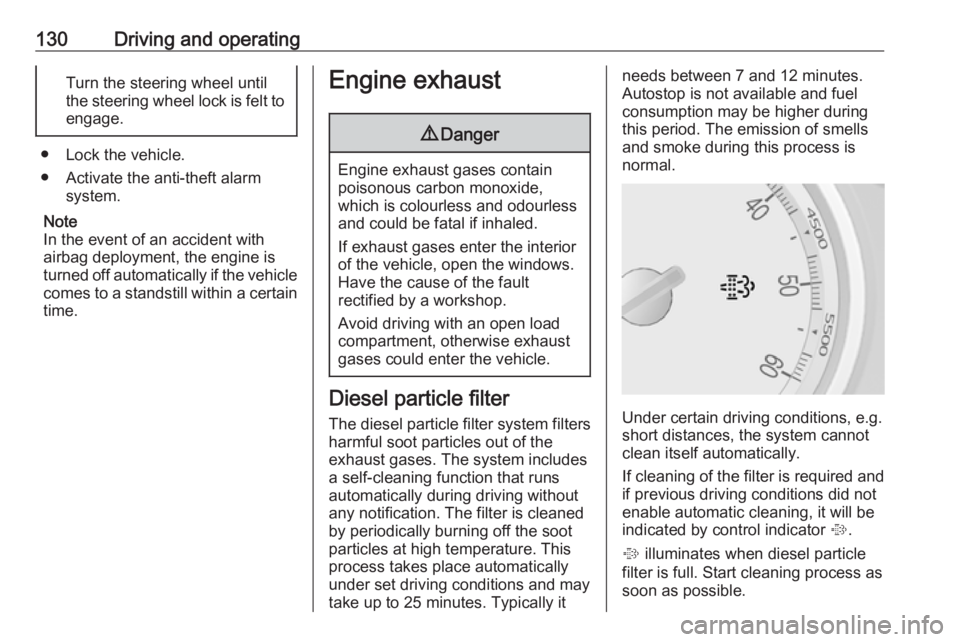
Under certain driving conditions, e.g.
short distances, the system cannot
clean itself automatically.
If cleaning of the filter is required and if previous driving conditions did not
enable automatic cleaning, it will be
indicated by control indicator %.
% illuminates when diesel particle
filter is full. Start cleaning process as
soon as possible.
Page 156 of 233

154Driving and operatingAs soon as the liquid gas tanks are
empty, petrol operation is
automatically engaged until the
ignition is switched off.
When switching automatically
between petrol or gas operation, a
brief delay of engine tractive power
may be noticeable.
Every six months, run the petrol tank
down until control indicator i
illuminates, then refuel. This helps
maintain fuel quality and system
function for petrol operation.
Fill the tank completely at regular
intervals to prevent corrosion in the
tank.
Faults and remedies
If gas mode is not possible, check the following:
● Is there enough liquid gas present?
● Is there enough petrol present for
starting?Due to extreme temperatures in
combination with the gas
composition, it may take slightly
longer before the system switches
from petrol to gas mode.
In extreme situations, the system may
also switch back to petrol mode if the
minimum requirements are not
fulfilled. If conditions allow, it may be
possible to manually switch back to
liquid gas operation.
Seek the assistance of a workshop in
the event of all other faults.Caution
Repairs and adjustments may only be made by trained specialists in
order to maintain the safety and
warranty on the LPG system.
Liquid gas is given a particular odour
(odorised) so that any leaks can be
detected easily.
9 Warning
If you smell gas in the vehicle or in
the immediate vicinity, switch to petrol mode immediately. No
smoking. No naked flames or
ignition sources.
If the gas odour persists, do not start
the engine. Have the cause of the
fault remedied by a workshop.
When using underground car parks,
follow the instructions of the operator
and local laws.
Note
In the event of an accident, switch off
the ignition and lights.
Page 182 of 233

180Vehicle careNo.Circuit1Sunroof2Exterior mirrors3–4–5Electrical brake control module6Intelligent battery sensor7–8Transmission control module9–10Headlight levelling11Rear window wiper12Heated rear window13Headlight actuator (left hand)14Heated exterior mirrors15–16Seat heating17Transmission control moduleNo.Circuit18Engine control module19Fuel pump20–21Cooling fan22–23Ignition coil/Engine control
module24Washer pump25Headlamp actuator (right hand)26Engine control sensors27–28Ignition29Ignition30Exhaust system31Left-hand high beam32Right-hand high beam33Engine control module34HornNo.Circuit35Air conditioning system36Front fog lamp
J-cases Fuses
No.Circuit1Electrical brake control module2Front wiper3Power module4Power terminal of instrument
panel fuse box5–6Fuel heater7–8Cooling fan9Cooling fan10Engine control module/Glow
plug11Starter
Page 186 of 233
184Vehicle careVehicle tools
Tools
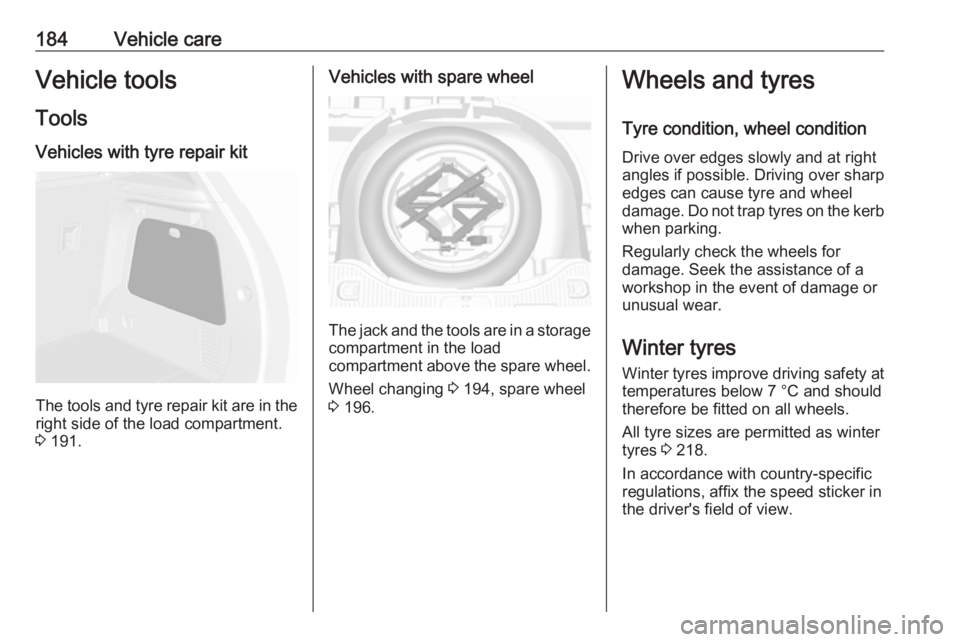
Vehicles with tyre repair kit
The tools and tyre repair kit are in the
right side of the load compartment.
3 191.
Vehicles with spare wheel
The jack and the tools are in a storage
compartment in the load
compartment above the spare wheel.
Wheel changing 3 194, spare wheel
3 196.
Wheels and tyres
Tyre condition, wheel condition Drive over edges slowly and at right
angles if possible. Driving over sharp
edges can cause tyre and wheel
damage. Do not trap tyres on the kerb when parking.
Regularly check the wheels for
damage. Seek the assistance of a
workshop in the event of damage or
unusual wear.
Winter tyres
Winter tyres improve driving safety at temperatures below 7 °C and shouldtherefore be fitted on all wheels.
All tyre sizes are permitted as winter
tyres 3 218.
In accordance with country-specific
regulations, affix the speed sticker in
the driver's field of view.
Page 188 of 233

186Vehicle careFor the tyres approved for your
vehicle, refer to the EEC Certificate of Conformity provided with your vehicle
or other national registration
documents.
The driver is responsible for correct
adjustment of tyre pressure.9 Warning
If the pressure is too low, this can
result in considerable tyre warm-
up and internal damage, leading to tread separation and even to tyre
blow-out at high speeds.
9 Warning
For specific tyres the
recommended tyre pressure as
shown in the tyre pressure table may exceed the maximum tyre
pressure as indicated on the tyre.
Never exceed the maximum tyre
pressure as indicated on the tyre.
Temperature dependency
The tyre pressure depends on the
temperature of the tyre. During
driving, tyre temperature and
pressure increase. Tyre pressure
values provided on the tyre
information label and tyre pressure
chart are valid for cold tyres, which means at 20 °C.
The pressure increases by nearly
10 kPa for a 10 °C temperature
increase. This must be considered
when warm tyres are checked.
The tyre pressure value displayed in
the Driver Information Centre shows
the real tyre pressure. A cooled down
tyre will show a decreased value,
which does not indicate an air leak.
Tyre pressure monitoringsystem
The tyre pressure monitoring system
checks the pressure of all four tyres
once a minute when vehicle speed
exceeds a certain limit.Caution
Tyre pressure monitoring system
warns only about low tyre pressure condition and does not replace
regular tyre maintenance by the
driver.
All wheels must be equipped with pressure sensors and the tyres must
have the prescribed pressure.
Note
In countries where the tyre pressure
monitoring system is legally
required, the use of wheels without
pressure sensors will invalidate the
vehicle type approval.
The current tyre pressures can be
shown in the Vehicle Information
Menu in the Driver Information
Centre.
The menu can be selected by the buttons on the turn signal lever.
Page 190 of 233

188Vehicle careThe use of commercially available
liquid tyre repair kits can impair the
function of the system. Factory-
approved repair kits can be used.
Operating electronic devices or being close to facilities using similar wave
frequencies could disrupt the tyre
pressure monitoring system.
Each time the tyres are replaced, tyre
pressure monitoring system sensors
must be dismounted and serviced. For the screwed sensor, replace
valve core and sealing ring. For
clipped sensor, replace complete
valve stem.
Vehicle loading status
Adjust tyre pressure to load condition according to tyre information label ortyre pressure chart 3 218, and select
the relevant setting in the menu Tyre
Load in the Driver Information Centre,
Vehicle Information Menu 3 89. This
setting is the reference for the tyre
pressure warnings.The Tyre Load menu only appears if
the vehicle is in a standstill and the
parking brake is applied. On vehicles
with automatic transmission the
selector lever has to be in P.
Select:
● Light for comfort pressure up to
3 people
● Eco for Eco pressure up to
3 people
● Max for full loading
Tyre pressure sensor matching
process
Each tyre pressure sensor has a
unique identification code. The
identification code must be matched
to a new wheel position after rotating the wheels or exchanging the
complete wheel set and if one or more tyre pressure sensors were replaced.The tyre pressure sensor matching
process should also be performed
after replacing a spare wheel with a
road wheel containing the tyre
pressure sensor.
The malfunction light w and the
warning message or code should go
off at the next ignition cycle. The
sensors are matched to the wheel
positions, using a relearn tool, in the
following order: left side front wheel,
right side front wheel, right side rear
wheel and left side rear wheel. The
turn signal light at the current active
position is illuminated until sensor is
matched.
Consult a workshop for service or
purchase a relearn tool. There are
two minutes to match the first wheel
position, and five minutes overall to
Page 226 of 233

224Customer informationoriginal source. Such altered
versions also must not be
misrepresented as being Info-ZIP
releases--including, but not
limited to, labeling of the altered
versions with the names “Info-
ZIP” (or any variation thereof,
including, but not limited to,
different capitalizations), “Pocket
UnZip,” “WiZ” or “MacZip” without
the explicit permission of Info-ZIP. Such altered versions are further
prohibited from misrepresentative
use of the Zip-Bugs or Info-ZIP e- mail addresses or of the Info-ZIP
URL(s).
4. Info-ZIP retains the right to use the names “Info-ZIP,” “Zip,”
“UnZip,” “UnZipSFX,” “WiZ,” “Pocket UnZip,” “Pocket Zip,” and
“MacZip” for its own source and
binary releases.Vehicle data recording
and privacy
Event data recorders Data storage modules in the
vehicle
A large number of electronic
components of your vehicle contain
data storage modules temporarily or
permanently storing technical data
about the condition of the vehicle,
events and errors. In general, this
technical information documents the
condition of parts, modules, systems
or the environment:
● Operating conditions of system components (e.g. filling levels)
● Status messages of the vehicle and its single components (e.g.
number of wheel revolutions / rotational speed, deceleration,
lateral acceleration)
● Dysfunctions and defects in important system components● Vehicle reactions in particular driving situations (e.g. inflation of
an airbag, activation of the
stability regulation system)
● Environmental conditions (e.g. temperature)
These data are exclusively technical
and help identifying and correcting
errors as well as optimizing vehicle
functions.
Motion profiles indicating travelled
routes cannot be created with these
data.
If services are used (e.g. repair
works, service processes, warranty cases, quality assurance),
employees of the service network
(manufacturer included) are able to
read out this technical information
from the event and error data storage
modules applying special diagnostic
devices. If required, you will receive
further information at these
workshops. After an error has been
corrected, the data are deleted from
the error storage module or they are
constantly overwritten.
Page 228 of 233
226IndexAAccessories and vehicle modifications .......................... 164
Adaptive forward lighting .....88, 110
Adjustable air vents ...................122
Airbag and belt tensioners ...........84
Airbag deactivation ................48, 84
Airbag label................................... 43 Airbag system .............................. 43
Air conditioning regular operation ................................ 123
Air conditioning system .............. 118
Air intake .................................... 123
Air vents...................................... 122
All-wheel drive ........................... 135
Antilock brake system ................ 136
Antilock brake system (ABS) .......85
Anti-theft alarm system ................26
Anti-theft locking system .............. 26
Appearance care ........................202
Automatic anti-dazzle ..................30
Automatic light control ...............108
Automatic locking ........................24
Automatic transmission .............131
Autostop ..................................... 127
Auxiliary heater ........................... 122
B Battery discharge protection ......116
Battery voltage ............................. 96Bicycle rack .................................. 57
Bonnet ....................................... 165
Bonnet open ................................. 89
Brake and clutch fluid .................206
Brake and clutch system .............85
Brake assist ............................... 137
Brake fluid .................................. 169
Brakes ............................... 136, 169
Breakdown.................................. 200
Bulb replacement ....................... 172
C Capacities .................................. 217
Catalytic converter .....................131
Central locking system ................22
Centre console storage ...............57
Centre high-mounted brake light 177
Changing tyre and wheel size ...190
Charging system .......................... 85
Child locks ................................... 25
Child restraint installation locations ................................... 50
Child restraints.............................. 49
Child restraint systems ................49
Climate control ............................. 16
Climate control systems .............117
Clock ............................................ 76
Code ............................................. 94
Collision damage repair ..............222
Control indicators.......................... 81