transmission OPEL MOKKA 2017 Owner's Manual
[x] Cancel search | Manufacturer: OPEL, Model Year: 2017, Model line: MOKKA, Model: OPEL MOKKA 2017Pages: 233, PDF Size: 6.69 MB
Page 190 of 233

188Vehicle careThe use of commercially available
liquid tyre repair kits can impair the
function of the system. Factory-
approved repair kits can be used.
Operating electronic devices or being close to facilities using similar wave
frequencies could disrupt the tyre
pressure monitoring system.
Each time the tyres are replaced, tyre
pressure monitoring system sensors
must be dismounted and serviced. For the screwed sensor, replace
valve core and sealing ring. For
clipped sensor, replace complete
valve stem.
Vehicle loading status
Adjust tyre pressure to load condition according to tyre information label ortyre pressure chart 3 218, and select
the relevant setting in the menu Tyre
Load in the Driver Information Centre,
Vehicle Information Menu 3 89. This
setting is the reference for the tyre
pressure warnings.The Tyre Load menu only appears if
the vehicle is in a standstill and the
parking brake is applied. On vehicles
with automatic transmission the
selector lever has to be in P.
Select:
● Light for comfort pressure up to
3 people
● Eco for Eco pressure up to
3 people
● Max for full loading
Tyre pressure sensor matching
process
Each tyre pressure sensor has a
unique identification code. The
identification code must be matched
to a new wheel position after rotating the wheels or exchanging the
complete wheel set and if one or more tyre pressure sensors were replaced.The tyre pressure sensor matching
process should also be performed
after replacing a spare wheel with a
road wheel containing the tyre
pressure sensor.
The malfunction light w and the
warning message or code should go
off at the next ignition cycle. The
sensors are matched to the wheel
positions, using a relearn tool, in the
following order: left side front wheel,
right side front wheel, right side rear
wheel and left side rear wheel. The
turn signal light at the current active
position is illuminated until sensor is
matched.
Consult a workshop for service or
purchase a relearn tool. There are
two minutes to match the first wheel
position, and five minutes overall to
Page 191 of 233
Vehicle care189match all four wheel positions. If it
takes longer, the matching process stops and must be restarted.
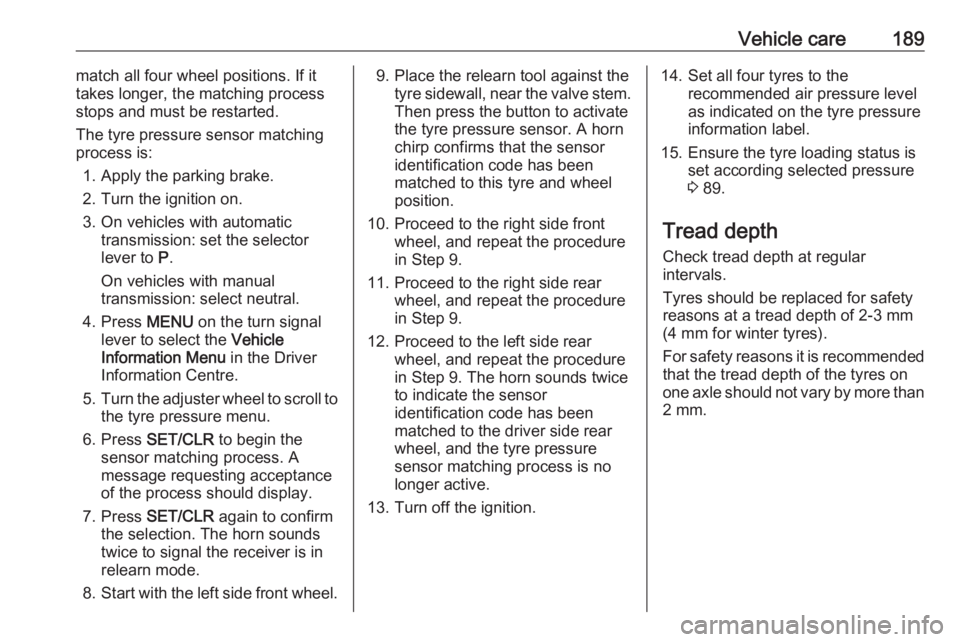
The tyre pressure sensor matching
process is:
1. Apply the parking brake.
2. Turn the ignition on.
3. On vehicles with automatic transmission: set the selector
lever to P.
On vehicles with manual
transmission: select neutral.
4. Press MENU on the turn signal
lever to select the Vehicle
Information Menu in the Driver
Information Centre.
5. Turn the adjuster wheel to scroll to
the tyre pressure menu.
6. Press SET/CLR to begin the
sensor matching process. A
message requesting acceptance
of the process should display.
7. Press SET/CLR again to confirm
the selection. The horn sounds
twice to signal the receiver is in
relearn mode.
8. Start with the left side front wheel.9. Place the relearn tool against the
tyre sidewall, near the valve stem.Then press the button to activate
the tyre pressure sensor. A horn
chirp confirms that the sensor
identification code has been
matched to this tyre and wheel
position.
10. Proceed to the right side front wheel, and repeat the procedure
in Step 9.
11. Proceed to the right side rear wheel, and repeat the procedure
in Step 9.
12. Proceed to the left side rear wheel, and repeat the procedure
in Step 9. The horn sounds twice
to indicate the sensor
identification code has been
matched to the driver side rear
wheel, and the tyre pressure
sensor matching process is no
longer active.
13. Turn off the ignition.14. Set all four tyres to the recommended air pressure level
as indicated on the tyre pressure information label.
15. Ensure the tyre loading status is set according selected pressure
3 89.
Tread depth
Check tread depth at regular
intervals.
Tyres should be replaced for safety
reasons at a tread depth of 2-3 mm
(4 mm for winter tyres).
For safety reasons it is recommended
that the tread depth of the tyres on
one axle should not vary by more than 2 mm.
Page 201 of 233

Vehicle care199● Apply the parking brake,transmission in neutral,
automatic transmission in P.
● Open the positive terminal protection caps of both batteries.
Lead connection order:
1. Connect the red lead to the positive terminal of the booster
battery.
2. Connect the other end of the red lead to the positive terminal of the
discharged battery.
3. Connect the black lead to the negative terminal of the booster
battery.
4. Connect the other end of the black
lead to a vehicle grounding point,
such as the engine block or an
engine mounting bolt. Connect as far away from the discharged
battery as possible, however at
least 60 cm.
Route the leads so that they cannot
catch on rotating parts in the engine
compartment.
To start the engine: 1. Start the engine of the vehicle providing the jump.
2. After five minutes, start the other engine. Start attempts should be
made for no longer than
15 seconds at an interval of
1 minute.
3. Allow both engines to idle for approx. three minutes with the
leads connected.4. Switch on electrical consumers (e.g. headlights, heated rear
window) of the vehicle receiving
the jump start.
5. Reverse above sequence exactly when removing leads.
Page 202 of 233

200Vehicle careTowingTowing the vehicle
Disengage cap by using a
screwdriver and remove.
The towing eye is stowed with the vehicle tools 3 184.
Screw in the towing eye as far as it will
go until it stops in a horizontal
position.
Attach a tow rope – or better still a tow
rod – to the towing eye.
The towing eye must only be used for towing and not for recovering the
vehicle.
Switch on ignition to release steering
wheel lock and to permit operation of
brake lights, horn and windscreen
wiper.
Transmission in neutral.
Caution
Never tow a vehicle equipped with All Wheel Drive (AWD) with the
front or rear tyres on the road. If
you tow a vehicle equipped with
AWD while the front or rear tyres
are rolling on the road, the drive
system in the vehicle could be
severely damaged. When towing
vehicles equipped with AWD, all
four tyres must not be in contact
with the road.
Caution
Drive slowly. Do not drive jerkily.
Excessive tractive force can
damage the vehicle.
When the engine is not running,
considerably more force is needed to
brake and steer.
To prevent the entry of exhaust gases from the towing vehicle, switch on the
air recirculation system 3 118 and
close the windows.
Page 203 of 233

Vehicle care201Vehicles with manual transmission:
The vehicle must be towed facing
forwards. The maximum speed is
80 km/h . In all other cases, and when
the transmission is defective, the front
axle must be raised off the ground.
Vehicles with automatic transmission: Do not tow the vehicle using a towingeye. Towing with a tow rope could
cause severe automatic transmission damage. When towing vehicles with
automatic transmission, use flat bed
or wheel lift equipment.
Seek the assistance of a workshop. After towing, unscrew the towing eye.
Insert cap and close cap.Towing another vehicle
Disengage the cap by using a
screwdriver and remove.
The towing eye is stowed with the
vehicle tools 3 184.
Screw in the towing eye as far as it will
go until it stops in a horizontal
position.
The lashing eye at the rear
underneath the vehicle must never be used as a towing eye.
Attach a tow rope – or even better a
tow bar – to the towing eye.
The towing eye must only be used for
towing and not for recovering a
vehicle.
Page 216 of 233
![OPEL MOKKA 2017 Owners Manual 214Technical dataPerformanceEngineA14NET
B14NET
LPG
A16XERA18XER
B16DTH
100 kWB16DTH
81 kWMaximum speed [km/h]Manual transmission193193170180190/187 3)178Automatic transmission187––180188–3)
Veh](/img/37/58234/w960_58234-215.png "OPEL MOKKA 2017 Owners Manual 214Technical dataPerformanceEngineA14NET
B14NET
LPG
A16XERA18XER
B16DTH
100 kWB16DTH
81 kWMaximum speed [km/h]Manual transmission193193170180190/187 3)178Automatic transmission187––180188–3)
Veh")
214Technical dataPerformanceEngineA14NET
B14NET
LPG
A16XERA18XER
B16DTH
100 kWB16DTH
81 kWMaximum speed [km/h]Manual transmission193193170180190/187 3)178Automatic transmission187––180188–3)
Vehicles with All-wheel drive system.
Page 217 of 233
![OPEL MOKKA 2017 Owners Manual Technical data215Vehicle weightKerb weight, basic model without any optional equipmentEngineManual transmissionAutomatic transmission[kg]A14NET13941409B14NET
LPG1464–A16XER1355–A18XER13491446B16DT](/img/37/58234/w960_58234-216.png "OPEL MOKKA 2017 Owners Manual Technical data215Vehicle weightKerb weight, basic model without any optional equipmentEngineManual transmissionAutomatic transmission[kg]A14NET13941409B14NET
LPG1464–A16XER1355–A18XER13491446B16DT")
Technical data215Vehicle weightKerb weight, basic model without any optional equipmentEngineManual transmissionAutomatic transmission[kg]A14NET13941409B14NET
LPG1464–A16XER1355–A18XER13491446B16DTH
83 kW1374–B16DTH
100 kW13741387B16DTH 4)
100 kW1429–4) Vehicles with All-wheel drive system.
Optional equipment and accessories increase the kerb weight.
Loading information 3 70.
Page 222 of 233
220Customer informationCustomer
informationCustomer information ................220
Declaration of conformity .........220
Collision damage repair ...........222
Software acknowledgement ....222
Vehicle data recording and pri‐ vacy ........................................... 224
Event data recorders ...............224
Radio Frequency Identification (RFID) ..................................... 225Customer information
Declaration of conformity
Transmission systems
This vehicle has systems that
transmit and/or receive radio waves
subject to Directive 1999/5/EC.
These systems are in compliance
with the essential requirements and
other relevant provisions of
Directive 1999/5/EC. Copies of the
original Declarations of Conformity
can be obtained on our website.
Page 227 of 233

Customer information225When using the vehicle, situations
may occur in which these technical
data related to other information
(accident report, damages on the
vehicle, witness statements etc.) may
be associated with a specific person - possibly, with the assistance of an
expert.
Additional functions contractually
agreed upon with the client (e.g.
vehicle location in emergency cases)
allow the transmission of particular vehicle data from the vehicle.
Radio Frequency
Identification (RFID)
RFID technology is used in some
vehicles for functions such as tyre
pressure monitoring and ignition
system security. It is also used in
connection with conveniences such
as radio remote controls for door
locking/unlocking and starting, and in-
vehicle transmitters for garage door
openers. RFID technology in Opel
vehicles does not use or record
personal information or link with any
other Opel system containing
personal information.
Page 228 of 233
226IndexAAccessories and vehicle modifications .......................... 164
Adaptive forward lighting .....88, 110
Adjustable air vents ...................122
Airbag and belt tensioners ...........84
Airbag deactivation ................48, 84
Airbag label................................... 43 Airbag system .............................. 43
Air conditioning regular operation ................................ 123
Air conditioning system .............. 118
Air intake .................................... 123
Air vents...................................... 122
All-wheel drive ........................... 135
Antilock brake system ................ 136
Antilock brake system (ABS) .......85
Anti-theft alarm system ................26
Anti-theft locking system .............. 26
Appearance care ........................202
Automatic anti-dazzle ..................30
Automatic light control ...............108
Automatic locking ........................24
Automatic transmission .............131
Autostop ..................................... 127
Auxiliary heater ........................... 122
B Battery discharge protection ......116
Battery voltage ............................. 96Bicycle rack .................................. 57
Bonnet ....................................... 165
Bonnet open ................................. 89
Brake and clutch fluid .................206
Brake and clutch system .............85
Brake assist ............................... 137
Brake fluid .................................. 169
Brakes ............................... 136, 169
Breakdown.................................. 200
Bulb replacement ....................... 172
C Capacities .................................. 217
Catalytic converter .....................131
Central locking system ................22
Centre console storage ...............57
Centre high-mounted brake light 177
Changing tyre and wheel size ...190
Charging system .......................... 85
Child locks ................................... 25
Child restraint installation locations ................................... 50
Child restraints.............................. 49
Child restraint systems ................49
Climate control ............................. 16
Climate control systems .............117
Clock ............................................ 76
Code ............................................. 94
Collision damage repair ..............222
Control indicators.......................... 81