brake OPEL MOKKA X 2018.5 Infotainment system
[x] Cancel search | Manufacturer: OPEL, Model Year: 2018.5, Model line: MOKKA X, Model: OPEL MOKKA X 2018.5Pages: 255, PDF Size: 6.79 MB
Page 206 of 255

204Vehicle care●Light for comfort pressure up to
three people.
● Eco for Eco pressure up to three
people.
● Max for full loading.
Tyre pressure sensor matching process
Each tyre pressure sensor has a
unique identification code. The
identification code must be matched
to a new wheel position after rotating
the wheels or exchanging the
complete wheel set and if one or more tyre pressure sensors were replaced.The tyre pressure sensor matching
process should also be performed
after replacing a spare wheel with a
road wheel containing a tyre pressure
sensor.
The malfunction light w and the
warning message should extinguish
at the next ignition cycle. The sensors
are matched to the wheel positions,
using a relearn tool, in the following
order: left side front wheel, right side
front wheel, right side rear wheel andleft side rear wheel. The turn signal
light at the current active position is
illuminated until sensor is matched.
Consult a workshop for service. There are two minutes to match the first
wheel position, and five minutes
overall to match all four wheel
positions. If it takes longer, the
matching process stops and must be
restarted.
The tyre pressure sensor matching
process is:
1. Apply the parking brake.
2. Turn the ignition on.
3. On vehicles with automatic transmission: set the selector
lever to P.
On vehicles with manual
transmission: select neutral.
4. Press MENU on the turn signal
lever to select the Vehicle
Information Menu in the Driver
Information Centre.
5. Turn the adjuster wheel to scroll to
the tyre pressure menu.
Midlevel display:
Uplevel display:
Page 208 of 255

206Vehicle careChanging tyre and wheel
size
If tyres of a different size than thosefitted at the factory are used, it may be necessary to reprogramme the
speedometer as well as the nominal
tyre pressure and make other vehicle modifications.
After converting to a different tyre
size, have the label with tyre
pressures replaced and the tyre
pressure monitoring system
reinitialised. 3 2019 Warning
The use of unsuitable tyres or
wheels may lead to accidents and will invalidate the vehicle
operating permit.
Wheel covers
Wheel covers and tyres that are
factory-approved for the respective
vehicle and comply with all of the
relevant wheel and tyre combination requirements must be used.
If the wheel covers and tyres used are
not factory-approved, the tyres must
not have a rim protection ridge.
Wheel covers must not impair brake
cooling.9 Warning
Use of unsuitable tyres or wheel
covers could lead to sudden
pressure loss and thereby
accidents.
Vehicles with alloy wheels: When
mounting steel wheels with alloy
wheel nuts, e.g. when changing to
winter tyres, the wheel covers cannot
be attached to the steel wheels.
Tyre chains
Use tyre chains only on front wheels.
9 Warning
Damage may lead to tyre blowout.
Tyre chains are permitted on tyres of
size 215/65 R16, 215/60 R17 and
215/55 R18.
On tyres of size 215/65 R16 and
215/60 R17 always use fine mesh
chains suitable for sport utility
vehicles that add no more than
9 mm to the tyre tread and the inboard sides (including chain lock).
Page 209 of 255

Vehicle care207On tyres of size 215/55 R18 only usespecial snow chains which are
permitted for Opel Mokka and tyres of
these sizes. For further information
contact a workshop.
The use of tyre chains is not permitted on the temporary spare wheel.
Tyre repair kit Minor damage to the tyre tread can be
repaired with the tyre repair kit.
Do not remove foreign bodies from
the tyres.
Tyre damage exceeding 4 mm or that is at tyre's sidewall cannot be repairedwith the tyre repair kit.9 Warning
Do not drive faster than 80 km/h.
Do not use for a lengthy period.
Steering and handling may be
affected.
If you have a flat tyre:
Apply the parking brake and engage
first gear, reverse gear or P.
The tyre repair kit is located in the
right side of rear compartment.
1. Take the tyre repair kit from the compartment.
2. Remove the compressor.
3. Remove the electrical connection cable (1) and air hose (2) from the
stowage compartments on the
underside of the compressor.
Page 212 of 255

210Vehicle careMake the following preparations and
observe the following information:
● Park the vehicle on a level, firm and non-skid surface. The front
wheels must be in the straight- ahead position.
● Apply the parking brake and engage first gear, reverse gear or
P .
● Remove the spare wheel 3 212.
● Never change more than one wheel at a time.
● Use the jack only to change wheels in case of puncture, not
for seasonal winter or summer
tyre change.
● The jack is maintenance-free.
● If the ground on which the vehicle
is standing is soft, a solid board
(max. 1 cm thick) should be
placed under the jack.
● Take heavy objects out of the vehicle before jacking up.
● No people or animals may be in the vehicle when it is jacked-up.
● Never crawl under a jacked-up vehicle.●Do not start the vehicle when it is
raised on the jack.
● Clean wheel nuts and thread with
a clean cloth before mounting the wheel.9 Warning
Do not grease wheel bolt, wheel
nut and wheel nut cone.
1. Disengage wheel nut caps with a
screwdriver and remove. Pull off
the wheel cover.
Alloy wheels: Disengage wheel
nut caps with a screwdriver and
remove. To protect the wheel,
place a soft cloth between the
screwdriver and the alloy wheel.
Vehicle tools 3 199.
2. Fold out the wheel wrench and
install ensuring that it is located
securely and loosen each wheel nut by half a turn.
Page 216 of 255
214Vehicle careJump startingDo not start with a quick charger.
A vehicle with a discharged battery
can be started using jump leads and the battery of another vehicle.9 Warning
Be extremely careful when starting
with jump leads. Any deviation
from the following instructions can
lead to injuries or damage caused
by battery explosion or damage to the electrical systems of both
vehicles.
9 Warning
Avoid contact of the battery with
eyes, skin, fabrics and painted
surfaces. The fluid contains
sulphuric acid which can cause
injuries and damage in the event
of direct contact.
● Never expose the battery to naked flames or sparks.
●A discharged battery can already
freeze at a temperature of 0 °C.
Defrost the frozen battery before
connecting jump leads.
● Wear eye protection and protective clothing when
handling a battery.
● Use a booster battery with the same voltage (12 V). Its capacity
(Ah) must not be much less than
that of the discharged battery.
● Use jump leads with insulated terminals and a cross section of
at least 16 mm 2
(25 mm 2
for
diesel engines).
● Do not disconnect the discharged
battery from the vehicle.
● Switch off all unnecessary electrical consumers.
● Do not lean over the battery during jump starting.
● Do not allow the terminals of one
lead to touch those of the other
lead.
● The vehicles must not come into contact with each other during
the jump starting process.● Apply the parking brake, transmission in neutral,
automatic transmission in P.
● Open the positive terminal protection caps of both batteries.
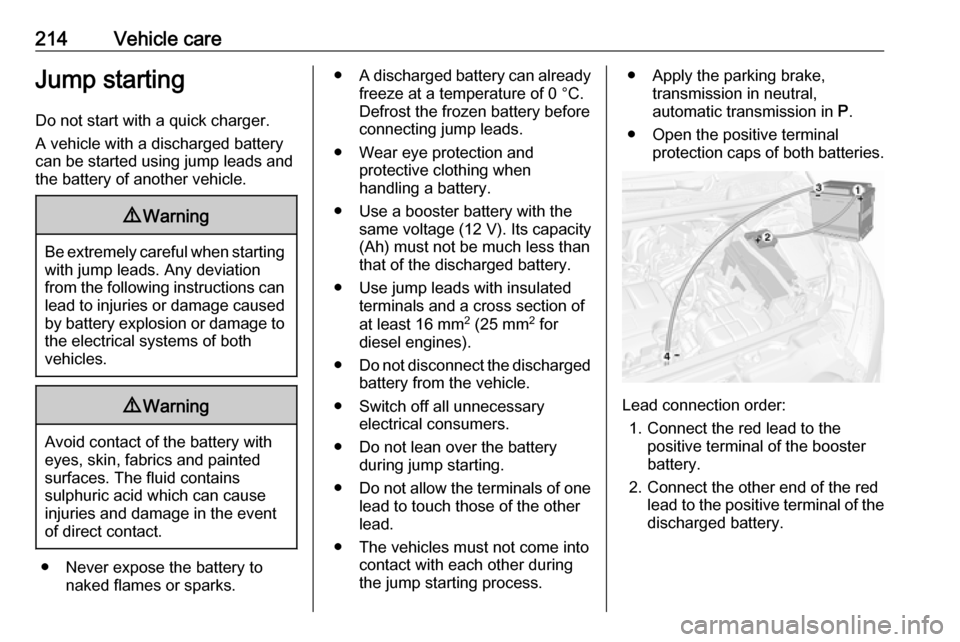
Lead connection order:
1. Connect the red lead to the positive terminal of the booster
battery.
2. Connect the other end of the red lead to the positive terminal of the
discharged battery.
Page 218 of 255

216Vehicle care
Screw in the towing eye as far as it will
go until it stops in a horizontal
position.
Attach a tow rope – or better still a tow
rod – to the towing eye.
The towing eye must only be used for towing and not for recovering the
vehicle.
Switch on ignition to release steering
wheel lock and to permit operation of
brake lights, horn and windscreen
wiper.
Switch the selector lever to neutral.
Release the parking brake.
Caution
Never tow a vehicle equipped with All Wheel Drive (AWD) with the
front or rear tyres on the road. If
you tow a vehicle equipped with
AWD while the front or rear tyres
are rolling on the road, the drive
system in the vehicle could be
severely damaged. When towing
vehicles equipped with AWD, all
four tyres must not be in contact
with the road.
Caution
Drive slowly. Do not drive jerkily.
Excessive tractive force can
damage the vehicle.
When the engine is not running,
considerably more force is needed to
brake and steer.
To prevent the entry of exhaust gases from the towing vehicle, switch on the
air recirculation system 3 127 and
close the windows.
Vehicles with manual transmission:
The vehicle must be towed facing
forwards. The maximum speed is
80 km/h . In all other cases, and when
the transmission is defective, the front axle must be raised off the ground.
Vehicles with automatic transmission:
Do not tow the vehicle using a towing eye. Towing with a tow rope could
cause severe automatic transmission damage. When towing vehicles with
automatic transmission, use flat bed
or wheel lift equipment.
Seek the assistance of a workshop. After towing, unscrew the towing eye.
Insert cap and close cap.
Page 226 of 255

224Service and maintenanceWasher fluid
Use only washer fluid approved for
the vehicle to prevent damage of wiper blades, paintwork, plastic and
rubber parts. Consult a workshop.
Brake and clutch fluidOver time, brake fluid absorbs
moisture which will reduce braking
effectiveness. The brake fluid should therefore be replaced at the specified
interval.
Page 247 of 255

Customer information245● Faults and defects in importantsystem components (e.g. lights,
brakes),
● System reactions in special driving situations (e.g. triggeringof an airbag, actuation of the
stability control systems),
● Information on events damaging the vehicle.
In special cases (e.g. if the vehicle
has detected a malfunction), it may be
necessary to save data that would
otherwise just be volatile.
When you use services, the operating
data saved can be read together with the vehicle identification number andused if necessary. Staff working for
the service net-work (e.g. garages,
manufacturers) or third parties (e.g.
breakdown services) can read the
data from the vehicle. Services
include repair services, maintenance
processes, warranty cases and
quality assurance measures.
Data is generally read via the OBD
(On-Board Diagnostics) port
prescribed by law in the vehicle. The operating data which has been read
out documents the technical conditionof the vehicle or individual
components and assists with fault
diagnosis, compliance with warranty
obligations and quality improvement.
This data, in particular information on
component stress, technical events,
operator errors and other faults, is
transmitted to the manufacturer
where appropriate, together with the vehicle identification number. The
manufacturer is also subject to
product liability. The manufacturer
potentially also needs operating data
from vehicles for product recalls.
Fault memories in the vehicle can be
reset by a service company when
carrying out servicing or repairs.
Comfort and infotainment
functions
Comfort settings and custom settings can be stored in the vehicle and
changed at any time.Depending on the equipment level in
question, these include
● Seat and steering wheel position settings,
● Chassis and air conditioning settings,
● Custom settings such as interior lighting.
You can input your own data in the
infotainment functions for your
vehicle as part of the selected
features.
Depending on the equipment level in
question, these include
● Multimedia data such as music, videos or photos for playback in
an integrated multimedia system,
● Address book data for use with an integrated hands-free system
or an integrated navigation
system,
● Input destinations,
● Data on the use of online services.
This data for comfort and
infotainment functions can be stored
locally in the vehicle or be kept on a
Page 250 of 255

248IndexAAccessories and vehicle modifications .......................... 180
Adaptive forward lighting .....95, 119
AdBlue .................................. 94, 143
Adjustable air vents ...................131
Airbag and belt tensioners ...........91
Airbag deactivation ................51, 92
Airbag label................................... 46 Airbag system .............................. 46
Air conditioning regular operation ................................ 132
Air conditioning system .............. 127
Air intake .................................... 131
Air vents...................................... 131
All-wheel drive ........................... 150
Antilock brake system ................ 150
Antilock brake system (ABS) .......93
Anti-theft alarm system ................30
Anti-theft locking system .............. 30
Appearance care ........................218
Automatic anti-dazzle ..................34
Automatic light control ...............116
Automatic locking ........................28
Automatic transmission .............146
Autostop ..................................... 138
Auxiliary heater ........................... 130B
Battery discharge protection ......125
Battery voltage ........................... 103
Bicycle rack .................................. 60
BlueInjection ............................... 143
Bonnet ....................................... 182
Brake and clutch fluid .................222
Brake and clutch system .............92
Brake assist ............................... 151
Brake fluid .................................. 185
Brakes ............................... 150, 185
Breakdown.................................. 215
Bulb replacement ....................... 188
C Capacities .................................. 235
Catalytic converter .....................142
Central locking system ................24
Centre console storage ...............60
Changing tyre and wheel size ...206
Charging system .......................... 92
Child locks ................................... 29
Child restraint installation locations ................................... 55
Child restraints.............................. 52
Child restraint systems ................52
Climate control ............................. 16
Climate control systems .............126
Clock............................................. 80
Code ........................................... 103
Page 251 of 255

249Control indicators.......................... 87
Control of the vehicle .................134
Controls ........................................ 76
Convex shape .............................. 32
Coolant and antifreeze ...............222
Cruise control ...................... 95, 155
Cupholders .................................. 58
Curtain airbag system .................. 50
D Danger, Warnings and Cautions ...4
Daytime running lights ...............119
Declaration of conformity ............238
DEF ............................................ 143
Delayed locking ............................ 27
Descent control system .......93, 154
Diesel exhaust fluid ....................143
Diesel fuel system bleeding .......187
Diesel particle filter ....................142
Door open .................................... 96
Doors ............................................ 29
Driver assistance systems ..........155
Driver Information Centre .............96
Driving characteristics and towing tips .............................. 176
Driving hints ................................ 134
E Electric adjustment ......................32
Electrical system......................... 193
Electronic climate control system 128Electronic driving programmes ..147
Electronic key system ...................22
Electronic Stability Control.......... 153
Electronic Stability Control and Traction Control system ............93
Electronic Stability Control off....... 93 End-of-life vehicle recovery .......181
Engine compartment fuse box ...194
Engine coolant ........................... 184
Engine coolant temperature gauge ....................................... 86
Engine data ............................... 230
Engine exhaust .......................... 141
Engine identification ...................226
Engine oil ................... 183, 222, 227
Engine oil pressure ......................94
Entry lighting .............................. 124
ERA GLONASS .......................... 113
Event data recorders ..................244
Exit lighting ................................ 125
Exterior care .............................. 218
Exterior light ................................. 95
Exterior lighting ....................13, 115
Exterior mirrors ............................. 32
F
Fault ........................................... 148
First aid kit ................................... 72
Fixed air vents ........................... 131
Flex-Fix system ............................ 60Fog light ....................................... 95
Fog lights ................................... 190
Folding mirrors ............................. 32
Following distance indication ......160
Forward collision alert................. 158
Front airbag system .....................49
Front fog lights ........................... 122
Front seats.................................... 39
Front storage ................................ 59
Fuel............................................. 169
Fuel for diesel engines ..............170
Fuel for liquid gas operation .......171
Fuel for petrol engines ...............169
Fuel gauge ................................... 84
Fuel selector ................................ 85
Fuses ......................................... 193
G Gauges ......................................... 83
Gear shifting ................................. 93
General information ...................176
Glovebox ..................................... 58
Glove box lighting .......................124
H Halogen headlights ....................189
Hand brake ......................... 150, 151
Hazard warning flashers ............121
Headlight flash ........................... 117
Headlight range adjustment ......118
Headlights when driving abroad 118