info OPEL MOKKA X 2018 Infotainment system
[x] Cancel search | Manufacturer: OPEL, Model Year: 2018, Model line: MOKKA X, Model: OPEL MOKKA X 2018Pages: 251, PDF Size: 6.61 MB
Page 203 of 251

Vehicle care201●Light for comfort pressure up to
three people.
● Eco for Eco pressure up to three
people.
● Max for full loading.
Uplevel display:
Select the Tyre load page under the
Options Menu in the Driver
Information Centre 3 98.
● Light for comfort pressure up to
three people.
● Eco for Eco pressure up to three
people.
● Max for full loading.
Tyre pressure sensor matching
process
Each tyre pressure sensor has a
unique identification code. The
identification code must be matched
to a new wheel position after rotating
the wheels or exchanging the
complete wheel set and if one or more tyre pressure sensors were replaced.
The tyre pressure sensor matching
process should also be performed
after replacing a spare wheel with a
road wheel containing a tyre pressure sensor.
The malfunction light w and the
warning message should extinguish
at the next ignition cycle. The sensors
are matched to the wheel positions,
using a relearn tool, in the following
order: left side front wheel, right side
front wheel, right side rear wheel and
left side rear wheel. The turn signal
light at the current active position is
illuminated until sensor is matched.
Consult a workshop for service. There
are two minutes to match the first
wheel position, and five minutes
overall to match all four wheelpositions. If it takes longer, the
matching process stops and must be
restarted.
The tyre pressure sensor matching
process is:
1. Apply the parking brake.
2. Turn the ignition on.
3. On vehicles with automatic transmission: set the selector
lever to P.
On vehicles with manual
transmission: select neutral.
4. Press MENU on the turn signal
lever to select the Vehicle
Information Menu in the Driver
Information Centre.
5. Turn the adjuster wheel to scroll to
the tyre pressure menu.
Midlevel display:
Page 204 of 251

202Vehicle care
Uplevel display:
6. Press SET/CLR to begin the
sensor matching process. A
message requesting acceptance
of the process should be
displayed.
7. Press SET/CLR again to confirm
the selection. The horn sounds
twice to signal that the receiver is
in relearn mode.
8. Start with the left side front wheel.
9. Place the relearn tool against the tyre sidewall, near the valve stem.Then press the button to activate
the tyre pressure sensor. A horn
chirp confirms that the sensor
identification code has been
matched to this tyre and wheel
position.
10. Proceed to the right side front wheel, and repeat the procedure
in Step 9.
11. Proceed to the right side rear wheel, and repeat the procedure
in Step 9.
12. Proceed to the left side rear wheel, and repeat the procedure
in Step 9. The horn sounds twice
to indicate the sensoridentification code has been
matched to the left side rear
wheel, and the tyre pressure
sensor matching process is no
longer active.
13. Turn off the ignition.
14. Set all four tyres to the recommended air pressure level
as indicated on the tyre pressure
information label.
15. Ensure the tyre loading status is set according to the selected tyre
pressure 3 98.
Tread depth Check tread depth at regular
intervals.
Tyres should be replaced for safety
reasons at a tread depth of 2-3 mm
(4 mm for winter tyres).
For safety reasons it is recommended
that the tread depth of the tyres on
one axle should not vary by more than 2 mm.
Page 206 of 251
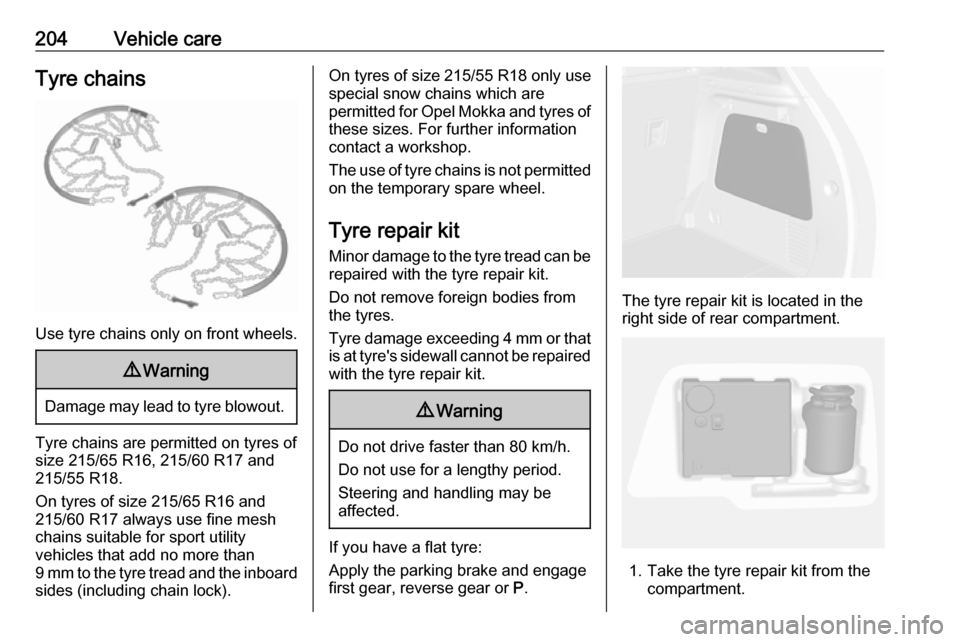
204Vehicle careTyre chains
Use tyre chains only on front wheels.
9Warning
Damage may lead to tyre blowout.
Tyre chains are permitted on tyres of
size 215/65 R16, 215/60 R17 and
215/55 R18.
On tyres of size 215/65 R16 and
215/60 R17 always use fine mesh
chains suitable for sport utility
vehicles that add no more than
9 mm to the tyre tread and the inboard sides (including chain lock).
On tyres of size 215/55 R18 only usespecial snow chains which are
permitted for Opel Mokka and tyres of these sizes. For further information
contact a workshop.
The use of tyre chains is not permitted
on the temporary spare wheel.
Tyre repair kit
Minor damage to the tyre tread can be repaired with the tyre repair kit.
Do not remove foreign bodies from
the tyres.
Tyre damage exceeding 4 mm or that
is at tyre's sidewall cannot be repaired with the tyre repair kit.9 Warning
Do not drive faster than 80 km/h.
Do not use for a lengthy period.
Steering and handling may be
affected.
If you have a flat tyre:
Apply the parking brake and engage
first gear, reverse gear or P.
The tyre repair kit is located in the
right side of rear compartment.
1. Take the tyre repair kit from the compartment.
Page 209 of 251

Vehicle care207Note
The driving characteristics of the
repaired tyre are severely affected, therefore have this tyre replaced.
If unusual noise is heard or the
compressor becomes hot, turn
compressor off for at least
30 minutes.
The built-in safety valve opens at a
pressure of 7 bar.
Note the expiry date of the kit. After
this date its sealing capability is no
longer guaranteed. Pay attention to
storage information on sealant
bottle.
Replace the used sealant bottle. Dispose of the bottle as prescribed
by applicable laws.
The compressor and sealant can be
used from approx. -30 °C.
The adapters supplied can be used
to pump up other items e.g.
footballs, air mattresses, inflatable
dinghies etc. They are located on the underside of the compressor. To
remove, screw on compressor air
hose and withdraw adapter.Wheel changing
Some vehicles are equipped with a
tyre repair kit instead of a spare wheel
3 204.
Make the following preparations and
observe the following information:
● Park the vehicle on a level, firm and non-skid surface. The front
wheels must be in the straight-
ahead position.
● Apply the parking brake and engage first gear, reverse gear or
P .
● Remove the spare wheel 3 209.
● Never change more than one wheel at a time.
● Use the jack only to change wheels in case of puncture, not
for seasonal winter or summer
tyre change.
● The jack is maintenance-free. ● If the ground on which the vehicle
is standing is soft, a solid board
(max. 1 cm thick) should be
placed under the jack.
● Take heavy objects out of the vehicle before jacking up.● No people or animals may be in the vehicle when it is jacked-up.
● Never crawl under a jacked-up vehicle.
● Do not start the vehicle when it is
raised on the jack.
● Clean wheel nuts and thread with
a clean cloth before mounting the wheel.9 Warning
Do not grease wheel bolt, wheel
nut and wheel nut cone.
1. Disengage wheel nut caps with a screwdriver and remove. Pull off
the wheel cover.
Page 220 of 251

218Service and maintenanceService and
maintenanceGeneral information ...................218
Service information ..................218
Recommended fluids, lubricants
and parts .................................... 219
Recommended fluids and lubricants ................................ 219General information
Service information In order to ensure economical and
safe vehicle operation and to
maintain the value of your vehicle, it
is of vital importance that all
maintenance work is carried out at the proper intervals as specified.
The detailed, up-to-date service
schedule for your vehicle is available
at the workshop.
Service display 3 88.
European service intervals
Maintenance of your vehicle is
required every 30,000 km or after one year, whichever occurs first, unless
otherwise indicated in the service
display.
A shorter service interval can be valid for severe driving behaviour, e.g. for
taxis and police vehicles.
The European service intervals are
valid for the following countries:Andorra, Austria, Belgium, Bosnia-
Herzegovina, Bulgaria, Croatia,
Cyprus, Czech Republic, Denmark,
Estonia, Finland, France, Germany,
Greece, Greenland, Hungary,
Iceland, Ireland, Italy, Latvia,
Liechtenstein, Lithuania,
Luxembourg, Macedonia, Malta,
Monaco, Montenegro, Netherlands,
Norway, Poland, Portugal, Romania,
San Marino, Serbia, Slovakia,
Slovenia, Spain, Sweden,
Switzerland, United Kingdom.
Service display 3 88.
International service intervals
Maintenance of your vehicle is
required every 15,000 km or after one
year, whichever occurs first, unless
otherwise indicated in the service
display.
Severe operating conditions exist if
one or more of the following
circumstances occur frequently: Cold starting, stop and go operation, trailer operation, mountain driving, driving
on poor and sandy road surfaces,
increased air pollution, presence of
airborne sand and high dust content,
Page 221 of 251

Service and maintenance219driving at high altitude and large
variations of temperature. Under
these severe operating conditions, certain service work may be required
more frequently than the regular service interval.
The international service intervals are
valid for the countries which are not
listed in the European service
intervals.
Service display 3 88.
Confirmations
Confirmation of service is recorded in the Service and warranty booklet.
The date and mileage is completed
with the stamp and signature of the
servicing workshop.
Make sure that the Service and
warranty booklet is completed
correctly as continuous proof of
service is essential if any warranty or
goodwill claims are to be met, and is
also a benefit when selling the
vehicle.Service interval with remaining
engine oil life duration
The service interval is based on
several parameters depending on
usage.
The service display lets you know when to change the engine oil.
Service display 3 88.Recommended fluids,
lubricants and parts
Recommended fluids andlubricants
Only use products that meet the
recommended specifications.9 Warning
Operating materials are
hazardous and could be
poisonous. Handle with care. Pay
attention to information given on
the containers.
Engine oil
Engine oil is identified by its quality
and its viscosity. Quality is more
important than viscosity when
selecting which engine oil to use. The oil quality ensures e.g. engine
cleanliness, wear protection and oil
aging control, whereas viscosity
grade gives information on the oil's
thickness over a temperature range.
Page 222 of 251

220Service and maintenanceDexos is the newest engine oil quality
that provides optimum protection for
gasoline and diesel engines. If it is unavailable, engine oils of other listed qualities have to be used.
Recommendations for gasoline
engines are also valid for
Compressed Natural Gas (CNG),
Liquified Petroleum Gas (LPG) and
Ethanol (E85) fuelled engines.
Select the appropriate engine oil
based on its quality and on the
minimum ambient temperature
3 224.
Topping up engine oilCaution
In case of any spilled oil, wipe it up and dispose it properly.
Engine oils of different manufacturersand brands can be mixed as long as
they comply with the required engine
oil quality and viscosity.
Use of engine oils for all petrol
engines with only ACEA quality is
prohibited, since it can cause engine
damage under certain operating
conditions.
Select the appropriate engine oil
based on its quality and on the
minimum ambient temperature
3 224.
Additional engine oil additives
The use of additional engine oil
additives could cause damage and
invalidate the warranty.
Engine oil viscosity grades
The SAE viscosity grade gives
information of the thickness of the oil.
Multigrade oil is indicated by two
figures, e.g. SAE 5W-30. The first
figure, followed by a W, indicates the
low temperature viscosity and the
second figure the high temperature
viscosity.
Select the appropriate viscosity grade depending on the minimum ambient
temperature 3 224.All of the recommended viscosity
grades are suitable for high ambient
temperatures.
Coolant and antifreeze
Use only organic acid type-long life
coolant (LLC) antifreeze approved for
the vehicle. Consult a workshop.
The system is factory filled with
coolant designed for excellent
corrosion protection and frost
protection down to approx. -28 °C. In
northern countries with very low
temperatures the factory filled coolant
provides frost protection down to
approx. -37 °C. This concentration
should be maintained all year round.
The use of additional coolant
additives that intend to give additional
corrosion protection or seal against
minor leaks can cause function
problems. Liability for consequences
resulting from the use of additional
coolant additives will be rejected.
Page 225 of 251

Technical data223Information on identification label:1:manufacturer2:type approval number3:vehicle Identification Number4:permissible gross vehicle weightrating in kg5:permissible gross train weight
in kg6:maximum permissible front axle
load in kg7:maximum permissible rear axle
load in kg
Engine identification
The technical data tables show the
engine identifier code. Engine data
3 227.
To identify the respective engine,
refer to the engine power in the EEC
Certificate of Conformity provided
with your vehicle or other national
registration documents.
The Certificate of Conformity shows
the engine identifier code, other
national publications may show the
engineering code. Check piston
displacement and engine power to identify the respective engine.
Page 232 of 251
![OPEL MOKKA X 2018 Infotainment system 230Technical dataVehicle weight
Kerb weight, basic model without any optional equipmentEngineManual transmissionAutomatic transmission[kg]B14NET1319/1370 4)1334B14NET
LPG1375–B14XFT–1406B16XER1280](/img/37/18893/w960_18893-231.png "OPEL MOKKA X 2018 Infotainment system 230Technical dataVehicle weight
Kerb weight, basic model without any optional equipmentEngineManual transmissionAutomatic transmission[kg]B14NET1319/1370 4)1334B14NET
LPG1375–B14XFT–1406B16XER1280")
230Technical dataVehicle weight
Kerb weight, basic model without any optional equipmentEngineManual transmissionAutomatic transmission[kg]B14NET1319/1370 4)1334B14NET
LPG1375–B14XFT–1406B16XER1280–A18XER13051392B16DTU1374–B16DTN1374–B16DTH1374/1429 4)13874)
Vehicles with All-wheel drive system.
Optional equipment and accessories increase the kerb weight.
Loading information 3 75.
Page 237 of 251

Customer information235Customer
informationCustomer information ................235
Declaration of conformity .........235
REACH .................................... 239
Collision damage repair ...........239
Software acknowledgement ....239
Registered trademarks ............241
Vehicle data recording and pri‐
vacy ........................................... 242
Event data recorders ...............242
Radio Frequency Identification (RFID) ..................................... 242Customer information
Declaration of conformity
Transmission systems
This vehicle has systems that
transmit and / or receive radio waves
subject to Directive 1999/5/EC or 2014/53/EU. The manufacturers ofthe systems listed below declare
conformity with Directive 1999/5/EC
or Directive 2014/53/EU. The full text
of the EU declaration of conformity for each system is available at the
following internet address:
www.opel.com/conformity
Importer is
Opel / Vauxhall, Bahnhofsplatz,
65423 Ruesselsheim, Germany.
Immobiliser
Robert Bosch GmbH
Robert Bosch Platz 1, 70839
Gerlingen, Germany
Operation frequency: 125 kHz
Maximum output:
4.9 dBµA/m @ 10 mInfotainment system R 4.0 / Navi 4.0
LG Electronics European Shared
Service Center B.V.
Krijgsman 1, 1186 DM Amstelveen,
The NetherlandsOperation
frequency (MHz)Maximum output
(dBm)2402 - 248042400.0 - 2483.5135725.0 - 5850.513
Infotainment system R300 BT
Humax Automotive Co. Ltd.
2, Yeongmun-ro, Cheoin-gu, Yong-
in-si, Gyeonggi-do, Korea
Operation frequency:
2402 - 2480 MHz
Maximum output: 4 dBm
Infotainment system Navi 900
IntelliLink
Robert Bosch Car Multimedia GmbH
Robert-Bosch-Straße 200, 31139
Hildesheim, Germany
Delphi Deutschland GmbH