belt OPEL MOKKA X 2019 Manual user
[x] Cancel search | Manufacturer: OPEL, Model Year: 2019, Model line: MOKKA X, Model: OPEL MOKKA X 2019Pages: 253, PDF Size: 6.86 MB
Page 114 of 253

112Instruments and controlsbreakdown, a flat tyre and empty fuel
tank, press Z to establish a
connection to an advisor.
Emergency services
In the case of an emergency situation,
press [ and talk to an advisor. The
advisor then contacts emergency or
assistance service providers and
directs them to your vehicle.
In the case of an accident with
activation of airbags or belt
tensioners, an automatic emergency
call is established. The advisor is
immediately connected to your
vehicle to see whether help is
needed.
Wi-Fi hotspot
The Wi-Fi hotspot of the vehicle
provides internet connectivity with a
maximum speed of 4G/LTE.
Note
The Wi-Fi hotspot functionality is not available for all markets.
Note
Some mobile devices connect to Wi-
Fi hotspots automatically and use
mobile data capacity in thebackground, even if they are not in
use. This includes automatic
updates, downloads, as well as
programme or app synchronisation
traffic. The data volume purchased
via OnStar might be consumed
rapidly. Turn off automatic
synchronisations in the settings of
your device.
Up to seven devices may be
connected.
To connect a mobile device with the
Wi-Fi hotspot:
1. Press j and then select Wi-Fi
settings on the Info Display. The
settings displayed include the Wi- Fi hotspot name (SSID),
password and connection type.
2. Start a Wi-Fi network search on your mobile device.
3. Select your vehicle hotspot (SSID) when listed.
4. When prompted, enter the password on your mobile device.
Note
To change the SSID or password,
press Z and talk to an advisor or log
in to your account.To switch off the Wi-Fi hotspot
functionality, press Z to call an
advisor.
Smartphone app
With the myOpel smartphone app,
some vehicle functions can be
operated remotely.
The following functions are available: ● Lock or unlock vehicle.
● Honk horn or flash lights.
● Check fuel level, engine oil life and tyre pressure (only with tyre
pressure monitoring system).
● Send navigation destination to the vehicle, if equipped with a
built-in navigation system.
● Locate vehicle on a map.
● Manage Wi-Fi settings.
To operate these functions, download the app from App Store ®
or
Google Play™ Store.
Page 116 of 253

114Instruments and controlsAccount data
An OnStar subscriber has an account
where all the data is stored. To
request a change of the account
information, press Z and talk to an
advisor or log in to your account.
If the OnStar service is used on
another vehicle, press Z and request
that the account be transferred to the
new vehicle.
Note
In any case, if the vehicle is disposed of, sold or otherwise transferred,
immediately inform OnStar about
the changes and terminate the
OnStar service on this vehicle.
Vehicle location
The vehicle location is transmitted to OnStar when service is requested or triggered. A message on the InfoDisplay informs about this
transmission.
To activate or deactivate the
transmission of the vehicle location,
press and hold j until an audio
message is heard.The deactivation is indicated by the
status light flashing red and green for
a short period of time and each time
the vehicle is started.
Note
If the transmission of the vehicle
location is deactivated, some
services are no longer available.
Note
The vehicle location always remains accessible to OnStar in the case of
an emergency.
Find the privacy policy in your
account.
Software updates
OnStar may remotely carry out
software updates without further
notice or consent. These updates are
to enhance or maintain safety and
security or the operation of the
vehicle.
These updates may concern privacy
issues. Find the privacy policy in your account.ERA GLONASS
ERA GLONASS is a manually or
automatically actuated emergency
service. Emergency centres provide assistance and information during an
emergency.
In case of an accident with activation
of airbags or belt tensioners, an
emergency call is placed
automatically. An immediate
connection with an advisor will be
established who will check whether
help is needed.9 Danger
The service is only available for
markets where it is legally required and activated. Furthermore, the
manual and the automatic
emergency call function depend
on the availability of the
emergency centres and the
infrastructure in the country.
Page 134 of 253
132Climate control
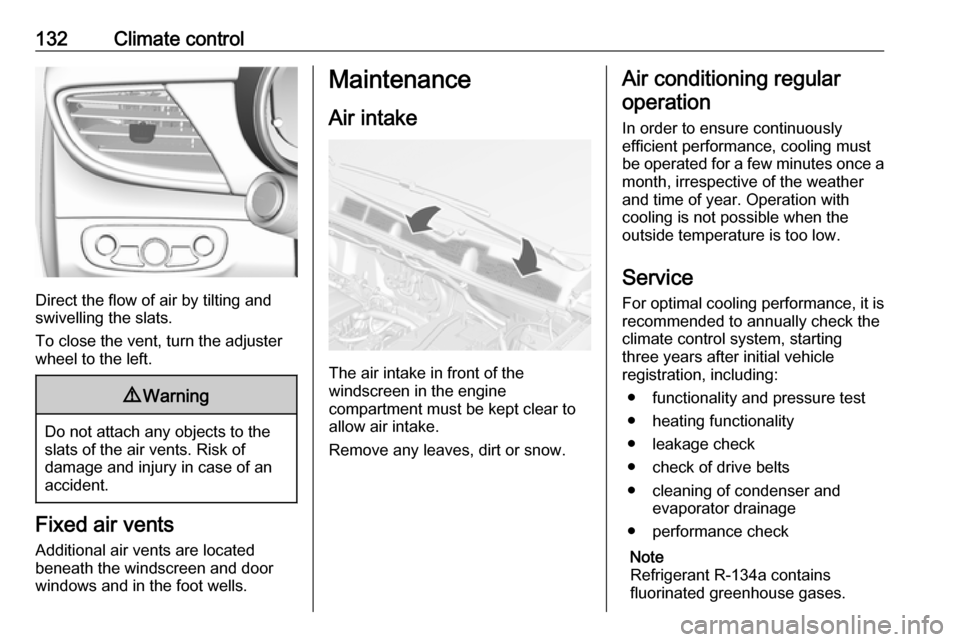
Direct the flow of air by tilting and
swivelling the slats.
To close the vent, turn the adjuster
wheel to the left.
9 Warning
Do not attach any objects to the
slats of the air vents. Risk of
damage and injury in case of an
accident.
Fixed air vents
Additional air vents are located
beneath the windscreen and door windows and in the foot wells.
Maintenance
Air intake
The air intake in front of the
windscreen in the engine
compartment must be kept clear to
allow air intake.
Remove any leaves, dirt or snow.
Air conditioning regular
operation
In order to ensure continuously
efficient performance, cooling must
be operated for a few minutes once a
month, irrespective of the weather
and time of year. Operation with
cooling is not possible when the
outside temperature is too low.
Service For optimal cooling performance, it is recommended to annually check the
climate control system, starting
three years after initial vehicle
registration, including:
● functionality and pressure test
● heating functionality
● leakage check
● check of drive belts
● cleaning of condenser and evaporator drainage
● performance check
Note
Refrigerant R-134a contains
fluorinated greenhouse gases.
Page 142 of 253

140Driving and operatingThe engine will be switched off while
the ignition stays on.
An Autostop is indicated by the
needle at the AUTOSTOP position in
the tachometer.
During an Autostop, the heating
performance, power steering and
brake performance will be
maintained.
Conditions for an Autostop
The stop-start system checks if each
of the following conditions is fulfilled:
● The stop-start system is not manually deactivated.
● The bonnet is fully closed.
● The driver's door is closed or the driver's seat belt is fastened.
● The vehicle battery is sufficiently charged and in good condition.
● The engine is warmed up.
● The engine coolant temperature is not too high.
● The engine exhaust temperature is not too high, e.g. after driving
with high engine load.
● The ambient temperature is above -5 °C.
● The climate control system allows an Autostop.
● The brake vacuum is sufficient.
● The self-cleaning function of the exhaust filter is not active.
● The vehicle was driven at least at
walking speed since the last
Autostop.
Otherwise an Autostop will be
inhibited.
Certain settings of the climate control
system may inhibit an Autostop.
Climate control 3 128.Immediately after motorway driving
an Autostop may be inhibited.
New vehicle running-in 3 134.
Vehicle battery discharge protection To ensure reliable engine restarts,
several battery discharge protection
features are implemented as part of
the stop-start system.
Power saving measures
During an Autostop, several electrical
features such as auxiliary electric
heater or rear window heating are
disabled or switched into a power
saving mode. The fan speed of the
climate control system is reduced to
save power.
Restart of the engine by the driver Depress the clutch pedal to restart the
engine.
The engine start is indicated by the
needle at the idle speed position in
the tachometer.
If the selector lever is shifted out of
neutral before depressing the clutch
first, - with a message is shown in
the Driver Information Centre.
Page 143 of 253

Driving and operating141Restart of the engine by the stop-start system
The selector lever must be in neutral
to enable an automatic restart.
If one of the following conditions
occurs during an Autostop, the
engine will be restarted automatically by the stop-start system:
● The stop-start system is manually deactivated.
● The bonnet is opened.
● The driver's seat belt is unfastened and the driver's door
is opened.
● The engine temperature is too low.
● The charging level of the vehicle battery is below a defined level.
● The brake vacuum is not sufficient.
● The vehicle is driven at least at walking speed.
● The climate control system requests an engine start.
● The air conditioning is manually switched on.If the bonnet is not fully closed, a
warning message is displayed in the
Driver Information Centre.
If an electrical accessory, e.g. a
portable CD player, is connected to
the power outlet, a brief power drop
during engine restart might be
noticeable.
Parking9 Warning
● Do not park the vehicle on an
easily ignitable surface. The
high temperature of the
exhaust system could ignite the
surface.
● Always apply the parking brake. Activate the parking
brake without pressing the
release button. Apply as firmly
as possible on a downhill slope
or uphill slope. Depress brake
pedal at the same time to
reduce operating force.
● Switch off the engine.
● If the vehicle is on a level surface or uphill slope, engage
first gear or set the selector
lever to position P before
removing the ignition key. On
an uphill slope, turn the front
wheels away from the kerb.
If the vehicle is on a downhill
slope, engage reverse gear or
set the selector lever to position P before removing the ignition
key. Turn the front wheels
towards the kerb.
● Close the windows and the sunroof.
● Remove the ignition key from the ignition switch. For vehicles
with automatic transmission,
the key can only be removed
when the selector lever is in
position P.
Turn the steering wheel until
the steering wheel lock is felt to engage.
● Lock the vehicle.
● Activate the anti-theft alarm system.
Page 202 of 253
200Vehicle caretread life. After changing to winter
tyres, be alert for changes in vehicle
handling and braking.
If using winter tyres, make sure to use ● tyres of the same brand and tread
type on all four wheel positions.
● only radial ply tyres of the same size, load range and speed ratingas the tyres originally fitted at the factory.
Winter tyres with the same speed
rating as the tyres originally fitted at
the factory may not be available for H,
V, W, Y and ZR speed rated tyres. If using winter tyres with a lower speed
rating, never exceed the tyre's
maximum speed capability.
Tyre designations
E.g. 215/60 R 16 95 H215:tyre width, mm60:cross-section ratio (tyre height
to tyre width), percentageR:belt type: RadialRF:type: RunFlat16:wheel diameter, inches95:load index e.g. 95 is equivalent
to 690 kgH:speed code letter
Speed code letter:
Q:up to 160 km/hS:up to 180 km/hT:up to 190 km/hH:up to 210 km/hV:up to 240 km/hW:up to 270 km/h
Choose a tyre appropriate for the
maximum speed of your vehicle.
The maximum speed is achievable at kerb weight with driver (75 kg) plus125 kg payload. Optional equipment
could reduce the maximum speed of
the vehicle.
Performance 3 231.
Directional tyres
Fit directional tyres such that they roll in the direction of travel. The rolling
direction is indicated by a symbol
(e.g. an arrow) on the sidewall.
Tyre pressure
Check the pressure of cold tyres at
least every 14 days and before any
long journey. Do not forget the spare
wheel. This also applies to vehicles
with tyre pressure monitoring system.
Tyre pressure 3 235.
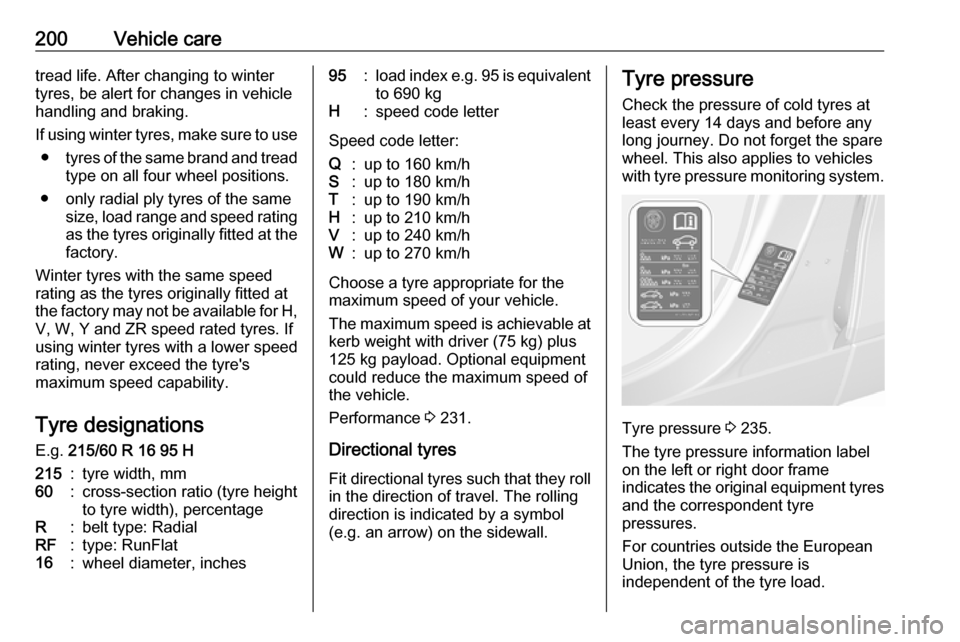
The tyre pressure information label
on the left or right door frame
indicates the original equipment tyres
and the correspondent tyre
pressures.
For countries outside the European
Union, the tyre pressure is
independent of the tyre load.
Page 222 of 253
220Vehicle careBefore and after winter, wash the
underbody and have the protective
wax coating checked.
Liquid gas system9 Danger
Liquid gas is heavier than air and
can collect in sink points.
Take care when performing work
at the underbody in a pit.
For painting work and when using a
drying booth at a temperature above
60 °C, the liquid gas system must be
completely evacuated.
Do not make any modifications to the
liquid gas system.
Towing equipment
Do not clean the coupling ball bar with a steam-jet or high-pressure jet
cleaner.
Rear carrier system Clean the rear carrier system with a
steam-jet or high-pressure jet cleaner
at least once a year.
Operate the rear carrier system
periodically if not in regular use, in
particular during winter.
Interior care
Interior and upholstery Only clean the vehicle interior,
including the instrument panel fascia
and panelling, with a dry cloth or
interior cleaner.
Clean the leather upholstery with
clear water and a soft cloth. In case of
heavy soiling, use leather care.
The instrument cluster and the
displays should only be cleaned using
a soft damp cloth. If necessary use a
weak soap solution.
Clean fabric upholstery with a
vacuum cleaner and brush. Remove
stains with an upholstery cleaner.
Clothing fabrics may not be
colourfast. This could cause visible
discolourations, especially on light- coloured upholstery. Removable
stains and discolourations should be
cleaned as soon as possible.Clean seat belts with lukewarm water or interior cleaner.Caution
Close Velcro fasteners as open
Velcro fasteners on clothing could damage seat upholstery.
The same applies to clothing with
sharp-edged objects, e.g. zips, belts or studded jeans.
Plastic and rubber parts
Plastic and rubber parts can be
cleaned with the same cleaner as
used to clean the body. Use interior
cleaner if necessary. Do not use any
other agent. Avoid solvents and petrol in particular. Do not use high-
pressure jet cleaners.
Page 244 of 253

242Customer informationEnGIS Technologies, Inc.
BringGo ®
is a registered trademark of
EnGIS Technologies, Inc.Google Inc.
Android™ and Google Play™ Store
are trademarks of Google Inc.Stitcher Inc.
Stitcher™ is a trademark of Stitcher,
Inc.Verband der Automobilindustrie e.V.
AdBlue ®
is a registered trademark of
the VDA.Vehicle data recording
and privacy
Event data recorders
Electronic control units are installed in
your vehicle. Control units process
data which is received by vehicle
sensors, for example, or which they
generate themselves or exchange
amongst themselves. Some control
units are necessary for the safe
functioning of your vehicle, others
assist you while you drive (driver
assistance systems), while others
provide comfort or infotainment
functions.
The following contains general
information about data processing in
the vehicle. You will find additional
information as to which specific data
is uploaded, stored and passed on to third parties and for what purpose in
your vehicle under the key word Data Protection closely linked to the
references for the affected functional
characteristics in the relevant owner's
manual or in the general terms of
sale. These are also available online.Operating data in the vehicle
Control units process data for
operation of the vehicle.
This data includes, e.g.: ● vehicle status information (e.g. speed, movement delay, lateral
acceleration, wheel rotation rate, "seat belts fastened" display)
● ambient conditions (e.g. temperature, rain sensor,
distance sensor)
As a rule such data is transient, not
stored for longer than an operational
cycle, and only processed on board
the vehicle itself. Control units often
include data storage (including the vehicle key). This is used to allowinformation to be documented
temporarily or permanently on vehicle
condition, component stress,
maintenance requirements and
technical events and errors.
Page 248 of 253

246IndexAAccessories and vehicle modifications .......................... 180
Adaptive forward lighting .....96, 120
AdBlue .................................. 95, 144
Adjustable air vents ...................131
Airbag and belt tensioners ...........92
Airbag deactivation ................52, 93
Airbag label................................... 47 Airbag system .............................. 47
Air conditioning regular operation ................................ 132
Air conditioning system .............. 128
Air intake .................................... 132
Air vents...................................... 131
All-wheel drive ........................... 150
Antilock brake system ................ 151
Antilock brake system (ABS) .......94
Anti-theft alarm system ................31
Anti-theft locking system .............. 31
Appearance care ........................218
Automatic anti-dazzle ..................35
Automatic light control ...............117
Automatic locking ........................29
Automatic transmission .............146
Autostop ..................................... 139
Auxiliary heater ........................... 131B
Battery discharge protection ......126
Battery voltage ........................... 105
Bicycle rack .................................. 61
BlueInjection ............................... 144
Bonnet ....................................... 182
Brake and clutch fluid .................222
Brake and clutch system .............93
Brake assist ............................... 152
Brake fluid .................................. 185
Brakes ............................... 151, 185
Breakdown.................................. 216
Bulb replacement ....................... 188
C Capacities .................................. 234
Catalytic converter .....................143
Central locking system ................25
Centre console storage ...............61
Changing tyre and wheel size ...206
Charging system .......................... 93
Child locks ................................... 30
Child restraint installation locations ................................... 56
Child restraints.............................. 53
Child restraint systems ................53
Climate control ............................. 16
Climate control systems .............127
Clock............................................. 81
Code ........................................... 104
Page 251 of 253

249Rear view camera ...................... 163
Rear window wiper and washer ..80
Recommended fluids and lubricants ........................ 222, 226
Refuelling ................................... 172
Registered trademarks ...............241
Retained power off .....................137
Reversing lights .........................123
Ride control systems ..................152
Roof .............................................. 37
Roof load ...................................... 74
Roof rack ..................................... 74
S Seat adjustment ....................... 6, 41
Seat belt ........................................ 8
Seat belt reminder .......................92
Seat belts ..................................... 44
Seat heating ................................. 43
Seat position ................................ 40
Selective catalytic reduction .......144
Selector lever ............................. 147
Service ....................................... 132
Service display ............................ 87
Service information ....................221
Side airbag system ......................51
Software acknowledgement .......240
Spare wheel ............................... 211
Speed limiter......................... 97, 157
Speedometer ............................... 84Starting and operating ................134
Starting off ................................... 17
Starting the engine ....................137
Steering ...................................... 134
Steering wheel adjustment ......9, 77
Steering wheel controls ...............77
Stop-start system........................ 139
Storage compartments .................59
Sunroof ........................................ 37
Sunvisor lights ........................... 125
Sun visors .................................... 37
Symbols ......................................... 4
T
Tachometer ................................. 85
Tail lights ................................... 191
Three-point seat belt .................... 45
Tools .......................................... 199
Tow bar....................................... 176
Towing ................................ 176, 216
Towing another vehicle .............217
Towing equipment .....................177
Towing the vehicle .....................216
Traction Control system ............. 152
Traction Control system off........... 95
Traffic sign assistant .............97, 165
Trailer towing ............................. 177
Transmission ............................... 17
Transmission display .................146
Tread depth ............................... 205Trip odometer .............................. 84
Turn lights ............................ 92, 123
Tyre chains ................................ 206
Tyre designations ......................200
Tyre pressure ............................ 200
Tyre pressure monitoring system ............................... 95, 201
Tyre pressures ........................... 235
Tyre repair kit ............................. 207
U Ultrasonic parking assist............. 161
Underseat storage .......................60
Upholstery .................................. 220
Uplevel display ............................. 97
Using this manual ..........................3
V Valet mode ................................. 102
Vehicle battery ........................... 186
Vehicle checks............................ 182
Vehicle data ................................ 226
Vehicle data recording and privacy ..................................... 242
Vehicle detected ahead ................97
Vehicle dimensions .................... 233
Vehicle Identification Number ....224
Vehicle jack ................................ 199
Vehicle messages .....................104
Vehicle personalisation .............106
Vehicle security ............................ 31