transmission OPEL MOVANO_B 2017.5 Manual user
[x] Cancel search | Manufacturer: OPEL, Model Year: 2017.5, Model line: MOVANO_B, Model: OPEL MOVANO_B 2017.5Pages: 261, PDF Size: 6.26 MB
Page 174 of 261
172Driving and operatingIn the case of trailer loads of
1200 kg or more, the vertical coupling load should not be less than 50 kg.
Rear axle load When the trailer is coupled and the
towing vehicle fully loaded (including all occupants), the permissible rear
axle load (see identification plate or
vehicle documents) must not be
exceeded.
Towing equipmentCaution
When operating without a trailer,
remove the coupling ball bar.
Towing equipment audible
warning
For vehicles fitted with towing
equipment, when connected to a
trailer the pitch of the audible warning
changes upon operation of the turn
signals.
The pitch of the audible warning will
change if a turn signal light on the
trailer or the towing vehicle fails.
Trailer stability assist
If the system detects snaking
movements, engine power is reduced
and the vehicle/trailer combination is
selectively braked until the snaking ceases. While the system is working,keep steering wheel as still as
possible.
Trailer stability assist (TSA) is a
function of the Electronic Stability
Program (ESP) 3 157.Auxiliary features
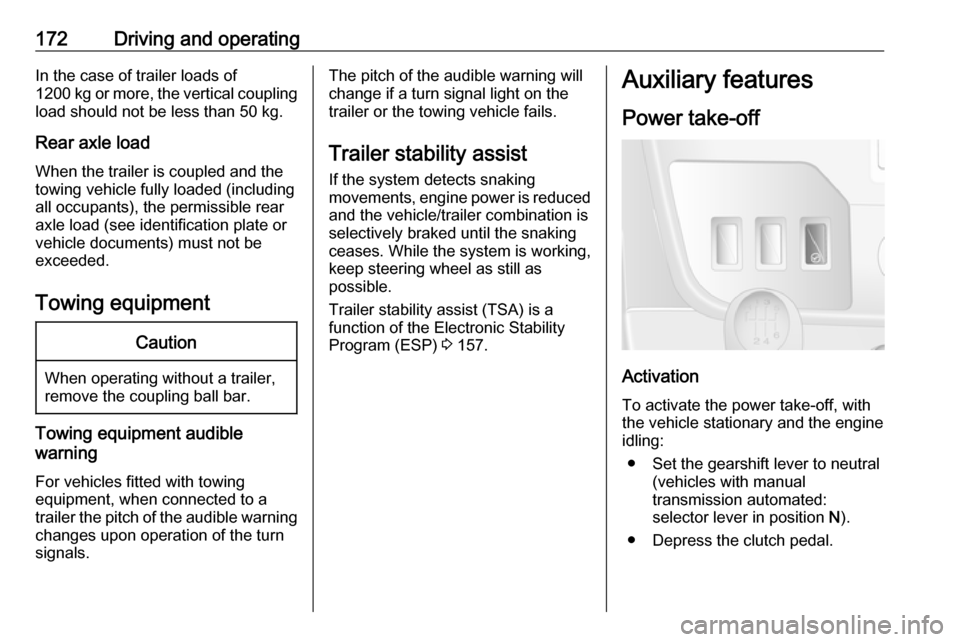
Power take-off
Activation
To activate the power take-off, with
the vehicle stationary and the engine
idling:
● Set the gearshift lever to neutral (vehicles with manual
transmission automated:
selector lever in position N).
● Depress the clutch pedal.
Page 175 of 261

Driving and operating173● Press switch on the instrumentpanel; LED in switch illuminates
after approx. two seconds.
● Release the clutch pedal.
The engine idle speed increases to
1,200 rpm.Caution
During operation of the power
take-off, never move the selector
lever out of neutral (vehicles with
manual transmission automated:
selector lever in position N), to
avoid damage to the transmission.
If a gear change becomes
necessary, i.e. to adjust the driving
speed, the power take-off must always be deactivated first.
Deactivation
To deactivate the power take-off: ● Depress the clutch pedal.
● Press switch on the instrument panel; LED in switch
extinguishes after approx.
two seconds.
● Release the clutch pedal.
Fault
If the LED in the switch does not
illuminate when attempting to activate the power take-off and/or the system
does not operate:
Gradually release the clutch pedal.
- or - ● Set the gearshift lever to neutral (vehicles with manual
transmission automated:
selector lever in position N).
● Depress the clutch pedal.
● Press switch on the instrument panel; LED in switch illuminatesafter approx. two seconds.
● Release the clutch pedal.
Then repeat the above procedure.
Note
The power take-off function is not
available when control indicator A
3 97, C 3 98 or W 3 99 is
illuminated.
Page 207 of 261
Vehicle care205Do not remove foreign bodies from
the tyres.
Tyre damage exceeding four mm or
that is at the tyre's sidewall near the
rim cannot be repaired with the tyre repair kit.9 Warning
Do not drive faster than 80 km/h.
Do not use for a lengthy period.
Steering and handling may be
affected.
If the vehicle has a flat tyre:
Apply the parking brake and engage
neutral (manual transmission) or N
(manual transmission automated).
The tyre repair kit is located under the
front seat. Slide seat forwards fully
and fold backrest down to access kit.
1. Take the tyre repair kit out from under the front seat.
2. Remove the compressor.
3. Remove the power supply lead(s)
and air hose from the stowage
compartments on the underside
of the compressor.
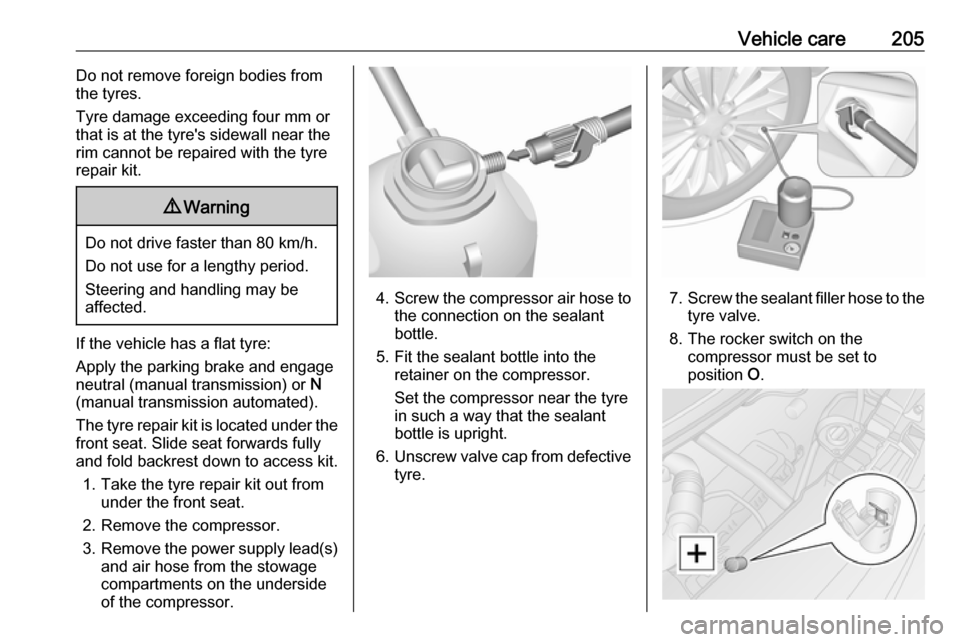
4. Screw the compressor air hose to
the connection on the sealant
bottle.
5. Fit the sealant bottle into the retainer on the compressor.
Set the compressor near the tyre
in such a way that the sealant
bottle is upright.
6. Unscrew valve cap from defective
tyre.7. Screw the sealant filler hose to the
tyre valve.
8. The rocker switch on the compressor must be set to
position O.
Page 210 of 261
208Vehicle careWheel changingSome vehicles are equipped with a
tyre repair kit instead of a spare wheel
3 204.
Make the following preparations and
observe the following information:
● Park the vehicle on a level, firm and non-slippery surface. The
front wheels must be in the
straight-ahead position.
● Apply the parking brake and engage first gear or reverse gear
(manual transmission) or N
(manual transmission
automated).
● Switch off the air suspension system 3 140.
● Remove the spare wheel 3 210.
● Never change more than one wheel at a time.
● Use the jack only to change wheels in case of puncture, not
for seasonal winter or summer
tyre change.
● The jack is maintenance-free.● If the ground on which the vehicle
is standing is soft, a solid board
(max. 1 cm thick) should be
placed under the jack.
● No people or animals may be in the vehicle when it is jacked-up.
● Never crawl under a jacked-up vehicle.
● Do not start the engine when the vehicle is raised on the jack.
● Clean wheel bolts/nuts and their threads before mounting thewheel.9 Warning
Do not grease wheel bolt, wheel
nut and wheel nut cone.
1. Remove the wheel cover using the hook supplied. Vehicle tools
3 198.
Depending on vehicle, first
remove the bolt/nut covers by
hand then remove the wheel
cover, or press wheel cover at the points indicated by the arrows and
turn to release.
Rear-wheel drive, with twin rear
wheels: Remove the tyre valve
extender from the inner rear
wheel.
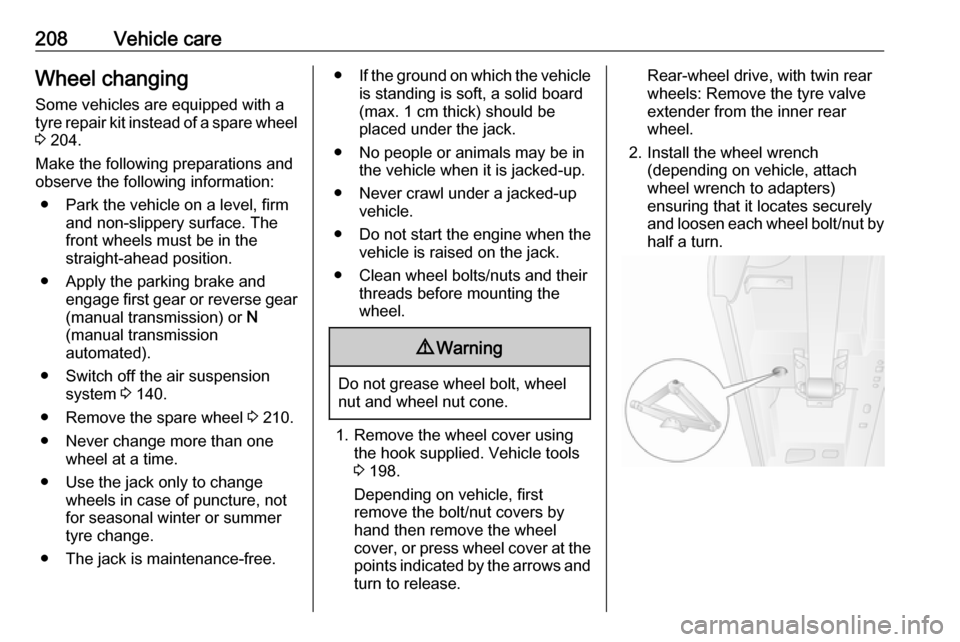
2. Install the wheel wrench (depending on vehicle, attach
wheel wrench to adapters)
ensuring that it locates securely
and loosen each wheel bolt/nut by half a turn.
Page 215 of 261
Vehicle care213Jump starting
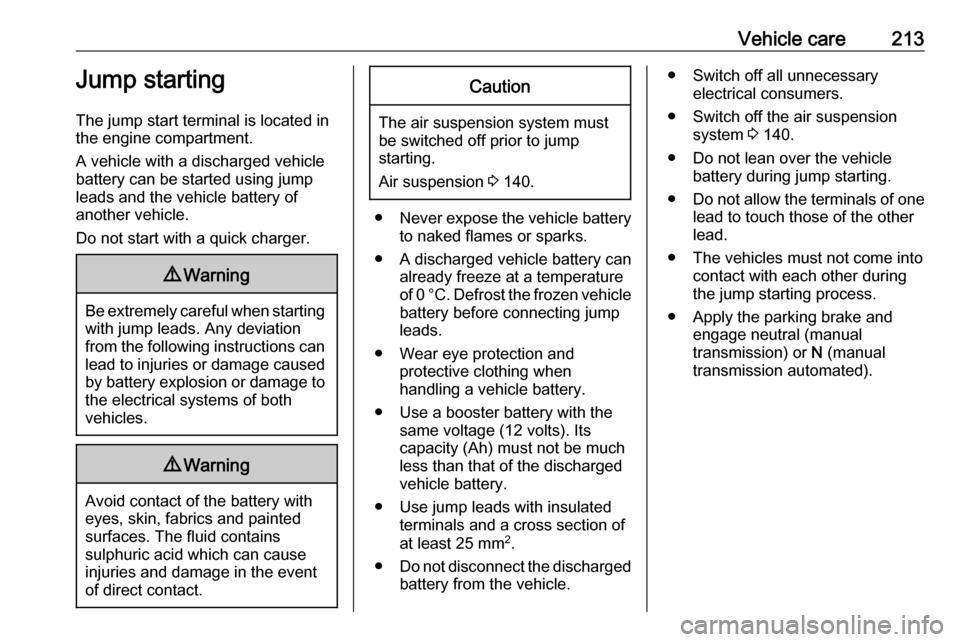
The jump start terminal is located in
the engine compartment.
A vehicle with a discharged vehicle
battery can be started using jump
leads and the vehicle battery of
another vehicle.
Do not start with a quick charger.9 Warning
Be extremely careful when starting
with jump leads. Any deviation
from the following instructions can
lead to injuries or damage caused
by battery explosion or damage to the electrical systems of both
vehicles.
9 Warning
Avoid contact of the battery with
eyes, skin, fabrics and painted
surfaces. The fluid contains
sulphuric acid which can cause
injuries and damage in the event
of direct contact.
Caution
The air suspension system must
be switched off prior to jump
starting.
Air suspension 3 140.
● Never expose the vehicle battery
to naked flames or sparks.
● A discharged vehicle battery can already freeze at a temperature
of 0 °C. Defrost the frozen vehicle
battery before connecting jump leads.
● Wear eye protection and protective clothing when
handling a vehicle battery.
● Use a booster battery with the same voltage (12 volts). Its
capacity (Ah) must not be much
less than that of the discharged
vehicle battery.
● Use jump leads with insulated terminals and a cross section of
at least 25 mm 2
.
● Do not disconnect the discharged
battery from the vehicle.
● Switch off all unnecessary electrical consumers.
● Switch off the air suspension system 3 140.
● Do not lean over the vehicle battery during jump starting.
● Do not allow the terminals of one
lead to touch those of the other
lead.
● The vehicles must not come into contact with each other during
the jump starting process.
● Apply the parking brake and engage neutral (manual
transmission) or N (manual
transmission automated).
Page 217 of 261
Vehicle care215far away from the discharged
vehicle battery as possible,
however at least 60 cm.
Route the leads so that they cannot
catch on rotating parts in the engine
compartment.
To start the engine: 1. Start the engine of the vehicle providing the jump start.
2. After five minutes, start the other engine. Start attempts should be
made for no longer than
15 seconds at an interval of
one minute.
3. Allow both engines to idle for approx. three minutes with the
leads connected.
4. Switch on electrical consumers (e.g. headlights, heated rear
window) of the vehicle receiving
the jump start.
5. Reverse above sequence exactly when removing leads.Towing
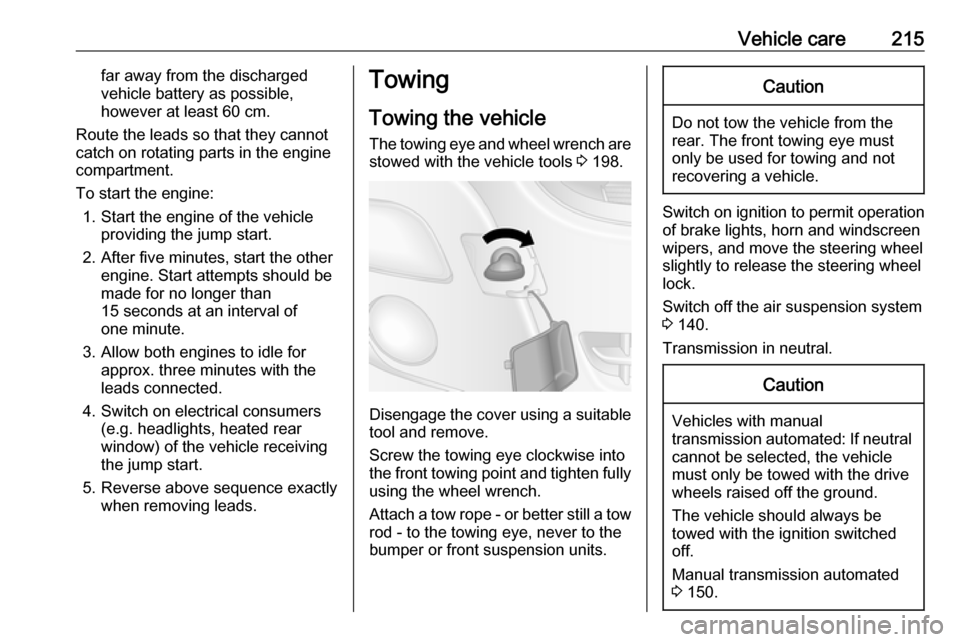
Towing the vehicle The towing eye and wheel wrench are
stowed with the vehicle tools 3 198.
Disengage the cover using a suitable
tool and remove.
Screw the towing eye clockwise into
the front towing point and tighten fully using the wheel wrench.
Attach a tow rope - or better still a tow
rod - to the towing eye, never to the
bumper or front suspension units.
Caution
Do not tow the vehicle from the
rear. The front towing eye must
only be used for towing and not
recovering a vehicle.
Switch on ignition to permit operation
of brake lights, horn and windscreen
wipers, and move the steering wheel
slightly to release the steering wheel
lock.
Switch off the air suspension system 3 140.
Transmission in neutral.
Caution
Vehicles with manual
transmission automated: If neutral cannot be selected, the vehiclemust only be towed with the drive
wheels raised off the ground.
The vehicle should always be
towed with the ignition switched
off.
Manual transmission automated
3 150.
Page 250 of 261

248Customer informationCustomer
informationCustomer information ................248
Declaration of conformity .........248
Collision damage repair ...........250
Registered trademarks ............250
Vehicle data recording and pri‐
vacy ........................................... 250
Event data recorders ...............250
Radio Frequency Identification (RFID) ..................................... 251Customer information
Declaration of conformity
Radio transmission systems
This vehicle has systems that
transmit and/or receive radio waves subject to Directive 1999/5/EC or
2014/53/EU. These systems are in compliance with the essential
requirements and other relevant
provisions of Directive 1999/5/EC or 2014/53/EU. Copies of the original
Declarations of Conformity can be
obtained on our website.
Radar systems
Country-specific Declarations of
Conformity for radar systems are
shown on the following page:
Page 253 of 261

Customer information251● Vehicle reactions in particulardriving situations (e.g. inflation ofan airbag, activation of the
stability regulation system).
● Environmental conditions (e.g. temperature).
These data are exclusively technical
and help identifying and correcting
errors as well as optimizing vehicle
functions.
Motion profiles indicating travelled
routes cannot be created with these
data.
If services are used (e.g. repair
works, service processes, warranty
cases, quality assurance),
employees of the service network
(manufacturer included) are able to
read out this technical information
from the event and error data storage
modules applying special diagnostic
devices. If required, you will receive
further information at these
workshops. After an error has been
corrected, the data are deleted from
the error storage module or they are
constantly overwritten.When using the vehicle, situations
may occur in which these technical
data related to other information
(accident report, damages on the
vehicle, witness statements etc.) may
be associated with a specific person - possibly, with the assistance of an
expert.
Additional functions contractually
agreed upon with the client (e.g.
vehicle location in emergency cases)
allow the transmission of particular
vehicle data from the vehicle.
Radio Frequency
Identification (RFID)
RFID technology is used in some
vehicles for functions such as tyre
pressure monitoring and ignition
system security. It is also used in
connection with conveniences such
as radio remote controls for door
locking/unlocking and starting, and in-
vehicle transmitters for garage door
openers. RFID technology in Opel
vehicles does not use or record
personal information or link with any
other Opel system containing
personal information.
Page 257 of 261

255Lighting features.........................115
Light switch ................................ 108
Limited-slip rear axle ..................159
Load compartment .................24, 75
Load compartment fuse box ......196
Load compartment grille ...............79
Load compartment lighting .........113
Loading information .....................81
Low fuel ..................................... 100
Luggage floor net .........................75
M Malfunction indicator light ............97
Manual adjustment ......................36
Manual anti-dazzle ......................38
Manual door locks ........................23
Manual mode ............................. 152
Manual transmission............. 17, 150
Manual transmission automated ......................... 17, 150
Manual windows ..........................39
Messages ................................... 103
Mirror adjustment ........................... 8
Mirrors .................................... 36, 38
Misted light covers .....................112
N
New vehicle running-in ..............134
Number plate light .....................192O
Object detection systems ...........163
Odometer ..................................... 90
Oil ............................................... 177
Oil, engine .......................... 222, 226
Oil level ......................................... 92
Oil pressure ................................ 100
Outside temperature ....................86
Overcab storage ..........................75
Overhead console .......................74
Overrun cut-off ........................... 136
P Parking ................................ 19, 139
Parking assist ............................ 163
Parking brake ............................ 155
Parking ticket holder .....................41
Particulate filter ........................... 142
Pedals......................................... 133
Performing work ........................176
Pollen filter ................................. 130
Power door locks ..........................27
Power outlets ............................... 87
Power side step ............................ 28
Power sliding door ........................28
Power steering fluid ....................179
Power take-off ............................ 172
Power windows ............................ 39
Preheating ........................... 99, 135
Puncture ............................. 204, 208R
Radio Frequency Identification (RFID) ..................................... 251
Radio remote control ...................22
Rain sensor .................................. 85
Reading lights ............................ 114
Rear air conditioning system .....122
Rear bench seat storage ..............74
Rear courtesy light...................... 113
Rear doors ................................... 32
Rear fog light ............................. 101
Rear fog lights ....................108, 112
Rear heating system .................. 120
Rear reading light .......................114
Rear reversing lens ......................39
Rear seats ................................... 50
Bus ............................................ 50
Installing .................................... 50
Rear seat access ......................50
Removing .................................. 50
Rear storage ................................. 75
Rear view camera ...................... 165
Rear windows .............................. 39
Recommended fluids and lubricants ........................ 222, 226
Refuelling ................................... 169
Registered trademarks ...............250
Remote control ............................. 22
Retractable parking brake ..........155
Reversing lights .........................112
Page 258 of 261

256Ride control systems..........156, 159
Ride height ................................. 140
Roof .............................................. 41
Glass panel ............................... 41
Roof load ...................................... 81
Roof rack ..................................... 81
S
Safety belts ................................... 53
Safety net .................................... 79
Seat adjustment ....................... 7, 45 Seat belt ........................................ 8
Seat belt reminder .......................96
Seat belts ..................................... 53 Seat heating ................................. 50
Seat position ................................ 44
Selective catalytic reduction .......143
Selector lever ............................. 151
Service ............................... 130, 220
Service display ......................92, 97
Service information ....................220
Service vehicle soon .................... 97
Side airbag system ......................61
Sidelights .................................... 108
Side turn signal lights ................190
Side windows................................ 39
Sliding door .................................. 28
Sliding side door ........................... 28
Spare wheel ............................... 210
Speed limiter......................... 89, 163Speedometer ............................... 89
Starting and operating ................134
Starting off ................................... 18
Starting the engine .......18, 135, 151
Steering ...................................... 133
Steering column controls ..............84
Steering wheel adjustment ......9, 84
Steering wheel controls ...............84
Stop engine .................................. 98
Stop-start system.......... 18, 100, 136
Storage ......................................... 72
Storage compartments .................72
Storage net ............................. 73, 74
Sun visors .................................... 41
Suspension height ......................140
Suspension seat ........................... 45
Swivelling shelf ............................. 73
Symbols ......................................... 4
T
Tachograph ........................ 101, 106
Tachometer ................................. 90
Tail lights ................................... 189
Technical data ....................226, 227
Three-point seat belt .................... 54
Tools .......................................... 198
Top-Tether .................................... 63
Touchscreen ............................... 102
Tow bar....................................... 171
Towing ........................................ 171Towing another vehicle .............216
Towing a trailer ........................... 171
Towing equipment .....................172
Towing eye ................................. 215
Towing the vehicle .....................215
Traction Control system ............. 156
Trailer coupling ........................... 171
Trailer stability assist .................172
Trailer towing ............................. 171
Transmission ............................... 17
Transmission display ...........93, 150
Tread depth ............................... 203
Trip computer ............................ 104
Trip odometer .............................. 90
Turbo engine warm-up ...............135
Turn and lane-change signals ...111
Turn signal ................................... 96
Tyre chains ................................ 204
Tyre changing ............................. 208
Tyre designations ......................200
Tyre pressure ............................ 200
Tyre pressure monitoring system ............................... 99, 201
Tyre pressures ........................... 246
Tyre repair kit ............................. 204
Tyres .......................................... 199
Tyres and wheel size, changing. 203