engine oil OPEL MOVANO_B 2017 Manual user
[x] Cancel search | Manufacturer: OPEL, Model Year: 2017, Model line: MOVANO_B, Model: OPEL MOVANO_B 2017Pages: 255, PDF Size: 6.12 MB
Page 171 of 255

Vehicle care169Vehicle careGeneral Information...................170
Accessories and vehicle modifications .......................... 170
Vehicle storage ........................170
End-of-life vehicle recovery .....171
Vehicle checks ........................... 171
Performing work ......................171
Bonnet ..................................... 171
Engine oil ................................. 172
Engine coolant ......................... 173
Power steering fluid .................174
Washer fluid ............................ 175
Brakes ..................................... 175
Brake fluid ............................... 175
Vehicle battery ......................... 175
Diesel fuel filter ........................178
Diesel fuel system bleeding .....178
Wiper blade replacement ........179
Bulb replacement .......................179
Headlights ............................... 179
Adaptive forward lighting .........182
Fog lights ................................. 182
Front turn signal lights .............182
Tail lights ................................. 183
Side turn signal lights ..............184Centre high-mounted brake
light ......................................... 185
Number plate light ...................185
Interior lights ............................ 186
Instrument panel illumination ...187
Electrical system ........................187
Fuses ....................................... 187
Engine compartment fuse box . 188
Instrument panel fuse box .......189
Load compartment fuse box ....190
Vehicle tools .............................. 192
Tools ........................................ 192
Wheels and tyres .......................193
Tyres ....................................... 193
Winter tyres ............................. 193
Tyre designations ....................193
Tyre pressure .......................... 193
Tyre pressure monitoring system .................................... 194
Tread depth ............................. 196
Changing tyre and wheel size . 197 Wheel covers ........................... 197
Tyre chains .............................. 197
Tyre repair kit .......................... 198
Wheel changing .......................201
Spare wheel ............................ 203
Jump starting ............................. 206Towing....................................... 208
Towing the vehicle ...................208
Towing another vehicle ...........209
Appearance care .......................209
Exterior care ............................ 209
Interior care ............................. 211
Page 172 of 255
170Vehicle careGeneral Information
Accessories and vehicle modifications
We recommend the use of genuine
parts and accessories and factory
approved parts specific for your
vehicle type. We cannot assess or guarantee reliability of other products
- even if they have a regulatory or
otherwise granted approval.
Any modification, conversion or other changes made to standard vehicle
specifications (including, without
limitation, software modifications,
modifications of the electronic control units) may invalidate the warranty
offered by Opel. Furthermore, such
changes may impact fuel
consumption, CO 2 emissions and
other emissions of the vehicle and
cause the vehicle to no longer
conform to the type approval,
impacting the validity of your vehicle
registration.Caution
When transporting the vehicle on
a train or on a recovery vehicle, the
mud flaps might be damaged.
Vehicle storage
Storage for a long period of time
If the vehicle is to be stored for several months:
● Wash and wax the vehicle.
● Have the wax in the engine compartment and underbody
checked.
● Clean and preserve rubber seals.
● Change engine oil.
● Drain washer fluid reservoir. ● Check coolant antifreeze and corrosion protection.
● Adjust tyre pressure to the value specified for full load.
● Park vehicle in a dry, well ventilated place. Engage first or
reverse gear. Prevent the vehicle
from rolling.
● Do not apply parking brake.
● Open bonnet, close all doors and
lock the vehicle.
● Disconnect the clamp from the negative terminal of the vehicle
battery. Beware that all systems
are not functional, e.g. anti-theft
alarm system.
Putting back into operation When the vehicle is to be put back into
operation:
● Connect the clamp to the negative terminal of the vehicle
battery. Activate the electronics
of the power windows.
● Check tyre pressure.
● Fill up the washer fluid reservoir. ● Check the engine oil level.
● Check the coolant level.
● Fit the number plate, if necessary.
Page 173 of 255
Vehicle care171End-of-life vehicle recovery
Information on end-of-life vehicle
recovery centres and the recycling of
end-of-life vehicles is available on our website, where legally required. Only
entrust this work to an authorised
recycling centre.Vehicle checks
Performing work9 Warning
Only perform engine compartment
checks when the ignition is off.
The cooling fan may start
operating even if the ignition is off.
9 Danger
The ignition system generates
extremely high voltages. Do not
touch.
The caps for topping up the engine oil, the coolant, the washer fluid and the
oil dipstick handle are yellow for ease
of identification.
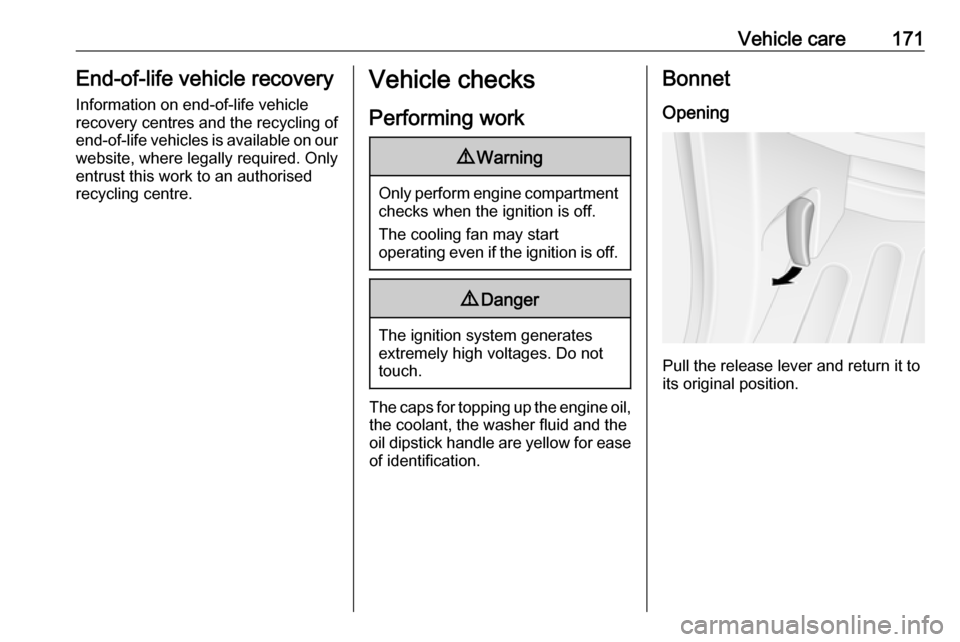
Bonnet
Opening
Pull the release lever and return it to
its original position.
Page 174 of 255
172Vehicle care
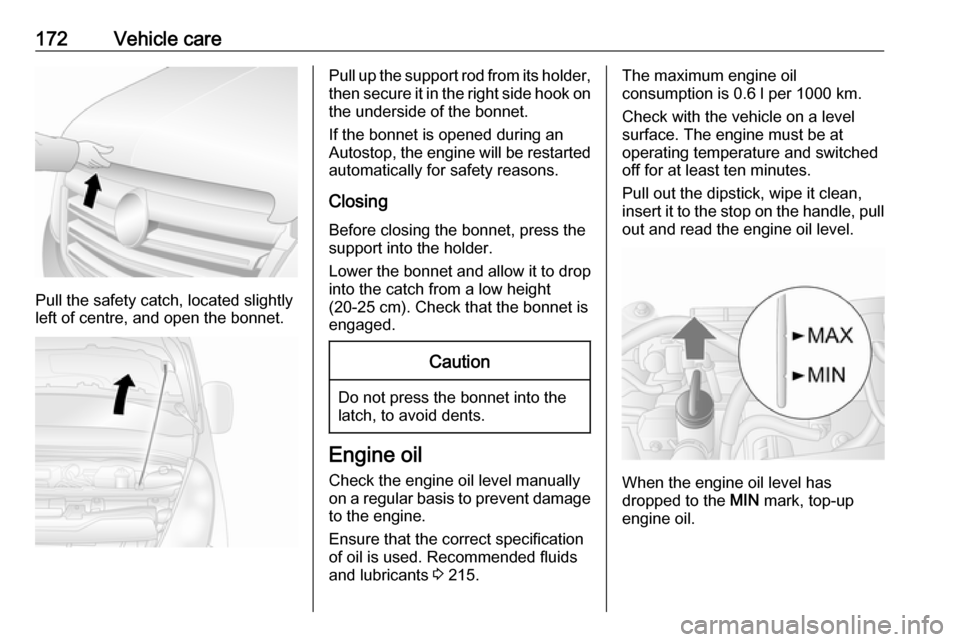
Pull the safety catch, located slightly
left of centre, and open the bonnet.
Pull up the support rod from its holder,
then secure it in the right side hook on the underside of the bonnet.
If the bonnet is opened during an Autostop, the engine will be restarted
automatically for safety reasons.
Closing Before closing the bonnet, press the
support into the holder.
Lower the bonnet and allow it to drop into the catch from a low height
(20-25 cm). Check that the bonnet is
engaged.Caution
Do not press the bonnet into the
latch, to avoid dents.
Engine oil
Check the engine oil level manually
on a regular basis to prevent damage
to the engine.
Ensure that the correct specification
of oil is used. Recommended fluids
and lubricants 3 215.
The maximum engine oil
consumption is 0.6 l per 1000 km.
Check with the vehicle on a level
surface. The engine must be at
operating temperature and switched
off for at least ten minutes.
Pull out the dipstick, wipe it clean,
insert it to the stop on the handle, pull
out and read the engine oil level.
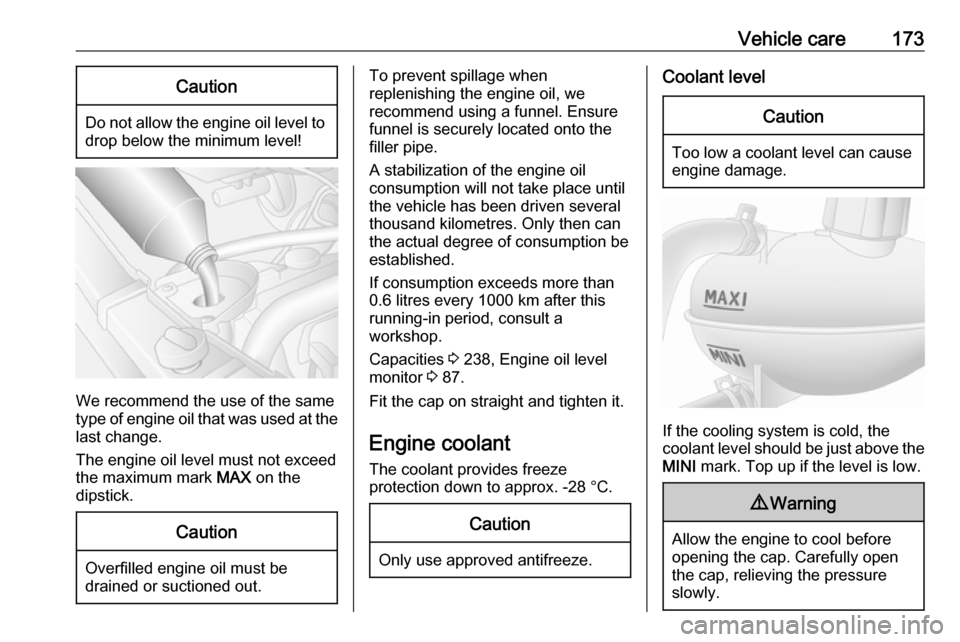
When the engine oil level has
dropped to the MIN mark, top-up
engine oil.
Page 175 of 255
Vehicle care173Caution
Do not allow the engine oil level todrop below the minimum level!
We recommend the use of the same
type of engine oil that was used at the
last change.
The engine oil level must not exceed the maximum mark MAX on the
dipstick.
Caution
Overfilled engine oil must be
drained or suctioned out.
To prevent spillage when
replenishing the engine oil, we
recommend using a funnel. Ensure funnel is securely located onto the
filler pipe.
A stabilization of the engine oil
consumption will not take place until
the vehicle has been driven several
thousand kilometres. Only then can
the actual degree of consumption be
established.
If consumption exceeds more than
0.6 litres every 1000 km after this
running-in period, consult a
workshop.
Capacities 3 238, Engine oil level
monitor 3 87.
Fit the cap on straight and tighten it.
Engine coolant The coolant provides freeze
protection down to approx. -28 °C.Caution
Only use approved antifreeze.
Coolant levelCaution
Too low a coolant level can cause engine damage.
If the cooling system is cold, the
coolant level should be just above the
MINI mark. Top up if the level is low.
9Warning
Allow the engine to cool before
opening the cap. Carefully open
the cap, relieving the pressure
slowly.
Page 180 of 255
178Vehicle caredisconnecting the main vehicle
battery or before jump starting the vehicle.
Jump starting 3 206.
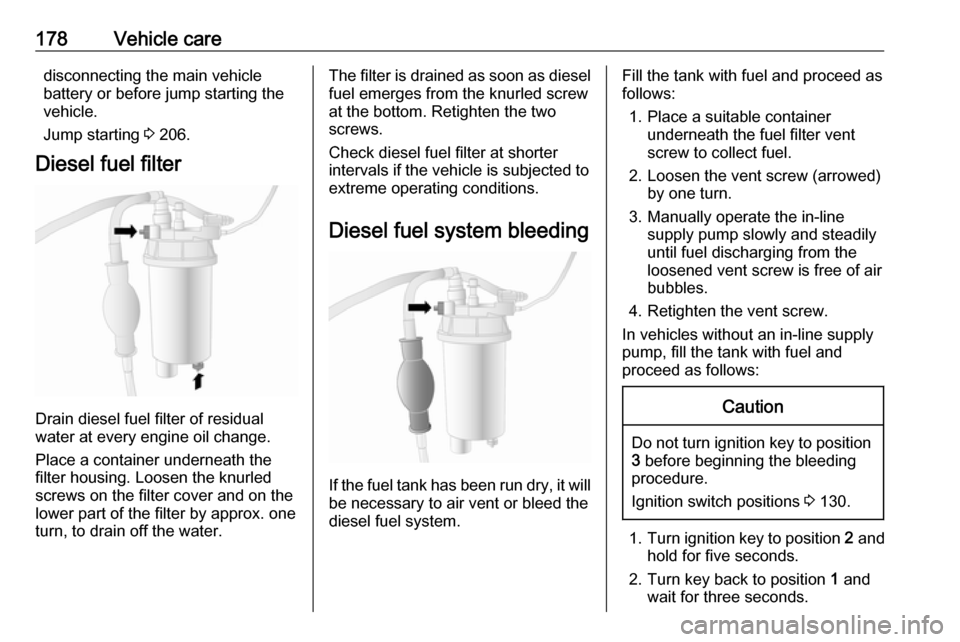
Diesel fuel filter
Drain diesel fuel filter of residual
water at every engine oil change.
Place a container underneath the
filter housing. Loosen the knurled
screws on the filter cover and on the
lower part of the filter by approx. one
turn, to drain off the water.
The filter is drained as soon as diesel fuel emerges from the knurled screw
at the bottom. Retighten the two
screws.
Check diesel fuel filter at shorter
intervals if the vehicle is subjected to
extreme operating conditions.
Diesel fuel system bleeding
If the fuel tank has been run dry, it will be necessary to air vent or bleed the
diesel fuel system.
Fill the tank with fuel and proceed as
follows:
1. Place a suitable container underneath the fuel filter vent
screw to collect fuel.
2. Loosen the vent screw (arrowed) by one turn.
3. Manually operate the in-line supply pump slowly and steadily
until fuel discharging from the
loosened vent screw is free of air
bubbles.
4. Retighten the vent screw.
In vehicles without an in-line supply
pump, fill the tank with fuel and
proceed as follows:Caution
Do not turn ignition key to position 3 before beginning the bleeding
procedure.
Ignition switch positions 3 130.
1. Turn ignition key to position 2 and
hold for five seconds.
2. Turn key back to position 1 and
wait for three seconds.
Page 217 of 255

Service and maintenance215starting, stop and go operation, trailer
operation, mountain driving, driving
on poor and sandy road surfaces,
increased air pollution, presence of
airborne sand and high dust content,
driving at high altitude and large
variations of temperature. Under
these severe operating conditions,
certain service work may be required more frequently than the regular
service interval.
Service display 3 88.
Confirmations Confirmation of service is recorded inthe Service and warranty booklet.
The date and mileage is completed
with the stamp and signature of the
servicing workshop.
Make sure that the Service and
warranty booklet is completed
correctly as continuous proof of
service is essential if any warranty or goodwill claims are to be met, and is
also a benefit when selling the
vehicle.Service display
The service interval is based on
several parameters depending on
usage.
The service display, located in the
Driver Information Centre, indicates
when the next service is due. Seek
the assistance of a workshop.
Service display 3 88.
Engine oil lever monitor 3 87.Recommended fluids,
lubricants and parts
Recommended fluids andlubricants
Only use products that meet the
recommended specifications.9 Warning
Operating materials are
hazardous and could be
poisonous. Handle with care. Pay
attention to information given on
the containers.
Engine oil
Engine oil is identified by its quality
and its viscosity. Quality is more
important than viscosity when
selecting which engine oil to use. The oil quality ensures e.g. engine
cleanliness, wear protection and oil
aging control, whereas viscosity
grade gives information on the oil's
thickness over a temperature range.
Page 218 of 255

216Service and maintenanceDexos is the newest engine oil quality
that provides optimum protection for
diesel engines. If it is unavailable,
engine oils of other listed qualities
must be used.
Select the appropriate engine oil
based on its quality and on the
minimum ambient temperature
3 219.
Topping up engine oil
Engine oils of different manufacturers and brands can be mixed as long as
they comply with the required engine
oil quality and viscosity.
Use of engine oil with only
ACEA A1/B1 or only A5/B5 quality is
prohibited, since it can cause long-
term engine damage under certain
operating conditions.
Select the appropriate engine oil
based on its quality and on the
minimum ambient temperature
3 219.
Additional engine oil additives
The use of additional engine oil
additives could cause damage and
invalidate the warranty.Engine oil viscosity grades
The SAE viscosity grade gives
information of the thickness of the oil.
Multigrade oil is indicated by two
figures, e.g. SAE 5W-30. The first
figure, followed by a W, indicates the
low temperature viscosity and the
second figure the high temperature viscosity.
Select the appropriate viscosity grade depending on the minimum ambient
temperature 3 219.
All of the recommended viscosity
grades are suitable for high ambient
temperatures.
Coolant and antifreeze
Use only silicate-free long life coolant (LLC) antifreeze approved for thevehicle. Consult a workshop.
The system is factory filled with
coolant designed for excellent
corrosion protection and frost
protection down to approx. -28 °C.
This concentration should be
maintained all year round. The use of additional coolant additives that
intend to give additional corrosionprotection or seal against minor leaks
can cause function problems. Liability
for consequences resulting from the
use of additional coolant additives will be rejected.
Washer fluid Use only washer fluid approved for
the vehicle to prevent damage of
wiper blades, paintwork, plastic and
rubber parts. Consult a workshop.
Brake fluid
Over time, brake fluid absorbs
moisture which will reduce braking
effectiveness. The brake fluid should
therefore be replaced at the specified interval.
AdBlue Only use AdBlue to reduce the
nitrogen oxides in the exhaust
emission 3 138.
Page 221 of 255

Technical data219Vehicle data
Recommended fluids and lubricants
Required engine oil qualityEngine oil quality: Europedexos 2✔
For countries with International
service interval 3 213, you may use
the oil qualities listed below:
Engine oil quality: Internationaldexos 2✔GM-LL-A/B-025✔ACEA C3
diesel engines with DPF✔ACEA A3/B4
diesel engines without DPF✔Engine oil viscosity gradesAmbient temperaturedown to -25 °CSAE 5W-30 or
SAE 5W-40below -25 °CSAE 0W-30 or
SAE 0W-40
Page 240 of 255
![OPEL MOVANO_B 2017 Manual user 238Technical dataCapacities
Engine oilEngineM9TEngine oil including filter [l] (approx.)8.0 Front-wheel drive
8.9 Rear-wheel drivebetween MIN and MAX [l] (approx.)1.5 - 2.0
Fuel tank
Fuel tank, nomina](/img/37/18904/w960_18904-239.png "OPEL MOVANO_B 2017 Manual user 238Technical dataCapacities
Engine oilEngineM9TEngine oil including filter [l] (approx.)8.0 Front-wheel drive
8.9 Rear-wheel drivebetween MIN and MAX [l] (approx.)1.5 - 2.0
Fuel tank
Fuel tank, nomina")
238Technical dataCapacities
Engine oilEngineM9TEngine oil including filter [l] (approx.)8.0 Front-wheel drive
8.9 Rear-wheel drivebetween MIN and MAX [l] (approx.)1.5 - 2.0
Fuel tank
Fuel tank, nominal capacity [l]80 or 105
AdBlue tank
AdBlue, nominal capacity [l]22.5