transmission OPEL MOVANO_B 2018.5 Manual user
[x] Cancel search | Manufacturer: OPEL, Model Year: 2018.5, Model line: MOVANO_B, Model: OPEL MOVANO_B 2018.5Pages: 271, PDF Size: 6.5 MB
Page 166 of 271
164Driving and operatingDriver assistance
systems9 Warning
Driver assistance systems are
developed to support the driver
and not to replace the driver's
attention.
The driver accepts full
responsibility when driving the
vehicle.
When using driver assistance
systems, always take care
regarding the current traffic
situation.
Cruise control
The cruise control can store and
maintain speeds of 30 km/h and
above. Deviations from the stored
speeds may occur when driving uphill or downhill. The stored speed will
flash in the Driver Information Centre
3 106.
For safety reasons the cruise control
cannot be activated until the brake
pedal has been operated once.
Do not use the cruise control if it is not advisable to maintain a constant
speed.
With manual transmission
automated, only activate cruise
control in automatic mode.
Control indicators m and U 3 105.
Switching on the system
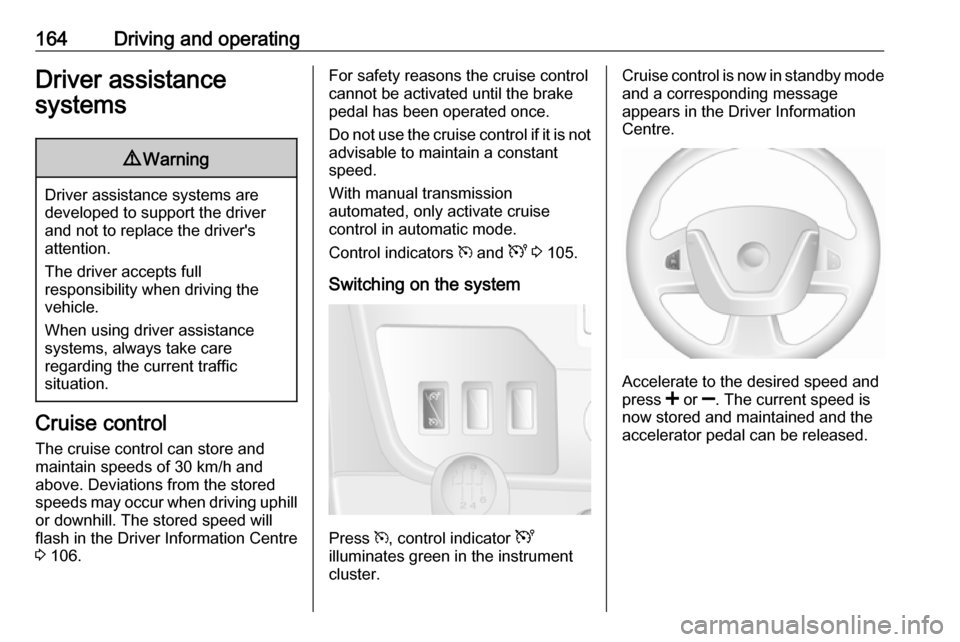
Press m, control indicator U
illuminates green in the instrument
cluster.
Cruise control is now in standby mode
and a corresponding message
appears in the Driver Information
Centre.
Accelerate to the desired speed and
press < or ]. The current speed is
now stored and maintained and the
accelerator pedal can be released.
Page 180 of 271
178Driving and operatingIn the case of trailer loads of
1200 kg or more, the vertical coupling load should not be less than 50 kg.
Rear axle load When the trailer is coupled and the
towing vehicle fully loaded (including all occupants), the permissible rear
axle load (see identification plate or
vehicle documents) must not be
exceeded.
Towing equipmentCaution
When operating without a trailer,
remove the coupling ball bar.
Towing equipment audible
warning
For vehicles fitted with towing
equipment, when connected to a
trailer the pitch of the audible warning
changes upon operation of the turn
lights.
The pitch of the audible warning will
change if a turn light on the trailer or
the towing vehicle fails.
Trailer stability assist
If the system detects snaking
movements, engine power is reduced
and the vehicle/trailer combination is
selectively braked until the snaking ceases. While the system is working,keep steering wheel as still as
possible.
Trailer stability assist (TSA) is a
function of the Electronic Stability
Program (ESP) 3 162.Auxiliary features
Power take-off
Activation
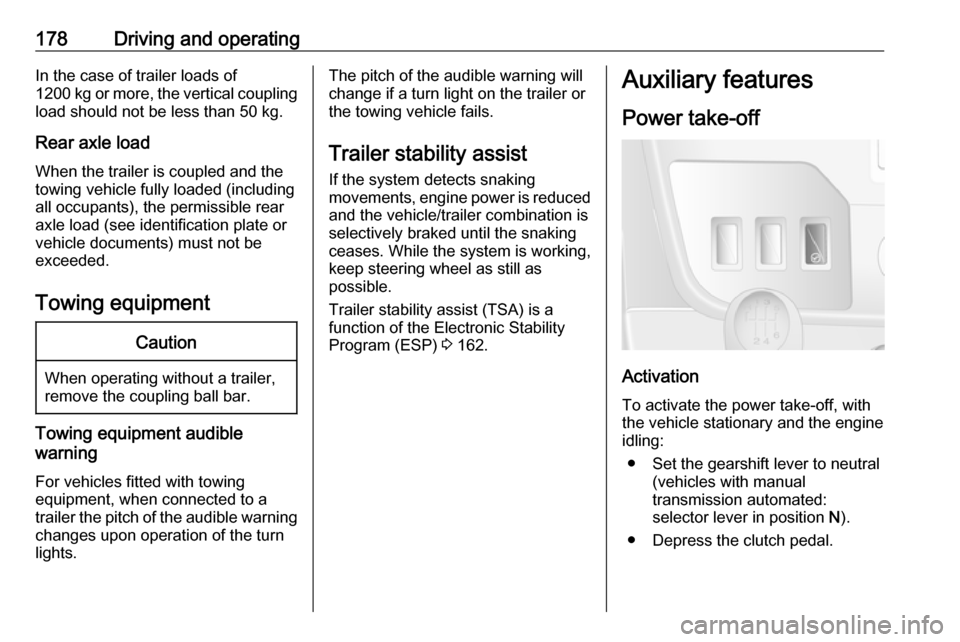
To activate the power take-off, with
the vehicle stationary and the engine
idling:
● Set the gearshift lever to neutral (vehicles with manual
transmission automated:
selector lever in position N).
● Depress the clutch pedal.
Page 181 of 271

Driving and operating179● Press switch on the instrumentpanel; LED in switch illuminates
after approx. 2 seconds.
● Release the clutch pedal.
The engine idle speed increases to 1,200 rpm.Caution
During operation of the power
take-off, never move the selector
lever out of neutral (vehicles with
manual transmission automated:
selector lever in position N), to
avoid damage to the transmission.
If a gear change becomes
necessary, i.e. to adjust the driving
speed, the power take-off must always be deactivated first.
Deactivation
To deactivate the power take-off: ● Depress the clutch pedal.
● Press switch on the instrument panel; LED in switch
extinguishes after approx.
2 seconds.
● Release the clutch pedal.
Fault
If the LED in the switch does not
illuminate when attempting to activate the power take-off and / or the system
does not operate:
Gradually release the clutch pedal.
- or - ● Set the gearshift lever to neutral (vehicles with manual
transmission automated:
selector lever in position N).
● Depress the clutch pedal.
● Press switch on the instrument panel. The LED in switch
illuminates after approx.
2 seconds.
● Release the clutch pedal.
Then repeat the above procedure.
Note
The power take-off function is not
available when control indicator j
3 101, C 3 102 or W 3 103 is
illuminated.
Page 213 of 271
Vehicle care211Tyre repair kitMinor damage to the tyre tread can be
repaired with the tyre repair kit.
Do not remove foreign bodies from
the tyres.
Tyre damage exceeding four mm or
that is at the tyre's sidewall near the
rim cannot be repaired with the tyre repair kit.9 Warning
Do not drive faster than 80 km/h.
Do not use for a lengthy period.
Steering and handling may be
affected.
If the vehicle has a flat tyre:
Apply the parking brake and engage
neutral (manual transmission) or N
(manual transmission automated).
The tyre repair kit is located under the
front seat. Slide seat forwards fully
and fold backrest down to access kit.
1. Take the tyre repair kit out from under the front seat.
2. Remove the compressor.
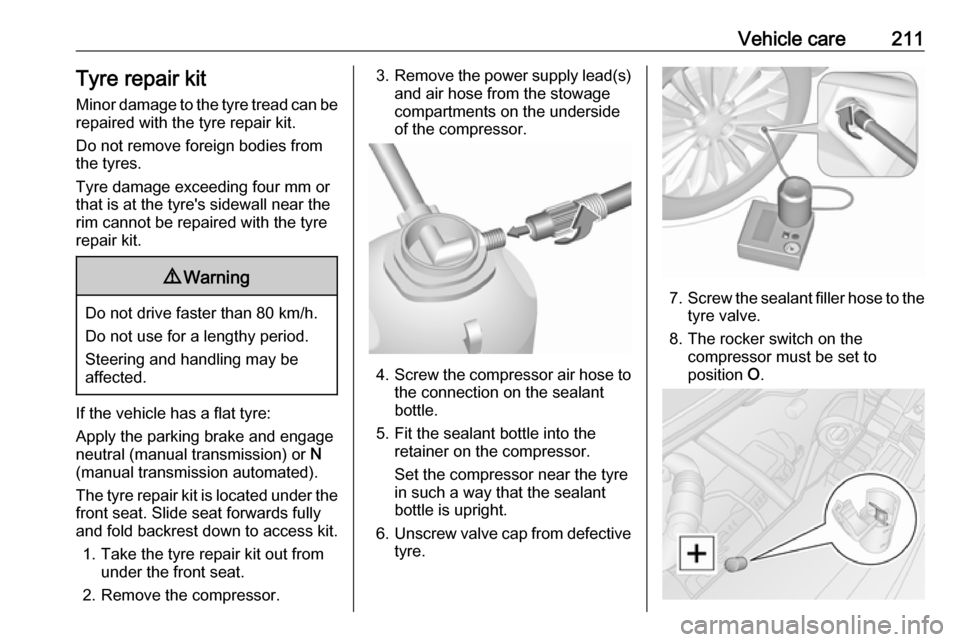
3. Remove the power supply lead(s)
and air hose from the stowage
compartments on the underside
of the compressor.
4. Screw the compressor air hose to
the connection on the sealant
bottle.
5. Fit the sealant bottle into the retainer on the compressor.
Set the compressor near the tyre
in such a way that the sealant
bottle is upright.
6. Unscrew valve cap from defective
tyre.
7. Screw the sealant filler hose to the
tyre valve.
8. The rocker switch on the compressor must be set to
position O.
Page 216 of 271
214Vehicle careWheel changingSome vehicles are equipped with a
tyre repair kit instead of a spare wheel
3 211.
Make the following preparations and
observe the following information:
● Park the vehicle on a level, firm and non-slippery surface. The
front wheels must be in the
straight-ahead position.
● Apply the parking brake and engage first gear or reverse gear
(manual transmission) or N
(manual transmission
automated).
● Switch off the air suspension system 3 144.
● Remove the spare wheel 3 216.
● Never change more than one wheel at a time.
● Use the jack only to change wheels in case of puncture, not
for seasonal winter or summer
tyre change.
● The jack is maintenance-free.● If the ground on which the vehicle
is standing is soft, a solid board
(max. 1 cm thick) should be
placed under the jack.
● No people or animals may be in the vehicle when it is jacked-up.
● Never crawl under a jacked-up vehicle.
● Do not start the engine when the vehicle is raised on the jack.
● Clean wheel bolts/nuts and their threads before mounting thewheel.9 Warning
Do not grease wheel bolt, wheel
nut and wheel nut cone.
1. Remove the wheel cover using the hook supplied.
Vehicle tools 3 204.
Depending on vehicle, first
remove the bolt / nut covers by
hand then remove the wheel
cover, or press wheel cover at the points indicated by the arrows and
turn to release.
Rear-wheel drive, with twin rear
wheels: Remove the tyre valve
extender from the inner rear
wheel.
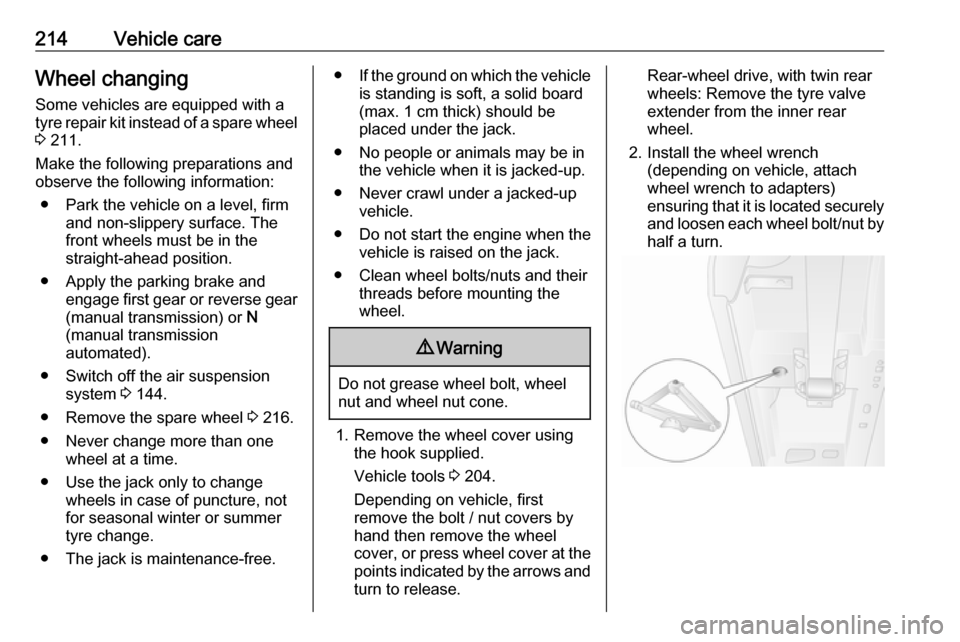
2. Install the wheel wrench (depending on vehicle, attach
wheel wrench to adapters)
ensuring that it is located securely and loosen each wheel bolt/nut byhalf a turn.
Page 221 of 271
Vehicle care219Jump starting
The jump start terminal is located in
the engine compartment.
A vehicle with a discharged vehicle
battery can be started using jump
leads and the vehicle battery of
another vehicle.
Do not start with a quick charger.9 Warning
Be extremely careful when starting
with jump leads. Any deviation
from the following instructions can
lead to injuries or damage caused
by battery explosion or damage to the electrical systems of both
vehicles.
9 Warning
Avoid contact of the battery with
eyes, skin, fabrics and painted
surfaces. The fluid contains
sulphuric acid which can cause
injuries and damage in the event
of direct contact.
Caution
The air suspension system must
be switched off prior to jump
starting.
Air suspension 3 144.
● Never expose the vehicle battery
to naked flames or sparks.
● A discharged vehicle battery can already freeze at a temperature
of 0 °C. Defrost the frozen vehicle
battery before connecting jump leads.
● Wear eye protection and protective clothing when
handling a vehicle battery.
● Use a booster battery with the same voltage (12 V). Its capacity(Ah) must not be much less than
that of the discharged vehicle
battery.
● Use jump leads with insulated terminals and a cross section of
at least 25 mm 2
.
● Do not disconnect the discharged
battery from the vehicle.
● Switch off all unnecessary electrical consumers.
● Switch off the air suspension system 3 144.
● Do not lean over the vehicle battery during jump starting.
● Do not allow the terminals of one
lead to touch those of the other
lead.
● The vehicles must not come into contact with each other during
the jump starting process.
● Apply the parking brake and engage neutral (manual
transmission) or N (manual
transmission automated).
Page 224 of 271
222Vehicle careCaution
Vehicles with manual
transmission automated: If neutral cannot be selected, the vehiclemust only be towed with the drive
wheels raised off the ground.
The vehicle should always be
towed with the ignition switched
off.
Manual transmission automated
3 155.
Caution
Drive slowly. Do not drive jerkily.
Excessive tractive force can
damage the vehicle.
When the engine is not running,
considerably more force is needed to
brake and steer.
To prevent the entry of exhaust fumes
from the towing vehicle, switch on the air recirculation system 3 121 and
close the windows.
Seek the assistance of a workshop.
After towing, unscrew the towing eye
and refit the cover.
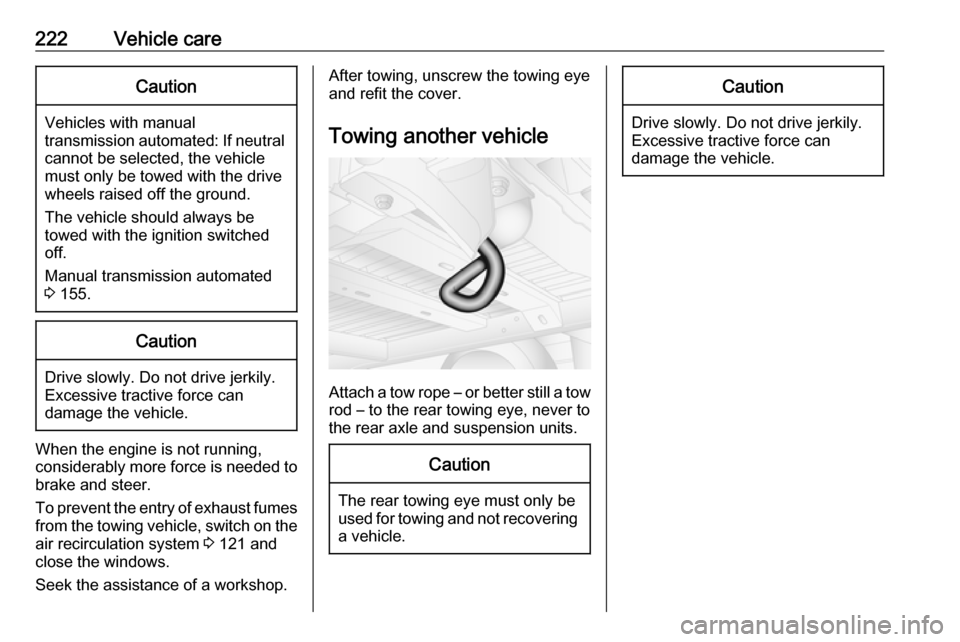
Towing another vehicle
Attach a tow rope – or better still a tow
rod – to the rear towing eye, never to
the rear axle and suspension units.
Caution
The rear towing eye must only be
used for towing and not recovering a vehicle.
Caution
Drive slowly. Do not drive jerkily.
Excessive tractive force can
damage the vehicle.
Page 256 of 271

254Customer informationCustomer
informationCustomer information ................254
Declaration of conformity .........254
REACH .................................... 258
Registered trademarks ............258
Vehicle data recording and pri‐
vacy ........................................... 258
Event data recorders ...............258
Radio Frequency Identification (RFID) ..................................... 261Customer information
Declaration of conformity
Radio transmission systems
This vehicle has systems that
transmit and / or receive radio waves
subject to Directive 2014/53/EU. The
manufacturers of the systems listed
below declare conformity with
Directive 2014/53/EU. The full text of
the EU declaration of conformity for each system is available at the
following internet address:
www.opel.com/conformity.
Importer is
Opel / Vauxhall, Bahnhofsplatz,
65423 Ruesselsheim am Main,
Germany.
Radio remote control receiver Visteon Electronics
04 Rue Nelson Mandela, Zone
Industrielle Borj Cedria, 2055 Bir El
Bey, Tunisia
Operation frequency: 433 MHz
Maximum output: 10 mW ERPRadio remote control transmitter
Visteon Electronics
04 Rue Nelson Mandela, Zone
Industrielle Borj Cedria, 2055 Bir El
Bey, Tunisia
Operation frequency: 433 MHz
Maximum output: 10 mW ERP
Electronic key transmitter
ALPS ELECTRIC EUROPE GmbH
Ohmstrasse 4, 85716
Unterschleissheim, Germany
Operation frequency: 433 MHz
Maximum output: 10 mW ERP
Immobiliser
Visteon Electronics
04 Rue Nelson Mandela, Zone
Industrielle Borj Cedria, 2055 Bir El
Bey, Tunisia
Operation frequency: 125 kHz
Maximum output:
42 dBμA/m @ 10 m
Immobiliser
ALPS ELECTRIC EUROPE GmbH
Page 267 of 271

265Lighting....................................... 112
Lighting features .........................119
Light switch ................................ 112
Limited-slip rear axle ..................163
Load compartment .................26, 79
Load compartment fuse box ......202
Load compartment grille ...............83
Load compartment lighting .........117
Loading information .....................85
Low beam ................................... 105
Low fuel ..................................... 104
Luggage floor net .........................79
M
Malfunction indicator light ..........101
Manual adjustment ......................40
Manual anti-dazzle ......................42
Manual door locks ........................25
Manual mode ............................. 156
Manual transmission............. 18, 154
Manual transmission automated ......................... 18, 155
Manual windows ..........................43
Messages ................................... 107
Mirror adjustment ........................... 9
Mirrors .................................... 40, 42
Misted light covers .....................116
N New vehicle running-in ..............138
Number plate light .....................198O
Object detection systems ...........169
Odometer ..................................... 94
Oil ............................................... 183
Oil, engine .......................... 228, 232
Oil level ......................................... 96
Oil pressure ................................ 104
Outside temperature ....................90
Overcab storage ..........................79
Overhead console .......................78
Overrun cut-off ........................... 140
P Parking ................................ 20, 143
Parking assist ............................ 169
Parking brake ............................ 159
Parking distance control .............169
Parking ticket holder .....................45
Particulate filter ........................... 146
Pedals......................................... 137
Performing work ........................182
Power door locks ..........................30
Power outlets ............................... 91
Power side step ............................ 32
Power sliding door ........................32
Power steering fluid ....................185
Power take-off ............................ 178
Power windows ............................ 43
Preheating ......................... 103, 139
Puncture ............................. 211, 214R
Radio Frequency Identification (RFID) ..................................... 261
Radio remote control ...................23
Rain sensor .................................. 89
REACH ....................................... 258
Reading lights ............................ 118
Rear air conditioning system .....126
Rear bench seat storage ..............78
Rear courtesy light...................... 117
Rear doors ................................... 35
Rear fog light ............................. 105
Rear fog lights ....................112, 116
Rear heating system .................. 124
Rear reading light .......................118
Rear reversing lens ......................44
Rear seats ................................... 54
Bus ............................................ 54
Installing .................................... 54
Rear seat access ......................54
Removing .................................. 54
Rear storage ................................. 79
Rear view camera ...................... 171
Rear windows .............................. 44
Recommended fluids and lubricants ........................ 228, 232
Refuelling ................................... 175 Registered trademarks ...............258
Remote control ............................. 23
Retractable parking brake ..........159
Page 268 of 271

266Reversing lights .........................116
Ride control systems ..........161, 163
Ride height ................................. 144
Roof .............................................. 46
Glass panel ............................... 46
Roof load ...................................... 85
Roof rack ..................................... 85
S Safety belts ................................... 57
Safety net .................................... 83
Seat adjustment ....................... 7, 49
Seat belt ........................................ 8
Seat belt reminder .....................100
Seat belts ..................................... 57
Seat heating ................................. 54
Seat position ................................ 48
Selective catalytic reduction .......147
Selector lever ............................. 155
Service ............................... 134, 226
Service display ....................96, 101
Service information ....................226
Service vehicle soon .................. 101
Side airbag system ......................65
Sidelights .................................... 112
Side turn lights ........................... 196
Side windows................................ 44
Sliding door .................................. 32
Sliding side door ........................... 32
Spare wheel ............................... 216Speed limiter ................93, 106, 166
Speedometer ............................... 93
Starting and operating ................138
Starting off ................................... 19
Starting the engine .......19, 139, 155
Steering ...................................... 137
Steering column controls ..............88
Steering wheel adjustment ....10, 88
Steering wheel controls ...............88
Stop engine ................................ 102
Stop-start system.......... 19, 105, 140
Storage ......................................... 76
Storage compartments .................76
Storage net ............................. 77, 78
Sun visors .................................... 45
Suspension height ......................144
Suspension seat ........................... 49
Swivelling shelf ............................. 77
Symbols ......................................... 4
T
Tachograph ........................ 106, 111
Tachometer ................................. 94
Tail lights ................................... 195
Technical data ....................232, 233
Three-point seat belt .................... 58
Tools .......................................... 204
Top-Tether .................................... 67
Touchscreen ............................... 107
Tow bar....................................... 177Towing ........................................ 177
Towing another vehicle .............222
Towing a trailer ........................... 177
Towing equipment .....................178
Towing eye ................................. 221
Towing the vehicle .....................221
Traction Control system ............. 161
Trailer coupling ........................... 177
Trailer stability assist .................178
Trailer towing ............................. 177
Transmission ............................... 18
Transmission display ...........97, 155
Tread depth ............................... 209
Trip computer ............................ 109
Trip odometer .............................. 94
Turbo engine warm-up ...............139
Turn lights .......................... 100, 115
Tyre chains ................................ 210
Tyre changing ............................. 214
Tyre designations ......................206
Tyre pressure ............................ 206
Tyre pressure monitoring system ............................. 104, 207
Tyre pressures ........................... 252
Tyre repair kit ............................. 211
Tyres .......................................... 205
Tyres and wheel size, changing. 210