brake light OPEL MOVANO_B 2018 Manual user
[x] Cancel search | Manufacturer: OPEL, Model Year: 2018, Model line: MOVANO_B, Model: OPEL MOVANO_B 2018Pages: 265, PDF Size: 6.39 MB
Page 174 of 265

172Driving and operatingTrailer hitch
General information
Only use towing equipment that has
been approved for your vehicle.
Entrust fitting of towing equipment at
a later date to a workshop. It may be
necessary to make changes that
affect the cooling system, heat
shields or other equipment.
Driving characteristics and towing tips
In the case of trailers with brakes,
attach the breakaway stopping cable.
Before attaching a trailer, lubricate
the coupling ball. However, do not do so if a stabiliser, which acts on thecoupling ball, is being used to reduce
snaking movements. For trailers with
low driving stability the use of a
stabiliser is recommended.
A maximum speed of 80 km/h must
not be exceeded, even in countries
where higher speeds are permitted.If the trailer starts snaking, drive more slowly, do not attempt to correct the
steering and brake sharply if
necessary.
When driving downhill, drive in the
same gear as if driving uphill and
drive at a similar speed.
Adjust tyre pressure to the value
specified for full load 3 247.
Trailer towing
Trailer loads The permissible trailer loads are
vehicle-dependent and engine-
dependent maximum values which
must not be exceeded. The actual
trailer load is the difference between
the actual gross weight of the trailer
and the actual coupling socket load
with the trailer coupled.
The permissible trailer loads are
specified in the vehicle documents. In
general, they are valid for gradients
up to max. 12%.
The permitted trailer load applies up to the specified incline and up to an
altitude of 1000 metres above sealevel. Since engine power decreases
as altitude increases due to the air
becoming thinner, therefore reducing
climbing ability, the permissible gross
train weight also decreases by 10%
for every 1000 metres of additional
altitude. The gross train weight does
not have to be reduced when driving
on roads with slight inclines (less than 8%, e.g. motorways).
The permissible gross train weight
must not be exceeded. This weight is
specified on the identification plate
3 226.
Vertical coupling load
The vertical coupling load is the load
exerted by the trailer on the coupling
ball. It can be varied by changing the
weight distribution when loading the
trailer.
The maximum permissible vertical
coupling load is specified on the
towing equipment identification plate
and in the vehicle documents. Always aim for the maximum load, especially in the case of heavy trailers. The
vertical coupling load should never
fall below 25 kg.
Page 175 of 265
Driving and operating173In the case of trailer loads of
1200 kg or more, the vertical coupling
load should not be less than 50 kg.
Rear axle loadWhen the trailer is coupled and the
towing vehicle fully loaded (including all occupants), the permissible rear
axle load (see identification plate or
vehicle documents) must not be
exceeded.
Towing equipmentCaution
When operating without a trailer,
remove the coupling ball bar.
Towing equipment audible
warning
For vehicles fitted with towing
equipment, when connected to a
trailer the pitch of the audible warning
changes upon operation of the turn
signals.
The pitch of the audible warning will
change if a turn signal light on the
trailer or the towing vehicle fails.
Trailer stability assist
If the system detects snaking
movements, engine power is reduced
and the vehicle/trailer combination is
selectively braked until the snaking ceases. While the system is working,keep steering wheel as still as
possible.
Trailer stability assist (TSA) is a
function of the Electronic Stability
Program (ESP) 3 158.Auxiliary features
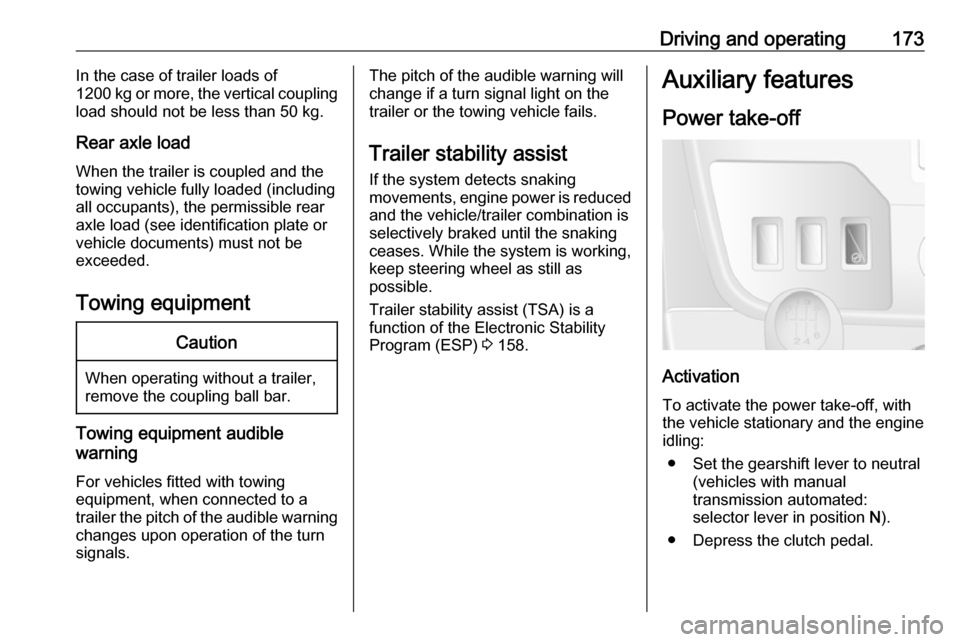
Power take-off
Activation
To activate the power take-off, with
the vehicle stationary and the engine
idling:
● Set the gearshift lever to neutral (vehicles with manual
transmission automated:
selector lever in position N).
● Depress the clutch pedal.
Page 177 of 265

Vehicle care175Vehicle careGeneral Information...................176
Accessories and vehicle modifications .......................... 176
Vehicle storage ........................176
End-of-life vehicle recovery .....177
Vehicle checks ........................... 177
Performing work ......................177
Bonnet ..................................... 177
Engine oil ................................. 178
Engine coolant ......................... 179
Power steering fluid .................180
Washer fluid ............................ 181
Brakes ..................................... 181
Brake fluid ............................... 181
Vehicle battery ......................... 182
Diesel fuel filter ........................184
Diesel fuel system bleeding .....184
Wiper blade replacement ........185
Bulb replacement .......................185
Headlights ............................... 186
Adaptive forward lighting .........188
Fog lights ................................. 188
Front turn signal lights .............189
Tail lights ................................. 189
Side turn signal lights ..............191Centre high-mounted brake
light ......................................... 192
Number plate light ...................192
Interior lights ............................ 193
Instrument panel illumination ...194
Electrical system ........................194
Fuses ....................................... 194
Engine compartment fuse box . 196
Instrument panel fuse box .......196
Load compartment fuse box ....197
Vehicle tools .............................. 199
Tools ........................................ 199
Wheels and tyres .......................200
Tyres ....................................... 200
Winter tyres ............................. 200
Tyre designations ....................200
Tyre pressure .......................... 201
Tyre pressure monitoring system .................................... 202
Tread depth ............................. 204
Changing tyre and wheel size . 204 Wheel covers ........................... 204
Tyre chains .............................. 205
Tyre repair kit .......................... 205
Wheel changing .......................208
Spare wheel ............................ 210
Jump starting ............................. 213Towing....................................... 216
Towing the vehicle ...................216
Towing another vehicle ...........217
Appearance care .......................217
Exterior care ............................ 217
Interior care ............................. 219
Page 191 of 265
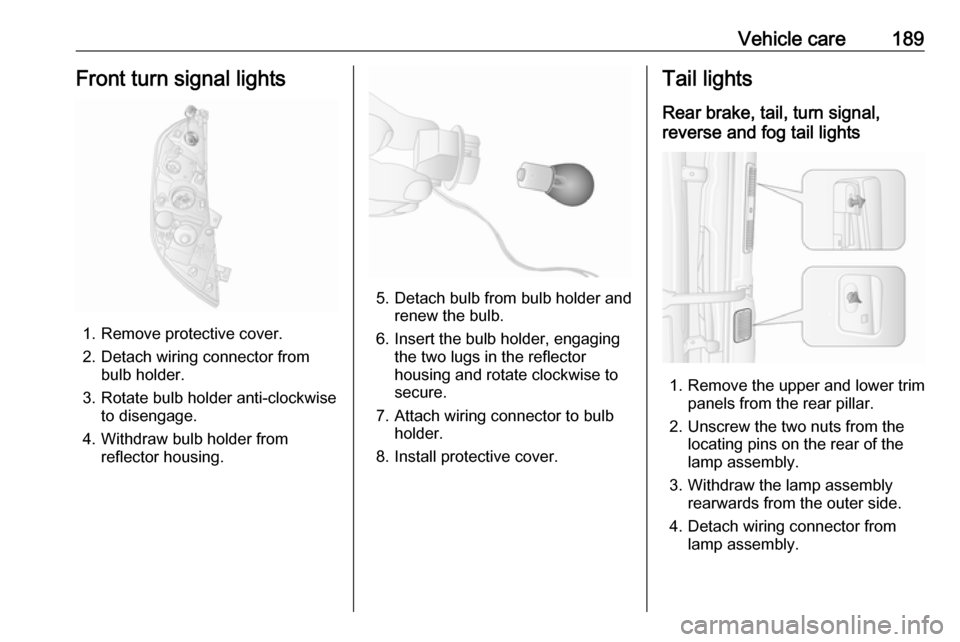
Vehicle care189Front turn signal lights
1. Remove protective cover.
2. Detach wiring connector from bulb holder.
3. Rotate bulb holder anti-clockwise to disengage.
4. Withdraw bulb holder from reflector housing.
5. Detach bulb from bulb holder andrenew the bulb.
6. Insert the bulb holder, engaging the two lugs in the reflectorhousing and rotate clockwise to
secure.
7. Attach wiring connector to bulb holder.
8. Install protective cover.
Tail lights
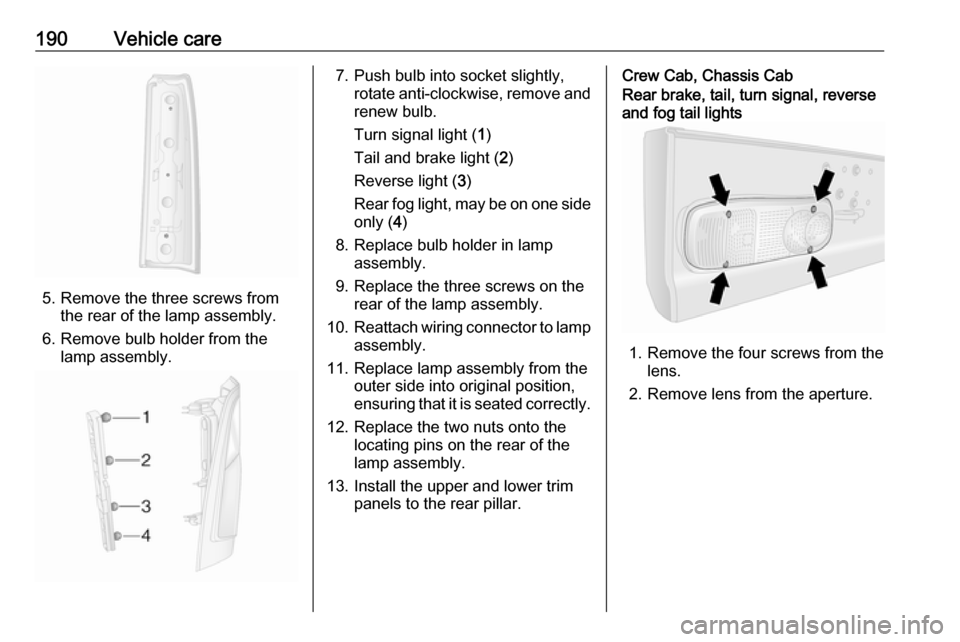
Rear brake, tail, turn signal,
reverse and fog tail lights
1. Remove the upper and lower trim panels from the rear pillar.
2. Unscrew the two nuts from the locating pins on the rear of the
lamp assembly.
3. Withdraw the lamp assembly rearwards from the outer side.
4. Detach wiring connector from lamp assembly.
Page 192 of 265
190Vehicle care
5. Remove the three screws fromthe rear of the lamp assembly.
6. Remove bulb holder from the lamp assembly.
7. Push bulb into socket slightly, rotate anti-clockwise, remove and
renew bulb.
Turn signal light ( 1)
Tail and brake light ( 2)
Reverse light ( 3)
Rear fog light, may be on one side only ( 4)
8. Replace bulb holder in lamp assembly.
9. Replace the three screws on the rear of the lamp assembly.
10. Reattach wiring connector to lamp
assembly.
11. Replace lamp assembly from the outer side into original position,
ensuring that it is seated correctly.
12. Replace the two nuts onto the locating pins on the rear of the
lamp assembly.
13. Install the upper and lower trim panels to the rear pillar.Crew Cab, Chassis CabRear brake, tail, turn signal, reverse
and fog tail lights
1. Remove the four screws from the lens.
2. Remove lens from the aperture.
Page 193 of 265
Vehicle care191
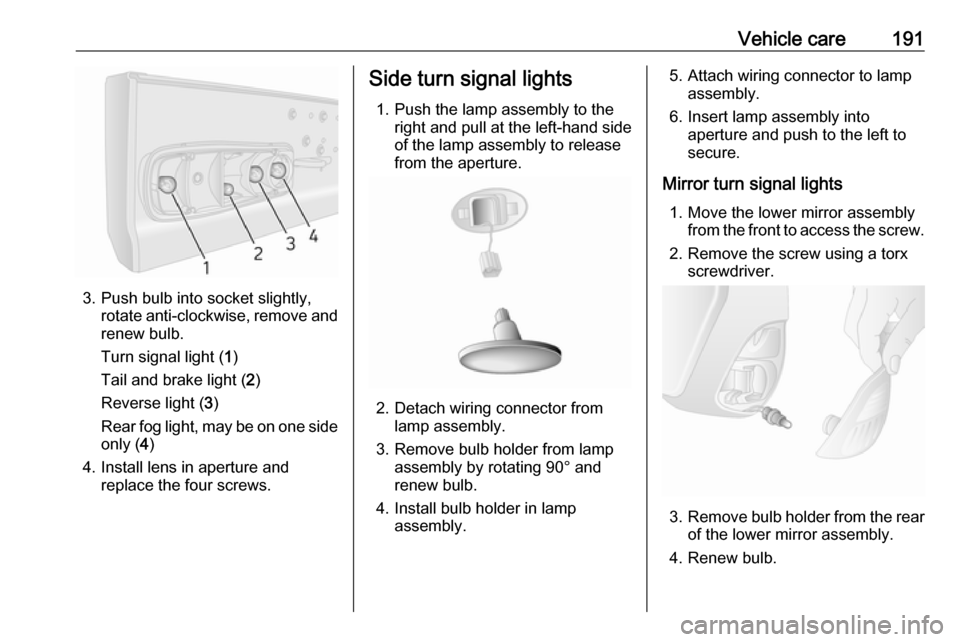
3. Push bulb into socket slightly,rotate anti-clockwise, remove and
renew bulb.
Turn signal light ( 1)
Tail and brake light ( 2)
Reverse light ( 3)
Rear fog light, may be on one side only ( 4)
4. Install lens in aperture and replace the four screws.
Side turn signal lights
1. Push the lamp assembly to the right and pull at the left-hand side
of the lamp assembly to release
from the aperture.
2. Detach wiring connector from lamp assembly.
3. Remove bulb holder from lamp assembly by rotating 90° and
renew bulb.
4. Install bulb holder in lamp assembly.
5. Attach wiring connector to lamp assembly.
6. Insert lamp assembly into aperture and push to the left to
secure.
Mirror turn signal lights 1. Move the lower mirror assembly from the front to access the screw.
2. Remove the screw using a torx screwdriver.
3. Remove bulb holder from the rear
of the lower mirror assembly.
4. Renew bulb.
Page 194 of 265
192Vehicle care5. Install bulb holder in lower mirrorassembly.
6. Replace the screw.
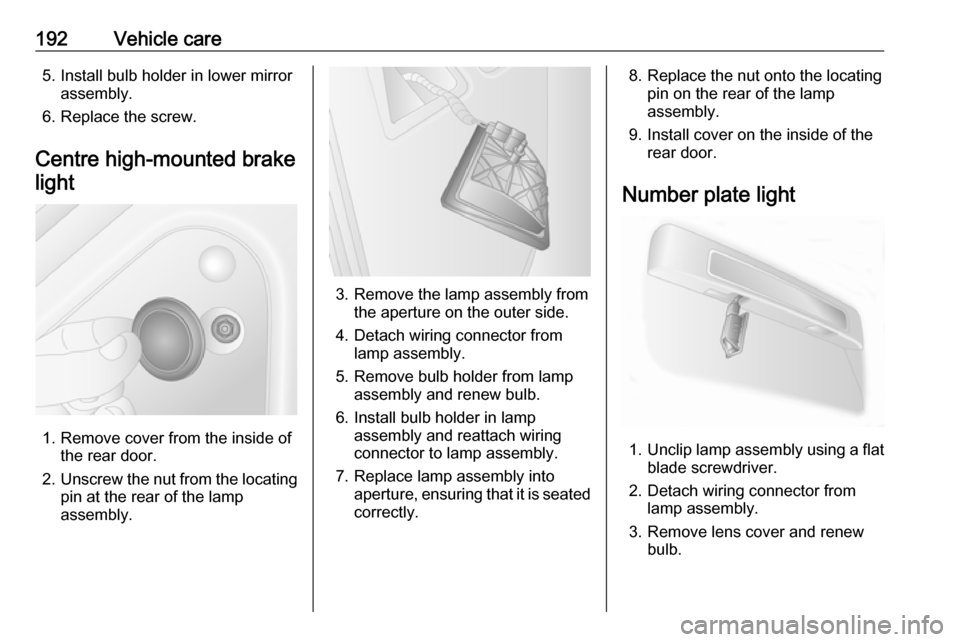
Centre high-mounted brake light
1. Remove cover from the inside of the rear door.
2. Unscrew the nut from the locating
pin at the rear of the lamp
assembly.
3. Remove the lamp assembly from the aperture on the outer side.
4. Detach wiring connector from lamp assembly.
5. Remove bulb holder from lamp assembly and renew bulb.
6. Install bulb holder in lamp assembly and reattach wiring
connector to lamp assembly.
7. Replace lamp assembly into aperture, ensuring that it is seated
correctly.
8. Replace the nut onto the locating pin on the rear of the lamp
assembly.
9. Install cover on the inside of the rear door.
Number plate light
1. Unclip lamp assembly using a flat
blade screwdriver.
2. Detach wiring connector from lamp assembly.
3. Remove lens cover and renew bulb.
Page 198 of 265
196Vehicle carePlace the fuse extractor on the
various types of fuse from the top or
side, and withdraw fuse.
Engine compartment fusebox
Located below the coolant expansion
tank.
Some circuits may be protected by
several fuses.
Due to restricted accessibility, have
fuses replaced by a workshop.SymbolCircuitSRight side lightsTLeft side lightsWRight low beamaLeft low beam>Front fog lightLLeft high beamNRight high beamuABSKWindscreen wiperSymbolCircuitnHeating and ventilation
system / Air conditioningVHeated windscreenQPneumatic suspension
Instrument panel fuse box
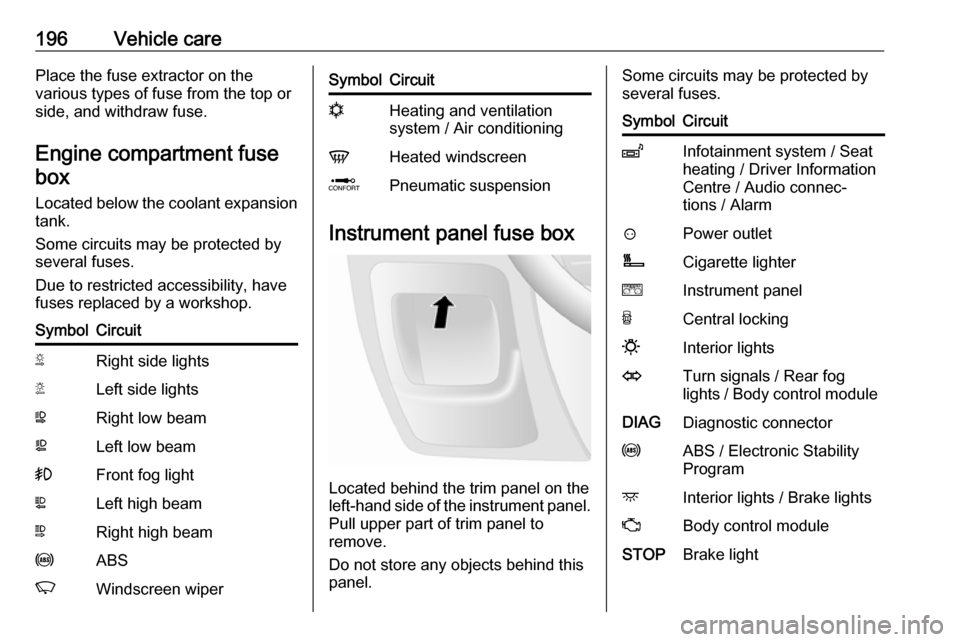
Located behind the trim panel on the
left-hand side of the instrument panel.
Pull upper part of trim panel to
remove.
Do not store any objects behind this
panel.
Some circuits may be protected by
several fuses.SymbolCircuitZInfotainment system / Seat
heating / Driver Information
Centre / Audio connec‐
tions / Alarm?Power outletÌCigarette lightereInstrument panelUCentral locking0Interior lightsOTurn signals / Rear fog
lights / Body control moduleDIAGDiagnostic connectoruABS / Electronic Stability
ProgramdInterior lights / Brake lightsZBody control moduleSTOPBrake light
Page 218 of 265
216Vehicle careTowingTowing the vehicle
The towing eye and wheel wrench are stowed with the vehicle tools 3 199.
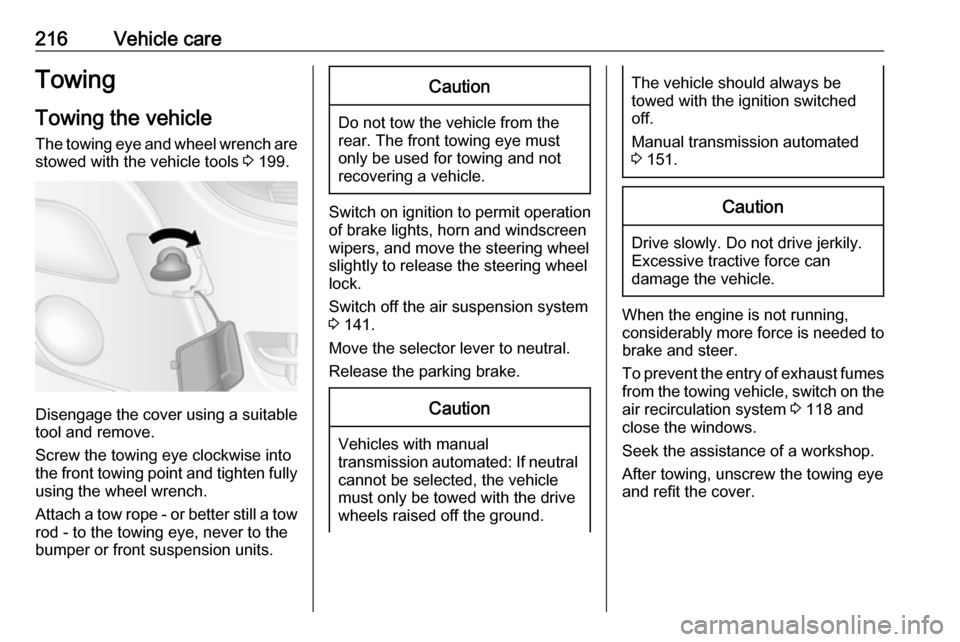
Disengage the cover using a suitable
tool and remove.
Screw the towing eye clockwise into
the front towing point and tighten fully using the wheel wrench.
Attach a tow rope - or better still a tow
rod - to the towing eye, never to the
bumper or front suspension units.
Caution
Do not tow the vehicle from the
rear. The front towing eye must
only be used for towing and not
recovering a vehicle.
Switch on ignition to permit operation
of brake lights, horn and windscreen
wipers, and move the steering wheel
slightly to release the steering wheel
lock.
Switch off the air suspension system 3 141.
Move the selector lever to neutral.
Release the parking brake.
Caution
Vehicles with manual
transmission automated: If neutral cannot be selected, the vehiclemust only be towed with the drive
wheels raised off the ground.
The vehicle should always be
towed with the ignition switched
off.
Manual transmission automated
3 151.Caution
Drive slowly. Do not drive jerkily.
Excessive tractive force can
damage the vehicle.
When the engine is not running,
considerably more force is needed to
brake and steer.
To prevent the entry of exhaust fumes
from the towing vehicle, switch on the air recirculation system 3 118 and
close the windows.
Seek the assistance of a workshop.
After towing, unscrew the towing eye
and refit the cover.
Page 258 of 265

256IndexAAbsorptive Glass Mat battery .....182
Accessories and vehicle modifications .......................... 176
Adaptive forward lighting ...112, 188
AdBlue ........................ 100, 144, 223
AdBlue gauge ............................... 92
AdBlue tank ................................ 246
Adjustable air vents ...................130
Airbag and belt tensioners ...........97
Airbag deactivation ................61, 97
Airbag label................................... 57 Airbag system .............................. 57
Air conditioning regular operation ................................ 131
Air conditioning system .............. 118
Air intake .................................... 131
Air suspension ........................... 141
Air suspension system................ 216
Air vents...................................... 130
Antifreeze ................................... 179
Antilock brake system ................ 155
Antilock brake system (ABS) .......99
Anti-theft alarm system ................34
Anti-theft bolts............................. 208
Anti-theft locking system .............. 34
Anti-theft security lock ..................23
Appearance care ........................217
Armrest ........................................ 49
Ashtrays ....................................... 90Automatic light control ...............109
Automatic locking ...................24, 27
Autostop ....................... 18, 136, 137
Auxiliary heater ........................... 124
B Battery ........................................ 182
Battery discharge protection ......116
Battery, jump starting.................. 213
Belts.............................................. 53
BlueInjection ............................... 144
Bonnet ....................................... 177
Bottle holders................................ 74 Brake assist ............................... 157
Brake fluid .......................... 181, 223
Brakes ............................... 155, 181
Brake system ............................... 99
Breakdown.................................. 216
Bulb replacement ....................... 185
Bus Rear seats ................................. 50
C Cabin bulkhead grille ....................80
Capacities .................................. 246
Cargo management system ........77
Car Pass ...................................... 21
Catalytic converter .....................143
Central locking system ................24
Centre high-mounted brake light 192
Changing tyre and wheel size ...204