AUX OPEL MOVANO_B 2018 Manual user
[x] Cancel search | Manufacturer: OPEL, Model Year: 2018, Model line: MOVANO_B, Model: OPEL MOVANO_B 2018Pages: 265, PDF Size: 6.39 MB
Page 13 of 265

In brief111Fixed air vents .................... 131
2 Headlight range
adjustment ......................... 111
Ultrasonic parking assist .....164
Traction control system ......157
Electronic Stability
Program ............................. 158
3 Side air vents .....................130
4 Light switch ........................ 109
Turn and lane-change
signals ................................ 112
High beam and low beam,
headlight flash ....................110
Sidelights ............................ 109
Automatic light control .......109
Exit lighting ......................... 116
Front fog lights ...................113
Rear fog light ...................... 113
High beam assist ................110
5 Instruments .......................... 90
Transmission display ............94Driver Information Centre .... 103
Trip computer ...................... 105
6 Horn ..................................... 85
Driver airbag ........................ 60
7 Remote control on
steering wheel .......................85
Cruise control .....................160
8 Windscreen wiper,
windscreen washer system ..86
Trip computer ...................... 105
9 Coin tray ............................... 73
10 Power outlet, USB slot ..........88
11 Centre air vents .................. 130
12 Storage compartment ...........73
13 Info-display .......................... 103
14 Front passenger airbag .........60
15 Storage compartment ..........73
16 Glovebox .............................. 74
17 Seat belt reminder ................. 97
Front passenger airbag
deactivation ........................... 61
18 Cupholders ........................... 7419Climate control system ....... 117
Electronic climate control
system ................................. 119
20 Cigarette lighter .................... 90
Power outlet ......................... 88
21 Gear lever, Manual
transmission ........................ 151
Manual transmission
automated ........................... 151
22 Cruise control and speed
limiter ................................. 160
Manual transmission
automated,
Winter and Laden modes ....153
Idle speed control ...............137
Stop-start system ................137
ECO mode .......................... 134
23 Ignition switch with
steering wheel lock ............135
24 Steering column controls .....85
25 Steering wheel adjustment ..85
26 Bonnet release lever ..........177
27 Auxiliary heater ...................124
Page 37 of 265
Keys, doors and windows35If the hazard warning lights do not
flash upon activation, a door or the bonnet is not fully closed.
Note
Changes to the vehicle interior, e.g. the use of seat covers, and open
windows, could impair the function
of passenger compartment
monitoring.
Deactivation
Unlocking the vehicle or switching on
the ignition deactivates the anti-theft
alarm system. Hazard warning lights
flash once to confirm deactivation.
Note
If the alarm has been triggered,
unlocking the vehicle with the key
will not stop the alarm siren. To stop the siren, switch on the ignition. The hazard warning lights will not flash
upon deactivation if the alarm has
been triggered.
Activation without monitoring of
passenger compartment
Switch off monitoring of the
passenger compartment when
people or animals are being left in thevehicle, or if the auxiliary heater
3 124 is set for a timed or remote
controlled start.
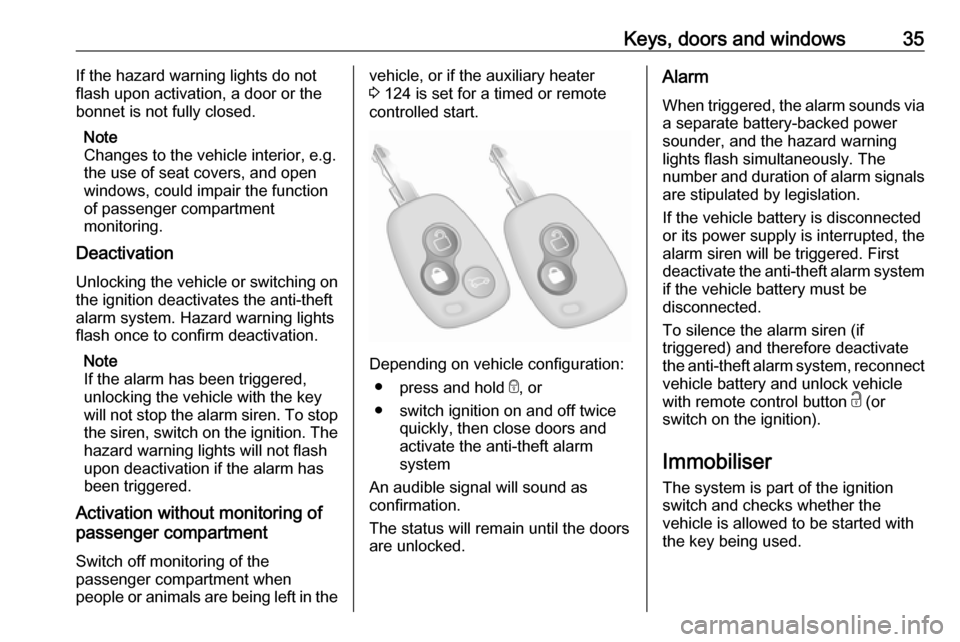
Depending on vehicle configuration:
● press and hold e, or
● switch ignition on and off twice quickly, then close doors and
activate the anti-theft alarm
system
An audible signal will sound as
confirmation.
The status will remain until the doors
are unlocked.
Alarm
When triggered, the alarm sounds via a separate battery-backed power
sounder, and the hazard warning
lights flash simultaneously. The
number and duration of alarm signals
are stipulated by legislation.
If the vehicle battery is disconnected
or its power supply is interrupted, the
alarm siren will be triggered. First
deactivate the anti-theft alarm system if the vehicle battery must be
disconnected.
To silence the alarm siren (if
triggered) and therefore deactivate
the anti-theft alarm system, reconnect vehicle battery and unlock vehicle
with remote control button c (or
switch on the ignition).
Immobiliser
The system is part of the ignition
switch and checks whether the
vehicle is allowed to be started with
the key being used.
Page 91 of 265
Instruments and controls89
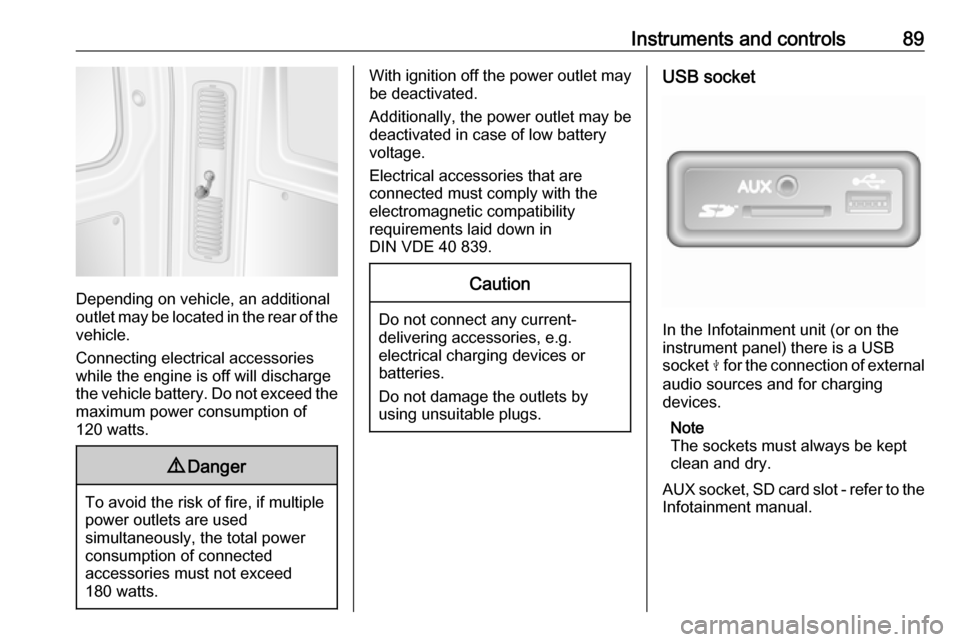
Depending on vehicle, an additional
outlet may be located in the rear of the
vehicle.
Connecting electrical accessories
while the engine is off will discharge
the vehicle battery. Do not exceed the
maximum power consumption of
120 watts.
9 Danger
To avoid the risk of fire, if multiple
power outlets are used
simultaneously, the total power
consumption of connected
accessories must not exceed
180 watts.
With ignition off the power outlet may
be deactivated.
Additionally, the power outlet may be
deactivated in case of low battery
voltage.
Electrical accessories that are
connected must comply with the
electromagnetic compatibility
requirements laid down in
DIN VDE 40 839.Caution
Do not connect any current- delivering accessories, e.g.
electrical charging devices or
batteries.
Do not damage the outlets by
using unsuitable plugs.
USB socket
In the Infotainment unit (or on the
instrument panel) there is a USB
socket M for the connection of external
audio sources and for charging
devices.
Note
The sockets must always be kept
clean and dry.
AUX socket, SD card slot - refer to the
Infotainment manual.
Page 119 of 265

Climate control117Climate controlClimate control systems.............117
Heating and ventilation system 117
Air conditioning system ...........118
Electronic climate control system .................................... 119
Rear heating system ...............121
Rear air conditioning system ...123
Auxiliary heater ........................124
Air vents ..................................... 130
Adjustable air vents .................130
Fixed air vents ......................... 131
Glovebox cooler ......................131
Maintenance .............................. 131
Air intake ................................. 131
Pollen filter ............................... 131
Air conditioning regular operation ................................ 131
Service .................................... 131Climate control systems
Heating and ventilation system
Controls for: ● temperature
● fan speed
● air distribution
● demisting and defrosting
Heated rear window Ü 3 41, Heated
seats ß 3 50.
Temperaturered:warmblue:cold
Heating will not be fully effective until
the engine has reached normal
operating temperature.
Fan speed
Adjust the air flow by switching the fan
to the desired speed.
Air distribution
M:to head areaL:to head area and foot wellK:to foot wellJ:to windscreen, front door
windows and foot wellV:to windscreen and front door
windows
Intermediate settings are possible.
Demisting and defrosting the
windows
● Set temperature control to warmest level.
● Set fan speed to highest level.
Page 126 of 265
124Climate controlFan speed
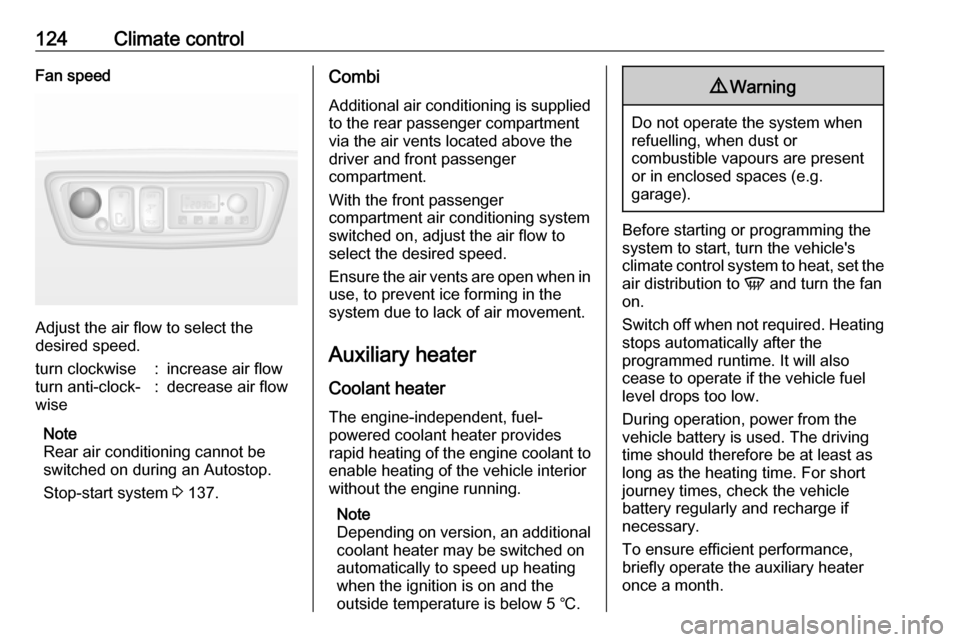
Adjust the air flow to select the
desired speed.
turn clockwise:increase air flowturn anti-clock‐
wise:decrease air flow
Note
Rear air conditioning cannot be
switched on during an Autostop.
Stop-start system 3 137.
Combi
Additional air conditioning is supplied to the rear passenger compartment
via the air vents located above the
driver and front passenger
compartment.
With the front passenger
compartment air conditioning system
switched on, adjust the air flow to
select the desired speed.
Ensure the air vents are open when in
use, to prevent ice forming in the
system due to lack of air movement.
Auxiliary heaterCoolant heater
The engine-independent, fuel-
powered coolant heater provides
rapid heating of the engine coolant to
enable heating of the vehicle interior
without the engine running.
Note
Depending on version, an additional
coolant heater may be switched on
automatically to speed up heating
when the ignition is on and the
outside temperature is below 5 ℃.9 Warning
Do not operate the system when
refuelling, when dust or
combustible vapours are present
or in enclosed spaces (e.g.
garage).
Before starting or programming the
system to start, turn the vehicle's
climate control system to heat, set the
air distribution to V and turn the fan
on.
Switch off when not required. Heating stops automatically after the
programmed runtime. It will also
cease to operate if the vehicle fuel
level drops too low.
During operation, power from the
vehicle battery is used. The driving
time should therefore be at least as
long as the heating time. For short
journey times, check the vehicle
battery regularly and recharge if
necessary.
To ensure efficient performance,
briefly operate the auxiliary heater
once a month.
Page 129 of 265
Climate control127Manual control
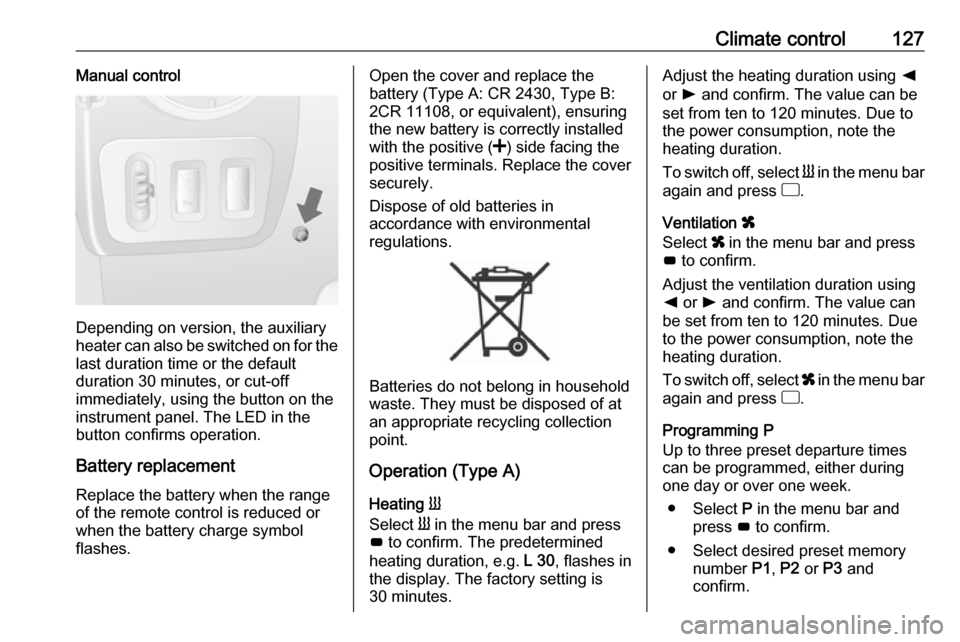
Depending on version, the auxiliary
heater can also be switched on for the
last duration time or the default
duration 30 minutes, or cut-off
immediately, using the button on the
instrument panel. The LED in the
button confirms operation.
Battery replacement
Replace the battery when the range
of the remote control is reduced or
when the battery charge symbol
flashes.
Open the cover and replace the
battery (Type A: CR 2430, Type B:
2CR 11108, or equivalent), ensuring
the new battery is correctly installed
with the positive ( <) side facing the
positive terminals. Replace the cover
securely.
Dispose of old batteries in
accordance with environmental
regulations.
Batteries do not belong in household
waste. They must be disposed of at
an appropriate recycling collection
point.
Operation (Type A)
Heating Y
Select Y in the menu bar and press
G to confirm. The predetermined
heating duration, e.g. L 30, flashes in
the display. The factory setting is 30 minutes.
Adjust the heating duration using k
or l and confirm. The value can be
set from ten to 120 minutes. Due to
the power consumption, note the
heating duration.
To switch off, select Y in the menu bar
again and press d.
Ventilation x
Select x in the menu bar and press
G to confirm.
Adjust the ventilation duration using k or l and confirm. The value can
be set from ten to 120 minutes. Due
to the power consumption, note the
heating duration.
To switch off, select x in the menu bar
again and press d.
Programming P
Up to three preset departure times
can be programmed, either during
one day or over one week.
● Select P in the menu bar and
press G to confirm.
● Select desired preset memory number P1, P2 or P3 and
confirm.
Page 135 of 265

Driving and operating133Driving and
operatingDriving hints ............................... 134
Driving economically ...............134
Control of the vehicle ...............134
Steering ................................... 134
Starting and operating ...............135
New vehicle running-in ............135
Ignition switch positions ...........135
Starting the engine ..................136
Idle speed control ....................137
Overrun cut-off ........................ 137
Stop-start system ....................137
Parking .................................... 140
Air suspension ......................... 141
Engine exhaust .......................... 143
Diesel particle filter ..................143
Catalytic converter ...................143
AdBlue ..................................... 144
Manual transmission ..................151
Manual transmission automa‐ ted .............................................. 151
Transmission display ...............151
Starting the engine ..................152
Selector lever .......................... 152Manual mode........................... 153
Electronic driving programmes 153
Fault ........................................ 154
Interruption of power supply ....155
Brakes ........................................ 155
Antilock brake system .............155
Parking brake .......................... 156
Brake assist ............................. 157
Hill start assist ......................... 157
Ride control systems .................157
Traction Control system ..........157
Electronic stability program .....158
Limited-slip rear axle ...............160
Driver assistance systems .........160
Cruise control .......................... 160
Speed limiter ........................... 164
Parking assist .......................... 164
Rear view camera ...................166
Lane departure warning ..........168
Fuel ............................................ 169
Fuel for diesel engines ............169
Refuelling ................................ 170
Fuel consumption - CO 2-
Emissions ............................... 171
Trailer hitch ................................ 172
General information .................172
Driving characteristics and towing tips .............................. 172
Trailer towing ........................... 172Towing equipment ...................173
Trailer stability assist ...............173
Auxiliary features .......................173
Power take-off ......................... 173
Page 175 of 265
Driving and operating173In the case of trailer loads of
1200 kg or more, the vertical coupling
load should not be less than 50 kg.
Rear axle loadWhen the trailer is coupled and the
towing vehicle fully loaded (including all occupants), the permissible rear
axle load (see identification plate or
vehicle documents) must not be
exceeded.
Towing equipmentCaution
When operating without a trailer,
remove the coupling ball bar.
Towing equipment audible
warning
For vehicles fitted with towing
equipment, when connected to a
trailer the pitch of the audible warning
changes upon operation of the turn
signals.
The pitch of the audible warning will
change if a turn signal light on the
trailer or the towing vehicle fails.
Trailer stability assist
If the system detects snaking
movements, engine power is reduced
and the vehicle/trailer combination is
selectively braked until the snaking ceases. While the system is working,keep steering wheel as still as
possible.
Trailer stability assist (TSA) is a
function of the Electronic Stability
Program (ESP) 3 158.Auxiliary features
Power take-off
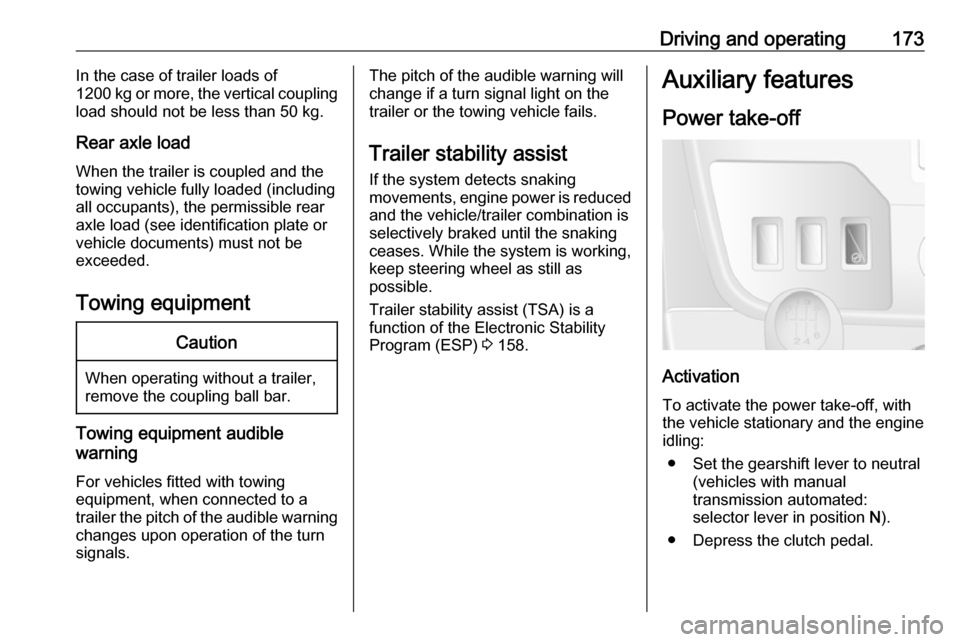
Activation
To activate the power take-off, with
the vehicle stationary and the engine
idling:
● Set the gearshift lever to neutral (vehicles with manual
transmission automated:
selector lever in position N).
● Depress the clutch pedal.
Page 185 of 265
Vehicle care183Replacing the vehicle batteryEnsure that the battery is always
replaced by the same type of battery.
Seek the assistance of a workshop to
have the vehicle battery replaced.
Stop-start system 3 137.
Charging the vehicle battery9 Warning
On vehicles with stop-start
system, ensure that the charging potential does not exceed
14.6 volts when using a battery
charger. Otherwise the vehicle
battery might be damaged.
9 Danger
Ensure adequate ventilation when
charging the battery. There is a
risk of explosion if gases
generated during charging are
allowed to accumulate!
Jump starting 3 213.
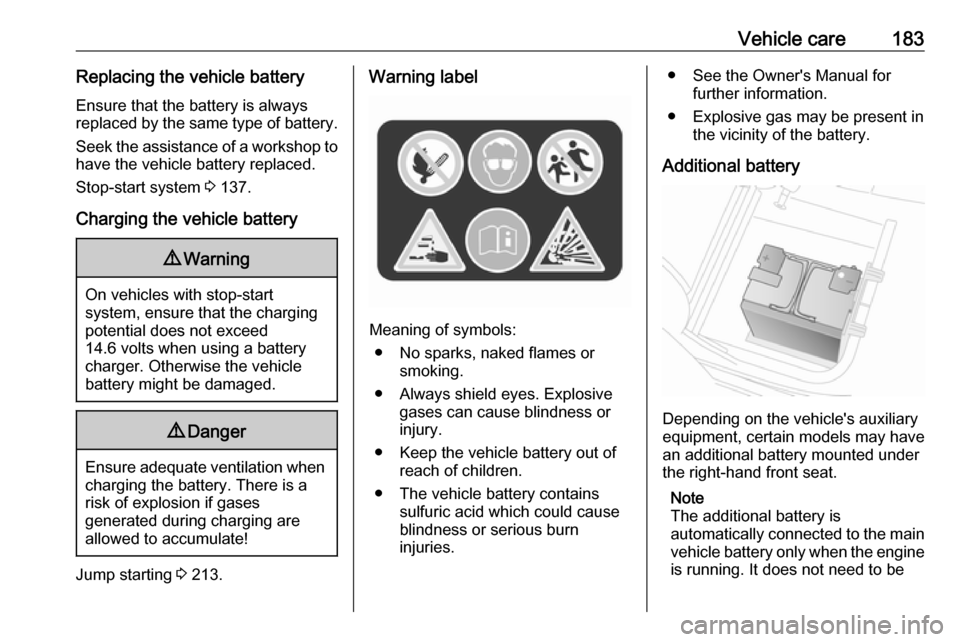
Warning label
Meaning of symbols:
● No sparks, naked flames or smoking.
● Always shield eyes. Explosive gases can cause blindness or
injury.
● Keep the vehicle battery out of reach of children.
● The vehicle battery contains sulfuric acid which could cause
blindness or serious burn
injuries.
● See the Owner's Manual for further information.
● Explosive gas may be present in the vicinity of the battery.
Additional battery
Depending on the vehicle's auxiliary
equipment, certain models may have
an additional battery mounted under
the right-hand front seat.
Note
The additional battery is
automatically connected to the main vehicle battery only when the engine
is running. It does not need to be
Page 251 of 265

Customer information249Customer
informationCustomer information ................249
Declaration of conformity .........249
REACH .................................... 253
Collision damage repair ...........253
Registered trademarks ............253
Vehicle data recording and pri‐
vacy ........................................... 253
Event data recorders ...............253
Radio Frequency Identification (RFID) ..................................... 254Customer information
Declaration of conformity
Radio transmission systems
This vehicle has systems that
transmit and / or receive radio waves
subject to Directive 1999/5/EC or 2014/53/EU. The manufacturers ofthe systems listed below declare
conformity with Directive 1999/5/EC
or 2014/53/EU . The full text of the EU
declaration of conformity for each
system is available at the following
internet address: www.opel.com/
conformity
Importer is
Opel / Vauxhall, Bahnhofsplatz,
65423 Ruesselsheim am Main,
Germany.
Radio remote control receiver
Visteon Electronics
04 Rue Nelson Mandela, Zone
Industrielle Borj Cedria, 2055 Bir El
Bey, Tunisia
Operation frequency: 433 MHz
Maximum output: 10 mW ERPRadio remote control transmitter
Visteon Electronics
04 Rue Nelson Mandela, Zone
Industrielle Borj Cedria, 2055 Bir El
Bey, Tunisia
Operation frequency: 433 MHz
Maximum output: 10 mW ERP
Electronic key transmitter
ALPS ELECTRIC EUROPE GmbH
Ohmstrasse 4, 85716
Unterschleissheim, Germany
Operation frequency: 433 MHz
Maximum output: 10 mW ERP
Immobiliser
Visteon Electronics
04 Rue Nelson Mandela, Zone
Industrielle Borj Cedria, 2055 Bir El
Bey, Tunisia
Operation frequency: 125 kHz
Maximum output:
42 dBμA/m @ 10 m
Immobiliser
ALPS ELECTRIC EUROPE GmbH