air condition OPEL MOVANO_B 2019 Manual user
[x] Cancel search | Manufacturer: OPEL, Model Year: 2019, Model line: MOVANO_B, Model: OPEL MOVANO_B 2019Pages: 251, PDF Size: 6.46 MB
Page 144 of 251

142Driving and operating9Warning
Switch off engine and ignition
before exiting the vehicle.
Conditions for an Autostop
The stop-start system checks if each
of the following conditions is fulfilled,
otherwise an Autostop will be
inhibited and control indicator \ will
illuminate in the instrument cluster.
● the stop-start system is not manually deactivated
● the bonnet is fully closed
● the vehicle battery is sufficiently charged and in good condition
● the engine is warmed up
● the engine coolant temperature is
not too high
● the ambient temperature is not too low
● the defrosting function is not activated
● the climate control system does not inhibit an Autostop
● the rear air conditioning system is
not activated
● the brake vacuum is sufficient
● the self-cleaning function of the diesel particle filter is not active
3 146
● the vehicle has moved since the last Autostop
Otherwise an Autostop will be
inhibited.
An Autostop may become
unavailable as the ambient
temperature approaches freezing
point.
Certain settings of the climate control
system may also inhibit an Autostop.
See "Climate control" chapter for
further information 3 120.
Immediately after motorway driving
an Autostop may be inhibited.
New vehicle running-in 3 138.
Vehicle battery discharge protection
To ensure reliable engine restarts, several vehicle battery discharge
protection features are implemented
as part of the stop-start system.Restart of the engine by the driverManual transmission
With the selector lever in neutral,
depress the clutch pedal to restart the
engine.
Note
If any gear is selected, the clutch
pedal must be fully depressed to
restart the engine.
If the engine does not restart first
time, depress clutch pedal fully again.Manual transmission automated
With the selector lever in position N
(or A/M ) and the parking brake
released, release the brake pedal to
restart the engine.
Engaging reverse gear or depressing
the accelerator pedal may also restart the engine.
The green control indicator Ï will
extinguish in the instrument cluster
when the engine is restarted. If
certain conditions are not fulfilled, a
restart will not take place. Start using
the ignition key.
Starting the engine 3 139.
Page 191 of 251
Vehicle care189● See the Owner's Manual forfurther information.
● Explosive gas may be present in the vicinity of the battery.
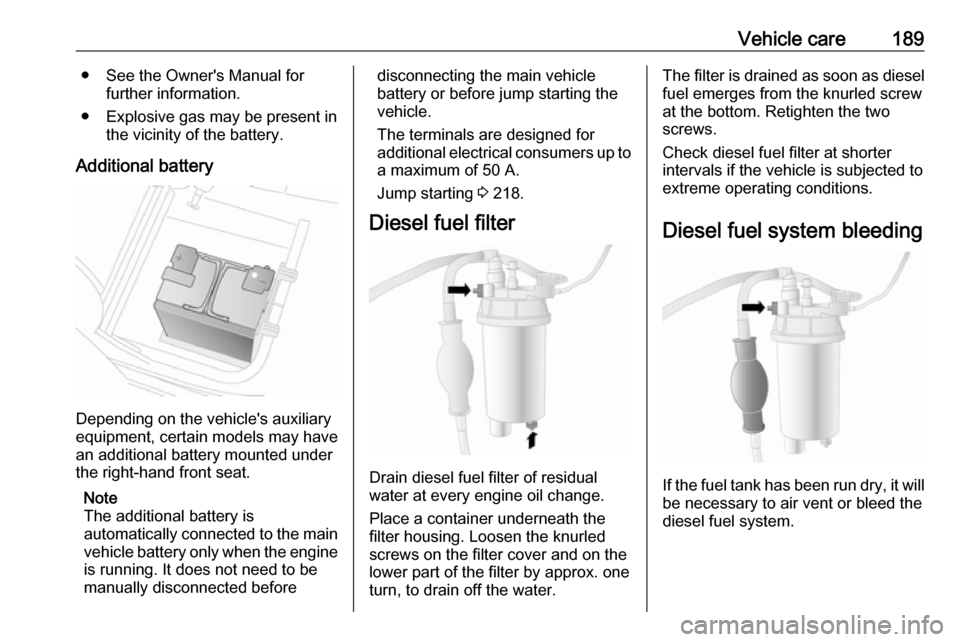
Additional battery
Depending on the vehicle's auxiliary
equipment, certain models may have
an additional battery mounted under
the right-hand front seat.
Note
The additional battery is
automatically connected to the main vehicle battery only when the engine
is running. It does not need to be
manually disconnected before
disconnecting the main vehicle
battery or before jump starting the vehicle.
The terminals are designed for
additional electrical consumers up to
a maximum of 50 A.
Jump starting 3 218.
Diesel fuel filter
Drain diesel fuel filter of residual
water at every engine oil change.
Place a container underneath the
filter housing. Loosen the knurled
screws on the filter cover and on the
lower part of the filter by approx. one
turn, to drain off the water.
The filter is drained as soon as diesel fuel emerges from the knurled screw
at the bottom. Retighten the two
screws.
Check diesel fuel filter at shorter
intervals if the vehicle is subjected to
extreme operating conditions.
Diesel fuel system bleeding
If the fuel tank has been run dry, it will be necessary to air vent or bleed the
diesel fuel system.
Page 203 of 251
Vehicle care201
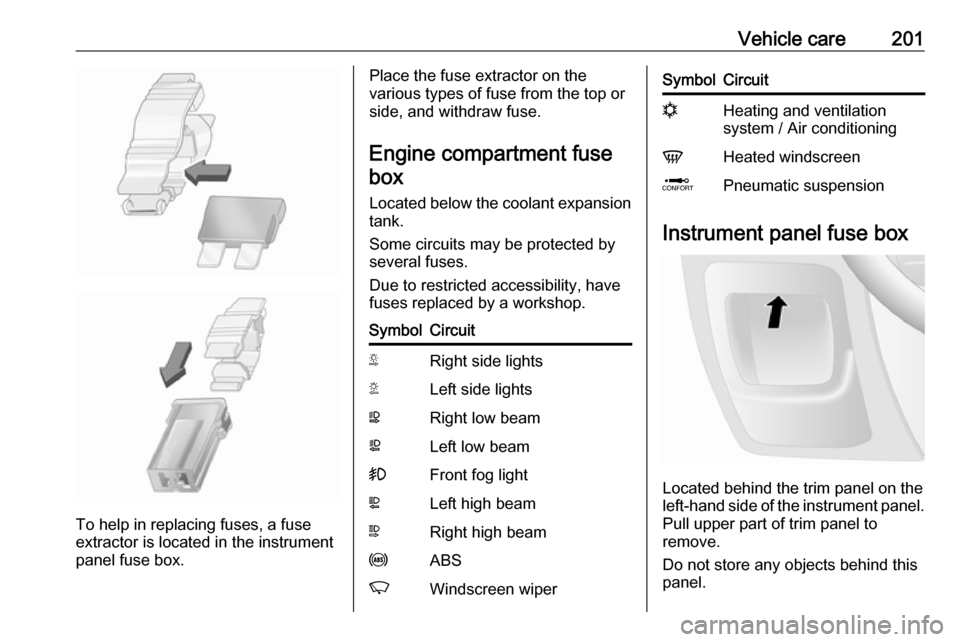
To help in replacing fuses, a fuse
extractor is located in the instrument
panel fuse box.
Place the fuse extractor on the
various types of fuse from the top or
side, and withdraw fuse.
Engine compartment fusebox
Located below the coolant expansion tank.
Some circuits may be protected by
several fuses.
Due to restricted accessibility, have
fuses replaced by a workshop.SymbolCircuitSRight side lightsTLeft side lightsWRight low beamaLeft low beam>Front fog lightLLeft high beamNRight high beamuABSKWindscreen wiperSymbolCircuitnHeating and ventilation
system / Air conditioningVHeated windscreenQPneumatic suspension
Instrument panel fuse box
Located behind the trim panel on the
left-hand side of the instrument panel.
Pull upper part of trim panel to
remove.
Do not store any objects behind this
panel.
Page 204 of 251

202Vehicle careSome circuits may be protected by
several fuses.SymbolCircuitZInfotainment system / Seat
heating / Driver Information
Centre / Audio connec‐
tions / Alarm?Power outletÌCigarette lightereInstrument panelUCentral locking0Interior lightsOTurn lights / Rear fog lights / Body control moduleDIAGDiagnostic connectoruABS / Electronic Stability
ControldInterior lights / Brake lightsZBody control moduleSTOPBrake lightSymbolCircuitIBody control module /
Power windows / Heating
and ventilation system / Air
conditioningmLeft heated rear windownRight heated rear windowRWindscreen washerMElectronic immobiliserUHeated seatsFBLCornering lightlHands-free connection&TachographPTOPower take-offjHornÍPreheating / Diesel fuel filterxClimate control fandHeated exterior mirrorsTLeft-hand side lightSRight-hand side lightSymbolCircuitONavigation systemADPAdditional adaptations,Power windows / Body
control module
Load compartment fuse box
Combi
Located behind the trim panel on the
right-hand side of the load
compartment, beside the rear door.
Page 207 of 251
Vehicle care205
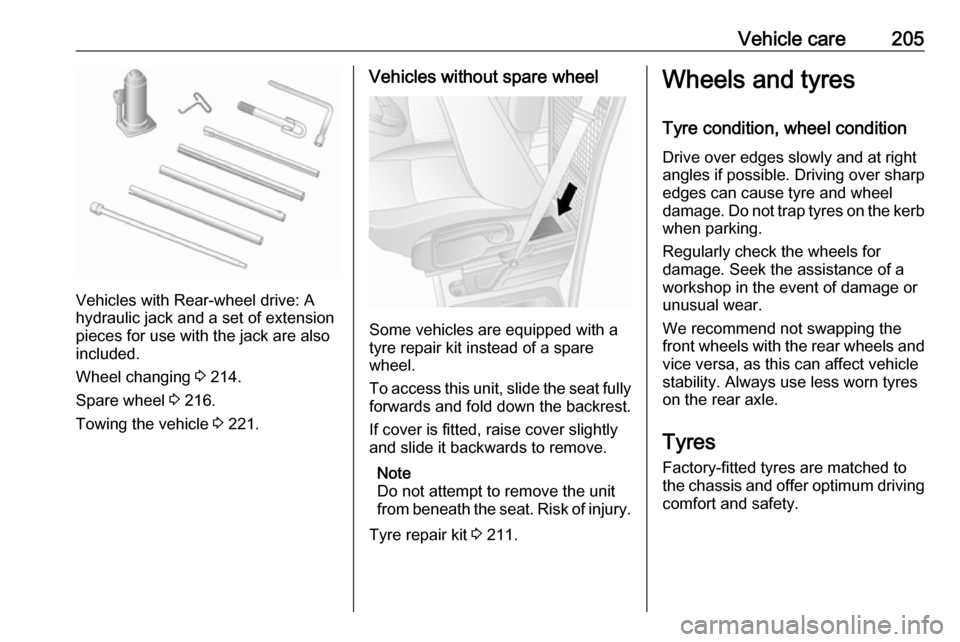
Vehicles with Rear-wheel drive: A
hydraulic jack and a set of extension
pieces for use with the jack are also
included.
Wheel changing 3 214.
Spare wheel 3 216.
Towing the vehicle 3 221.
Vehicles without spare wheel
Some vehicles are equipped with a
tyre repair kit instead of a spare
wheel.
To access this unit, slide the seat fully forwards and fold down the backrest.
If cover is fitted, raise cover slightly
and slide it backwards to remove.
Note
Do not attempt to remove the unit
from beneath the seat. Risk of injury.
Tyre repair kit 3 211.
Wheels and tyres
Tyre condition, wheel condition Drive over edges slowly and at right
angles if possible. Driving over sharp
edges can cause tyre and wheel
damage. Do not trap tyres on the kerb when parking.
Regularly check the wheels for
damage. Seek the assistance of a
workshop in the event of damage or
unusual wear.
We recommend not swapping the
front wheels with the rear wheels and
vice versa, as this can affect vehicle
stability. Always use less worn tyres
on the rear axle.
Tyres
Factory-fitted tyres are matched to the chassis and offer optimum driving comfort and safety.
Page 209 of 251
Vehicle care2079Warning
If the pressure is too low, this can
result in considerable tyre warm-
up and internal damage, leading to tread separation and even to tyre
blow-out at high speeds.
9 Warning
For specific tyres the
recommended tyre pressure as
shown in the tyre pressure table may exceed the maximum tyre
pressure as indicated on the tyre.
Never exceed the maximum tyre
pressure as indicated on the tyre.
Temperature dependency
Tyre pressure depends on the
temperature of the tyre. During
driving, tyre temperature and
pressure increase.
Tyre pressure values provided on the
tyre information label and tyre
pressure chart are valid for cold tyres, which means at 20 °C. The pressure
increases by nearly 10 kPa (0.1 bar)
for a 10 °C temperature increase.
This must be considered when warm
tyres are checked.
Trailer towing
When towing a trailer with a fully laden vehicle, the tyre pressure must
be increased by 20 kPa / 0.2 bar
(3.0 psi) and the maximum speed
limited to 100 km/h.
Trailer towing 3 177.
Rear-wheel drive, with twin rear
wheels
When inflating the outer tyre, the
inflation tube should be passed
between the two wheels.
Tyre pressure monitoringsystem
The tyre pressure monitoring system
uses radio and sensor technology to
check tyre pressure levels.Caution
Tyre pressure monitoring system
warns only about low tyre pressure condition and does not replace
regular tyre maintenance by the
driver.
All wheels must be equipped with pressure sensors and the tyres must
have the prescribed pressure.
Note
In countries where the tyre pressure
monitoring system is legally
required, the use of wheels without
pressure sensors will invalidate the
vehicle operating permit.
The tyre pressure monitoring system
sensors monitor the air pressure in
the tyres and transmit tyre pressure
readings to a receiver located in the
vehicle.
Tyre pressure chart 3 233.
Page 210 of 251
208Vehicle careLow tyre pressure condition
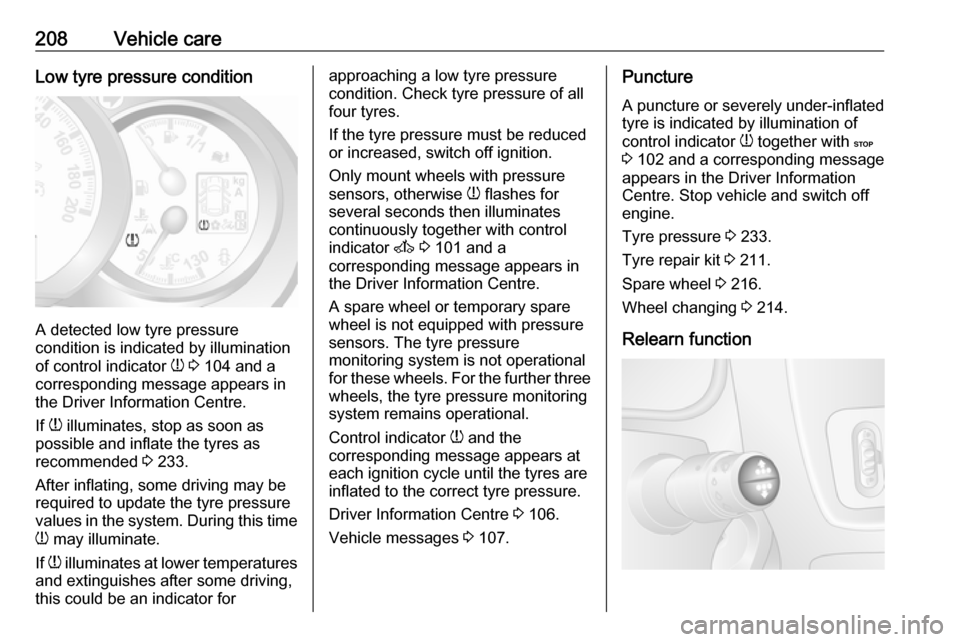
A detected low tyre pressure
condition is indicated by illumination
of control indicator w 3 104 and a
corresponding message appears in
the Driver Information Centre.
If w illuminates, stop as soon as
possible and inflate the tyres as
recommended 3 233.
After inflating, some driving may be
required to update the tyre pressure
values in the system. During this time
w may illuminate.
If w illuminates at lower temperatures
and extinguishes after some driving,
this could be an indicator for
approaching a low tyre pressure
condition. Check tyre pressure of all
four tyres.
If the tyre pressure must be reduced
or increased, switch off ignition.
Only mount wheels with pressure
sensors, otherwise w flashes for
several seconds then illuminates
continuously together with control
indicator A 3 101 and a
corresponding message appears in
the Driver Information Centre.
A spare wheel or temporary spare
wheel is not equipped with pressure
sensors. The tyre pressure
monitoring system is not operational
for these wheels. For the further three wheels, the tyre pressure monitoring
system remains operational.
Control indicator w and the
corresponding message appears at
each ignition cycle until the tyres are
inflated to the correct tyre pressure.
Driver Information Centre 3 106.
Vehicle messages 3 107.Puncture
A puncture or severely under-inflated
tyre is indicated by illumination of
control indicator w together with C
3 102 and a corresponding message
appears in the Driver Information
Centre. Stop vehicle and switch off
engine.
Tyre pressure 3 233.
Tyre repair kit 3 211.
Spare wheel 3 216.
Wheel changing 3 214.
Relearn function
Page 229 of 251

Service and maintenance227International service intervalsAlbania, Bosnia-Herzegovina,
Kosovo, Macedonia, Montenegro,
Serbia, Romania, Bulgaria, Moldova,
Cyprus:
Maintenance of your vehicle is
required every 30,000 km or after
two years, whichever occurs first,
unless otherwise indicated by the
service display.
Turkey, Morocco:
Maintenance of your vehicle is
required every 20,000 km or after one year, whichever occurs first,
unless otherwise indicated by the
service display.
Russia, Ukraine, Belarus,
Kazakhstan, Malta:
Maintenance of your vehicle is
required every 15,000 km or after
one year, whichever occurs first,
unless otherwise indicated by the
service display.Algeria, Tunisia:
Maintenance of your vehicle is
required every 10,000 km or after
one year, whichever occurs first,
unless otherwise indicated by the service display.
Severe operating conditions exist if
one or more of the following
circumstances occur frequently: Cold
starting, stop and go operation, trailer operation, mountain driving, driving
on poor and sandy road surfaces,
increased air pollution, presence of
airborne sand and high dust content,
driving at high altitude and large
variations of temperature. Under
these severe operating conditions,
certain service work may be required more frequently than the regular
service interval.
Confirmations Confirmation of service is recorded inthe Service and warranty booklet.
The date and mileage is completed
with the stamp and signature of the
servicing workshop.Make sure that the Service and
warranty booklet is completed
correctly as continuous proof of
service is essential if any warranty or
goodwill claims are to be met, and is
also a benefit when selling the
vehicle.
Service display The service interval is based on
several parameters depending on
usage.
The service display, located in the
Driver Information Centre, indicates
when the next service is due. Seek
the assistance of a workshop.
Service display 3 96.
Engine oil lever monitor 3 96.
Page 241 of 251

Customer information239Operating data in the vehicleControl units process data for
operation of the vehicle.
This data includes, e.g.: ● vehicle status information (e.g. speed, movement delay, lateral
acceleration, wheel rotation rate,
"seat belts fastened" display)
● ambient conditions (e.g. temperature, rain sensor,
distance sensor)
As a rule such data is transient, not
stored for longer than an operational
cycle, and only processed on board
the vehicle itself. Control units often
include data storage (including the
vehicle key). This is used to allow
information to be documented
temporarily or permanently on vehicle
condition, component stress,
maintenance requirements and
technical events and errors.Depending on technical equipment
level, the data stored is as follows:
● system component operating states (e.g. fill level, tyre
pressure, battery status)
● faults and defects in important system components (e.g. lights,brakes)
● system reactions in special driving situations (e.g. triggering
of an airbag, actuation of the
stability control systems)
● information on events damaging the vehicle
● for electric vehicles the amount of
charge in the high-voltage
battery, estimated range
In special cases (e.g. if the vehicle
has detected a malfunction), it may be
necessary to save data that would
otherwise just be volatile.
When you use services (e.g. repairs,
maintenance), the operating data
saved can be read together with the
vehicle identification number and
used when necessary. Staff working
for the service network ( e.g. garages,
manufacturers) or third parties (e.g.breakdown services) can read the
data from the vehicle. The same
applies to warranty work and quality
assurance measures.
Data is generally read via the OBD
(On-Board Diagnostics) port
prescribed by law in the vehicle. The operating data which is read out,
documents the technical condition of
the vehicle or individual components
and assists with fault diagnosis,
compliance with warranty obligations
and quality improvement. This data,
in particular information on
component stress, technical events,
operator errors and other faults, is
transmitted to the manufacturer
where appropriate, together with the
vehicle identification number. The
manufacturer is also subject to
product liability. The manufacturer
potentially also uses operating data
from vehicles for product recalls. This
data can also be used to check
customer warranty and guarantee
claims.
Fault memories in the vehicle can be
reset by a service company when
carrying out servicing or repairs or at
your request.
Page 242 of 251

240Customer informationComfort and infotainment
functions
Comfort settings and custom settings
can be stored in the vehicle and
changed or reset at any time.
Depending on the equipment level in
question, these include
● seat and steering wheel position settings
● chassis and air conditioning settings
● custom settings such as interior lighting
You can input your own data in the
infotainment functions for your
vehicle as part of the selected
features.
Depending on the equipment level in
question, these include
● multimedia data such as music, videos or photos for playback in
an integrated multimedia system
● address book data for use with an
integrated hands-free system or an integrated navigation system● input destinations
● data on the use of online services
This data for comfort and
infotainment functions can be stored
locally in the vehicle or be kept on a
device that you have connected to the
vehicle ( e.g. a smartphone, USB stick
or MP3 player). Data that you have
input yourself can be deleted at any
time.
This data can only be transmitted out
of the vehicle at your request,
particularly when using online
services in accordance with the
settings selected by you.
Smartphone integration, e.g.
Android Auto or Apple CarPlay
If your vehicle is equipped
accordingly, you can connect your
smartphone or another mobile device
to the vehicle so that you can control
it via the controls integrated in the
vehicle. The smartphone image and
sound can be output via the
multimedia system in this case. At the same time, specific information is
transmitted to your smartphone.
Depending on the type of integration,this includes data such as position
data, day / night mode and other
general vehicle information. For more
information, please see the operating
instructions for the vehicle /
infotainment system.
Integration allows selected
smartphone apps to be used, such as
navigation or music playback. No
further integration is possible
between smartphone and vehicle, in particular active access to vehicle
data. The nature of further data
processing is determined by the
provider of the app used. Whether
you can define settings, and if so
which ones, is dependent on the app
in question and your smartphone's
operating system.