belt OPEL MOVANO_B 2019 Manual user
[x] Cancel search | Manufacturer: OPEL, Model Year: 2019, Model line: MOVANO_B, Model: OPEL MOVANO_B 2019Pages: 251, PDF Size: 6.46 MB
Page 101 of 251
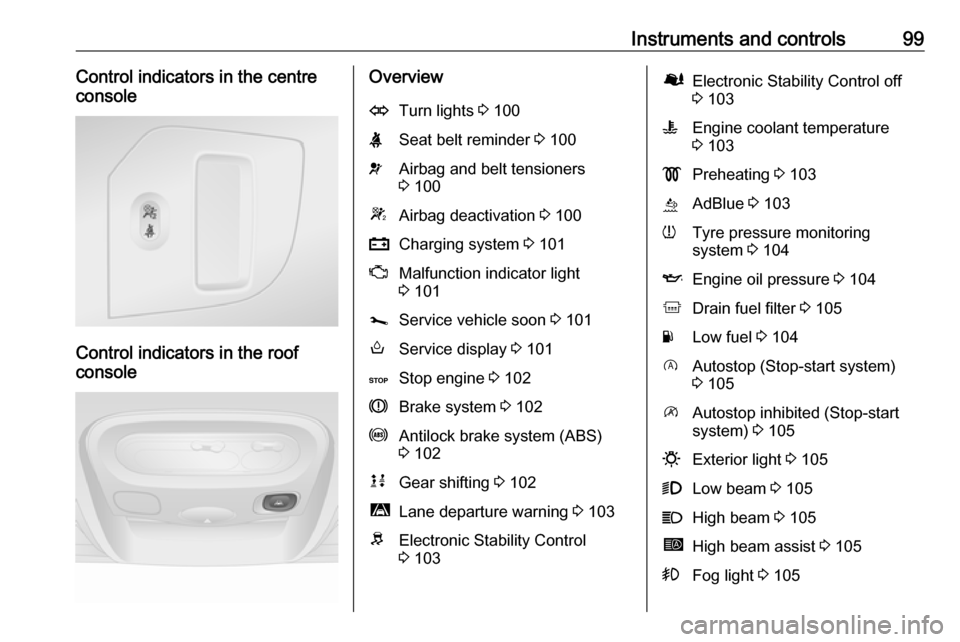
Instruments and controls99Control indicators in the centre
console
Control indicators in the roof
console
OverviewOTurn lights 3 100XSeat belt reminder 3 100vAirbag and belt tensioners
3 100WAirbag deactivation 3 100pCharging system 3 101ZMalfunction indicator light
3 101jService vehicle soon 3 101oService display 3 101CStop engine 3 102RBrake system 3 102uAntilock brake system (ABS)
3 102kjGear shifting 3 102ìLane departure warning 3 103RElectronic Stability Control
3 103ØElectronic Stability Control off
3 103WEngine coolant temperature
3 103!Preheating 3 103úAdBlue 3 103wTyre pressure monitoring
system 3 104IEngine oil pressure 3 104kDrain fuel filter 3 105YLow fuel 3 104DAutostop (Stop-start system)
3 105\Autostop inhibited (Stop-start
system) 3 1050Exterior light 3 1059Low beam 3 105CHigh beam 3 105íHigh beam assist 3 105>Fog light 3 105
Page 102 of 251
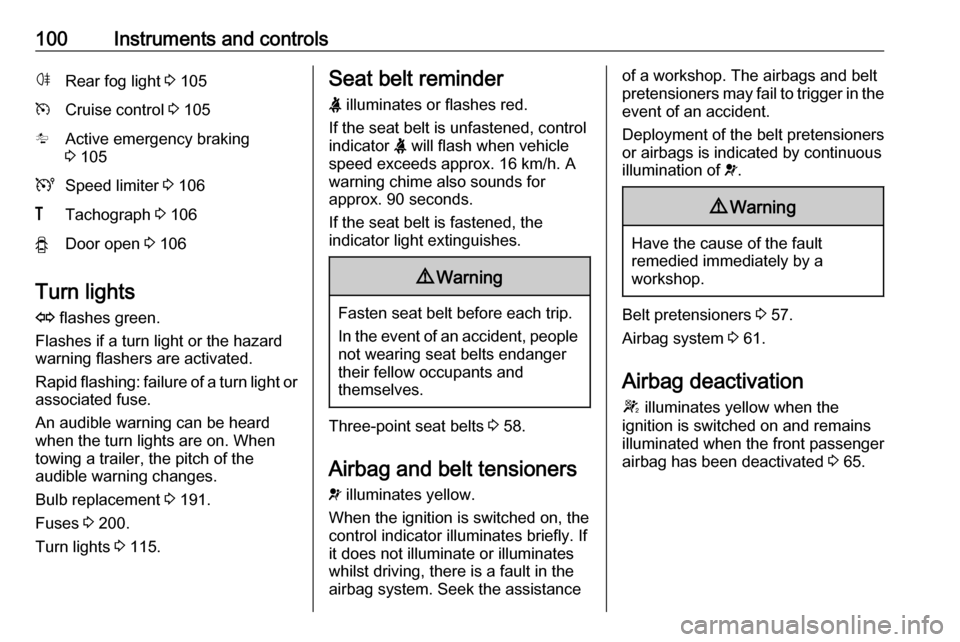
100Instruments and controlsøRear fog light 3 105mCruise control 3 105lActive emergency braking
3 105USpeed limiter 3 106&Tachograph 3 106yDoor open 3 106
Turn lights
O flashes green.
Flashes if a turn light or the hazard
warning flashers are activated.
Rapid flashing: failure of a turn light or
associated fuse.
An audible warning can be heard
when the turn lights are on. When
towing a trailer, the pitch of the
audible warning changes.
Bulb replacement 3 191.
Fuses 3 200.
Turn lights 3 115.
Seat belt reminder
X illuminates or flashes red.
If the seat belt is unfastened, control indicator X will flash when vehicle
speed exceeds approx. 16 km/h. A warning chime also sounds for
approx. 90 seconds.
If the seat belt is fastened, the
indicator light extinguishes.9 Warning
Fasten seat belt before each trip.
In the event of an accident, people
not wearing seat belts endanger their fellow occupants and
themselves.
Three-point seat belts 3 58.
Airbag and belt tensioners
v illuminates yellow.
When the ignition is switched on, the control indicator illuminates briefly. If
it does not illuminate or illuminates
whilst driving, there is a fault in the
airbag system. Seek the assistance
of a workshop. The airbags and belt
pretensioners may fail to trigger in the event of an accident.
Deployment of the belt pretensioners
or airbags is indicated by continuous
illumination of v.9 Warning
Have the cause of the fault
remedied immediately by a
workshop.
Belt pretensioners 3 57.
Airbag system 3 61.
Airbag deactivation W illuminates yellow when the
ignition is switched on and remains
illuminated when the front passenger
airbag has been deactivated 3 65.
Page 103 of 251

Instruments and controls1019Danger
Risk of fatal injury for a child using
a child restraint system together
with activated front passenger
airbag.
Risk of fatal injury for an adult
person with deactivated front
passenger airbag.
Airbag system 3 61.
Belt tensioners 3 57.
Airbag deactivation 3 65.
Charging system p illuminates red.
Illuminates when the ignition is
switched on and extinguishes shortly after the engine starts.
Illuminates when the engine is
running
Stop, switch off engine. Vehicle
battery is not charging. Engine
cooling may be interrupted. The
brake servo unit may cease to be
effective. Seek the assistance of a
workshop.
Malfunction indicator light
Z illuminates or flashes yellow.
Illuminates briefly when the ignition is
switched on.
Illuminates when the engine is
running
Fault in the emission control system. The permitted emission limits may be exceeded. Seek the assistance of a
workshop immediately.
If Z illuminates in combination with
A , stop vehicle and switch off engine
as soon as possible.9 Warning
Have the cause of the fault
remedied immediately by a
workshop.
Flashes when the engine is
running
Fault that could lead to catalytic
converter damage. Ease up on the
accelerator until the flashing stops.
Seek the immediate assistance of a
workshop.
Service vehicle soon
j illuminates yellow.
Illuminates briefly when the ignition is
switched on.
The vehicle needs a service.
May illuminate in combination with
another control indicator or a
message in the Driver Information
Centre 3 106.
Illuminates if cleaning of the diesel particle filter is required and
automatic cleaning does not occur
3 146.
Page 110 of 251

108Instruments and controlsdisappear automatically and j
remains illuminated. The fault will
then be stored in the on board
system.Fault messagesCHECK ESPCHECK FUEL FILTERCHECK GEARBOXCHECK AUTO LIGHTSWARNING AEBS CHECKWARNING AEBS DISABLED
Warning messages
These may appear with control
indicator C or in combination with
other warning messages, control
indicators or an audible warning. Stop engine immediately and seek the
assistance of a workshop.
Warning messagesINJECTION FAULTENGINE OVERHEATINGGEARBOX OVERHEATING
Tyre pressure monitoring system
3 207.
Warning chimes If several warnings appear at thesame time, only one warning chime
will sound.
When starting the engine or whilst
driving
The warning chime regarding
unfastened seat belts has priority
over any other warning chime.
● If seat belt is not fastened 3 58.
● If a certain speed is exceeded with the parking brake applied
3 159.
● If the parking assist detects an object or a fault is present
3 169.
● If the vehicle has manual
transmission automated and theclutch temperature is too high3 154.
● If the vehicle speed briefly exceeds a set limit 3 93.
● During closing of the power sliding door 3 32.
● If the sliding door is open and the
parking brake is released 3 32.
● During activation and deactivation of alarm monitoringof vehicle inclination 3 38.
● If the AdBlue level falls below a certain amount or a fault is
present 3 147.
● If the lane departure warning system detects an unintended
lane change and when the
system is activated 3 173.
When the vehicle is parked and / or the driver's door is opened
● When the key is in the ignition switch.
● With exterior lights on 3 112.
Page 136 of 251
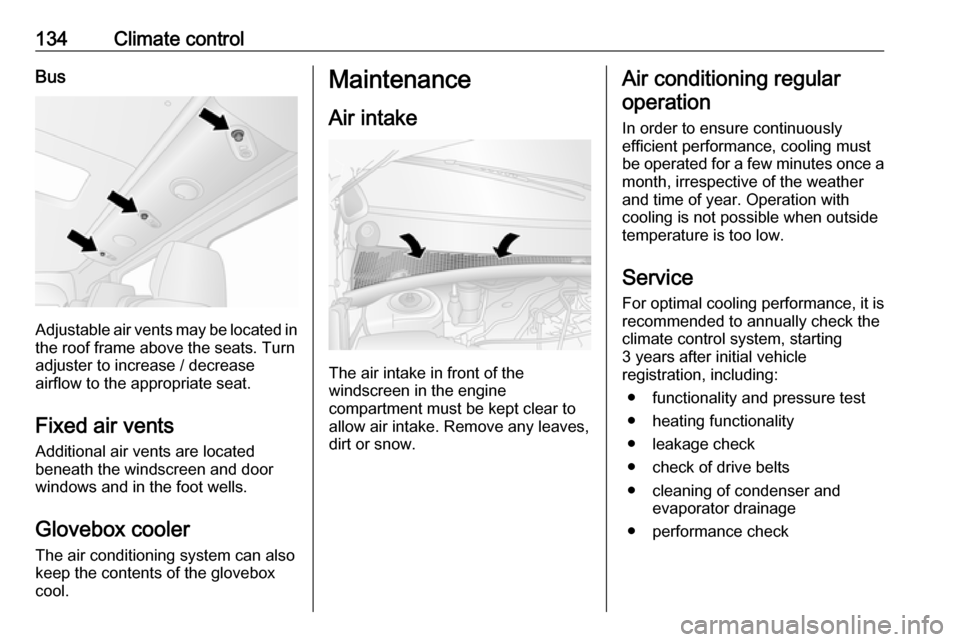
134Climate controlBus
Adjustable air vents may be located inthe roof frame above the seats. Turn
adjuster to increase / decrease
airflow to the appropriate seat.
Fixed air vents
Additional air vents are located
beneath the windscreen and door
windows and in the foot wells.
Glovebox cooler The air conditioning system can alsokeep the contents of the glovebox
cool.
Maintenance
Air intake
The air intake in front of the
windscreen in the engine
compartment must be kept clear to
allow air intake. Remove any leaves,
dirt or snow.
Air conditioning regular
operation
In order to ensure continuously
efficient performance, cooling must
be operated for a few minutes once a
month, irrespective of the weather
and time of year. Operation with
cooling is not possible when outside
temperature is too low.
ServiceFor optimal cooling performance, it is
recommended to annually check the
climate control system, starting
3 years after initial vehicle
registration, including:
● functionality and pressure test
● heating functionality
● leakage check
● check of drive belts
● cleaning of condenser and evaporator drainage
● performance check
Page 208 of 251

206Vehicle careWinter tyresWinter tyres improve driving safety at
temperatures below 7 °C and should
therefore be fitted on all wheels.
In accordance with country-specific
regulations, affix the maximum speed sticker in the driver's field of view.
Tyre designations
E.g. 215/65 R 16 C 109 R215:tyre width, mm65:cross-section ratio (tyre height
to tyre width), %R:belt type: RadialRF:type: RunFlat16:wheel diameter, inchesC:cargo or commercial use88:load index e.g. 109 is
equivalent to approx. 1030 kgR:speed code letter
Speed code letter:
Q:up to 160 km/hS:up to 180 km/hT:up to 190 km/hH:up to 210 km/hV:up to 240 km/hW:up to 270 km/hChoose a tyre appropriate for the
maximum speed of your vehicle.
The maximum speed is achievable at kerb weight with driver (75 kg) plus
125 kg payload. Optional equipment
could reduce the maximum speed of
the vehicle.
Directional tyres
Fit directional tyres such that they roll in the direction of travel. The rolling
direction is indicated by a symbol
(e.g. an arrow) on the sidewall.
Tyre pressure
Check the pressure of cold tyres at
least every 14 days and before any
long journey. Do not forget the spare
wheel. This also applies to vehicles
with tyre pressure monitoring system.
The tyre pressure information label
on the driver's door frame indicates the original equipment tyres and the
correspondent tyre pressures.
Always inflate tyres to the pressures
shown on the label.
Tyre pressures 3 233.The tyre pressure data refers to cold
tyres. It applies to summer and winter tyres.
Always inflate the spare tyre to the
highest pressure specified for this
tyre size.
Incorrect tyre pressures will impair
safety, vehicle handling, comfort and
fuel economy and will increase tyre
wear.
Tyre pressures differ depending on
various options. For the correct tyre
pressure value, follow the procedure
below:
1. Identify the type of drive.
2. Identify the gross vehicle weight.
3. Identify the respective tyre.
The tyre pressure tables show all
possible tyre combinations 3 233.
For the tyres approved for your
vehicle, refer to the EEC Certificate of Conformity provided with your vehicle
or other national registration
documents.
The driver is responsible for correct
adjustment of tyre pressure.
Page 226 of 251

224Vehicle careFor mechanical removal of ice, use a
sharp-edged ice scraper. Press the
scraper firmly against the glass so
that no dirt can get under it and
scratch the glass.
Remove dirt residues from smearing
wiper blades by using a soft cloth and window cleaner. Also make sure to
remove any residues such as wax,
insect residues and similar from the
window.
Wheels and tyres Do not use high-pressure jet
cleaners.
Clean rims with a pH-neutral wheel
cleaner.
Rims are painted and can be treated
with the same agents as the body.
Paintwork damage
Rectify minor paintwork damage with a touch-up pen before rust forms.
Have more extensive damage or rust areas repaired by a workshop.Underbody
Some areas of the vehicle underbody
have a PVC undercoating while other
critical areas have a durable
protective wax coating.
After the underbody is washed, check
the underbody and have it waxed if
necessary.
Bitumen / rubber materials could
damage the PVC coating. Have
underbody work carried out by a
workshop.
Before and after winter, wash the
underbody and have the protective
wax coating checked.
Towing equipment
Do not clean the coupling ball bar with a steam-jet or high-pressure jet
cleaner.Interior care
Interior and upholstery Only clean the vehicle interior,
including the instrument panel fascia
and panelling, with a dry cloth or
interior cleaner.
Clean leather upholstery with clear
water and a soft cloth. In case of
heavy soiling, use leather care.
The instrument cluster and the
displays should only be cleaned using
a soft damp cloth. If necessary use a
weak soap solution.
Clean fabric upholstery with a
vacuum cleaner and brush. Remove
stains with an upholstery cleaner.
Clothing fabrics may not be
colourfast. This could cause visible
discolourations, especially on light-
coloured upholstery. Removable
stains and discolourations should be
cleaned as soon as possible.
Clean seat belts with lukewarm water or interior cleaner.
Page 227 of 251

Vehicle care225Caution
Close Velcro fasteners as open
Velcro fasteners on clothing could damage seat upholstery.
The same applies to clothing with
sharp-edged objects, like zips or
belts or studded jeans.
Plastic and rubber parts
Plastic and rubber parts can be
cleaned with the same cleaner as
used to clean the body. Use interior cleaner if necessary. Do not use any
other agent. Avoid solvents and petrol in particular. Do not use high-
pressure jet cleaners.
Page 241 of 251

Customer information239Operating data in the vehicleControl units process data for
operation of the vehicle.
This data includes, e.g.: ● vehicle status information (e.g. speed, movement delay, lateral
acceleration, wheel rotation rate,
"seat belts fastened" display)
● ambient conditions (e.g. temperature, rain sensor,
distance sensor)
As a rule such data is transient, not
stored for longer than an operational
cycle, and only processed on board
the vehicle itself. Control units often
include data storage (including the
vehicle key). This is used to allow
information to be documented
temporarily or permanently on vehicle
condition, component stress,
maintenance requirements and
technical events and errors.Depending on technical equipment
level, the data stored is as follows:
● system component operating states (e.g. fill level, tyre
pressure, battery status)
● faults and defects in important system components (e.g. lights,brakes)
● system reactions in special driving situations (e.g. triggering
of an airbag, actuation of the
stability control systems)
● information on events damaging the vehicle
● for electric vehicles the amount of
charge in the high-voltage
battery, estimated range
In special cases (e.g. if the vehicle
has detected a malfunction), it may be
necessary to save data that would
otherwise just be volatile.
When you use services (e.g. repairs,
maintenance), the operating data
saved can be read together with the
vehicle identification number and
used when necessary. Staff working
for the service network ( e.g. garages,
manufacturers) or third parties (e.g.breakdown services) can read the
data from the vehicle. The same
applies to warranty work and quality
assurance measures.
Data is generally read via the OBD
(On-Board Diagnostics) port
prescribed by law in the vehicle. The operating data which is read out,
documents the technical condition of
the vehicle or individual components
and assists with fault diagnosis,
compliance with warranty obligations
and quality improvement. This data,
in particular information on
component stress, technical events,
operator errors and other faults, is
transmitted to the manufacturer
where appropriate, together with the
vehicle identification number. The
manufacturer is also subject to
product liability. The manufacturer
potentially also uses operating data
from vehicles for product recalls. This
data can also be used to check
customer warranty and guarantee
claims.
Fault memories in the vehicle can be
reset by a service company when
carrying out servicing or repairs or at
your request.
Page 244 of 251

242IndexAAbsorptive Glass Mat battery .....187
Accessories and vehicle modifications .......................... 181
Active emergency braking ..105, 167
AdBlue ........................ 103, 147, 228
AdBlue gauge ............................... 95
AdBlue tank ................................ 232
Adjustable air vents ...................133
Airbag and belt tensioners .........100
Airbag deactivation ..............65, 100
Airbag label................................... 61 Airbag system .............................. 61
Air conditioning regular operation ................................ 134
Air conditioning system .............. 121
Air intake .................................... 134
Air suspension ........................... 144
Air suspension system................ 221
Air vents...................................... 133
Antifreeze ................................... 185
Antilock brake system ................ 158
Antilock brake system (ABS) .....102
Anti-theft alarm system ................38
Anti-theft bolts............................. 214
Anti-theft locking system .............. 37
Anti-theft security lock ..................25
Appearance care ........................222
Armrest ........................................ 53
Ashtrays ....................................... 93Automatic light control ...............112
Automatic locking ...................26, 31
Autostop ....................... 19, 139, 140
Auxiliary heater ........................... 127
B Battery .................... 23, 24, 127, 187
Battery discharge protection ......119
Battery, jump starting.................. 218
Belts.............................................. 57 Bonnet ....................................... 182
Bottle holders................................ 77
Brake assist ............................... 160
Brake fluid .......................... 187, 228
Brakes ............................... 158, 187
Brake system ............................. 102
Breakdown.................................. 221
Bulb replacement ....................... 191
Bus Rear seats ................................. 54
C Cabin bulkhead grille ....................83
Capacities .................................. 232
Cargo management system ........80
Car Pass ...................................... 23
Catalytic converter .....................146
Central locking system ................26
Centre high-mounted brake light 197
Changing tyre and wheel size ...210
Charging system ........................ 101