lock OPEL MOVANO_B 2020 Manual user
[x] Cancel search | Manufacturer: OPEL, Model Year: 2020, Model line: MOVANO_B, Model: OPEL MOVANO_B 2020Pages: 353, PDF Size: 9.4 MB
Page 310 of 353
308Vehicle careCaution
Drive slowly. Do not drive jerkily.
Excessive tractive force can
damage the vehicle.
Appearance care
Exterior care Locks
The locks are lubricated at the factory using a high quality lock cylinder
grease. Use de-icing agent only when absolutely necessary, as this has a
degreasing effect and impairs lock function. After using a de-icing agent,
have the locks regreased by a
workshop.
WashingThe paintwork of your vehicle is
exposed to environmental influences.
Wash and wax your vehicle regularly.
When using automatic vehicle
washes, select a programme that
includes waxing. Restrictions for
filmed or matt painted body parts or
decor tapes, see "Polishing and
waxing".
Bird droppings, dead insects, resin,
pollen and the like should be cleaned
off immediately, as they contain
aggressive constituents which can
cause paint damage.If using a vehicle wash, comply with
the vehicle wash manufacturer's
instructions. The windscreen wipers
must be switched off and the exterior
mirrors must be folded in. Remove
antenna and external accessories
such as roof racks etc.
If you wash your vehicle by hand,
make sure that the insides of the
wheel housings are also thoroughly
rinsed out.
Clean edges and folds on opened
doors and the bonnet as well as the
areas they cover.
Clean bright metal mouldings with a
cleaning solution approved for
aluminium to avoid damages.Caution
Always use a cleaning agent with
a pH value of four to nine.
Do not use cleaning agents on hot surfaces.
Have the door hinges of all doors
greased by a workshop.
Page 318 of 353
316Technical dataIdentification plate
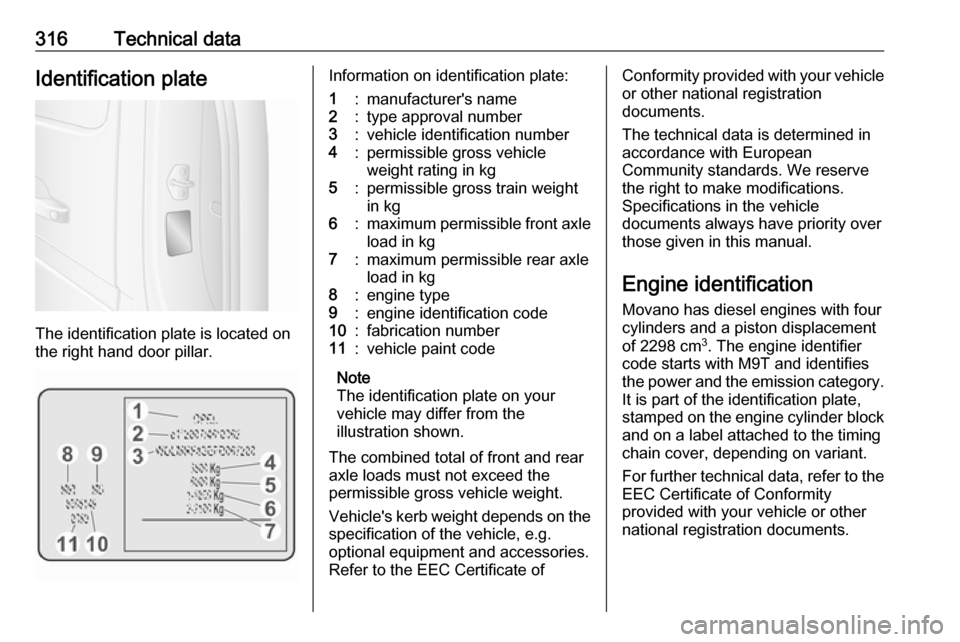
The identification plate is located on
the right hand door pillar.
Information on identification plate:1:manufacturer's name2:type approval number3:vehicle identification number4:permissible gross vehicle
weight rating in kg5:permissible gross train weight
in kg6:maximum permissible front axle load in kg7:maximum permissible rear axle
load in kg8:engine type9:engine identification code10:fabrication number11:vehicle paint code
Note
The identification plate on your
vehicle may differ from the
illustration shown.
The combined total of front and rear
axle loads must not exceed the
permissible gross vehicle weight.
Vehicle's kerb weight depends on the
specification of the vehicle, e.g.
optional equipment and accessories. Refer to the EEC Certificate of
Conformity provided with your vehicle
or other national registration
documents.
The technical data is determined in
accordance with European
Community standards. We reserve
the right to make modifications.
Specifications in the vehicle
documents always have priority over
those given in this manual.
Engine identification
Movano has diesel engines with four
cylinders and a piston displacement
of 2298 cm 3
. The engine identifier
code starts with M9T and identifies
the power and the emission category. It is part of the identification plate,
stamped on the engine cylinder block
and on a label attached to the timing
chain cover, depending on variant.
For further technical data, refer to the EEC Certificate of Conformity
provided with your vehicle or other
national registration documents.
Page 328 of 353

326Customer informationOnline servicesIf your vehicle has a radio networkconnection, this allows data to be
exchanged between your vehicle and other systems. The radio network
connection is made possible by
means of a transmitter device in your
vehicle or a mobile device provided
by you (e.g. a smartphone). Online
functions can be used via this radio
network connection. These include
online services and applications /
apps provided to you by the
manufacturer or other providers.
Proprietary services
In the case of the manufacturer's
online services, the relevant functions are described by the manufacturer in
an appropriate location (e.g. Owner's
Manual, the manufacturer's website) and the associated data protection
information is provided. Personal
data may be used to provide online
services. Data exchange for this
purpose takes place via a protected
connection, e.g. using the
manufacturer's IT systems provided
for the purpose. Collection,processing and use of personal data
for the purposes of preparation of services take place solely on the
basis of legal permission, e.g. in the
case of a legally prescribed
emergency communication system or a contractual agreement, or by virtue
of consent.
You can activate or deactivate the services and functions (which are
subject to charges to some extent)
and, in some cases, the vehicle's
entire radio network connection. This
does not include statutory functions
and services such as an emergency
communication system.
Third party services If you make use of online services
from other providers (third parties),
these services are subject to the
liability and data protection and usage conditions of the provider in question.
The manufacturer frequently has no
influence over the content exchanged
in this regard.Therefore, please note the nature,
scope and purpose of the collection
and use of personal data within the
scope of third party services provided by the service provider in question.
Radio Frequency
Identification (RFID)
RFID technology is used in some
vehicles for functions such as tyre
pressure monitoring and immobiliser.
It is also used in connection with
conveniences such as radio remote
controls for door locking / unlocking and starting. RFID technology in Opel vehicles does not use or record
personal information or link with any
other Opel system containing
personal information.
Page 330 of 353
328Body conversions● Place loads from the minimumpracticable height. Do not drop
loads onto the body.
● Do not overload the body.
● Ensure the load will not fall out or
endanger other road users.
● Do not drive with the body tipped.
● Do not drive with the tailboard or sideboards down.
● Do not attempt to tip loads from the body when body sides or
tailboard are closed.
● Observe the safety warning labels placed on the tipper and
dropside bodies.
● Do not attempt to tip loads unless
the vehicle is on solid ground.
● The isolation switch must be in the OFF position when tipping
function is not in use.Caution
Do not exceed the maximum
lateral load of 200 kg (dropside body) and 400 kg (tipper body) as
stated on the head board.
When loading heavy or bulk items, the lashing eyes must be flush with
the body floor to avoid causing any damage.
Refer to the safety warning labels
located on the tipper or dropside
body.
The maximum loading on the
dropside body floor is 230 kg per
80 mm x 80 mm or 80 kg per 50
mm x 50 mm.
Tailboard
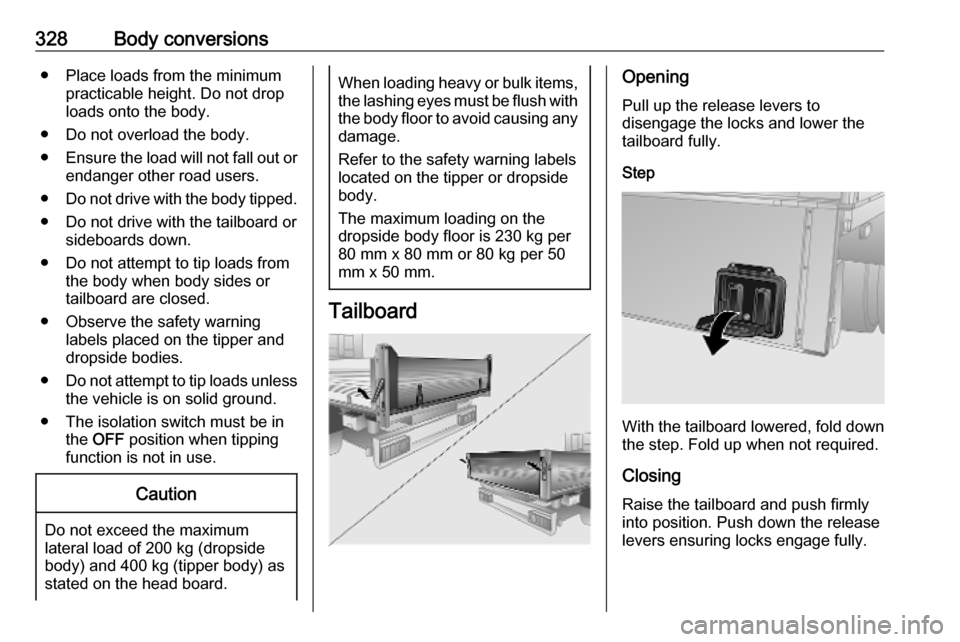
Opening
Pull up the release levers to
disengage the locks and lower the
tailboard fully.
Step
With the tailboard lowered, fold down
the step. Fold up when not required.
Closing
Raise the tailboard and push firmly
into position. Push down the release
levers ensuring locks engage fully.
Page 331 of 353
Body conversions329SwingingThe tailboard lower hinges can be
released to allow the tailboard to
swing from its upper hinges during
tipping operations.9 Warning
To prevent the tailboard becoming
detached from the vehicle, ensure that the upper hinges are engaged
with the release levers in the
locked position.
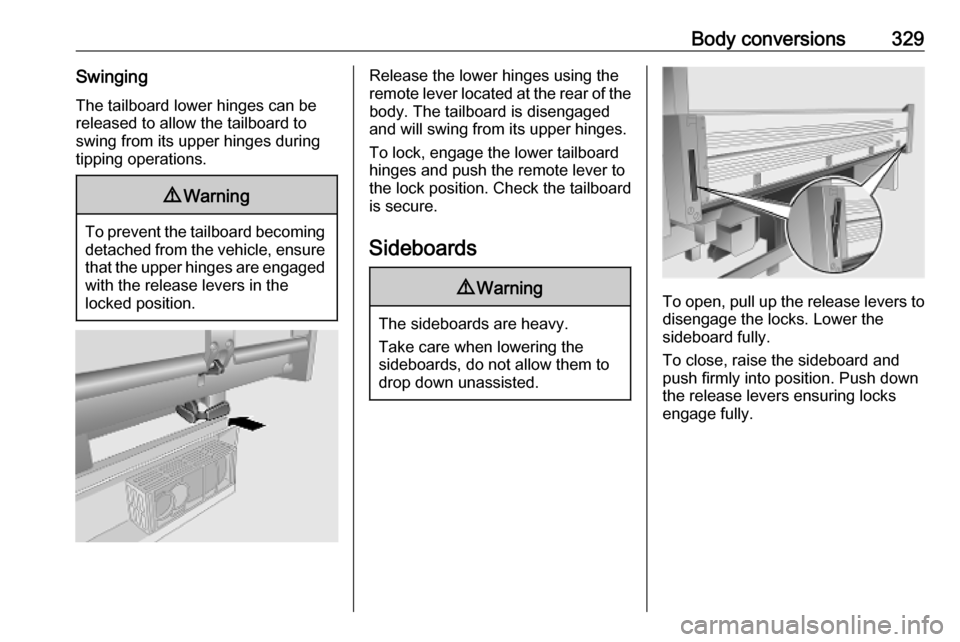
Release the lower hinges using the
remote lever located at the rear of the body. The tailboard is disengaged
and will swing from its upper hinges.
To lock, engage the lower tailboard
hinges and push the remote lever to
the lock position. Check the tailboard
is secure.
Sideboards9 Warning
The sideboards are heavy.
Take care when lowering the
sideboards, do not allow them to
drop down unassisted.
To open, pull up the release levers to disengage the locks. Lower the
sideboard fully.
To close, raise the sideboard and
push firmly into position. Push down
the release levers ensuring locks
engage fully.
Page 332 of 353
330Body conversionsLashing eyes
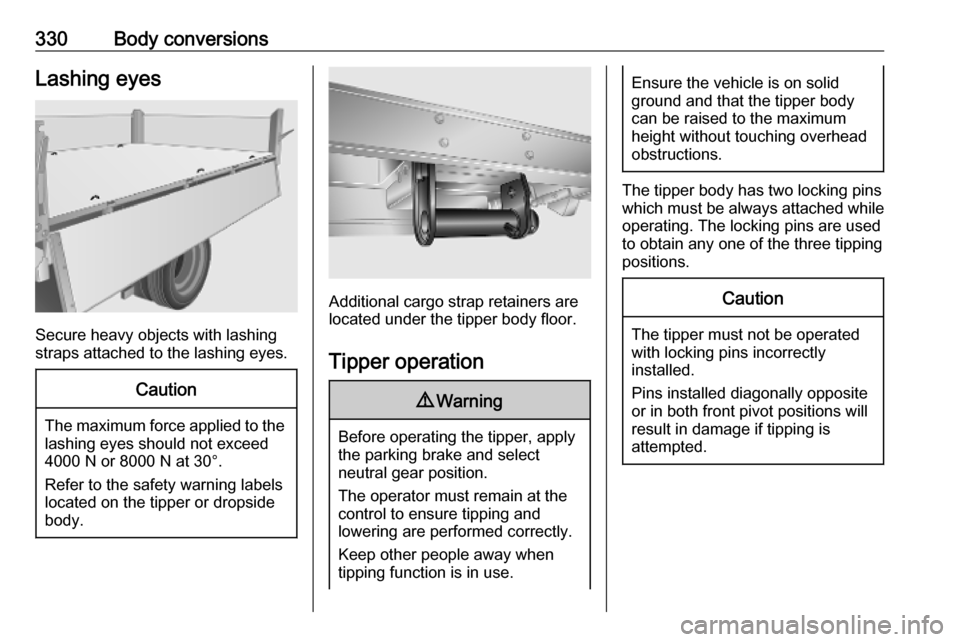
Secure heavy objects with lashing
straps attached to the lashing eyes.
Caution
The maximum force applied to the
lashing eyes should not exceed
4000 N or 8000 N at 30°.
Refer to the safety warning labels
located on the tipper or dropside
body.
Additional cargo strap retainers are
located under the tipper body floor.
Tipper operation
9 Warning
Before operating the tipper, apply
the parking brake and select
neutral gear position.
The operator must remain at the
control to ensure tipping and
lowering are performed correctly.
Keep other people away when
tipping function is in use.
Ensure the vehicle is on solid
ground and that the tipper body
can be raised to the maximum
height without touching overhead
obstructions.
The tipper body has two locking pins
which must be always attached while
operating. The locking pins are used
to obtain any one of the three tipping
positions.
Caution
The tipper must not be operated
with locking pins incorrectly
installed.
Pins installed diagonally opposite or in both front pivot positions will
result in damage if tipping is
attempted.
Page 333 of 353
Body conversions331Tipping to the side
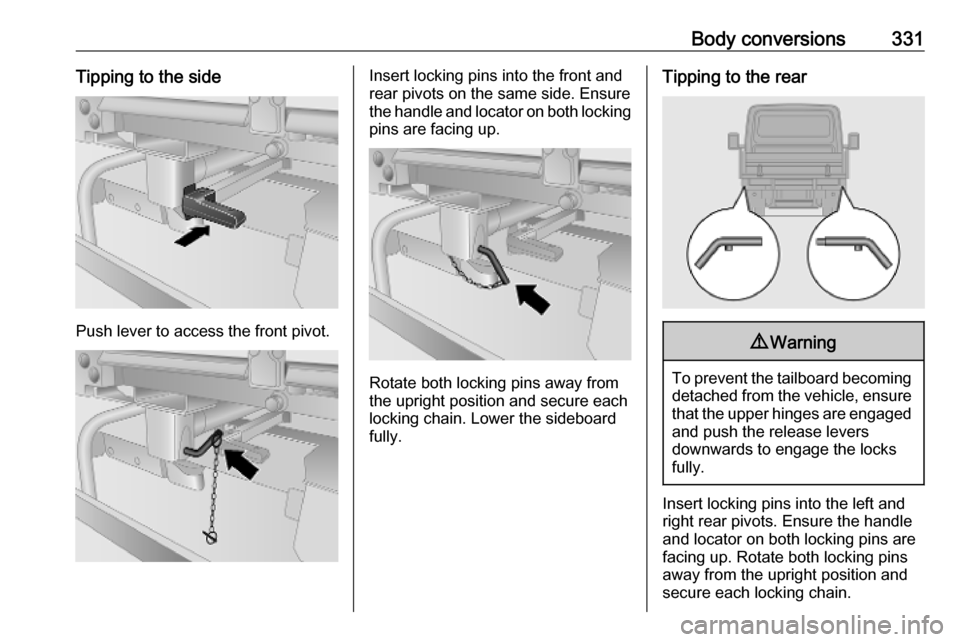
Push lever to access the front pivot.
Insert locking pins into the front and
rear pivots on the same side. Ensure the handle and locator on both locking
pins are facing up.
Rotate both locking pins away from
the upright position and secure each
locking chain. Lower the sideboard
fully.
Tipping to the rear9 Warning
To prevent the tailboard becoming
detached from the vehicle, ensure that the upper hinges are engaged
and push the release levers
downwards to engage the locks
fully.
Insert locking pins into the left and
right rear pivots. Ensure the handle
and locator on both locking pins are
facing up. Rotate both locking pins
away from the upright position and
secure each locking chain.
Page 336 of 353
334Body conversionsToolbox
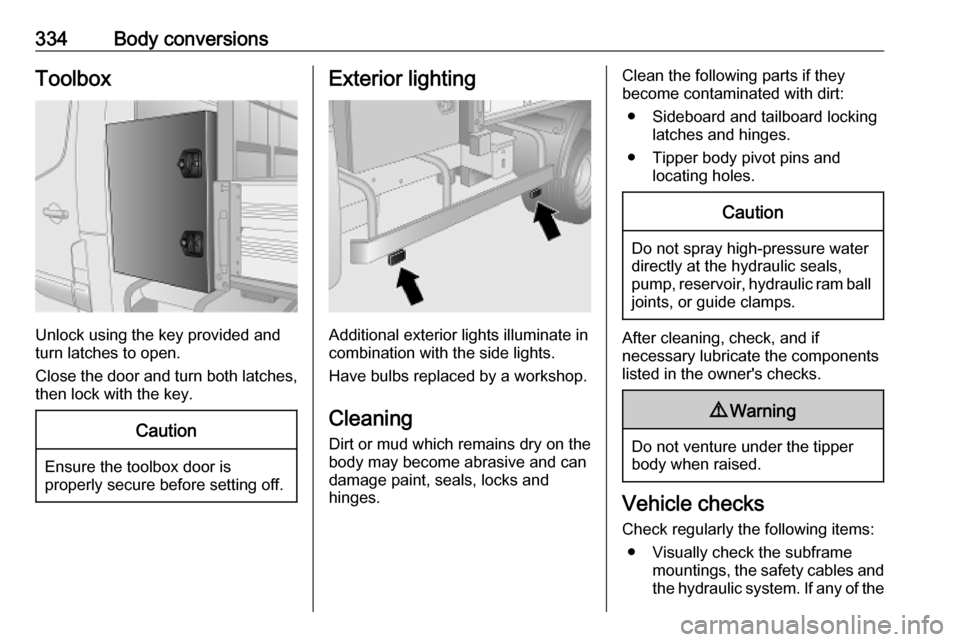
Unlock using the key provided and
turn latches to open.
Close the door and turn both latches,
then lock with the key.
Caution
Ensure the toolbox door is
properly secure before setting off.
Exterior lighting
Additional exterior lights illuminate in
combination with the side lights.
Have bulbs replaced by a workshop.
Cleaning Dirt or mud which remains dry on thebody may become abrasive and can
damage paint, seals, locks and
hinges.
Clean the following parts if they
become contaminated with dirt:
● Sideboard and tailboard locking latches and hinges.
● Tipper body pivot pins and locating holes.Caution
Do not spray high-pressure water
directly at the hydraulic seals,
pump, reservoir, hydraulic ram ball
joints, or guide clamps.
After cleaning, check, and if
necessary lubricate the components
listed in the owner's checks.
9 Warning
Do not venture under the tipper
body when raised.
Vehicle checks
Check regularly the following items: ● Visually check the subframe mountings, the safety cables andthe hydraulic system. If any of the
Page 338 of 353
336Body conversionsBox body
Keys
The radio remote control only
operates the front door locks.
Additional keys are provided for the
load compartment door locks.
Doors Side door
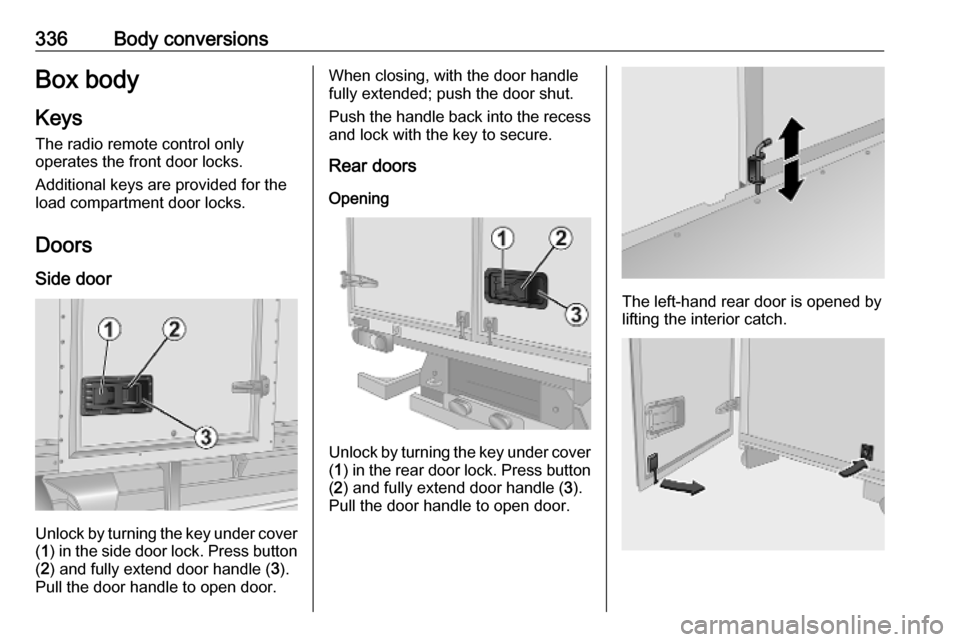
Unlock by turning the key under cover( 1 ) in the side door lock. Press button
( 2 ) and fully extend door handle ( 3).
Pull the door handle to open door.
When closing, with the door handle
fully extended; push the door shut.
Push the handle back into the recess
and lock with the key to secure.
Rear doors
Opening
Unlock by turning the key under cover( 1 ) in the rear door lock. Press button
( 2 ) and fully extend door handle ( 3).
Pull the door handle to open door.
The left-hand rear door is opened by
lifting the interior catch.
Page 339 of 353
Body conversions337When opening the doors to 270°, the
doors are retained in the fully open
position by securing the catches on
the body side.
Closing
Release the catches from the body
side and always close the left-hand
rear door first.
When closing, with the door handle
fully extended; push the door shut.
Push the handle back into the recess
and lock with the key to secure.
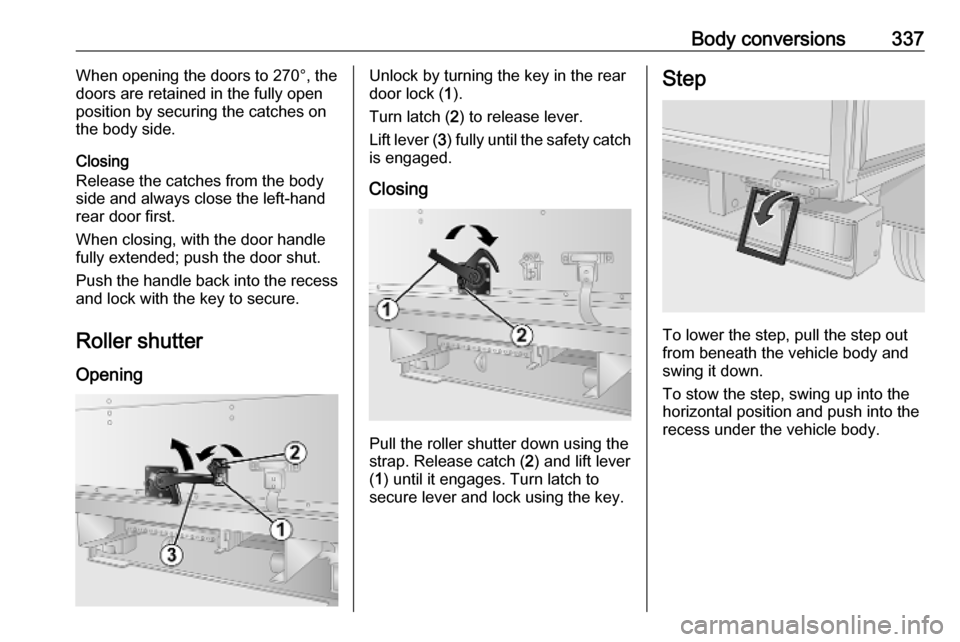
Roller shutterOpeningUnlock by turning the key in the rear
door lock ( 1).
Turn latch ( 2) to release lever.
Lift lever ( 3) fully until the safety catch
is engaged.
Closing
Pull the roller shutter down using the
strap. Release catch ( 2) and lift lever
( 1 ) until it engages. Turn latch to
secure lever and lock using the key.
Step
To lower the step, pull the step out
from beneath the vehicle body and swing it down.
To stow the step, swing up into the
horizontal position and push into the
recess under the vehicle body.