airbag OPEL MOVANO_B 2020 Manual user
[x] Cancel search | Manufacturer: OPEL, Model Year: 2020, Model line: MOVANO_B, Model: OPEL MOVANO_B 2020Pages: 353, PDF Size: 9.4 MB
Page 66 of 353
64Seats, restraints
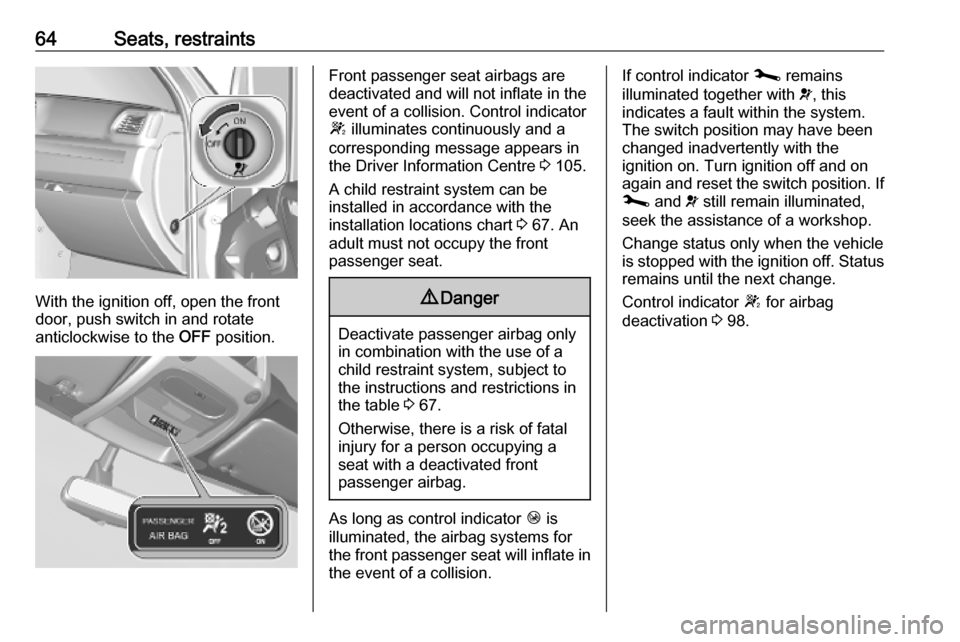
With the ignition off, open the front
door, push switch in and rotate
anticlockwise to the OFF position.
Front passenger seat airbags are
deactivated and will not inflate in the event of a collision. Control indicator
W illuminates continuously and a
corresponding message appears in
the Driver Information Centre 3 105.
A child restraint system can be
installed in accordance with the
installation locations chart 3 67. An
adult must not occupy the front
passenger seat.9 Danger
Deactivate passenger airbag only
in combination with the use of a
child restraint system, subject to
the instructions and restrictions in
the table 3 67.
Otherwise, there is a risk of fatal
injury for a person occupying a
seat with a deactivated front
passenger airbag.
As long as control indicator Ó is
illuminated, the airbag systems for the front passenger seat will inflate in the event of a collision.
If control indicator j remains
illuminated together with v, this
indicates a fault within the system.
The switch position may have been
changed inadvertently with the
ignition on. Turn ignition off and on
again and reset the switch position. If
j and v still remain illuminated,
seek the assistance of a workshop.
Change status only when the vehicle is stopped with the ignition off. Status remains until the next change.
Control indicator W for airbag
deactivation 3 98.
Page 67 of 353
Seats, restraints65Child restraints
Child restraint systems9 Warning
When using a child restraint
system on the front passenger
seat, the airbag systems for the
front passenger seat must be
deactivated; if not, the triggering of the airbags poses a risk of fatal
injury to the child.
This is especially the case if rear-
facing child restraint systems are
used on the front passenger seat.
Airbag deactivation 3 63.
Airbag label 3 59.
We recommend a child restraint
system which is tailored specifically to the vehicle. For further information,
contact your workshop.
When a child restraint system is being
used, pay attention to the following
usage and installation instructions
and also those supplied with the child
restraint system.
Always comply with local or national
regulations. In some countries, the
use of child restraint systems is
forbidden on certain seats.
Child restraint systems can be
fastened with:
● Three-point seat belt
● ISOFIX brackets
● Top-Tether
Three-point seat belt
Child restraint systems can be
fastened by using a three-point seat
belt 3 56.
Depending on the size of the used
child restraint systems and the model
variant, child restraint systems can be
attached to certain 2nd row and 3rd
row rear seats. After fastening the
child restraint system the seat belt
has to be tightened 3 67.ISOFIX child restraint systems
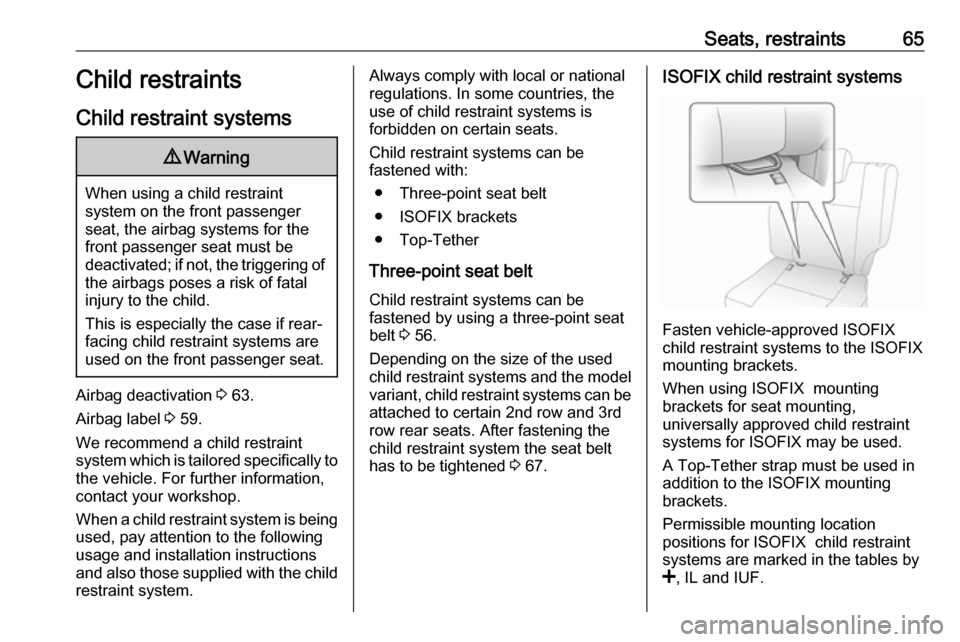
Fasten vehicle-approved ISOFIX
child restraint systems to the ISOFIX
mounting brackets.
When using ISOFIX mounting
brackets for seat mounting,
universally approved child restraint
systems for ISOFIX may be used.
A Top-Tether strap must be used in
addition to the ISOFIX mounting
brackets.
Permissible mounting location
positions for ISOFIX child restraint
systems are marked in the tables by
< , IL and IUF.
Page 69 of 353

Seats, restraints67Child restraint installation locations
Permissible options for fitting a child restraint system Front seats - All variantsWeight and age classSingle seat - front passenger side 1)Bench seat - front passenger sidewithout airbagwith airbagwithout airbagwith airbagcentreoutercentreouterGroup 0: up to 10 kg
Group 0+: up to 13 kgUU 2)UUU 2)U2)Group I: 9 to 18 kgUU 2)UUU2)U 2)Group II: 15 to 25 kg
Group III: 22 to 36 kgUU 2)UUU 2)U2)1)
If adjustable, ensure seat is in its rearmost position. Make sure vehicle seat belt is as straight as possible between shoulder and
upper anchorage point.
2) Ensure the front passenger airbag system is deactivated when installing a child restraint in this position.
Page 86 of 353

84Instruments and controlsInstruments and
controlsControls ....................................... 85
Steering wheel adjustment ........85
Steering wheel controls .............85
Horn ........................................... 85
Steering column controls ...........85
Windscreen wiper and washer ..86
Outside temperature ..................87
Clock ......................................... 88
Power outlets ............................. 88
Inductive charging .....................90
Cigarette lighter ......................... 91
Ashtrays .................................... 91
Warning lights, gauges and indi‐ cators ........................................... 91
Instrument cluster ......................91
Speedometer ............................. 91
Odometer .................................. 92
Trip odometer ............................ 92
Tachometer ............................... 92
Fuel gauge ................................ 93
AdBlue gauge ............................ 93
Engine coolant temperature gauge ....................................... 93
Service display .......................... 94Transmission display .................94
Control indicators ......................95
Turn lights .................................. 98
Seat belt reminder .....................98
Airbag and belt tensioners .........98
Airbag deactivation ....................98
Charging system .......................99
Malfunction indicator light ..........99
Service vehicle soon .................99
Stop engine ............................. 100
Brake system ........................... 100
Parking brake .......................... 100
Antilock brake system (ABS) ...100
Gear shifting ............................ 100
Variable effort steering ............100
Lane departure warning ..........101
Electronic Stability Control ......101
Engine coolant temperature ....101
Preheating ............................... 101
AdBlue ..................................... 101
Tyre pressure monitoring system .................................... 102
Engine oil pressure ..................102
Low fuel ................................... 103
Stop-start system ....................103
Exterior light ............................ 103
Low beam ................................ 103
High beam ............................... 103
High beam assist .....................103
Front fog lights ......................... 103Rear fog light........................... 103
Cruise control .......................... 103
Active emergency braking .......104
Speed warning ........................ 104
Speed limiter ........................... 104
Tachograph ............................. 104
Door open ................................ 104
Displays ..................................... 105
Driver Information Centre ........105
Info Display .............................. 105
Vehicle messages ......................106
Warning chimes .......................107
Trip computer ............................. 108
Tachograph ................................ 109
Page 99 of 353
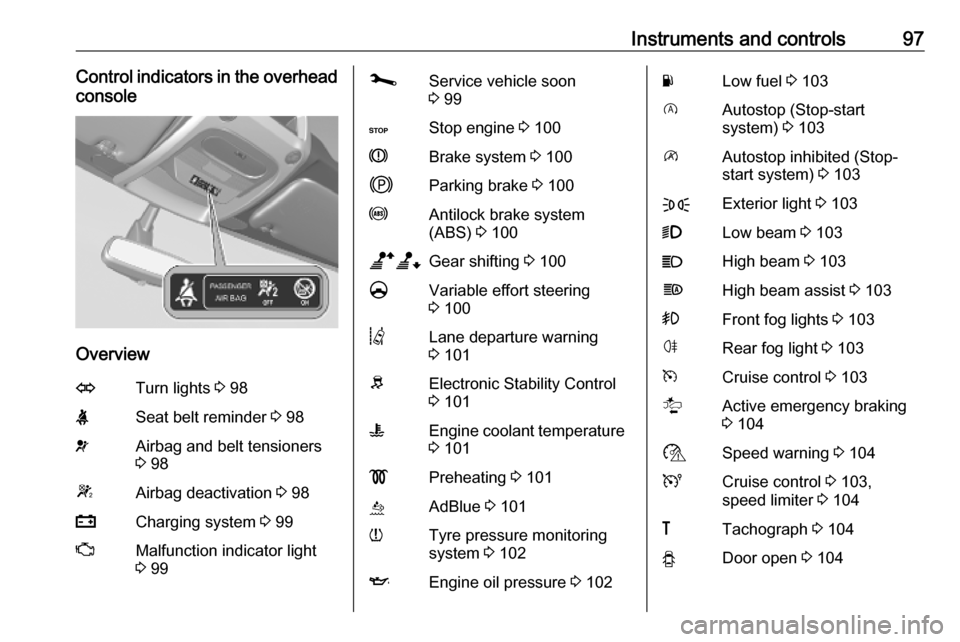
Instruments and controls97Control indicators in the overheadconsole
Overview
OTurn lights 3 98XSeat belt reminder 3 98vAirbag and belt tensioners
3 98WAirbag deactivation 3 98pCharging system 3 99ZMalfunction indicator light
3 99jService vehicle soon
3 99CStop engine 3 100RBrake system 3 100jParking brake 3 100uAntilock brake system
(ABS) 3 100baGear shifting 3 100§Variable effort steering
3 100QLane departure warning
3 101RElectronic Stability Control
3 101WEngine coolant temperature
3 101!Preheating 3 101úAdBlue 3 101wTyre pressure monitoring
system 3 102IEngine oil pressure 3 102YLow fuel 3 103DAutostop (Stop-start
system) 3 103\Autostop inhibited (Stop-
start system) 3 103FExterior light 3 1039Low beam 3 103CHigh beam 3 103fHigh beam assist 3 103>Front fog lights 3 103øRear fog light 3 103mCruise control 3 103lActive emergency braking
3 104$Speed warning 3 104UCruise control 3 103,
speed limiter 3 104&Tachograph 3 104yDoor open 3 104
Page 100 of 353
98Instruments and controlsTurn lightsO flashes green.
Flashes if a turn light or the hazard
warning flashers are activated.
Rapid flashing: failure of a turn light or
associated fuse.
An audible warning can be heard
when the turn lights are on. When
towing a trailer, the pitch of the
audible warning changes.
Bulb replacement 3 277.
Fuses 3 285.
Turn lights 3 113.
Seat belt reminder X illuminates or flashes red in the
overhead console.
If the seat belt is unfastened, control
indicator X will flash when vehicle
speed exceeds approx. 16 km/h. A warning chime also sounds for
approx. 90 seconds.
Depending on the vehicle, the control
indicator flashes if the front
passenger seat belt is not fastened.If the seat belt is fastened, the
indicator light extinguishes.9 Warning
Fasten seat belt before each trip.
In the event of an accident, people
not wearing seat belts endanger their fellow occupants and
themselves.
Three-point seat belts 3 56.
Airbag and belt tensioners
v illuminates yellow.
When the ignition is switched on, the control indicator illuminates briefly. If
it does not illuminate or illuminates
whilst driving, there is a fault in the
airbag system. Seek the assistance
of a workshop. The airbags and belt
pretensioners may fail to trigger in the event of an accident.
Deployment of the belt pretensioners
or airbags is indicated by continuous
illumination of v.
9 Warning
Have the cause of the fault
remedied immediately by a
workshop.
Belt pretensioners 3 55.
Airbag system 3 59.
Airbag deactivation Ó illuminates yellow.
Illuminates for approx. 60 seconds
after the ignition is switched on. The
front passenger airbag is activated.
W illuminates yellow when the
ignition is switched on and remains
illuminated when the front passenger
airbag has been deactivated 3 63.
Page 101 of 353
Instruments and controls999Danger
Risk of fatal injury for a child using
a child restraint system together
with activated front passenger
airbag.
Risk of fatal injury for an adult
person with deactivated front
passenger airbag.
Airbag system 3 59.
Belt tensioners 3 55.
Airbag deactivation 3 63.
Charging system p illuminates red.
Illuminates when the ignition is
switched on and extinguishes shortly after the engine starts.
Illuminates when the engine is
running
Stop, switch off engine. Vehicle
battery is not charging. Engine
cooling may be interrupted. The
brake servo unit may cease to be
effective. Seek the assistance of a
workshop.
Malfunction indicator light
Z illuminates or flashes yellow.
Illuminates briefly when the ignition is
switched on.
Illuminates when the engine is
running
Fault in the emission control system. The permitted emission limits may be exceeded. Seek the assistance of a
workshop immediately.
If Z illuminates in combination with
A , stop vehicle and switch off engine
as soon as possible.9 Warning
Have the cause of the fault
remedied immediately by a
workshop.
Flashes when the engine is
running
Fault that could lead to catalytic
converter damage. Ease up on the
accelerator until the flashing stops.
Seek the immediate assistance of a
workshop.
Service vehicle soon
j illuminates yellow.
Illuminates briefly when the ignition is
switched on.
The vehicle needs a service.
May illuminate in combination with
another control indicator or a
message in the Driver Information
Centre 3 105.
Illuminates if cleaning of the diesel particle filter is required and
automatic cleaning does not occur
3 233.
Page 209 of 353

Infotainment system207Mobile phones and CB radio
equipment
Installation instructions and
operating guidelines
The vehicle specific installation
instructions and the operating
guidelines of the mobile phone and
handsfree manufacturer must be observed when installing and
operating a mobile telephone. Failure to do so could invalidate the vehicle
type approval (EU directive 95/54/
EC).
Recommendations for fault-free
operation:
● professionally installed exterior antenna to obtain the maximum
range possible
● maximum transmission power ten watts
● installation of the phone in a suitable spot, consider relevant
Note in the Owner's Manual
section Airbag system
Seek advice on predetermined
installation points for the external
antenna or equipment holder andways of using devices with a
transmission power exceeding
ten watts.
Use of a handsfree attachment
without external antenna with mobile
telephone standards GSM
900/1800/1900 and UMTS is only
permitted if the maximum
transmission power of the mobile
telephone is two watts for GSM 900
or one watt for the other types.
For reasons of safety, do not use the
phone while driving. Even use of a handsfree set can be a distractionwhile driving.9 Warning
Operation of radio equipment and
mobile telephones which fail to
meet above mentioned mobile
telephone standards is only
permitted using an antenna
located outside of the vehicle.
Caution
Mobile telephones and radio
equipment may lead to
malfunctions in the vehicle
electronics when operated inside
the vehicle with no exterior
antenna, unless the above
mentioned regulations are
observed.
Page 326 of 353

324Customer informationOperating data in the vehicleControl units process data for
operation of the vehicle.
This data includes, e.g.: ● vehicle status information (e.g. speed, movement delay, lateral
acceleration, wheel rotation rate, "seat belts fastened" display)
● ambient conditions (e.g. temperature, rain sensor,
distance sensor)
As a rule such data is transient, not
stored for longer than an operational
cycle, and only processed on board the vehicle itself. Control units often
include data storage (including the
vehicle key). This is used to allow
information to be documented
temporarily or permanently on vehicle
condition, component stress,
maintenance requirements and
technical events and errors.Depending on technical equipment
level, the data stored is as follows:
● system component operating states (e.g. fill level, tyre
pressure, battery status)
● faults and defects in important system components (e.g. lights,
brakes)
● system reactions in special driving situations (e.g. triggering
of an airbag, actuation of the
stability control systems)
● information on events damaging the vehicle
● for electric vehicles the amount of
charge in the high-voltage
battery, estimated range
In special cases (e.g. if the vehicle
has detected a malfunction), it may be
necessary to save data that would
otherwise just be volatile.
When you use services (e.g. repairs,
maintenance), the operating data
saved can be read together with the
vehicle identification number and
used when necessary. Staff working
for the service network ( e.g. garages,
manufacturers) or third parties (e.g.breakdown services) can read the
data from the vehicle. The same
applies to warranty work and quality
assurance measures.
Data is generally read via the OBD
(On-Board Diagnostics) port
prescribed by law in the vehicle. The operating data which is read out,
documents the technical condition of
the vehicle or individual components
and assists with fault diagnosis,
compliance with warranty obligations
and quality improvement. This data,
in particular information on
component stress, technical events,
operator errors and other faults, is
transmitted to the manufacturer
where appropriate, together with the
vehicle identification number. The
manufacturer is also subject to
product liability. The manufacturer
potentially also uses operating data
from vehicles for product recalls. This
data can also be used to check
customer warranty and guarantee
claims.
Fault memories in the vehicle can be
reset by a service company when
carrying out servicing or repairs or at
your request.
Page 344 of 353

342IndexAAbsorptive Glass Mat battery .....274
Accessories and vehicle modifications .......................... 269
ACC files..................................... 153
Activating Bluetooth function ......197
Activating the navigation system 166
Activating voice recognition ........192
Active emergency braking ..104, 253
Adaptation volume km/h .............138
AdBlue ........................ 101, 234, 313
AdBlue gauge ............................... 93
AdBlue tank ................................ 317
Add a favourite destination .........177
Adding contacts to the phonebook .............................. 201
Adjustable air vents ...................221
AF (Alternative Frequency)......... 148
Airbag and belt tensioners ...........98
Airbag deactivation ................63, 98
Airbag label................................... 59 Airbag system .............................. 59
Air conditioning regular operation ................................ 223
Air conditioning system .............. 209
Air intake .................................... 223
Air suspension ........................... 231
Air suspension system................ 306
Air vents...................................... 221
Antifreeze ................................... 272Antilock brake system ................ 244
Antilock brake system (ABS) .....100
Anti-theft alarm system ................36
Anti-theft bolts............................. 299
Anti-theft locking system .............. 35
Anti-theft security lock ..................23
Appearance care ........................308
Armrest ........................................ 51
Ashtrays ....................................... 91
AST (Autostore list) ....................147
Audio players .............................. 129
Audio settings ............................. 137
Automatic call waiting .................201
Automatic light control ...............110
Automatic locking ...................24, 29
Automatic phone connection ......195
Automatic station search ............145
Automatic station storing ............147
Automatic switch-off ...................129
Automatic zoom .......................... 166
Autostop ....................... 18, 227, 228
Autostore lists ............................. 147
Auxiliary heater ........................... 216
AUX input ................................... 151
AUX input usage ........................152
Avoid part of route ......................183
B Balance....................................... 137
Bass............................................ 137