belt OPEL MOVANO_B 2020 Manual user
[x] Cancel search | Manufacturer: OPEL, Model Year: 2020, Model line: MOVANO_B, Model: OPEL MOVANO_B 2020Pages: 353, PDF Size: 9.4 MB
Page 59 of 353
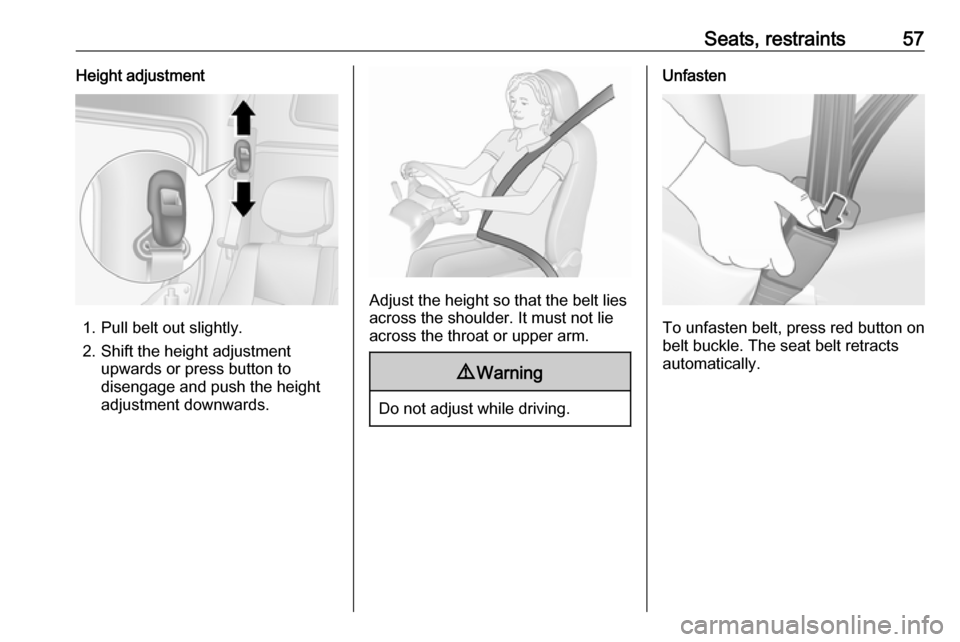
Seats, restraints57Height adjustment
1. Pull belt out slightly.
2. Shift the height adjustment upwards or press button to
disengage and push the height
adjustment downwards.
Adjust the height so that the belt lies across the shoulder. It must not lie
across the throat or upper arm.
9 Warning
Do not adjust while driving.
Unfasten
To unfasten belt, press red button on
belt buckle. The seat belt retracts automatically.
Page 60 of 353
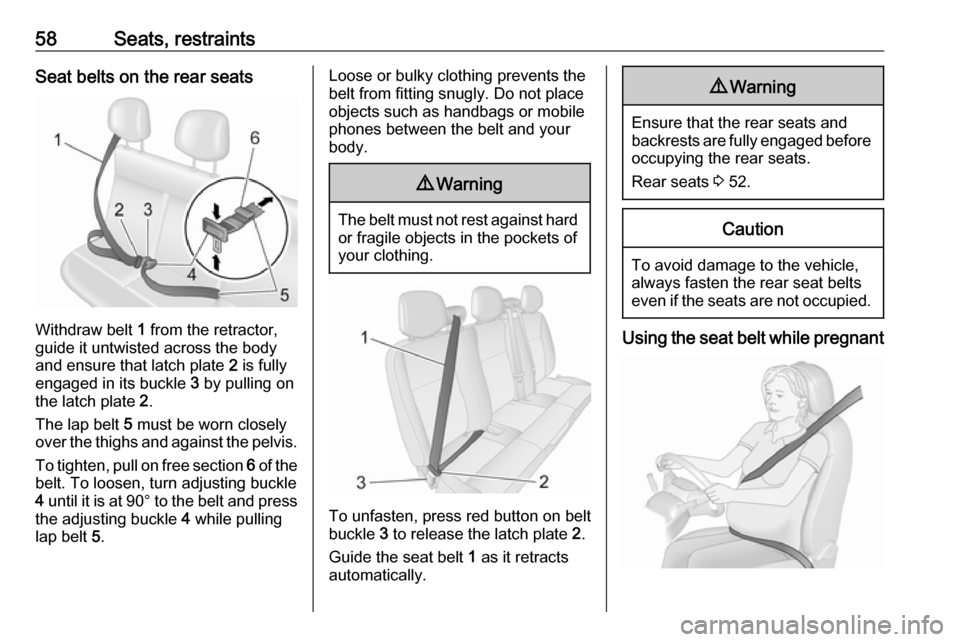
58Seats, restraintsSeat belts on the rear seats
Withdraw belt 1 from the retractor,
guide it untwisted across the body
and ensure that latch plate 2 is fully
engaged in its buckle 3 by pulling on
the latch plate 2.
The lap belt 5 must be worn closely
over the thighs and against the pelvis.
To tighten, pull on free section 6 of the
belt. To loosen, turn adjusting buckle 4 until it is at 90° to the belt and press
the adjusting buckle 4 while pulling
lap belt 5.
Loose or bulky clothing prevents the
belt from fitting snugly. Do not place
objects such as handbags or mobile
phones between the belt and your body.9 Warning
The belt must not rest against hard
or fragile objects in the pockets of
your clothing.
To unfasten, press red button on belt buckle 3 to release the latch plate 2.
Guide the seat belt 1 as it retracts
automatically.
9 Warning
Ensure that the rear seats and
backrests are fully engaged before occupying the rear seats.
Rear seats 3 52.
Caution
To avoid damage to the vehicle,
always fasten the rear seat belts
even if the seats are not occupied.
Using the seat belt while pregnant
Page 61 of 353
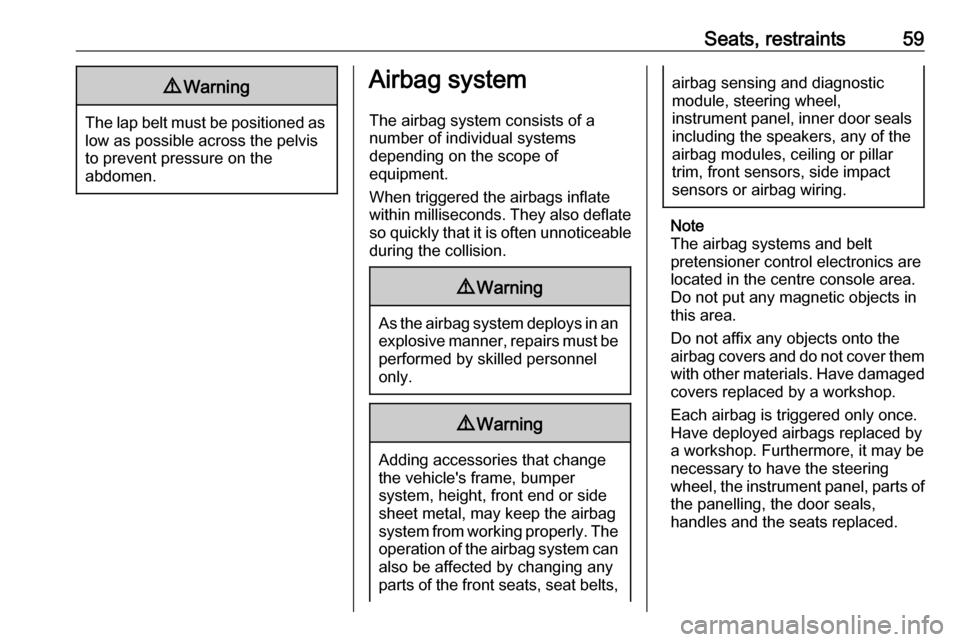
Seats, restraints599Warning
The lap belt must be positioned as
low as possible across the pelvis
to prevent pressure on the
abdomen.
Airbag system
The airbag system consists of a
number of individual systems
depending on the scope of
equipment.
When triggered the airbags inflate
within milliseconds. They also deflate
so quickly that it is often unnoticeable
during the collision.9 Warning
As the airbag system deploys in an
explosive manner, repairs must be
performed by skilled personnel
only.
9 Warning
Adding accessories that change
the vehicle's frame, bumper
system, height, front end or side
sheet metal, may keep the airbag
system from working properly. The operation of the airbag system can
also be affected by changing any
parts of the front seats, seat belts,
airbag sensing and diagnostic
module, steering wheel,
instrument panel, inner door seals including the speakers, any of the
airbag modules, ceiling or pillar
trim, front sensors, side impact
sensors or airbag wiring.
Note
The airbag systems and belt
pretensioner control electronics are
located in the centre console area.
Do not put any magnetic objects in
this area.
Do not affix any objects onto the
airbag covers and do not cover them with other materials. Have damagedcovers replaced by a workshop.
Each airbag is triggered only once.
Have deployed airbags replaced by
a workshop. Furthermore, it may be
necessary to have the steering
wheel, the instrument panel, parts of
the panelling, the door seals,
handles and the seats replaced.
Page 65 of 353
Seats, restraints63Additionally there is a warning labelon the side of the instrument panel,
visible when the front passenger door
is open.
The front airbag system is triggered in
the event of an accident of a certain
severity. The ignition must be
switched on.
The inflated airbags cushion the
impact, thereby reducing the risk of
injury to the upper body and head of
the front seat occupants
considerably.9 Warning
Optimum protection is only
provided when the seat is in the
proper position.
Seat position 3 46.
Keep the area in which the airbag
inflates clear of obstructions.
Fasten the seat belt correctly and
engage securely. Only then is the
airbag able to protect.
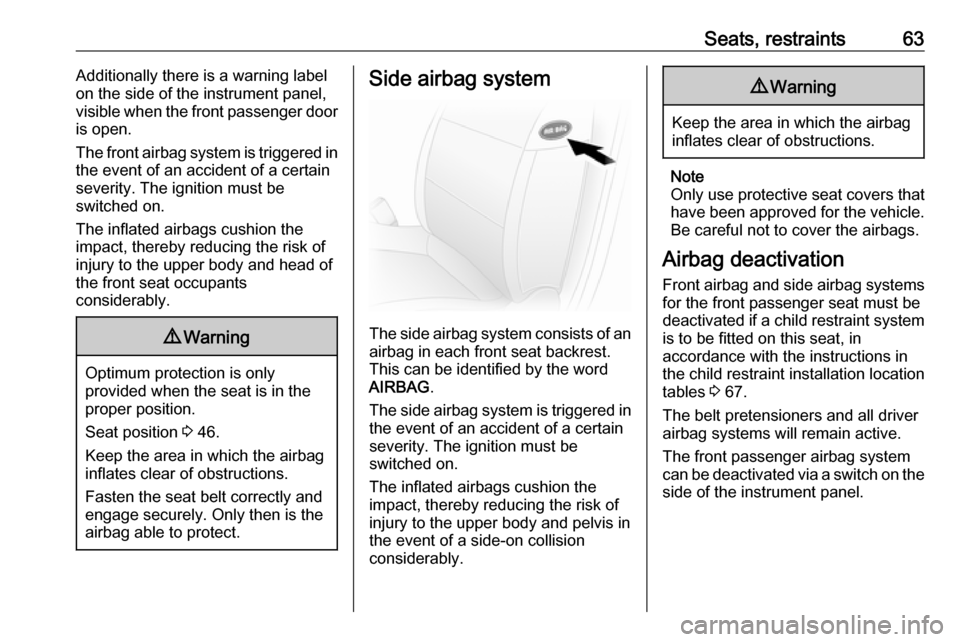
Side airbag system
The side airbag system consists of an
airbag in each front seat backrest.
This can be identified by the word
AIRBAG .
The side airbag system is triggered in the event of an accident of a certain
severity. The ignition must be
switched on.
The inflated airbags cushion the
impact, thereby reducing the risk of
injury to the upper body and pelvis in
the event of a side-on collision
considerably.
9 Warning
Keep the area in which the airbag
inflates clear of obstructions.
Note
Only use protective seat covers that have been approved for the vehicle.Be careful not to cover the airbags.
Airbag deactivation
Front airbag and side airbag systems for the front passenger seat must be
deactivated if a child restraint system
is to be fitted on this seat, in
accordance with the instructions in
the child restraint installation location
tables 3 67.
The belt pretensioners and all driver
airbag systems will remain active.
The front passenger airbag system
can be deactivated via a switch on the
side of the instrument panel.
Page 67 of 353
Seats, restraints65Child restraints
Child restraint systems9 Warning
When using a child restraint
system on the front passenger
seat, the airbag systems for the
front passenger seat must be
deactivated; if not, the triggering of the airbags poses a risk of fatal
injury to the child.
This is especially the case if rear-
facing child restraint systems are
used on the front passenger seat.
Airbag deactivation 3 63.
Airbag label 3 59.
We recommend a child restraint
system which is tailored specifically to the vehicle. For further information,
contact your workshop.
When a child restraint system is being
used, pay attention to the following
usage and installation instructions
and also those supplied with the child
restraint system.
Always comply with local or national
regulations. In some countries, the
use of child restraint systems is
forbidden on certain seats.
Child restraint systems can be
fastened with:
● Three-point seat belt
● ISOFIX brackets
● Top-Tether
Three-point seat belt
Child restraint systems can be
fastened by using a three-point seat
belt 3 56.
Depending on the size of the used
child restraint systems and the model
variant, child restraint systems can be
attached to certain 2nd row and 3rd
row rear seats. After fastening the
child restraint system the seat belt
has to be tightened 3 67.ISOFIX child restraint systems
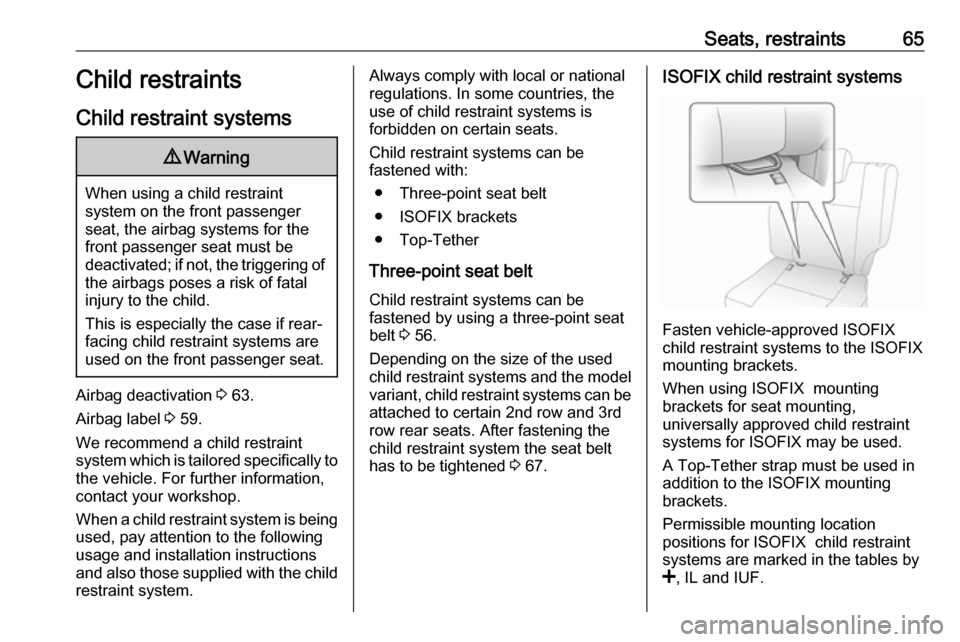
Fasten vehicle-approved ISOFIX
child restraint systems to the ISOFIX
mounting brackets.
When using ISOFIX mounting
brackets for seat mounting,
universally approved child restraint
systems for ISOFIX may be used.
A Top-Tether strap must be used in
addition to the ISOFIX mounting
brackets.
Permissible mounting location
positions for ISOFIX child restraint
systems are marked in the tables by
< , IL and IUF.
Page 68 of 353
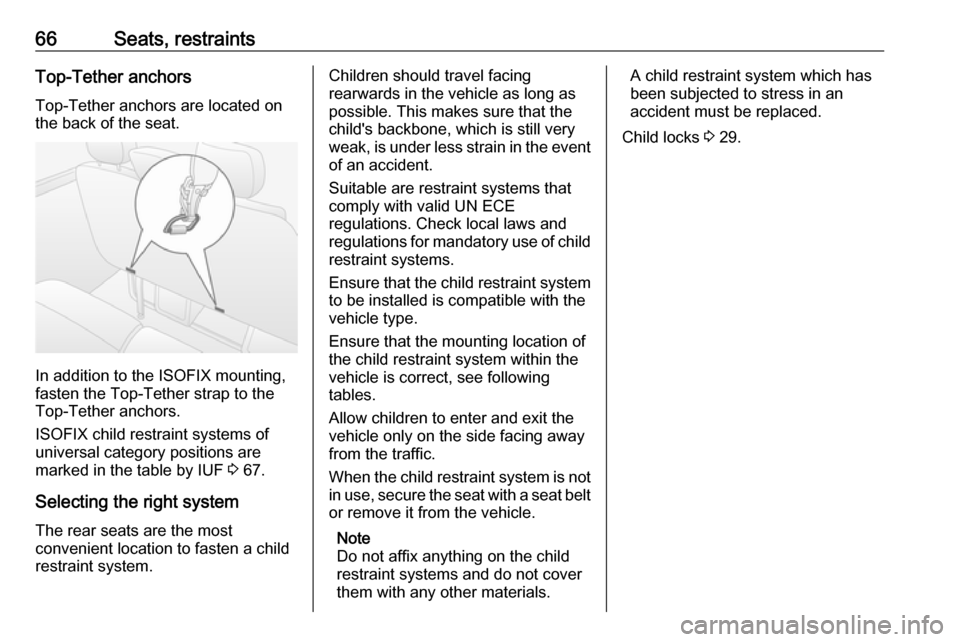
66Seats, restraintsTop-Tether anchorsTop-Tether anchors are located on
the back of the seat.
In addition to the ISOFIX mounting,
fasten the Top-Tether strap to the
Top-Tether anchors.
ISOFIX child restraint systems of
universal category positions are
marked in the table by IUF 3 67.
Selecting the right system The rear seats are the most
convenient location to fasten a child
restraint system.
Children should travel facing
rearwards in the vehicle as long as
possible. This makes sure that the child's backbone, which is still very
weak, is under less strain in the event of an accident.
Suitable are restraint systems that
comply with valid UN ECE
regulations. Check local laws and
regulations for mandatory use of child
restraint systems.
Ensure that the child restraint system to be installed is compatible with the
vehicle type.
Ensure that the mounting location of
the child restraint system within the
vehicle is correct, see following
tables.
Allow children to enter and exit the
vehicle only on the side facing away
from the traffic.
When the child restraint system is not in use, secure the seat with a seat beltor remove it from the vehicle.
Note
Do not affix anything on the child
restraint systems and do not cover
them with any other materials.A child restraint system which has
been subjected to stress in an
accident must be replaced.
Child locks 3 29.
Page 69 of 353

Seats, restraints67Child restraint installation locations
Permissible options for fitting a child restraint system Front seats - All variantsWeight and age classSingle seat - front passenger side 1)Bench seat - front passenger sidewithout airbagwith airbagwithout airbagwith airbagcentreoutercentreouterGroup 0: up to 10 kg
Group 0+: up to 13 kgUU 2)UUU 2)U2)Group I: 9 to 18 kgUU 2)UUU2)U 2)Group II: 15 to 25 kg
Group III: 22 to 36 kgUU 2)UUU 2)U2)1)
If adjustable, ensure seat is in its rearmost position. Make sure vehicle seat belt is as straight as possible between shoulder and
upper anchorage point.
2) Ensure the front passenger airbag system is deactivated when installing a child restraint in this position.
Page 72 of 353

70Seats, restraintsCrew cab - rear seatsWeight and age class2nd row seatsOuterCentreGroup 0: up to 10 kg
Group 0+: up to 13 kgUXGroup I: 9 to 18 kgUXGroup II: 15 to 25 kg
Group III: 22 to 36 kgUXU:suitable for universal category restraint systems for use in this weight and age class, in conjunction with three-point
seat belt.UF:suitable for universal category forward-facing restraint systems for use in this weight and age class, in conjunction
with three-point seat belt.<:suitable for ISOFIX child restraint system with mounting brackets and anchorage points, where fitted. When mounting
an ISOFIX child restraint system, only systems that have been approved for the vehicle may be used. Refer to
" Permissible options for fitting an ISOFIX child restraint system ".X:seat position not suitable for children in this weight and age class.
Page 86 of 353

84Instruments and controlsInstruments and
controlsControls ....................................... 85
Steering wheel adjustment ........85
Steering wheel controls .............85
Horn ........................................... 85
Steering column controls ...........85
Windscreen wiper and washer ..86
Outside temperature ..................87
Clock ......................................... 88
Power outlets ............................. 88
Inductive charging .....................90
Cigarette lighter ......................... 91
Ashtrays .................................... 91
Warning lights, gauges and indi‐ cators ........................................... 91
Instrument cluster ......................91
Speedometer ............................. 91
Odometer .................................. 92
Trip odometer ............................ 92
Tachometer ............................... 92
Fuel gauge ................................ 93
AdBlue gauge ............................ 93
Engine coolant temperature gauge ....................................... 93
Service display .......................... 94Transmission display .................94
Control indicators ......................95
Turn lights .................................. 98
Seat belt reminder .....................98
Airbag and belt tensioners .........98
Airbag deactivation ....................98
Charging system .......................99
Malfunction indicator light ..........99
Service vehicle soon .................99
Stop engine ............................. 100
Brake system ........................... 100
Parking brake .......................... 100
Antilock brake system (ABS) ...100
Gear shifting ............................ 100
Variable effort steering ............100
Lane departure warning ..........101
Electronic Stability Control ......101
Engine coolant temperature ....101
Preheating ............................... 101
AdBlue ..................................... 101
Tyre pressure monitoring system .................................... 102
Engine oil pressure ..................102
Low fuel ................................... 103
Stop-start system ....................103
Exterior light ............................ 103
Low beam ................................ 103
High beam ............................... 103
High beam assist .....................103
Front fog lights ......................... 103Rear fog light........................... 103
Cruise control .......................... 103
Active emergency braking .......104
Speed warning ........................ 104
Speed limiter ........................... 104
Tachograph ............................. 104
Door open ................................ 104
Displays ..................................... 105
Driver Information Centre ........105
Info Display .............................. 105
Vehicle messages ......................106
Warning chimes .......................107
Trip computer ............................. 108
Tachograph ................................ 109
Page 99 of 353
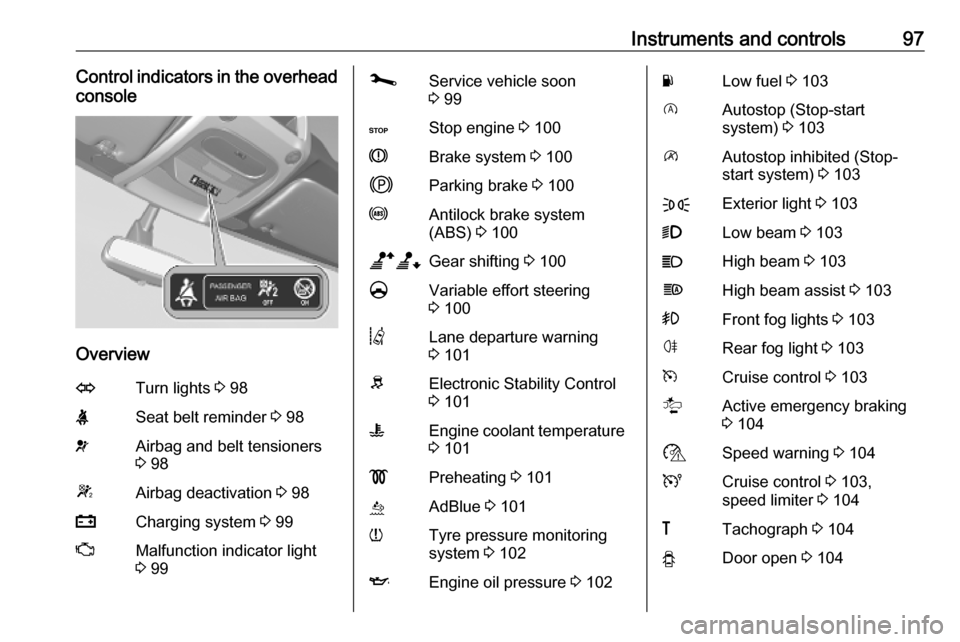
Instruments and controls97Control indicators in the overheadconsole
Overview
OTurn lights 3 98XSeat belt reminder 3 98vAirbag and belt tensioners
3 98WAirbag deactivation 3 98pCharging system 3 99ZMalfunction indicator light
3 99jService vehicle soon
3 99CStop engine 3 100RBrake system 3 100jParking brake 3 100uAntilock brake system
(ABS) 3 100baGear shifting 3 100§Variable effort steering
3 100QLane departure warning
3 101RElectronic Stability Control
3 101WEngine coolant temperature
3 101!Preheating 3 101úAdBlue 3 101wTyre pressure monitoring
system 3 102IEngine oil pressure 3 102YLow fuel 3 103DAutostop (Stop-start
system) 3 103\Autostop inhibited (Stop-
start system) 3 103FExterior light 3 1039Low beam 3 103CHigh beam 3 103fHigh beam assist 3 103>Front fog lights 3 103øRear fog light 3 103mCruise control 3 103lActive emergency braking
3 104$Speed warning 3 104UCruise control 3 103,
speed limiter 3 104&Tachograph 3 104yDoor open 3 104