mirror OPEL MOVANO_B 2020 Manual user
[x] Cancel search | Manufacturer: OPEL, Model Year: 2020, Model line: MOVANO_B, Model: OPEL MOVANO_B 2020Pages: 353, PDF Size: 9.4 MB
Page 213 of 353
Climate control211Basic setting for maximum comfort:● Press AUTO (AUTO appears in
the display).
● Set desired temperature (the temperature appears in the
display).
● Open all air vents.
During automatic mode, the settings for fan speed, air distribution, air
conditioning and air recirculation are
automatically regulated by the system
and are not shown on the display.
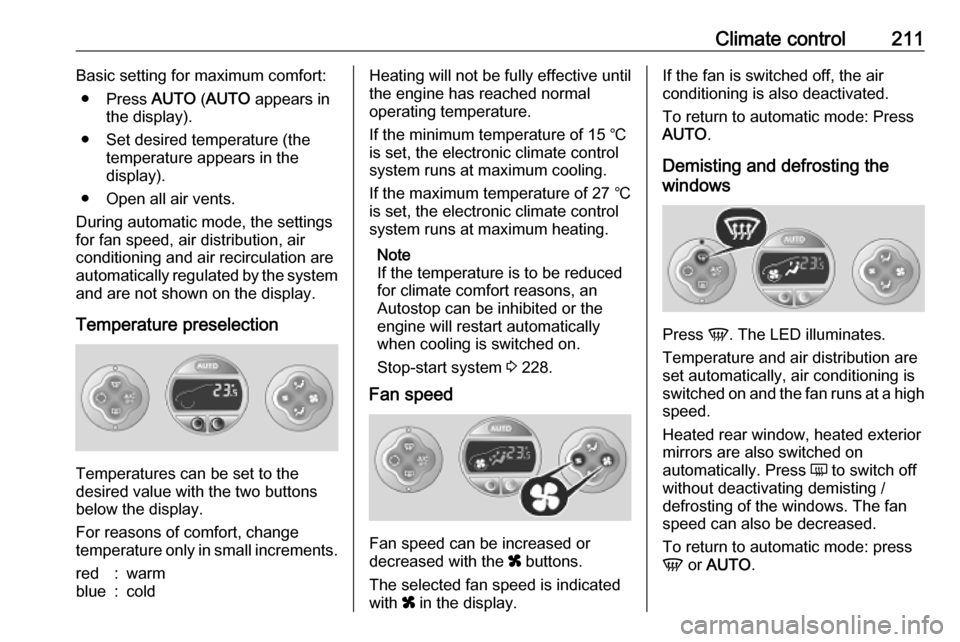
Temperature preselection
Temperatures can be set to the
desired value with the two buttons
below the display.
For reasons of comfort, change
temperature only in small increments.
red:warmblue:coldHeating will not be fully effective until
the engine has reached normal
operating temperature.
If the minimum temperature of 15 ℃
is set, the electronic climate control
system runs at maximum cooling.
If the maximum temperature of 27 ℃
is set, the electronic climate control
system runs at maximum heating.
Note
If the temperature is to be reduced
for climate comfort reasons, an
Autostop can be inhibited or the
engine will restart automatically
when cooling is switched on.
Stop-start system 3 228.
Fan speed
Fan speed can be increased or
decreased with the x buttons.
The selected fan speed is indicated
with x in the display.
If the fan is switched off, the air
conditioning is also deactivated.
To return to automatic mode: Press AUTO .
Demisting and defrosting the
windows
Press V. The LED illuminates.
Temperature and air distribution are
set automatically, air conditioning is
switched on and the fan runs at a high
speed.
Heated rear window, heated exterior
mirrors are also switched on
automatically. Press Ü to switch off
without deactivating demisting /
defrosting of the windows. The fan speed can also be decreased.
To return to automatic mode: press
V or AUTO .
Page 259 of 353
Driving and operating257Caution
When reversing, the area should
be free from obstacles which could impact on the underside of the
vehicle.
Impact to the rear axle, which may
not be visible, could lead to
uncharacteristic changes in the
vehicle handling. In the event of
such an impact, consult a
workshop.
Basic notes on parking assist
system
9 Warning
Under certain circumstances,
various reflective surfaces on
objects or clothing as well as
external noise sources may cause the system to fail to detect
obstacles.
Special attention must be paid to
low obstacles which can damage
the lower part of the bumper.
Caution
Performance of the sensors can
be reduced when sensors are
covered, e.g. by ice or snow.
Performance of the parking assist
system can be reduced due to
heavy loading.
Special conditions apply if there
are taller vehicles involved (e.g.
off-road vehicles, mini vans,
vans). Object identification in the
upper part of these vehicles
cannot be guaranteed.
Objects with a very small reflection
cross-section, e.g. objects of
narrow size or soft materials, may
not be detected by the system.
The parking assist system will not
detect objects which are out of the detection range of the sensors.
Side blind spot alert
The side blind spot alert system
detects and reports objects on either
side of the vehicle, within a specified
blind spot zone. The system displays
a visual alert in each exterior mirror,
when detecting objects that may not
be visible in the interior and exterior
mirrors.
Side blind spot alert uses some of the
parking assist sensors which are
located in the front and rear bumper
on both sides of the vehicle.9 Warning
Side blind spot alert does not
replace driver vision.
The system does not detect:
● vehicles outside the side blind zones which may be rapidly
approaching
● pedestrians, cyclists or animals
Before changing a lane, always
check all mirrors, look over the
shoulder and use the turn signal.
Activation
The system is activated when the
speed of the vehicle is between
approx. 30 km/h and 140 km/h.
Page 260 of 353
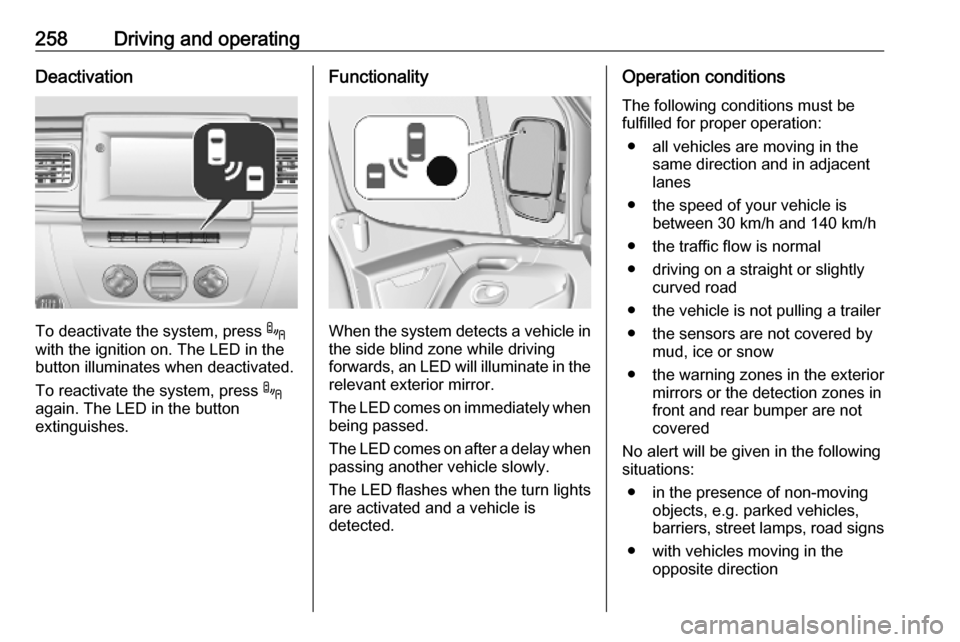
258Driving and operatingDeactivation
To deactivate the system, press .
with the ignition on. The LED in the
button illuminates when deactivated.
To reactivate the system, press .
again. The LED in the button
extinguishes.
Functionality
When the system detects a vehicle in the side blind zone while driving
forwards, an LED will illuminate in the
relevant exterior mirror.
The LED comes on immediately when being passed.
The LED comes on after a delay when
passing another vehicle slowly.
The LED flashes when the turn lights
are activated and a vehicle is
detected.
Operation conditions
The following conditions must be
fulfilled for proper operation:
● all vehicles are moving in the same direction and in adjacent
lanes
● the speed of your vehicle is between 30 km/h and 140 km/h
● the traffic flow is normal
● driving on a straight or slightly curved road
● the vehicle is not pulling a trailer
● the sensors are not covered by mud, ice or snow
● the warning zones in the exterior mirrors or the detection zones in
front and rear bumper are not
covered
No alert will be given in the following
situations:
● in the presence of non-moving objects, e.g. parked vehicles,
barriers, street lamps, road signs
● with vehicles moving in the opposite direction
Page 261 of 353
Driving and operating259● driving on a winding road or asharp corner
● when passing or being passed by
a very long vehicle, e.g. lorry,
coach, which is at the same time
detected at the rear in the blind spot angle and present in the
driver's forward field of vision
● in very heavy traffic, vehicles detected in front and behind are
confused with a lorry or a
stationary object
● when passing too quickly
Fault
In the event of a fault, a
corresponding message will be
displayed in the instrument cluster.
Have the cause of the fault remedied
by a workshop.
Rear view camera The rear view camera assists the
driver when reversing by displaying a view of the area behind the vehicle in
either the interior mirror or the Info
Display.9 Warning
The rear view camera does not
replace driver vision. Note that
objects that are outside the
camera's field of view, e.g. below
the bumper or underneath the
vehicle, are not displayed.
Do not reverse the vehicle by only looking at the display and checkthe surrounding area behind and
around the vehicle before
reversing.
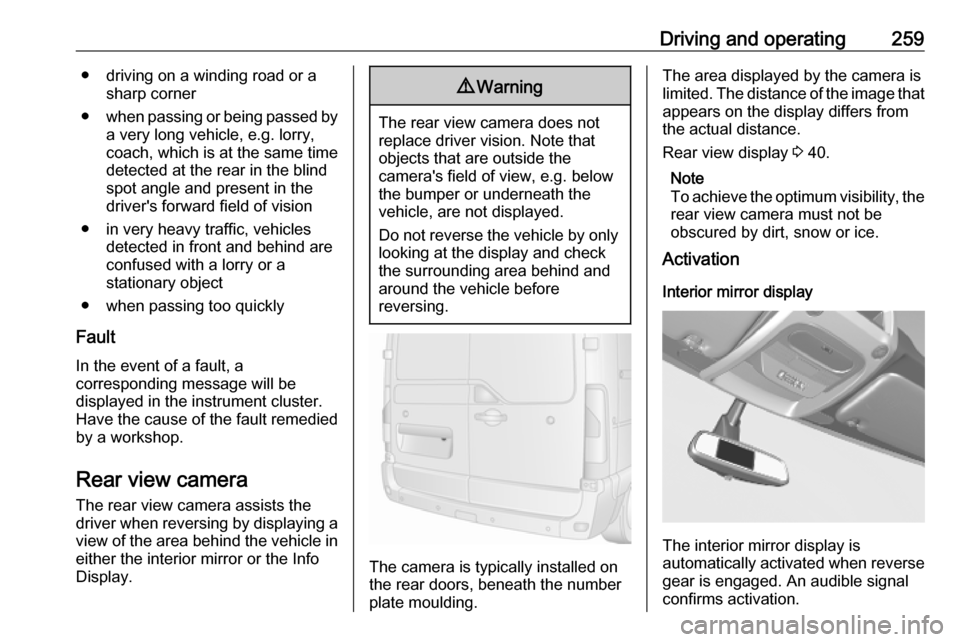
The camera is typically installed on
the rear doors, beneath the number
plate moulding.
The area displayed by the camera is
limited. The distance of the image that
appears on the display differs from
the actual distance.
Rear view display 3 40.
Note
To achieve the optimum visibility, the rear view camera must not be
obscured by dirt, snow or ice.
Activation
Interior mirror display
The interior mirror display is
automatically activated when reverse
gear is engaged. An audible signal
confirms activation.
Page 262 of 353
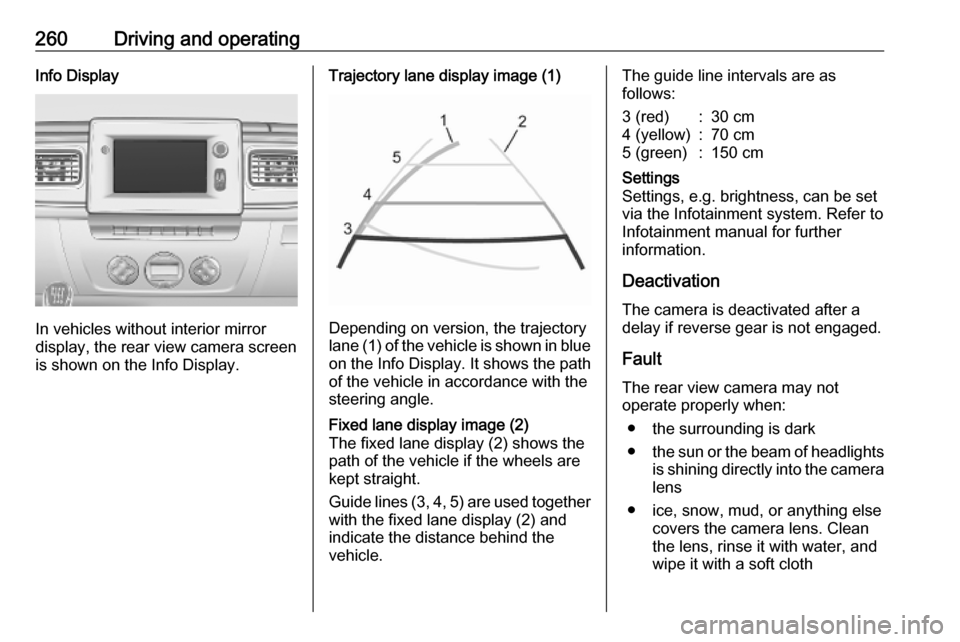
260Driving and operatingInfo Display
In vehicles without interior mirror
display, the rear view camera screen
is shown on the Info Display.
Trajectory lane display image (1)
Depending on version, the trajectory
lane (1) of the vehicle is shown in blue
on the Info Display. It shows the path of the vehicle in accordance with the
steering angle.
Fixed lane display image (2)
The fixed lane display (2) shows the
path of the vehicle if the wheels are
kept straight.
Guide lines (3, 4, 5) are used together
with the fixed lane display (2) and
indicate the distance behind the
vehicle.The guide line intervals are as
follows:3 (red):30 cm4 (yellow):70 cm5 (green):150 cmSettings
Settings, e.g. brightness, can be set
via the Infotainment system. Refer to
Infotainment manual for further
information.
Deactivation
The camera is deactivated after a
delay if reverse gear is not engaged.
Fault
The rear view camera may not
operate properly when:
● the surrounding is dark
● the sun or the beam of headlights
is shining directly into the camera lens
● ice, snow, mud, or anything else covers the camera lens. Clean
the lens, rinse it with water, and
wipe it with a soft cloth
Page 284 of 353
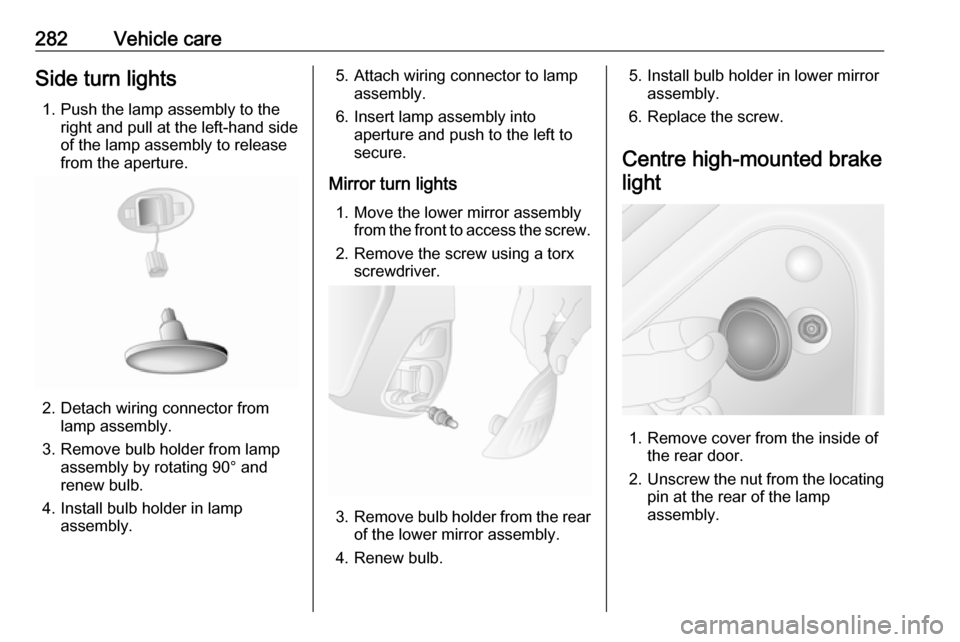
282Vehicle careSide turn lights1. Push the lamp assembly to the right and pull at the left-hand side
of the lamp assembly to release
from the aperture.
2. Detach wiring connector from lamp assembly.
3. Remove bulb holder from lamp assembly by rotating 90° and
renew bulb.
4. Install bulb holder in lamp assembly.
5. Attach wiring connector to lamp assembly.
6. Insert lamp assembly into aperture and push to the left to
secure.
Mirror turn lights 1. Move the lower mirror assembly from the front to access the screw.
2. Remove the screw using a torx screwdriver.
3. Remove bulb holder from the rear
of the lower mirror assembly.
4. Renew bulb.
5. Install bulb holder in lower mirror assembly.
6. Replace the screw.
Centre high-mounted brake light
1. Remove cover from the inside of the rear door.
2. Unscrew the nut from the locating
pin at the rear of the lamp
assembly.
Page 290 of 353
288Vehicle careSymbolCircuiteInstrument panel / Diag‐
nostic connectordHeated exterior mirrors?Power outletÌCigarette lighter
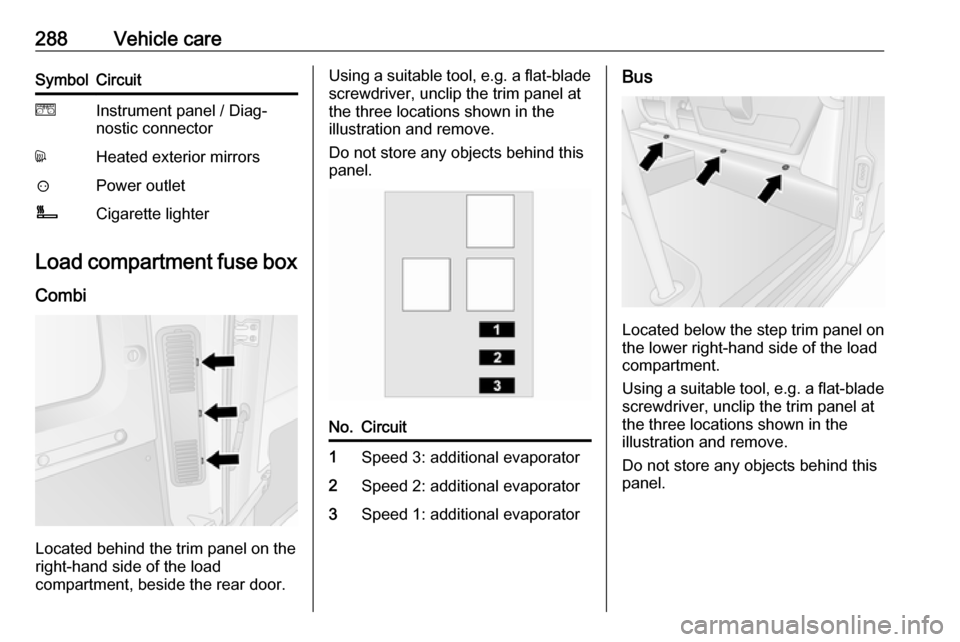
Load compartment fuse box
Combi
Located behind the trim panel on the
right-hand side of the load
compartment, beside the rear door.
Using a suitable tool, e.g. a flat-blade screwdriver, unclip the trim panel at
the three locations shown in the
illustration and remove.
Do not store any objects behind this
panel.No.Circuit1Speed 3: additional evaporator2Speed 2: additional evaporator3Speed 1: additional evaporatorBus
Located below the step trim panel on
the lower right-hand side of the load
compartment.
Using a suitable tool, e.g. a flat-blade screwdriver, unclip the trim panel at
the three locations shown in the
illustration and remove.
Do not store any objects behind this
panel.
Page 310 of 353
308Vehicle careCaution
Drive slowly. Do not drive jerkily.
Excessive tractive force can
damage the vehicle.
Appearance care
Exterior care Locks
The locks are lubricated at the factory using a high quality lock cylinder
grease. Use de-icing agent only when absolutely necessary, as this has a
degreasing effect and impairs lock function. After using a de-icing agent,
have the locks regreased by a
workshop.
WashingThe paintwork of your vehicle is
exposed to environmental influences.
Wash and wax your vehicle regularly.
When using automatic vehicle
washes, select a programme that
includes waxing. Restrictions for
filmed or matt painted body parts or
decor tapes, see "Polishing and
waxing".
Bird droppings, dead insects, resin,
pollen and the like should be cleaned
off immediately, as they contain
aggressive constituents which can
cause paint damage.If using a vehicle wash, comply with
the vehicle wash manufacturer's
instructions. The windscreen wipers
must be switched off and the exterior
mirrors must be folded in. Remove
antenna and external accessories
such as roof racks etc.
If you wash your vehicle by hand,
make sure that the insides of the
wheel housings are also thoroughly
rinsed out.
Clean edges and folds on opened
doors and the bonnet as well as the
areas they cover.
Clean bright metal mouldings with a
cleaning solution approved for
aluminium to avoid damages.Caution
Always use a cleaning agent with
a pH value of four to nine.
Do not use cleaning agents on hot surfaces.
Have the door hinges of all doors
greased by a workshop.
Page 311 of 353

Vehicle care309Do not clean the engine compartment
with a steam-jet or high-pressure jet
cleaner.
Thoroughly rinse and leather-off the
vehicle. Rinse leather frequently. Use
separate leathers for painted and
glass surfaces: remnants of wax on
the windows will impair vision.
Do not use hard objects to remove
spots of tar. Use tar removal spray on painted surfaces.
Exterior lights
Headlight and other light covers are
made of plastic. Do not use any
abrasive or caustic agents, do not use an ice scraper, and do not clean them
dry.
Polishing and waxing
Wax the vehicle regularly (at the
latest when water no longer beads).
Otherwise, the paintwork will dry out.
Polishing is necessary only if the paint
has become dull or if solid deposits
have become attached to it.Paintwork polish with silicone forms a
protective film, making waxing
unnecessary.
Unpainted plastic body parts must not be treated with wax or polishing
agents.
Matt filmed body parts or decor tapes must not be polished, to avoid
gleaming. Do not use hot wax
programmes in automatic car washes if the vehicle is equipped with these
parts.
Matt painted decor parts, e.g. mirror
housing cover, must not be polished. Otherwise these parts would become
agleam or the colour would be
dissolved.
Windows and windscreen wiper
blades
Switch off wipers before handling in
their areas.
Use a soft lint-free cloth or chamois leather together with window cleaner
and insect remover.
When cleaning the rear window from
inside, always wipe in parallel to the
heating element to prevent damage.For mechanical removal of ice, use a
sharp-edged ice scraper. Press the
scraper firmly against the glass so
that no dirt can get under it and
scratch the glass.
Remove dirt residues from smearing wiper blades by using a soft cloth and window cleaner. Also make sure to
remove any residues such as wax,
insect residues and similar from the
window.
Wheels and tyres
Do not use high-pressure jet
cleaners.
Clean rims with a pH-neutral wheel
cleaner.
Rims are painted and can be treated
with the same agents as the body.
Paintwork damage
Rectify minor paintwork damage with
a touch-up pen before rust forms.
Have more extensive damage or rust areas repaired by a workshop.
Page 346 of 353

344Disconnecting a phone...............195
Display ........................................ 129
Displaying pictures .....................161
Display screen operation ....129, 193
Door locks..................................... 23
Door open .................................. 104
Doors .................................... 30, 336
DPF (diesel particle filter) ...........233
Drink holders ................................ 74
Driver assistance systems ..........249
Driver Information Centre ...........105
Driving characteristics and towing tips .............................. 265
Driving economically................... 225
Driving hints ................................ 225
Driving style indicator Fuel economy gauge ..............129
E Easy access ............................... 129
Eco-coaching .............................. 129
Eco Driving ................................. 129
ECO mode .................................. 225
Edit Itinerary ............................... 183
Electric adjustment ......................39
Electrical accessories ...................88
Electrical system......................... 285
Electronic climate control system 210
Electronic driving programmes ..243
Electronic key system ...................22Electronic Stability Control 101,
248, 266
Emergency call ........................... 200
Emergency exit .......................42, 44
Emergency number ....................200
End-of-life vehicle recovery .......270
Engine compartment fuse box ...286
Engine coolant ........................... 272
Engine coolant temperature ......101
Engine coolant temperature gauge ....................................... 93
Engine drag torque control .........248
Engine exhaust .......................... 233
Engine identification ...................316
Engine oil ................... 271, 313, 317
Engine oil additives ....................313
Engine oil pressure ....................102
Engine oil viscosity grades .........313
Enhanced traction function 247, 248, 249
Enter an address ........................177
Entering a number manually ......201
Event data recorders ..................323
Exhaust gases ............................ 233
Exit lighting ................................ 116
Exterior care .............................. 308
Exterior light ............................... 103
Exterior lighting ............14, 110, 334
Exterior mirrors ............................. 38
External device authorisation .....197F
Fader .......................................... 137
Fault ........................................... 244
Favourite destinations ................177
Favourites ................................... 129
Media ...................................... 129
Navigation ............................... 129
Phone ...................................... 129
Services .................................. 129
Fire extinguisher ........................... 81
First aid ......................................... 81
First aid kit ................................... 81
Fixed air vents ........................... 222
FM station list ............................. 147
Fog lights .................................... 113
Folding mirrors ............................. 39
Folding mirrors setting ................129
Folding seat .................................. 74
Front airbag system .....................62
Front courtesy light .....................114
Front fog lights ...........103, 113, 279
Front reading light....................... 116
Front seats.................................... 46
Front storage ................................ 74
Front turn lights .......................... 279
Fuel economy gauge Driving style indicator ..............129
Fuel for diesel engines ..............262
Fuel gauge ................................... 93 Fuel tank ..................................... 317