oil OPEL MOVANO_B 2020 Manual user
[x] Cancel search | Manufacturer: OPEL, Model Year: 2020, Model line: MOVANO_B, Model: OPEL MOVANO_B 2020Pages: 353, PDF Size: 9.4 MB
Page 271 of 353
Vehicle care269General Information
Accessories and vehicle modifications
We recommend the use of genuine
parts and accessories and factory
approved parts specific for your
vehicle type. We cannot assess or guarantee reliability of other products
- even if they have a regulatory or
otherwise granted approval.
Any modification, conversion or other changes made to standard vehicle
specifications (including, without
limitation, software modifications,
modifications of the electronic control
units) may invalidate the warranty
offered by Opel. Furthermore, such
changes may affect driver assistance systems, fuel consumption, CO 2
emissions and other emissions of the
vehicle. They may also invalidate the
vehicle operating permit.Caution
When transporting the vehicle on
a train or on a recovery vehicle, the
mud flaps might be damaged.
Vehicle storage
Storage for a long period of time
If the vehicle is to be stored for several months:
● Wash and wax the vehicle.
● Have the wax in the engine compartment and underbody
checked.
● Clean and preserve rubber seals.
● Change engine oil.
● Drain washer fluid reservoir. ● Check coolant antifreeze and corrosion protection.
● Adjust tyre pressure to the value specified for full load.
● Park vehicle in a dry, well ventilated place. Engage first or
reverse gear. Prevent the vehicle
from rolling.
● Do not apply parking brake.
● Close all doors except front left- hand door and lock the vehicle.
● Disconnect the clamp from the negative terminal of the vehicle
battery. Note that all systems are
not functional, e.g. anti-theft
alarm system.
● Close and lock front left-hand door.
Putting back into operation When the vehicle is to be put back into
operation:
● Connect the clamp to the negative terminal of the vehicle
battery. Initialize the power
windows 3 41.
● Check tyre pressure.
● Fill up the washer fluid reservoir.
● Check the engine oil level.
● Check the coolant level.
● Fit the number plate, if necessary.
Page 272 of 353
270Vehicle careEnd-of-life vehicle recoveryInformation on end-of-life vehicle
recovery centres and the recycling of
end-of-life vehicles is available on our website, where legally required. Only
entrust this work to an authorised
recycling centre.Vehicle checks
Performing work9 Warning
Only perform engine compartment
checks when the ignition is off.
The vehicle must not be in an
Autostop 3 228.
The cooling fan may start
operating even if the ignition is off.
9 Danger
The ignition system generates
extremely high voltages. Do not
touch.
The caps for topping up the engine oil, the coolant, the washer fluid and the
oil dipstick handle are yellow for ease
of identification.
Bonnet
Opening
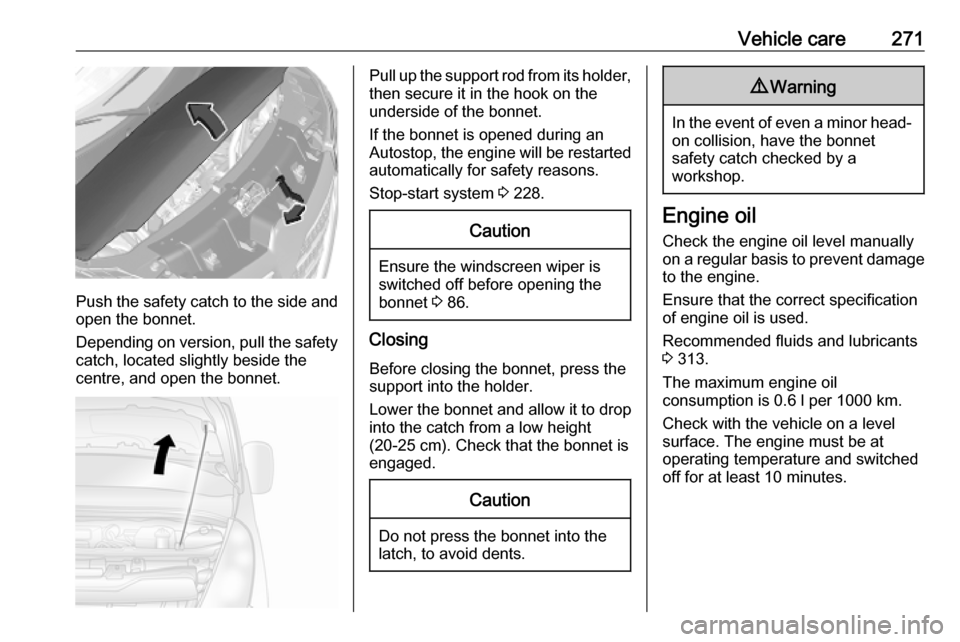
Pull the release lever and return it to
its original position.
Page 273 of 353
Vehicle care271
Push the safety catch to the side and
open the bonnet.
Depending on version, pull the safety catch, located slightly beside the
centre, and open the bonnet.
Pull up the support rod from its holder,
then secure it in the hook on the
underside of the bonnet.
If the bonnet is opened during an
Autostop, the engine will be restarted automatically for safety reasons.
Stop-start system 3 228.Caution
Ensure the windscreen wiper is
switched off before opening the
bonnet 3 86.
Closing
Before closing the bonnet, press the
support into the holder.
Lower the bonnet and allow it to drop into the catch from a low height
(20-25 cm). Check that the bonnet is
engaged.
Caution
Do not press the bonnet into the
latch, to avoid dents.
9 Warning
In the event of even a minor head-
on collision, have the bonnet
safety catch checked by a
workshop.
Engine oil
Check the engine oil level manually on a regular basis to prevent damage
to the engine.
Ensure that the correct specification
of engine oil is used.
Recommended fluids and lubricants
3 313.
The maximum engine oil
consumption is 0.6 l per 1000 km.
Check with the vehicle on a level
surface. The engine must be at
operating temperature and switched
off for at least 10 minutes.
Page 274 of 353
272Vehicle care
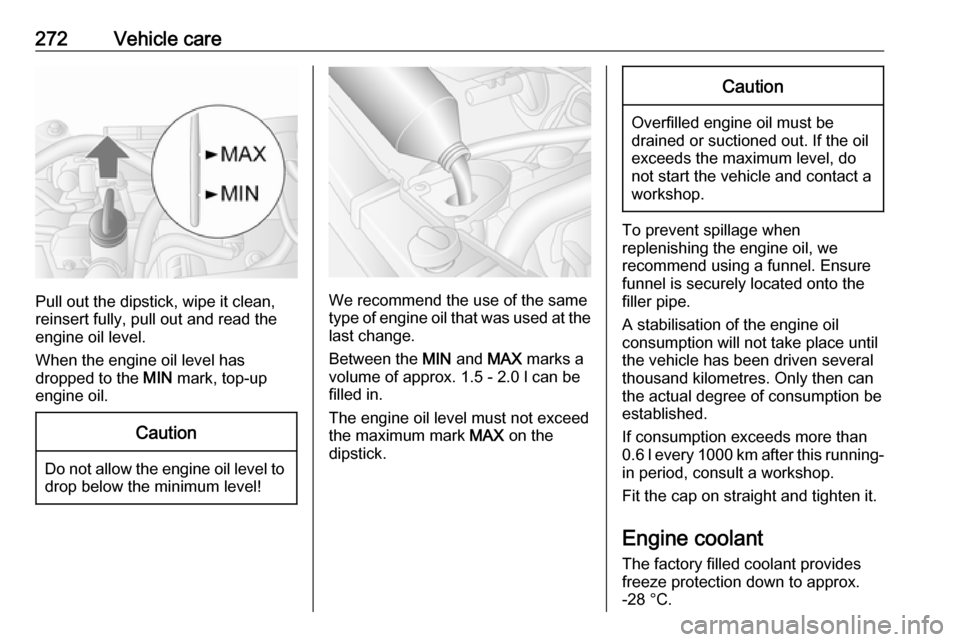
Pull out the dipstick, wipe it clean,
reinsert fully, pull out and read the
engine oil level.
When the engine oil level has
dropped to the MIN mark, top-up
engine oil.
Caution
Do not allow the engine oil level to drop below the minimum level!
We recommend the use of the same
type of engine oil that was used at the
last change.
Between the MIN and MAX marks a
volume of approx. 1.5 - 2.0 l can be
filled in.
The engine oil level must not exceed the maximum mark MAX on the
dipstick.
Caution
Overfilled engine oil must be
drained or suctioned out. If the oil exceeds the maximum level, do
not start the vehicle and contact a
workshop.
To prevent spillage when
replenishing the engine oil, we
recommend using a funnel. Ensure
funnel is securely located onto the
filler pipe.
A stabilisation of the engine oil
consumption will not take place until
the vehicle has been driven several
thousand kilometres. Only then can
the actual degree of consumption be
established.
If consumption exceeds more than
0.6 l every 1000 km after this running-
in period, consult a workshop.
Fit the cap on straight and tighten it.
Engine coolant
The factory filled coolant provides
freeze protection down to approx.
-28 °C.
Page 303 of 353

Vehicle care301Raise the vehicle by pressing the
wheel wrench until the wheel is
clear of the ground.
4. Unscrew wheel bolts / nuts completely and wipe clean with a
cloth.
Put wheel bolts / nuts somewhere
where the threads will not be
soiled.
5. Change the wheel.
6. Screw in the wheel bolts / nuts. Separately supplied bolts must beused for the temporary spare
wheel. These are allowed only for the temporary spare wheel. Refer
to an label on the temporary spare
wheel.
7. Lower vehicle.
8. Install the wheel wrench (depending on vehicle, attach
wheel wrench to adapters)
ensuring that it is securely located and tighten each wheel bolt / nut
in a crosswise sequence.
Tightening torque is: 172 Nm
(Front-wheel drive), 235 Nm(Rear-wheel drive with twin rear
wheels), 264 Nm (Rear-wheel
drive with single rear wheels).
9. Refit wheel cover. Rear-wheel drive, with twin rear
wheels: Install the tyre valve
extender to the inner rear wheel
before refitting the wheel cover.
Note
If applicable, fit anti-theft bolts
nearest the tyre valve (otherwise it
may not be possible to refit the wheel
cover).
10. Stow the replaced wheel 3 301
and the vehicle tools 3 290.
11. Have the new wheel balanced on the vehicle. Check the tyre
pressure of the installed tyre
3 317 and also the wheel bolt /
nut torque as soon as possible.
Have the defective tyre renewed or
repaired.
Spare wheel
The spare wheel can be classified as
a temporary spare wheel depending
on the size compared to the othermounted wheels and country
regulations. In this case a permissible maximum speed applies, even
though no label at the spare wheel
indicates this.Caution
The use of a spare wheel that is smaller than the other wheels or in
combination with winter tyres
could affect driveability. Have the
defective tyre replaced as soon as
possible.
The spare wheel is held under the
vehicle frame using a winch and
secured by tightening a cable using
the wheel wrench and adapters
(depending on vehicle).
It may be necessary to jack the
vehicle up to gain access to the spare
wheel on a fully loaded vehicle with a flat rear tyre.
Page 312 of 353

310Vehicle careUnderbody
Some areas of the vehicle underbody
have a PVC undercoating while other critical areas have a durable
protective wax coating.
After the underbody is washed, check
the underbody and have it waxed if
necessary.
Bitumen / rubber materials could
damage the PVC coating. Have
underbody work carried out by a
workshop.
Before and after winter, wash the
underbody and have the protective
wax coating checked.
Towing equipment
Do not clean the coupling ball bar with a steam-jet or high-pressure jet
cleaner.Interior care
Interior and upholstery Only clean the vehicle interior,
including the instrument panel fascia
and panelling, with a dry cloth or
interior cleaner.
Clean leather upholstery with clear
water and a soft cloth. In case of
heavy soiling, use leather care.
The instrument cluster and the
displays should only be cleaned using
a soft damp cloth. If necessary use a
weak soap solution.
Clean fabric upholstery with a
vacuum cleaner and brush. Remove
stains with an upholstery cleaner.
Clothing fabrics may not be
colourfast. This could cause visible discolourations, especially on light-
coloured upholstery. Removable
stains and discolourations should be
cleaned as soon as possible.
Clean seat belts with lukewarm water or interior cleaner.Caution
Close Velcro fasteners as open
Velcro fasteners on clothing could damage seat upholstery.
The same applies to clothing with
sharp-edged objects, like zips or
belts or studded jeans.
Plastic and rubber parts
Plastic and rubber parts can be
cleaned with the same cleaner as
used to clean the body. Use interior cleaner if necessary. Do not use any
other agent. Avoid solvents and petrol in particular. Do not use high-
pressure jet cleaners.
Page 315 of 353
Service and maintenance313Recommended fluids,
lubricants and parts
Recommended fluids and lubricants
Only use products that meet the
recommended specifications.9 Warning
Operating materials are
hazardous and could be
poisonous. Handle with care. Pay
attention to information given on
the containers.
Engine oil
Engine oil is identified by its quality
and its viscosity. Quality is more
important than viscosity when
selecting which engine oil to use. The oil quality ensures e.g. engine
cleanliness, wear protection and oil
aging control, whereas viscosity
grade gives information on the oil's
thickness over a temperature range.
Select the appropriate engine oil
based on its quality and on the
minimum ambient temperature
3 317.
Topping up engine oilCaution
In case of any spilled oil, wipe it up and dispose of it properly.
Engine oils of different manufacturersand brands can be mixed as long as
they comply with the required engine oil quality and viscosity.
Select the appropriate engine oil
based on its quality and on the
minimum ambient temperature
3 317.
Additional engine oil additives
The use of additional engine oil
additives could cause damage and
invalidate the warranty.
Engine oil viscosity grades
The SAE viscosity grade gives
information of the thickness of the oil.
Multigrade oil is indicated by two
figures, e.g. SAE 5W-30. The first figure, followed by a W, indicates the
low temperature viscosity and the
second figure the high temperature
viscosity.
Select the appropriate viscosity grade depending on the minimum ambient
temperature 3 317.
All of the recommended viscosity grades are suitable for high ambient
temperatures.
Coolant and antifreeze
Use only silicate-free long life coolant
(LLC) antifreeze approved for the
vehicle. Consult a workshop.
The system is factory filled with
coolant designed for excellent
corrosion protection and frost
protection down to approx. -28 °C.
This concentration should be
maintained all year round. The use of additional coolant additives that
intend to give additional corrosion
protection or seal against minor leaks
can cause function problems. Liability
Page 319 of 353

Technical data317Vehicle data
Recommended fluids and lubricants
Required engine oil qualityEngine oil quality: Europedexos 2✔
For countries with International
service interval 3 311, you may use
the engine oil qualities listed below:
Engine oil quality: Internationaldexos 2✔ACEA C3
engines with diesel particle filter✔ACEA A3/B4
engines without diesel particle
filter✔Engine oil viscosity gradesAmbient temperaturedown to
-25 °CSAE 0W-30 or
SAE 0W-40
SAE 5W-30 or
SAE 5W-40below
-25 °CSAE 0W-30 or
SAE 0W-40
Capacities
Fuel tank
Fuel tank, nominal capacity [l]80 or 105
AdBlue tank
AdBlue, nominal capacity [l]22.5
Page 329 of 353

Body conversions327Body conversionsTipper and dropside...................327
Loading information .................327
Tailboard ................................. 328
Sideboards .............................. 329
Lashing eyes ........................... 330
Tipper operation ......................330
Safety prop .............................. 332
Hydraulic oil level ....................333
Toolbox .................................... 334
Exterior lighting ........................334
Cleaning .................................. 334
Vehicle checks ........................ 334
Technical data ......................... 335
Declaration of conformity .........335
Box body .................................... 336
Keys ........................................ 336
Doors ....................................... 336
Roller shutter ........................... 337
Step ......................................... 337
Ladder ..................................... 338
Overcab storage ......................338
Load rails ................................. 338
Interior lighting ......................... 339Crew van.................................... 339
Child restraint systems ............339
Storage .................................... 339Tipper and dropside
Loading information The tipper and dropside are not
designed for carrying people or
unsuitable / unsafe materials.
● Load the vehicle evenly, distributing the load across the
body.
● Ensure the vehicle tailboard and sideboards are securely closed
before loading.
● Secure any solid loads with additional lashing equipment.
Page 335 of 353
Body conversions333
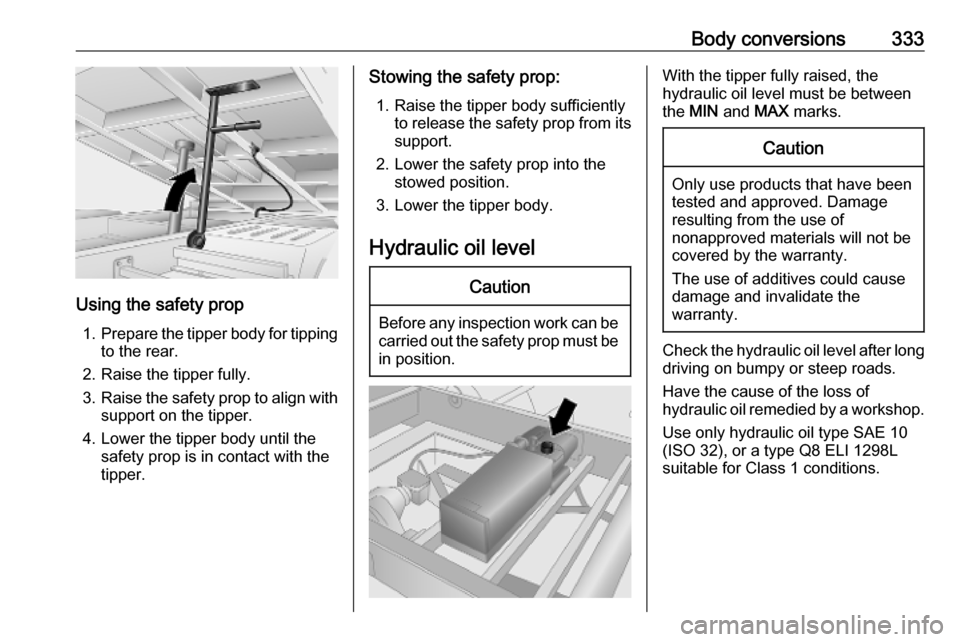
Using the safety prop1. Prepare the tipper body for tipping
to the rear.
2. Raise the tipper fully.
3. Raise the safety prop to align with
support on the tipper.
4. Lower the tipper body until the safety prop is in contact with the
tipper.
Stowing the safety prop:
1. Raise the tipper body sufficiently to release the safety prop from its
support.
2. Lower the safety prop into the stowed position.
3. Lower the tipper body.
Hydraulic oil levelCaution
Before any inspection work can be carried out the safety prop must be
in position.
With the tipper fully raised, the
hydraulic oil level must be between
the MIN and MAX marks.Caution
Only use products that have been
tested and approved. Damage
resulting from the use of
nonapproved materials will not be
covered by the warranty.
The use of additives could cause
damage and invalidate the
warranty.
Check the hydraulic oil level after long
driving on bumpy or steep roads.
Have the cause of the loss of
hydraulic oil remedied by a workshop.
Use only hydraulic oil type SAE 10
(ISO 32), or a type Q8 ELI 1298L
suitable for Class 1 conditions.