belt OPEL VIVARO 2015 User Guide
[x] Cancel search | Manufacturer: OPEL, Model Year: 2015, Model line: VIVARO, Model: OPEL VIVARO 2015Pages: 205, PDF Size: 4.47 MB
Page 60 of 205

58Seats, restraints
Note
Only use protective seat covers that have been approved for the vehicle.Be careful not to cover the airbags.
Curtain airbag system
The curtain airbag system consists of an airbag in the roof frame on each
side. This may be identified by the
word AIRBAG on the headlining trim.
The curtain airbag system is triggered
in the event of a side-on impact of a
certain severity. The ignition must be
switched on.
The inflated airbags cushion the
impact, thereby reducing the risk of
injury to the head in the event of a
side-on impact considerably.9 Warning
Keep the area in which the airbag
inflates clear of obstructions.
Airbag deactivation
The front passenger airbag system
must be deactivated if a child restraint is to be fitted on the front passenger
seat in accordance with the
instructions in the Child restraint
installation locations tables 3 61.
The belt tensioners and all other
airbag systems will remain active.
The airbag deactivation system may
be indicated by a label on the side of
the instrument panel, visible when the
front passenger door is open.
Page 62 of 205

60Seats, restraintsChild restraintsChild restraint systems
We recommend the Opel child
restraint system which is tailored
specifically to the vehicle.
When a child restraint system is being used, pay attention to the following
usage and installation instructions
and also those supplied with the child
restraint system.
Always comply with local or national
regulations. In some countries, the
use of child restraint systems is
forbidden on certain seats.9 Danger
If using a rear-facing child restraint
system on the front passenger
seat, the airbag system for the
front passenger seat must be
deactivated. This also applies to certain forward-facing child
restraint systems as indicated in
the table 3 61.
Airbag deactivation 3 58.
Airbag label 3 53.
Selecting the right system The rear seats are the most
convenient location to fasten a child restraint system.
Children should travel facing
rearwards in the vehicle as long as
possible. This makes sure that the child's backbone, which is still very
weak, is under less strain in the event of an accident.
Suitable are restraint systems that
comply with valid UN ECE
regulations. Check local laws and
regulations for mandatory use of child restraint systems.
Ensure that the child restraint system
to be installed is compatible with the
vehicle type.
Ensure that the mounting location of
the child restraint system within the
vehicle is correct, see following
tables.
Allow children to enter and exit the
vehicle only on the side facing away
from the traffic.When the child restraint system is not in use, secure the seat with a seat beltor remove it from the vehicle.
Note
Do not affix anything on the child
restraint systems and do not cover
them with any other materials.
A child restraint system which has
been subjected to stress in an
accident must be replaced.
Page 65 of 205

Seats, restraints63
Rear seats - Combi, Bus, Double cabWeight and age class2nd row seats13rd row seatsGroup 0: up to 10 kg
or approx. 10 months
Group 0+: up to 13 kg
or approx. 2 years
UU
Group I: 9 to 18 kg
or approx. 8 months to 4 yearsU 2U 2Group II: 15 to 25 kg
or approx. 3 to 7 years
Group III: 22 to 36 kg
or approx. 6 to 12 years
U 2U2
1=If necessary, slide adjustable front seat forwards to install a child restraint system on these seats. There may not be
enough clearance to install particular child restraint systems on vehicles fitted with fixed front seats.2=Forward-facing child restraints: Remove head restraint 3 43 before installing child restraint. The seat in front of this
installation position must not be more than halfway back on its runners. Maximum backrest rake is 25°. Seat adjustment
3 45.U=Suitable for universal category restraint systems for use in this weight and age class, in conjunction with three-point
seat belt.X=Seat position not suitable for children in this weight and age class.
Page 87 of 205
Instruments and controls85
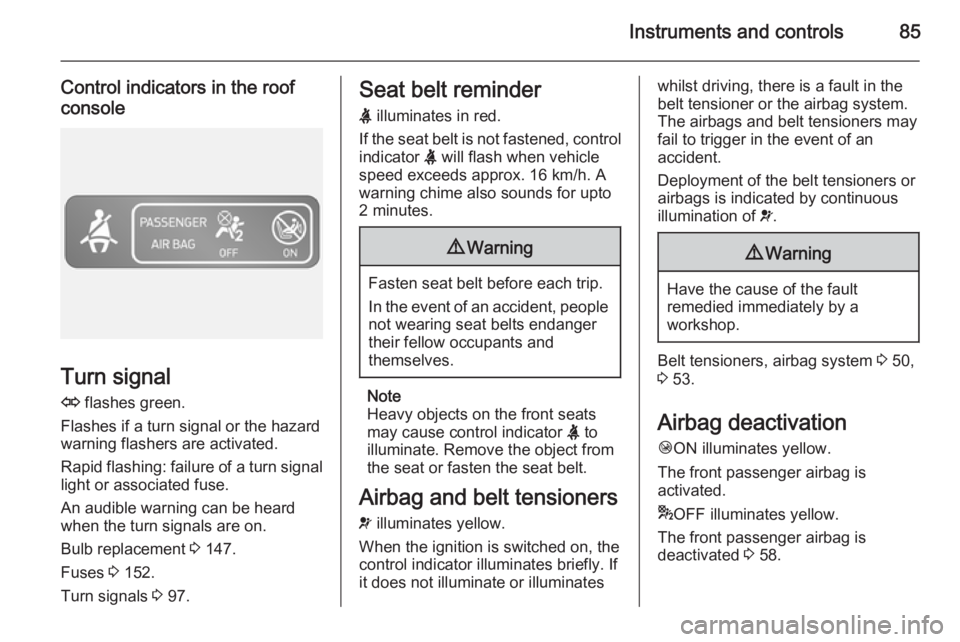
Control indicators in the roof
console
Turn signal
O flashes green.
Flashes if a turn signal or the hazard
warning flashers are activated.
Rapid flashing: failure of a turn signal
light or associated fuse.
An audible warning can be heard
when the turn signals are on.
Bulb replacement 3 147.
Fuses 3 152.
Turn signals 3 97.
Seat belt reminder
X illuminates in red.
If the seat belt is not fastened, control
indicator X will flash when vehicle
speed exceeds approx. 16 km/h. A
warning chime also sounds for upto
2 minutes.9 Warning
Fasten seat belt before each trip.
In the event of an accident, people
not wearing seat belts endanger their fellow occupants and
themselves.
Note
Heavy objects on the front seats
may cause control indicator X to
illuminate. Remove the object from
the seat or fasten the seat belt.
Airbag and belt tensioners
v illuminates yellow.
When the ignition is switched on, the
control indicator illuminates briefly. If it does not illuminate or illuminates
whilst driving, there is a fault in the
belt tensioner or the airbag system.
The airbags and belt tensioners may
fail to trigger in the event of an
accident.
Deployment of the belt tensioners or
airbags is indicated by continuous
illumination of v.9 Warning
Have the cause of the fault
remedied immediately by a
workshop.
Belt tensioners, airbag system 3 50,
3 53.
Airbag deactivation Ó ON illuminates yellow.
The front passenger airbag is
activated.
* OFF illuminates yellow.
The front passenger airbag is
deactivated 3 58.
Page 88 of 205
86Instruments and controls
If both control indicators ÓON and
* OFF are illuminated
simultaneously, there is a system
failure. The status of the system is not discernible, therefore no person is
permitted to occupy the front
passenger seat. Contact a workshop immediately.
If illuminated in conjunction with v or
F , seek the assistance of a workshop.9 Danger
Risk of fatal injury for a child using
a child restraint system together
with activated front passenger
airbag.
Risk of fatal injury for an adult
person with deactivated front
passenger airbag.
Airbag system 3 53, belt tensioners
3 50, airbag deactivation 3 58.
Charging system p illuminates red.
Illuminates briefly when the ignition is
switched on.
Illuminates when the engine is
running
If control indicator p illuminates
when the engine is running (together
with control indicator C and a
warning chime): Stop, switch off
engine.
Vehicle battery is not charging.
Engine cooling may be interrupted.
Power to the brake servo unit may be
cut. Seek the assistance of a
workshop.
Malfunction indicator light Z illuminates or flashes yellow.
Illuminates briefly when the ignition is
switched on.
Illuminates when the engine is running Fault in the emission control system.
The permitted emission limits may be
exceeded. Seek the assistance of a
workshop immediately.Flashes when the engine is
running
Fault that could lead to catalytic
converter damage. Ease up on the
accelerator until the flashing stops.
Seek the immediate assistance of a
workshop.
Service vehicle soon F illuminates in yellow.
Illuminates when the ignition is
switched on and goes out shortly after
the engine starts.
May illuminate together with other
control indicators and a
corresponding message in the Driver
Information Centre. Seek the
assistance of a workshop
immediately.
Stop engine C illuminates in red.
Illuminates when the ignition is
switched on and goes out shortly after
the engine starts.
Page 93 of 205
Instruments and controls91Vehicle messages
Messages are displayed in the Driver
Information Centre and may be
accompanied by illumination of
control indicator F or C in the
instrument cluster.
Information messages Information messages regarding,
e.g. engine starting conditions, stop-
start system, parking brake
application, central locking, steering
wheel lock etc. provide the current
status of certain vehicle functions and
instructions for use.
Fault messages Fault messages regarding, e.g. fuel
filter, airbags, exhaust emissions etc.
are displayed together with control
indicator F. Drive with caution and
seek the assistance of a workshop as
soon as possible.
To remove fault messages from the
display, press button on end of wiper
lever. After a few seconds the
message may disappearautomatically and F remains
illuminated. The fault will then be
stored in the on board system.
Warning messagesWarning messages regarding, e.g.
engine, battery or brake system
failure, are displayed together with
control indicator C and may be
accompanied by a warning chime.
Stop engine immediately and seek
the assistance of a workshop.
Fuel economy messages
Fuel economy messages provide tips to improve fuel efficiency. Journeys
can be saved in the system memory,
enabling you to compare
performances.
Refer to Infotainment system manual
for further information.
Fuel economy rating 3 92.
Warning chimes
A corresponding message may also
appear in the Driver Information
Centre when a warning chime is
sounded.When starting the engine or
whilst driving: ■ If seat belt is not fastened 3 50.
■ During operation of the turn and lane-change signals 3 97.
■ During illumination of certain control indicators.
■ If the parking assist detects an object 3 130.
■ If the vehicle speed briefly exceeds
a set limit 3 126, 3 130.
■ If a door or the bonnet is not properly closed when vehicle
exceeds a certain speed.
■ If there is a fault in the brake system
3 87.
■ If the vehicle battery is not charging
3 86.
■ If engine lubrication is interrupted 3 88.
■ If the electronic key is outside of the
detection range.
Electronic key system 3 23, Power
button 3 114.
Page 113 of 205
Climate control111Maintenance
Air intake
The air intake in front of the
windscreen in the engine
compartment must be kept clear to
allow air intake. Remove any leaves,
dirt or snow.
Pollen filter
The pollen filter cleans dust, soot,
pollen and spores from the air
entering the vehicle through the air
intake.
Air conditioning regular
operation In order to ensure continuously
efficient performance, cooling must
be operated for a few minutes once a
month, irrespective of the weather
and time of year. Operation with
cooling is not possible when outside
temperature is too low.Service
For optimal cooling performance, it is
recommended that the climate control system be checked annually, starting
three years after initial vehicle
registration, including:
■ Functionality and pressure test■ Heating functionality
■ Leakage check
■ Check of drive belts
■ Cleaning of condenser and evaporator drainage
■ Performance check
Page 159 of 205
Vehicle care157Wheels and tyresTyre condition, wheel condition
Drive over edges slowly and at right
angles if possible. Driving over sharp
edges can cause tyre and wheel
damage. Do not trap tyres on the kerb
when parking.
Regularly check the wheels for
damage. Seek the assistance of a
workshop in the event of damage or
unusual wear.
We recommend not swapping the
front wheels with the rear wheels and vice versa, as this can affect vehicle
stability. Always use less worn tyres
on the rear axle.
Tyres Factory-fitted tyres are matched to
the chassis and offer optimum driving comfort and safety.Winter tyres
Winter tyres improve driving safety attemperatures below 7 °C and should
therefore be fitted on all wheels.
In accordance with country-specific
regulations, a notice indicating the
maximum permissible speed for the
tyres must be affixed within the
driver's field of vision.
Tyre designations E.g. 195/65 R 16 C 88 Q195=Tyre width, mm65=Cross-section ratio (tyre height
to tyre width), %R=Belt type: RadialRF=Type: RunFlat16=Wheel diameter, inchesC=Cargo or commercial use88=Load index e.g. 88 is
equivalent to 567 kgQ=Speed code letter
Speed code letter:
Q=up to 160 km/hS=up to 180 km/hT=up to 190 km/hH=up to 210 km/hV=up to 240 km/hW=up to 270 km/h
Directional tyres
Fit directional tyres such that they roll in the direction of travel. The rolling
direction is indicated by a symbol
(e.g. an arrow) on the sidewall.
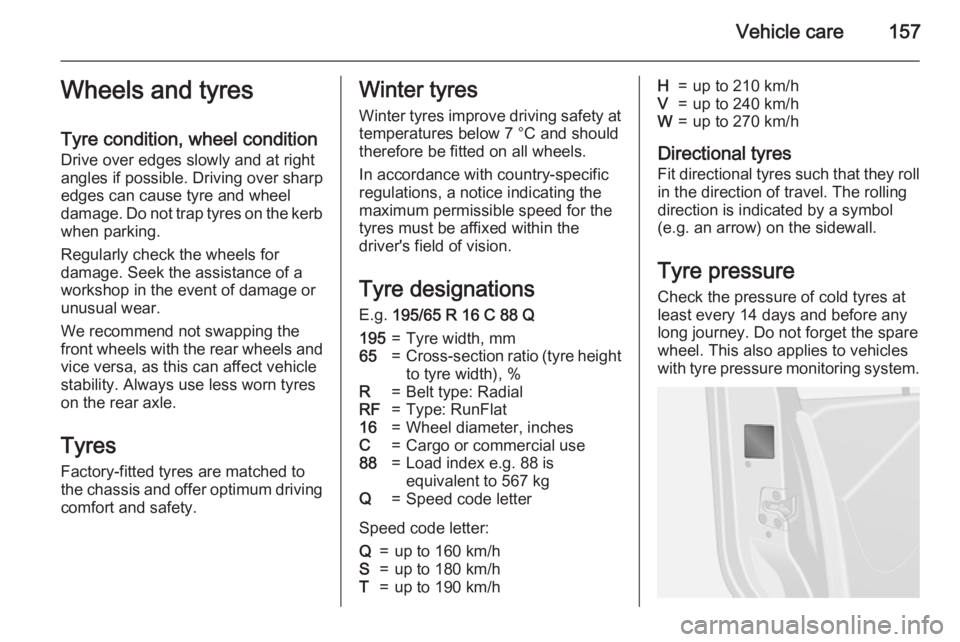
Tyre pressure Check the pressure of cold tyres atleast every 14 days and before any
long journey. Do not forget the spare
wheel. This also applies to vehicles
with tyre pressure monitoring system.
Page 175 of 205
Vehicle care173
The instrument cluster and the
displays should only be cleaned using
a soft damp cloth. If necessary use a
weak soap solution.
Clean fabric upholstery with a
vacuum cleaner and brush. Remove
stains with an upholstery cleaner.
Clothing fabrics may not be
colourfast. This could cause visible
discolourations, especially on light-
coloured upholstery. Removable
stains and discolourations should be
cleaned as soon as possible.
Clean seat belts with lukewarm water or interior cleaner.Caution
Close Velcro fasteners as open
Velcro fasteners on clothing could damage seat upholstery.
The same applies to clothing with
sharp-edged objects, like zips or
belts or studded jeans.
Plastic and rubber parts
Plastic and rubber parts can be
cleaned with the same cleaner as
used to clean the body. Use interior cleaner if necessary. Do not use any
other agent. Avoid solvents and petrol in particular. Do not use high-
pressure jet cleaners.
Page 198 of 205
196IndexAAccessories and vehicle modifications .......................... 138
Adaptive forward lighting .............97
Adjustable air vents ...................110
AGM (Absorptive Glass Mat) battery ..................................... 144
Airbag and belt tensioners ...........85
Airbag deactivation ................58, 85
Airbag label................................... 53
Airbag system .............................. 53
Air conditioning regular operation ................................ 111
Air conditioning system .............. 102
Air intake .................................... 111
Air recirculation ...................102, 169
Air vents...................................... 110
Alert .............................................. 91
Antifreeze ................................... 142
Antilock brake system ................ 122
Antilock brake system (ABS) .......87
Anti-theft alarm system ................35
Anti-theft bolts............................. 165
Anti-theft locking system .............. 34
Anti-theft security lock ..................25
Appearance care ........................171
Armrest ........................................ 47
Ashtrays ....................................... 80
Automatic anti-dazzle ..................40Automatic fuel cut-off ..................117
Automatic light control .................95
Automatic locking ........................30
Autostop ............................... 89, 116
Auxiliary heater ........................... 106
B Battery ........................................ 144
Battery, jump starting.................. 168
Belts.............................................. 50
Bench seat.................................... 69
Bonnet ....................................... 140
Bottle holders................................ 68
Brake and clutch fluid .................176
Brake assist ............................... 123
Brake fluid .................................. 143 Brakes ............................... 122, 143
Brake system ............................... 87
Breakdown.................................. 169
Bulb replacement ....................... 147
C Capacities .................................. 191
Car Pass ...................................... 21
Catalytic converter .....................120
Central locking system ................25
Centre high-mounted brake light 149
Changing tyre and wheel size ...161
Charging system .......................... 86
Child locks ................................... 30