display OPEL VIVARO 2015 Owner's Manual
[x] Cancel search | Manufacturer: OPEL, Model Year: 2015, Model line: VIVARO, Model: OPEL VIVARO 2015Pages: 205, PDF Size: 4.47 MB
Page 143 of 205
Vehicle care141
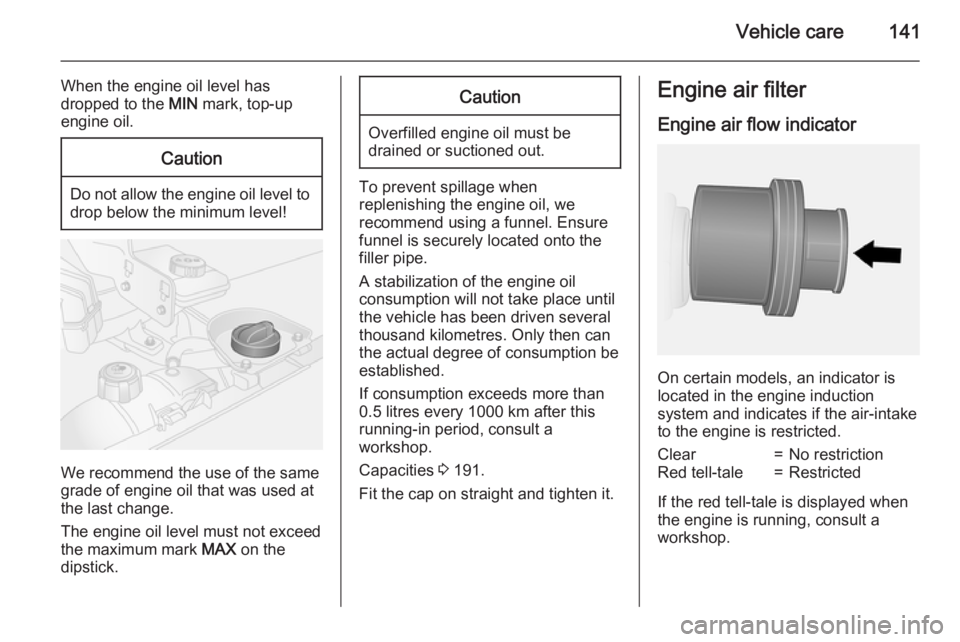
When the engine oil level has
dropped to the MIN mark, top-up
engine oil.Caution
Do not allow the engine oil level to drop below the minimum level!
We recommend the use of the same
grade of engine oil that was used at
the last change.
The engine oil level must not exceed the maximum mark MAX on the
dipstick.
Caution
Overfilled engine oil must be
drained or suctioned out.
To prevent spillage when
replenishing the engine oil, we
recommend using a funnel. Ensure funnel is securely located onto the
filler pipe.
A stabilization of the engine oil
consumption will not take place until
the vehicle has been driven several
thousand kilometres. Only then can
the actual degree of consumption be
established.
If consumption exceeds more than
0.5 litres every 1000 km after this
running-in period, consult a
workshop.
Capacities 3 191.
Fit the cap on straight and tighten it.
Engine air filter
Engine air flow indicator
On certain models, an indicator is
located in the engine induction
system and indicates if the air-intake
to the engine is restricted.
Clear=No restrictionRed tell-tale=Restricted
If the red tell-tale is displayed when
the engine is running, consult a
workshop.
Page 157 of 205
Vehicle care155
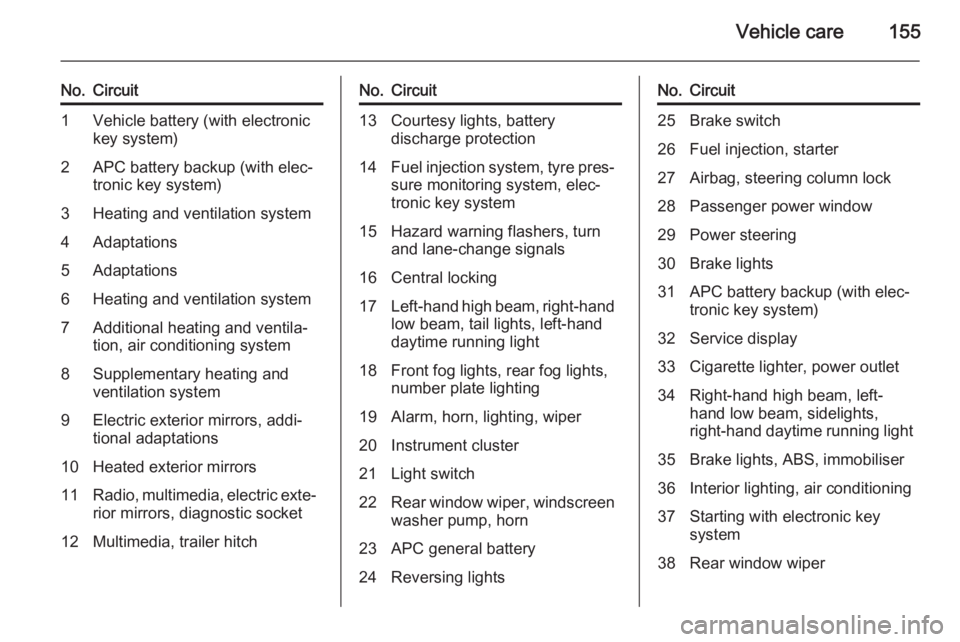
No.Circuit1Vehicle battery (with electronic
key system)2APC battery backup (with elec‐
tronic key system)3Heating and ventilation system4Adaptations5Adaptations6Heating and ventilation system7Additional heating and ventila‐
tion, air conditioning system8Supplementary heating and
ventilation system9Electric exterior mirrors, addi‐
tional adaptations10Heated exterior mirrors11Radio, multimedia, electric exte‐ rior mirrors, diagnostic socket12Multimedia, trailer hitchNo.Circuit13Courtesy lights, battery
discharge protection14Fuel injection system, tyre pres‐ sure monitoring system, elec‐
tronic key system15Hazard warning flashers, turn and lane-change signals16Central locking17Left-hand high beam, right-hand
low beam, tail lights, left-hand
daytime running light18Front fog lights, rear fog lights,
number plate lighting19Alarm, horn, lighting, wiper20Instrument cluster21Light switch22Rear window wiper, windscreen
washer pump, horn23APC general battery24Reversing lightsNo.Circuit25Brake switch26Fuel injection, starter27Airbag, steering column lock28Passenger power window29Power steering30Brake lights31APC battery backup (with elec‐
tronic key system)32Service display33Cigarette lighter, power outlet34Right-hand high beam, left-
hand low beam, sidelights,
right-hand daytime running light35Brake lights, ABS, immobiliser36Interior lighting, air conditioning37Starting with electronic key
system38Rear window wiper
Page 160 of 205
158Vehicle care
Tyre pressures 3 192. Always inflate
tyres to the pressures shown on the
label on the driver's door frame.
The tyre pressure data refers to cold
tyres. It applies to summer and winter tyres.
Always inflate the spare tyre to the
pressure specified for full load.
Incorrect tyre pressures will impair
safety, vehicle handling, comfort and
fuel economy and will increase tyre
wear.
Tyre pressures differ depending on
various options. For the correct tyre
pressure value, follow the procedure
below:
1. Identify the engine identifier code.
Engine data 3 182.
2. Identify the respective tyre.
The tyre pressure tables show all possible tyre combinations 3 192.
For the tyres approved for your
vehicle, refer to the EEC Certificate of
Conformity provided with your vehicle
or other national registration
documents.The driver is responsible for correct
adjustment of tyre pressure.9 Warning
If the pressure is too low, this can
result in considerable tyre warm-
up and internal damage, leading to tread separation and even to tyre
blow-out at high speeds.
Tyre pressure monitoring
system
The Tyre Pressure Monitoring
System (TPMS) uses radio and
sensor technology to check tyre
pressure levels.
Caution
Tyre pressure monitoring system
warns only about low tyre pressure condition and does not replace
regular tyre maintenance by the
driver.
All wheels must be equipped with pressure sensors and the tyres must
have the prescribed pressure.
Note
In countries where the tyre pressure
monitoring system is legally
required, the use of wheels without
pressure sensors will invalidate the
vehicle type approval.
The TPMS sensors monitor the air
pressure in the tyres and transmit tyre pressure readings to a receiver
located in the vehicle.
Tyre pressures in display The current tyre pressures can be
shown in the Driver Information
Centre 3 90.
Page 161 of 205
Vehicle care159
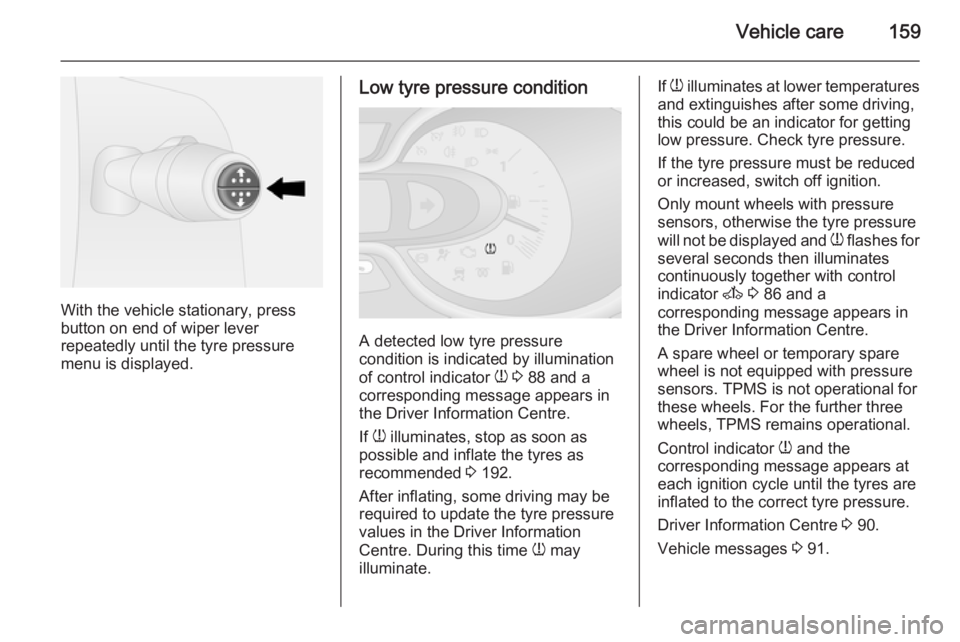
With the vehicle stationary, press
button on end of wiper lever
repeatedly until the tyre pressure
menu is displayed.
Low tyre pressure condition
A detected low tyre pressure
condition is indicated by illumination
of control indicator w 3 88 and a
corresponding message appears in
the Driver Information Centre.
If w illuminates, stop as soon as
possible and inflate the tyres as
recommended 3 192.
After inflating, some driving may be
required to update the tyre pressure
values in the Driver Information
Centre. During this time w may
illuminate.
If w illuminates at lower temperatures
and extinguishes after some driving,
this could be an indicator for getting low pressure. Check tyre pressure.
If the tyre pressure must be reduced
or increased, switch off ignition.
Only mount wheels with pressure
sensors, otherwise the tyre pressure
will not be displayed and w flashes for
several seconds then illuminates continuously together with control
indicator A 3 86 and a
corresponding message appears in
the Driver Information Centre.
A spare wheel or temporary spare
wheel is not equipped with pressure
sensors. TPMS is not operational for these wheels. For the further three
wheels, TPMS remains operational.
Control indicator w and the
corresponding message appears at
each ignition cycle until the tyres are
inflated to the correct tyre pressure.
Driver Information Centre 3 90.
Vehicle messages 3 91.
Page 162 of 205
160Vehicle care
Puncture
A puncture or severely under-inflated
tyre is indicated by illumination of
control indicator w together with C
3 86 and a corresponding message
appears in the Driver Information
Centre. Stop vehicle and switch off
engine.
Tyre pressure 3 192, Tyre repair kit
3 162, Spare wheel 3 166, Wheel
changing 3 165.
Temperature dependency Tyre pressure depends on the
temperature of the tyre. During
driving, tyre temperature and
pressure increase.
The tyre pressure value displayed in
the Driver Information Centre shows
the actual tyre pressure. Therefore it
is important to check tyre pressure
with cold tyres.Relearn function
After changing the wheels, TPMS
needs to recalculate.
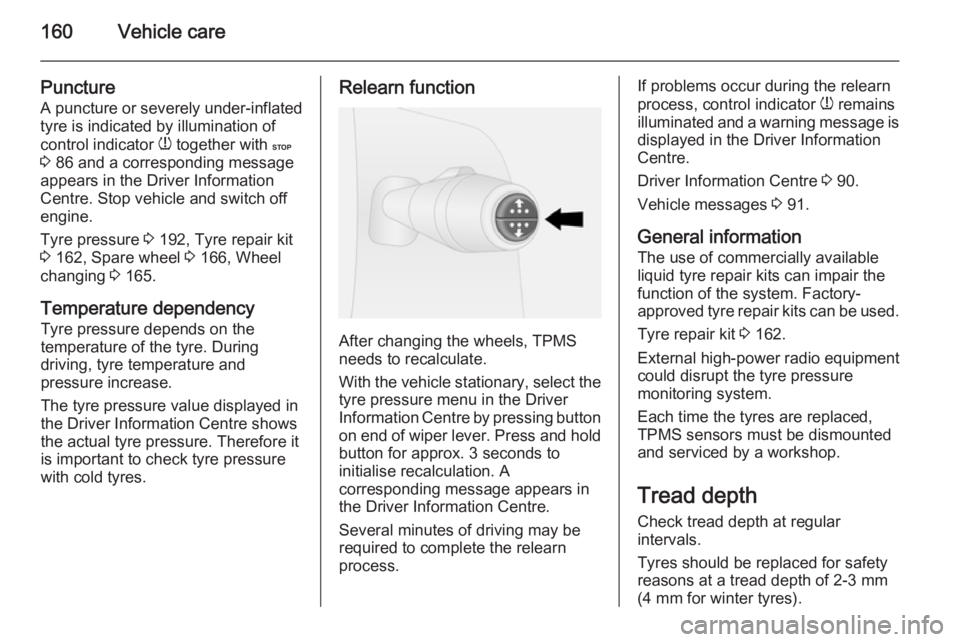
With the vehicle stationary, select the tyre pressure menu in the Driver
Information Centre by pressing button
on end of wiper lever. Press and hold button for approx. 3 seconds to
initialise recalculation. A
corresponding message appears in
the Driver Information Centre.
Several minutes of driving may be
required to complete the relearn
process.
If problems occur during the relearn
process, control indicator w remains
illuminated and a warning message is displayed in the Driver Information
Centre.
Driver Information Centre 3 90.
Vehicle messages 3 91.
General information
The use of commercially available
liquid tyre repair kits can impair the
function of the system. Factory-
approved tyre repair kits can be used.
Tyre repair kit 3 162.
External high-power radio equipment
could disrupt the tyre pressure
monitoring system.
Each time the tyres are replaced,
TPMS sensors must be dismounted
and serviced by a workshop.
Tread depth
Check tread depth at regular
intervals.
Tyres should be replaced for safety
reasons at a tread depth of 2-3 mm
(4 mm for winter tyres).
Page 175 of 205
Vehicle care173
The instrument cluster and the
displays should only be cleaned using
a soft damp cloth. If necessary use a
weak soap solution.
Clean fabric upholstery with a
vacuum cleaner and brush. Remove
stains with an upholstery cleaner.
Clothing fabrics may not be
colourfast. This could cause visible
discolourations, especially on light-
coloured upholstery. Removable
stains and discolourations should be
cleaned as soon as possible.
Clean seat belts with lukewarm water or interior cleaner.Caution
Close Velcro fasteners as open
Velcro fasteners on clothing could damage seat upholstery.
The same applies to clothing with
sharp-edged objects, like zips or
belts or studded jeans.
Plastic and rubber parts
Plastic and rubber parts can be
cleaned with the same cleaner as
used to clean the body. Use interior cleaner if necessary. Do not use any
other agent. Avoid solvents and petrol in particular. Do not use high-
pressure jet cleaners.
Page 176 of 205
174Service and maintenanceService and
maintenanceGeneral information ...................174
Recommended fluids, lubricants and parts .................................... 176General information
Service information In order to ensure economical and
safe vehicle operation and to
maintain the value of your vehicle, it
is of vital importance that all
maintenance work is carried out at the proper intervals as specified.
The detailed, up-to-date service
schedule for the vehicle is available at
the workshop.
Service display 3 82.
Engine identification 3 179.
European service intervals
Maintenance of your vehicle is
required every 40,000 km or after
2 years, whichever occurs first,
unless otherwise indicated by the
service display.
A shorter service interval can be valid for severe driving behaviour, e.g. for
taxis and police vehicles.
The European service intervals are
valid for the following countries:Andorra, Austria, Belgium, Croatia,
Czech Republic, Denmark, Estonia,
Finland, France, Germany, Greece,
Hungary, Iceland, Ireland, Italy,
Latvia, Liechtenstein, Lithuania,
Luxembourg, Netherlands, Norway,
Poland, Portugal, Slovakia, Slovenia,
Spain, Sweden, Switzerland, United
Kingdom.
International service intervals Israel:
Maintenance of your vehicle is
required every 40,000 km or after
1 year , whichever occurs first, unless
otherwise indicated by the service
display.
Romania, Bulgaria:
Maintenance of your vehicle is
required every 30,000 km or after
1 year , whichever occurs first, unless
otherwise indicated by the service
display.
Page 177 of 205
Service and maintenance175
Australia:
Maintenance of your vehicle is
required every 15,000 km or after
1 year , whichever occurs first, unless
otherwise indicated by the service
display.
Turkey:
Maintenance of your vehicle is
required every 20,000 km or after
1 year , whichever occurs first, unless
otherwise indicated by the service
display.
Morocco:
Maintenance of your vehicle is
required every 15,000 km or after
1 year , whichever occurs first, unless
otherwise indicated by the service
display.
Russia, Ukraine, Belarus,
Kazakhstan:
Maintenance of your vehicle is
required every 15,000 km or after
1 year , whichever occurs first, unless
otherwise indicated by the service
display.South Africa:
Maintenance of your vehicle is
required every 15,000 km or after
1 year , whichever occurs first, unless
otherwise indicated by the service
display.
Algeria, Tunisia:
Maintenance of your vehicle is
required every 10,000 km or after
1 year , whichever occurs first, unless
otherwise indicated by the service
display.
International:
Maintenance of your vehicle is
required every 10,000 km or after
1 year , whichever occurs first, unless
otherwise indicated by the service
display.
International countries include:
Albania, Bosnia-Herzegovina,
Cyprus, Kosovo, Macedonia, Malta,
Montenegro, New Zealand, Serbia,
Singapore.International+:
Maintenance of your vehicle is
required every 8,000 km or after
1 year , whichever occurs first, unless
otherwise indicated by the service
display.
International + countries include:
Moldova.
International++:
Maintenance of your vehicle is
required every 5,000 km or after
6 months, whichever occurs first,
unless otherwise indicated by the
service display.
International ++ countries include:
Hong Kong.
Confirmations
Confirmation of service is recorded in
the Service and Warranty Booklet.
The date and mileage is completed
with the stamp and signature of the
servicing workshop.
Make sure that the Service and
Warranty Booklet is completed
correctly as continuous proof of
Page 178 of 205
176Service and maintenance
service is essential if any warranty or
goodwill claims are to be met, and is
also a benefit when selling the
vehicle.
Service display
The service interval is based on
several parameters depending on
usage.
The service display, located in the
Driver Information Centre, indicates
when the next service is due. Seek
the assistance of a workshop.
Service display 3 82.Recommended fluids,
lubricants and parts
Recommended fluids and
lubricants Only use products that meet the
recommended specifications.
Damage resulting from the use of
products not in line with these
specifications will not be covered by
the warranty.9 Warning
Operating materials are
hazardous and could be
poisonous. Handle with care. Pay
attention to information given on
the containers.
Engine oil
Engine oil is identified by its quality
and its viscosity. Quality is more
important than viscosity when
selecting which engine oil to use. The oil quality ensures e.g. engine
cleanliness, wear protection and oil
aging control, whereas viscosity
grade gives information on the oil's
thickness over a temperature range.
Dexos is the newest engine oil quality
that provides optimum protection for petrol and diesel engines. If it is
unavailable, engine oils of other listed qualities must be used.
Select the appropriate engine oil
based on its quality and on the
minimum ambient temperature
3 181.
Topping up engine oil
Engine oils of different manufacturers
and brands can be mixed as long as
they comply with the required engine
oil quality and viscosity.
Use of engine oil with only
ACEA A1/B1 or only A5/B5 quality is
prohibited, since it can cause long-
term engine damage under certain
operating conditions.
Select the appropriate engine oil
based on its quality and on the
minimum ambient temperature
3 181.
Page 180 of 205

178Technical dataTechnical dataVehicle identification..................178
Vehicle data ............................... 181Vehicle identification
Vehicle Identification
Number
The Vehicle Identification Number is
visible through the windscreen.
The VIN is also displayed behind a
removable plastic cover on the right-
hand side door step.