ignition OPEL VIVARO 2015 Service Manual
[x] Cancel search | Manufacturer: OPEL, Model Year: 2015, Model line: VIVARO, Model: OPEL VIVARO 2015Pages: 205, PDF Size: 4.47 MB
Page 136 of 205
134Driving and operatingFuel
Fuel for diesel engines Only use diesel fuel that complies
with EN 590. The fuel must have low
sulphur content (max. 10 ppm).
Equivalent standardised fuels with a
biodiesel (= FAME according to
EN14214) content of max. 7% by
volume (like DIN 51628 or equivalent
standards) may be used.
In countries outside the European
Union, use Euro-Diesel fuel with a
sulphur concentration below 50 ppm.Caution
Use of fuel that does not comply to EN 590 or similar can lead to
engine powerloss, increased wear
or engine damage and loss of
warranty.
Do not use marine diesel oils, heating
oils, Aquazole and similar diesel-
water emulsions. Diesel fuels must
not be diluted with fuels for petrol
engines.
The flow and filterability of diesel fuels are temperature-dependent. When
temperatures are low, refuel with
diesel fuel with guaranteed winter
properties.
Diesel fuel filter 3 146, diesel fuel
system bleeding 3 146.
Refuelling9 Danger
Before refuelling, switch off engine
and any external heaters with
combustion chambers.
Vehicles with stop-start system:
The engine must be switched off
and the ignition key removed, to avoid risk of engine being
restarted automatically by the
system.
Switch off any mobile phones.
Follow the operating and safety
instructions of the filling station
when refuelling.
9 Danger
Fuel is flammable and explosive.
No smoking. No naked flames or
sparks.
If you can smell fuel in your
vehicle, have the cause of this
remedied immediately by a
workshop.
Caution
In case of misfuelling, do not
switch on ignition.
Note
To ensure the fuel level is displayed
correctly, the ignition must be
switched off before refuelling. Avoid
minor fuel top-ups (e.g. less than
5 litres) to ensure accurate readings.
The fuel filler flap is located on the left-
hand side of the vehicle.
The fuel filler flap can only be opened
if the vehicle is unlocked and the left-
hand door is opened.
Pull flap to open.
Page 141 of 205
Vehicle care139
■ Open the bonnet, close all doorsand lock the vehicle.
■ Disconnect the clamp from the negative terminal of the vehicle
battery. Beware that all systems are
not functional, e.g. anti-theft alarm
system.
Putting back into operation
When the vehicle is to be put back into
operation:
■ Connect the clamp to the negative terminal of the vehicle battery.
Activate the electronics of the
power windows.
■ Check tyre pressure.
■ Fill up the washer fluid reservoir.
■ Check the engine oil level.
■ Check the coolant level.
■ Fit the number plate, if necessary.End-of-life vehicle
recovery
Information on end-of-life vehicle
recovery centres and the recycling of
end-of-life vehicles is available on our website. Only entrust this work to an
authorised recycling centre.Vehicle checks
Performing work9 Warning
Only perform engine compartment
checks when the ignition is off.
The cooling fan may start
operating even if the ignition is off.
9 Danger
The ignition system generates
extremely high voltages. Do not
touch.
The caps for topping up the engine oil, the coolant, the washer fluid and the
oil dipstick handle are yellow for ease
of identification.
Page 146 of 205
144Vehicle care
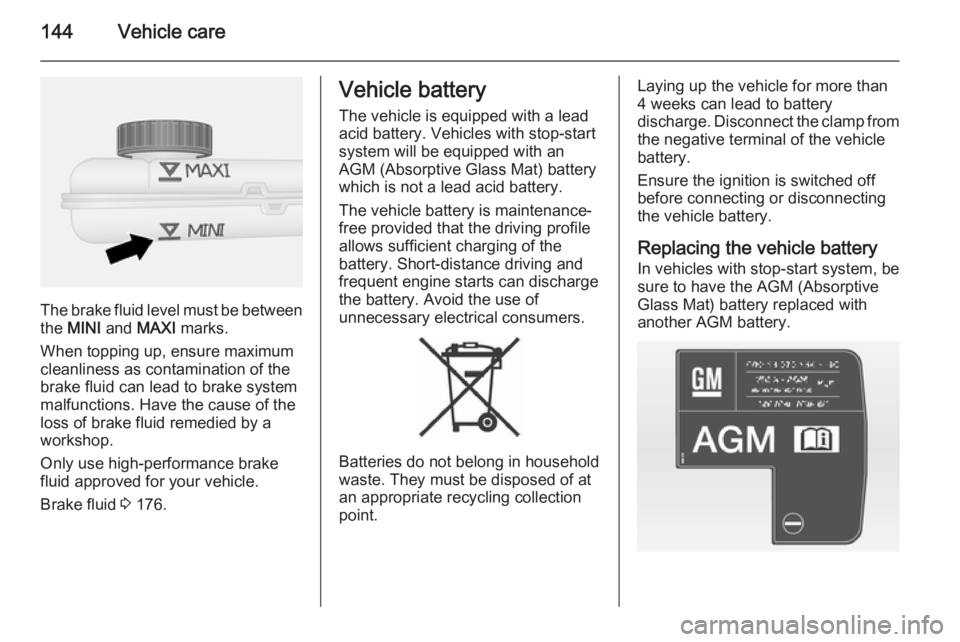
The brake fluid level must be betweenthe MINI and MAXI marks.
When topping up, ensure maximum cleanliness as contamination of the
brake fluid can lead to brake system
malfunctions. Have the cause of the
loss of brake fluid remedied by a
workshop.
Only use high-performance brake
fluid approved for your vehicle.
Brake fluid 3 176.
Vehicle battery
The vehicle is equipped with a lead
acid battery. Vehicles with stop-start
system will be equipped with an
AGM (Absorptive Glass Mat) battery
which is not a lead acid battery.
The vehicle battery is maintenance-
free provided that the driving profile
allows sufficient charging of the
battery. Short-distance driving and
frequent engine starts can discharge
the battery. Avoid the use of
unnecessary electrical consumers.
Batteries do not belong in household
waste. They must be disposed of at
an appropriate recycling collection
point.
Laying up the vehicle for more than
4 weeks can lead to battery
discharge. Disconnect the clamp from the negative terminal of the vehicle
battery.
Ensure the ignition is switched off
before connecting or disconnecting
the vehicle battery.
Replacing the vehicle battery
In vehicles with stop-start system, be
sure to have the AGM (Absorptive
Glass Mat) battery replaced with
another AGM battery.
Page 148 of 205
146Vehicle careDiesel fuel filter
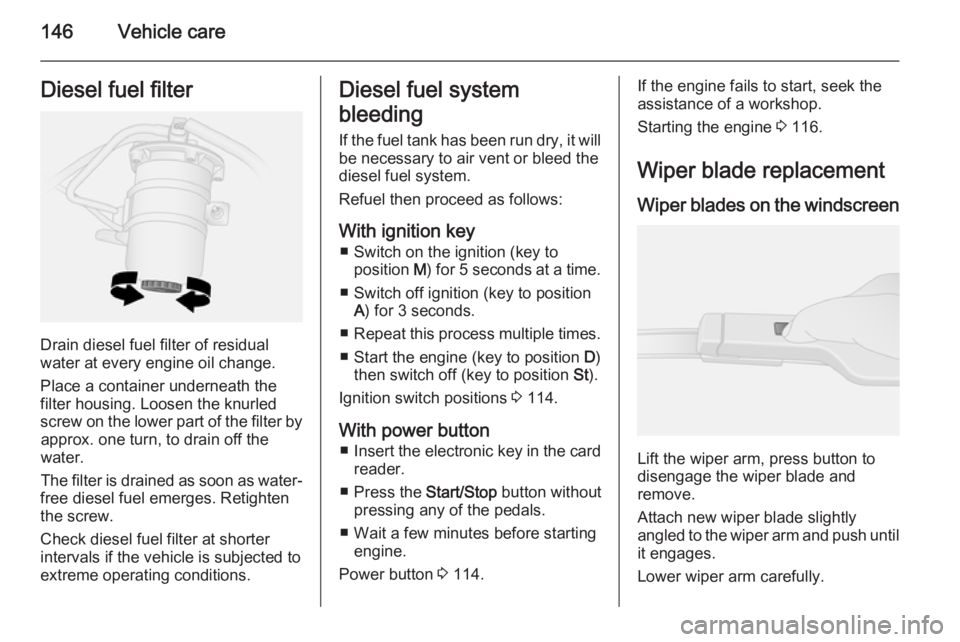
Drain diesel fuel filter of residual
water at every engine oil change.
Place a container underneath the
filter housing. Loosen the knurled
screw on the lower part of the filter by approx. one turn, to drain off the
water.
The filter is drained as soon as water-
free diesel fuel emerges. Retighten
the screw.
Check diesel fuel filter at shorter
intervals if the vehicle is subjected to
extreme operating conditions.
Diesel fuel system
bleeding
If the fuel tank has been run dry, it will
be necessary to air vent or bleed the
diesel fuel system.
Refuel then proceed as follows:
With ignition key ■ Switch on the ignition (key to position M) for 5 seconds at a time.
■ Switch off ignition (key to position A) for 3 seconds.
■ Repeat this process multiple times.
■ Start the engine (key to position D)
then switch off (key to position St).
Ignition switch positions 3 114.
With power button ■ Insert the electronic key in the card
reader.
■ Press the Start/Stop button without
pressing any of the pedals.
■ Wait a few minutes before starting engine.
Power button 3 114.If the engine fails to start, seek the
assistance of a workshop.
Starting the engine 3 116.
Wiper blade replacement Wiper blades on the windscreen
Lift the wiper arm, press button to
disengage the wiper blade and
remove.
Attach new wiper blade slightly
angled to the wiper arm and push until
it engages.
Lower wiper arm carefully.
Page 149 of 205
Vehicle care147
Wiper blade on the rear windowLift wiper arm, rotate wiper blade and
detach.Bulb replacement
Switch off the ignition and turn off the
relevant switch or close the doors.
Only hold a new bulb at the base. Do not touch the bulb glass with bare
hands.
Use only the same bulb type for
replacement.
Bulb check
After a bulb replacement, switch on
the ignition, operate and check the
lights.Headlights
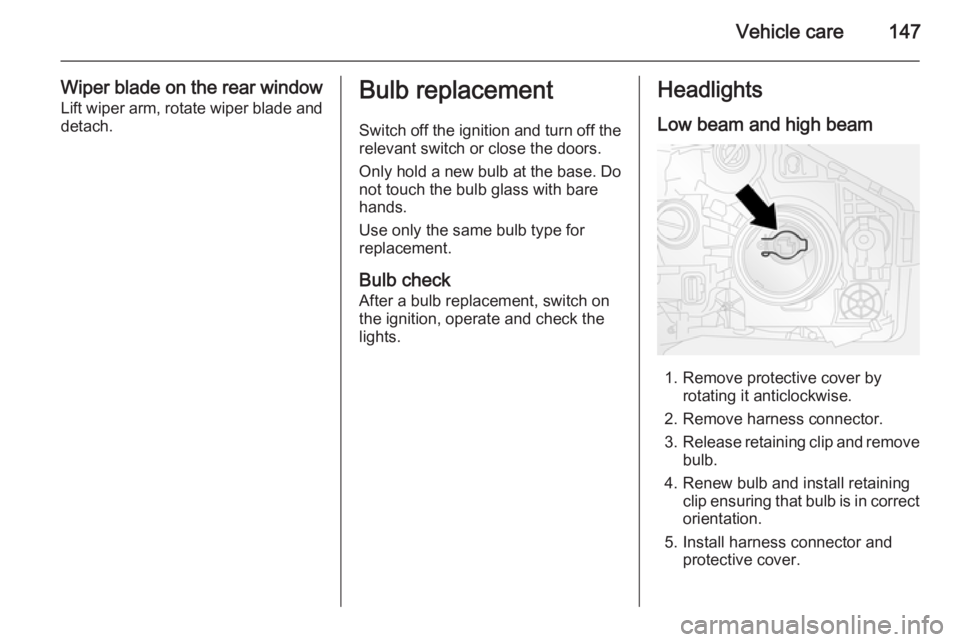
Low beam and high beam
1. Remove protective cover by rotating it anticlockwise.
2. Remove harness connector.
3. Release retaining clip and remove
bulb.
4. Renew bulb and install retaining clip ensuring that bulb is in correctorientation.
5. Install harness connector and protective cover.
Page 154 of 205
152Vehicle care
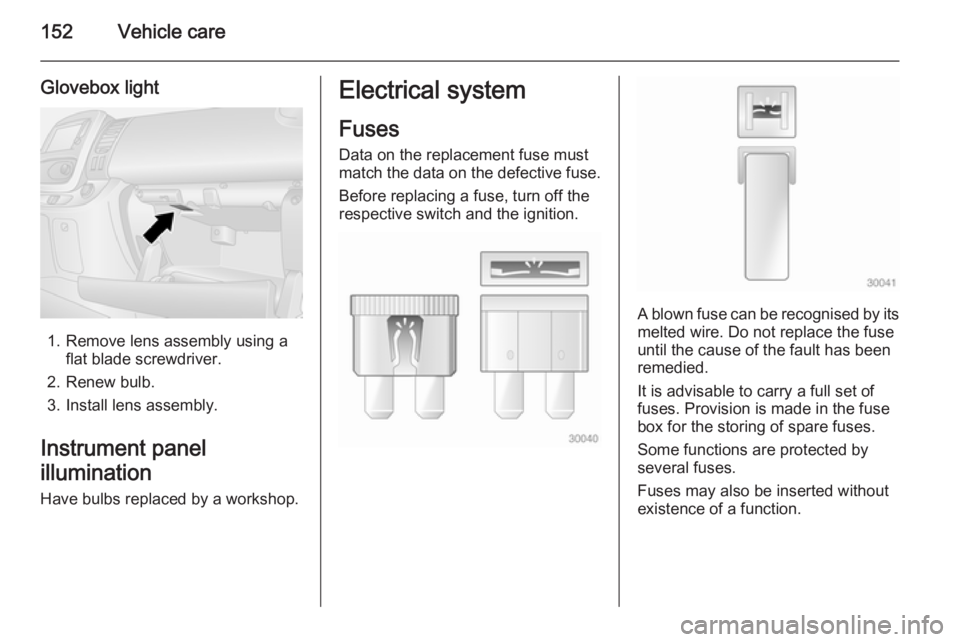
Glovebox light
1. Remove lens assembly using aflat blade screwdriver.
2. Renew bulb.
3. Install lens assembly.
Instrument panel
illumination
Have bulbs replaced by a workshop.
Electrical system
Fuses
Data on the replacement fuse must
match the data on the defective fuse.
Before replacing a fuse, turn off the
respective switch and the ignition.
A blown fuse can be recognised by its melted wire. Do not replace the fuse
until the cause of the fault has been
remedied.
It is advisable to carry a full set of
fuses. Provision is made in the fuse
box for the storing of spare fuses.
Some functions are protected by
several fuses.
Fuses may also be inserted without
existence of a function.
Page 161 of 205
Vehicle care159
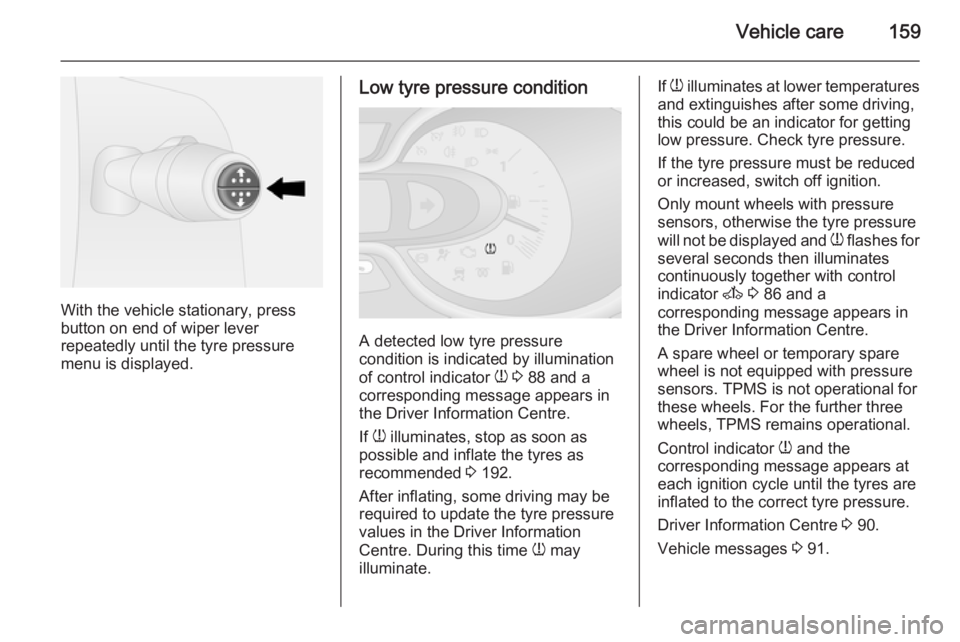
With the vehicle stationary, press
button on end of wiper lever
repeatedly until the tyre pressure
menu is displayed.
Low tyre pressure condition
A detected low tyre pressure
condition is indicated by illumination
of control indicator w 3 88 and a
corresponding message appears in
the Driver Information Centre.
If w illuminates, stop as soon as
possible and inflate the tyres as
recommended 3 192.
After inflating, some driving may be
required to update the tyre pressure
values in the Driver Information
Centre. During this time w may
illuminate.
If w illuminates at lower temperatures
and extinguishes after some driving,
this could be an indicator for getting low pressure. Check tyre pressure.
If the tyre pressure must be reduced
or increased, switch off ignition.
Only mount wheels with pressure
sensors, otherwise the tyre pressure
will not be displayed and w flashes for
several seconds then illuminates continuously together with control
indicator A 3 86 and a
corresponding message appears in
the Driver Information Centre.
A spare wheel or temporary spare
wheel is not equipped with pressure
sensors. TPMS is not operational for these wheels. For the further three
wheels, TPMS remains operational.
Control indicator w and the
corresponding message appears at
each ignition cycle until the tyres are
inflated to the correct tyre pressure.
Driver Information Centre 3 90.
Vehicle messages 3 91.
Page 172 of 205
170Vehicle careCaution
Do not tow the vehicle from the
rear. The front towing eye must
only be used for towing and not
recovering a vehicle.
Caution
Activate the child locks in the rear
doors if the rear seats are
occupied. Child locks 3 30.
Switch on ignition to permit operation
of brake lights, horn and windscreen
wipers, and move the steering wheel
slightly to release the steering wheel
lock.
Transmission in neutral.
Caution
Drive slowly. Do not drive jerkily.
Excessive tractive force can
damage the vehicle.
When the engine is not running,
considerably more force is needed to
brake and steer.
To prevent the entry of exhaust fumes
from the towing vehicle, switch on the air recirculation system 3 102 and
close the windows.
Seek the assistance of a workshop.
After towing, unscrew the towing eye
and replace cap.
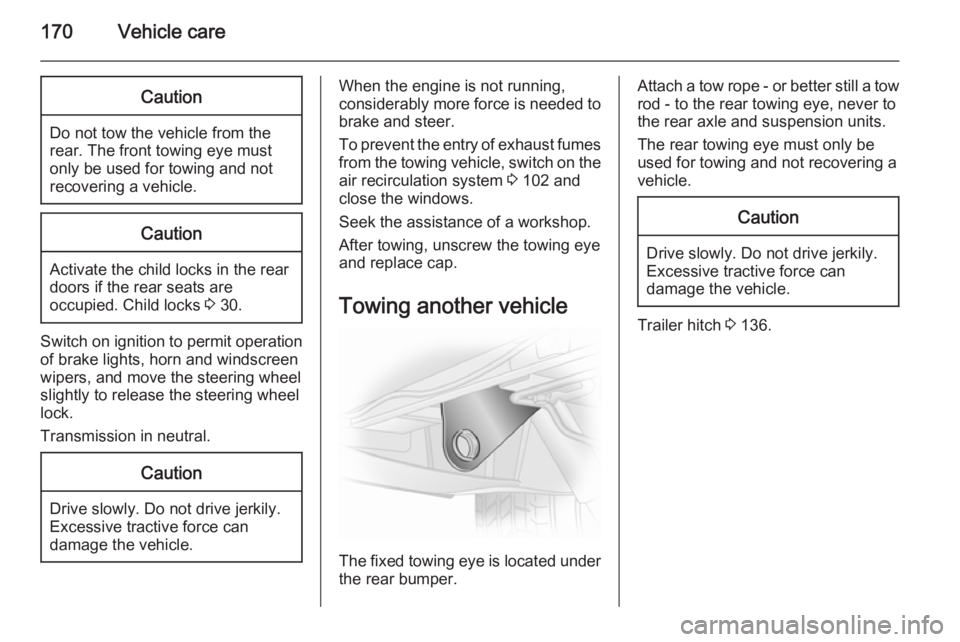
Towing another vehicle
The fixed towing eye is located under the rear bumper.
Attach a tow rope - or better still a tow
rod - to the rear towing eye, never to
the rear axle and suspension units.
The rear towing eye must only be
used for towing and not recovering a
vehicle.Caution
Drive slowly. Do not drive jerkily.
Excessive tractive force can
damage the vehicle.
Trailer hitch 3 136.
Page 196 of 205

194Customer information
■ Vehicle reactions in particulardriving situations (e.g. inflation of
an airbag, activation of the stability
regulation system)
■ Environmental conditions (e.g. temperature)
These data are exclusively technical
and help identifying and correcting
errors as well as optimizing vehicle
functions.
Motion profiles indicating travelled
routes cannot be created with these
data.
If services are used (e.g. repair
works, service processes, warranty
cases, quality assurance),
employees of the service network
(manufacturer included) are able to
read out this technical information
from the event and error data storage
modules applying special diagnostic
devices. If required, you will receive
further information at these
workshops. After an error has been
corrected, the data are deleted from
the error storage module or they are
constantly overwritten.When using the vehicle, situations
may occur in which these technical
data related to other information
(accident report, damages on the
vehicle, witness statements etc.) may be associated with a specific person -
possibly, with the assistance of an
expert.
Additional functions contractually
agreed upon with the client (e.g.
vehicle location in emergency cases)
allow the transmission of particular vehicle data from the vehicle.Radio Frequency
Identification (RFID) RFID technology is used in somevehicles for functions such as tyre
pressure monitoring and ignition
system security. It is also used in
connection with conveniences such
as radio remote controls for door
locking/unlocking and starting, and in-
vehicle transmitters for garage door
openers. RFID technology in Opel
vehicles does not use or record
personal information or link with any
other Opel system containing
personal information.
Page 200 of 205

198
Front door pockets........................ 68
Front fog lights ........................ 95, 98
Front seats.................................... 44 Front storage ................................ 68
Front turn signal lights ...............148
Fuel consumption - CO 2-
Emissions ............................... 135
Fuel cut-off system .....................117
Fuel economy gauge ....................82
Fuel economy mode .....................89
Fuel economy rating ...............91, 92
Fuel for diesel engines ..............134
Fuel gauge ................................... 82 Fuse box ..................................... 153
Fuses ......................................... 152
G Gauges ......................................... 80
General information ...................136
Glovebox ..................................... 67
Glovebox cooler ......................... 110
Glove box lighting .........................99
H Hand brake - see Parking brake. 123
Hazard warning flashers ..............97
Headlight flash ............................. 96
Headlight range adjustment ........96
Headlights ...................... 95, 96, 147
Headlights when driving abroad ..96Head restraint adjustment .............8
Head restraints ............................ 43
Heated exterior mirrors .................17
Heated mirrors ............................. 39
Heated rear window ...............17, 42
Heating ........................................ 47
Heating and ventilation system . 101
High beam ............................. 89, 96
Hill start assist ........................... 123
Horn ....................................... 16, 76
I
Identification plate .....................179
Idle speed control .......................116
Ignition switch positions .............114
Immobiliser .................................. 37
Indicators ...................................... 80
Info-display ................................... 90
Information displays...................... 90
Initial drive information.................... 6 Instrument cluster ........................80
Instrument panel fuse box .........153
Instrument panel illumination .....152
Instrument panel illumination control ...................................... 98
Instrument panel overview ........... 10
Instrument panel storage ..............67
Interior care ............................... 172
Interior lighting .............................. 98
Interior lights ........................ 99, 151Interior mirrors.............................. 39
Introduction .................................... 3
Isofix child restraint systems ........ 66
J Jack ............................................ 156
Journey record.............................. 92
Jump starting ............................. 168
K Keys ............................................. 21
Keys, locks ................................... 21
L
Lashing eyes ............................... 71
Light covers, misted...................... 98
Lighting ......................................... 95
Lighting features .........................100
Light switch .................................. 95
Load compartment ....................... 33
Load compartment cover .............70
Load compartment lighting ...........99
Loading information .....................73
Load-through feature ....................69
Low fuel ....................................... 89
M
Malfunction indicator light ............86
Manual adjustment ......................38
Manual anti-dazzle ......................39