child seat OPEL VIVARO B 2017.5 Manual user
[x] Cancel search | Manufacturer: OPEL, Model Year: 2017.5, Model line: VIVARO B, Model: OPEL VIVARO B 2017.5Pages: 233, PDF Size: 5.43 MB
Page 70 of 233

68Seats, restraintsChild restraint installation locations
Permissible options for fitting a child restraint system Front seats - Van
Weight and age class
Single front passenger seat 1Double front passenger seat
activated airbag
deactivated
or without airbag
activated airbag
deactivated
or without airbagcentreouterGroup 0: up to 10 kg
Group 0+: up to 13 kgXUXXUGroup I: 9 to 18 kgXUXXUGroup II: 15 to 25 kg
Group III: 22 to 36 kgXUXXU1:Forward-facing child restraints: Remove head restraint 3 46. Slide seat as far back as possible. Set seat height to
highest position. Maximum backrest rake is 25°. Seat adjustment 3 48.
Page 71 of 233

Seats, restraints69Front seats - Combi, Double cab
Weight and age class
Single front passenger seat1Double front passenger seat
activated airbag
deactivated
or without airbag
activated airbag
deactivated
or without airbagcentreouterGroup 0: up to 10 kg
Group 0+: up to 13 kgXUXXUGroup I: 9 to 18 kgXU 2XXU2Group II: 15 to 25 kg
Group III: 22 to 36 kgXXXXX1:If adjustable, slide seat as far back as possible and set seat height to highest position. Maximum backrest rake is
25°. Seat adjustment 3 48.2:Rear-facing child restraints only for this weight and age class.
Page 72 of 233

70Seats, restraintsRear seats - Combi, Double cabWeight and age class2nd row seats13rd row seatsGroup 0: up to 10 kg
Group 0+: up to 13 kgUUGroup I: 9 to 18 kgU 2U2Group II: 15 to 25 kg
Group III: 22 to 36 kgU 2U21:If necessary, slide adjustable front seat forwards to install a child restraint system on these seats. There may not be
enough clearance to install particular child restraint systems on vehicles fitted with fixed front seats.2:Forward-facing child restraints: Remove head restraint 3 46 before installing child restraint. The seat in front of this
installation position must not be more than halfway back on its runners. Maximum backrest rake is 25°. Seat adjustment
3 48.U:Suitable for universal category restraint systems for use in this weight and age class, in conjunction with three-point
seat belt.X:Seat position not suitable for children in this weight and age class.
Page 73 of 233

Seats, restraints71Permissible options for fitting an ISOFIX child restraint systemWeight classSize
classFixtureFront seats2nd row seats 13rd row seatsCentreOutervehicles with single
passenger seatvehicles with double
passenger seatGroup 0: up to 10 kgEISO/R1XXILILXGroup 0+: up to 13 kgEISO/R1XXILILXDISO/R2XXILXXCISO/R3XXILXXGroup I: 9 to 18 kgDISO/R2XXILXXCISO/R3XXILXXBISO/F2XXIL, IUF 2IL, IUF2XB1ISO/F2XXXIL, IUF2IL, IUF2XAISO/F3XXIL, IUF2IL, IUF 2XGroup II: 15 to 25 kgXXIL, IUF2IL, IUF2XGroup III: 22 to 36 kgXXIL, IUF2IL, IUF 2X
Page 74 of 233

72Seats, restraints1:If necessary, slide adjustable front seat forwards to install a child restraint system on these seats. There may not be
enough clearance to install a child restraint system on vehicles fitted with fixed front seats.2:Forward-facing child restraints: Remove head restraint 3 46 before installing child restraint. The seat in front of this
installation position must not be more than halfway back on its runners. Maximum backrest rake is 25°. Seat adjustment
3 48.IUF:Suitable for ISOFIX forward-facing child restraint systems of universal category approved for use in this weight class.X:No ISOFIX child restraint system approved in this weight class.IL:Suitable for particular ISOFIX restraint systems of the 'specific-vehicle', 'restricted' or 'semi-universal' categories.
The ISOFIX restraint system must be approved for the specific vehicle type.
ISOFIX size class and seat device
A - ISO/F3:Forward-facing child restraint system for children of maximum size in the weight class 9 to 18 kg.B - ISO/F2:Forward-facing child restraint system for smaller children in the weight class 9 to 18 kg.B1 - ISO/F2X:Forward-facing child restraint system for smaller children in the weight class 9 to 18 kg.C - ISO/R3:Rear-facing child restraint system for children of maximum size in the weight class up to 18 kg.D - ISO/R2:Rear-facing child restraint system for smaller children in the weight class up to 18 kg.E - ISO/R1:Rear-facing child restraint system for young children in the weight class up to 13 kg.
Page 99 of 233
Instruments and controls97Fuses 3 179.
Turn signals 3 111.
Seat belt reminder X illuminates or flashes red.
If the seat belt is unfastened, control
indicator X will flash when vehicle
speed exceeds approx. 16 km/h. A
warning chime also sounds for up to
two minutes.
If the seat belt is fastened, the
indicator light extinguishes.
Note
Heavy objects on the front seats
may cause control indicator X to
illuminate. Remove the object from
the seat or fasten the seat belt.9 Warning
Fasten seat belt before each trip.
In the event of an accident, people
not wearing seat belts endanger
their fellow occupants and
themselves.
Three-point seat belts 3 56.
Airbag and belt tensioners
v illuminates yellow.
Illuminates briefly when the ignition is switched on.
If it does not illuminate or illuminates
whilst driving, there is a fault in the
belt tensioner or the airbag system.
The airbags and belt tensioners may
fail to trigger in the event of an
accident.
Deployment of the belt tensioners or airbags is indicated by continuous
illumination of v.9 Warning
Have the cause of the fault
remedied immediately by a
workshop.
Belt tensioners, airbag system 3 55,
3 59.
Airbag deactivation Ó ON illuminates yellow.
The front passenger airbag is
activated.
* OFF illuminates yellow.
The front passenger airbag is
deactivated 3 64.
If both control indicators ÓON and
* OFF are illuminated
simultaneously, there is a system
failure. The status of the system is not discernible, therefore no person is
permitted to occupy the front
passenger seat. Contact a workshop
immediately.
If illuminated in conjunction with v or
F , seek the assistance of a workshop.9 Danger
Risk of fatal injury for a child using
a child restraint system together
with activated front passenger
airbag.
Risk of fatal injury for an adult
person with deactivated front
passenger airbag.
Airbag system 3 59, belt tensioners
3 55, airbag deactivation 3 64.
Page 199 of 233
Vehicle care197Caution
Do not tow the vehicle from the
rear. The front towing eye must
only be used for towing and not
recovering a vehicle.
Caution
Activate the child locks in the rear
doors if the rear seats are
occupied. Child locks 3 32.
Switch on ignition to permit operation
of brake lights, horn and windscreen
wipers, and move the steering wheel
slightly to release the steering wheel
lock.
Note
Depending on version, it may be
necessary to switch on the engine to
permit operation of brake lights.
Transmission in neutral.
Caution
Drive slowly. Do not drive jerkily.
Excessive tractive force can
damage the vehicle.
When the engine is not running,
considerably more force is needed to
brake and steer.
Switch on hazard warning flashers
3 111.
To prevent the entry of exhaust fumes
from the towing vehicle, switch on the air recirculation system 3 117 and
close the windows.
Seek the assistance of a workshop.
After towing, unscrew the towing eye
and replace cap.
Towing another vehicle
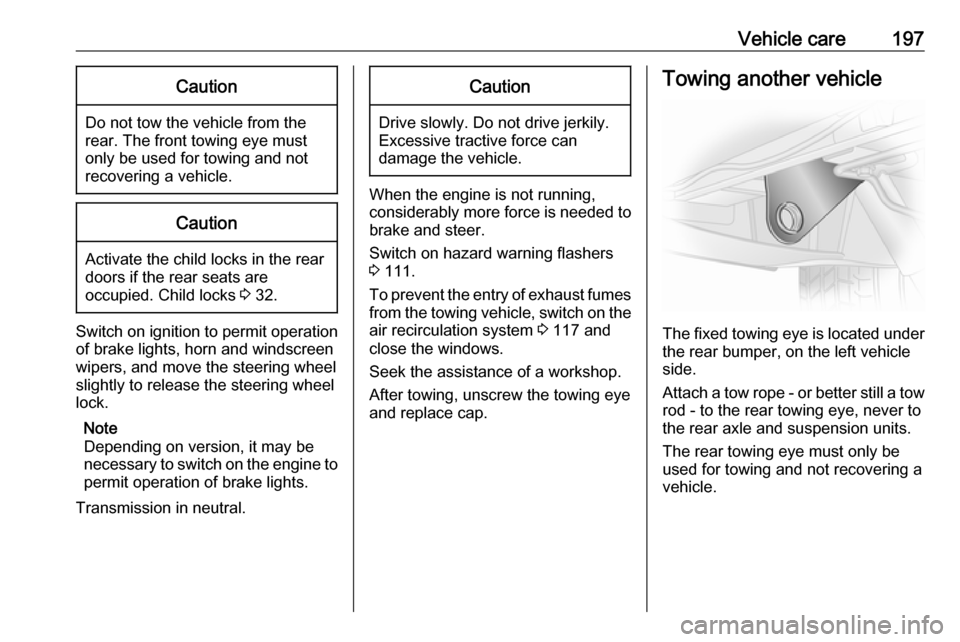
The fixed towing eye is located under the rear bumper, on the left vehicle
side.
Attach a tow rope - or better still a tow
rod - to the rear towing eye, never to
the rear axle and suspension units.
The rear towing eye must only be
used for towing and not recovering a
vehicle.