battery OPEL VIVARO B 2017.5 Manual user
[x] Cancel search | Manufacturer: OPEL, Model Year: 2017.5, Model line: VIVARO B, Model: OPEL VIVARO B 2017.5Pages: 233, PDF Size: 5.43 MB
Page 135 of 233
Driving and operating133These functions stop working when
the driver's door is opened and the vehicle is locked.
Note
Always take the electronic key with
you when exiting the vehicle.
The electronic key being left in the
card reader is indicated by a warning
chime 3 104 and a message in the
Driver Information Centre 3 103
when the driver's door is opened.9 Danger
Never leave an electronic key
inside the vehicle when children or animals are left in the vehicle, to
avoid unintended operation of
windows, doors or engine. Risk of
fatal injury.
Fault
If the engine cannot be started, the
cause may be one of the following:
● Fault in electronic key.
● Electronic key out of reception range.
● Battery voltage too low.
● Overload of the central locking system by operating at frequentintervals, the power supply is
interrupted for a short time.
● Interference from higher-power radio waves from other sources.
Battery replacement 3 22.
Central locking system 3 26.
Electronic key system 3 24.
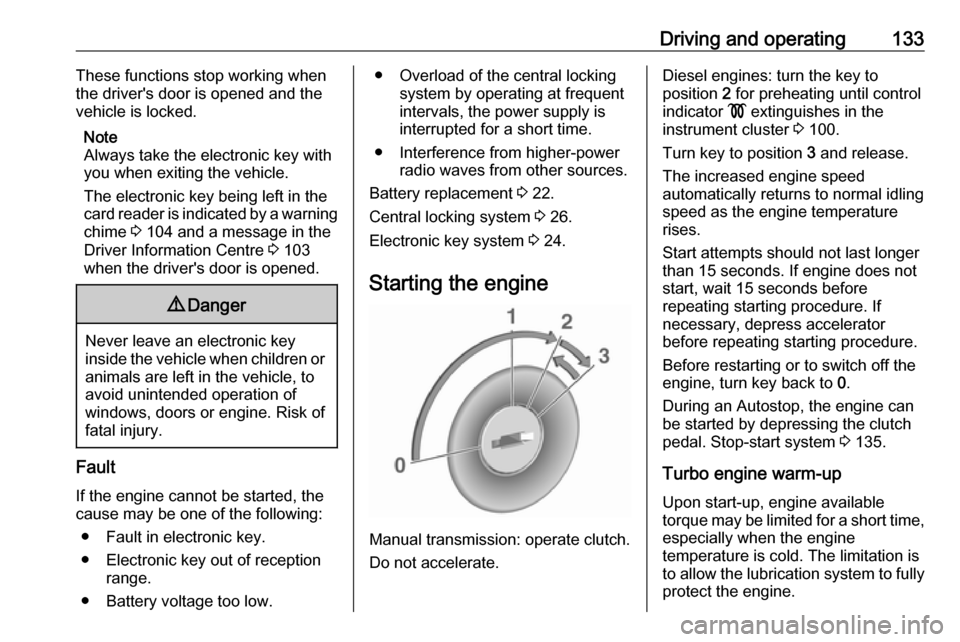
Starting the engine
Manual transmission: operate clutch.
Do not accelerate.
Diesel engines: turn the key to
position 2 for preheating until control
indicator ! extinguishes in the
instrument cluster 3 100.
Turn key to position 3 and release.
The increased engine speed
automatically returns to normal idling
speed as the engine temperature
rises.
Start attempts should not last longer
than 15 seconds. If engine does not
start, wait 15 seconds before
repeating starting procedure. If
necessary, depress accelerator
before repeating starting procedure.
Before restarting or to switch off the
engine, turn key back to 0.
During an Autostop, the engine can
be started by depressing the clutch
pedal. Stop-start system 3 135.
Turbo engine warm-up Upon start-up, engine available
torque may be limited for a short time,
especially when the engine
temperature is cold. The limitation is
to allow the lubrication system to fully protect the engine.
Page 137 of 233
Driving and operating135Power button 3 131.
Refuelling 3 158.
Overrun cut-off
The fuel supply is automatically cut off
during overrun, i.e. when the vehicle
is driven with a gear engaged but accelerator pedal is released.
Depending on driving conditions, the
overrun cut-off may be deactivated.
Stop-start system
The stop-start system helps to save
fuel and to reduce the exhaust
emissions. When conditions allow, it
switches off the engine as soon as the
vehicle is at a low speed or at a
standstill, e.g. at a traffic light or in a
traffic jam. It restarts the engine
automatically as soon as the clutch
pedal is depressed.
A vehicle battery sensor ensures that an Autostop is only performed if the
vehicle battery is sufficiently charged
for a restart.Activation
The stop-start system is available as
soon as the engine is started, the
vehicle starts-off and the conditions
as stated below in this section are
fulfilled.
If the below conditions are not
fulfilled, an Autostop is prohibited and
control indicator \ illuminates in the
instrument cluster 3 101.
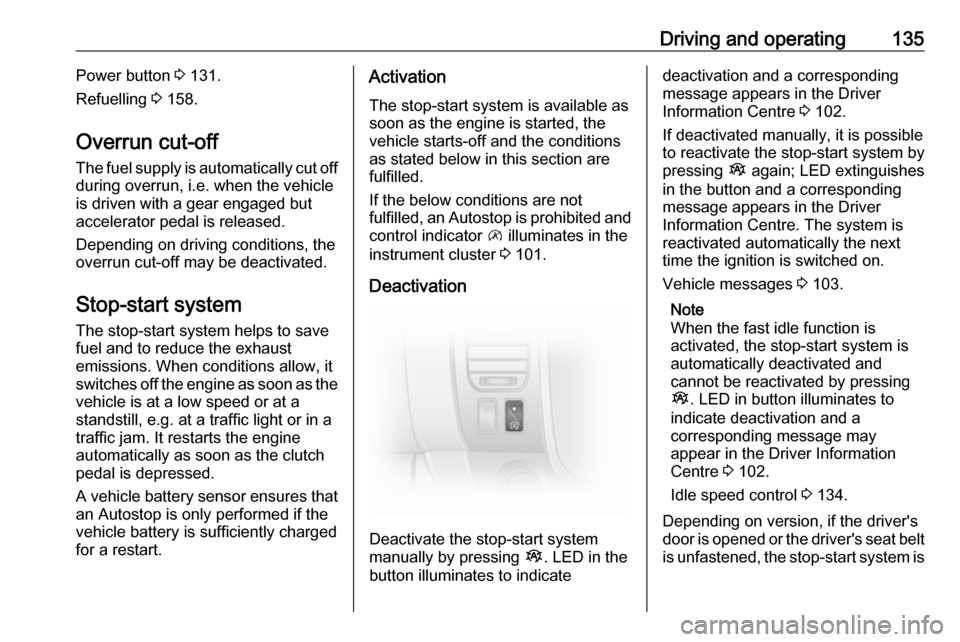
Deactivation
Deactivate the stop-start system
manually by pressing Î. LED in the
button illuminates to indicate
deactivation and a corresponding message appears in the Driver
Information Centre 3 102.
If deactivated manually, it is possible to reactivate the stop-start system by
pressing Î again; LED extinguishes
in the button and a corresponding
message appears in the Driver
Information Centre. The system is
reactivated automatically the next
time the ignition is switched on.
Vehicle messages 3 103.
Note
When the fast idle function is
activated, the stop-start system is
automatically deactivated and
cannot be reactivated by pressing
Î . LED in button illuminates to
indicate deactivation and a
corresponding message may
appear in the Driver Information
Centre 3 102.
Idle speed control 3 134.
Depending on version, if the driver's
door is opened or the driver's seat belt is unfastened, the stop-start system is
Page 138 of 233
136Driving and operatingdeactivated automatically, and the
engine is switched off. Restart engine by pressing START/STOP .
Power button 3 131.
Autostop
If the vehicle is at a low speed or at a standstill, activate an Autostop as
follows:
● depress the clutch pedal
● move the selector lever to neutral
● release the clutch pedal
The engine will be switched off while
the ignition stays on if the required
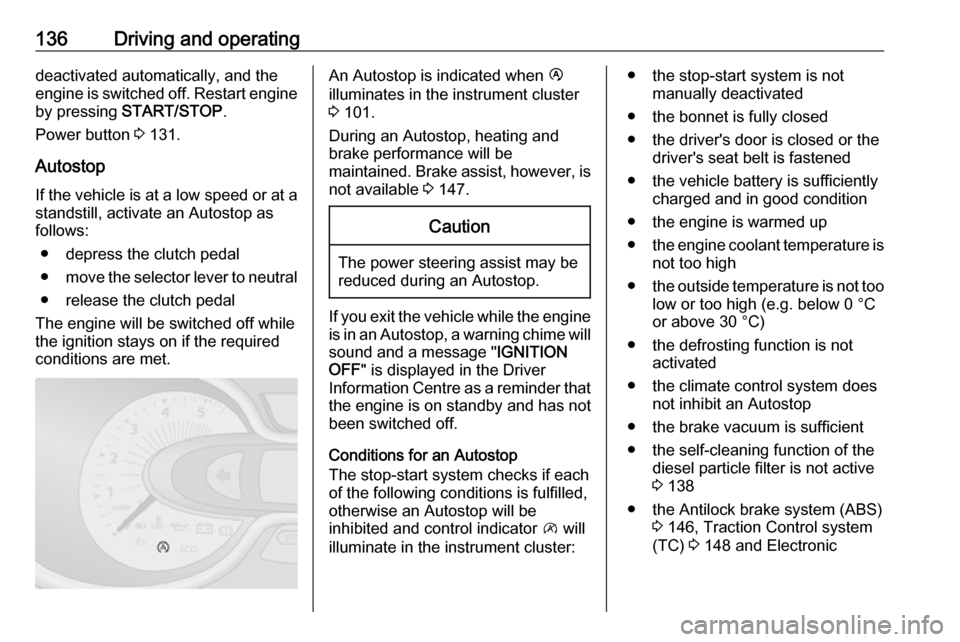
conditions are met.An Autostop is indicated when Ï
illuminates in the instrument cluster
3 101.
During an Autostop, heating and brake performance will be
maintained. Brake assist, however, is
not available 3 147.Caution
The power steering assist may be
reduced during an Autostop.
If you exit the vehicle while the engine
is in an Autostop, a warning chime will
sound and a message " IGNITION
OFF " is displayed in the Driver
Information Centre as a reminder that
the engine is on standby and has not
been switched off.
Conditions for an Autostop
The stop-start system checks if each
of the following conditions is fulfilled,
otherwise an Autostop will be
inhibited and control indicator \ will
illuminate in the instrument cluster:
● the stop-start system is not manually deactivated
● the bonnet is fully closed
● the driver's door is closed or the driver's seat belt is fastened
● the vehicle battery is sufficiently charged and in good condition
● the engine is warmed up
● the engine coolant temperature is
not too high
● the outside temperature is not too
low or too high (e.g. below 0 °C
or above 30 °C)
● the defrosting function is not activated
● the climate control system does not inhibit an Autostop
● the brake vacuum is sufficient
● the self-cleaning function of the diesel particle filter is not active
3 138
● the Antilock brake system (ABS) 3 146, Traction Control system
(TC) 3 148 and Electronic
Page 139 of 233

Driving and operating137Stability Program (ESP®Plus
)
3 149 ride control systems are
not actively engaged
● the vehicle has moved since the last Autostop
Otherwise an Autostop will be
inhibited.
Certain settings of the climate control system may also inhibit an Autostop.
See " Climate control " chapter for
further information 3 118.
Immediately after motorway driving
an Autostop may be inhibited.
New vehicle running-in 3 131.
Vehicle battery discharge protection
To ensure reliable engine restarts,
several battery discharge protection
features are implemented as part of
the stop-start system.
Restart of the engine by the driver
Depress the clutch pedal to restart the
engine.
Note
If any gear is selected, the clutch pedal must be fully depressed to
restart the engine.If the engine does not restart first
time, depress clutch pedal fully again.
Alternatively, press button Î to
restart the engine while in an
Autostop.
Control indicator Ï 3 101
extinguishes in the instrument cluster
when the engine is restarted.
Restart of the engine by the stop- start system
The selector lever must be in neutral to enable an automatic restart.
If one of the following conditions
occurs during an Autostop, the
engine will be restarted automatically by the stop-start system:
● the vehicle battery is discharged
● the outside temperature is too low or too high (e.g. below 0 °C
or above 30 °C)
● the defrosting function is activated 3 118
● the brake vacuum is not sufficient
● the brake pedal is operated repeatedly
● the vehicle starts to moveAn automatic engine restart may not
be possible if a door or the bonnet is
open.
If an electrical accessory, e.g. a
portable CD player, is connected to
the power outlet, a brief power drop
during engine restart may be
noticeable.
If the Infotainment system is active,
audio sound may briefly be reduced
or interrupted during the restart.
Fault
If a fault occurs in the stop-start
system, the LED in Î illuminates,
and a corresponding message
appears in the Driver Information
Centre 3 102 . Seek the assistance of
a workshop.
Vehicle messages 3 103.
Warning chimes 3 104.
Page 164 of 233

162Vehicle careVehicle careGeneral Information...................163
Accessories and vehicle modifications .......................... 163
Vehicle storage ........................163
End-of-life vehicle recovery .....164
Vehicle checks ........................... 164
Performing work ......................164
Bonnet ..................................... 164
Engine oil ................................. 165
Engine air filter ........................ 166
Engine coolant ......................... 167
Power steering fluid .................167
Washer fluid ............................ 168
Brakes ..................................... 168
Brake fluid ............................... 168
Vehicle battery ......................... 169
Diesel fuel filter ........................171
Diesel fuel system bleeding .....171
Wiper blade replacement ........172
Bulb replacement .......................173
Headlights ............................... 173
Fog lights ................................. 173
Front turn signal lights .............174
Tail lights ................................. 174
Side turn signal lights ..............175Centre high-mounted brake
light ......................................... 175
Reversing light ......................... 176
Number plate light ...................177
Fog tail light ............................. 177
Interior lights ............................ 178
Instrument panel illumination ...178
Electrical system ........................179
Fuses ....................................... 179
Instrument panel fuse box .......180
Vehicle tools .............................. 183
Tools ........................................ 183
Wheels and tyres .......................184
Tyres ....................................... 184
Winter tyres ............................. 184
Tyre designations ....................184
Tyre pressure .......................... 184
Tyre pressure monitoring system .................................... 186
Tread depth ............................. 188
Changing tyre and wheel size . 188
Wheel covers ........................... 188
Tyre chains .............................. 189
Tyre repair kit .......................... 189
Wheel changing .......................192
Spare wheel ............................ 193
Jump starting ............................. 195Towing....................................... 196
Towing the vehicle ...................196
Towing another vehicle ...........197
Appearance care .......................198
Exterior care ............................ 198
Interior care ............................. 200
Page 171 of 233

Vehicle care169
The brake fluid level must be betweenthe MINI and MAXI marks.
When topping up, ensure maximum cleanliness as contamination of the
brake fluid can lead to brake system
malfunctions. Have the cause of the
loss of brake fluid remedied by a
workshop.
Only use high-performance brake
fluid approved for your vehicle.
Brake fluid 3 203.
Vehicle battery
The vehicle battery is located under a
cover in the engine compartment.
The vehicle battery is maintenance-
free provided that the driving profile
allows sufficient charging of the
battery. Short-distance driving and
frequent engine starts can discharge
the battery. Avoid the use of
unnecessary electrical consumers.
Control indicator p illuminates if
there is a fault with the charging
system. Stop, switch off engine and
seek the assistance of a workshop.
Charging system 3 98.
Batteries do not belong in household
waste. They must be disposed of at
an appropriate recycling collection
point.
Laying up the vehicle for more than
four weeks can lead to battery
discharge.
9 Danger
Ensure the ignition is switched off
completely (the vehicle must not
be in an Autostop) before
connecting or disconnecting the
vehicle battery.
Stop-start system 3 135.
Replacing the vehicle battery
In vehicles with an AGM (Absorptive
Glass Mat) battery, make sure to
have the battery replaced with
another AGM battery.
Page 172 of 233

170Vehicle care
An AGM battery can be identified by
the label on the battery. We
recommend the use of an original
Opel battery.
Note
Using an AGM vehicle battery
different from the original Opel
vehicle battery may result in a lower performance of the stop-start
system.
Seek the assistance of a workshop to
have the vehicle battery replaced.
Stop-start system 3 135.
Charging the vehicle battery9 Warning
On vehicles with stop-start
system, ensure that the charging potential does not exceed
14.6 volts when using a battery
charger. Otherwise the vehicle
battery might be damaged.
9 Danger
Ensure adequate ventilation when
charging the battery. There is a
risk of explosion if gases
generated during charging are
allowed to accumulate!
Jump starting 3 195.
Warning label
Meaning of symbols:
● No sparks, naked flames or smoking.
● Always shield eyes. Explosive gases can cause blindness or
injury.
● Keep the vehicle battery out of reach of children.
● The vehicle battery contains sulfuric acid which could cause
blindness or serious burn
injuries.
Page 173 of 233

Vehicle care171● See the Owner's Manual forfurther information.
● Explosive gas may be present in the vicinity of the battery.
Additional battery
Depending on the vehicle's auxiliary
equipment, certain models may have
an additional battery located under
the front passenger seat.
Note
The additional battery is
automatically connected to the main vehicle battery only when the engine
is running. It does not need to be manually disconnected before
disconnecting the main vehicle
battery or before jump starting the vehicle.
Jump starting 3 195.
Diesel fuel filter
The diesel fuel filter is accessible from the underside of the vehicle.
Drain filter of residual water at every
engine oil change.
Place a container underneath the
filter housing. Loosen the knurled
screw on the lower part of the filter by
approx. one turn, to drain off the
water.
The filter is drained as soon as water- free diesel fuel emerges. Retighten
the screw.
Check diesel fuel filter at shorter
intervals if the vehicle is subjected to
extreme operating conditions.
Diesel fuel system bleeding
If the fuel tank has been run dry, it will be necessary to air vent or bleed the
diesel fuel system.
Refuel then proceed as follows:
With ignition key
● Switch on the ignition (key to position 2) for five seconds at a
time.
● Switch off ignition (key to position
1 ) for three seconds.
Page 181 of 233

Vehicle care179Electrical system
Fuses Data on the replacement fuse must
match the data on the defective fuse.
There are two fuse boxes in the
vehicle:
● on the left-hand side of the instrument panel, behind the trim
panel
● in the engine compartment located next to the battery
Note
The engine compartment fuse box
should only be accessed by a
workshop.
Before replacing a fuse, turn off the
respective switch and the ignition.
There are different types of fuses in
the vehicle.
Depending on the type of fuse, a
blown fuse can be recognised by its
melted wire. Do not replace the fuse until the cause of the fault has been
remedied.
It is advisable to carry a full set of
fuses. Provision is made in the fuse
box for the storing of spare fuses.
Some functions are protected by
several fuses.
Fuses may also be inserted without existence of a function.
Note
Not all fuse box descriptions in this
Owner's Manual may apply to your
vehicle. Refer to the fuse box label,
where fitted.
Fuse extractor
Page 184 of 233

182Vehicle careNo.Circuit1Battery backup (with electronic
key system)2Adaptations3Adaptations4Vehicle battery (with electronic
key system)5Additional heating and ventila‐
tion / Air conditioning system6Supplementary heating and
ventilation system7Electric exterior mirrors / Addi‐
tional adaptations8Heated exterior mirrors9Radio / Multimedia / Electric
exterior mirrors / Diagnostic
socket10Multimedia / Trailer hitch11Courtesy lights / Battery
discharge protectionNo.Circuit12Right-hand high beam / Left-
hand low beam / Sidelights /
Right-hand daytime running
light13Hazard warning flashers / Turn
and lane-change signals14Central locking15Left-hand high beam / Right-
hand low beam / Tail lights /
Left-hand daytime running light16Front fog lights / Rear fog lights /
Number plate lighting17Alarm / Horn / Lighting / Wiper18Instrument cluster19Heating and ventilation system20Rear window wiper / Wind‐
screen washer pump / Horn21General battery22Reversing lights23Brake switchNo.Circuit24Fuel injection / Starter25Airbag / Steering column lock26Passenger power window27Power steering28Brake lights29Battery backup (with electronic
key system)30Service display31Cigarette lighter / Power outlet32Heating and ventilation system33Brake lights / ABS / Immobiliser34Interior lighting / Air conditioning35Starting with electronic key
system36Rear window wiper37Warning chimes38Load compartment power outlet39Driver power window