lights OPEL VIVARO B 2017.5 Manual user
[x] Cancel search | Manufacturer: OPEL, Model Year: 2017.5, Model line: VIVARO B, Model: OPEL VIVARO B 2017.5Pages: 233, PDF Size: 5.43 MB
Page 175 of 233

Vehicle care173Bulb replacement
Switch off the ignition and turn off the
relevant switch or close the doors.
Only hold a new bulb at the base. Do not touch the bulb glass with bare
hands.
Use only the same bulb type for
replacement.
Bulb check
After a bulb replacement, switch on
the ignition, operate and check the
lights.
Headlights Low beam and high beam
Replace headlight bulbs from within
the engine compartment.
1. Remove protective cover by rotating it anticlockwise.
2. Detach wiring connector.
3. Release retaining clip (see illustration) and remove bulb.
4. Renew bulb and install retaining clip ensuring that bulb is in correct
orientation.
5. Reattach wiring connector and protective cover.
Sidelights/Daytime running lights
1. Remove protective cover byrotating it anticlockwise.
2. Release retaining clips and remove bulb holder from reflector
housing.
3. Renew bulb.
4. Install bulb holder in reflector housing and engage retaining
clips.
5. Install protective cover.
Fog lights
Access the front fog light bulb from
beneath the vehicle.
Page 176 of 233
174Vehicle care
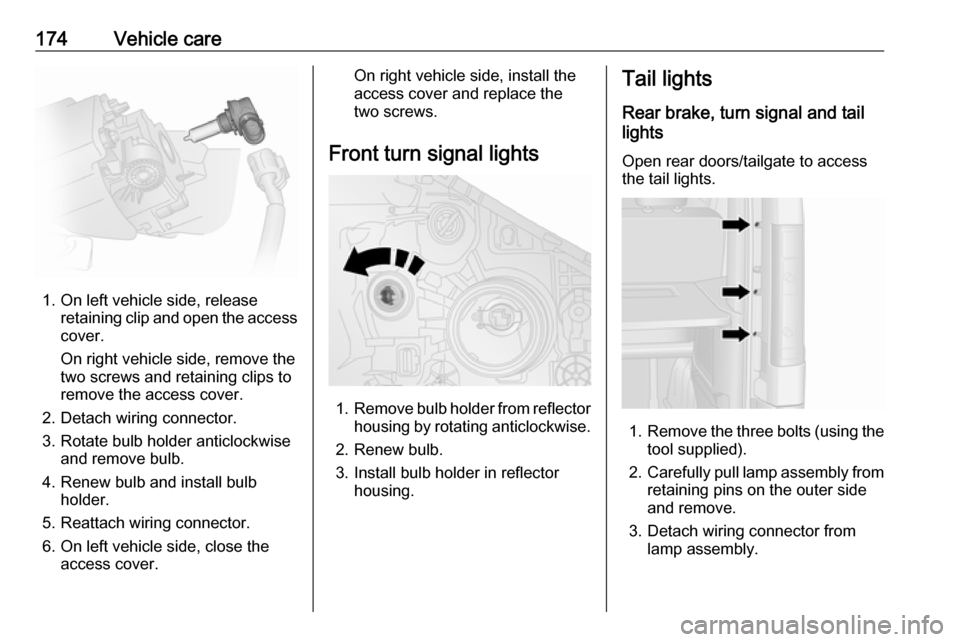
1. On left vehicle side, releaseretaining clip and open the accesscover.
On right vehicle side, remove the
two screws and retaining clips to
remove the access cover.
2. Detach wiring connector.
3. Rotate bulb holder anticlockwise and remove bulb.
4. Renew bulb and install bulb holder.
5. Reattach wiring connector.
6. On left vehicle side, close the access cover.
On right vehicle side, install the
access cover and replace the
two screws.
Front turn signal lights
1. Remove bulb holder from reflector
housing by rotating anticlockwise.
2. Renew bulb.
3. Install bulb holder in reflector housing.
Tail lights
Rear brake, turn signal and tail
lights
Open rear doors/tailgate to access
the tail lights.
1. Remove the three bolts (using the
tool supplied).
2. Carefully pull lamp assembly from
retaining pins on the outer side
and remove.
3. Detach wiring connector from lamp assembly.
Page 177 of 233
Vehicle care175
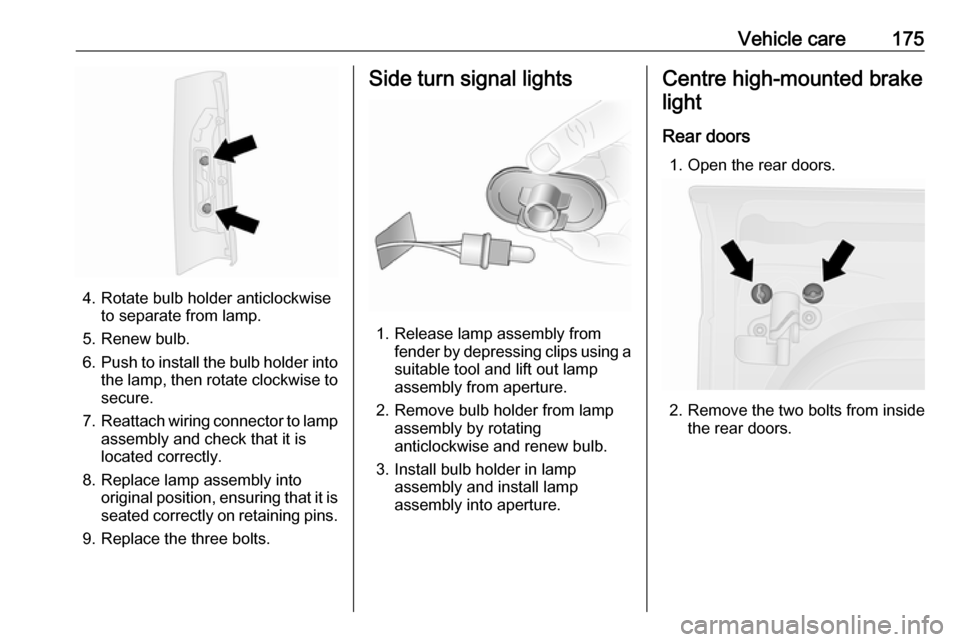
4. Rotate bulb holder anticlockwiseto separate from lamp.
5. Renew bulb.
6. Push to install the bulb holder into
the lamp, then rotate clockwise to secure.
7. Reattach wiring connector to lamp
assembly and check that it is
located correctly.
8. Replace lamp assembly into original position, ensuring that it isseated correctly on retaining pins.
9. Replace the three bolts.
Side turn signal lights
1. Release lamp assembly from fender by depressing clips using a
suitable tool and lift out lamp
assembly from aperture.
2. Remove bulb holder from lamp assembly by rotating
anticlockwise and renew bulb.
3. Install bulb holder in lamp assembly and install lamp
assembly into aperture.
Centre high-mounted brake
light
Rear doors 1. Open the rear doors.
2. Remove the two bolts from inside the rear doors.
Page 180 of 233

178Vehicle care6.Reattach wiring connector to lamp
assembly.
7. Install lamp assembly with the two bolts.
Interior lights
Front and rear courtesy lights
1. Release lens assembly from the clips and the locator using a flat
blade screwdriver.
2. Renew bulb.
3. Install lens assembly.
Load compartment light
1. Release lens assembly from the clips using a flat blade
screwdriver.
2. Remove rear cover on lamp assembly.
3. Renew bulb.
4. Install rear cover and lamp assembly.
Glovebox light
1. Remove lens assembly using aflat blade screwdriver.
2. Renew bulb.
3. Install lens assembly.
Instrument panel illumination
Have bulbs replaced by a workshop.
Page 184 of 233

182Vehicle careNo.Circuit1Battery backup (with electronic
key system)2Adaptations3Adaptations4Vehicle battery (with electronic
key system)5Additional heating and ventila‐
tion / Air conditioning system6Supplementary heating and
ventilation system7Electric exterior mirrors / Addi‐
tional adaptations8Heated exterior mirrors9Radio / Multimedia / Electric
exterior mirrors / Diagnostic
socket10Multimedia / Trailer hitch11Courtesy lights / Battery
discharge protectionNo.Circuit12Right-hand high beam / Left-
hand low beam / Sidelights /
Right-hand daytime running
light13Hazard warning flashers / Turn
and lane-change signals14Central locking15Left-hand high beam / Right-
hand low beam / Tail lights /
Left-hand daytime running light16Front fog lights / Rear fog lights /
Number plate lighting17Alarm / Horn / Lighting / Wiper18Instrument cluster19Heating and ventilation system20Rear window wiper / Wind‐
screen washer pump / Horn21General battery22Reversing lights23Brake switchNo.Circuit24Fuel injection / Starter25Airbag / Steering column lock26Passenger power window27Power steering28Brake lights29Battery backup (with electronic
key system)30Service display31Cigarette lighter / Power outlet32Heating and ventilation system33Brake lights / ABS / Immobiliser34Interior lighting / Air conditioning35Starting with electronic key
system36Rear window wiper37Warning chimes38Load compartment power outlet39Driver power window
Page 198 of 233
196Vehicle care
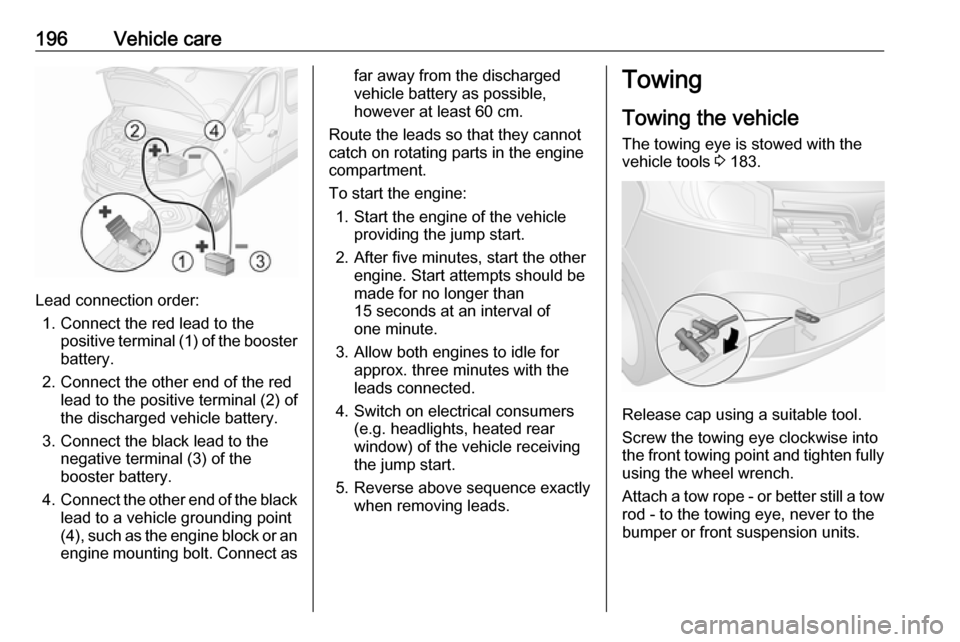
Lead connection order:1. Connect the red lead to the positive terminal (1) of the booster
battery.
2. Connect the other end of the red lead to the positive terminal (2) of
the discharged vehicle battery.
3. Connect the black lead to the negative terminal (3) of the
booster battery.
4. Connect the other end of the black
lead to a vehicle grounding point
(4), such as the engine block or an
engine mounting bolt. Connect as
far away from the discharged
vehicle battery as possible,
however at least 60 cm.
Route the leads so that they cannot
catch on rotating parts in the engine
compartment.
To start the engine: 1. Start the engine of the vehicle providing the jump start.
2. After five minutes, start the other engine. Start attempts should be
made for no longer than
15 seconds at an interval of
one minute.
3. Allow both engines to idle for approx. three minutes with the
leads connected.
4. Switch on electrical consumers (e.g. headlights, heated rear
window) of the vehicle receiving
the jump start.
5. Reverse above sequence exactly when removing leads.Towing
Towing the vehicle The towing eye is stowed with thevehicle tools 3 183.
Release cap using a suitable tool.
Screw the towing eye clockwise into
the front towing point and tighten fully
using the wheel wrench.
Attach a tow rope - or better still a tow rod - to the towing eye, never to the
bumper or front suspension units.
Page 199 of 233
Vehicle care197Caution
Do not tow the vehicle from the
rear. The front towing eye must
only be used for towing and not
recovering a vehicle.
Caution
Activate the child locks in the rear
doors if the rear seats are
occupied. Child locks 3 32.
Switch on ignition to permit operation
of brake lights, horn and windscreen
wipers, and move the steering wheel
slightly to release the steering wheel
lock.
Note
Depending on version, it may be
necessary to switch on the engine to
permit operation of brake lights.
Transmission in neutral.
Caution
Drive slowly. Do not drive jerkily.
Excessive tractive force can
damage the vehicle.
When the engine is not running,
considerably more force is needed to
brake and steer.
Switch on hazard warning flashers
3 111.
To prevent the entry of exhaust fumes
from the towing vehicle, switch on the air recirculation system 3 117 and
close the windows.
Seek the assistance of a workshop.
After towing, unscrew the towing eye
and replace cap.
Towing another vehicle
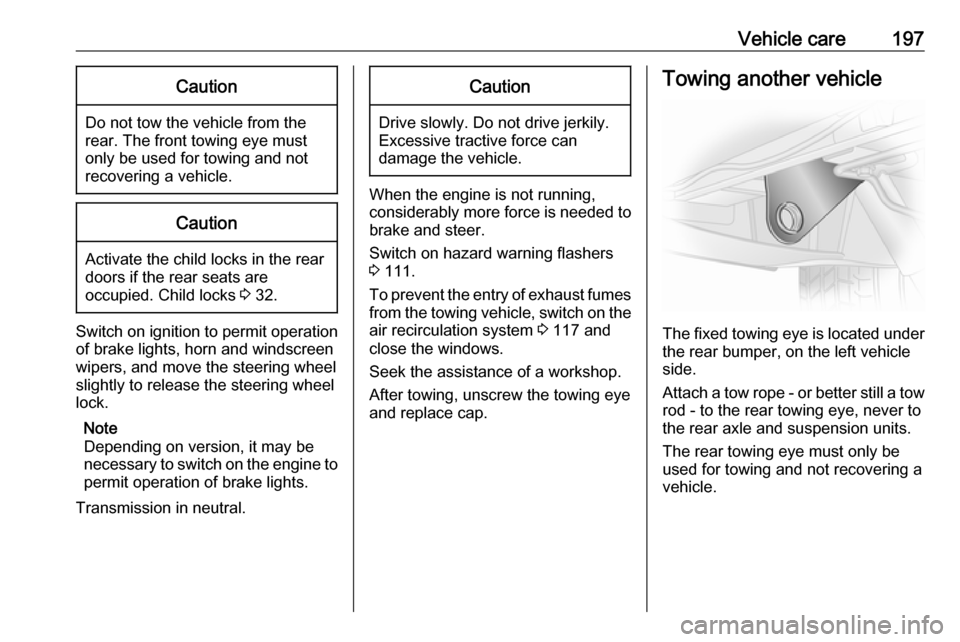
The fixed towing eye is located under the rear bumper, on the left vehicle
side.
Attach a tow rope - or better still a tow
rod - to the rear towing eye, never to
the rear axle and suspension units.
The rear towing eye must only be
used for towing and not recovering a
vehicle.
Page 201 of 233

Vehicle care199Caution
Always use a cleaning agent with
a pH value of four to nine.
Do not use cleaning agents on hot surfaces.
Thoroughly rinse and leather-off the
vehicle. Rinse leather frequently. Use
separate leathers for painted and
glass surfaces: remnants of wax on
the windows will impair vision.
Have the door hinges of all doors
greased by a workshop.
Do not use hard objects to remove
spots of tar. Use tar removal spray on
painted surfaces.
Exterior lights
Headlight and other light covers are
made of plastic. Do not use any
abrasive or caustic agents, do not use
an ice scraper, and do not clean them
dry.
Polishing and waxing
Wax the vehicle regularly (at the
latest when water no longer beads).
Otherwise, the paintwork will dry out.
Polishing is necessary only if the paint
has become dull or if solid deposits
have become attached to it.
Paintwork polish with silicone forms a protective film, making waxing
unnecessary.
Unpainted plastic body parts must not
be treated with wax or polishing
agents.
Matt filmed body parts or decor tapes must not be polished, to avoid
gleaming. Do not use hot wax
programmes in automatic car washes if the vehicle is equipped with these
parts.
Matt painted decor parts, e.g. mirror
housing cover, must not be polished. Otherwise these parts would become
agleam or the colour would be
dissolved.Windows and windscreen wiper
blades
Use a soft lint-free cloth or chamois
leather together with window cleaner and insect remover.
When cleaning the rear window from
inside, always wipe in parallel to the
heating element to prevent damage.
For mechanical removal of ice, use a
sharp-edged ice scraper. Press the
scraper firmly against the glass so
that no dirt can get under it and
scratch the glass.
Remove dirt residues from smearing wiper blades by using a soft cloth and window cleaner. Also make sure to
remove any residues such as wax,
insect residues and similar from the
window.
Ice residues, pollution and continuous
wiping on dry windows will damage or
even destroy the wiper blades.
Wheels and tyres Do not use high-pressure jet
cleaners.
Page 227 of 233

225Charging system .......................... 98
Child locks ................................... 32
Child restraint installation locations ................................... 68
Child restraints.............................. 65
Child restraint systems ................65
Cigarette lighter ........................... 90
Cleaning the vehicle ...................198
Climate control ............................. 17
Climate control systems .............116
Clock ............................................ 88
Coat hooks ................................... 75
Coin holder ................................... 73
Collision damage repair ..............221
Control indicators.......................... 94
Control of the vehicle .................130
Controls ........................................ 85
Controls in steering wheel ............85
Convex shape .............................. 40
Coolant ....................................... 167
Coolant and antifreeze ...............203
Coolant heater ............................ 121
Cooling (A/C) .............................. 117
Cornering light ............................ 110
Cruise control ....................102, 150
Cupholders .................................. 75
Curtain airbag system .................. 63D
Danger, Warnings and Cautions ...4
Dashboard .................................... 10
Daytime running lights ........109, 110
Declaration of conformity ............219
DEF ............................................ 139
Demisting and defrosting ..............17
Diesel exhaust fluid ....................139
Diesel fuel filter .......................... 171
Diesel fuel system bleeding .......171
Diesel particle filter ....................138
Directional tyres ..................184, 193
Distance to service .......................93
Document tray .............................. 75
Door locks..................................... 25
Door open .................................. 102
Door panel storage .......................76
Doors ............................................ 32
Double cab ................................... 76
DPF (diesel particle filter) ...........138
Driver assistance systems ..........150
Driver Information Centre ...........102
Driving characteristics and towing tips .............................. 160
Driving economically................... 129
Driving hints ........................ 129, 130
Driving style indicator ...................93E
ECO mode .................................. 129
ecoScoring.................................. 105
Electric adjustment ......................41
Electrical accessories ...................88
Electrical system......................... 179
Electronic climate control system 118
Electronic data recording ..............43
Electronic key system ...................24
Electronic Stability Program 99,
149, 161
Electronic Stability Program off ...99
End-of-life vehicle recovery .......164
Engine air filter............................ 166
Engine air flow indicator .............166
Engine coolant ........................... 167
Engine coolant temperature ........99
Engine data ............................... 208
Engine Drag Torque Control ......149
Engine exhaust .......................... 138
Engine identification ...................206
Engine oil ...........165, 203, 207, 217
Engine oil additives ....................203
Engine oil level .......................... 104
Engine oil pressure ....................100
Engine oil viscosity grades .........203
Enhanced Traction function 148, 149
Entry lighting .............................. 114
Event data recorders ..................221
Exhaust gases ....................138, 196
Page 228 of 233

226Exit lighting ................................ 114
Exterior care .............................. 198
Exterior light ............................... 101
Exterior lighting ....................14, 108
Exterior mirrors ............................. 40
F
Fault messages .......................... 103
First aid kit ................................... 82
Fixed air vents ........................... 127
Fog light ..................................... 101
Fog lights ............................ 111, 173
Fog tail light ............................... 177
Folding centre seatback ...............75
Folding front centre passenger seat ........................................... 50
Folding mirrors ............................. 41
Foot well lights ............................ 112
Front airbag system .....................62
Front courtesy lights ...................112
Front door pockets........................ 76
Front fog lights ....................108, 111
Front reading light....................... 113
Front seats.................................... 47
Front storage ................................ 75
Front turn signal lights ...............174
Fuel consumption - CO 2-
Emissions ............................... 160
Fuel cut-off system .....................134
Fuel economy gauge ....................93Fuel economy mode ...................101
Fuel economy rating ...........103, 105
Fuel for diesel engines ..............158
Fuel gauge ................................... 92
Fuel tank ..................................... 217
Fuse box ..................................... 180
Fuses ......................................... 179
G Gauges ......................................... 91
General information ...................160
Glovebox ..................................... 74
Glovebox cooler ......................... 127
Glove box lighting .......................114
Grab handles ................................ 78
H Hand brake ................................. 146
Hand brake - see Parking brake. 147
Hazard warning flashers ............111
Headlight flash ........................... 109
Headlight range adjustment ......109
Headlights .................. 108, 109, 173
Headlights when driving abroad 110
Head restraint adjustment .............8
Head restraints ............................ 46
Heated exterior mirrors .................17
Heated mirrors ............................. 41
Heated rear window ...............17, 45
Heating ........................................ 50
Heating and ventilation system . 116Heat-reflecting windscreen ...........43
High beam ......................... 101, 109
Hill start assist ........................... 147
Horn ....................................... 16, 85
I
Identification plate .....................206
Idle speed control .......................134
Ignition switch positions .............131
Immobiliser .................................. 40
Indicators ...................................... 91
Info display ................................. 102
Information displays.................... 102
Infotainment system ...................102
Initial drive information.................... 6
Instrument cluster ........................91
Instrument panel fuse box .........180
Instrument panel illumination .....178
Instrument panel illumination control .................................... 112
Instrument panel overview ........... 10
Instrument panel storage ..............73
Instrument panel tray ....................73
Interior care ............................... 200
Interior lighting ............................ 112
Interior lights ...................... 112, 178
Interior mirrors .............................. 42
Introduction .................................... 3
ISOFIX .......................................... 65