height OPEL VIVARO B 2017.5 Manual user
[x] Cancel search | Manufacturer: OPEL, Model Year: 2017.5, Model line: VIVARO B, Model: OPEL VIVARO B 2017.5Pages: 233, PDF Size: 5.43 MB
Page 9 of 233
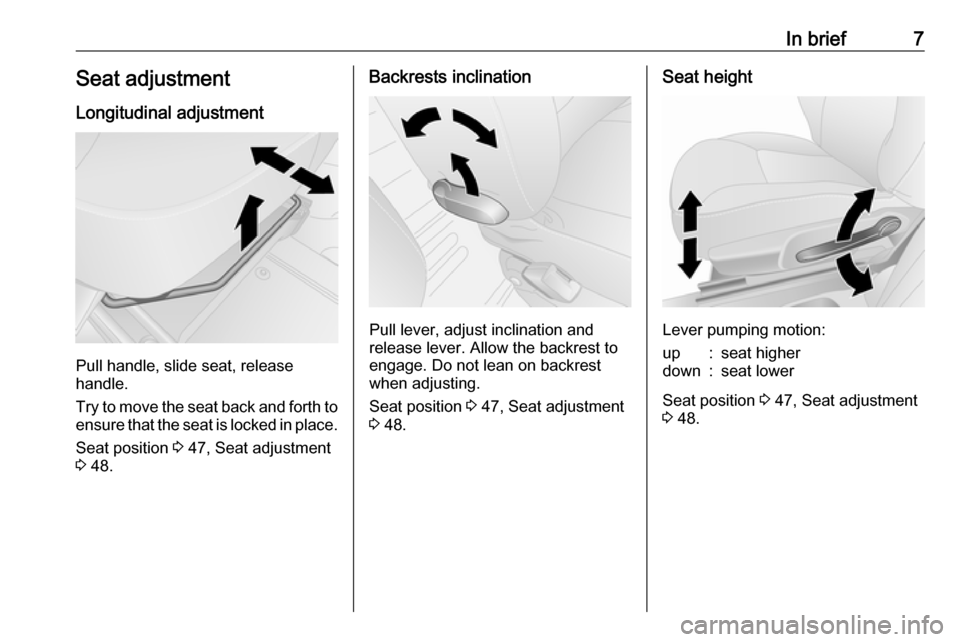
In brief7Seat adjustmentLongitudinal adjustment
Pull handle, slide seat, release
handle.
Try to move the seat back and forth to ensure that the seat is locked in place.
Seat position 3 47, Seat adjustment
3 48.
Backrests inclination
Pull lever, adjust inclination and
release lever. Allow the backrest to
engage. Do not lean on backrest
when adjusting.
Seat position 3 47, Seat adjustment
3 48.
Seat height
Lever pumping motion:
up:seat higherdown:seat lower
Seat position 3 47, Seat adjustment
3 48.
Page 10 of 233
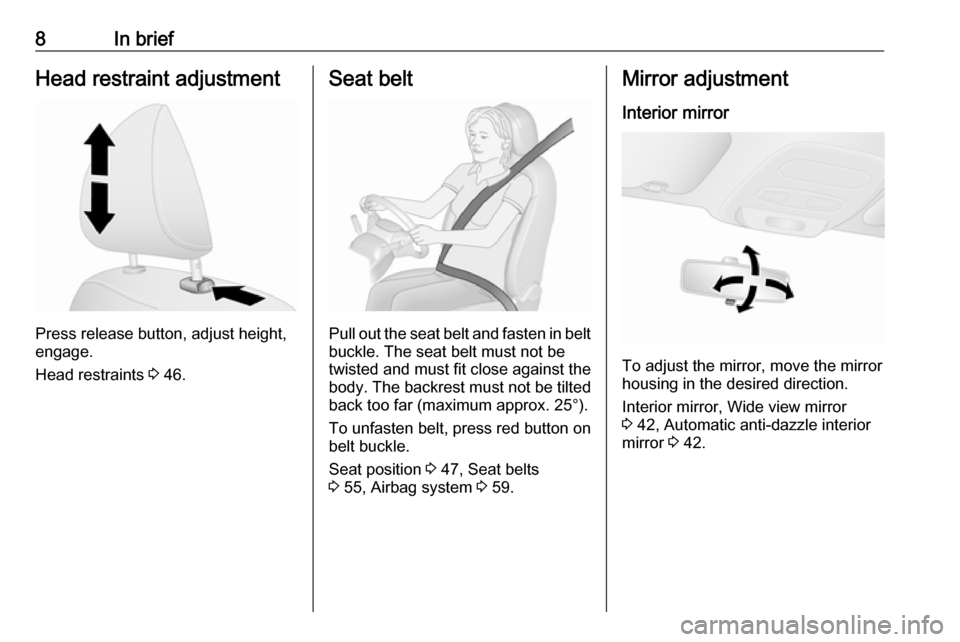
8In briefHead restraint adjustment
Press release button, adjust height,
engage.
Head restraints 3 46.
Seat belt
Pull out the seat belt and fasten in belt
buckle. The seat belt must not be
twisted and must fit close against the
body. The backrest must not be tilted back too far (maximum approx. 25°).
To unfasten belt, press red button on belt buckle.
Seat position 3 47, Seat belts
3 55, Airbag system 3 59.
Mirror adjustment
Interior mirror
To adjust the mirror, move the mirror
housing in the desired direction.
Interior mirror, Wide view mirror
3 42, Automatic anti-dazzle interior
mirror 3 42.
Page 48 of 233
46Seats, restraintsSeats, restraintsHead restraints............................ 46
Front seats ................................... 47
Seat position .............................. 47
Seat adjustment ........................48
Seat folding ............................... 50
Armrest ...................................... 50
Heating ...................................... 50
Rear seats ................................... 51
Seat belts ..................................... 55
Three-point seat belt .................56
Airbag system .............................. 59
Front airbag system ...................62
Side airbag system ....................63
Curtain airbag system ...............63
Airbag deactivation ....................64
Child restraints ............................. 65
Child restraint systems ..............65
Child restraint installation locations ................................... 68Head restraints
Position9 Warning
Only drive with the head restraint
set to the proper position.
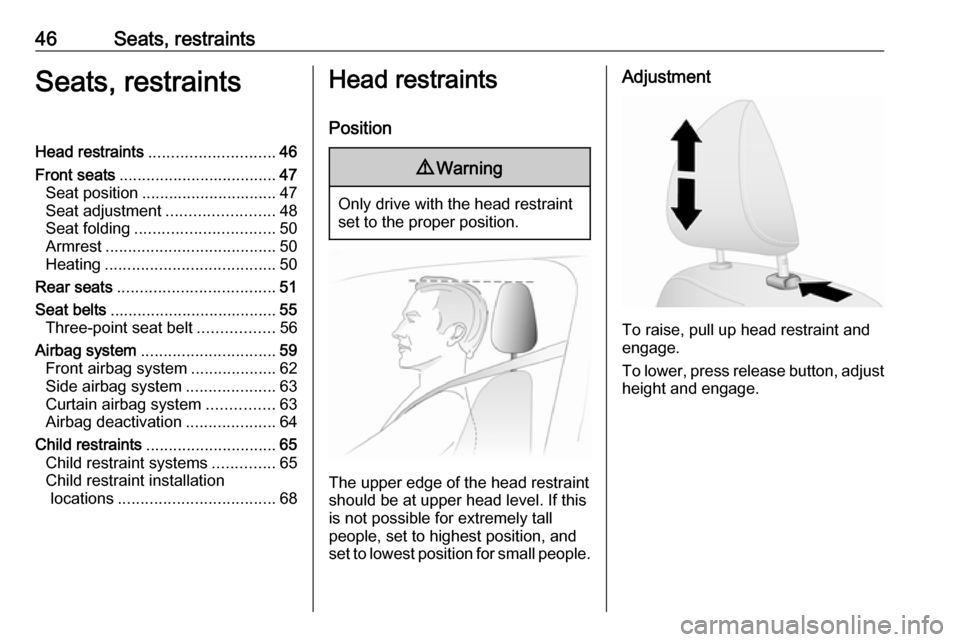
The upper edge of the head restraint
should be at upper head level. If this
is not possible for extremely tall
people, set to highest position, and
set to lowest position for small people.
Adjustment
To raise, pull up head restraint and
engage.
To lower, press release button, adjust
height and engage.
Page 50 of 233
48Seats, restraints
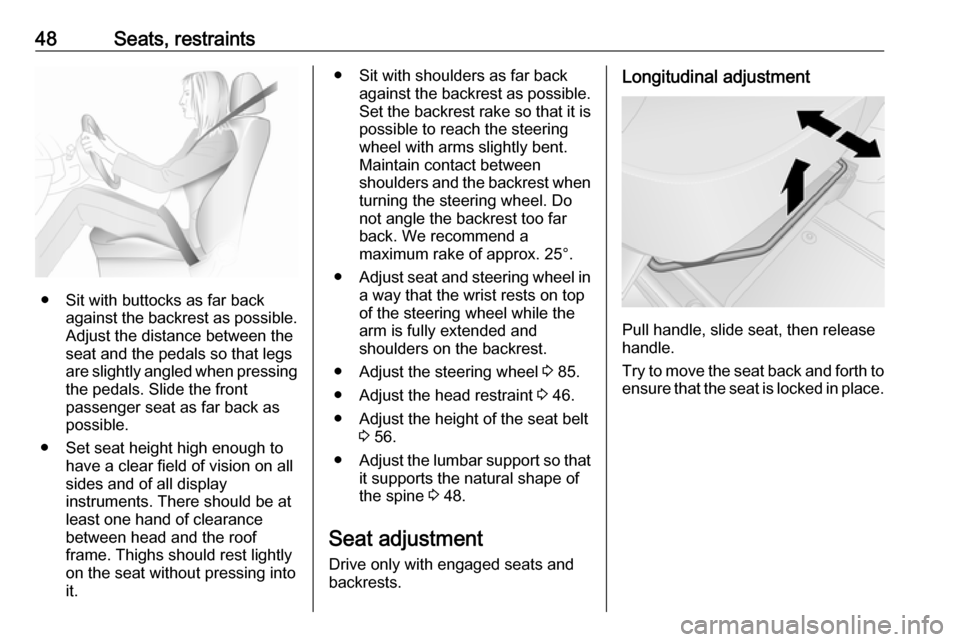
● Sit with buttocks as far backagainst the backrest as possible.
Adjust the distance between the
seat and the pedals so that legs
are slightly angled when pressing
the pedals. Slide the front
passenger seat as far back as
possible.
● Set seat height high enough to have a clear field of vision on allsides and of all display
instruments. There should be at
least one hand of clearance
between head and the roof
frame. Thighs should rest lightly
on the seat without pressing into
it.
● Sit with shoulders as far back against the backrest as possible.Set the backrest rake so that it is
possible to reach the steering
wheel with arms slightly bent.
Maintain contact between
shoulders and the backrest when turning the steering wheel. Do
not angle the backrest too far
back. We recommend a
maximum rake of approx. 25°.
● Adjust seat and steering wheel in
a way that the wrist rests on top
of the steering wheel while the
arm is fully extended and
shoulders on the backrest.
● Adjust the steering wheel 3 85.
● Adjust the head restraint 3 46.
● Adjust the height of the seat belt 3 56.
● Adjust the lumbar support so that
it supports the natural shape of
the spine 3 48.
Seat adjustment Drive only with engaged seats and
backrests.Longitudinal adjustment
Pull handle, slide seat, then release
handle.
Try to move the seat back and forth to ensure that the seat is locked in place.
Page 51 of 233

Seats, restraints49Backrest inclination
Pull lever, adjust inclination and
release lever. Allow the backrest to
engage audibly.
Do not lean on backrest when
adjusting.
Seat height
Lever pumping motion:
up:seat higherdown:seat lowerLumbar support
Adjust lumbar support using
handwheel to suit personal
requirements.
Rotate handwheel to increase and
decrease support.
Page 52 of 233
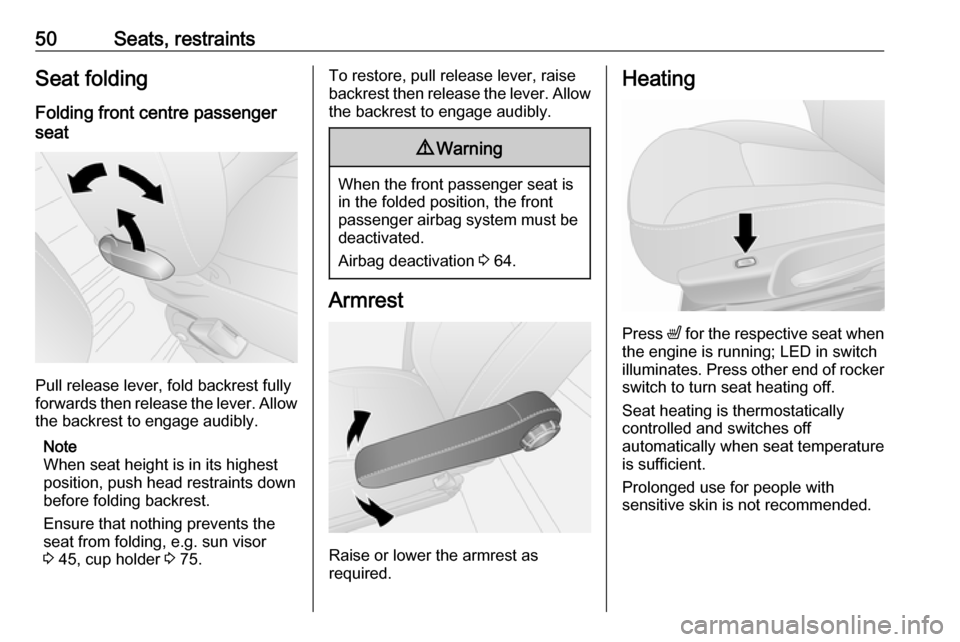
50Seats, restraintsSeat foldingFolding front centre passenger
seat
Pull release lever, fold backrest fully
forwards then release the lever. Allow the backrest to engage audibly.
Note
When seat height is in its highest
position, push head restraints down
before folding backrest.
Ensure that nothing prevents the
seat from folding, e.g. sun visor
3 45, cup holder 3 75.
To restore, pull release lever, raise
backrest then release the lever. Allow the backrest to engage audibly.9 Warning
When the front passenger seat is
in the folded position, the front
passenger airbag system must be deactivated.
Airbag deactivation 3 64.
Armrest
Raise or lower the armrest as
required.
Heating
Press ß for the respective seat when
the engine is running; LED in switch
illuminates. Press other end of rocker switch to turn seat heating off.
Seat heating is thermostatically
controlled and switches off
automatically when seat temperature
is sufficient.
Prolonged use for people with
sensitive skin is not recommended.
Page 59 of 233

Seats, restraints57Height adjustment
Slide adjuster up or down to desired
position:
● Pull belt out slightly.
● Tilt adjuster downwards to disengage then slide height
adjustment downwards or push
the height adjustment up without
tilting adjuster.
Adjust the height so that the belt lies across the shoulder. It must not lie
across the throat or upper arm.
9 Warning
Do not adjust while driving.
Unfasten
To unfasten belt, press red button on
belt buckle. The seat belt retracts automatically.
Page 70 of 233

68Seats, restraintsChild restraint installation locations
Permissible options for fitting a child restraint system Front seats - Van
Weight and age class
Single front passenger seat 1Double front passenger seat
activated airbag
deactivated
or without airbag
activated airbag
deactivated
or without airbagcentreouterGroup 0: up to 10 kg
Group 0+: up to 13 kgXUXXUGroup I: 9 to 18 kgXUXXUGroup II: 15 to 25 kg
Group III: 22 to 36 kgXUXXU1:Forward-facing child restraints: Remove head restraint 3 46. Slide seat as far back as possible. Set seat height to
highest position. Maximum backrest rake is 25°. Seat adjustment 3 48.
Page 71 of 233

Seats, restraints69Front seats - Combi, Double cab
Weight and age class
Single front passenger seat1Double front passenger seat
activated airbag
deactivated
or without airbag
activated airbag
deactivated
or without airbagcentreouterGroup 0: up to 10 kg
Group 0+: up to 13 kgXUXXUGroup I: 9 to 18 kgXU 2XXU2Group II: 15 to 25 kg
Group III: 22 to 36 kgXXXXX1:If adjustable, slide seat as far back as possible and set seat height to highest position. Maximum backrest rake is
25°. Seat adjustment 3 48.2:Rear-facing child restraints only for this weight and age class.
Page 85 of 233

Storage83hinder the freedom of movement
of the driver. Do not place any
unsecured objects in the interior.
● Do not drive with an open load compartment. In addition, the
number plate is only
distinguishable and illuminated correctly if the doors are closed.9 Warning
Always make sure that the load in
the vehicle is securely stowed.
Otherwise objects can be thrown
around inside the vehicle and
cause personal injury or damage
to the load or car.
● The payload is the difference between the permitted gross
vehicle weight (see identification
plate 3 206) and the EC kerb
weight.
To calculate the payload, enter
the data for your vehicle in the
Weights table at the front of this
manual.
The EC kerb weight includes
weights for the driver (68 kg),
luggage (7 kg) and all fluids (fuel
tank 90% full).
Optional equipment and
accessories increase the kerb
weight.
● Driving with a roof load increases
the sensitivity of the vehicle to
cross-winds and has a
detrimental effect on vehicle
handling due to the vehicle's
higher centre of gravity.
Distribute the load evenly and
secure it properly with retaining
straps. Adjust the tyre pressure
and vehicle speed according to
the load conditions. Check and
retighten the straps frequently.
Do not drive faster than
120 km/h.
The permissible roof load is
200 kg for H1 Roof height
variants and 150 kg for H2 Roof
height variants (excludes
Platform cab conversions). The
roof load is the combined weight
of the roof rack and the load.