tyre pressure OPEL VIVARO B 2018.5 Manual user
[x] Cancel search | Manufacturer: OPEL, Model Year: 2018.5, Model line: VIVARO B, Model: OPEL VIVARO B 2018.5Pages: 241, PDF Size: 5.58 MB
Page 191 of 241

Vehicle care189Trailer towingWhen towing a trailer with a fully
laden vehicle, the tyre pressure must
be increased by 20 kPa/0.2 bar
(3.0 psi) and the maximum speed
limited to 100 km/h.
Trailer towing 3 163.
Tyre pressure monitoring
system
The tyre pressure monitoring system
uses radio and sensor technology to
check tyre pressure levels.Caution
Tyre pressure monitoring system
warns only about low tyre pressure condition and does not replace
regular tyre maintenance by the
driver.
All wheels must be equipped with pressure sensors and the tyres must
have the prescribed pressure.
Note
In countries where the tyre pressure
monitoring system is legally
required, the use of wheels without
pressure sensors will invalidate the
vehicle operating permit.
The tyre pressure monitoring system
sensors monitor the air pressure in
the tyres and transmit tyre pressure
readings to a receiver located in the
vehicle.
Tyre pressure chart 3 223.
Low tyre pressure conditionA detected low tyre pressure
condition is indicated by illumination
of control indicator w 3 101 and a
corresponding message appears in
the Driver Information Centre.
If w illuminates, stop as soon as
possible and inflate the tyres as
recommended 3 223.
After inflating, some driving may be
required to update the tyre pressure
values in the system. During this time
w may illuminate.
If w illuminates at lower temperatures
and extinguishes after some driving,
this could be an indicator for
approaching a low tyre pressure
condition. Check tyre pressure of all
four tyres.
If the tyre pressure must be reduced
or increased, switch off ignition.
Only mount wheels with pressure
sensors, otherwise w flashes for
several seconds then illuminates
continuously together with control
indicator j 3 99 and a corresponding
message appears in the Driver
Information Centre.
Page 192 of 241
190Vehicle careA spare wheel or temporary spare
wheel is not equipped with pressure
sensors. The tyre pressure
monitoring system is not operational
for these wheels. For the further three wheels, the tyre pressure monitoring
system remains operational.
Control indicator w and the
corresponding message appears at
each ignition cycle until the tyres are
inflated to the correct tyre pressure.
Driver Information Centre 3 103.
Vehicle messages 3 104.
Puncture A puncture or severely under-inflated
tyre is indicated by illumination of
control indicator w together with C
3 99 and a corresponding message
appears in the Driver Information
Centre. Stop vehicle and switch off
engine.
Tyre pressure 3 223.
Tyre repair kit 3 192.
Spare wheel 3 197.
Wheel changing 3 195.Relearn function
After a puncture has been repaired
and the driver has inflated the tyres to
the correct tyre pressure, the tyre
pressure monitoring system needs to recalculate.
Tyre pressure 3 223.
Tyre repair kit 3 192.
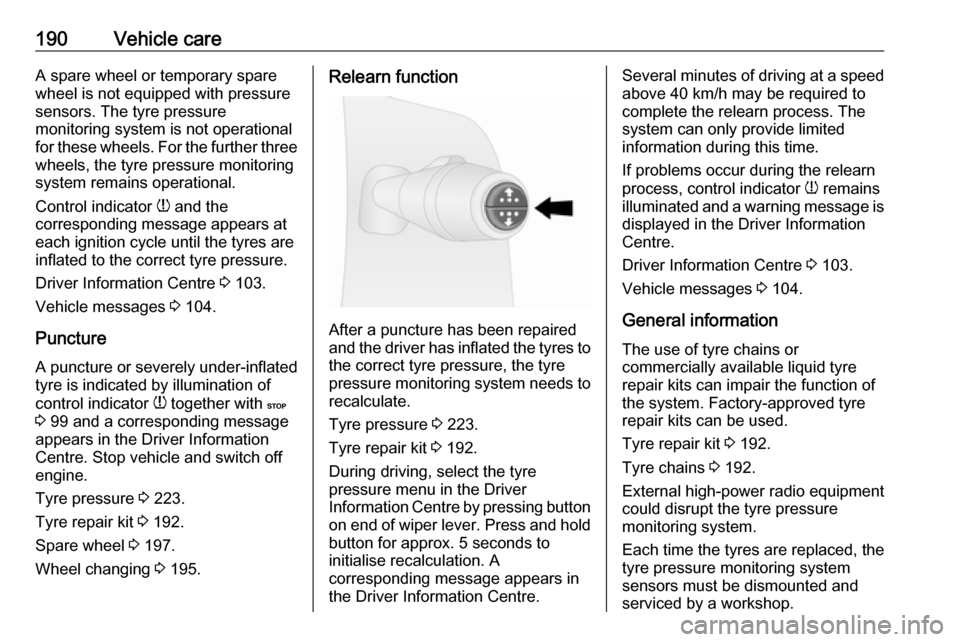
During driving, select the tyre
pressure menu in the Driver
Information Centre by pressing button
on end of wiper lever. Press and hold button for approx. 5 seconds to
initialise recalculation. A
corresponding message appears in
the Driver Information Centre.
Several minutes of driving at a speed above 40 km/h may be required to
complete the relearn process. The system can only provide limited
information during this time.
If problems occur during the relearn
process, control indicator w remains
illuminated and a warning message is displayed in the Driver Information
Centre.
Driver Information Centre 3 103.
Vehicle messages 3 104.
General information The use of tyre chains or
commercially available liquid tyre
repair kits can impair the function of
the system. Factory-approved tyre
repair kits can be used.
Tyre repair kit 3 192.
Tyre chains 3 192.
External high-power radio equipment
could disrupt the tyre pressure
monitoring system.
Each time the tyres are replaced, the
tyre pressure monitoring system
sensors must be dismounted and
serviced by a workshop.
Page 193 of 241
Vehicle care191Tread depthCheck tread depth at regular
intervals.
Tyres should be replaced for safety
reasons at a tread depth of 2–3 mm
(4 mm for winter tyres).
For safety reasons it is recommended
that the tread depth of the tyres on
one axle should not vary by more than
2 mm.
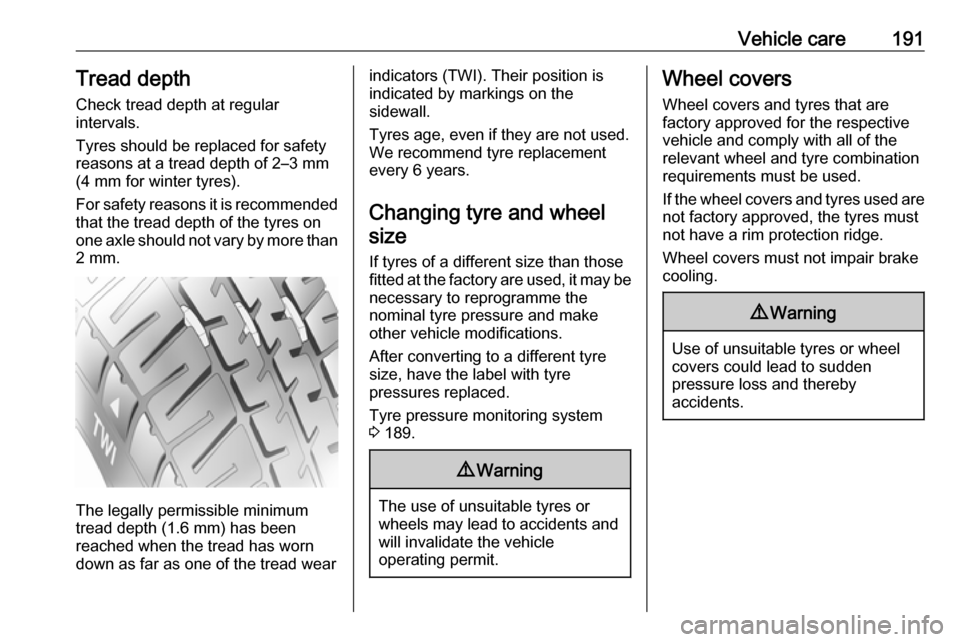
The legally permissible minimum
tread depth (1.6 mm) has been
reached when the tread has worn
down as far as one of the tread wear
indicators (TWI). Their position is
indicated by markings on the
sidewall.
Tyres age, even if they are not used.
We recommend tyre replacement
every 6 years.
Changing tyre and wheel size
If tyres of a different size than those fitted at the factory are used, it may be necessary to reprogramme the
nominal tyre pressure and make
other vehicle modifications.
After converting to a different tyre
size, have the label with tyre
pressures replaced.
Tyre pressure monitoring system
3 189.9 Warning
The use of unsuitable tyres or
wheels may lead to accidents and will invalidate the vehicle
operating permit.
Wheel covers
Wheel covers and tyres that are
factory approved for the respective
vehicle and comply with all of the
relevant wheel and tyre combination
requirements must be used.
If the wheel covers and tyres used are
not factory approved, the tyres must
not have a rim protection ridge.
Wheel covers must not impair brake
cooling.9 Warning
Use of unsuitable tyres or wheel
covers could lead to sudden
pressure loss and thereby
accidents.
Page 195 of 241
Vehicle care193
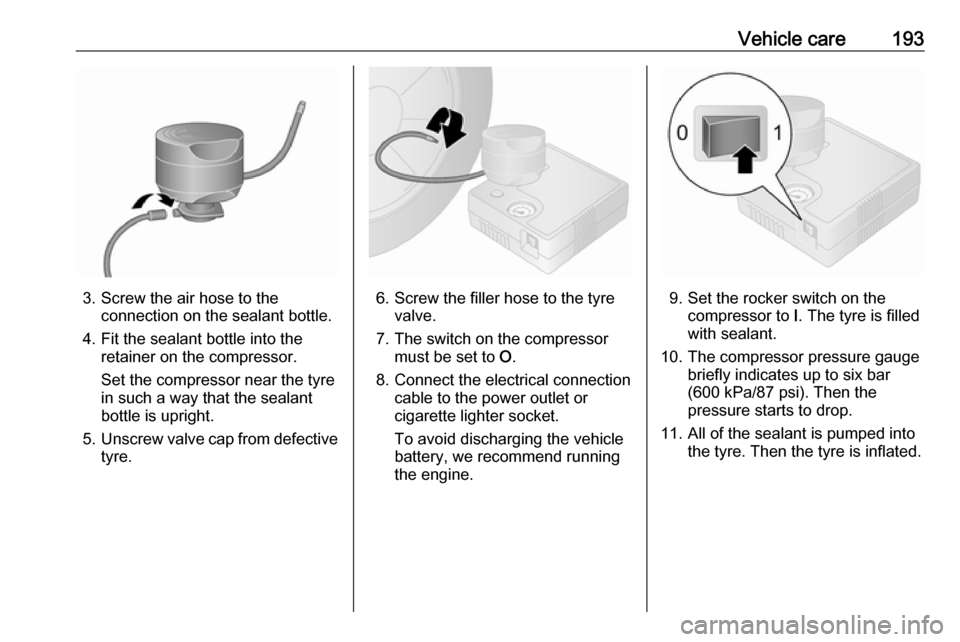
3. Screw the air hose to theconnection on the sealant bottle.
4. Fit the sealant bottle into the retainer on the compressor.
Set the compressor near the tyre
in such a way that the sealant
bottle is upright.
5. Unscrew valve cap from defective
tyre.6. Screw the filler hose to the tyre valve.
7. The switch on the compressor must be set to O.
8. Connect the electrical connection cable to the power outlet or
cigarette lighter socket.
To avoid discharging the vehicle
battery, we recommend running
the engine.9. Set the rocker switch on the compressor to I. The tyre is filled
with sealant.
10. The compressor pressure gauge briefly indicates up to six bar
(600 kPa/87 psi). Then the
pressure starts to drop.
11. All of the sealant is pumped into the tyre. Then the tyre is inflated.
Page 196 of 241

194Vehicle care
12. The prescribed tyre pressureshould be obtained within
15 minutes.
Tyre pressure 3 223.
When the correct pressure is
obtained, switch off the
compressor.
If the prescribed tyre pressure is
not obtained within 15 minutes,
remove the tyre repair kit. Move
the vehicle one tyre rotation
(approx. 2 m). Reattach the tyre
repair kit and continue the filling
procedure for 15 minutes. If the
prescribed tyre pressure is still not
obtained, the tyre is too badly
damaged. Seek the assistance of
a workshop.
Drain excess tyre pressure with
the button beside the pressure
indicator.
Do not run the compressor for
longer than 15 minutes.
13. Detach the tyre repair kit.
14. Remove any excess sealant using a cloth.
15. Take the label indicating maximum permitted speed from
the tyre repair kit and affix in the
driver's field of view.
16. Store the sealant bottle in the plastic bag. Return tyre repair kit
to case and stow under the driver's seat.
17. Continue driving immediately so that the sealant is evenly
distributed throughout the tyre.
After driving approx. 10 km, but no more than 10 minutes, stop and
check tyre pressure using the
compressor. Screw air hose from
compressor directly onto tyre
valve when doing this.
18. If the tyre pressure is more than 2.2 bar (220 kPa/31 psi), set it to
the correct value. Repeat the
procedure until there is no more
loss of pressure.
If the tyre pressure has fallen
below 2.2 bar (220 kPa/31 psi),
the vehicle must not be driven.
Page 199 of 241

Vehicle care19711. Stow the replaced wheel 3 197
and the vehicle tools 3 186.
12. Have the new wheel balanced on the vehicle.
Check the tyre pressure of the
installed tyre 3 223.
Check the wheel bolt torque.
Have the defective tyre renewed or repaired as soon as possible.
Spare wheel Some vehicles are equipped with a
tyre repair kit instead of a spare wheel
3 192.
The spare wheel can be classified as
a temporary spare wheel depending
on the size compared to the other
mounted wheels and country
regulations. In this case a permissible maximum speed applies, even
though no label at the spare wheel
indicates this.Caution
The use of a spare wheel that is smaller than the other wheels or in combination with winter tyres
could affect driveability. Have the defective tyre replaced as soon as
possible.
It may be necessary to jack the
vehicle up to gain access to the spare
wheel on a fully loaded vehicle with a
flat rear tyre.
Wheel changing 3 195.
The spare wheel is mounted under
the rear underbody and may be
secured using a security bolt that can
only be removed using the wheel bolt sleeve supplied.
Vehicle tools 3 186.9 Warning
Due to the weight of the tyre
assembly, exercise caution when
releasing the spare wheel carrier.
Do not fully remove bolt 1.
Support the spare wheel with a
suitable object to prevent the
wheel falling suddenly when
loosening the carrier bolts - risk of injury!
To release the spare wheel carrier,fully remove bolt 2 then loosen bolt 1,
ensuring it is not fully removed. Then
move the spare wheel carrier up and
down and from side to side, until it
clears bolt 1, and lower the carrier
assembly.
When installing the wheel ensure that
the spare wheel carrier is correctly
positioned before tightening the bolts.
Page 205 of 241

Vehicle care203Use a soft lint-free cloth or chamois
leather together with window cleaner and insect remover.
When cleaning the rear window from
inside, always wipe in parallel to the
heating element to prevent damage.
For mechanical removal of ice, use a
sharp-edged ice scraper. Press the
scraper firmly against the glass so
that no dirt can get under it and
scratch the glass.
Remove dirt residues from smearing wiper blades by using a soft cloth and
window cleaner. Also make sure to
remove any residues such as wax,
insect residues and similar from the
window.
Ice residues, pollution and continuous wiping on dry windows will damage or
even destroy the wiper blades.
Wheels and tyres Do not use high-pressure jet
cleaners.
Clean rims with a pH-neutral wheel
cleaner.
Rims are painted and can be treated
with the same agents as the body.Paintwork damage
Rectify minor paintwork damage with
a touch-up pen before rust forms.
Have more extensive damage or rust areas repaired by a workshop.
Underbody
Some areas of the vehicle underbody
have a PVC undercoating while other critical areas have a durable
protective wax coating.
After the underbody is washed, check
the underbody and have it waxed if
necessary.
Bitumen / rubber materials could damage the PVC coating. Have
underbody work carried out by a
workshop.
Before and after winter, wash the
underbody and have the protective
wax coating checked.
Towing equipment
Do not clean the coupling ball bar with a steam-jet or high-pressure jet
cleaner.Interior care
Interior and upholstery Only clean the vehicle interior,
including the instrument panel fascia
and panelling, with a dry cloth or
interior cleaner.
Clean any leather upholstery with
clear water and a soft cloth. In case of
heavy soiling, use leather care.
The instrument cluster and the
displays should only be cleaned using
a soft damp cloth. If necessary use a
weak soap solution.
Clean fabric upholstery with a
vacuum cleaner and brush. Remove
stains with an upholstery cleaner.
Clothing fabrics may not be
colourfast. This could cause visible
discolourations, especially on light- coloured upholstery. Removable
stains and discolourations should be
cleaned as soon as possible.
Clean seat belts with lukewarm water or interior cleaner.
Page 211 of 241
Technical data209Technical dataVehicle identification..................209
Vehicle Identification Number ..209
Identification plate ...................210
Engine identification ................210
Vehicle data ............................... 211
Recommended fluids and lubricants ................................ 211
Engine data ............................. 212
Vehicle weight ......................... 215
Vehicle dimensions .................218
Capacities ................................ 222
Tyre pressures ........................ 223Vehicle identification
Vehicle IdentificationNumber
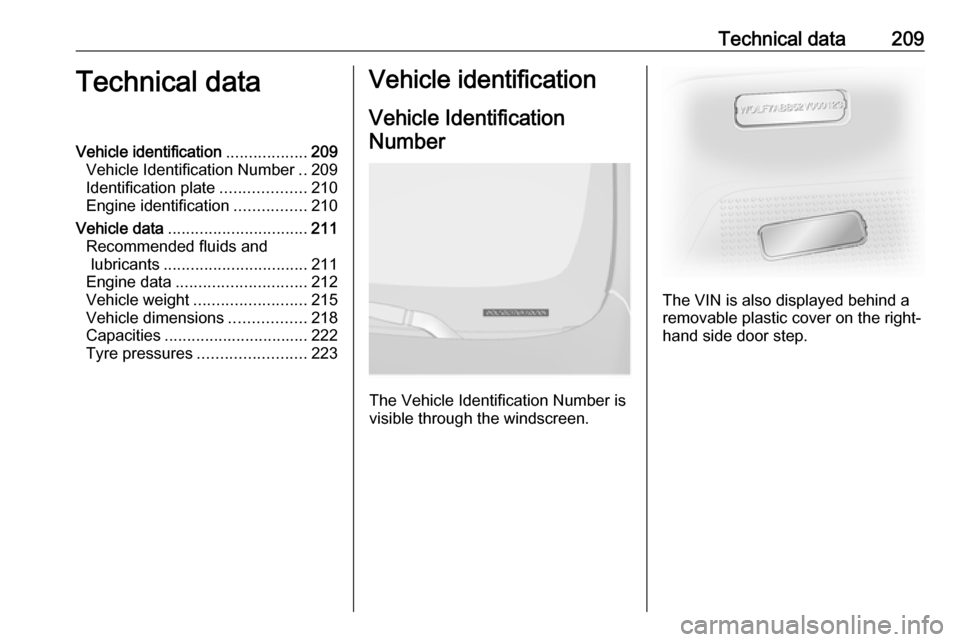
The Vehicle Identification Number is
visible through the windscreen.
The VIN is also displayed behind a
removable plastic cover on the right-
hand side door step.
Page 225 of 241
![OPEL VIVARO B 2018.5 Manual user Technical data223Tyre pressuresTyreTyre pressure with full load9)10)Front
[kPa/bar] (psi)Rear
[kPa/bar] (psi)205/65 R16 C 107/105T380/3.8 (55)420/4.2 (61)215/65 R16 C 106/104T,
215/65 R16 C 107/105T31](/img/37/18917/w960_18917-224.png "OPEL VIVARO B 2018.5 Manual user Technical data223Tyre pressuresTyreTyre pressure with full load9)10)Front
[kPa/bar] (psi)Rear
[kPa/bar] (psi)205/65 R16 C 107/105T380/3.8 (55)420/4.2 (61)215/65 R16 C 106/104T,
215/65 R16 C 107/105T31")
Technical data223Tyre pressuresTyreTyre pressure with full load9)10)Front
[kPa/bar] (psi)Rear
[kPa/bar] (psi)205/65 R16 C 107/105T380/3.8 (55)420/4.2 (61)215/65 R16 C 106/104T,
215/65 R16 C 107/105T310/3.1 (45)340/3.4 (49)195/75 R16 C 107/105T380/3.8 (55)420/4.2 (61)215/60 R17 C 109/107T350/3.5 (51) 11)390/3.9 (57)12)9)
The spare wheel should be set to the highest applicable pressure shown in the table.
10) When towing a trailer with a fully laden vehicle, the tyre pressure must be increased by 20 kPa/0.2 bar (3.0 psi) and the maximum
speed limited to 100 km/h.
11) Combi: 320/3.2 (46) for non-motorway driving below 160 km/h.
12) Combi: 350/3.5 (51) for non-motorway driving below 160 km/h.
The tyre pressure information label on the driver's door frame indicates the original equipment tyres and the correspondent
tyre pressures. Always inflate tyres to the pressures shown on the label.
Tyre pressure information label 3 187.
Tyre designations 3 187.
Page 228 of 241

226Customer informationOperation
frequency (MHz)Maximum output
(dBm)90033180030
Tyre Pressure Monitoring
Schrader Electronics
Trooperslane Industrial Estate, 2
Meadowbank Rd, Carrickfergus
BT38 8YF, United Kingdom
Operation frequency: 433 MHz
Maximum output: 10 mW ERP
Radar systems
Country-specific Declarations of
Conformity for radar systems are
shown on the following page: