ad blue OPEL VIVARO B 2018 User Guide
[x] Cancel search | Manufacturer: OPEL, Model Year: 2018, Model line: VIVARO B, Model: OPEL VIVARO B 2018Pages: 237, PDF Size: 5.57 MB
Page 118 of 237
116Climate controlClimate controlClimate control systems.............116
Heating and ventilation system 116
Air conditioning system ...........117
Electronic climate control system .................................... 118
Rear heating system ...............120
Rear air conditioning system ...121
Auxiliary heater ........................122
Air vents ..................................... 127
Adjustable air vents .................127
Fixed air vents ......................... 128
Glovebox cooler ......................128
Maintenance .............................. 128
Air intake ................................. 128
Pollen filter ............................... 128
Air conditioning regular operation ................................ 128
Service .................................... 129Climate control systems
Heating and ventilation system
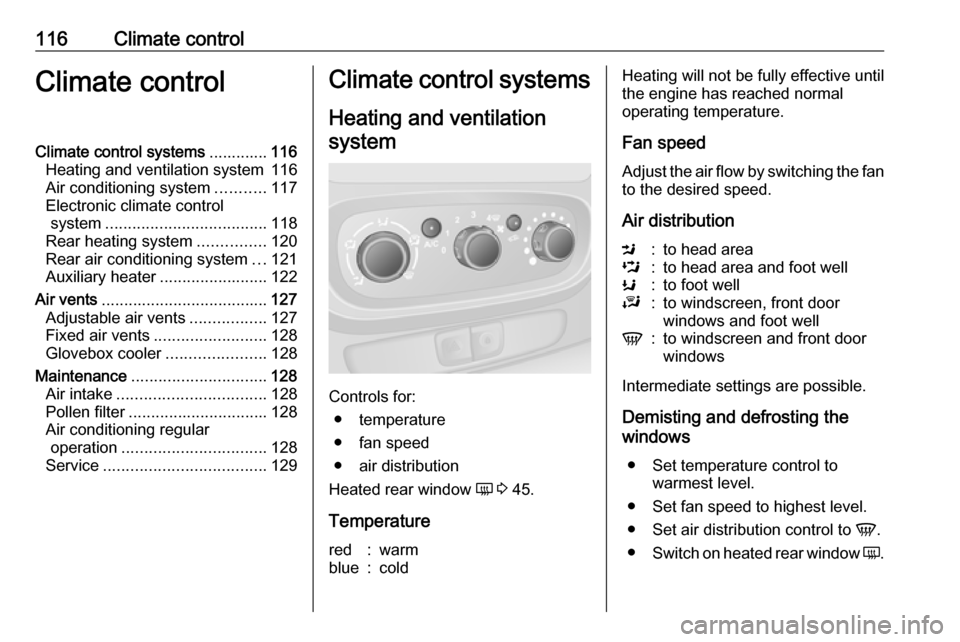
Controls for: ● temperature
● fan speed
● air distribution
Heated rear window Ü 3 45.
Temperature
red:warmblue:coldHeating will not be fully effective until
the engine has reached normal
operating temperature.
Fan speed
Adjust the air flow by switching the fan
to the desired speed.
Air distributionM:to head areaL:to head area and foot wellK:to foot wellJ:to windscreen, front door
windows and foot wellV:to windscreen and front door
windows
Intermediate settings are possible.
Demisting and defrosting the
windows
● Set temperature control to warmest level.
● Set fan speed to highest level.
● Set air distribution control to V.
● Switch on heated rear window Ü.
Page 132 of 237
130Driving and operatingDriving and
operatingDriving hints ............................... 130
Driving economically ...............130
Control of the vehicle ...............131
Steering ................................... 131
Starting and operating ...............132
New vehicle running-in ............132
Ignition switch positions ...........132
Power button ........................... 132
Starting the engine ..................134
Idle speed control ....................135
Vehicle shutdown ....................135
Overrun cut-off ........................ 136
Stop-start system ....................136
Parking .................................... 139
Engine exhaust .......................... 140
Diesel particle filter ..................140
Catalytic converter ...................140
AdBlue ..................................... 141
Manual transmission ..................146
Brakes ........................................ 147
Antilock brake system .............147
Parking brake .......................... 148Brake assist............................. 148
Hill start assist ......................... 148
Ride control systems .................149
Traction Control system ..........149
Electronic stability program .....150
Driver assistance systems .........152
Cruise control .......................... 152
Speed limiter ........................... 155
Parking assist .......................... 155
Rear view camera ...................157
Fuel ............................................ 159
Fuel for diesel engines ............159
Refuelling ................................ 160
Fuel consumption - CO 2-
Emissions ............................... 161
Trailer hitch ................................ 162
General information .................162
Driving characteristics and towing tips .............................. 162
Trailer towing ........................... 162
Trailer stability assist ...............163Driving hints
Driving economically
ECO mode ECO mode is a function that
optimises fuel consumption. It affects
engine power and torque,
acceleration, gear shift indication,
heating, air conditioning and electrical consumers.
Activation
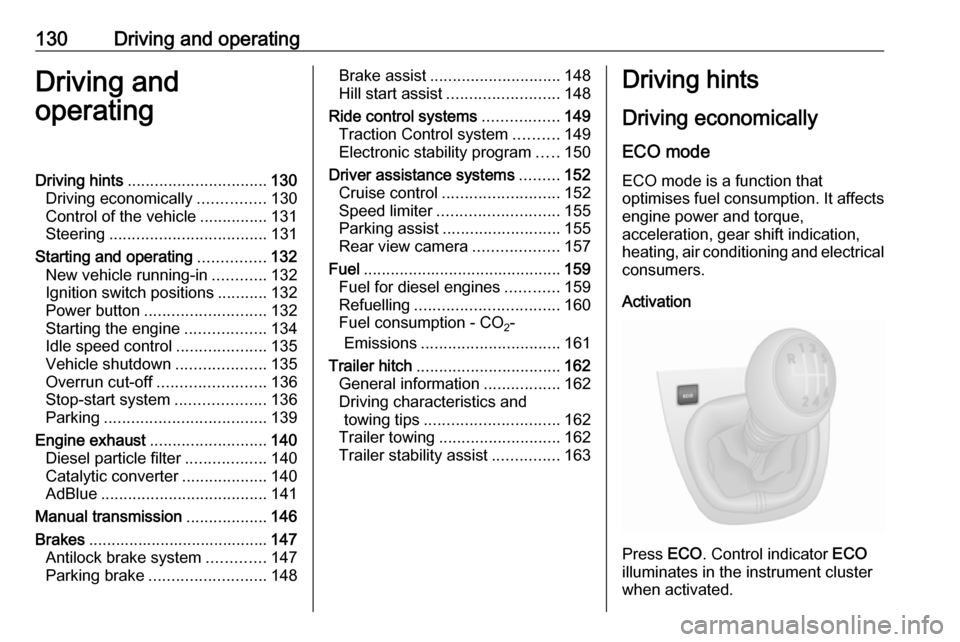
Press ECO. Control indicator ECO
illuminates in the instrument cluster when activated.
Page 143 of 237
Driving and operating141If control indicator Z flashes, the
permitted emission limits may be
exceeded. Lift your foot off the
accelerator until Z stops flashing and
is steadily illuminated. Contact a
workshop immediately.
Malfunction indicator light 3 98.
AdBlue
General information The selective catalytic reduction
(BlueInjection) is a method to
substantially reduce the nitrogen
oxides in the exhaust emission. This
is achieved by injecting a Diesel
Exhaust Fluid (DEF) into the exhaust system.
The designation of this fluid is
AdBlue ®
. It is a non-toxic, non-
flammable, colourless and odourless
fluid which consists of 32% urea and
68% water.9 Warning
Avoid contact of your eyes or skin
with AdBlue.
In case of eye or skin contact,
rinse off with water.
Caution
Avoid contact of the paintwork with AdBlue.
In case of contact, rinse off with water.
AdBlue freezes at a temperature of
approx. -11 °C. As the vehicle is
equipped with an AdBlue pre-heater,
the emissions reduction at low
temperatures is ensured. The AdBlue
pre-heater works automatically.
AdBlue level indicator
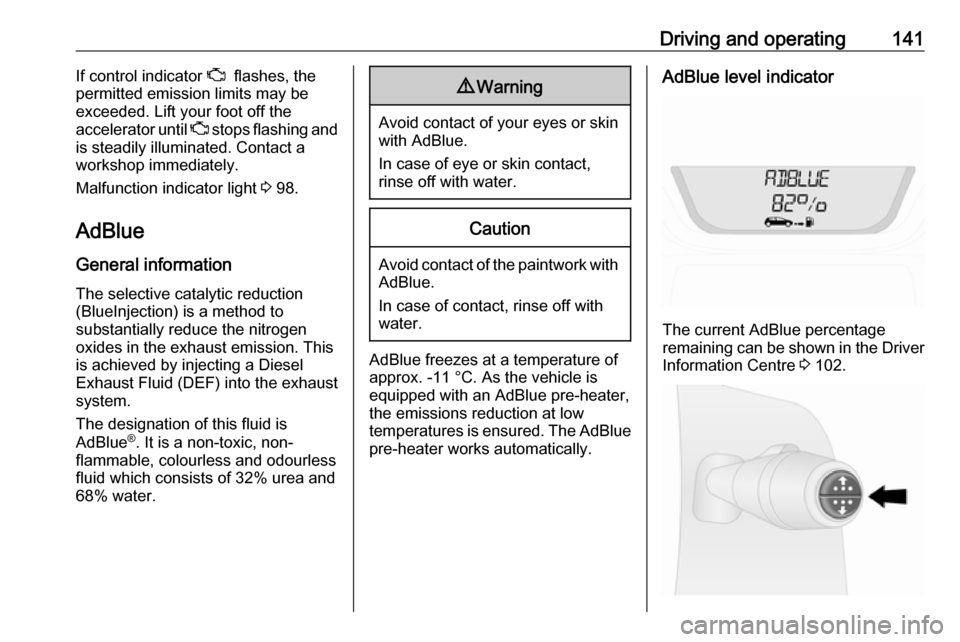
The current AdBlue percentage
remaining can be shown in the Driver
Information Centre 3 102.
Page 144 of 237

142Driving and operatingPress button on end of wiper lever
repeatedly until the 'AdBlue
percentage remaining' menu is
displayed.
Level warnings
The AdBlue consumption is approx.
3.0 litres per 1000 km and depends on the driving behaviour.
If the AdBlue level falls below a
certain value, a level warning will be
displayed in the Driver Information
Centre 3 102. Additionally, control
indicator Y illuminates continuously
together with a warning chime.
Refill the AdBlue tank as soon as
possible. Refer to "Refilling AdBlue"
below.
If AdBlue is not refilled within a certain distance, further level warnings are
displayed in the Driver Information
Centre depending on the current
AdBlue level.
Engine restarts prevented
Subsequent requests to refill AdBlue
and finally the announcement that an
engine restart will be prevented are
displayed in the Driver Information
Centre.
Note
These restrictions are a legal
requirement.
Before the prevention of an engine restart, a warning message with
0 km is displayed in the Driver
Information Centre, indicating that
after switching off the ignition an
engine restart will be prohibited.
After the prevention of an engine
start, a warning message is displayed in the Driver Information Centre
reminding the driver that AdBlue level is insufficient.To allow the engine to be restarted,
the tank should be refilled completely
or with a volume of at least ten litres
of AdBlue, depending on AdBlue
consumption.
Warning stages: level warnings,
engine restarts prevented
1. Y illuminates after ignition is
switched on with warning
message LEVEL ADBLUE LOW :
Driving is possible without any
restrictions.
Refill the AdBlue tank as soon as
possible.
2. Y illuminates during driving with
warning message TOP UP
ADBLUE :
Possible loss of engine power.
Refill the AdBlue tank as soon as
possible.
3. Y illuminates during driving with
warning message XXX KM STOP
ADD ADBLUE :
Vehicle speed may be limited to
20 km/h after switching the engine
off and on again until the range is
reduced to 0 km.
Page 145 of 237

Driving and operating143Refill the tank completely or with avolume of at least ten litres of
AdBlue (depending on AdBlue
consumption) as soon as
possible.
4. Y illuminates during driving with
warning message 0 KM STOP
ADD ADBLUE :
The engine cannot be restarted
after switching off the ignition.
To allow the engine to be
restarted, refill the tank
completely or with a volume of at
least ten litres of AdBlue
(depending on AdBlue
consumption) as soon as
possible.
Illumination of control indicator Y may
be accompanied by a warning chime.
Warning chimes 3 104.
High emission warnings If the exhaust emission rises above a
certain value, warnings similar to the
range warnings as described above
will be displayed in the DriverInformation Centre. Control indicator
Y illuminates continuously together
with F and a warning chime.
Requests to have the exhaust system checked and finally the
announcement that an engine restart
will be prevented are displayed in the Driver Information Centre.
Note
These restrictions are a legal
requirement.
At an AdBlue range of 1100 km, a
warning message is displayed in the
Driver Information Centre showing
the remaining distance the vehicle
can travel before engine restarts are
prevented. This warning message is
repeated every 100 km.
Seek the assistance of a workshop as
soon as possible.
Warning stages: high emission
warnings
1. Y and F illuminate with warning
message CHECK ANTI-
POLLUTION :
Fault in the system that may result in a loss of engine power.Seek the assistance of a
workshop as soon as possible.
2. Y and F illuminate with warning
message ANTIPOLLUTION xxx
KM FAIL :
Indicates that in less than
1100 km an engine restart will be
prohibited after switching off the
ignition.
This warning message will be
repeated every 100 km.
Vehicle speed may be limited to
20 km/h after switching the engine
off and on again until the range is
reduced to 0 km.
Seek the assistance of a
workshop as soon as possible.
3. Y and F illuminate with warning
message ANTIPOLLUTION 0 KM
FAILURE :
The engine cannot be restarted
after switching off the ignition.
Seek the assistance of a
workshop.
Illumination of control indicators Y
and F may be accompanied by a
warning chime.
Page 146 of 237

144Driving and operatingWarning chimes 3 104.
Refilling AdBlueCaution
Only use AdBlue that complies
with European standards
DIN 70 070 and ISO 22241-1.
Do not use additives.
Do not dilute AdBlue.
Otherwise the selective catalytic
reduction system could be
damaged.
Note
If AdBlue must be refilled at very low temperatures, the refilling of AdBlue
may not be detected by the system.
In this case, park the vehicle in a
space with a higher ambient
temperature until AdBlue is
liquefied.
Note
If engine starting is prohibited due to low AdBlue level, we recommend
refilling the tank completely or with a volume of at least ten litres of AdBlue(depending on AdBlue
consumption).
Avoid minor top-ups (e.g. less than ten litres), otherwise the system may
not detect a refill.
Note
When unscrewing the protective cap from the filler neck, ammonia fumes
may emerge. Do not inhale as the fumes have a pungent smell. The
fumes are not harmful by inhalation.
The vehicle must be parked on a level
surface.The filler neck for AdBlue is located
behind the fuel filler flap, located on
the left-hand side of the vehicle.
The fuel filler flap can only be opened if the vehicle is unlocked and the left-
hand door is opened.9 Danger
Vehicles with stop-start system:
The engine must be switched off
and the ignition key removed, to
avoid risk of engine being
restarted automatically by the
system.
Capacities 3 219.
Filling station
9 Danger
Follow the operating and safety
instructions of the filling station
when refilling AdBlue.
1. Switch off engine and remove key
from ignition switch.
Page 147 of 237

Driving and operating1452. Open left-hand door and pull fuelfiller flap to open.
3. Unscrew protective capanticlockwise from the filler neck.
Caution
The AdBlue protective cap is the
blue lower cap (arrowed in
illustration), and the fuel filler cap
is the black upper cap 3 160.
In case of incorrect refilling, do not switch on ignition. Seek the
assistance of a workshop
immediately.
4. Fully insert the pump nozzle into the filler neck and switch it on.
5. When refilling is complete, mount the protective cap and turn
clockwise until it engages.
6. Close fuel filler flap and left-hand door.
AdBlue canister Note
Only use the designated AdBlue
canisters for refilling, to prevent a
topping-up of too much AdBlue.
Additionally, the fumes in the tank
are captured in the canister and do
not emerge.
Note
Since AdBlue has a limited
durability, check the date of expiry
before refilling.
1. Switch off engine and remove key
from ignition switch.
2. Open left-hand door and pull fuel filler flap to open.
3. Unscrew protective capanticlockwise from the filler neck.
Caution
The AdBlue protective cap is the
blue lower cap (arrowed in
illustration), and the fuel filler cap
is the black upper cap 3 160.
In case of incorrect refilling, do not switch on ignition. Seek the
assistance of a workshop
immediately.
4. Open AdBlue canister.
Page 148 of 237
146Driving and operating5.Mount one end of the hose on the
canister and screw the other end
on the filler neck.
6. Lift the canister until it is empty, or
until the flow from the canister has stopped. This can take up to five
minutes.
7. Place the canister on the ground to empty the hose, wait 15
seconds.
8. Unscrew the hose from the filler neck.
9. Mount the protective cap and turn
clockwise until it engages.
10. Close fuel filler flap and left-hand door.
Note
Dispose of AdBlue canister
according to environmental
requirements. Hose can be reused
after flushing with clear water before
AdBlue dries out.Note
Allow the vehicle to idle for at least
ten seconds to allow the system to
detect the AdBlue refill.
Failure to observe this procedure will
result in the system only recognising the AdBlue refill after approx.
20 minutes of driving.
If the AdBlue refill is detected
successfully, AdBlue level warnings
will disappear.
If the AdBlue refill is not detected
some time after running the engine,
seek the assistance of a workshop.
Filler cap
Only use genuine filler caps. AdBlue
tank has a special filler cap.
Fault
If the system detects an operating
fault, control indicator Y illuminates
together with F and a warning chime.
Seek the assistance of a workshop
immediately.
A corresponding message appears in the Driver Information Centre 3 102.Manual transmission
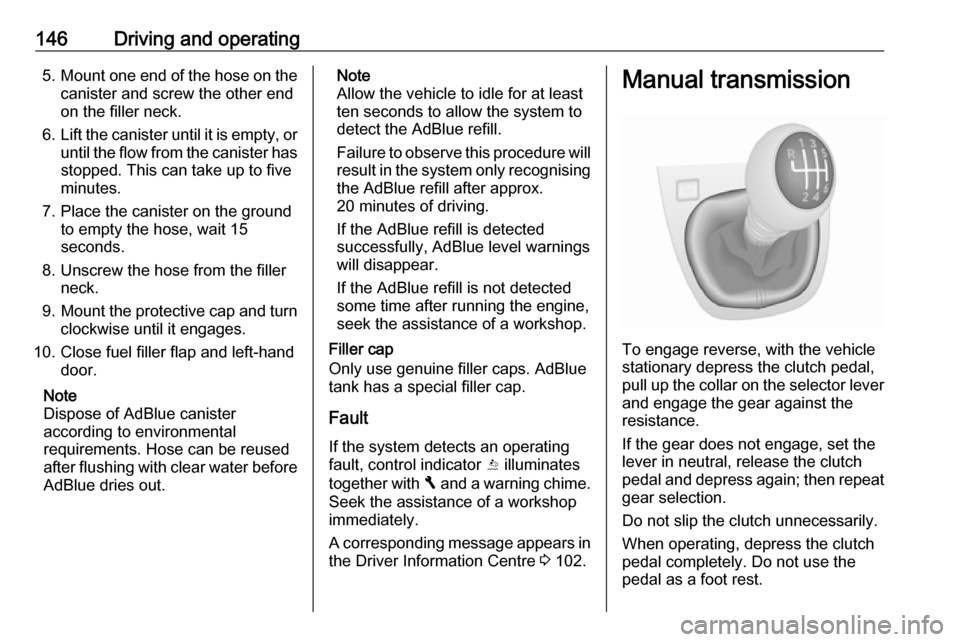
To engage reverse, with the vehicle
stationary depress the clutch pedal, pull up the collar on the selector lever
and engage the gear against the
resistance.
If the gear does not engage, set the
lever in neutral, release the clutch
pedal and depress again; then repeat
gear selection.
Do not slip the clutch unnecessarily.
When operating, depress the clutch pedal completely. Do not use the
pedal as a foot rest.
Page 160 of 237

158Driving and operatingThe area displayed by the camera is
limited. The distance of the image that
appears on the display differs from
the actual distance.
Note
To achieve the optimum visibility, the
rear view camera must not be
obscured by dirt, snow or ice.
Activation
Interior mirror display screen
Rear view camera display is
automatically activated when reverse
gear is engaged. An audible signal
confirms activation.
Infotainment system display screen
In vehicles with Navigation system,
the rear view camera display may be
shown on the Infotainment system
display screen (depending on
version).
Trajectory lane display (1)
Depending on version, the trajectory
lane (1) of the vehicle is shown in blue
on the Info-Display. It shows the path of the vehicle in accordance with the
steering angle.
Fixed lane display (2)
The fixed lane display (2) shows the
path of the vehicle if the wheels are
kept straight.
Guide lines (3, 4, 5) are used together
with the fixed lane display (2) and
indicate the distance behind the
vehicle.
Page 163 of 237

Driving and operating161Caution
In vehicles with AdBlue, the
AdBlue protective cap is the blue
lower cap 3 141 , and the fuel filler
cap is the black upper cap
(arrowed in illustration).
In case of misfuelling, do not
switch on ignition. Seek the
assistance of a workshop
immediately.
To open the fuel filler cap, turn
anticlockwise.
The fuel filler cap can be retained in
the bracket on the fuel filler flap.
For refuelling, fully insert the pump
nozzle and switch it on.
After automatic cut-off, it can be
topped up by operating the pump
nozzle a maximum of two more times.Caution
Wipe off any overflowing fuel
immediately.
When refuelling is complete, replace
the fuel filler cap and turn clockwise
as far as it will go.
Close the fuel filler flap.
Fuel filler cap Only use genuine fuel filler caps.Diesel-engined vehicles have special
fuel filler caps.
Fuel consumption - CO 2-
Emissions
The values for fuel consumption
(combined) of the model Opel Vivaro
is within a range of 7.4 to
5.7 l/100 km.
Depending on country, the fuel
consumption is displayed in km/l. In
this case, the fuel consumption
(combined) of the model Opel Vivaro
is within a range of approx. 13.5 to
17.5 km/l.
The CO 2 emission (combined) is
within a range of 195 to 149 g/km.
For the values specific to your
vehicle, refer to the EEC Certificate of Conformity provided with your vehicle
or other national registration
documents.
General information
The official fuel consumption and
specific CO 2 emission figures quoted
relate to the EU base model with
standard equipment.
Fuel consumption data and CO 2
emission data are determined
according to regulation
R (EC) No. 715/2007 (in the latest
applicable version), taking into
consideration the vehicle weight in
running order, as specified by the
regulation.