belt OPEL VIVARO B 2019 Manual user
[x] Cancel search | Manufacturer: OPEL, Model Year: 2019, Model line: VIVARO B, Model: OPEL VIVARO B 2019Pages: 235, PDF Size: 5.67 MB
Page 107 of 235

Instruments and controls105automatically and j remains
illuminated. The fault will then be
stored in the on board system.
Warning messages
Warning messages regarding, e.g.
engine, battery or brake system
failure, are displayed together with
control indicator C and may be
accompanied by a warning chime.
Stop engine immediately and seek
the assistance of a workshop.
Warning messages, e.g. " BATTERY
CHARGING FAULT " disappear from
the display automatically when the
cause of the fault has been remedied.
Fuel economy messages
Fuel economy messages provide tips to improve fuel efficiency. Journeys
can be saved in the system memory,
enabling you to compare
performances.
Refer to Infotainment manual for
further information.
Fuel economy rating 3 106.Warning chimes
If several warnings appear at the
same time, only one warning chime
will sound.
When starting the engine or whilst driving:
The warning chime regarding
unfastened seat belts has priority
over any other warning chime.
● If seat belt is not fastened 3 55.
● If the parking assist detects an object 3 156.
● If the vehicle speed briefly exceeds a set limit 3 153,
3 155.
● If a door or the bonnet is not properly closed when vehicle
exceeds a certain speed.
● During activation and deactivation of alarm monitoring
of vehicle inclination 3 38.
● If there is a fault in the brake system 3 99.
● If the vehicle battery is not charging 3 99.● If engine lubrication is interrupted
3 101.
● If AdBlue needs to be refilled or a
fault is present 3 142.
● If the electronic key is outside of the detection range.
Electronic key system 3 23.
Power button 3 133.
When the vehicle is parked and / or the driver's door is opened:
● If the key has been left in the ignition.
● If the electronic key has been left
in the card reader.
Electronic key system 3 23.
Power button 3 133.
● If the vehicle is in an Autostop. Stop-start system 3 137.
● If the exterior lights are on 3 110.
Page 132 of 235

130Climate controlRear air ventsDepending on vehicle, additional
adjustable air vents are located in the
rear passenger compartment.
Fixed air vents
Additional air vents are located
beneath the windscreen and door
windows, in the foot wells and,
depending on vehicle, in the rear
passenger compartment.
Glovebox cooler The air conditioning system can alsokeep the contents of the glovebox
cool.Maintenance
Air intake The air intake in front of the
windscreen in the engine
compartment must be kept clear to
allow air intake. Remove any leaves,
dirt or snow.
Air conditioning regular operation
In order to ensure continuously
efficient performance, cooling must
be operated for a few minutes once a
month, irrespective of the weather
and time of year. Operation with
cooling is not possible when outside
temperature is too low.
ServiceFor optimal cooling performance, it is
recommended to annually check the
climate control system, starting
3 years after initial vehicle
registration, including:
● functionality and pressure test
● heating functionality● leakage check
● check of drive belts
● cleaning of condenser and evaporator drainage
● performance check
Note
Refrigerant R-134a contains
fluorinated greenhouse gases with a global warming potential of 1430.
Front air conditioning system is filled
with 0.58 kg and has a CO 2
equivalent of 0.83 tonnes, the front
and rear air conditioning system is
filled with 0.88 kg and has a CO 2
equivalent of 1.26 tonnes.
Depending on vehicle, information
regarding air conditioning refrigerant
appears on a label located in the
engine compartment.
Page 140 of 235
138Driving and operatingVehicle messages 3 104.
Note
When the fast idle function is
activated, the stop-start system is
automatically deactivated and
cannot be reactivated by pressing
Î . LED in button illuminates to
indicate deactivation and a
corresponding message may
appear in the Driver Information Centre 3 103.
Idle speed control 3 136.
Depending on version, if the driver's door is opened or the driver's seat belt is unfastened, the stop-start system is
deactivated automatically, and the
engine is switched off. Restart engine by pressing START/STOP .
Power button 3 133.
Autostop
If the vehicle is at a low speed or at a standstill, activate an Autostop as
follows:
● depress the clutch pedal
● move the selector lever to neutral
● release the clutch pedalThe engine will be switched off while
the ignition stays on if the required
conditions are met.
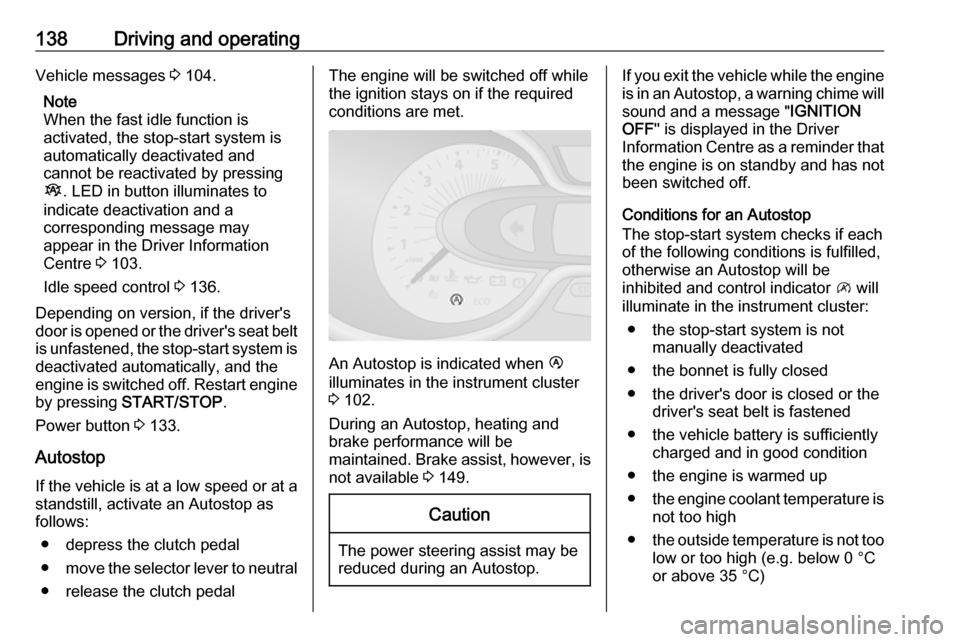
An Autostop is indicated when Ï
illuminates in the instrument cluster
3 102.
During an Autostop, heating and brake performance will be
maintained. Brake assist, however, is
not available 3 149.
Caution
The power steering assist may be
reduced during an Autostop.
If you exit the vehicle while the engine is in an Autostop, a warning chime will
sound and a message " IGNITION
OFF " is displayed in the Driver
Information Centre as a reminder that
the engine is on standby and has not
been switched off.
Conditions for an Autostop
The stop-start system checks if each
of the following conditions is fulfilled,
otherwise an Autostop will be
inhibited and control indicator \ will
illuminate in the instrument cluster:
● the stop-start system is not manually deactivated
● the bonnet is fully closed
● the driver's door is closed or the driver's seat belt is fastened
● the vehicle battery is sufficiently charged and in good condition
● the engine is warmed up
● the engine coolant temperature is
not too high
● the outside temperature is not too
low or too high (e.g. below 0 °C
or above 35 °C)
Page 190 of 235

188Vehicle careWheels and tyres
Tyre condition, wheel condition Drive over edges slowly and at right
angles if possible. Driving over sharp
edges can cause tyre and wheel
damage. Do not trap tyres on the kerb when parking.
Regularly check the wheels for
damage. Seek the assistance of a
workshop in the event of damage or
unusual wear.
We recommend not swapping the
front wheels with the rear wheels and
vice versa, as this can affect vehicle
stability. Always use less worn tyres
on the rear axle.
Tyres
Factory-fitted tyres are matched to
the chassis and offer optimum driving comfort and safety.Winter tyres
Winter tyres improve driving safety at temperatures below 7 °C and should
therefore be fitted on all wheels.
In accordance with country-specific
regulations, a notice indicating the
maximum permissible speed for the
tyres must be affixed within the
driver's field of vision.
Tyre designations
E.g. 195/65 R 16 C 88 Q195:Tyre width, mm65:Cross-section ratio (tyre height
to tyre width), %R:Belt type: RadialRF:Type: RunFlat16:Wheel diameter, inchesC:Cargo or commercial use88:Load index e.g. 88 is
equivalent to 567 kgQ:Speed code letter
Speed code letter:
Q:up to 160 km/hS:up to 180 km/hT:up to 190 km/hH:up to 210 km/hV:up to 240 km/hW:up to 270 km/h
Choose a tyre appropriate for the
maximum speed of your vehicle.
The maximum speed is achievable at kerb weight with driver (75 kg) plus
125 kg payload. Optional equipment
could reduce the maximum speed of
the vehicle.
Directional tyres
Fit directional tyres such that they roll in the direction of travel. The rolling
direction is indicated by a symbol
(e.g. an arrow) on the sidewall.
Tyre pressure
Check the pressure of cold tyres at
least every 14 days and before any
long journey. Do not forget the spare
wheel. This also applies to vehicles
with tyre pressure monitoring system.
Page 206 of 235

204Vehicle carePaintwork damageRectify minor paintwork damage with
a touch-up pen before rust forms.
Have more extensive damage or rust
areas repaired by a workshop.
Underbody Some areas of the vehicle underbody
have a PVC undercoating while other
critical areas have a durable
protective wax coating.
After the underbody is washed, check
the underbody and have it waxed if
necessary.
Bitumen / rubber materials could
damage the PVC coating. Have
underbody work carried out by a
workshop.
Before and after winter, wash the
underbody and have the protective
wax coating checked.
Towing equipment Do not clean the coupling ball bar with
a steam-jet or high-pressure jet
cleaner.Interior care
Interior and upholstery Only clean the vehicle interior,
including the instrument panel fascia
and panelling, with a dry cloth or
interior cleaner.
Clean any leather upholstery with
clear water and a soft cloth. In case of
heavy soiling, use leather care.
The instrument cluster and the
displays should only be cleaned using a soft damp cloth. If necessary use aweak soap solution.
Clean fabric upholstery with a
vacuum cleaner and brush. Remove
stains with an upholstery cleaner.
Clothing fabrics may not be
colourfast. This could cause visible
discolourations, especially on light-
coloured upholstery. Removable
stains and discolourations should be
cleaned as soon as possible.
Clean seat belts with lukewarm water or interior cleaner.Caution
Close Velcro fasteners as open
Velcro fasteners on clothing could damage seat upholstery.
The same applies to clothing with
sharp-edged objects, like zips or
belts or studded jeans.
Plastic and rubber parts
Plastic and rubber parts can be
cleaned with the same cleaner as
used to clean the body. Use interior cleaner if necessary. Do not use any
other agent. Avoid solvents and petrol in particular. Do not use high-
pressure jet cleaners.
Page 224 of 235

222Customer informationOperating data in the vehicleControl units process data for
operation of the vehicle.
This data includes, e.g.: ● vehicle status information (e.g. speed, movement delay, lateral
acceleration, wheel rotation rate, "seat belts fastened" display)
● ambient conditions (e.g. temperature, rain sensor,
distance sensor)
As a rule such data is transient, not
stored for longer than an operational
cycle, and only processed on board the vehicle itself. Control units often
include data storage (including the
vehicle key). This is used to allow
information to be documented
temporarily or permanently on vehicle
condition, component stress,
maintenance requirements and
technical events and errors.Depending on technical equipment
level, the data stored is as follows:
● system component operating states (e.g. fill level, tyre
pressure, battery status)
● faults and defects in important system components (e.g. lights,
brakes)
● system reactions in special driving situations (e.g. triggering
of an airbag, actuation of the
stability control systems)
● information on events damaging the vehicle
● for electric vehicles the amount of
charge in the high-voltage
battery, estimated range
In special cases (e.g. if the vehicle
has detected a malfunction), it may be
necessary to save data that would
otherwise just be volatile.
When you use services (e.g. repairs,
maintenance), the operating data
saved can be read together with the
vehicle identification number and
used when necessary. Staff working
for the service network ( e.g. garages,
manufacturers) or third parties (e.g.breakdown services) can read the
data from the vehicle. The same
applies to warranty work and quality
assurance measures.
Data is generally read via the OBD
(On-Board Diagnostics) port
prescribed by law in the vehicle. The operating data which is read out,
documents the technical condition of
the vehicle or individual components
and assists with fault diagnosis,
compliance with warranty obligations
and quality improvement. This data,
in particular information on
component stress, technical events,
operator errors and other faults, is
transmitted to the manufacturer
where appropriate, together with the
vehicle identification number. The
manufacturer is also subject to
product liability. The manufacturer
potentially also uses operating data
from vehicles for product recalls. This
data can also be used to check
customer warranty and guarantee
claims.
Fault memories in the vehicle can be
reset by a service company when
carrying out servicing or repairs or at
your request.
Page 228 of 235

226IndexAAbsorptive Glass Mat battery .....173
Accessories and vehicle modifications .......................... 167
AdBlue ................ 101, 106, 142, 207
AdBlue tank ................................ 215
Adjustable air vents ...................129
AGM battery ............................... 173
Airbag and belt tensioners ...........98
Airbag deactivation ................64, 98
Airbag label............................. 60, 64
Airbag system .............................. 60
Air conditioning regular operation ................................ 130
Air conditioning system .............. 119
Air intake .................................... 130
Air recirculation ...................119, 200
Air vents...................................... 129
Alert ............................................ 105
Antifreeze ................................... 171
Antilock brake system ................ 148
Antilock brake system (ABS) .....100
Anti-theft alarm system ................38
Anti-theft bolts............................. 196
Anti-theft locking system .............. 37
Anti-theft security lock ..................25
Appearance care ........................202
Armrest ........................................ 50
Ashtrays ....................................... 90 Automatic anti-dazzle ..................42Automatic fuel cut-off ..................136
Automatic light control ...............111
Automatic locking ........................31
Autostop ............................. 135, 137
Auxiliary heater ........................... 124
B Battery .................... 22, 23, 124, 173
Battery discharge protection ......117
Battery, jump starting.................. 199
Belts.............................................. 55 Bench seat.................................... 76
Bonnet ....................................... 168
Bottle holders................................ 76
Brake and clutch fluid .................207
Brake assist ............................... 149
Brake fluid .................................. 172
Brakes ............................... 148, 172
Brake system ............................... 99
Breakdown.................................. 200
Bulb replacement ....................... 177
C
Capacities .................................. 215
Car Pass ...................................... 22
Catalytic converter .....................141
Central locking system ................26
Centre high-mounted brake light 179
Changing tyre and wheel size ...192
Charging system .......................... 99
Child locks ................................... 32
Page 232 of 235

230Recommended fluids andlubricants ........................ 207, 211
Refuelling ................................... 162 Registered trademarks ...............221
Remote control ............................. 22
Restraining lattice .........................81
Reversing light ........................... 180
Reversing lights .........................114
Ride control systems ..................150
Roof load ...................................... 82
Roof rack ..................................... 82
S Safety belts ................................... 55
Safety net .................................... 80
Seat adjustment ....................... 7, 48 Seat belt ........................................ 8
Seat belt reminder .......................98
Seat belts ..................................... 55
Seat folding .................................. 50
Seat heating ................................. 50
Seat position ................................ 47
Seats ............................................ 76
Selective catalytic reduction .......142
Service ............................... 130, 205
Service display ............................ 94
Service information ....................205
Service vehicle soon .................... 99
Side airbag system ......................63
Sidelights .................................... 110Side turn lights ........................... 179
Sliding door .................................. 32
Sliding side door ........................... 32
Spare wheel ............................... 197
Spare wheel security tool ...........187
Speed limiter ................91, 103, 155
Speedometer ............................... 91
Starting and operating ................133
Starting off ................................... 18
Starting the engine ...............18, 135
Steering ...................................... 132
Steering column controls ..............85
Steering wheel adjustment ......9, 85
Steering wheel controls ...............85
Stop engine .................................. 99
Stop-start system.......... 18, 102, 137
Storage ......................................... 73
Storage box .................................. 76
Storage compartment ...................75
Storage compartments .................73
Sun visors .................................... 45
Symbols ......................................... 4
T
Tablet holder................................. 73
Tachograph ........................ 103, 108
Tachometer ................................. 92
Tailgate ......................................... 35
Tailgate emergency release .........35
Tail lights ................................... 178Temporary spare wheel ..............197
Three-point seat belt .................... 56
Toll road stickers .......................... 43
Tools .......................................... 187
Top-Tether .................................... 66
Torx key ...................................... 187
Touchscreen ............................... 104
Tow bar....................................... 164
Towing ................................ 164, 200
Towing another vehicle .............201
Towing a trailer ........................... 164
Towing eye ......................... 187, 200
Towing the vehicle .....................200
Traction Control system ............. 150
Trailer coupling ........................... 164
Trailer stability assist .................165
Trailer towing ............................. 164
Transmission ............................... 18
Tread depth ............................... 191
Trip computer ............................ 106
Trip odometer .............................. 92
Turbo engine warm-up ...............135
Turn lights ............................ 97, 113
Tyre chains ................................ 192
Tyre changing ............................. 196
Tyre designations ......................188
Tyre pressure ............................ 188
Tyre pressure monitoring system ............................. 101, 190
Tyre pressures ........................... 216